As models like Vidu, Kling, and Veo evolve, compute costs continue to rise. Marketing teams now face a tough decision. Should they spend months building a custom video system or use a proven API? The answer is simple. API integration offers faster results, lower costs, and better flexibility.
The 2026 Marketing Scene: Video is "No Essential"
In 2026, the digital world is crowded. Marketing teams don't wonder if they need video anymore. Instead, they struggle to meet the massive demand for fresh content.
| Strategic Driver | Build (Proprietary) | Buy (AI Video API) | The 2026 Winner |
| Speed to Market | 6–12 Months (Dev Cycle) | Near Instant (Plug & Play) | API |
| Model Freshness | High Risk of Obsolescence | Always State-of-the-Art | API |
| Cost Structure | High CapEx ($250k+ Salary) | Flexible OpEx (Usage-based) | API |
| Tech Focus | Maintaining "The Plumbing" | Creating Content & ROI | API |
| Core Advantage | Total Niche Customization | Agility & Ecosystem Scaling | API |
For most marketing teams, building a custom video engine is a race against a moving target. The AI Video API model transforms video from a complex engineering hurdle into a scalable utility, reducing production time from 13 days to 27 minutes.
Search Trends and Consumer Intent
Search trends show a huge change in how people act. More people are looking for "Vertical Video AI" and "Scalable Video Personalization" than ever before. Brands want to win on short-form apps. This shift shows a need for content that fits local areas and specific people. Old ways of making videos just cannot keep up anymore.
The divide between old-school production and modern workflows is staggering:
| Production Method | Average Turnaround Time |
| Traditional Manual Production | 13 Days |
| AI-Driven Production (via AI Video API) | 27 Minutes |
Market Reality and Bottlenecks
91% of enterprises now identify video as their primary communication tool. However, internal teams remain trapped in "production bottlenecks," struggling with rendering times and manual editing. Transitioning to an AI Video API allows these teams to bypass the infrastructure "build" phase and move directly to high-volume execution.
The Hidden Costs of "Building": Asset or Liability?
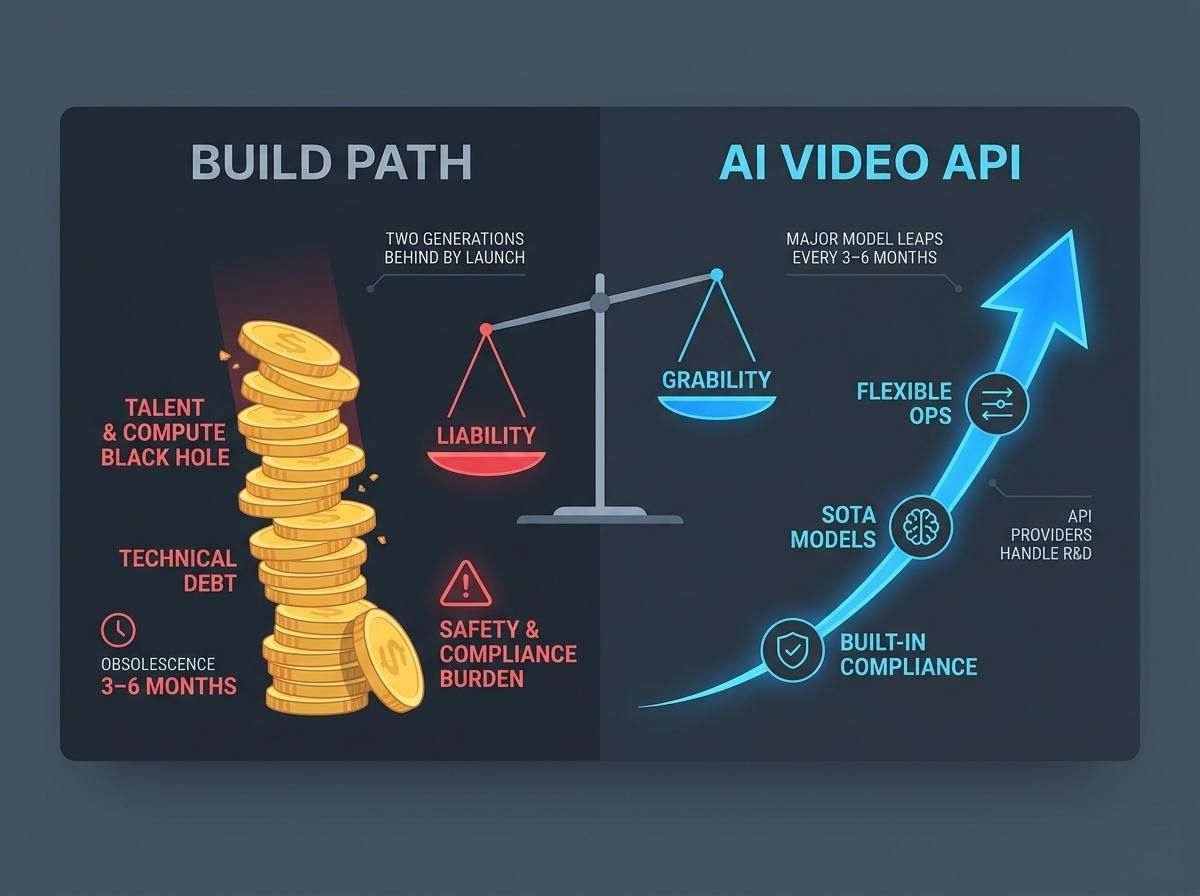
Choosing to build a proprietary video generation engine often sounds like a strategic asset, but in the fast-moving AI landscape of 2026, it frequently becomes a financial liability. The "Build" path introduces significant overhead that can drain a marketing budget before the first video is even rendered.
The Talent and Compute Black Hole
Creating your own system needs a rare and pricey team of experts. These fixed costs are high. In contrast, an AI Video API offers flexible operations. The way you spend your budget is greatly affected by this choice.
| Resource Category | In-House Build (Annual Est.) | API Model (Usage-Based) |
| ML/Full-Stack Engineers | $150k - $250k+ per head | Included in service cost |
| Compute (GPU) Infrastructure | High upfront + Maintenance | Scalable cloud-based pricing |
| Operational Focus | Managing server clusters | Creating marketing campaigns |
Technical Debt: The Race Against Obsolescence
AI models are currently evolving at a staggering pace, typically transitioning through major versions every 3–6 months. For instance, the industry recently witnessed the rapid leap from basic Text-to-Video to high-fidelity, physics-aware Image-to-Video.
- The Risk: By the time an internal team completes a stable build, the underlying model is likely two generations behind.
- The API Advantage: API providers handle the R&D, ensuring users always have access to "State-of-the-Art" (SOTA) models without reinvesting in codebases.
Safety and Compliance: An Engineering Burden
Modern video production requires robust safety layers to prevent copyright infringement and ensure content moderation.
- Copyright Filters: Building a database to flag protected IP.
- Moderation Layers: Ensuring output aligns with brand safety standards.
Managing these ethical and legal guardrails is a full-time engineering task. By leveraging an AI Video API, marketing teams inherit built-in compliance frameworks, shifting the burden of legal and safety monitoring to the vendor.
Why APIs are the "Supercharger" for Modern Teams
While building an in-house engine tethered to a single model creates a "single point of failure," leveraging an AI Video API transforms your marketing department into an agile, creative powerhouse. By 2026, the transition from simple generation to complex, integrated "orchestration" has become the primary driver of ROI.
Workflow Integration: The End of Data Silos
New APIs are built for easy connections. You don't have to download and upload huge video files by hand anymore. Instead, an AI Video API links your creative apps directly to your social channels.
- CMS & DAM: Move your new videos into WordPress or Adobe Experience Manager instantly and automatically.
- CRM Automation: Set HubSpot or Salesforce to trigger custom videos. These send out the moment a new lead gets interested.
- Low-Code Tools: Apps like Zapier now manage entire AI video projects. Marketing teams save roughly 34 hours every week by cutting out manual editing (Vivideo).
From Generation to "Controlled Creation"
The 2026 advantage lies in "Identity Locking" and cinematic precision. Unlike static in-house builds, top-tier APIs offer fine-grained control parameters:
| Feature | Marketing Benefit |
| Motion Control | Use reference clips to direct specific character movements. |
| Consistent Characters | Lock "Visual DNA" to maintain the same brand mascot across 100+ shots. |
| Virtual Cinematography | Programmatically adjust lighting, focal length, and camera pans. |
Multi-Model Flexibility: No Vendor Lock-In
The AI landscape is volatile. Organizations utilizing a multi-model approach report 47% higher AI ROI compared to those locked into a single-vendor strategy.
An API-first setup lets you swap models easily. You can use one for sharp 4K product shots and another for fun social media clips. You won't have to fix your whole system every time. This helps your team pick the top tool for every single ad goal without any extra tech work.
Case Study: Scaling Global Creative Production via API Orchestration
The Challenge: The "Multi-Model" Bottleneck
A large global online store hit a major wall in early 2026. They had to keep their lead by making over 1,500 custom videos every month for TikTok, Instagram, and YouTube.
Their initial "In-House" approach—manually managing separate API integrations for Kling (for realism), Vidu (for motion), and Veo (for cinematic quality)—led to severe operational friction:
- Engineering Drain: 40% of their backend team's time was spent maintaining three different codebases.
- Production Lag: Long delays and constant server crashes meant it took four days to finish one campaign.
- Cost Inefficiency: They wasted money on too many GPU credits just to make sure things worked during busy hours.
The Solution: Unified API Integration
The enterprise migrated to Atlas Cloud as their singular orchestration layer, standardizing their entire video pipeline through a unified API schema.
veo3.1 image-to-video API request code example:
plaintext1import requests 2import time 3 4# Step 1: Start video generation 5generate_url = "https://api.atlascloud.ai/api/v1/model/generateVideo" 6headers = { 7 "Content-Type": "application/json", 8 "Authorization": "Bearer $ATLASCLOUD_API_KEY" 9} 10data = { 11 "model": "google/veo3.1/image-to-video", # Required. model name 12 "aspect_ratio": "16:9", # The aspect ratio of the generated media. options: 16:9 | 9:16 13 "duration": 8, # The duration of the generated media in seconds. default: 4. options: 8 | 4 | 6 14 "generate_audio": True, # Whether to generate audio. default: false 15 "image": "https://static.atlascloud.ai/media/images/b569f422a1e73c3f3d5f196f1dcfcaa2.png", # Required. The image to use for the generation 16 "last_image": "example_value", # The end image for generating the output 17 "negative_prompt": "example_value", # The negative prompt for the generation 18 "prompt": "Delicate flower petals slowly float upward into the air, gently drifting as if carried by a soft breeze, soft sunlight filtering through the scene, cinematic slow motion, dreamy atmosphere, ultra-detailed, poetic visual style.", # Required. The positive prompt for the generation 19 "resolution": "1080p", # Video resolution. options: 720p | 1080p 20 "seed": 1, # The random seed to use for the generation 21} 22 23generate_response = requests.post(generate_url, headers=headers, json=data) 24generate_result = generate_response.json() 25prediction_id = generate_result["data"]["id"] 26 27# Step 2: Poll for result 28poll_url = f"https://api.atlascloud.ai/api/v1/model/prediction/{prediction_id}" 29 30def check_status(): 31 while True: 32 response = requests.get(poll_url, headers={"Authorization": "Bearer $ATLASCLOUD_API_KEY"}) 33 result = response.json() 34 35 if result["data"]["status"] in ["completed", "succeeded"]: 36 print("Generated video:", result["data"]["outputs"][0]) 37 return result["data"]["outputs"][0] 38 elif result["data"]["status"] == "failed": 39 raise Exception(result["data"]["error"] or "Generation failed") 40 else: 41 # Still processing, wait 2 seconds 42 time.sleep(2) 43 44video_url = check_status()
Measured Impact: The Data-Driven Results
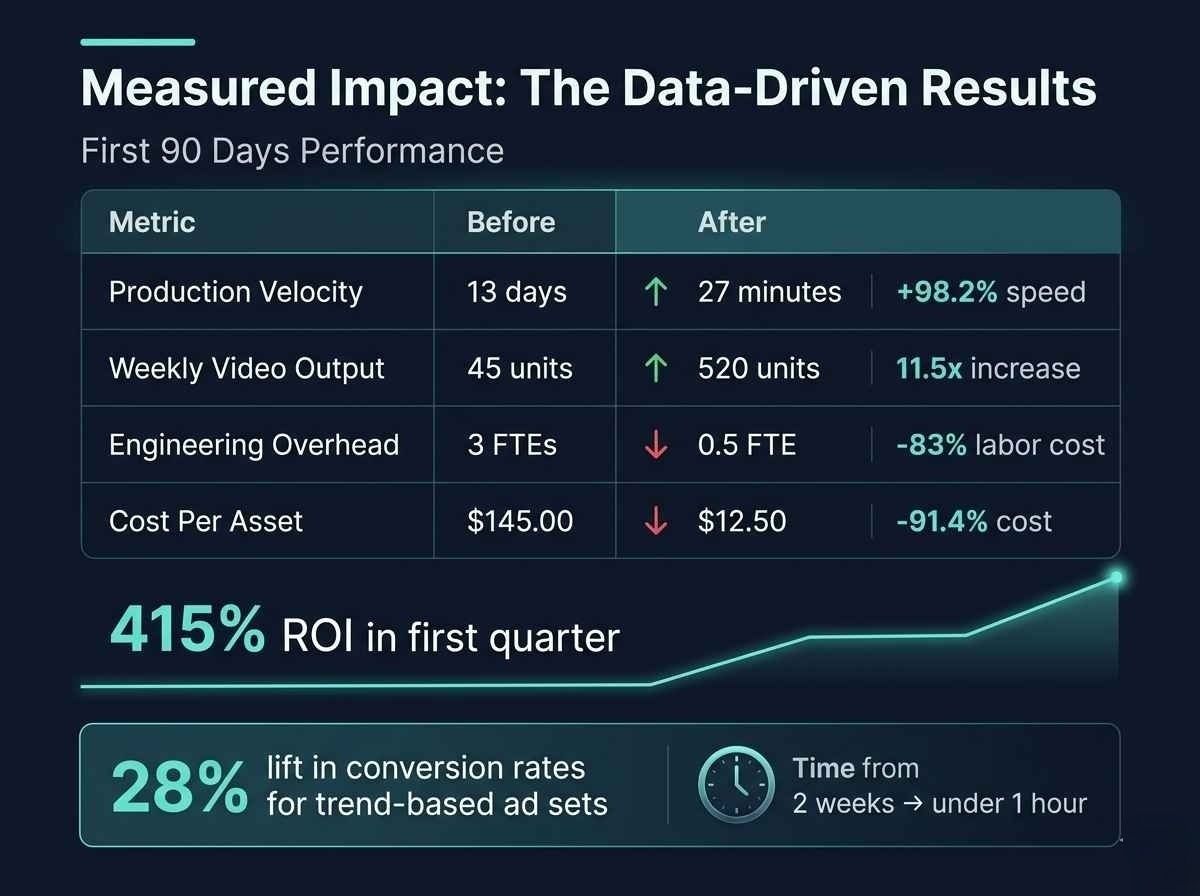
By moving from messy manual work to a smooth API setup, the company saw big wins fast. They hit these new performance goals in just the first 90 days:
| Metric | Pre-Integration (Manual/Multi-Build) | Post-Integration (Atlas Cloud API) | Delta |
| Production Velocity | 13 Days per Campaign | 27 Minutes | +98.2% Speed |
| Weekly Video Output | 45 Units | 520 Units | 11.5x Increase |
| Engineering Overhead | 3 Full-Time ML Engineers | 0.5 FTE (Maintenance) | -83% Labor Cost |
| Cost Per Asset (CPA) | $145.00 | $12.50 | -91.4% Cost |
The enterprise realized a 415% ROI in the first quarter. The Delta Speed was the most significant factor: by reducing time-to-market from two weeks to under an hour, the brand was able to capitalize on viral social trends in real-time, resulting in a 28% lift in conversion rates for trend-based ad sets.
The "Build" model failed because it couldn't keep pace with model evolution. By "Buying" into a unified API, the enterprise decoupled their creative strategy from technical limitations. They no longer manage "plumbing"; they manage output and ROI.
The Economics: Total ROI Comparison
To truly understand the "Buy vs. Build" debate, marketing leaders must look at the long-term financial impact. In 2026, the decision to invest in an AI Video API versus developing an in-house solution often dictates whether a department stays within budget or sinks into a capital-intensive "project trap."
Analyzing the Total Cost of Ownership
The primary driver of ROI isn't just the cost of generation, but the speed of execution and the elimination of overhead. While an in-house build may seem like a one-time asset, the recurring costs of specialized labor and hardware maintenance often outweigh the benefits.
| Dimension | Build (In-House) | Buy (AI Video API) |
| Initial Investment | High: $50k - $200k+ for infrastructure & hiring | Low: $0 upfront; usually tiered subscriptions |
| Time-to-Market | Slow: 6 - 12 months for dev & testing | Fast: Days to weeks for full integration |
| Maintenance Burden | Heavy: Requires dedicated DevOps & ML teams | Zero: Handled entirely by the provider |
| Innovation Speed | Lagging: Limited by internal R&D cycles | Instant: Access to the latest 4K/2K updates |
| Scalability | Capped: Limited by GPU server capacity | Elastic: Scales to thousands of concurrent requests |
ROI is about more than just the bill. It is about saving time and not missing out on new chances. To see the real value of moving to an API model, marketing bosses can use this simple formula:

Variable Definitions:
- Cmanual: Average cost of traditional manual video production (Labor + Time).
- Capi: Cost per video via API (Usage-based pricing).
- V: Total volume of video assets required per year.
- I integration: One-time cost of connecting the API to your existing CMS/CRM.
- Speed: The "Agility Premium"—calculated by the revenue generated from launching campaigns weeks earlier than competitors.
The Competitive Edge of Agility
Marketing teams prioritizing "Agile Infrastructure" see a significantly faster return on investment. By opting for an AI Video API, organizations convert high fixed costs into manageable operational expenses.
- Minimized Opportunity Cost: Instead of waiting a year for a tool to be built, teams launch campaigns in days.
- Reduced Risk: Outsourcing technical complexity to specialists prevents the "Innovation Tax" of maintaining outdated internal codebases.
Ultimately, the API model ensures that capital is spent on creative output and market reach rather than the "plumbing" of AI infrastructure.
Decision Matrix: Which Path Should Your Team Take?
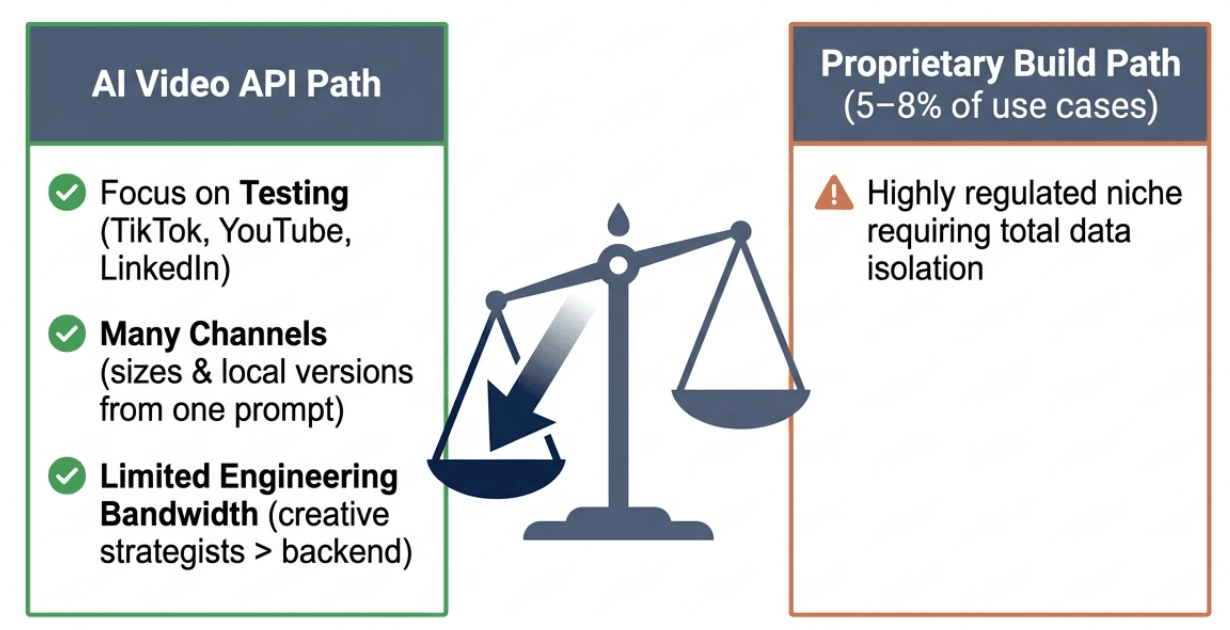
Choosing between developing a custom solution and integrating an AI Video API is a pivotal strategic decision. While the industry is rapidly leaning toward "Buy" for most enterprise use cases, understanding the specific technical and operational requirements of your organization is essential to avoid long-term "sunk cost" fallacies.
Choosing the AI Video API Path
For most marketing teams today, using an API is the best move. It keeps you fast and competitive when speed matters most.
- Focus on Testing: You have to launch and change ads on TikTok, YouTube, and LinkedIn instantly.
- Many Channels: Your team needs to make many different sizes and local versions from just one prompt.
- Limited Engineering Bandwidth: You prefer to allocate your budget toward creative strategists and prompt engineers rather than backend infrastructure maintenance.
When to Consider a Proprietary Build
In rare "edge cases," building a bespoke system may be justifiable. Only about 5–8% of non-tech enterprises choose to build their own core GenAI models due to the following specialized needs:
| Criterion | Why Build? | Why an AI Video API? |
| Data Sensitivity | Handing air-gapped, highly classified data. | Standard enterprise-grade security (SOC2). |
| Unique Algorithms | Developing a patented, non-standard visual style. | Access to diversified SOTA models. |
| Resource Profile | Large, underutilized in-house ML team. | Lean, creative-focused marketing team. |
Final Recommendation
Unless your brand operates within a highly regulated niche requiring total data isolation, the agility and cost-efficiency provided by an AI Video API offer a superior competitive advantage. By choosing "Buy," you invest in the outcome—high-quality video—rather than the complex, fast-depreciating plumbing of AI development.
Conclusion: Winning on "Speed," Not Just "Tools"
The "Build vs. Buy" debate for generative media is effectively settled. In the quick world of 2026 video production, big servers don't make you a winner. Success now belongs to the teams that move fast. The real leaders are the ones who turn a new idea into a live post in just minutes.
Marketing bosses need to stop arguing about the tech and start getting good at using it. Your competitive advantage lies in AI video API integration—connecting high-level models to your unique brand voice.
- Focus on Prompts: Invest in "Creative Technologists" who can refine prompts and style references.
- Optimize Assets: Build a library of high-quality image and brand assets to feed the API for consistent, "Identity-Locked" outputs.
- Check Your Workflow: Find spots where a 27-minute AI process can take over for a 13-day manual job. This will help you finally catch up on all your backed-up content.
Future Outlook: AI as Public Utility
The trajectory of AI mirrors the evolution of the web. Just as Stripe revolutionized payments and AWS democratized cloud storage, the AI Video API is becoming a fundamental utility.
In the end, winning in 2026 is all about how fast you move. Using a strong AI Video API lets your team stay focused on the real work. You can spend your time telling great stories that actually get people to buy.
FAQ
Can an API provide the same level of "Brand Safety" as a custom build?
Many people wrongly think that "Buying" means can't control your content. Actually, top AI Video API companies spend millions on safety. These layers are usually stronger than what one brand can make alone.
- Copyright Safety: APIs scan work in real-time to make sure your videos don't steal anyone's ideas.
- Smart Filters: Built-in rules stop the system from making mean, biased, or off-brand pictures.
- Data Security: Most big APIs follow SOC2 Type II rules. This keeps your private marketing info locked and safe.
How difficult is the technical integration process?
Adding an API is a simple "Low-Code" or "No-Code" task. Making your own "Build" eats up 6 to 12 months of work. In contrast, an AI video API integration usually works on this much faster schedule:
- Day 1-2: API Key generation and initial "Hello World" video test.
- Week 1: Mapping API fields to your Content Management System.
- Week 2: Setting up automated triggers, e.g., "New Product Launch" -> "Generate 5 Social Ads".
- Week 3: Full production rollout.
What happens if a better AI model is released next month?
This is the strongest argument for the "Buy" model. When a breakthrough model (like a 4K native motion engine) is released, API providers update their backend almost instantly. If you "Build," you are stuck with your current architecture; if you "Buy," you simply update a single line of code to access the next generation of Scalable video production 2026.