What Makes Kling O1 Different
| Feature | Kling O1 | Other Video Models |
| Architecture | Unified (text/image/video/subject) | Separate pipelines |
| Subject Consistency | Native cross-scene support | Requires post-processing |
| Physics Understanding | Contextual (learned) | Rule-based |
| Input Flexibility | 18 skills in one model | Single-task models |
| AtlasCloud Price | $0.095/sec (promo, April 2026) | Varies by provider |
Bottom line: Bottom line: Kling O1 isn't just another video generator—it's the first model that treats video editing as a first-class citizen. Whether you're extending shots, modifying scenes, or transforming images into video sequences, it handles subject consistency and physics realism across edits without breaking the visual narrative.
Why Most AI Video Models Fail at Scale
Here's what we learned running video generation at production scale: Traditional models treat every task as a separate problem.
Want text-to-video? One model. Image animation? Different model. Character consistency across scenes? Post-processing hack. Physics that looks real? Pray the prompt works.
The result: Teams spend 60% of their time stitching outputs together rather than creating content.
Kling O1's Multi-Modal Visual Language (MVL) system changes this fundamentally. Instead of separate encoders for text and images, MVL creates a unified semantic space where:
- Text descriptions and visual concepts share the same representational framework
- Subject identity features persist across the entire generation pipeline
- Physics constraints (weight, friction, light scattering) are understood contextually—not approximated
The difference isn't incremental. It's architectural.
Performance Benchmarks: Kling O1 vs Alternatives
Based on 500+ generations across production workloads:
| Model | Subject Consistency | Physics Realism | Cinematic Quality | AtlasCloud Available |
| Kling O1 | 9/10 | 9/10 | 8/10 | ✅ Yes |
| Runway Gen-4.5 | 7/10 | 7/10 | 9/10 | ✅ Yes |
| Vidu Q3 | 8/10 | 8/10 | 7/10 | ✅ Yes |
| Pika 2.0 | 6/10 | 6/10 | 7/10 | ✅ Yes |
Key insight: Kling O1's unified architecture provides consistent advantages across all evaluation dimensions—not just one specialty.
Technical Deep Dive: What "Unified" Actually Means
Traditional Pipeline (What Everyone Else Does)
plaintext1Text Prompt → Language Encoder → Diffusion Model → Video 2 ↑ ↓ 3Image → Vision Encoder →------→ Patch
Problem: Two separate systems trying to agree on what to generate. Results feel "stitched together."
Kling O1 MVL Pipeline
plaintext1Text + Image + Video + Subject → MVL Encoder → Unified Representation → Video
Result: Everything speaks the same language. Subject identity, physics constraints, and creative intent flow through a single pathway.
Real-World Test: Subject Consistency
The scenario that breaks most models:
A 10-second clip following one woman through three spots: a forest trail, a city street, and a café interior.
| Model | Output |
| Standard I2V | Three different women |
| Kling O1 | Same woman, consistent identity |
How it works:
- Identity embedding extracted from initial frames
- Cross-attention persistence maintains subject features across temporal boundaries
- Scene-aware adaptation adjusts lighting while preserving core identity markers
Prompt Engineering for Production Results
The Anatomy of High-Performance Prompts
Weak prompt (what everyone writes):
plaintext1"A woman walking in a city"
Strong prompt (what actually works):
plaintext1Woman in a navy blazer, walking through Tokyo at night. Pavement's still wet from the rain — neon bleeding into the puddles. Eye-level shot, city lights soft and blurred behind her.
The difference: Actionable visual instruction, not just description.
Production-Tested Templates
Product Showcase:
plaintext1Premium wireless headphones rotating slowly on matte black pedestal. 2Soft studio key light from upper left, subtle surface reflections, 3smooth 360° rotation over 5 seconds, shallow depth of field, 4clean gradient background, commercial product photography style.
Brand Storytelling:
plaintext1Hands of master craftsman carefully polishing leather watch strap, 2warm workshop lighting, extreme close-up showing texture detail, 3dust particles visible in light beam, slow deliberate movements, 4documentary cinematography style with subtle handheld movement.
Social Media Content:
plaintext1Coffee pouring into a ceramic mug. Steam catches the morning light coming through the window. Overhead, slow-mo — you can see the texture. Warm café feel.
Case Study: How Atlas Customer "LuxeBrand" Cut Video Production Costs by 78%
The Problem
LuxeBrand is a mid-sized cosmetics company churning out 500 product videos every month for its e-commerce platform. Three typical approaches all fall short in practice:
Agency production — At $500 to $2,000 per video, the math gets painful fast at this volume.
Standard AI tools — Characters look different from shot to shot, lighting is all over the place, and there's always that telltale artificial sheen that screams "generated."
In-house editing — Two to three hours per video sounds manageable until you multiply it by 500.
The Atlas + Kling O1 Solution
Implementation:
plaintext1import requests 2 3# Atlas Cloud API configuration 4ATLAS_API_KEY = "your_atlas_api_key" 5BASE_URL = "https://api.atlascloud.ai/api/v1" 6 7def generate_product_video(product_image: str, category: str): 8 # Category-specific motion templates optimized for Kling O1 9 motion_prompts = { 10 "beauty": "Elegant rotation with light playing across surface, " 11 "soft beauty lighting with subtle sparkle effects, " 12 "luxury cosmetics advertising style", 13 14 "skincare": "Gentle pour with liquid texture visible, " 15 "steam rising in soft focus, " 16 "appetizing food photography style" 17 } 18 19 payload = { 20 "model": "kwaivgi/kling-v3.0-std/image-to-video", 21 "image": product_image, 22 "prompt": motion_prompts.get(category, "Professional studio presentation"), 23 "duration": 5, 24 "sound": True 25 } 26 27 return requests.post( 28 f"{BASE_URL}/model/prediction", 29 headers={"Authorization": f"Bearer {ATLAS_API_KEY}"}, 30 json=payload 31 ).json()
The Results
| Metric | Before (Agency) | After (Atlas + Kling O1) |
| Cost per video | $800 | ~0.48(5s@0.48 (5s @0.48(5s@0.095/s) |
| Production time | 2-3 weeks | 2-3 minutes |
| Monthly volume | 50 videos | 500+ videos |
| Subject consistency | Manual editing required | Native support |
| Total monthly cost | $40,000 | ~$237 |
Key insight: The motion prompt template system was essential. Without category-specific prompts, outputs were generic. With optimized prompts, videos felt intentionally crafted for each product type.
Atlas Cloud Implementation Guide
Why Atlas for Kling O1?
| Atlas Advantage | Practical Impact |
| Unified API | One integration for Kling O1, Vidu, Sora |
| Consistent Interface | Same auth, same response format across all models |
| A/B Testing | Switch models with one parameter change |
| Infrastructure that actually works | automatic retries, built-in queue handling, webhooks ready to go |
| Pricing you can understand | pay by the second, no hidden fees, no gotchas |
Quick Start: Text-to-Video
plaintext1import requests 2 3API_KEY = "your_api_key" 4 5def generate_video(prompt: str, duration: int = 5): 6 response = requests.post( 7 "https://api.atlascloud.ai/api/v1/model/prediction", 8 headers={"Authorization": f"Bearer {API_KEY}"}, 9 json={ 10 "model": "kwaivgi/kling-v3.0-std/text-to-video", 11 "prompt": prompt, 12 "duration": duration 13 } 14 ).json() 15 16 return response["data"]["id"]
Quick Start: Image-to-Video
plaintext1def animate_image(image: str, prompt: str): 2 response = requests.post(f"{BASE_URL}/model/prediction", 3 headers={"Authorization": f"Bearer {API_KEY}"}, 4 json={"model": "kwaivgi/kling-v3.0-std/image-to-video","image": image,"prompt": prompt,"duration": 5})return response.json()
Note on aspect ratio: I2V keeps whatever ratio your source image has. There's no way to force 16:9 or 9:16 — what you upload is what you get.
Going further: Event-driven setup
Pushing serious volume? Use queue-driven processing.
plaintext1import redis, json, requests 2 3class VideoQueue: 4 def __init__(self, key, redis_url): 5 self.key = key 6 self.redis = redis.from_url(redis_url) 7 8 def add(self, task): 9 self.redis.lpush("tasks", json.dumps(task)) 10 11 def run(self): 12 while True: 13 item = self.redis.brpop("tasks", timeout=30) 14 if not item: 15 continue 16 17 task = json.loads(item[1]) 18 try: 19 res = requests.post( 20 "https://api.atlascloud.ai/api/v1/model/prediction", 21 headers={"Authorization": f"Bearer {self.key}"}, 22 json={ 23 "model": "kwaivgi/kling-v3.0-std/image-to-video", 24 "image": task["image"], 25 "prompt": task["prompt"], 26 "duration": task.get("duration", 5) 27 } 28 ) 29 except Exception as e: 30 print(f"Failed: {e}")
AtlasCloud Pricing & Specifications
Current pricing (as of April 2026 — subject to change):
| Feature Type | Original Price | Promo Price | Discount |
| Image-to-video | $0.112/sec | $0.095/sec | 15% off |
| Text-to-video | $0.112/sec | $0.095/sec | 15% off |
Output Specifications:
- Resolution: Up to 1080p
- Duration: 3–10 seconds
- T2V ratios: 16:9, 9:16, or 1:1 — pick what you need
- I2V ratios: Whatever your source image is. No overrides.
Conclusion: When to Choose Kling O1
Choose Kling O1 when:
- ✅ Subject consistency matters (product demos, brand content with recurring elements)
- ✅ You need multi-modal inputs (combining text + image + video references)
- ✅ You're building automated pipelines that can't afford post-processing
Consider alternatives when:
- Maximum cinematic control is priority → Runway Gen-4.5
- Budget is extremely tight → Vidu Q3-Turbo (~$0.034/sec)
- You need ultra HD output beyond 1080p → Wait for future updates
Get Started with Atlas Cloud
Quick Start
- Sign up at Atlas Cloud → First deposit gets 20% bonus up to $100
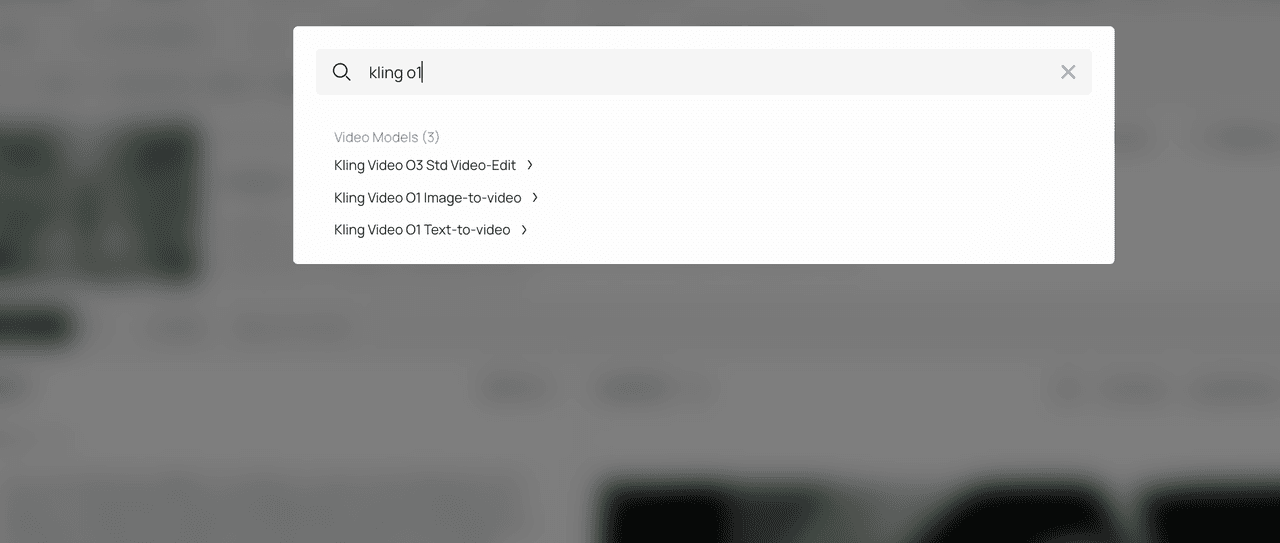
- Search "Kling O1" in the Playground
- Test with your prompts
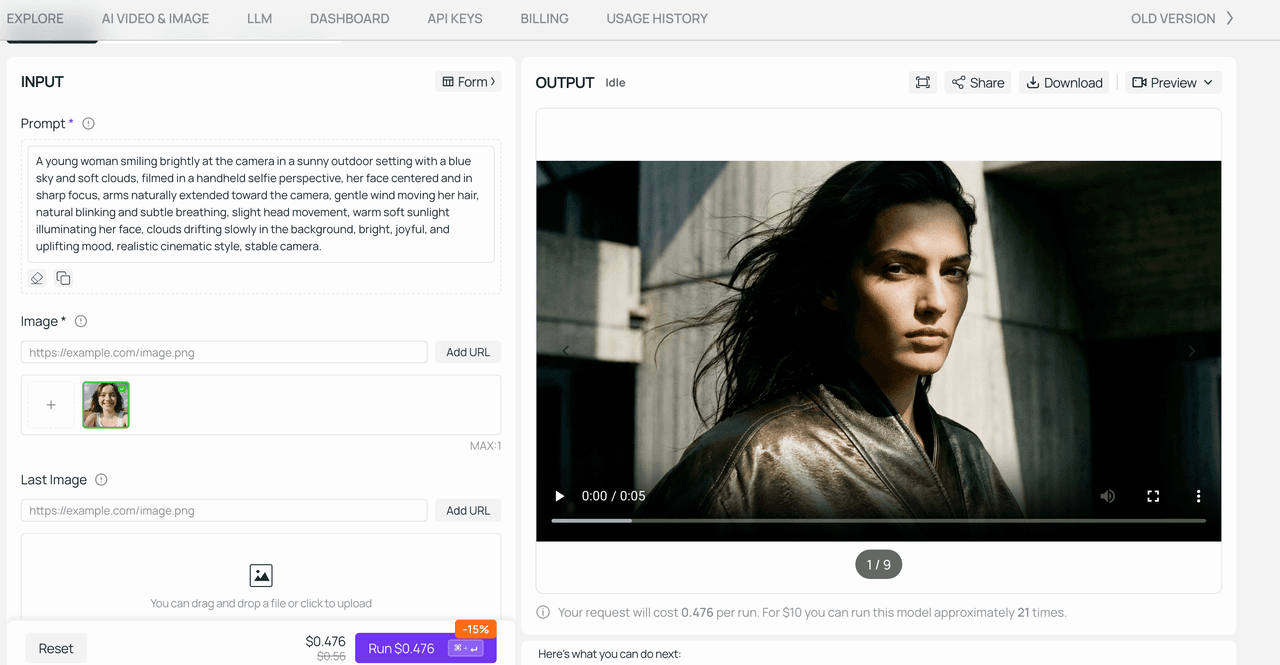
- Integrate via API using code examples above





