Two sentences on vidwud.com cannot both be true. The face swap page tells you the tool is "completely free to use. No subscription, or anything like credits or coins to buy." The pricing page puts Photo Face Swap in the first row of a credit-consumption table and bills it at one credit per image.
Neither page acknowledges the other. Whichever one you land on first decides what you think this tool costs, and only one of them carries numbers.
Key Takeaways
- Vidwud's face swap page says there is nothing like credits to buy. Its pricing page bills every swap tool in credits, and gives the free plan zero of them.
- That free plan labels its swap tools "AI face swap (Limited)" and never publishes what the limit is.
- Three upload ceilings are in circulation: 100MB on the free plan, 500MB after upgrading, and 200MB in the notice the tool shows when it rejects a file.
- Watermarks get opposite answers depending on the page, and no face swap API turned up anywhere we checked, with the terms barring scrapers outright.
- For a single still, Atlas Cloud's free AI face swap states its terms up front: no usage cap, no watermark. Metered endpoints handle video and batch work.
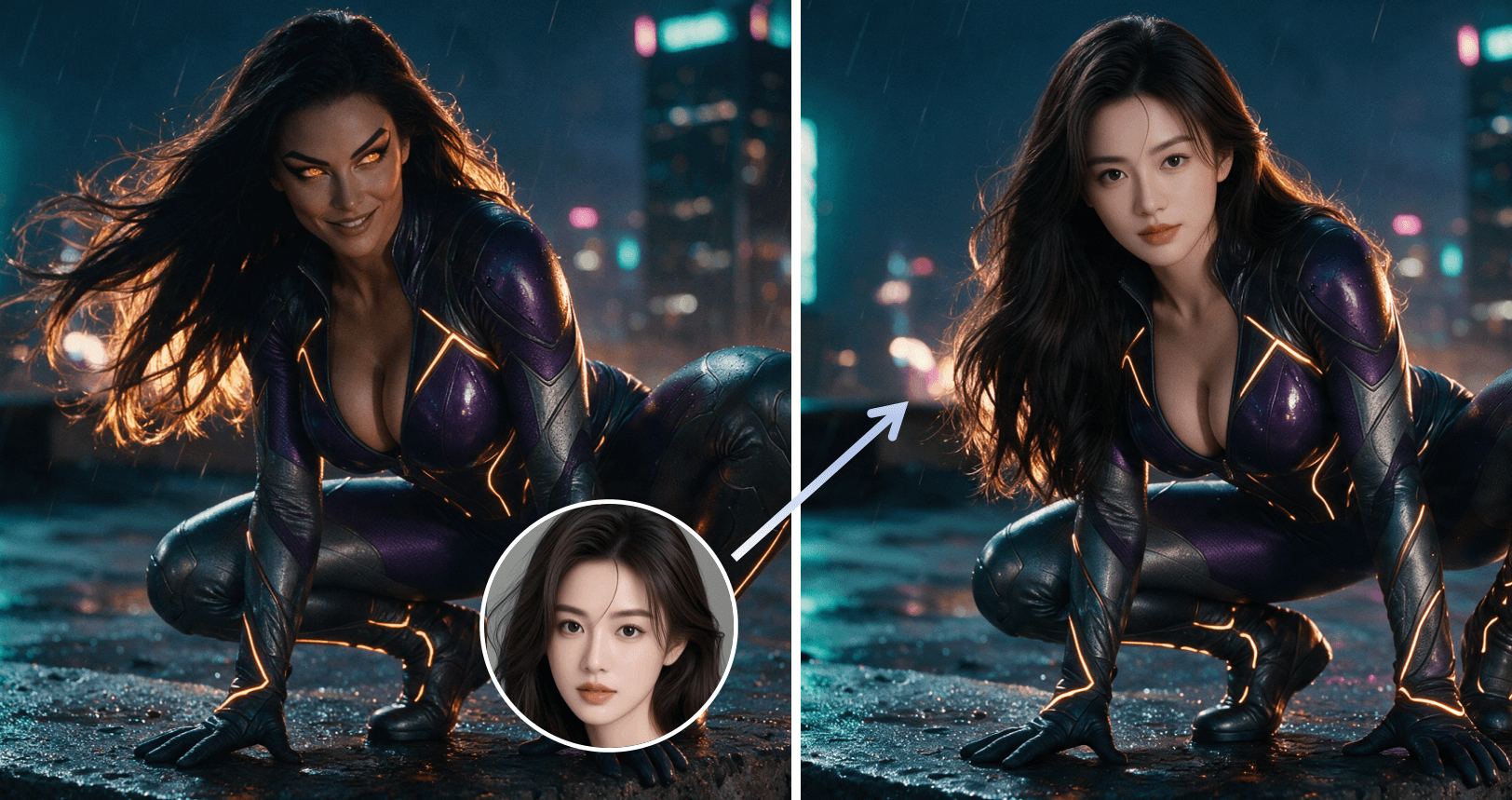
What the Vidwud Face Swap Page Puts on One Screen
Three modes share a single widget on the face swap page. Switching tabs changes what the first slot will accept, and nothing else about the layout moves.
| Tab | First upload | Second upload |
|---|---|---|
| Photo Face Swap | The image being changed | A photo of the borrowed face |
| Video Face Swap | The video or GIF being changed | A photo of the borrowed face |
| Multiple Face Swap | A group photo or video | One photo per replacement face |
Ask how many faces one pass can carry and the multi-face page answers that "there is no number limit for face swap in photos and videos," then walks it back in the next breath: too many faces "may lead to blur or other bad situations," and "two to six faces are proper."
Formats are consistent across modes. Stills go in as JPG, PNG or WEBP. Footage goes in as GIF, M4V, MP4, MOV or WEBM. The second slot always wants a still photo, even in video mode, so the face you borrow is never lifted from a moving clip.
How to Face Swap on Vidwud Step by Step
Vidwud publishes three steps. They are accurate as far as they go, and they lean on two words that point in confusing directions.
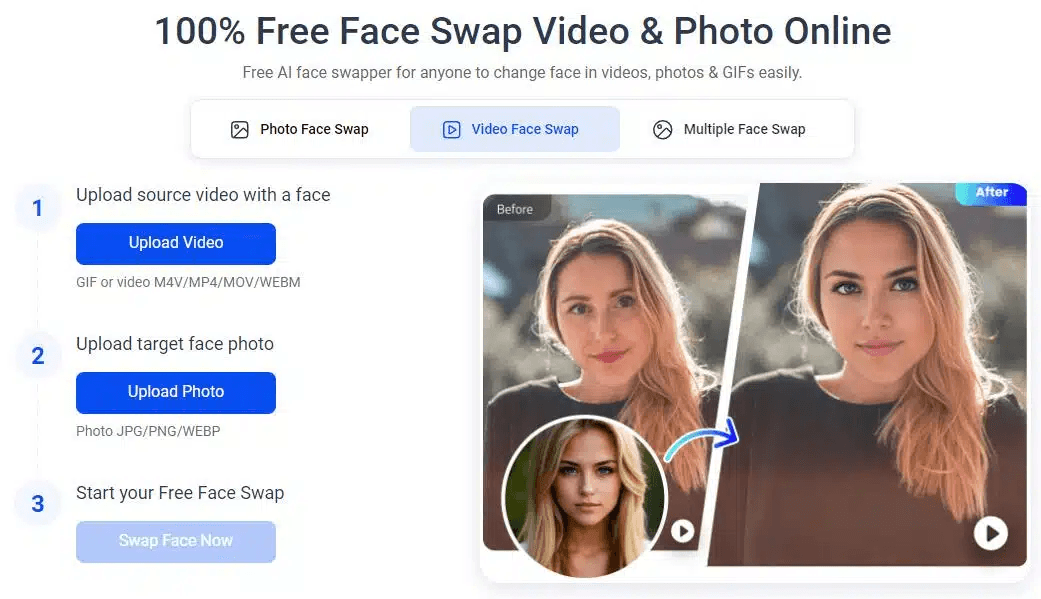
- Upload the file you want changed. Vidwud's wording is "upload your original photo or video from your PC or Smartphone." This is the scene that keeps its body, background and lighting.
- Upload the face you are borrowing. Vidwud calls it choosing "the target face that you want to swap." A still photo, front-facing and well lit, is what the tool asks for.
- Click Face Swap Now. Vidwud's own claim for this step is a result "in seconds."
The vocabulary is where people slip. Vidwud's first slot is the "source," meaning the picture being edited, and its second slot wants the "target face," meaning the donor. Read at speed, target sounds like the thing you are aiming at, which is the opposite of what the slot holds. In photo mode both slots take the same file types, so those labels are the only thing keeping them apart.
Multi-face work follows the same shape with one addition: upload the group shot, then upload a separate photo for each face you want replaced. The two modes describe that mapping differently. Video mode asks you to "upload and specify the target face for each character who needs a face swap," which implies you control the pairing. Photo mode says only "upload the faces you want to replace," leaving the assignment to whatever the detector decides. Worth a cheap test on a crowded frame before committing to a batch.
Published quality guidance is thin and all of it concerns your inputs. Donor faces should be "front and clear with good lighting," and uploads should be high resolution. Glasses, occlusion, motion blur, extreme head rotation, none of the conditions that actually decide whether a swap reads as convincing get a mention anywhere on the page.
A Metered Vidwud Face Swap Alternative on Atlas Cloud
An allowance nobody publishes is workable for one meme and unworkable for a repeated task. Atlas Cloud covers the same operation from two directions: metered endpoints where the rate per run is printed before you spend, and a browser tool in its AI tools collection that swaps a face without charging for it.
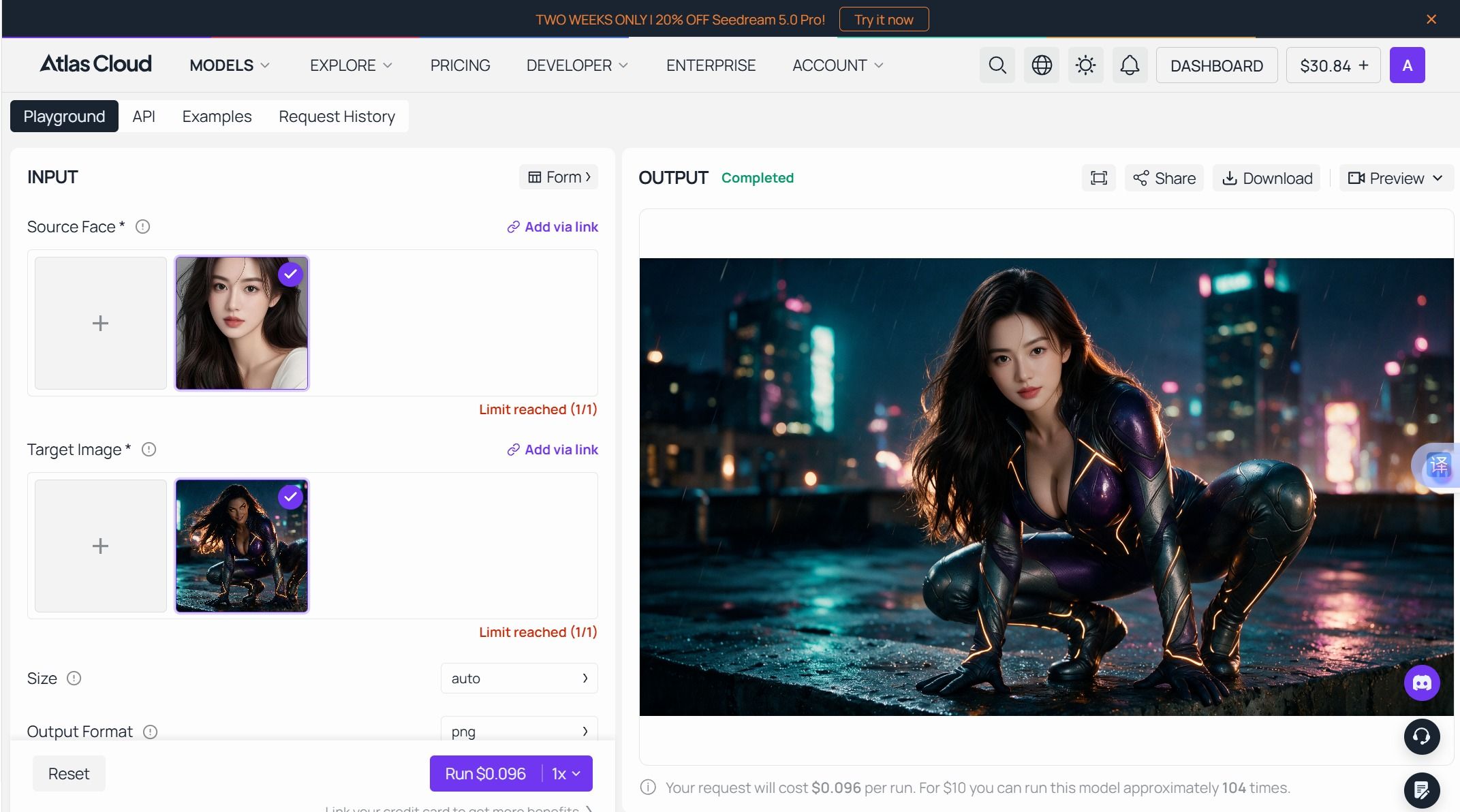
Take the metered side first. You give the Face Swap endpoint a source face and a target image, and it transfers facial identity while pose, clothing, background and lighting on the target stay where they were. The catalog lists it from $0.09 per image, and the Face Swap playground quotes $0.096 for a run at the default auto size, then does the arithmetic on screen: $10 buys approximately 104 runs. Video runs through a companion endpoint listed from $0.20 per second, taking MP4 or MOV targets between two and ten seconds at 720P or 1080P.
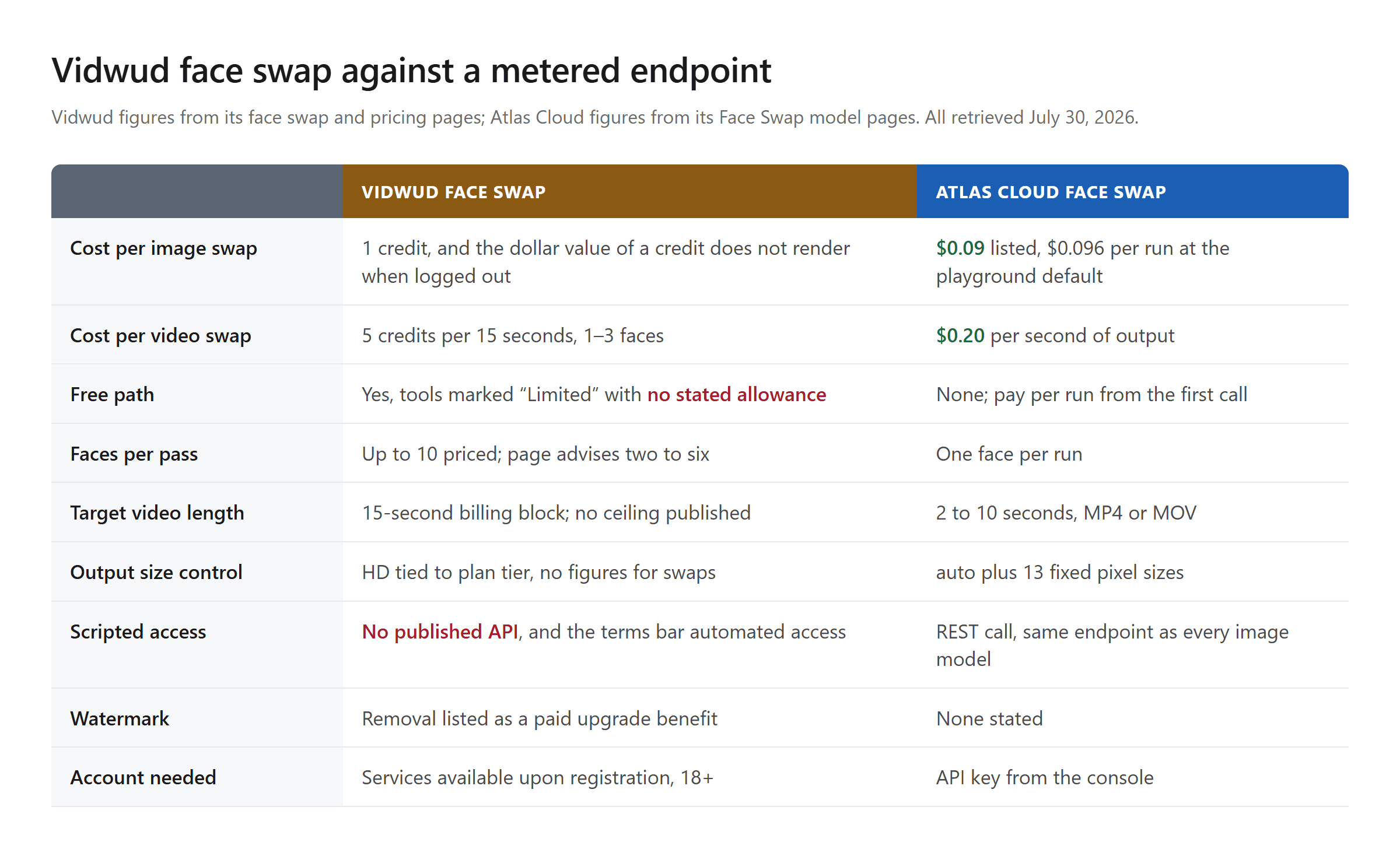
Vidwud figures from its face swap and pricing pages; Atlas Cloud figures from its Face Swap model pages. All retrieved July 30, 2026.
Each side wins something. Vidwud handles up to ten faces in a single pass, and its video path swallows far more than ten seconds of footage. The metered endpoint gives you a number you can multiply. Fifty headshots come to $4.80 and arrive in one batch, while fifty swaps against an allowance described only as "Limited" is an unknown number of sessions, and the only way to learn the ceiling is to reach it. If the swap you have in mind is a single still, the third route below skips the meter entirely.
Method 1: Swap Faces in the Atlas Cloud Playground
No code needed. Log in, open the Face Swap model page, and fill two fields. Source Face takes a clear, front-facing photo of the face you are placing. Target Image takes the photo whose face gets replaced. Note that this reverses the vocabulary from the previous section: here the target is the picture being edited, which is the intuitive reading and the opposite of Vidwud's.
Size defaults to auto. The parameter also accepts thirteen explicit pixel sizes spanning square, landscape and portrait, from 1024×1024 through 2720×1530. Auto returns one of those presets rather than your input's exact dimensions, so set the value explicitly when a pipeline downstream expects the original shape back. Output arrives as JPEG unless you ask for PNG.
Method 2: Script Face Swaps Through the Atlas Cloud API
Three steps take you from nothing to a scripted swap.
Step 1: Get your API key. Create one in the Atlas Cloud console dashboard and copy it.
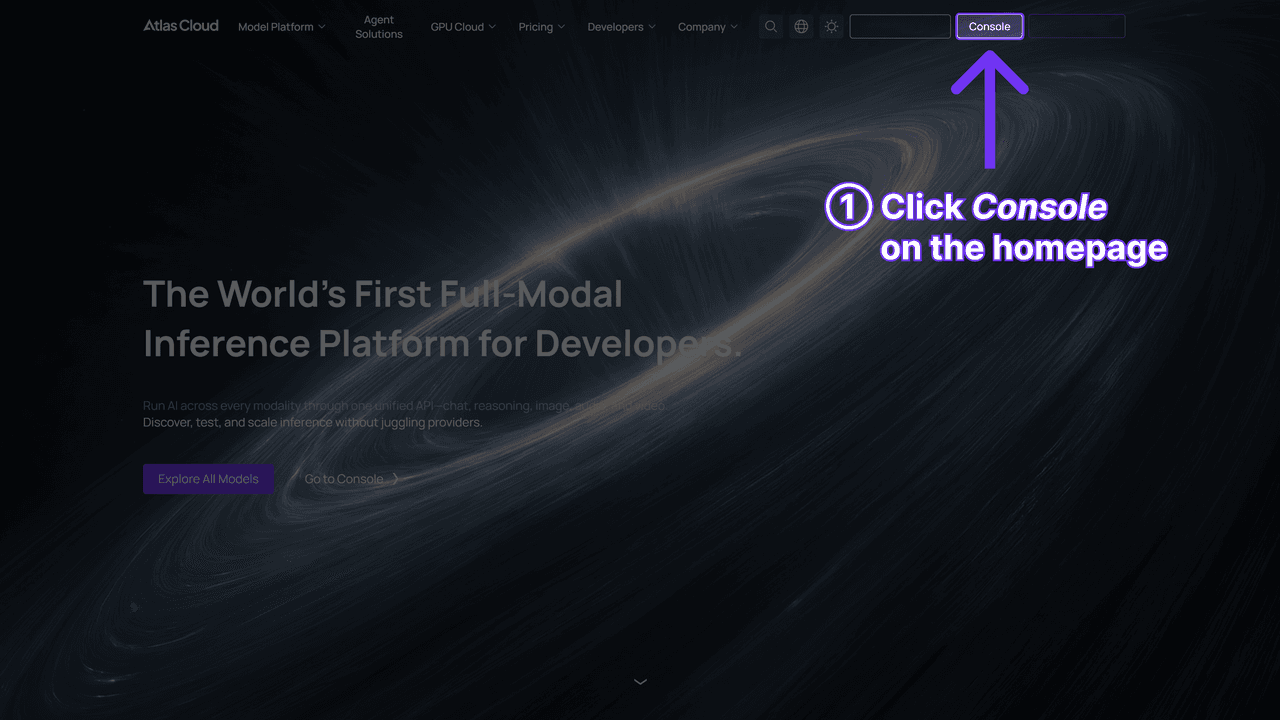
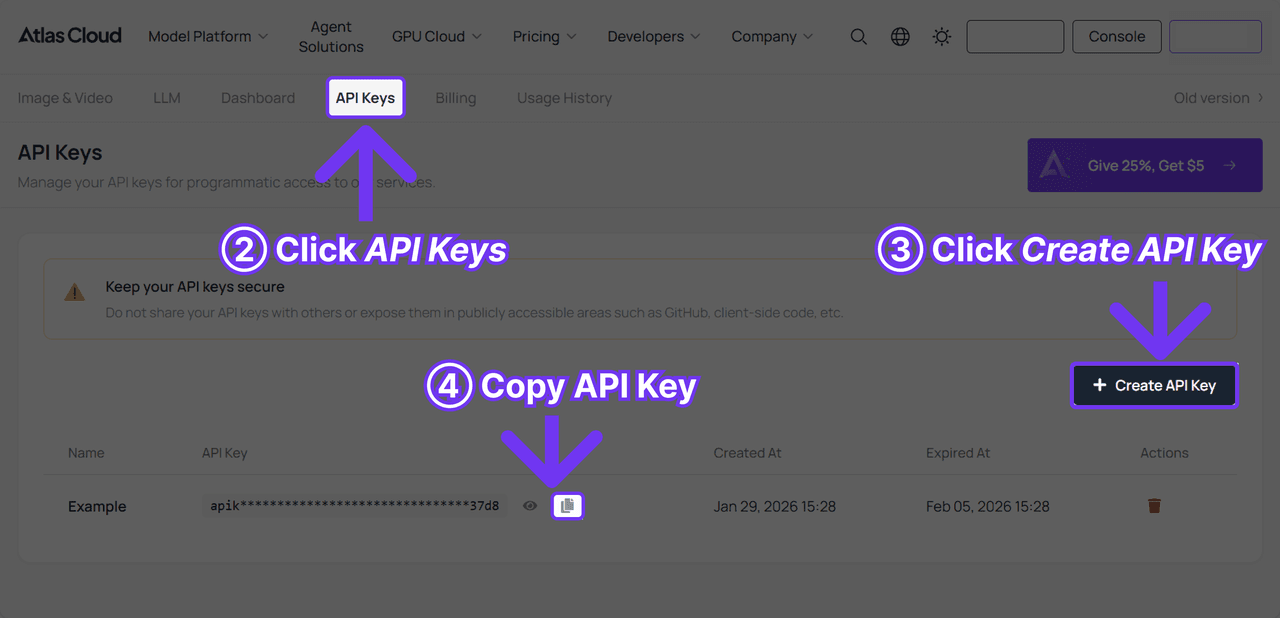
Step 2: Check the API docs for authentication, parameters and the shared image endpoint.
Step 3: Send the request. Face swap runs through the same generateImage endpoint as every image model on the platform:
Bash1curl -X POST https://api.atlascloud.ai/api/v1/model/generateImage \ 2 -H "Authorization: Bearer $ATLASCLOUD_API_KEY" \ 3 -H "Content-Type: application/json" \ 4 -d '{ 5 "model": "atlascloud/face-swap-image", 6 "image": "https://your-cdn.com/source-face.jpg", 7 "Image": "https://your-cdn.com/target-photo.jpg", 8 "output_format": "jpeg", 9 "size": "auto" 10 }'
Watch the capitalisation in that payload. Lowercase image is the source face, capital Image is the target photo. The two field names differ by one letter, and swapping them reverses your inputs the same way transposing Vidwud's two upload slots does.
Generation is asynchronous. The response returns a prediction ID, which you poll until the status reads completed:
Bash1curl https://api.atlascloud.ai/api/v1/model/prediction/<prediction_id> \ 2 -H "Authorization: Bearer $ATLASCLOUD_API_KEY"
The finished image comes back as a URL in the outputs array. Video swaps use generateVideo with image for the source face, video for the target clip, and resolution set to 720P or 1080P. Same authentication, same polling loop, so extending working image code to video is mostly a model-string change.
Method 3: Run a Free AI Face Swap on a Single Photo
Both routes above bill per run. For one still image, Atlas Cloud also publishes a free AI face swap tool, and its FAQ answers the obvious question without hedging: asked whether the tool is free, it says yes, with no usage cap and no watermark on the finished image. That is the part Vidwud's "Limited" label never puts in writing.
The layout will look familiar after the playground. Source Face takes the donor, Target Image takes the picture being edited, same vocabulary as the metered endpoint and the same reversal of Vidwud's. Two sliders sit underneath. Blend controls how strongly the new face fuses into the target, and Feather controls how wide the edge transition runs, which is what you reach for when a jawline or hairline reads as pasted on.
This is a good fit for the sort of thing Vidwud advertises. Dropping your own face into a classic portrait or a film still is a single-face, single-image job, and it is the exact task where paying to discover whether the effect even works is annoying.
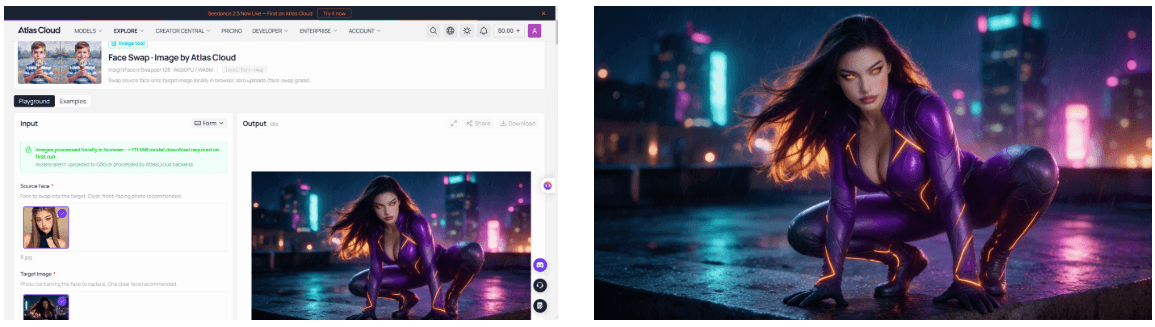
Know the ceilings before you commit to it. Results download as PNG "at the size of your target photo, up to 1280 pixels on the longest side," which sits below the 2048-pixel presets the metered endpoint offers. It handles one image at a time, so there is no batch path. The first visit pulls roughly 711 MiB of model data before anything runs, and a swap takes around eight seconds after that. Video is out of scope: asked directly, the page says it is built for photos and points moving footage back to the model library.
One rule carries across every route in this article. The tool's own licensing answer puts it plainly: make sure you have permission to use both photos, especially when another person's face is involved.
Where the Free Vidwud Face Swap Claim Comes Apart
Vidwud does publish exact face swap prices. They sit on the pricing page, which the tool page gives a free user no reason to open.
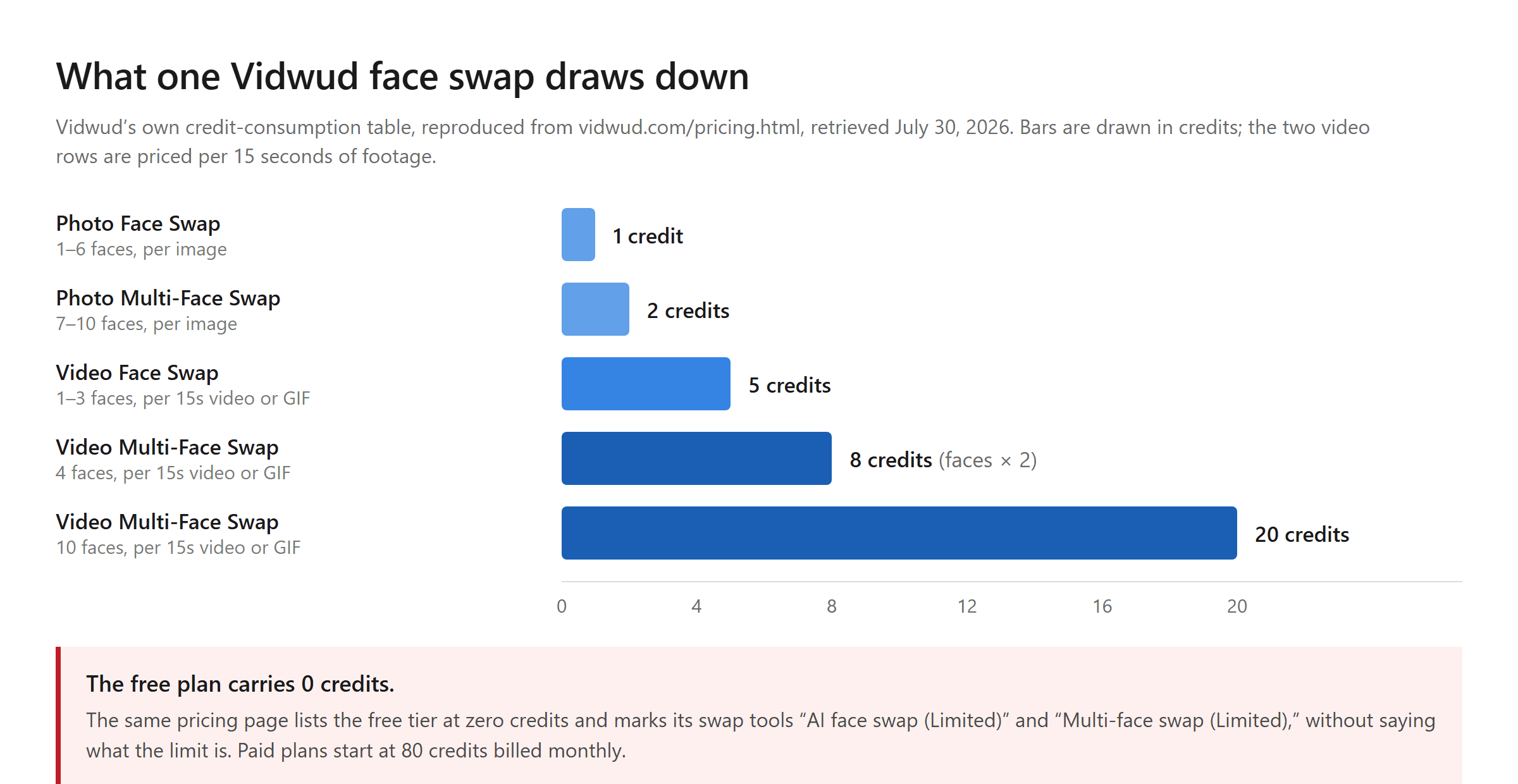
Data reproduced from the credit-consumption table on vidwud.com/pricing.html, retrieved July 30, 2026.
The table settles two things the rest of the site leaves open. Billing recognises a face count, splitting a 1-to-6-face photo from a 7-to-10-face one, which is a firmer ceiling than the FAQ's "no number limit." And multi-face video scales at faces times two per fifteen seconds, putting a ten-face clip at 20 credits.
The multi-face page, meanwhile, sells itself against competitors "that either charge hidden fees or run at a snail's pace" and offers "unlimited free face-swapping fun." Whatever Limited means on the pricing page, it is not unlimited.
What the free tier actually holds is 0 credits. Its column reads "AI face swap (Limited)" and "Multi-face swap (Limited)," and we found no definition of Limited anywhere on the site. Paid plans start at 80 credits billed monthly.
Try to convert credits into money and the trail stops. Logged out, Vidwud's pricing page renders every subscription tier as $0. The credit table loads, the plan features load, the prices do not. Sitting on that same page is a second, unrelated set of plans for an AI presentation generator, priced openly from $9.99 to $46.99 with 15% and 30% discounts marked, so the blank credit tiers are not a site-wide rendering fault.
Credits themselves behave conventionally. Unused ones roll into the next cycle, they last as long as the subscription does, and cancelling leaves them alive until the end of the period you already paid for. Getting money back is narrower. Vidwud's refund policy, last updated April 15, 2025, limits monthly subscribers to claims for service errors, while half-yearly and annual plans get a full refund if under 10% of credits are used within seven days, and 50% back above that line. Credits already spent and credits received from promotions are excluded outright.
Vidwud Face Swap Limits Worth Checking Before You Upload
The upload ceiling depends on which Vidwud page you read, and the number the tool enforces belongs to neither plan.
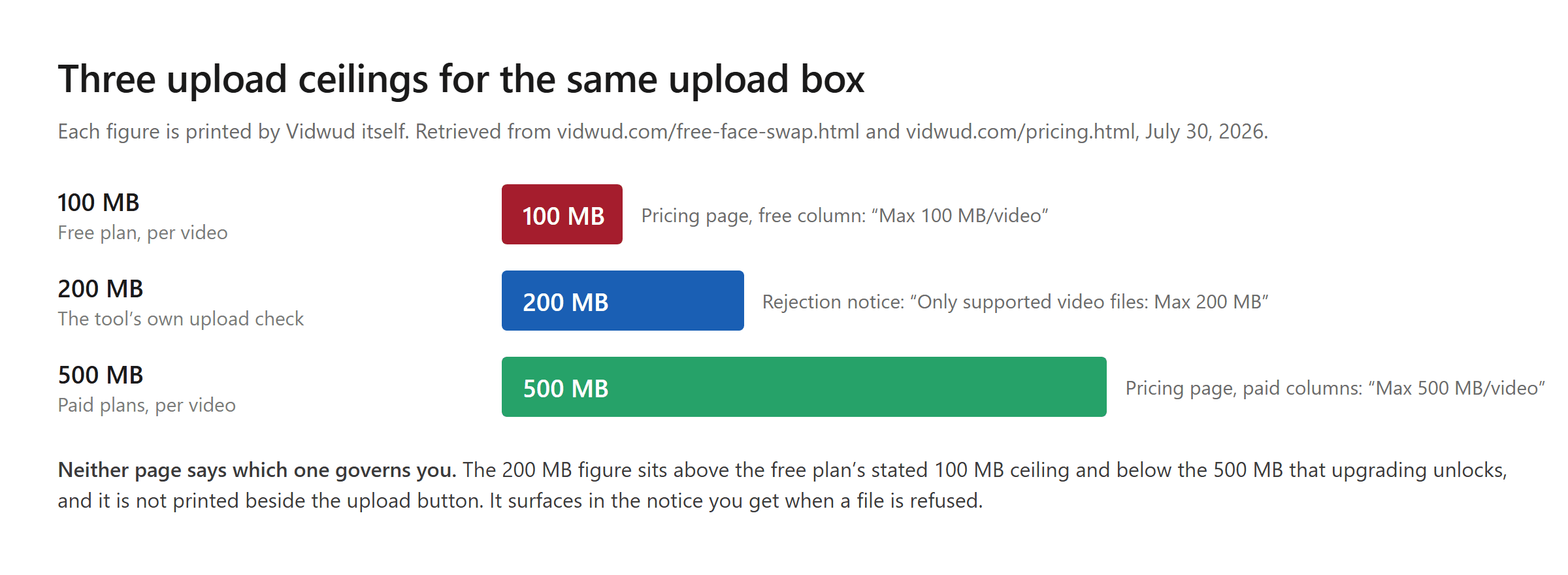
Figures from vidwud.com/free-face-swap.html and vidwud.com/pricing.html, retrieved July 30, 2026.
The 200MB figure takes some finding. It is not printed beside the upload button, where the only guidance is a format list. It lives in the notice the page returns when it refuses a file: "Only supported video files: Max 200 MB." So the ceiling a free user is most likely to meet is double what the pricing page grants that plan, and they meet it by failing an upload. Which figure actually governs is stated nowhere. Plan around 100MB until you have tested otherwise.
Video duration is a different kind of gap. Vidwud bills video swaps in 15-second blocks, and no maximum length appears on any page we checked, so pricing a two-minute clip in advance means assuming the blocks simply keep stacking. Output resolution has the same problem. HD sits in the paid column of the plan comparison as "HD image resolution," with no pixel figures attached to swaps at all.
Watermarks get two answers depending on where you ask. The multi-face page puts the question to itself and replies: "Yes. After generation, you can download the output without a watermark. Feel free to download and use it for any purpose." The pricing page lists "No watermark" among the things upgrading buys you, which only makes sense if free output carries one. Both pages were live when we checked, and Vidwud never reconciles them or shows what the mark would look like.
Scripted access has no ambiguity at least. No face swap API turned up in any Vidwud page we checked, and the terms of use prohibit using "any automated system, including bots, spiders, or scrapers, to access the Site or the Service." Batch work here means a browser and a mouse.
Consent and Content Rules Behind a Vidwud Face Swap
For a tool that moves real faces onto real bodies, what the rules cover matters as much as what they forbid.
| Where the rule lives | What it says | Covers ordinary likeness use |
|---|---|---|
| Terms of use, prohibited conduct | Bars non-consensual intimate imagery "including deepfake or manipulated content"; bars CSAM | Only where the result is intimate or sexual |
| Terms of use, account terms | Services available upon registration; you confirm you are 18 or older | No |
| Terms of use, content review | Pornographic and violent uploads bring a permanent account and IP ban, with an email appeal route | No |
| Multi-face swap FAQ | Uploads are "private and visible only to you" | No |
Date the documents before you rely on them. The terms carry no last-updated line, a copyright notice inside the text reads 2024, and the site footer reads 2025.
The NCII clause is the strongest thing in that set, and it is specific in a useful way. It names deepfake and manipulated content directly, it turns on the depicted person's explicit consent, and it treats a fabricated intimate image the same as a captured one. Enforcement reads as absolute: verified reports get the content deleted and the account and IP address banned, with an appeal route by email to support.
What we could not find in those documents is a general likeness rule. Once the result is not intimate, no clause we read asks whether the person whose face you borrowed agreed to it, which leaves something like a colleague's face dropped into a marketing image unaddressed. That is a narrower commitment than the tool's reach, and worth knowing before you upload someone else's photo.
The privacy assurance has the same shape. "All your uploaded photos are private and visible only to you" lives in a product FAQ rather than the privacy policy, and it says nothing about how long uploads are kept, whether faces count as biometric data, or whether anything feeds training. None of this is legal advice and rules vary by country. Atlas Cloud's face swap page puts the same expectation on the user in one line: "Only upload images you have the right to use and obtain consent from the people depicted."
Frequently Asked Questions
Is Vidwud face swap actually free?
Partly. The tool page says there is nothing like credits to buy, and the pricing page charges 1 credit per photo swap and 5 per 15 seconds of video while giving the free plan 0 credits and marking its swap tools "Limited." A free path clearly exists, since the widget runs without payment. What we could not find on any Vidwud page is a number telling you how many swaps that path covers.
How many credits does a Vidwud face swap cost?
By Vidwud's own table: 1 credit for a photo with 1 to 6 faces, 2 credits for a photo with 7 to 10 faces, 5 credits for a 15-second video or GIF with 1 to 3 faces, and faces times two credits for a 15-second multi-face video, so 20 credits at ten faces. Paid plans begin at 80 credits per month.
Does Vidwud face swap add a watermark?
Vidwud's multi-face page says output downloads without a watermark and can be used for any purpose. Its pricing page lists watermark-free export among the upgrade benefits. The two statements conflict, so test a throwaway file before planning around either.
Does Vidwud have a face swap API?
None that we could find in its published pages, and the terms of use bar automated access with bots, spiders or scrapers. For a scripted swap, Atlas Cloud's face swap endpoint takes a source face and a target image through a standard REST call at $0.096 per run in the playground.
What file size can Vidwud face swap handle?
The face swap page prints "Max 200 MB" on its video upload slot. The pricing page caps free plans at 100MB per video and paid plans at 500MB. Neither page says which one governs you, so treat 100MB as the safe working figure on a free account.
Can Vidwud swap multiple faces in one photo?
Yes, through the Multiple Face Swap tab, and Vidwud prices photo swaps up to ten faces. Its FAQ says there is no hard number limit while warning that too many faces may cause blurring, and it recommends staying between two and six.
Conclusion
Vidwud earns its reputation on the thing it does best: opening a page, taking two files, and returning a swapped face without asking for a card. Three modes on one screen, GIF treated as an ordinary input, video and group shots both handled. As a first stop for a meme, or a test of whether the effect survives on your footage at all, it holds up.
The problem is that Vidwud tells two different stories about what it costs and never reconciles them. Free with no credits on one page, one credit per image on another, three upload ceilings across two pages, and a watermark question with a different answer depending on where you ask it. For a single swap, none of that matters. For anything you intend to repeat, or hand to a client, or run overnight, a rate you can read and multiply is worth more than a free tier whose size only reveals itself when you run out.





