ByteDance's Volcano Engine launched Seedance 2.0 Mini in mid-June 2026, a lighter, cheaper member of the Seedance 2.0 video family. The pitch is simple: roughly half the cost of standard Seedance 2.0, about twice the speed of Seedance 2.0 Fast, aimed at teams that produce video at volume. Here is what changed, what it costs, and how to access it. One thing has already moved past the launch hype: you no longer have to wait on an API to use it. Atlas Cloud has Seedance 2.0 Mini live now across all three input modes, text-to-video, image-to-video, and reference-to-video, at $0.056 per second, which is exactly half the standard tier. Because it sits behind the same single API as standard Seedance 2.0 and Fast, with usage-based pricing, you can run high-volume drafts on Mini and promote finished shots to a higher tier without rewiring anything. More on access and pricing below.
Key Takeaways
- Seedance 2.0 Mini launched in mid-June 2026, and its API is now live, including through Atlas Cloud (ByteDance, 2026).
- It costs about 50% less than standard Seedance 2.0 and runs roughly 2x faster than Seedance 2.0 Fast, at comparable quality.
- It outputs 480P and 720P only, in 4 to 15 second clips, so it targets high-volume production, not cinema-grade work.
- On Atlas Cloud, Mini runs at $0.056 per second, exactly half of standard Seedance 2.0 at $0.112, behind the same single, multi-model API.
What Is Seedance 2.0 Mini?
Seedance 2.0 Mini is the cheapest, fastest tier of ByteDance's Seedance 2.0 video model, released in mid-June 2026 (ByteDance, 2026). It joins two existing tiers, standard Seedance 2.0 and Seedance 2.0 Fast, and targets cost-sensitive, high-frequency work: e-commerce content, marketing assets, UGC, and effects.
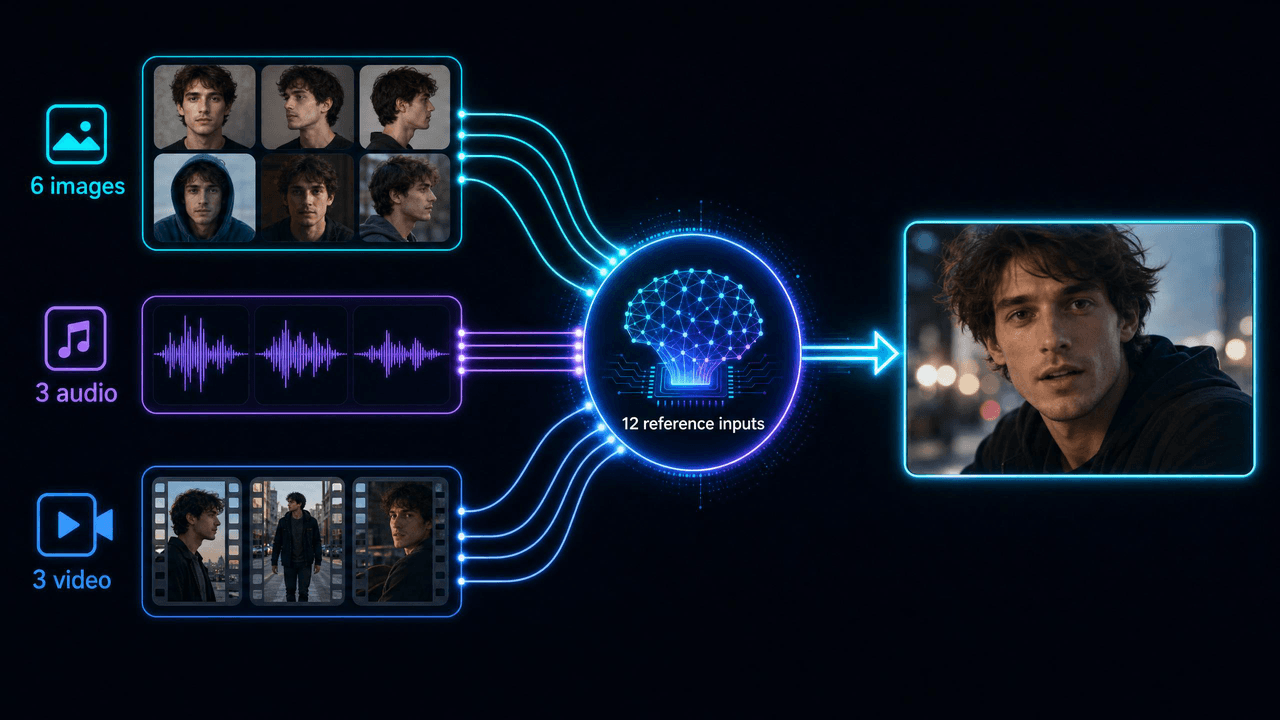 So what is Seedance 2.0 Mini built to do? Generate a lot of usable video, fast and cheap. It keeps the family's multimodal reference system, accepting up to 12 reference inputs (6 images, 3 audio clips, 3 videos) to lock character identity and motion. Note one naming trap: ByteDance also ships a text LLM called "Seed 2.0 mini," which is unrelated to this video model.
Seedance 2.0 Mini Price: How Cheap Is It Really?
The Seedance 2.0 Mini price is the headline. ByteDance advertises rates as low as ¥0.16 per second, with 720P landing around ¥0.5 per second, roughly half the cost of standard Seedance 2.0, which sits near ¥1 per second (ByteDance, 2026). On Volcano Ark, experience pricing runs about ¥0.023 per 1,000 tokens for text to video, or ¥0.014 per 1,000 tokens with video input. One correction worth flagging: several English outlets reported the 720P rate as "$0.50 per second" by reading the RMB figure as dollars. That conflates two currencies. ByteDance's published prices are in RMB, and an official USD rate on BytePlus had not appeared as of June 17, 2026. Converted at current exchange rates, ¥0.5 is closer to $0.07 per second and the ¥0.16 floor is about $0.022, but treat those as conversions, and advertised floors as a best case rather than a guarantee.
Specs and Features at a Glance
The headline Seedance 2.0 Mini features are speed and price, but the spec sheet sets clear limits. It outputs 480P and 720P, in 4 to 15 second clips, at 24fps (ByteDance, 2026). There is no 1080P, so it is not built for broadcast masters. In practice, that envelope fits short-form video almost exactly. Most social clips, ad cutdowns, and product demos live inside 15 seconds at 720P, so the model matches the format people actually publish, then leaves the high-resolution finishing to standard Seedance 2.0.
Seedance 2.0 Mini vs Seedance 2.0 and Fast
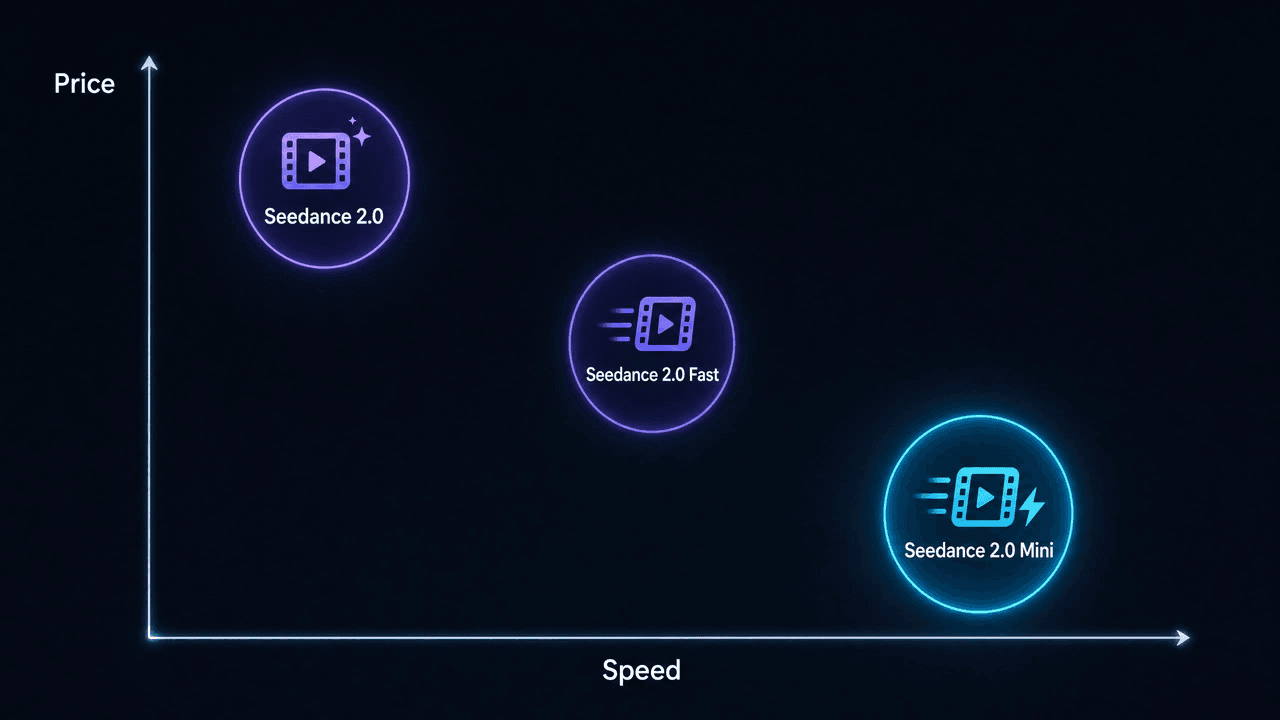
How does Seedance 2.0 Mini compare to its siblings? On Seedance 2.0 Mini vs Fast, the Mini runs about twice as fast at comparable quality and a lower per-clip cost (ByteDance, 2026). On Seedance 2.0 Mini vs Seedance 2.0, the standard model stays ahead on top-end fidelity and detail, which is why it remains the pick for cinema-grade work.
| Tier | Speed | Max resolution | Best for |
|---|---|---|---|
| Seedance 2.0 | Baseline | Higher fidelity | Cinema-grade, premium production |
| Seedance 2.0 Fast | Faster | Up to 720P | Lightweight drafts |
| Seedance 2.0 Mini | ~2x Fast | 480P / 720P | High-volume, low-cost production |
Early ByteDance tests claim the Mini even edges out Fast on motion quality and stability. Independent reviewers are more mixed, with some calling it a trimmed version best suited to drafts and batch assets rather than polished short films.
Why ByteDance Cut the Price Now
Read the Mini as a defensive move, not just a discount. By cutting price in its strongest niche, ByteDance protects its real-person video advantage from being undercut on cost alone. The endgame looks like cloud computing: once a model is wired into your production pipeline, switching cost becomes the real moat.
How to Access Seedance 2.0 Mini via API
You can use Seedance 2.0 Mini inside ByteDance apps like Jimeng (Dreamina) and CapCut, and the dedicated API has since opened (ByteDance, 2026). International developers bill through BytePlus in USD, while mainland China runs through Volcengine in RMB.
If you want Seedance through a single, multi-model API today, Atlas Cloud already serves the whole family: standard Seedance 2.0 at $0.112 per second, Seedance 2.0 Fast at $0.09 per second, and Seedance 2.0 Mini now live at $0.056 per second, exactly half the standard rate. You can see the live per-second rates for every tier on the Atlas Cloud model pricing page, then compare Seedance against 300+ other models in the Atlas Cloud model library.
Where Seedance 2.0 Mini Fits in the AI Video Race
Seedance 2.0 Mini lands in a crowded, price-sensitive market. On raw per-second API pricing, Kling 3.0 is widely considered the cheapest option and offers daily free credits, so it is friendly to small teams. Seedance's differentiator has been real-person video: facial expression detail, full-body motion, and multi-language lip sync.
Frequently Asked Questions
When did Seedance 2.0 Mini launch?
ByteDance's Volcano Engine launched Seedance 2.0 Mini in mid-June 2026. The API is now live, including through Atlas Cloud, and the model is also available inside ByteDance apps such as Jimeng and CapCut.
How much does Seedance 2.0 Mini cost?
ByteDance advertises Seedance 2.0 Mini from about ¥0.16 per second, with 720P near ¥0.5 per second (about $0.07 converted from RMB). That is about half the cost of standard Seedance 2.0. On Atlas Cloud the Mini tier is listed at $0.056 per second. Real costs vary by platform and membership tier.
Does Seedance 2.0 Mini support 1080P?
No. Seedance 2.0 Mini outputs 480P and 720P only, in 4 to 15 second clips at 24fps. For 1080P or cinema-grade detail, standard Seedance 2.0 remains the better choice.
Is Seedance 2.0 Mini better than Seedance 2.0 Fast?
On speed and cost, yes. Seedance 2.0 Mini runs about twice as fast as Fast at comparable quality and a lower per-clip price. ByteDance also claims better motion stability, though independent reviews are mixed.
Can I use Seedance 2.0 Mini through an API?
Yes. Seedance 2.0 Mini is now live through Atlas Cloud at $0.056 per second, alongside standard Seedance 2.0 and Fast behind one model API. ByteDance's own BytePlus and Volcengine endpoints opened on a similar timeline.
Conclusion
Seedance 2.0 Mini is less about new tricks and more about economics. By halving the cost of standard Seedance 2.0 and doubling the speed of Fast, ByteDance is lowering the barrier to high-volume video production. The trade-off is resolution and top-end polish, which still belong to the standard model. If you produce video at scale, the Mini is built for you, and with the API now live you can put it to work today. Test it on your own content, watch the real cost per second rather than the advertised floor, and route premium work to a higher-fidelity model when quality matters most.





