Pixlr's face swap page is titled "Free AI Face Swap Online," and everything on it behaves that way. Two drop zones, a swap-direction button, one big Run button. Nothing asks you to log in, nothing shows a price, and no credit cost turns up anywhere in the copy.
Then you fill both slots and click Run, and a sign-up dialog slides in. Behind that dialog sits a check on your AI credit balance that nothing in the copy prepares you for. Neither of those is hidden, exactly. They just live in the tool's code rather than in its marketing.
Key Takeaways
- The face swap widget is two upload slots and a Run button. Clicking Run while signed out opens Pixlr's sign-up dialog, and once signed in the run is blocked unless your balance holds at least 2 AI credits.
- A swap costs 2 credits. Signed in, the button says so itself, reading "Run Face Swap (2c)"; the marketing copy that surrounds it mentions no price, no credits, and no free allowance.
- At 2 credits a swap, the effective rate runs from about $0.062 on the $2.49 Plus plan down to roughly $0.010 on the $24.99 Ultra plan, and $0.012 on the largest credit pack.
- Your uploads are shrunk to a 2160 px longest side and converted to JPEG inside your browser before they are sent. The result comes back as JPEG and is re-encoded to the PNG the page advertises.
- The page offers "hundreds of templates." We found no template browser in the tool on July 29, 2026.
- Pixlr's own licence agreement takes a "perpetual, royalty-free and irrevocable" licence over both the photos you upload and the swap you get back, which reads oddly next to the FAQ line promising uploads are "promptly deleted."
- Atlas Cloud runs a metered face swap endpoint at $0.096 per image run, listed from $0.09, plus a video version from $0.2 per second, with no plan and nothing to expire.
What the Pixlr Face Swap Page Promises
The tool is one widget. Upload Face on the left, Upload Target on the right, a switch control between them that flips which is which, and Run underneath. That switch is a genuinely useful touch: filling the two slots the wrong way round is an easy mistake, and Pixlr lets you correct it without re-uploading anything.
What surrounds the widget is marketing for six use cases: new hairstyles, LinkedIn headshots, themed party invitations, faces on classical paintings, gender swaps, and memes. Pixlr's own blog post introducing the tool, dated April 2024, groups them as "Social Media Stardom," "Professional Polish," and "Special Occasions."
The gap between that copy and the tool underneath it is worth walking through before you plan any work around it.
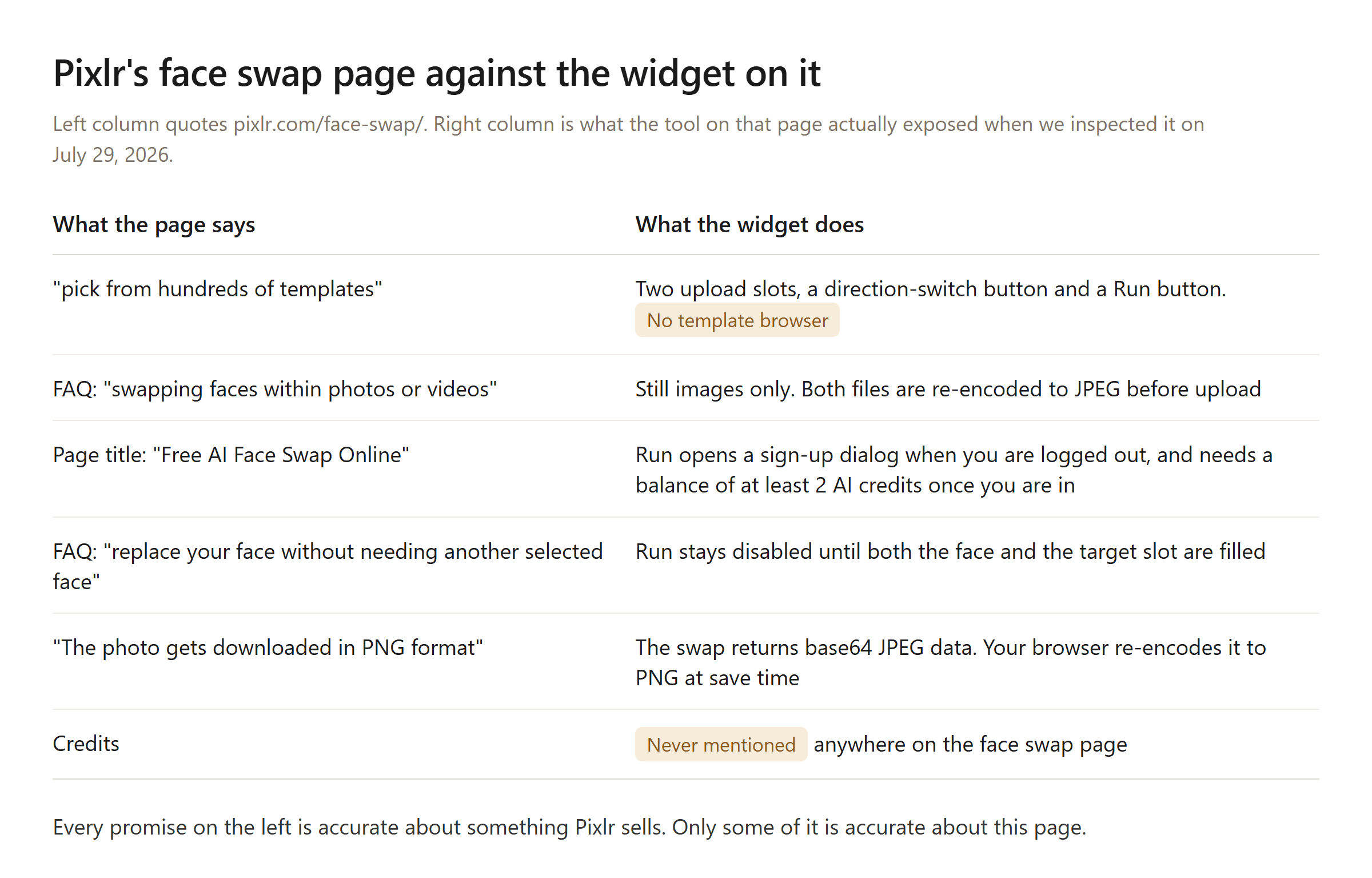
Left column quoted from pixlr.com/face-swap/. Right column from the page and its client script, inspected July 29, 2026.
Two of those rows deserve a note. The FAQ answer describing "swapping faces within photos or videos" reads like generic AI-face-swap copy, and it sits on a page whose upload handler turns everything into a still image. The answer claiming you can "replace your face without needing another selected face" describes a one-upload workflow that this widget does not have; Run stays greyed out until both slots are filled.
How to Face Swap in Pixlr Step by Step
Pixlr publishes four steps. Here they are with the parts the page leaves out.
- Open the tool. Go to the face swap page. Sign in first if you can, because doing it later means clicking Run and getting a registration dialog instead of a swap.
- Upload the face. This is the identity you are borrowing. Pixlr's advice, from its FAQ: use "high-quality photos for both source and target images," and pick shots with "similar facial expressions" so the alignment holds up.
- Upload the target. This is the photo that gets changed. If you realise the two are the wrong way round, hit the switch control between the slots rather than starting over. Step 3 in Pixlr's own instructions also offers "a template from the library" as an alternative here, which is the promise we could not find a control for.
- Run, then click the result to save. Output lands under the form. Clicking it downloads a PNG.
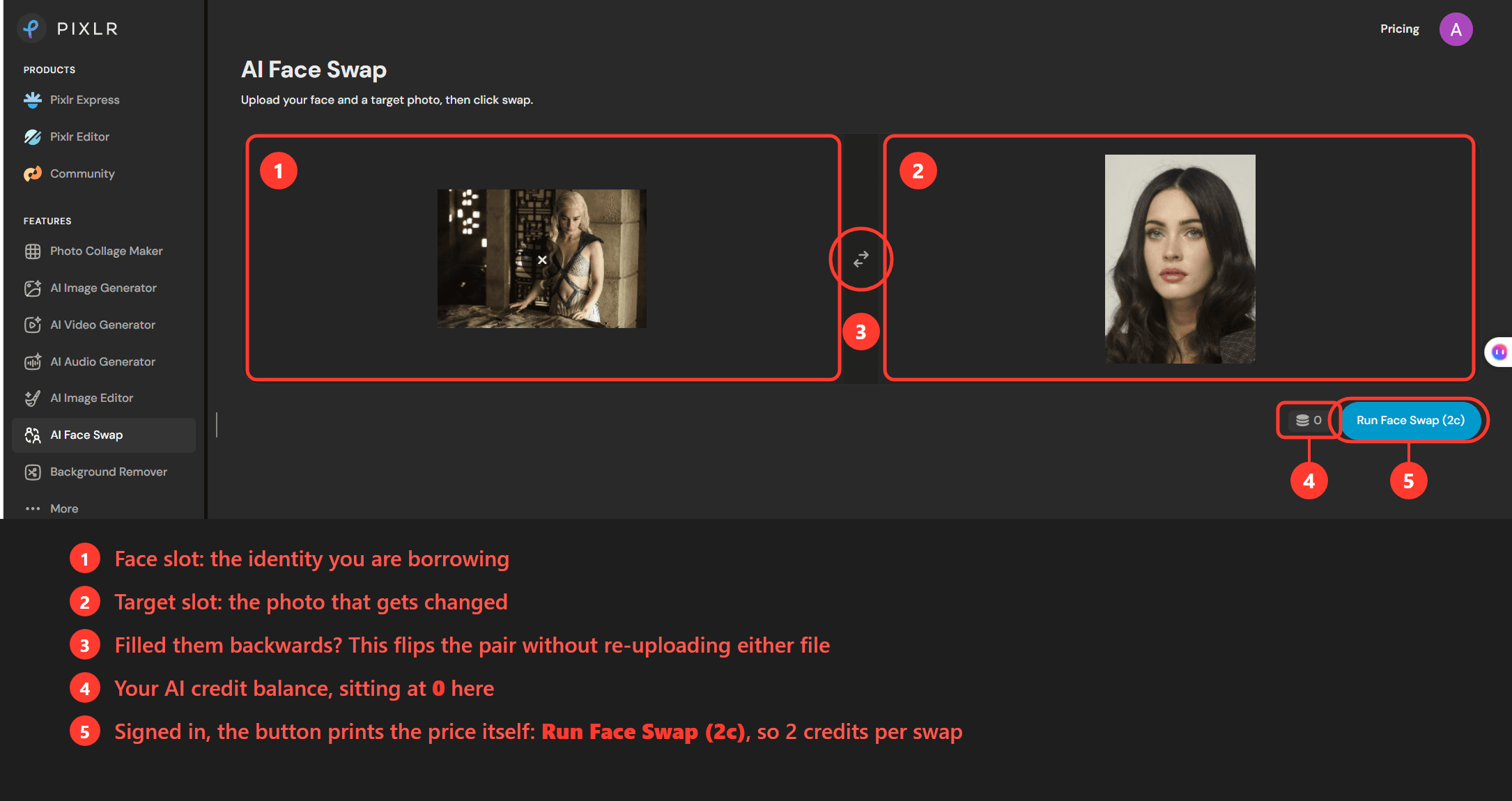
Signing in changes the furniture. A credit chip appears next to Run, showing the balance on your account, and the button relabels itself Run Face Swap (2c). That parenthesis is the price the marketing page never quotes: 2 credits a swap. With the balance at 0, as in the screenshot above, pressing Run produces a dialog rather than an image; subscribers get a top-up prompt and everyone else an upgrade pitch. After a swap that does go through, the page re-reads your balance from Pixlr's credit endpoint so the chip stays current.
The rest of the interface stays sparse. No queue position, no progress percentage, just the Run button sitting in a working state until an image appears. Each new result is added above the last one, so a session's swaps stack up on the page and a reload clears the lot. Nothing here keeps a history for you.
A Metered Pixlr Face Swap Alternative on Atlas Cloud
A credit pool that resets monthly suits occasional swaps. It gets awkward the moment swapping turns into a task with a deadline, because the ceiling is whatever your plan allotted that month. Atlas Cloud prices the same operation per run instead, with the endpoint sitting in its image tools lineup next to four other utilities.
Mechanically it matches what you do by hand on Pixlr: supply a source face and a target photo, and the model transfers facial identity while holding the target's pose, clothing, background, and lighting. The catalog lists it from $0.09 per image. In the Face Swap playground, a run quotes $0.096, which puts $10 at roughly 104 swaps. Neither face swap endpoint carried a discount on July 29, 2026, unlike several image models on the platform that were running limited-time cuts that week.
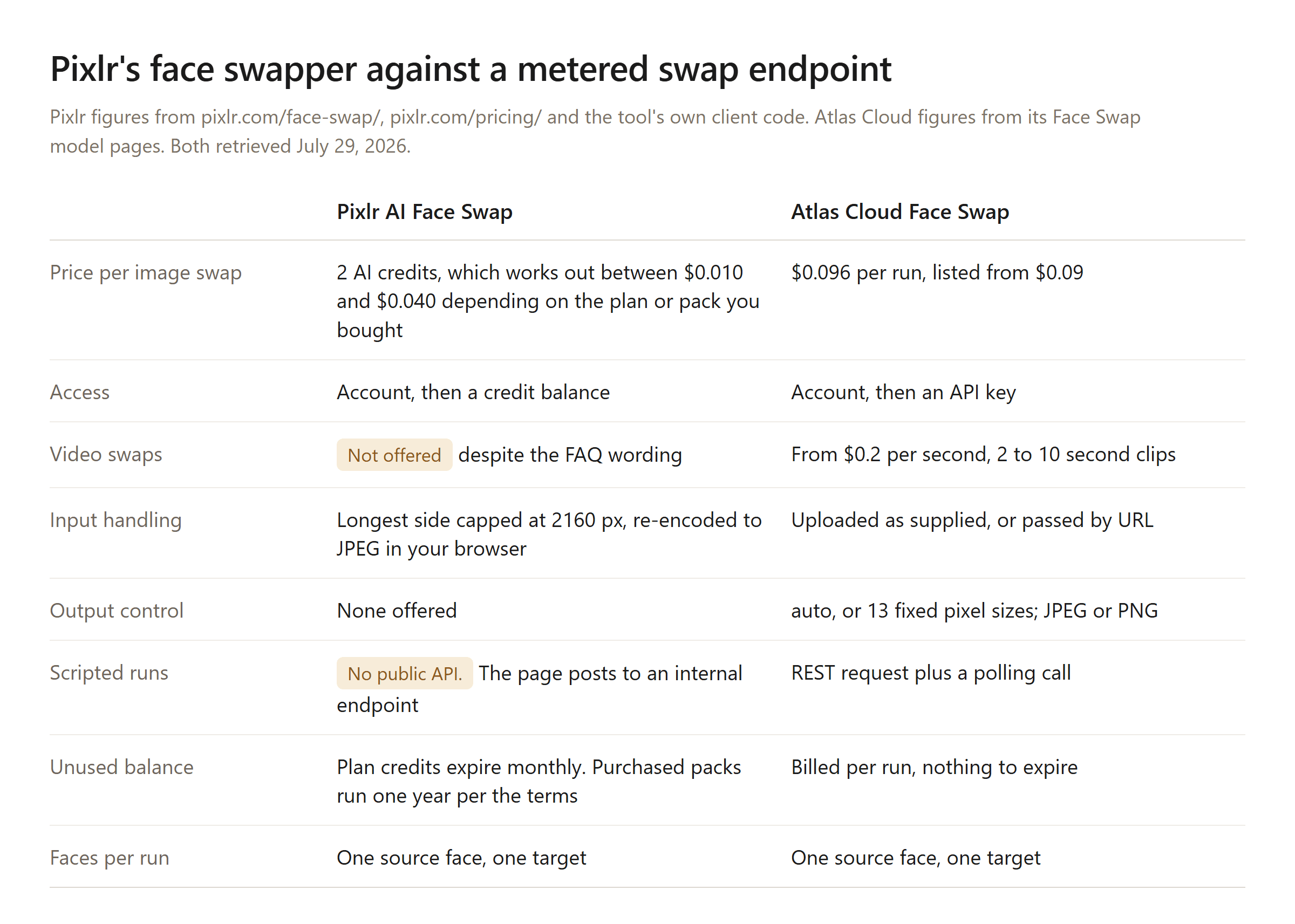
Pixlr figures from its face swap page, pricing page and client script; Atlas Cloud figures from its Face Swap model pages. Both retrieved July 29, 2026.
One row in that table goes Pixlr's way, and it is the row most people look at first. A subscriber who spends a whole plan on nothing but faces gets down to about a cent a swap, roughly a tenth of the metered rate. The arithmetic behind that figure, and the conditions attached to it, are in the credits section below.
Video is where the two routes stop being comparable at all. Pixlr's swapper takes no footage, whatever its FAQ wording implies. Atlas Cloud's companion endpoint takes a source face plus a target clip of two to ten seconds at 720P or 1080P, listed from $0.2 per second, with the playground quoting $1.2996 for a run at its 1080P default.
Method 1: Swap Faces in the Atlas Cloud Playground
No code needed. Open the model page and the form asks for two uploads: Source Face, which the page specifies should be a clear, front-facing photo of the face you want swapped in, and Target Image, the photo whose face gets replaced. Size defaults to auto. The size parameter otherwise accepts 13 explicit pixel dimensions across square, landscape, and portrait shapes, from 1024×1024 through 2048×2048, with 2720×1530 the widest of them. Output is JPEG by default, with PNG available.
We put a plain studio headshot in the source slot and a fantasy throne-room scene styled after Game of Thrones in the target slot, left the size on auto, and pressed Run once.
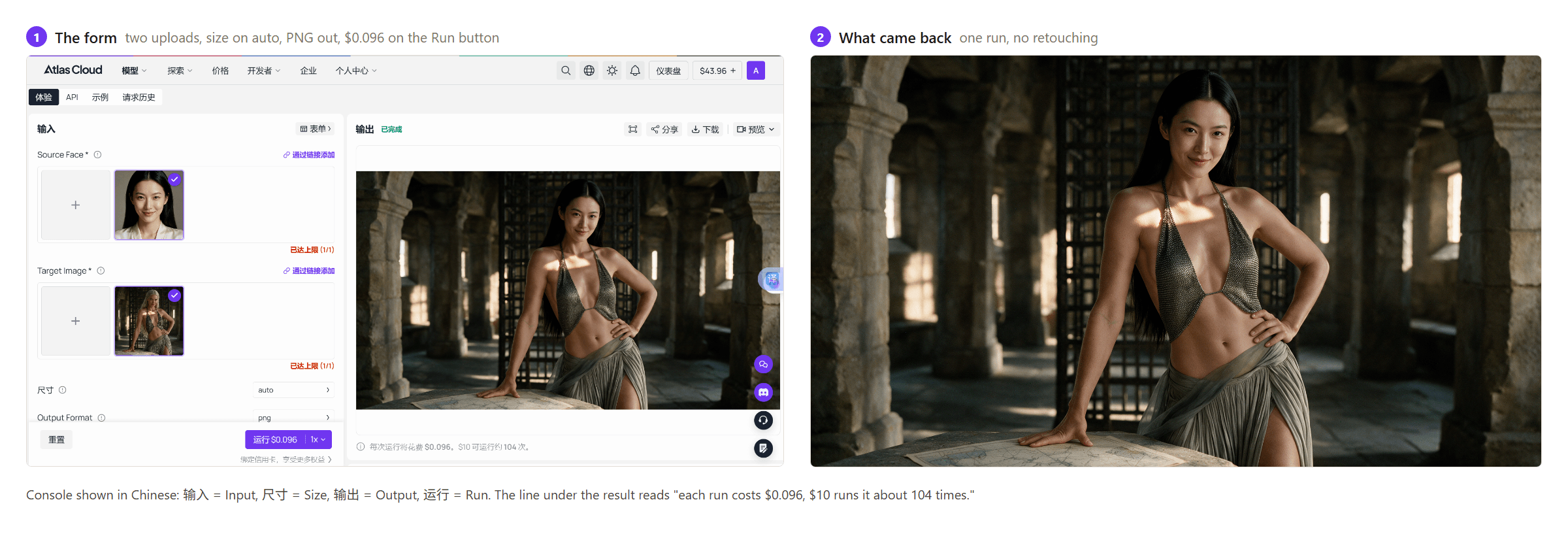
Identity is the only thing that moves. The chainmail costume, the hand planted on the map table, the shafts of light across the stonework: all of it comes back untouched, which is the behaviour the model page describes and the reason a dedicated swap endpoint beats a general image editor for this job.
Method 2: Automate Swaps Through the Atlas Cloud API
Three steps get you from nothing to a scripted swap.
Step 1: Create an API key in the Atlas Cloud console dashboard and copy it.
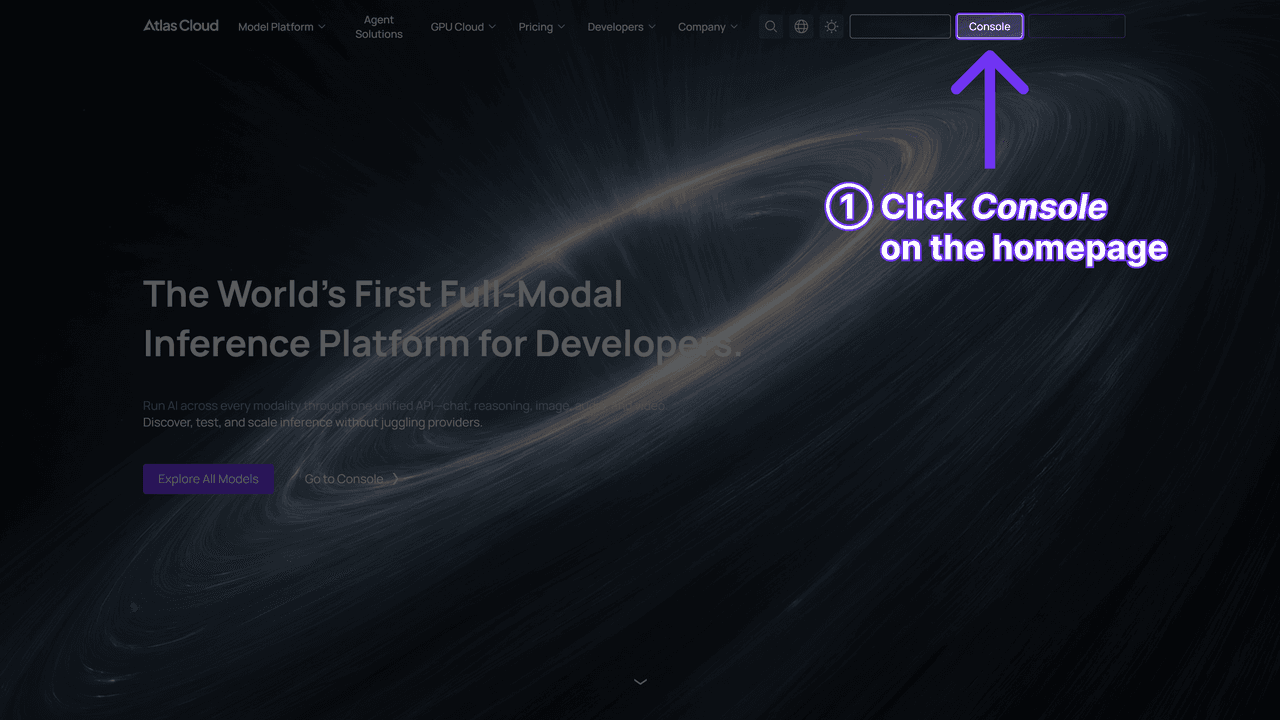
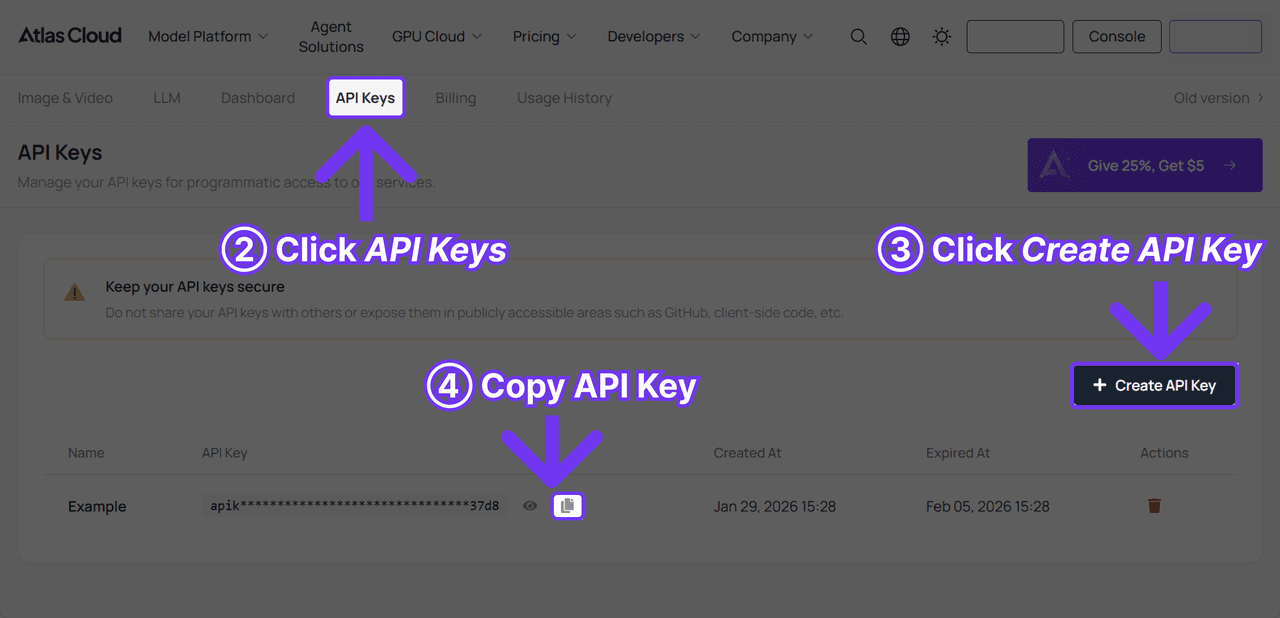
Step 2: Check the API docs for authentication and the shared image endpoint.
Step 3: Send the request. Face swap goes through the platform's shared generateImage endpoint, with the model string doing the routing:
plaintext1curl -X POST https://api.atlascloud.ai/api/v1/model/generateImage \ 2 -H "Authorization: Bearer $ATLASCLOUD_API_KEY" \ 3 -H "Content-Type: application/json" \ 4 -d '{ 5 "model": "atlascloud/face-swap-image", 6 "image": "https://your-cdn.com/source-face.jpg", 7 "Image": "https://your-cdn.com/target-photo.jpg", 8 "output_format": "jpeg", 9 "size": "auto" 10 }'
Watch the capitalisation in that payload. Lowercase image is the source face, capitalised Image is the target photo, and swapping them reverses your inputs exactly the way filling Pixlr's two slots backwards does. Pixlr at least gives you a button to undo that mistake.
Generation is asynchronous, so the response carries a prediction ID you poll until the status flips to completed:
plaintext1curl https://api.atlascloud.ai/api/v1/model/prediction/<prediction_id> \ 2 -H "Authorization: Bearer $ATLASCLOUD_API_KEY"
The finished image arrives as a URL in the outputs array. Video swaps use generateVideo with image for the source face, video for the target clip, and resolution set to 720P or 1080P, so adding footage to working image code is close to a model-string change.
What a Pixlr Face Swap Costs in Credits
Two credits per swap only tells you what a swap costs once you know what a credit costs, and for that you need Pixlr pricing, where four tiers sell into one credit pool shared across Pixlr's AI tools. There is no per-tool credit table anywhere in between; the button label and the pricing page are the two halves you have to multiply yourself.
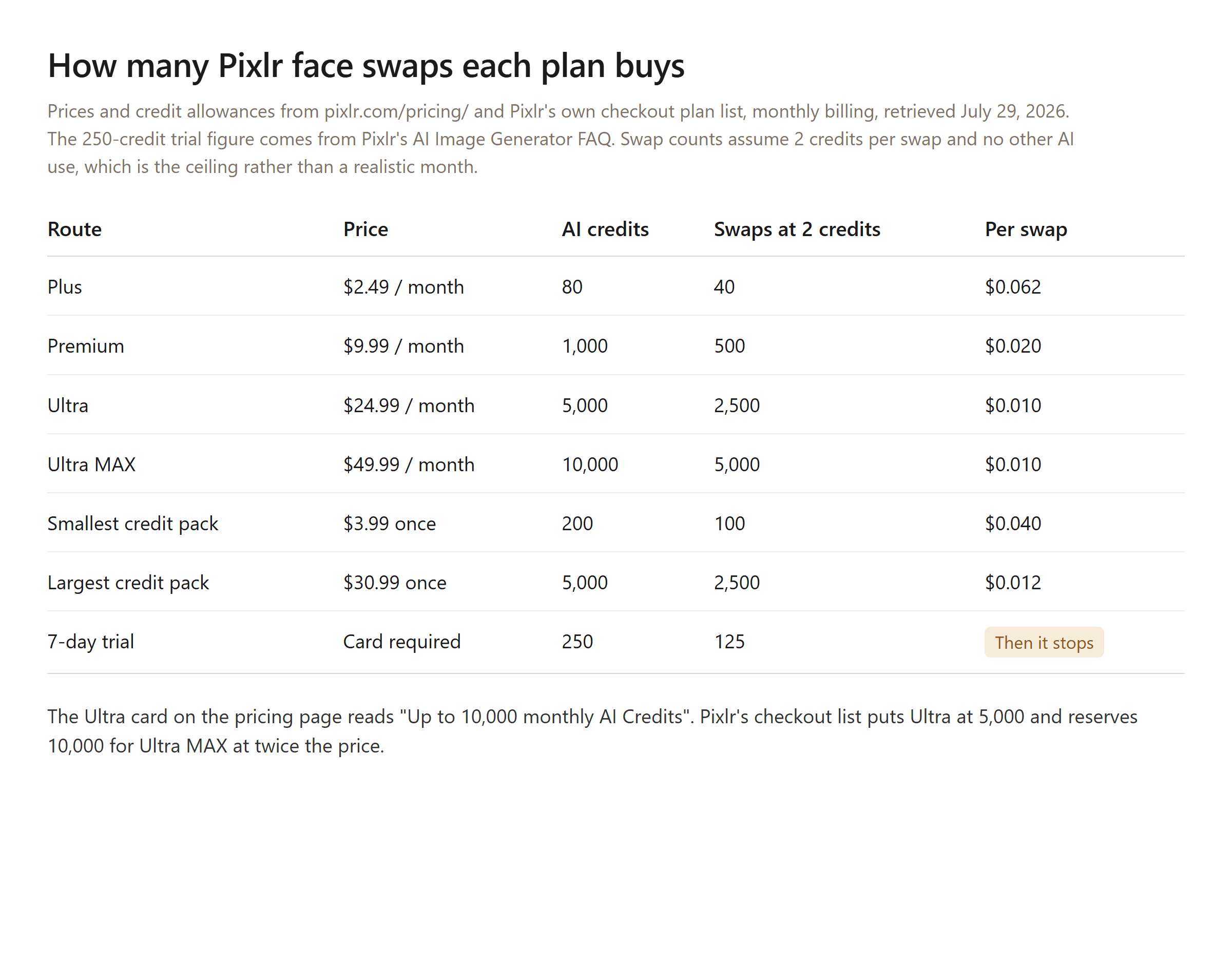
Prices from pixlr.com/pricing/ and Pixlr's checkout plan list, monthly billing, July 29, 2026. Trial figure from Pixlr's AI Image Generator FAQ.
There is no free monthly allowance on that pricing page, and we found no Pixlr page that names one. Third-party reviews fill the silence with numbers of their own: one starts a free account at 10 credits and charges 2 per swap, another starts it at 50 and charges 1. On the per-swap half of that, the button settles it at 2. On the free balance, both are guesses. What Pixlr itself publishes, on its image generator page, is the trial: "During the 7 days free trial period, new users get 250 free AI credits." At the swap threshold that is 125 swaps, if the trial goes on nothing else, and it wants a card up front.
Two more wrinkles in the credit ledger. The Ultra card advertises "Up to 10,000 monthly AI Credits" while Pixlr's own checkout list puts Ultra at 5,000 and Ultra MAX at 10,000, which makes the Ultra card's number a description of the tier above it. And the pricing FAQ says credits bought as a pack "will never expires" [sic], while the terms of use give purchased credits "a period of one (1) year from the date of purchase." Plan credits are unambiguous by comparison: they reset at renewal, they do not roll over, cancelling zeroes them, and payments are non-refundable. If you hold both kinds, the same FAQ says subscription credits are spent first and pack credits only start draining once those run out.
Pixlr Face Swap Limits That Never Reach the Page
The tool page states no file size cap, no resolution figure, and no format list. The client script it loads answers all three, and one answer will matter to anyone doing print or retouch work.
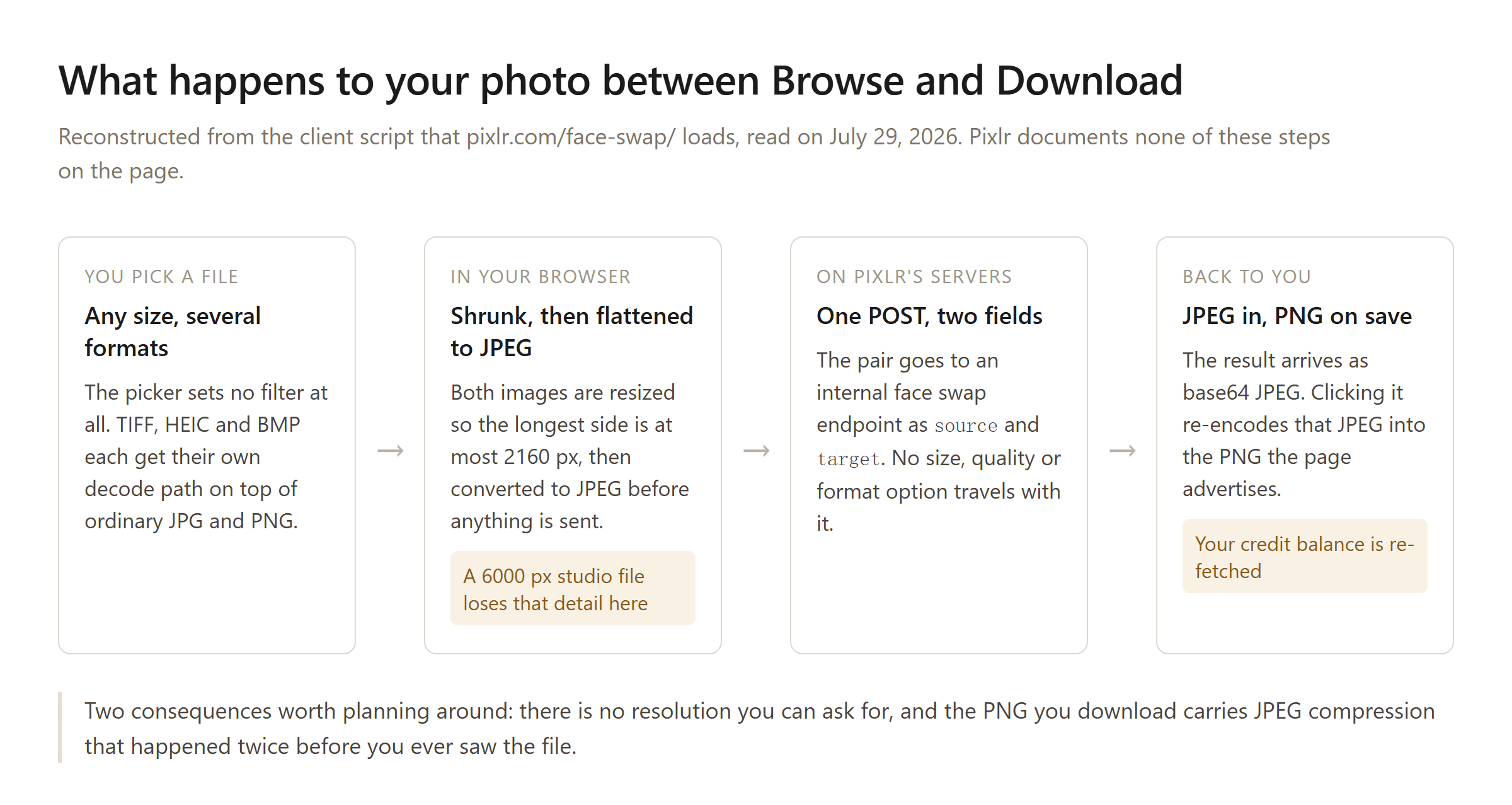
Reconstructed from the client script pixlr.com/face-swap/ loads, read July 29, 2026.
So the PNG you download is a PNG wrapper around a JPEG, made from JPEG inputs. For a meme that is irrelevant. For a headshot going into a print layout, or a swap you plan to retouch afterwards, the 2160 px ceiling and the double JPEG pass are the two facts you would want to have known first.
The rest of the ceiling list is short. One face per run, since the form takes exactly one source and one target with no multi-face control anywhere. No output size or format choice, because none is sent with the request. And no public API. The page posts to an internal endpoint on pixlr.com, while Pixlr's published developer SDK covers embedding its editor and moving files in and out of it, with no AI route documented at all. Batching means driving a browser.
One more detail from the same script, offered with a hedge. Errors from the swap are caught and re-thrown with a third-party provider's name stripped off the front, which reads like the swap runs on an external inference service rather than a model Pixlr trained. Pixlr does not say either way on the page.
Consent, Mature Content, and the Licence You Accept
Face swapping puts a real person's face somewhere they never were, so the paperwork matters more here than it does for a background remover. Pixlr's paperwork on the subject is thinner than its FAQ suggests.
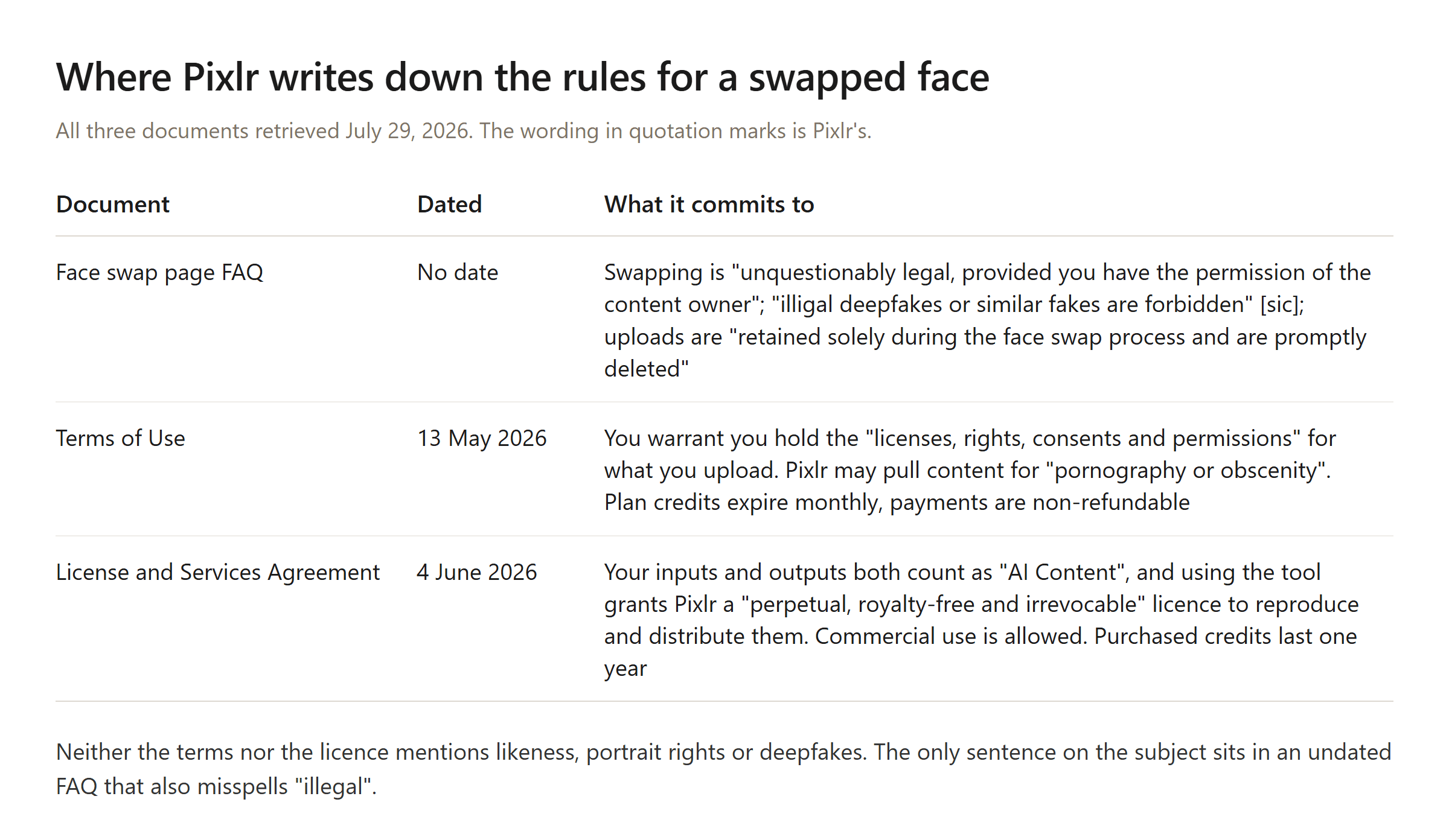
All three retrieved July 29, 2026; quoted wording is Pixlr's.
The FAQ line most people will read is reassuring and slightly odd: swapping is "unquestionably legal, provided you have the permission of the content owner," and "illigal deepfakes or similar fakes are forbidden" [sic]. Content owner is a copyright concept. The person whose face you are moving may not own the photo, and Pixlr's licence agreement does not mention likeness, portrait rights, or consent from a depicted person anywhere. The nearest thing is a warranty in the terms of use that you hold the "licenses, rights, consents and permissions" for whatever you upload, which pushes the whole question onto you.
Then there is what you hand over by clicking Run. The licence agreement classes your uploads and your results together as "AI Content" and takes a "non-exclusive, sublicensable, worldwide, perpetual, royalty-free and irrevocable" right to reproduce, display, and distribute both, surviving termination. The face swap FAQ, on the same site, says uploaded photos and facial features are "retained solely during the face swap process and are promptly deleted." Both statements can be technically true at once, since a licence over something is not the same as storing it. Read together they are still a strange pair to put in front of someone about to upload their face.
Enforcement leaves fingerprints in the client code too. One error path opens an upgrade prompt when the server refuses a swap and mentions an Ultra subscription, which lines up with Ultra being the cheapest tier whose feature list includes mature content, and the same code flags mature-content restrictions by country. A separate path passes through a server message about sexual depictions of minors verbatim, which indicates a server-side block rather than a client warning. Atlas Cloud's face swap page asks for the same thing in plainer language: upload only what you have the right to use, get consent from the people depicted, and do not make misleading content.
None of this is legal advice, and the rules differ by country. Both vendors point the same direction anyway: swap faces you have permission to swap.
Frequently Asked Questions
Is Pixlr's face swap actually free?
Opening the tool and loading two photos into it costs nothing. Completing the swap needs a balance of at least 2 AI credits, and the cheapest ways to hold any are the $2.49 Plus plan, a $3.99 credit pack, or the 7-day trial. No free monthly allowance for the tool appears on a Pixlr page we could find.
How many credits does one Pixlr face swap use?
Two. Signed in, the button spells it out as "Run Face Swap (2c)", and the tool's code refuses to start a job when the balance is below 2. That figure appears nowhere in Pixlr's marketing copy or pricing table, only on the button. At 2 credits, the Plus plan's 80 monthly credits cover about 40 swaps and Premium's 1,000 cover about 500.
Do you need an account to use Pixlr face swap?
Yes, for the swap itself. Both uploads and the preview work while signed out, and the block lands at the Run button. Pixlr also sets 16 as its minimum age for the service, with younger users required to be supervised by an adult.
Can Pixlr swap a face in a video?
No. The tool takes still images, and the client converts both uploads to JPEG before sending them. Pixlr's FAQ text mentions photos and videos together, which appears to be generic copy rather than a description of this tool. For footage, Atlas Cloud's video face swap endpoint takes clips of two to ten seconds at 720P or 1080P, listed from $0.2 per second.
Does Pixlr have a face swap API?
Not a documented one. The page posts to an internal endpoint on pixlr.com, and Pixlr's published SDK is about embedding its editor rather than calling its AI tools. For a scripted swap, Atlas Cloud's endpoint takes a source face and a target image through a standard REST call at $0.096 per run and returns a URL you can poll for.
Can Pixlr swap two faces in a group photo?
The form gives you one source slot and one target slot, with no control for a second face and no stated cap either way. Treat it as one face per run and test a group shot before you rely on it.
Why does a Pixlr swap look softer than the photo you uploaded?
Because the file that reaches Pixlr's servers is not the file you chose. Anything longer than 2160 px on its long edge is downscaled in your browser first, and the JPEG conversions on either side of the swap cost a little more. Neither step is adjustable, so the fix is to start from a photo that is already close to 2160 px rather than a large one.
Conclusion
For a meme, a party invite, or a quick look at whether your face works on a Renaissance portrait, Pixlr is a fine place to start. The widget is uncluttered, the swap direction is fixable with one click, and nothing about the interface makes you read documentation.
The trouble is that every number you would use to plan around it sits somewhere else. The cost of a swap is printed on the button and nowhere in the copy, what a credit costs is on the pricing page, the resolution ceiling is in the client script, and the licence you grant over your own face is in a separate agreement dated three weeks after the terms of use. None of that is a dealbreaker for one swap. It gets expensive in time once swapping stops being a one-off.
The shape of the work decides this more than the headline price does. If you already hold credits and swap a few dozen faces a month, Pixlr's rate undercuts the metered one comfortably. If the work arrives in bursts, needs an exact output size, has to run inside a script, or involves video, a published per-run price with an endpoint behind it is what survives contact with a deadline.