What are the most innovative use cases for AI video APIs? They go way beyond simple filters or deepfakes. AI video APIs act as programmable infrastructure that powers real business results. The best applications include programmatic ad generation, dynamic sales avatars, real estate virtual staging, e-learning localization, automated VOD clipping, synthetic training data, and dynamic in-game billboards. You can embed them into practically any workflow at scale.
The creative AI video API we are going to look at below are already being built by forward-thinking companies behind the scenes. Most people just haven't connected the dots yet on how these pieces fit together. Whether you are leveraging AI video for business to streamline operations or scale your reach, the potential is massive.
What Are AI Video APIs?
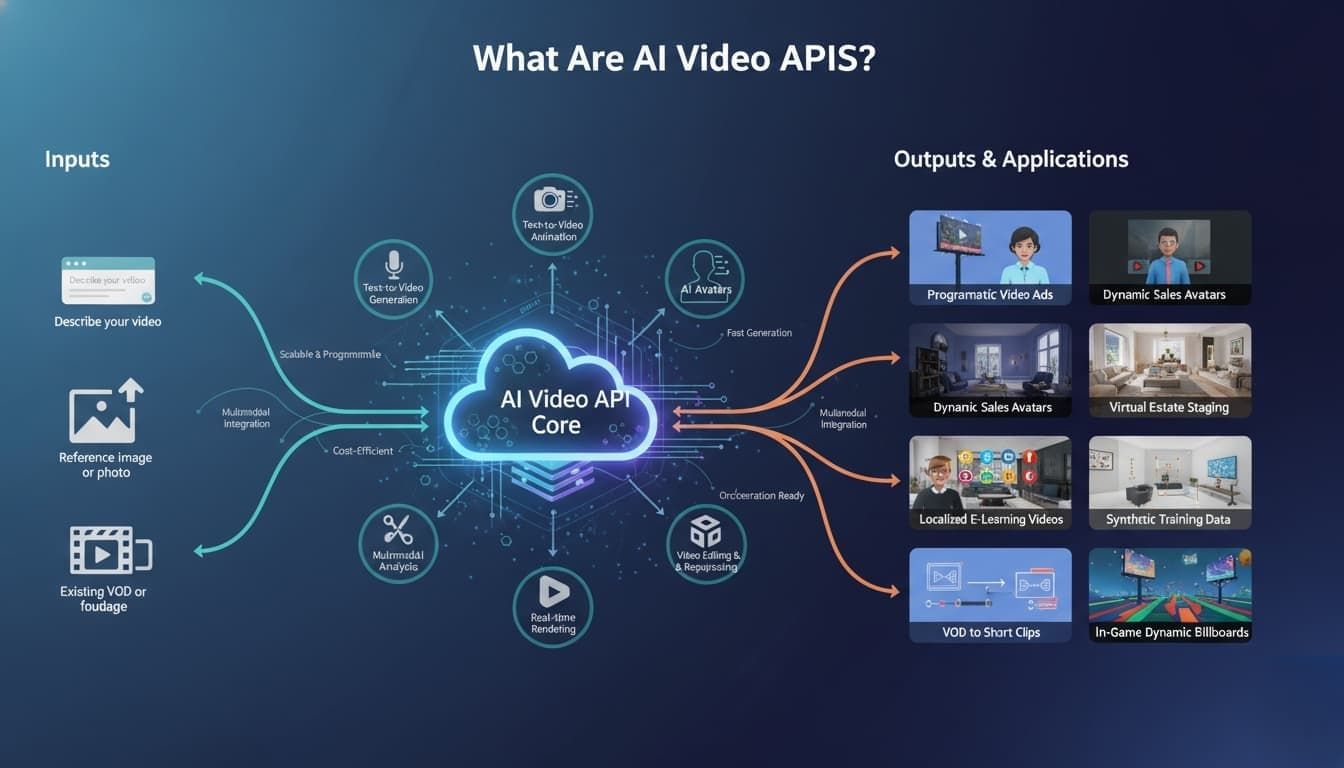
- Simple Definition: AI video API is a raw, programmable engine. Instead of a human clicking buttons in a software interface, developers write code to send data (like text prompts or images) to a server. The server then automatically generates and returns a video.
- Conceptual Distinctions: people confuse these AI APIs with generative AI all the time. Generative AI is great if you just want to generate one quick clip manually. But an API? It runs quietly in the background, allowing you to generate 10,000 personalized videos without ever lifting a finger.
- What an aggregator API: No single AI vendor does everything perfectly. One model might be incredible at lip-syncing, while another is vastly superior at generating realistic backgrounds. An aggregator API bundles multiple specialized models into one single connection. If you're building complex AI video API use cases, managing a dozen different vendor accounts is just a nightmare. Aggregators solve that mess by letting you switch models effortlessly.
| Category | What It Does | AI Capability Level | Typical Input | Output | When to Use |
| AI Video APIs | Programmatically generate, edit, or analyze videos using AI models | High (generation + understanding) | Code, API calls, JSON, Text/Images | Raw video files (MP4) | Building automated workflows or custom apps at scale. |
| AI Model Aggregation APIs | Provides unified access to multiple AI models | Very High (multi-model orchestration) | Unified API calls | Video outputs from different providers | When you want flexibility, redundancy, and model choice without vendor lock-in |
| Video Editing Software | Manual or semi-automated video creation tools | Medium (some AI features) | Existing raw footage | Polished, edited videos | Final human-driven touch-ups or traditional video production. |
| Generative AI Video | Generate video from prompts | High | Typed text prompts, uploaded images | Downloadable video clips | Brainstorming, one-off marketing clips, or personal use. |
While consumer tools are for manual creation, AI video APIs are for automated, large-scale production. Aggregator APIs like Atlas Cloud take this a step further by combining the best models into one seamless integration.
7 Innovative and High-Impact AI Video API Use Cases
You’ll see AI video starting to quietly run the backend of major industries. They aren't just cool experiments anymore. They are essential tools fixing massive operational headaches. Let’s break down seven specific ways creative AI video applications are being used right now.
Innovative AI Video API Use Cases Comparison Table
| Use Case Name | Primary Goal | Key Features Required | Implementation Complexity | Real-Time Capability | Business Impact | Best For |
| Programmatic Video Ad Generation | Beat ad fatigue | Stitching, dynamic text, object detection | Medium | Near Real-Time | Lower Customer Acquisition Cost (CAC) | E-commerce, Agencies |
| Dynamic AI Avatars for Sales Outreach | Scale personalized outreach | Facial analysis, lip-sync, voice cloning | Low to Medium | Real-Time triggers | Higher open/reply rates | B2B Sales, Recruiting |
| Automated Real Estate Virtual Staging | Sell properties faster | Spatial mapping, depth estimation, inpainting | High | Offline / Minutes | Faster sales cycles | Real Estate, Brokers |
| Zero-Touch E-Learning Localization | Global audience reach | Speech recognition, translation, lip-sync | High | Offline / Hours | Increased global revenue | EdTech, HR Training |
| Auto-Conversion of VOD to Short Clips | Boost social engagement | Semantic analysis, facial tracking, auto-crop | Medium | Near Real-Time | Viral growth, traffic | Media, Podcasters |
| Synthetic Training Data Generation | Train machine learning | Generative modeling, physics rendering | Very High | Offline / Bulk | Safer, smarter robots | Auto, Robotics |
| Dynamic In-Game Video Billboards | Monetize virtual spaces | Texture mapping, low-latency streaming | High | Real-Time | New ad revenue streams | Gaming, Metaverse |
Programmatic Video Ad Generation
- The problem it solves: Manually creating dozens of variations for an ad campaign takes weeks, and the creative burns out fast. You need fresh content constantly to keep conversion rates high.
- How the API makes it happen: Developers use object detection, dynamic text overlays, and multi-source stitching. The API basically takes a core product video and programmatically swaps out the background, the call-to-action text, or the product color on the fly.
- Real industry context: Big e-commerce brands and digital marketing agencies use this daily. For example, platforms running Meta Advantage+ campaigns desperately need bulk creative variations to feed the algorithm.
- Why API access matters: You simply can't do this with consumer tools. Imagine trying to render 5,000 personalized ad variations by hand in video editing software. With an API, your inventory database automatically triggers the video generation whenever a new product drops.
Dynamic AI Avatars for Sales Outreach
- The problem it solves: Cold emails are basically dead. People want personalization, but a sales rep simply cannot physically record 200 custom greeting videos every single day without burning out.
- How the API makes it happen: It leans heavily on facial analysis, audio-to-video lip-syncing, and sometimes voice cloning. You feed it a text script, and the API generates a video of a photorealistic human speaking those exact words perfectly.
- Real industry context: B2B SaaS sales teams and recruitment agencies are eating this up. When a new lead signs up, it triggers a workflow. The teams integrate these APIs directly into CRM platforms to boost reply rates.
- Why API access matters: This relies on real-time triggers. A consumer app requires a human to type the script and wait. An API connects to your CRM. The moment a prospect opens an email, the API generates and sends the personalized video messaging instantly.
Automated Real Estate Virtual Staging
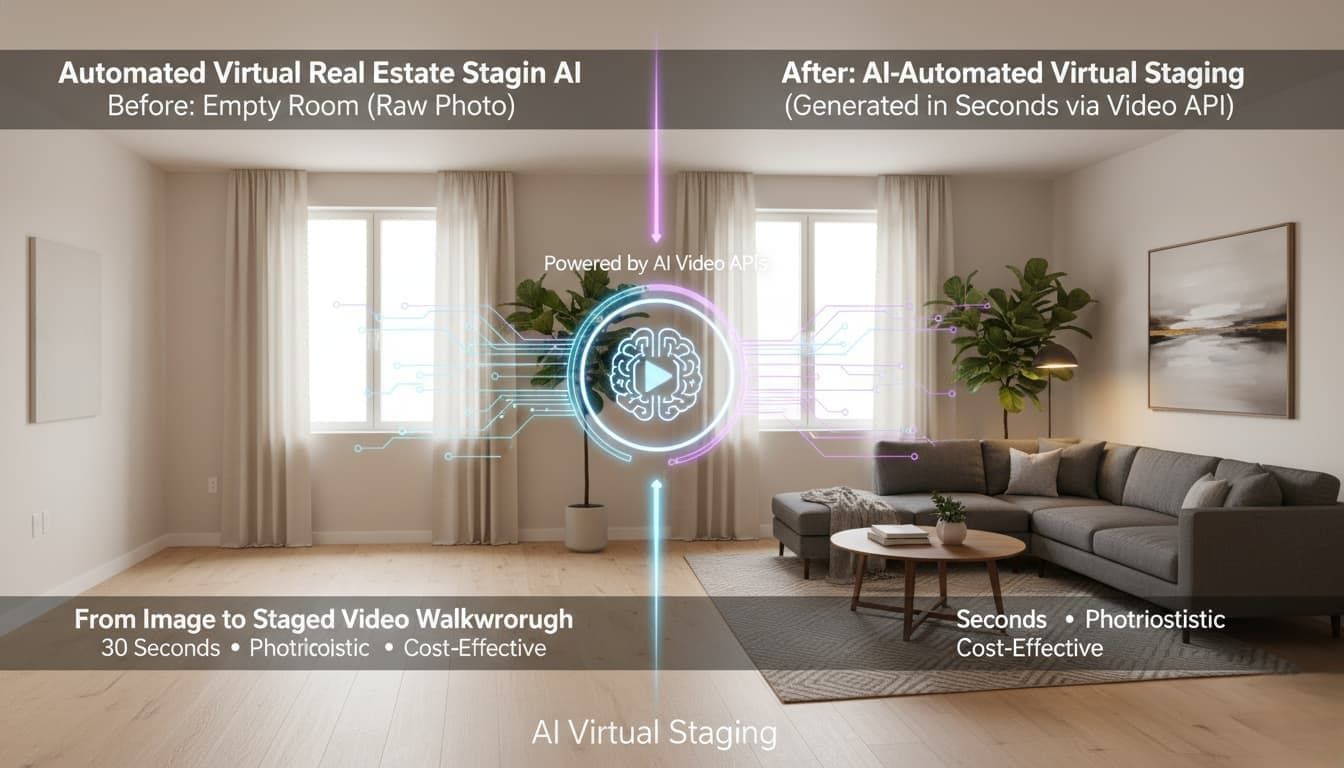
- The problem it solves: Empty houses sell much slower. But physically renting furniture to stage a room is super expensive. Traditional 3D rendering? It's slow and costs hundreds of dollars per room.
- How the API makes it happen: This requires spatial mapping, depth estimation, and generative inpainting. The API analyzes a pan-and-scan video of an empty room, understands the physical space, and realistically inserts 3D furniture into the video.
- Real industry context: Large property portals like Zillow and aggressive local brokerages need this. They handle thousands of listings a day.
- Why API access matters: Scale is the bottleneck here. A real estate agent uploads a raw smartphone video of an empty house to a portal. Behind the scenes, the API instantly processes the file and spits out a fully staged video tour in minutes. No manual video editing software is required.
Zero-Touch E-Learning Localization
- The problem it solves: Translating a 10-hour video course into five different languages is a nightmare. You usually have to hire voice actors, book studios, and spend months editing. It's just too slow.
- How the API makes it happen: The workflow combines speech recognition, machine translation, voice cloning, and audio-to-face mapping. It translates the audio, generates new voiceover in the target language, and then alters the speaker's lips to match the new audio.
- Real industry context: EdTech platforms like Coursera or enterprise HR departments use this to push global compliance training. If you want to expand into Japan, your videos need to speak Japanese.
- Why API access matters: An educational platform might host thousands of hours of video. When they update a course module, the API automatically grabs the new file, translates it into ten languages, and updates the streaming servers automatically.
Auto-Conversion of VOD to Short Clips
- The problem it solves: Podcasts and webinars are way too long for social media. Finding that perfect 30-second "viral moment" manually takes hours of scrubbing through footage.
- How the API makes it happen: It uses semantic text analysis to find the most engaging conversation spikes. Then, it uses facial tracking to auto-crop the speaker for mobile screens and adds dynamic, animated captions.
- Real industry context: Media publishers, sports broadcasters, and podcasters desperately need this. You see this everywhere on TikTok and YouTube Shorts.
- Why API access matters: Broadcasters need speed. Imagine a live sports event. The moment a player scores, the API grabs the stream, crops it, captions it, and pushes it to social media before the game even ends. Consumer tools just can't move that fast.
Synthetic Training Data Generation
- The problem it solves: Training computer vision systems or robots requires millions of edge-case videos. Try safely filming a dog running in front of a car in a rainstorm... it’s nearly impossible and highly dangerous.
- How the API makes it happen: This relies on generative world modeling and physics-based rendering. The API generates photorealistic, mathematically accurate video sequences from scratch based on text or parameter inputs.
- Real industry context: Autonomous driving companies like Waymo or warehouse robotics startups need this. They train their AI models on these fake videos so the robots don't crash in the real world.
- Why API access matters: You need massive, programmatic variation. A developer can write a script that tells the API to generate 50,000 videos of a street corner, changing the weather, lighting, and pedestrian traffic slightly in every single clip.
Dynamic In-Game Video Billboards
- The problem it solves: Video game environments are usually totally static. Brands want to advertise inside popular games, but updating game files for a temporary video ad disrupts the players.
- How the API makes it happen: This involves real-time video generation, texture mapping, and latency-optimized streaming. The API generates or adapts a video clip and streams it directly onto a 3D surface inside the game engine.
- Real industry context: Open-world games, esports arenas, and platforms like Roblox use this. Brands can finally run dynamic, targeted video campaigns inside virtual worlds.
- Why API access matters: It happens at runtime. If I walk past a digital billboard in a game, the API checks my location and player profile. It then instantly generates and displays a localized video ad right on the virtual wall. It is fully automated.
These use cases show that AI video for business is far past the gimmick stage. From selling houses to training self-driving cars, API access lets companies build invisible, high-volume video factories that run entirely in the background.
Common Threads Across Use Cases
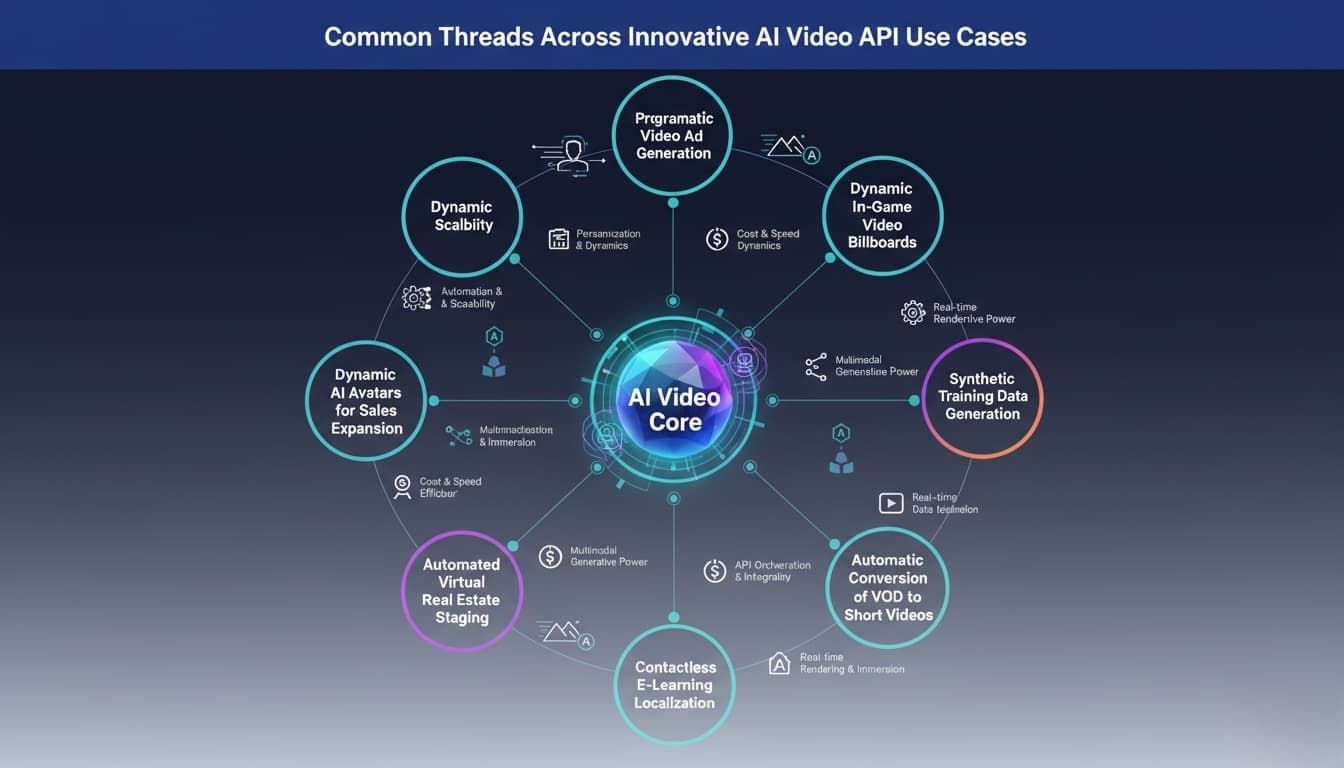
- Summary of common points: If you look closely at all these creative AI video applications, there is one glaring similarity. None of them rely on just one magic AI model. Real-world workflows are usually a bit messy. They involve multi-step AI processes, not single-model tasks.
- Industry Case Studies: This is exactly why AI model aggregator APIs are becoming so crucial. Frankly, no single vendor does all of this perfectly. Composing your workflow across specialized models—mixing the best lip-syncing tech with the best background generator—is the real competitive advantage. I've noticed marketing agencies and global e-learning platforms increasingly rely on aggregators. They need to scale things like personalized video messaging without juggling a dozen different vendor contracts.
A mid-sized fintech migrated video OCR and speech models to a unified aggregation API, achieving an 80% reduction in monthly AI bills (from 100kto100k to 100kto20k). An e-commerce player scaled from 1,000 to 10,000 daily interactions without proportional cost increases by routing across models dynamically.
- Deployment details: Single unified endpoint with model switch, failover, and volume-based optimization replaced direct multi-vendor integrations.
- Results: Rapid ROI (payback in 1–3 months) and resilience against provider issues.
- Why notable: Illustrates cost and reliability benefits of aggregation in production environments involving video-related models (OCR, speech-to-text in video contexts).
- Industry Transformation: We are watching a massive industry shift right now. AI video APIs are moving away from being just neat "features." They are becoming core infrastructure. AI video for business is basically the new foundational plumbing for content creation.
Core AI Video API Workflow (Applicable to All Use Cases)
| Step | Stage | AI Type |
| 1.Input | Pre-production | NLP (Text analysis), Computer Vision (Image/Video mapping) |
| 2.Generation | Core Generation | Text-to-Video models, Generative AI engines |
| 3.Asset Creation | Component Build | Voice cloning, 3D asset generation, Audio synthesis |
| 4.Editing | Assembly | Multi-source stitching, Semantic auto-cropping |
| 5.Personalization | Targeted Tweaks | Dynamic avatars, Variable data text overlays |
| 6.Localization | Global Reach | Machine translation, Audio-to-video lip-syncing |
| 7.Delivery | Final Delivery | Format optimization, API endpoint streaming |
Building complex AI video API use cases requires stringing multiple specialized models together. Aggregator platforms make this multi-step workflow manageable, turning AI video into reliable business infrastructure.
How to Take Action
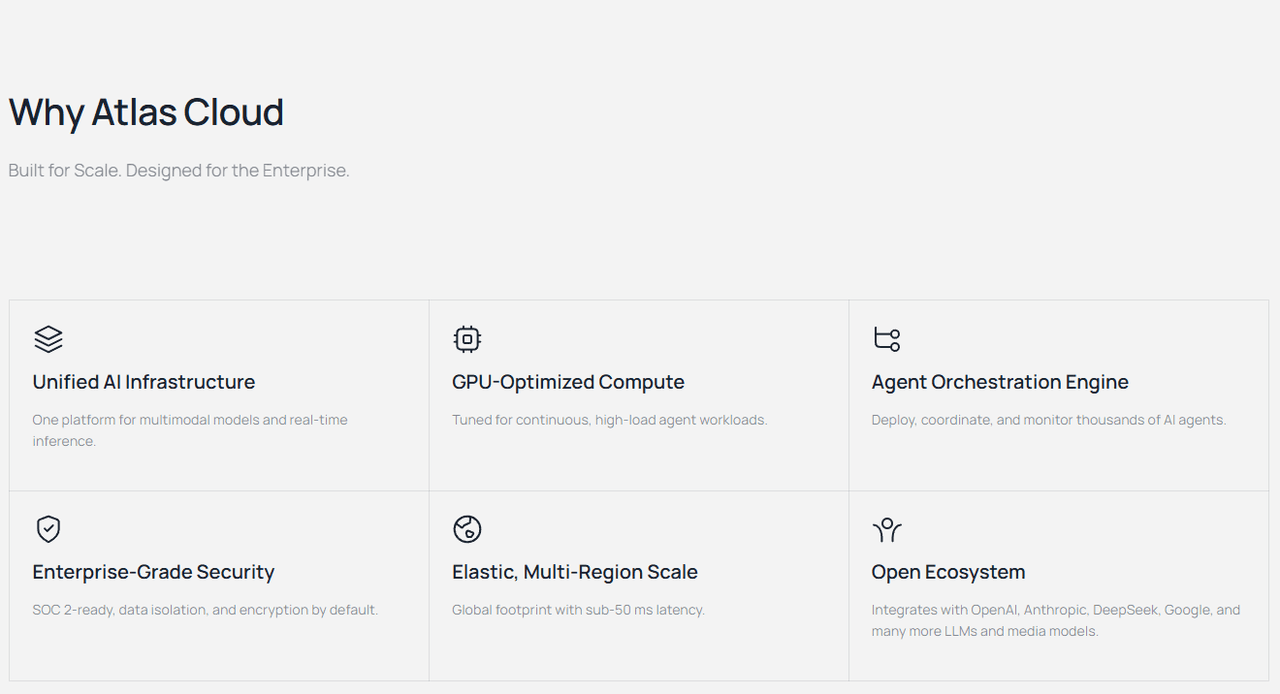
You just need to get straight to action. Whether you're a solo developer, a product owner, or an enterprise buyer, I highly recommend choosing an aggregator API platform.
Because an aggregator gives you unified API access. You get multiple model options right under one roof. It ensures global availability and seriously reduces your integration overhead. You really don't want to waste weeks reading ten different API docs just to send personalized video messaging to your users.
It’s time to move AI video for business out of the brainstorming phase and into your actual product. Ready to test these AI video API use cases yourself? Try the API, view our docs to see the code, or contact us directly to set up enterprise access.
How to Use AI Video APIs: Recommendation Table
| User Type / Goal | Recommended Starting Point | What to Do First | AI Video API Needs | Common Pitfalls | Next Step |
| Beginner / Explorer | Try simple video generation | Use text-to-video API with sample prompt | Generative AI, basic video API | Overcomplicating workflow too early | Move to personalization |
| Developer building MVP | Build a single use case (e.g., summaries) | Integrate one AI Video API endpoint | Video understanding + NLP | Trying to integrate multiple models at once | Expand to multi-step workflow |
| Product team | Validate business use case | Choose 1–2 high-impact use cases (e.g., personalization) | Generative + personalization AI | Ignoring cost/performance tradeoffs | Scale to automation pipeline |
| Enterprise team | Build scalable video system | Design full AI video workflow architecture | Multi-model stack (gen + vision + NLP + TTS) | Vendor lock-in, fragmented APIs | Consider aggregation platform |
| AI/Platform engineer | Optimize multi-model pipeline | Evaluate different AI Video APIs per workflow step | Full AI stack (CV, NLP, generative AI) | Managing multiple integrations manually | Adopt unified API layer |
| Startup founder | Focus on fastest ROI use case | Pick high-impact use case (marketing videos) | Generative AI + personalization | Building infrastructure too early | Scale after product-market fit |
Starting is easier than it seems. Identify your role, leverage an aggregator platform to skip the integration headaches, and just start testing code.
FAQ
Q1: How can businesses use AI video APIs to improve customer engagement?
Engagement spikes when things feel personal. Businesses use AI video APIs to automatically send personalized video messaging at scale. Instead of a boring text email, your CRM triggers a unique video greeting for every new lead. This humanizes the brand and grabs attention way better.
Q2: Which industries can benefit the most from AI video APIs?
Pretty much anyone needing massive scale, really. E-commerce uses them for dynamic ads. Real estate agents automate virtual staging. E-learning platforms translate courses globally. I'd say marketing, sales, and education see the fastest ROI with these creative AI video applications. It fixes those huge content bottlenecks.
Q3: Are AI video APIs suitable for developers with limited AI experience?
Yes. You don't need a PhD in machine learning to pull this off. An API Aggregator Platforms offer unified, straightforward endpoints. If you can handle a basic REST API or a webhook, you can easily build robust AI video API use cases. The complex math stays hidden entirely.
Q4: What cost factors should be considered when using AI video APIs?
Costs can be a bit tricky. Usually, you pay per second of generated video or per API call. Watch out for hidden fees tied to server rendering time. When budgeting your AI video for business, always remember to factor in storage costs for those large MP4 files, too.
Q5: How do AI video APIs handle privacy, security, and data compliance?
Reputable enterprise aggregators won't train public models on your private data. They usually offer secure encryption and strict data retention policies.
Q6: What limitations or challenges currently exist when using AI video APIs?
Rendering high-quality video sometimes takes a few minutes, making pure real-time streaming tough. Also, complex prompts can sometimes yield weird visual artifacts. That's exactly why picking an aggregator API matters—you need fallback options when one model glitches out unexpectedly.
AI Video API FAQ Quick Reference Table
| Topic | Core Question | Quick Answer |
| Engagement | How to boost it? | Automate personalized video messaging via CRM triggers. |
| Industries | Who benefits most? | Marketing, e-commerce, real estate, and global e-learning. |
| Skill Level | Hard for devs? | No, basic REST API knowledge is enough for aggregator platforms. |
| Costs | What to budget for? | Video seconds generated, API calls, rendering time, and file storage. |
| Security | Is data safe? | Yes, but always verify zero-retention policies and enterprise compliance. |
| Limitations | What are the flaws? | Latency on heavy renders and occasional visual AI artifacts. |





