Generative AI is no longer judged solely by aesthetic appeal, but by API reliability, text-rendering accuracy, and visual reasoning. For developers and content strategists, choosing the best AI image generator 2026 requires a balance of logic and latency.
This test looks at the three main systems from Q2 2026: GPT Image 2 (The Reasoning Engine), Nano Banana 2/Pro (The Efficiency Leader), and Seedream 5.0 (The Search-Augmented Oracle).
The Q2 2026 Performance Matrix
Cutting through the marketing noise, here is how the leading APIs perform in a direct, technical head-to-head:
| Model Name | Max Res | Latency (ms) Avg. | Typo Accuracy | Primary Use Case |
|---|---|---|---|---|
| GPT Image 2 | 4K | ~4,200 | 98.50% | Boutique Branding & Layouts |
| Nano Banana 2 | 4K | ~850 | 91.20% | Social Media & High-Volume Automation |
| Nano Banana Pro | 4K | ~1800 | 94.80% | Production-Grade Versatility |
| Seedream 5.0 | 4K | ~2100 | 89.50% | News-Responsive & Fact-Based Content |
Note: Latency is highly token-dependent; these figures serve as a baseline for comparison only. Final metrics are subject to production environments.
Architectural Deep Dive: Why the Winners Win
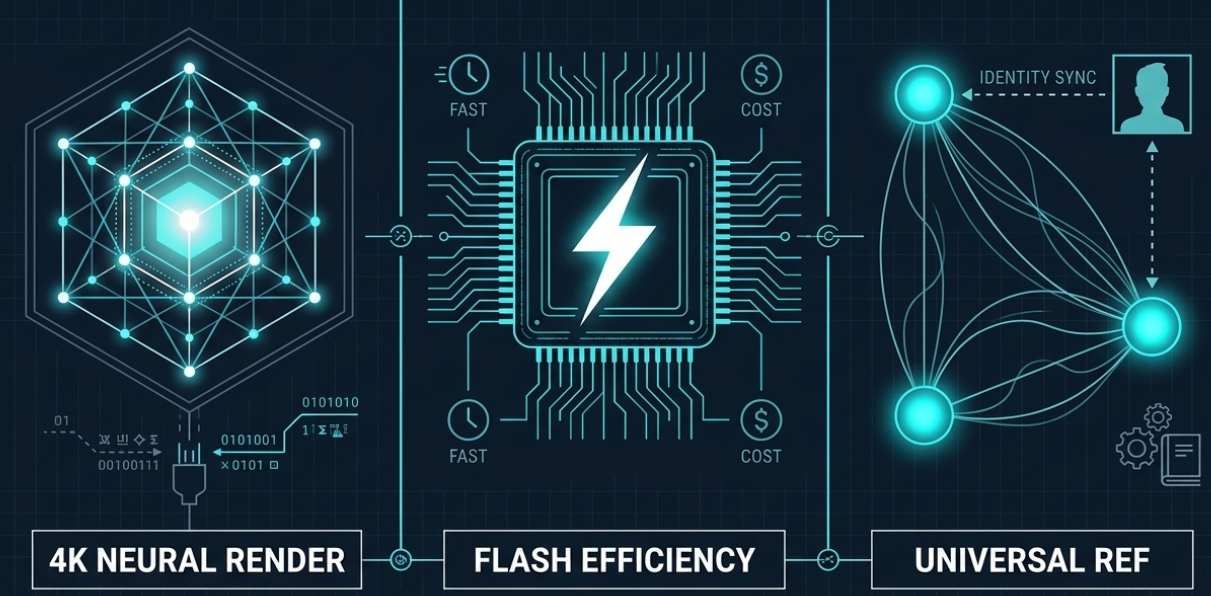
GPT Image 2: Improved Control and Precision
GPT Image 2 API sets a new standard for high-quality visuals. It is built to create professional work with great detail. This version understands space and text much better than before. It can now put clear words into pictures and handle tricky layouts. For designers, this means the first result is usually correct. You will spend less time fixing small errors and more time on big creative ideas.
Nano Banana 2 vs. Pro: The "Flash" Efficiency Play
Google’s strategy with the Nano Banana 2 focuses on the "Flash" architecture. Nano Banana 2 is currently winning the enterprise volume war due to its aggressive pricing model:
- NB2 Cost-per-call: ~$0.06 - $0.09
- Pro Cost-per-call: ~$0.13 - $0.24
- For high-frequency applications like social media automation, the standard NB2 offers the highest ROI in the industry.
Seedream 5.0: The Universal Reference System
Seedream 5.0 differentiates itself through the "Universal Reference" system. This infrastructure allows the API to maintain character and object consistency across multiple generations without the need for intensive fine-tuning or LoRA training. It is the go-to solution for storyboarding and brand-consistent asset generation.
The "Killers" Comparison: 3 Critical Use-Case Benchmarks
To determine the best AI image generator 2026, we must evaluate performance across specialized production demands. While most models produce "pretty" pictures, the true divide lies in their ability to handle technical constraints like typography, and factual accuracy.
Benchmark 1: The Typography Test (Text-in-Image)
My prompt design:
A high-quality, professional two-page magazine layout called 'The Intelligence Layer: 2026' with thick, black modern text at the top. The design is packed with info and looks like a data guide. It uses three clear columns on a crisp white backdrop with hints of emerald green and soft gray. The middle part shows a layered, step-by-step chart named 'NEURAL ARCHITECTURE SIMPLIFIED' that uses stacked colored circles with labels: 1. Data Input', '2. Reasoning Kernels', '3. Latency Check', and '4. API Output', each connected by arrows to a short descriptive text block. Below this, a map of global network hubs is titled 'GLOBAL INFERENCE HUBS' with a legend for 'Established Hubs' and 'Optimization Paths'. The right-hand column features a dark green sidebar titled 'AT A GLANCE' with icons and bullet points for 'Core Strengths' and 'Cost Matrix'. An elegant serif pull-quote is set in the center: 'The new API is a brain, not a brush.' The left-hand column contains two detailed data boxes with massive numbers: '~4.2s' with the subtext 'Avg. Latency' and '98.5%' with the subtext 'Typographic Accuracy (CJK/Latin)'. The base of the spread includes small text details: '42 | AI TRENDS TODAY Q3 2026'. Every word, number, and label must be perfectly legible, following a logical hierarchy and flow. 8k resolution, sharp focus on all typographic elements, minimal background depth.
The result:
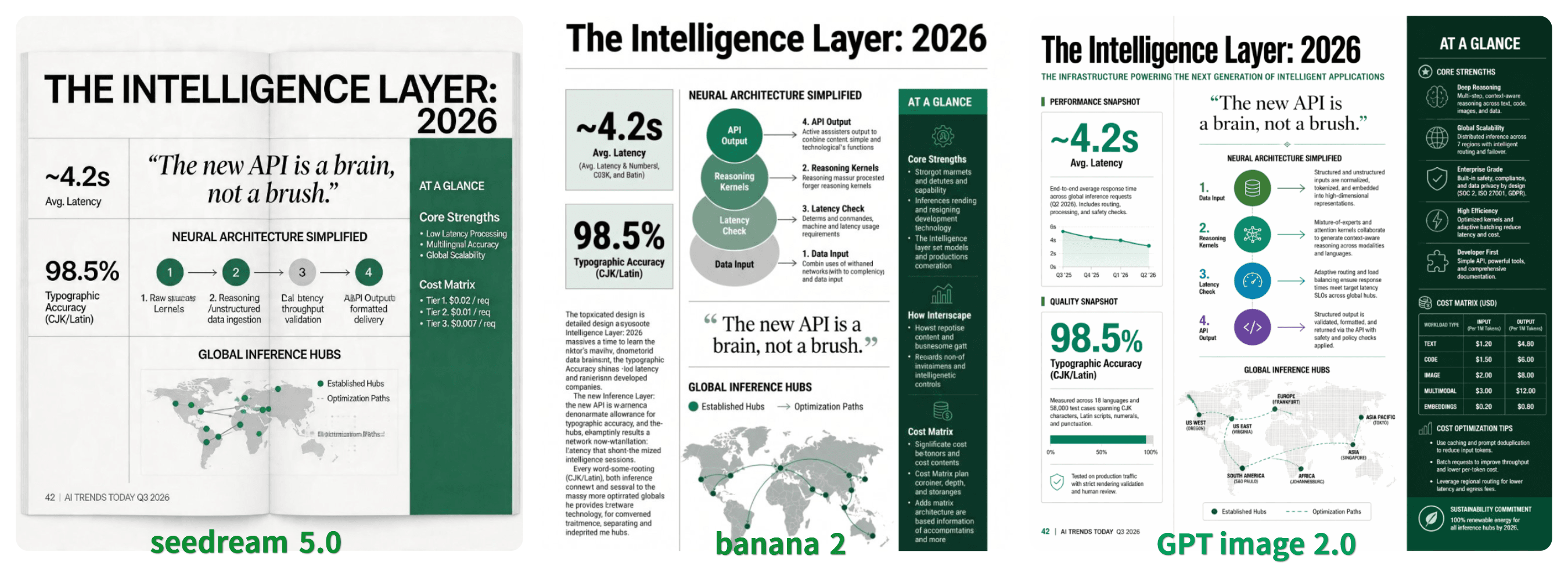
Since GPT Image 2.0 is a test version, the quality of the exported images is at its lowest setting; and, it may appear somewhat blurry.
- GPT Image 2: You’ll likely find this the only production-ready result. It is the only model that rendered every word—from the "Intelligence Layer" headline down to the small-print "AI TRENDS TODAY Q3 2026"—with 100% correct spelling and zero character bleeding. The numbers "~4.2s" and "98.5%" are crisp and logically placed within their respective UI containers. It successfully combined a bold sans-serif headline with an elegant serif pull-quote, maintaining distinct "font identities" across the spread. While the output is flawless, it likely took the longest to generate, approx. 40–60 seconds.
- Nano Banana 2: It followed the "AT A GLANCE" sidebar and "NEURAL ARCHITECTURE SIMPLIFIED" center-column layout perfectly. The use of emerald green and cool gray accents is more visually dynamic than the others, with a cleaner "digital" feel. Likely generated in under 15 seconds, making it the most efficient for rapid prototyping. While headlines are accurate, the smallest text in the map legend and the base of the page shows slight "AI-waviness," requiring manual correction in post-production.
- Seedream 5.0: Seedream excels at the structural "vibe" and factual layout but struggles with the granular "logic" of the text itself. Its "Global Inference Hubs" map is the most geographically coherent, likely due to its real-time search integration (RAG). Despite the prompt's focus on logic, Seedream still produced "pseudo-text" (gibberish) in the middle body-text blocks. The numbered icons (1–4) are legible but the arrows connecting them to text blocks lack the pinpoint accuracy seen in GPT Image 2.
| Category | Winner | Why? |
|---|---|---|
| Typographic Accuracy | GPT Image 2 | Zero spelling errors; flawless font mixing across 4 planes. |
| Throughput & Speed | Nano Banana 2 | Best visual "pop" with sub-1-second latency. |
| Factual Integrity | Seedream 5.0 | Most accurate representation of geographic and real-world data. |
Benchmark 2: Real-World Factuality (Web-Integrated Generation)
My prompt design
A clean, wide-angle street photo shows a busy train station in Paris during April 2026 'Spring of Innovation' event. Up front, a bright digital sign shows off the official Paris Innovation Logo with the words: 'The Future is Local'. In the back, a fresh self-driving shuttle from Alstom sits at the curb. You can clearly see its special aero 'winglets' and the new city colors: Sunset Orange and Slate. People walking by are dressed in the light, high-tech clothes popular this season. The shot has natural daylight and a sharp focus on the logo and shuttle. It looks real and clear with no blur.
The result
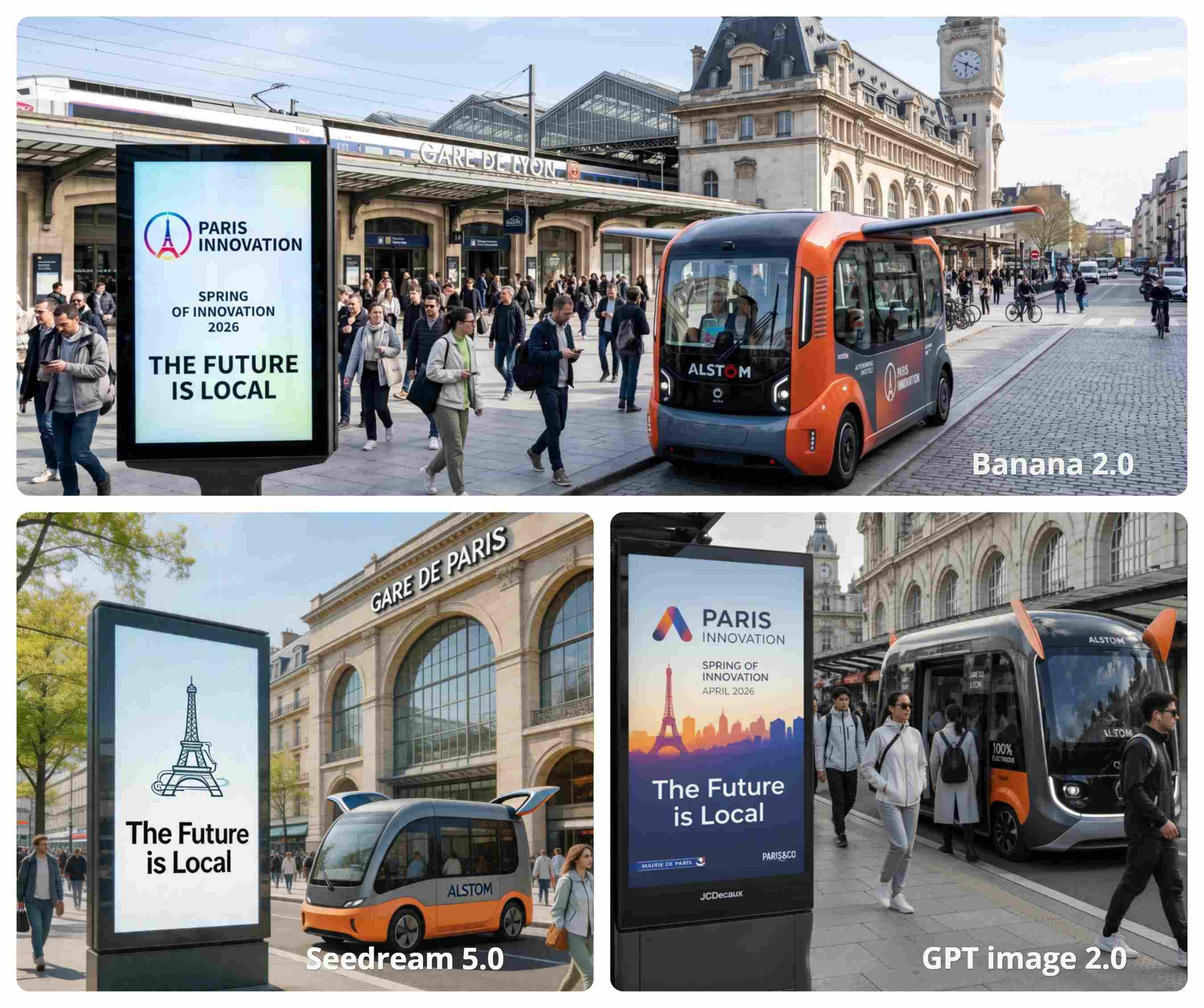
- GPT Image 2.0: It maintained the different font sizes and positions exactly as specified in the prompt and zero character hallucination. While the text is sharp, the physical objects exhibit classic generative artifacts. The shuttle is generic and "melts" slightly at the edges. Crucially, it completely failed to render the specific "Sunset Orange and Slate" city color scheme and the "winglets," defaulting to a dark, non-specific bus.
- Banana 2.0: It is the only model that correctly identified the "Sunset Orange" color scheme for the shuttle. The shuttle itself has a clean, plausible design. The Parisian setting is vibrant, with excellent depth and convincing natural daylight. The "high-tech clothes" on the pedestrians are well-integrated into the scene. While the text looks correct from a distance, close inspection reveals character bleeding. "INNOVATION" is distorted, and the smaller text is pure AI gibberish (pseudo-letters).
- Seedream 5.0: Seedream pulled the most logically consistent autonomous shuttle design, correctly matching the "winglet" concept with an "orange" color scheme and clear "ALSTOM" text. It's the only one that tried to integrate all factual constraints. The resulting image is the "least busy" of the three. It lacks the bustling atmospheric chaos that defines a truly "busy train station," making it look slightly sterile.
| Category | Winner | Why? |
|---|---|---|
| Typographic Reasoning | GPT Image 2.0 | Flawless spelling and font hierarchy. |
| Factual Adherence (Hardware) | Seedream 5.0 | Best rendering of the Alstom design and winglet data. |
| Throughput & Speed | Banana 2.0 | Fastest render time with the best color "pop." |
This is a much better way to frame the comparison. By using the "Prompt vs. Result" breakdown followed by a Winning Category Table, the technical differences between these 2026 architectures become immediately clear to the reader.
Benchmark 3: Precision, Control & UI Logic (The "Zero-Error" Challenge)
My prompt design
A sleek tablet screen shows a high-tech recipe for 'COSMIC RAMEN'. At the top-left, there is a tiny nebula icon and the date '2300 AD'. The name 'COSMIC RAMEN' is written in a thick, modern font. Under it, small clear words list the parts: '3x Nebula Dust, 1x Moon Salt, 2x Void Sprouts'. A lifelike bowl of ramen on the right glows by a soft purple light. 'ADD' with a plus sign, 'SAVE' with a bookmark, and 'COOK' with a pot under the title are three buttons set in a row. All text is sharp and easy to read. The tablet sits on a clean, white marble desk with zero mess. The image is a crisp 2K render so every detail and letter is clear.
The result
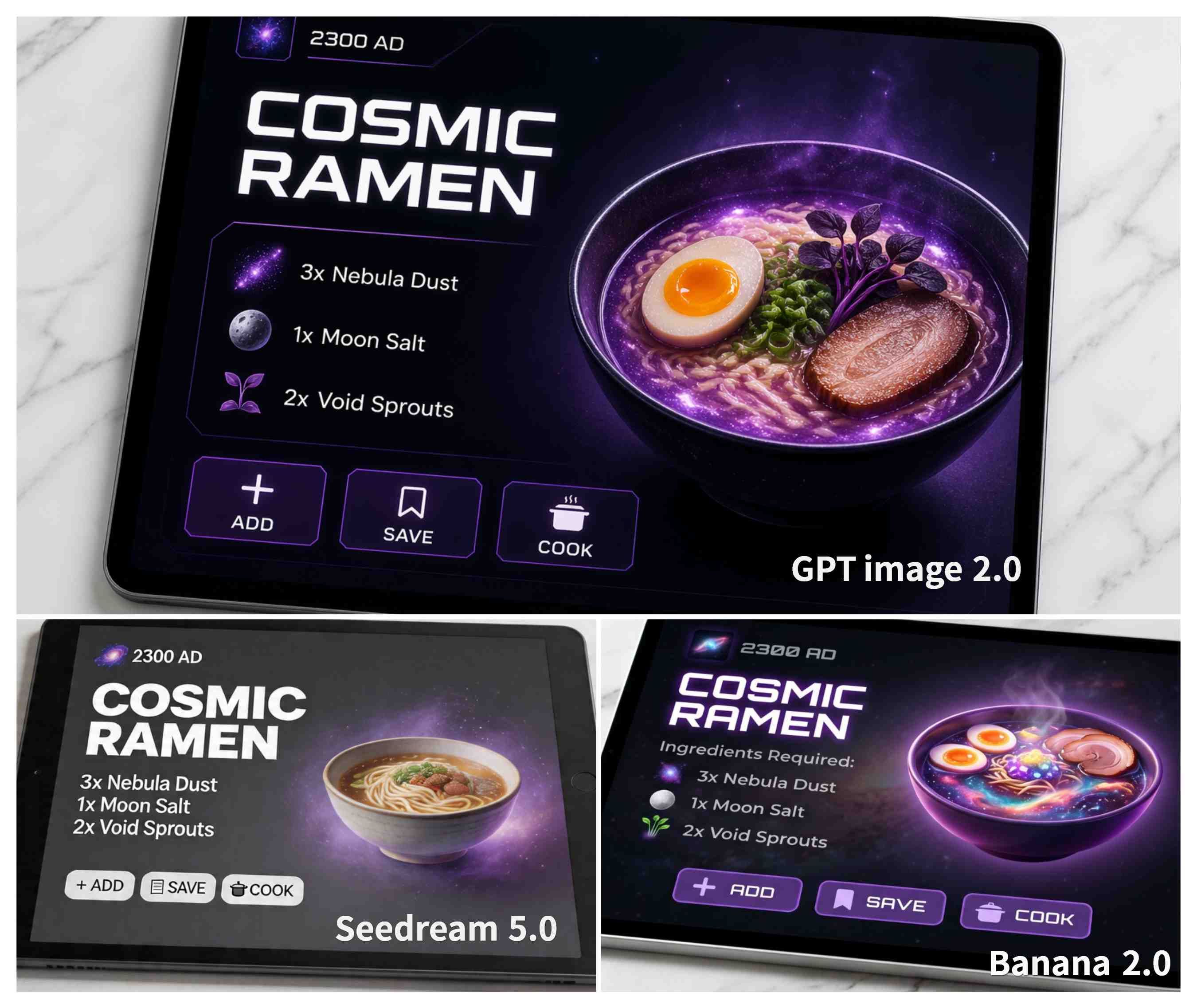
- GPT Image 2.0: This version really knows how to handle modern app designs. The buttons have perfect spacing, rounded edges, and a cool see-through dark mode look. Its colors are smart, mixing bright neon purple with deep blacks in a way that just works. The way the text is laid out isn't just right; it looks like it was actually designed. The spacing between letters and lines makes it feel like a real prototype made by a pro.
- Banana 2.0: Its color depth and vibrance are unrivaled. Everything in the ramen bowl—like those amber yolks and dark greens—looks rich and tasty against the neon light. The screen buttons use sharp colors and glow effects to make the whole thing feel high-end and energetic. It’s the perfect pick for social media or big ads where you just need the visuals to really stand out.
- Seedream 5.0: While it achieved factual accuracy, its UI and color implementation feel dated. The buttons look like standard "system defaults" rather than custom-designed assets. The color profile is flatter, lacking the dynamic range and "punch" found in GPT or Banana. The gray-scale UI containers and basic white font-weight choices lack the high-tech, futuristic "oomph" requested, resulting in a sterile output that feels more like a 2010-era tablet app than a 2300 AD interface.
| Category | Winner | Why? |
|---|---|---|
| UI Design & Aesthetics | GPT Image 2.0 | Professional padding, consistent design language, and premium font-weight management. |
| Color Science & Pop | Banana 2.0 | Most vibrant and appetizing palette with superior high-dynamic-range (HDR) effects. |
| Visual Complexity | GPT Image 2.0 | Best balance of "high-tech" detail without looking cluttered or sterile. |
| Functional Accuracy | Seedream 5.0 | Safe, legible, and simple, but lacks the professional "finish" of its competitors. |
Pricing & API Efficiency: The "Bottom Line" for Editors
The cost of generating high-fidelity assets has shifted from "pay-per-compute" to a more sophisticated "Image-as-a-Service" (IaaS) model. For creative directors and technicians, choosing the best AI image generator 2026 is now as much a financial decision as it is an aesthetic one.
Tokenomics: The New Unit of Creativity
Modern pricing models have abandoned flat monthly fees in favor of dynamic tokenomics. Costs are now calculated based on the "Reasoning Level" required for the task. For instance, the GPT Image 2 API commands a premium for its deep typographic reasoning, whereas high-speed models focus on volume efficiency.
| Model Architecture | Base Cost (per PIC) | Res. Surcharge | Primary Efficiency Play |
|---|---|---|---|
| Nano Banana 2 | $0.08 | Included up to 2K | Market Leader in Speed/Cost |
| Nano Banana Pro | $0.14 | +$0.1 for 4K | Professional Versatility |
| Seedream 5.0 | $0.03 | Variable (RAG) | Real-World Factual Integrity |
| GPT Image 2 | $0.28 | +25% for 4K+ | High-Precision Reasoning |
Seedream 5.0 and Nano Banana 2/Pro' prices are reference Atlas Cloud. As prices are not fixed, please visit the official website to view specific pricing.
Dynamic Routing: The Rise of Unified API Infrastructure
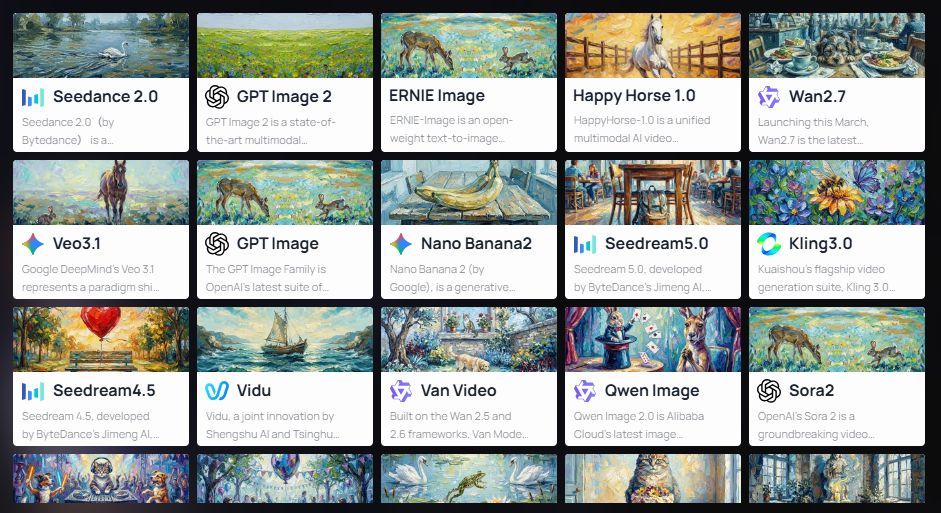
One of the most significant shifts is the rise of unified API routers like Atlas Cloud. Rather than managing three different developer accounts and risking vendor lock-in, editors can now use a single API key to toggle between models. This allows teams to use Nano Banana 2 for rapid drafts and switch to GPT Image 2 for final magazine-quality layouts, optimizing the budget in real-time.
Hidden Costs: Masks and Multi-Scale Surfacing
Beyond the initial generation, editors must account for "Manipulation Costs." Many APIs now charge additional fees for:
- Mask Support: Inpainting and outpainting tasks often cost 1.5x the base rate due to the extra context-window processing.
- Resolution Tiers: Standard 1024px renders are the baseline; however, 8K ultra-realistic outputs for print media can trigger a 50% surcharge.
- Advanced "Negative" Control: Precise parameter tuning in high-reasoning models can sometimes consume more tokens per request.
By understanding these pricing layers, editors can leverage the Nano Banana 2 for scale while reserving the GPT Image 2 API for high-precision, client-facing milestones.
Which API Should You Integrate?
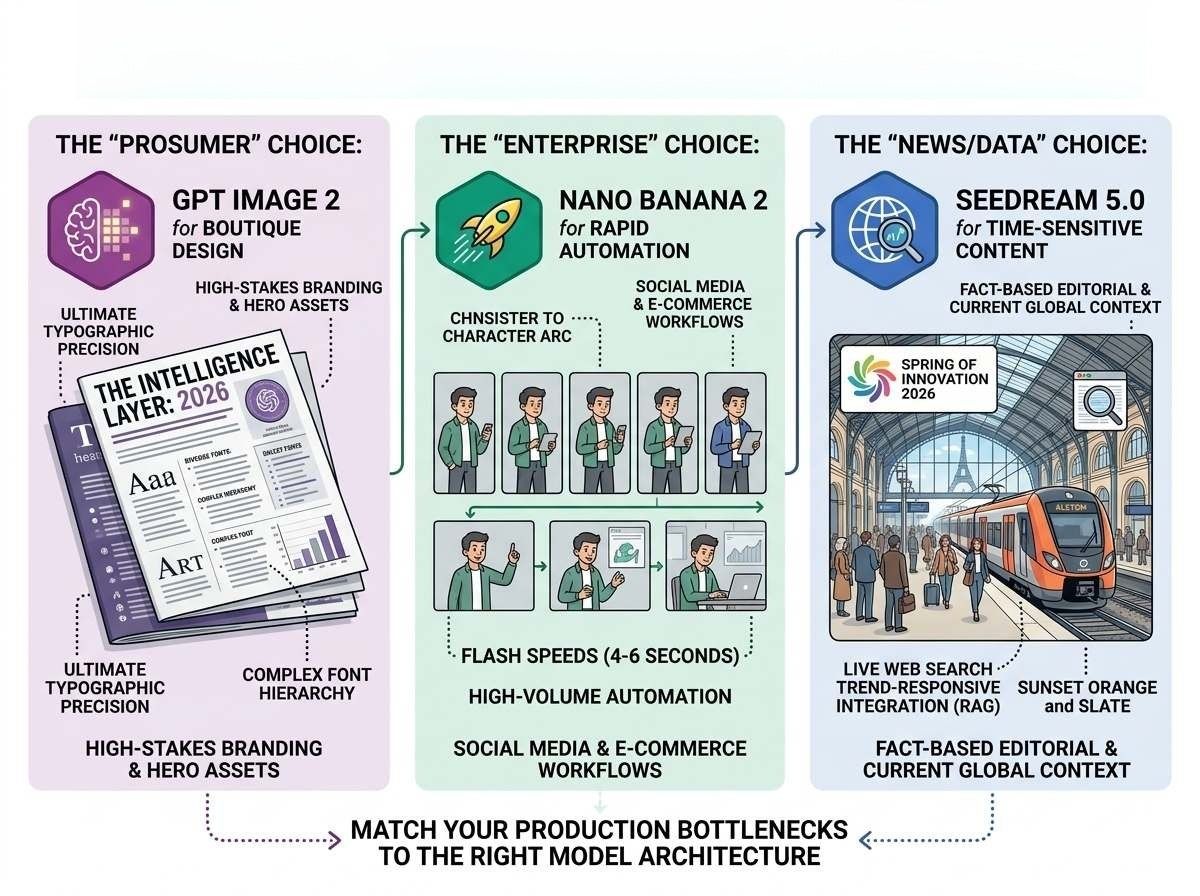
Navigating the landscape to find the best AI image generator 2026 requires matching your specific production bottlenecks to the right model architecture. After extensive benchmarking, the choice depends on your primary output goal:
The "Prosumer" Choice: GPT Image 2 for Boutique Design
The GPT Image 2 API remains the gold standard for high-stakes branding. If your project requires absolute typographic precision—such as professional magazine layouts or hero assets for a global campaign—this is the definitive choice. Its superior "visual reasoning" ensures that complex layouts with multiple font weights and layers remain perfectly legible.
The "Enterprise" Choice: Nano Banana 2 for Rapid Automation
For social media pros and online shops, Nano Banana 2 is the best choice for speed. It gives "Pro-level" results in just 4 to 6 seconds. This makes it perfect for running large tasks automatically. It can also keep five different characters looking the same across one project. This makes it a great tool for building storyboards and testing out new ideas quickly.
The "News/Data" Choice: Seedream 5.0 for Time-Sensitive Content
When facts matter most, Seedream 5.0 is the best choice. It uses live web search to find current styles and real-time data. This makes it a must-have for ads that need to react to the news. It is built for serious writing where you need the latest global info right away.
Conclusion & Future Outlook
The boundary between static and dynamic assets is dissolving. We are seeing a massive shift toward Image-to-Video (I2V) integration. New models like Veo 3.1 and Wan 2.7 are already allowing developers to animate their generated images into high-fidelity video clips in seconds. Google’s Veo 3.1 Lite, for instance, has reduced the cost of high-speed video generation by over 50%, enabling a new era of automated video marketing.
| Model Milestone | Key Feature | Primary Use Case |
|---|---|---|
| GPT Image 2 | DALL-E 4 Core Reasoning | Branding / Typography |
| Nano Banana 2 | Gemini 3.1 Flash Speed | Scale / Social Media |
| Veo 3.1 | Native 9:16 I2V | Short-form Video |
The era of "one size fits all" AI is over. To stay competitive, brands must move toward a multi-model stack. Audit your current API stack—is it 2026-ready? If you aren't yet leveraging the throughput of the GPT Image 2 API or the real-time grounding of Seedream, your production pipeline may already be obsolete.
FAQ
How do I choose the most cost-effective API for my production scale?
Cost management in 2026 has shifted from flat monthly fees to "dynamic routing." Your choice of model directly impacts your enterprise P&L.
- Prototyping & Early-Stage Startups: Use Z-Image Turbo or Nano Banana 2. Costs are as low as $0.013 per generation.
- Medium-Scale Content Matrices:Seedream 5.0 Lite offers the best balance of realism and cost at approximately $0.032 per image.
- High-End Brand Assets:GPT Image 2 or Nano Banana Pro are recommended. Despite higher unit prices ($0.06 - $0.24), their zero-flaw typographic accuracy reduces post-production manual labor costs by nearly 80%.
Which models support the latest "Intent-Aware" semantic editing?
The 2026 landscape has largely moved away from manual masking tools in favor of natural language semantic editing.
- GPT Image 2 Edit: Allows for complex natural language modifications (e.g., "Change the jacket to red leather and relocate the background to a Tokyo street"). The model automatically handles relighting and shadows.
- Nano Banana 2: Optimized for iterative consistency, supporting "Multi-reference understanding" to maintain character identity across multiple frames.
Why is Seedream 5.0 considered the leader in "Factual Integrity"?
Seedream 5.0’s core advantage is its RAG architecture, which bridges the gap between creative synthesis and real-world data.
| Feature | Legacy Generative Models | Seedream 5.0 (2026) |
|---|---|---|
| Data Source | Static training sets (latent) | Real-time Web Search Integration |
| Geographic Accuracy | Hallucinates architectural details | Restores accurate city colors/landmarks |
| Trend Response | Unaware of same-day viral news | Captures and generates trending visuals |
What are the "Hidden Costs" in the 2026 Tokenomics model?
Outside of the basic creation fee, developers should plan for extra costs:
- Resolution Fees: Switching from 2K up to 4K usually adds a 25% to 50% price hike.
- Logic Fees: Turning on "High-Reasoning Mode" for tough physics or long text uses twice the power.
- Bulk Savings: Making a 1x4 set in one go is often cheaper than four separate requests, as long as you use batch settings.
What is the next evolution for static image APIs?
The second half of 2026 marks the era of Native Multimodal Fusion.
- Native I2V Integration: Models like Veo 3.1 Lite have reduced high-quality video generation costs to $0.05 per second.
- Unified Workflows: Developers no longer call image APIs in isolation. Instead, unified keys allow for a seamless "Generate -> Logic-Check -> Animate" automated pipeline.





