
GLM API for Autonomous Task Execution
GLM is Z.ai's flagship LLM series from Zhipu AI, and the GLM API spans everything from the agentic GLM-5 to the efficient 357B MoE GLM-4.6. These models specialize in autonomous task execution, complex agent orchestration, and production-grade programming. On Atlas Cloud, a single unified endpoint gives you Day-0 access to the entire GLM family with usage-based pricing and dependable production uptime. Start building today.
GLM is developed by Z.ai. Atlas Cloud (operated by Atlas Cloud AI LLC) provides access to it and does not own it. All trademarks belong to their respective owners.
Explore the Leading GLM
Atlas Cloud provides you with the latest industry-leading creative models.
GLM API Models Compared: From GLM-4.6 to GLM-5.2
Match each endpoint to your workload and budget.
| Modality | Description |
|---|---|
| GLM-5.2 | Purpose-built as an agent-oriented model, GLM-5.2 turns natural language prompts and tool-call context into structured reasoning, function calls, and autonomous task execution. It is tuned for complex problems where the model must plan, act, and iterate on its own. Reach for it when building autonomous agents and long-horizon tool-using workflows, priced at $1.4 per million input tokens and $4.4 per million output tokens. |
| GLM-5.1 | Feed GLM-5.1 a coding task or a multi-step problem and it returns strong programming output alongside stable step-by-step execution. As Z.AI's latest flagship, it also delivers more natural conversation and refined front-end aesthetics. It suits teams building complex web apps and agent pipelines, with input at $1.4 and output at $4.4 per million tokens. |
| GLM-5v Turbo | GLM-5v Turbo converts text prompts into fast completions while retaining the flagship's enhanced programming and stable multi-step execution. This turbo variant prioritizes lower latency for interactive, high-throughput products without sacrificing conversational polish. Pick it when responsiveness matters most, at $1.2 per million input tokens and $4 per million output tokens. |
| GLM-5 Turbo | Text goes in and completions come out at speed with GLM-5 Turbo, a latency-optimized flagship built for enhanced programming and reliable multi-step reasoning. It keeps responses natural and front-end generation clean while accelerating throughput for real-time use. Well matched to chat interfaces and rapid agent loops, billed at $1.2 per million input tokens and $4 per million output tokens. |
| GLM-5 | GLM-5 takes text instructions and generates code, reasoning chains, and conversational replies as Z.AI's core flagship release. Its headline upgrades center on stronger programming and steadier multi-step execution across complex agent tasks. A balanced choice for full-stack development and everyday reasoning, offered at $1 input and $3.2 output per million tokens. |
| GLM-4.7 | Prompt GLM-4.7 for coding or agent orchestration and it responds with dependable multi-step execution and natural dialogue. This flagship-tier model pairs enhanced programming with polished front-end output at a more accessible price. It fits cost-sensitive production workloads, billed at $0.6 per million input tokens and $2.2 per million output tokens. |
| GLM-4.6 | A 357B-parameter efficient Mixture-of-Experts model from Zhipu AI, GLM-4.6 maps text prompts to high-quality completions with strong throughput. Its MoE design activates only the experts each request needs, keeping inference efficient across analysis and content tasks. Deploy it for data analysis, slide drafting, and web content at $0.6 input and $2.2 output per million tokens. |
What Powers the GLM API
From a sparse Mixture-of-Experts core and 200K-token context to native tool calling and switchable thinking modes, the GLM API brings Z.ai's flagship reasoning and coding stack behind a single OpenAI-compatible endpoint.
Sparse Mixture-of-Experts at Scale
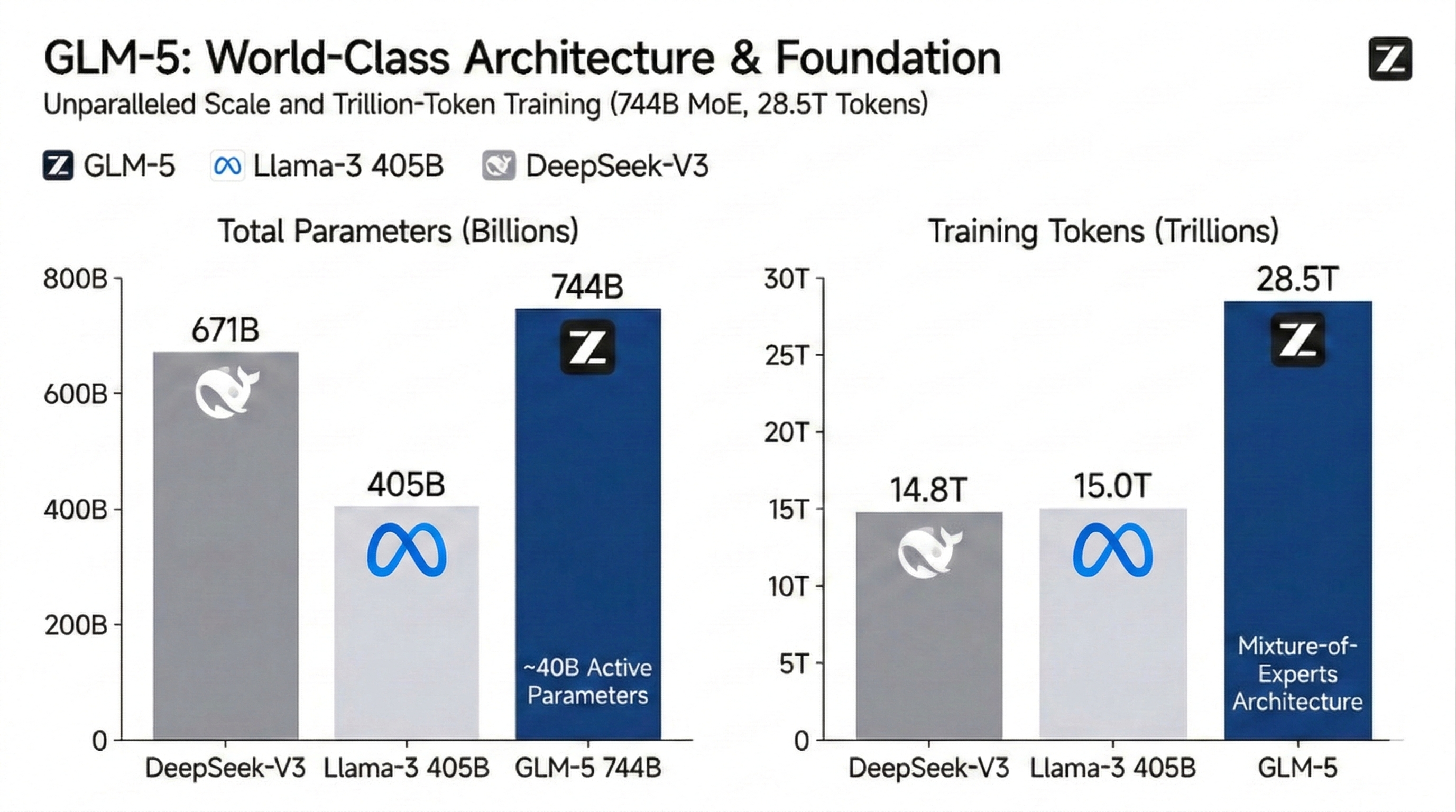
A sparse Mixture-of-Experts core activates only about 40 billion parameters per query, drawing on a far larger pool of experts. The result is deep knowledge and precise recall without dense-model cost on every call.
Agentic Execution Built Into the GLM API
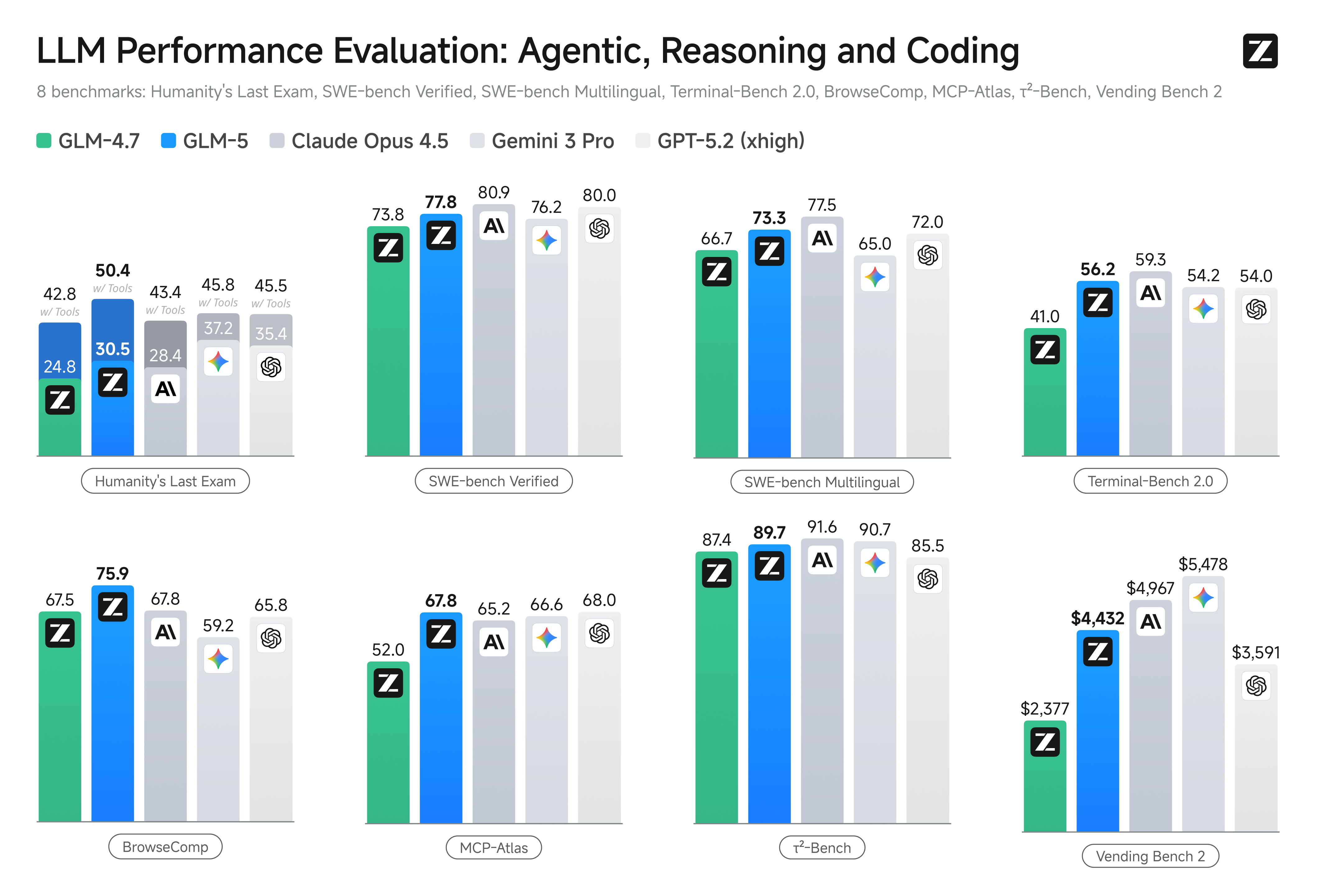
Planning logic is built into the GLM API so agents execute long-horizon, multi-step tasks without drifting off course. This stability suits automated software development, research pipelines, and workflows that stay coherent over many steps.
Reinforcement-Tuned Coding and Reasoning
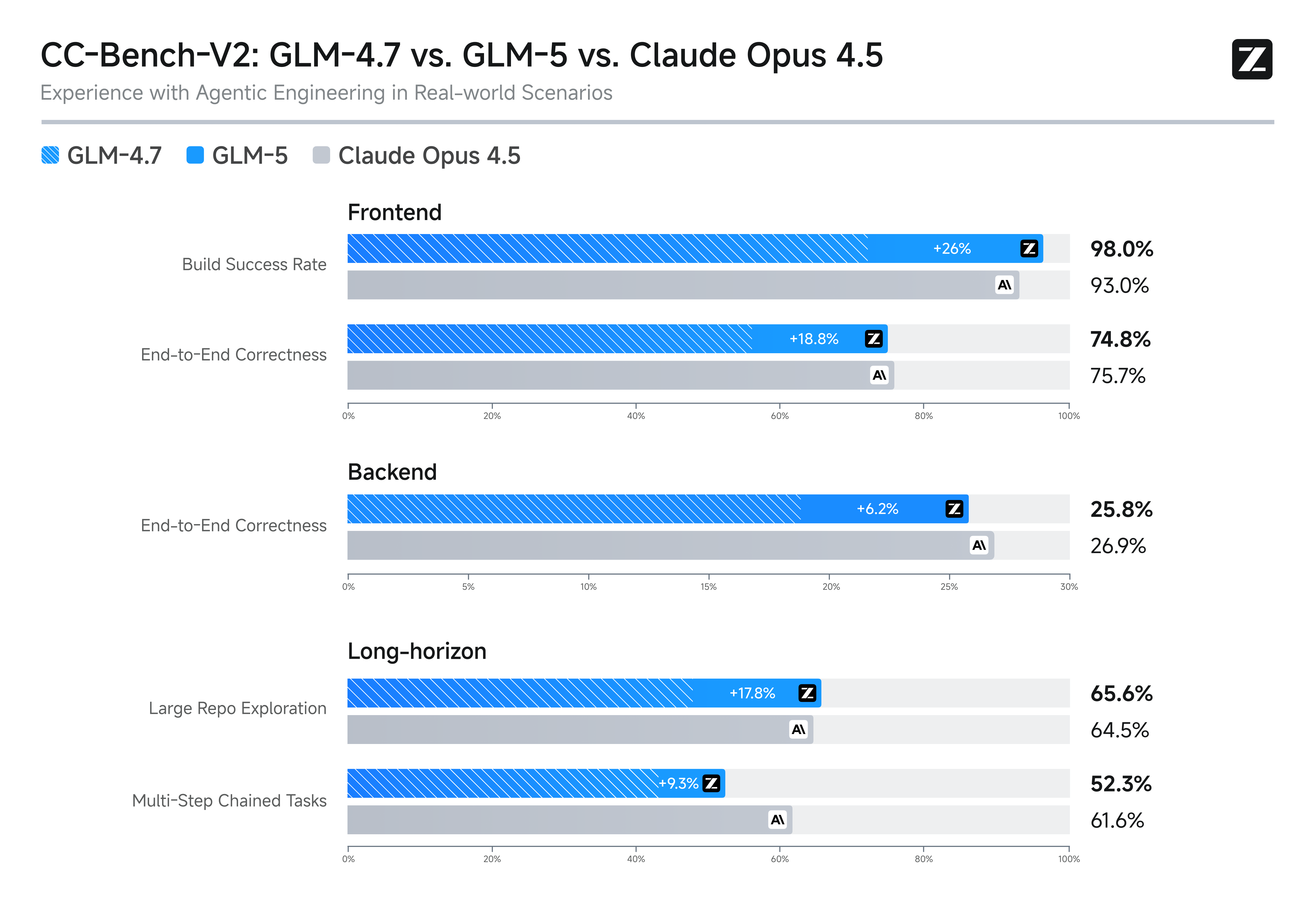
Reinforcement-learning post-training sharpens the model's code generation and algorithmic reasoning well beyond earlier GLM releases. Developers get more reliable full-stack output and stronger structural problem-solving where small logic errors tend to compound.

A 200K Context Window with Sparse Attention
Each model handles 200K tokens of context or more, with up to 128K output tokens, and sparse attention keeps that scale affordable. Whole repositories, long contracts, and research briefs stay in view at once.
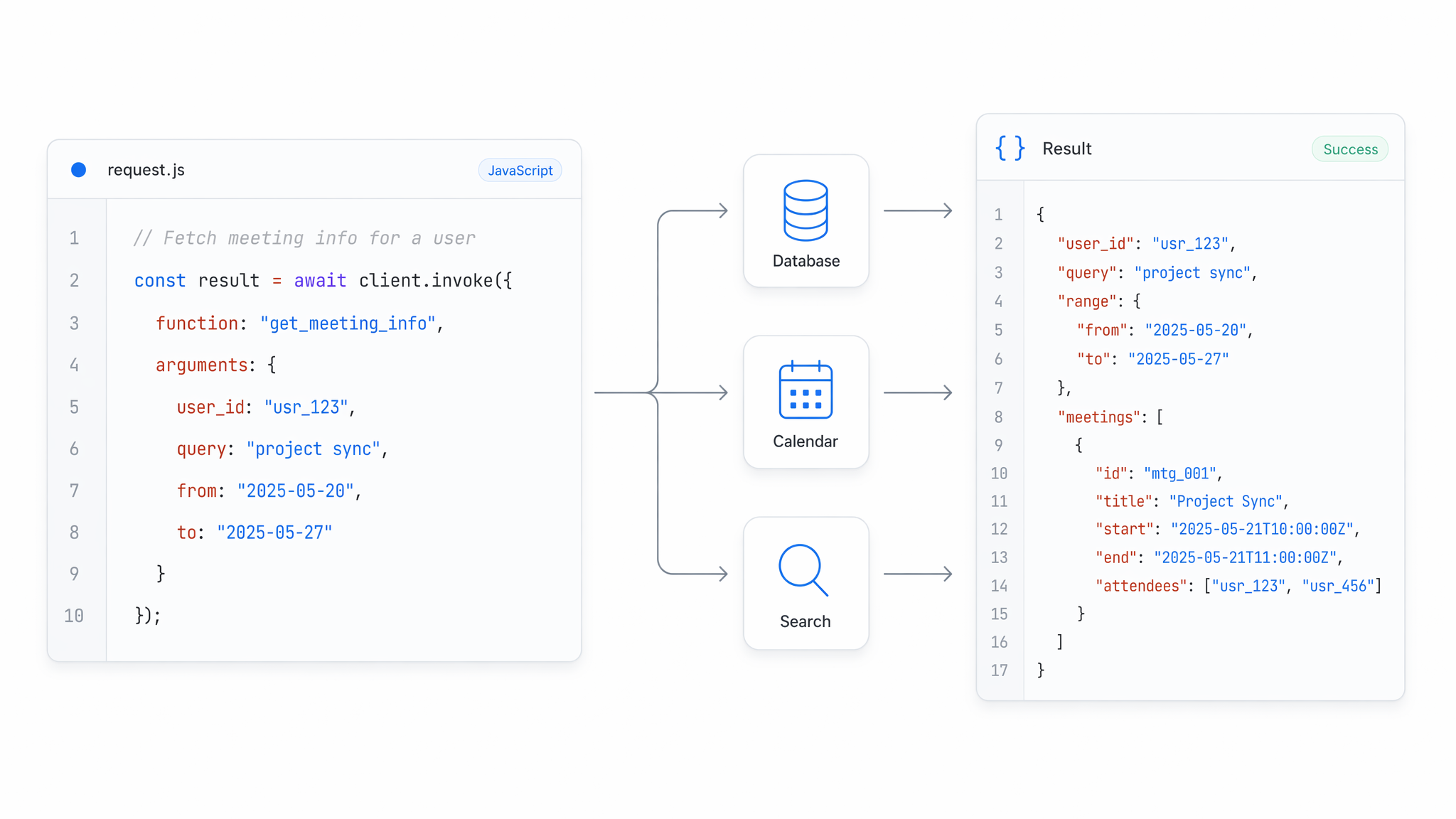
Native Tool Calling Through the GLM API
Wire external tools and services into the GLM API through native function calling and structured JSON output. The model decides when to invoke a tool, formats arguments to your schema, and returns machine-readable results.
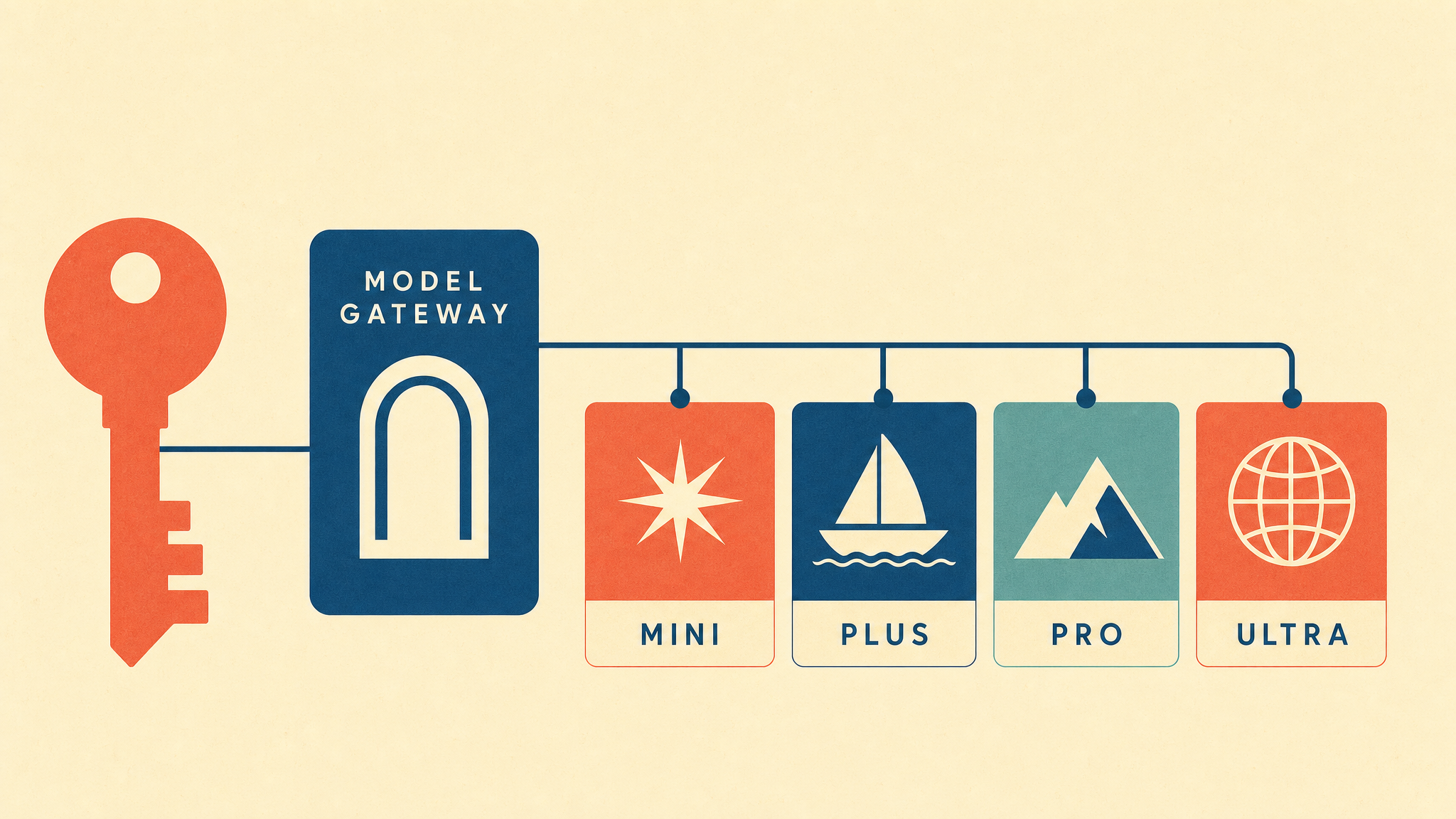
The Full GLM API Lineup Under One Key
One OpenAI-compatible key reaches the entire GLM API lineup, from flagship GLM-5.2 to the Turbo tiers and cost-efficient GLM-4.6. Prototype on a lighter tier, then promote to production with one line and pay-as-you-go pricing.
GLM API Head to Head: One Brief, Three Models Compared
Send a single build request through the GLM API and watch GLM 5.2, DeepSeek V4 Pro, and GLM 5 turn the same instruction into a working interactive page, so you can weigh front-end quality, layout logic, and interaction polish at a glance.
Generate a complete, single-file, self-contained HTML document (all CSS and JavaScript inlined, absolutely no external dependencies, no CDNs, no image URLs, no external fonts) that renders an interactive "Aurora Tuning Console" — a full-viewport WebGL experience of a midnight polar sky where the aurora is computed in real time inside a GLSL fragment shader, never faked with sprites, textures, or particle stacks. Core rendering requirement: render a single full-screen quad and do all the visual work in a fragment shader. The aurora borealis must be generated procedurally from layered fractal value/simplex noise (fbm, 4–6 octaves) that flows and warps over time via a uniform clock, producing tall vertical light curtains that breathe, ripple, knot, and dissipate. Model the aurora as self-emissive volumetric glow: accumulate brightness along a vertical falloff, add soft bloom at the base of each curtain, and scatter faint drifting star-dust noise through the dark upper sky. Compose the frame as a minimalist low-horizon upward gaze — roughly 80% sky, with a dark silhouetted mountain ridge and a mirror-still lake across the bottom that reflects the aurora and stars in a softly rippling, vertically-mirrored copy. Base palette is near-black indigo (deep blue-violet night); the aurora is the only high-saturation element — restrained, luminous, translucent, never garish. Interactions (all real-time, smooth, and clearly responsive): - Mouse drag across the sky "pulls" the light curtains like fabric — feed the pointer position/velocity into shader uniforms so the aurora bends, stretches, and streams toward the cursor, then eases back with gentle inertia when released. - Mouse-wheel scroll cycles the "season," continuously interpolating the aurora's color band through emerald green → magenta → indigo (and back), shown as a smooth gradient shift, not discrete jumps. - Double-click ignites a new star at that point in the sky: it pulses (sinusoidal brightness) and casts a matching reflection on the lake. Support many simultaneous stars. - Keep a subtle idle animation so the first light curtain appears to slowly awaken and unfurl on load — a quiet, sacred, cold-and-still mood. UI & polish: a small, elegant, semi-transparent control overlay in a corner showing the current season/color and a faint one-line hint of the controls (drag / scroll / double-click), styled in a clean modern cold-toned aesthetic with soft fade transitions. Make it fully responsive: resize the WebGL canvas and update resolution uniforms on window resize so it fills any viewport and stays crisp on high-DPI screens. Target a steady 60fps using requestAnimationFrame. Include a graceful fallback message if WebGL is unavailable. Prioritize the mathematical quality of the noise flow, the volumetric glow, and the fluidity of the interactions — this is where a capable model should visibly outshine a weaker one.
Generated with GLM 5.2 on Atlas Cloud
Generated with Grok 4.5 on Atlas Cloud
Generated with GLM 5 on Atlas Cloud
Build a complete, single-file, self-contained HTML document (all CSS and JavaScript inlined in one file, absolutely zero external dependencies — no CDNs, no external scripts, no web fonts, no image URLs, no SVG assets fetched over the network; generate every sound with the native Web Audio API and draw every visual with CSS and Canvas/DOM) that opens directly in any modern browser and runs a playable cyberpunk step-sequencer drum machine in the visual language of 1980s synthwave neon. Core instrument: render a glowing step matrix of 16 columns × 6 tracks laid out horizontally across the screen, one row per voice — Kick, Snare, Closed Hi-Hat, Open Hi-Hat, Clap, and Synth Bass. Each of the 96 cells is a clickable pad; clicking toggles it on/off, an active cell lights up with a saturated magenta-to-cyan glow, an inactive cell sits as a dim recessed rectangle on the near-black indigo background. The user programs a beat by lighting cells column by column. Support click-and-drag painting across cells to toggle many at once. Audio: synthesize all drum voices live with the Web Audio API — kick as a pitch-swept sine with fast amplitude decay, snare and clap as filtered white-noise bursts with envelope, closed and open hi-hats as high-passed noise with short vs. long decay, and synth bass as a detuned saw/square through a resonant low-pass filter playing a selectable root note. Schedule steps with an accurate look-ahead clock (not naive setInterval timing) so the loop stays rock-solid at high tempo. Loop the 16-step pattern continuously when playing. Transport and controls, docked in a symmetric control bar pinned across the bottom: a large Play/Stop button, a BPM dial or rotary knob (draggable, range ~60–200 BPM, default 120) with a live numeric readout, a master volume fader, per-track mute buttons, a Clear button, and a Randomize button that generates a plausible beat. A moving playhead — a vertical light-blade — sweeps across the grid in perfect sync with the audio, and every cell it hits that is active blooms with a radial ripple pulse that fades. Include a live oscilloscope/waveform display that visualizes the master output amplitude in real time, reacting to the sound. Visual style: deep indigo-to-violet gradient background so dark it reads near-black, grid lines and UI accents in electric magenta and cyan, all luminosity coming from element self-glow and hit-flash bloom (box-shadow glow, additive-feeling highlights) to evoke a late-night underground club pulsing to the loop. Center the full grid on screen, keep the layout symmetric with the control bar compressing the base, and make it responsive so the grid scales gracefully down to smaller viewports. Add subtle animated scanline or chromatic shimmer for atmosphere without hurting readability. Interaction requirements: everything responds instantly — clicking pads, dragging the BPM knob and volume fader, toggling mutes, pressing spacebar to Play/Stop, and pressing the number keys to jump the bass root note. State (which cells are active, BPM, volume, mutes, playing status) must be managed cleanly so the UI and audio never drift out of sync. First interaction with the page should also unlock/resume the AudioContext. Prioritize tight audio-visual synchronization, smooth 60fps animation of the playhead and ripples, and a genuinely satisfying, musical result out of the box.
Generated with GLM 5.2 on Atlas Cloud
Generated with Grok 4.5 on Atlas Cloud
Generated with GLM 5 on Atlas Cloud
Where Developers Put the GLM API to Work
From autonomous coding agents and long-horizon research to conversational products and high-volume data analysis, the GLM API gives developers one OpenAI-compatible endpoint for building reliable, agent-driven software.

Autonomous Coding Agents with the GLM API
Built for autonomous task execution, GLM models plan, write, and refine code across multi-step workflows without losing project context. Development teams rely on this to power PR review bots, refactoring assistants, and build pipelines.

Long-Horizon Research and Workflow Orchestration
Stable multi-step reasoning lets these models decompose sprawling research questions, call external tools, and hold context across long chains of dependent actions. This suits analysts and product teams automating multi-source synthesis and cross-platform operations.

Building Polished Front-End Interfaces
GLM models turn rough mockups and plain descriptions into clean, responsive interface code with a strong sense of visual polish. Solo founders and design-minded developers ship functional prototypes and production UIs far faster.

Conversational Products on the GLM API
Want assistants that feel human? The GLM API delivers natural conversational experiences backed by stable reasoning, powering chatbots, support copilots, and in-app assistants that stay coherent across long, branching dialogues.

Tool-Calling Backends and Function Execution
Because these models are built for tool use, they select functions, format arguments, and chain API calls inside agentic systems. Engineers use this to wire GLM into orchestration layers, RAG pipelines, and multi-agent stacks.

Scale Data Analysis with the GLM API
Tap the GLM API to reason over large documents, spreadsheets, and reports, extracting structured insights through an efficient Mixture-of-Experts design. Ideal for finance, legal, and operations teams that need dependable, high-volume analysis.
GLM API vs Rival LLMs: Spec and Pricing Matrix
Compare every GLM API model against leading text LLMs on Atlas Cloud across context length, output ceilings, and transparent pay-as-you-go pricing.
| Model | Context Window | Max Output | Input ($/1M tokens) | Output ($/1M tokens) |
|---|---|---|---|---|
| GLM 5.2 | 1M | 128K | $1.40 | $4.40 |
| GLM 5.1 | 203K | 203K | $1.40 | $4.40 |
| GLM 5 | 203K | 203K | $1.00 | $3.20 |
| GLM 4.7 | 203K | 203K | $0.60 | $2.20 |
| DeepSeek V4 Pro | 1M | 384K | $1.74 | $3.45 |
| Kimi K2.7 Code | 256K | 256K | $0.95 | $4.00 |
| MiniMax M3 | 512K | 512K | $0.60 / $1.20 >512K | $2.40 / $4.80 >512K |
How to Use GLM on Atlas Cloud
Get started in minutes — follow these simple steps to integrate and deploy models through Atlas Cloud's platform.
Create an Atlas Cloud Account
Sign up at atlascloud.ai and complete verification. New users receive free credits to explore the platform and test models.
Why Use GLM on Atlas Cloud
Combining the advanced GLM models with Atlas Cloud's GPU-accelerated platform provides unmatched performance, scalability, and developer experience.
Performance & flexibility
Low Latency:
GPU-optimized inference for real-time reasoning.
Unified API:
Run GLM, GPT, Gemini, and DeepSeek with one integration.
Transparent Pricing:
Predictable per-token billing with serverless options.
Enterprise & Scale
Developer Experience:
SDKs, analytics, fine-tuning tools, and templates.
Reliability:
99.99% uptime, RBAC, and compliance-ready logging.
Security & Compliance:
SOC 2 Type II, HIPAA alignment, data sovereignty in US.
GLM API: Answers to Common Developer Questions
The GLM API gives developers access to Z.ai's (Zhipu AI) GLM series of open-weight large language models, including GLM-5.2, GLM-5, GLM-4.7, and GLM-4.6. These models are engineered for coding, multi-step reasoning, and autonomous agent tasks. On Atlas Cloud you reach the entire family through one OpenAI-compatible endpoint with pay-as-you-go pricing.
Atlas Cloud hosts the current GLM lineup, including GLM-5.2, GLM-5.1, GLM-5, GLM-5 Turbo, GLM-5v Turbo, GLM-4.7, and GLM-4.6. Flagship versions target complex agentic and coding work, while the Turbo variants prioritize faster, lower-latency responses. Switching between them takes only a change to the model identifier in your request.
Sign up for Atlas Cloud, generate one API key, and point your existing OpenAI-compatible client at our endpoint. Because the GLM API follows the OpenAI request format, most integrations need only a base URL and model name change to begin sending requests. Access is pay-as-you-go with transparent per-call pricing and no subscription.
Pricing is pay-as-you-go and billed per token, with no subscription required. GLM-4.7 and GLM-4.6 start at $0.60 per million input tokens and $2.20 per million output tokens, GLM-5 is $1.00 input and $3.20 output, and GLM-5.2 is $1.40 input and $4.40 output. Cached input is billed at a lower rate, which reduces cost on repeated context.
GLM models on Atlas Cloud offer a large context window of roughly 200K tokens, with maximum output reaching about 131K tokens on flagship versions. That capacity is enough to load entire repositories, long documents, or extended agent histories in a single request. Longer-context variants exist within the GLM family, so check each model page for its exact limit.
Yes. GLM models support tool and function calling along with structured JSON output, which lets them slot directly into agentic pipelines and production systems that expect machine-readable responses. Paired with the OpenAI-compatible format, the GLM API is straightforward to wire into existing tool-use workflows.
These models are built for programming, long-horizon reasoning, and autonomous agent execution. Common uses include whole-repository code analysis, full-stack prototyping, and multi-step research or workflow automation. The flagship GLM-5 series handles the most demanding agentic work, while GLM-4.6 offers a strong balance of speed and capability for everyday tasks.
GLM's flagship models are positioned as competitive open-weight alternatives to leading closed-source models on coding and agentic benchmarks. The main practical draw is cost, since per-token pricing runs a fraction of comparable proprietary models while programming performance stays strong. For teams weighing budget against quality, GLM offers frontier-level capability at a lower rate.
Yes. Atlas Cloud serves GLM models through an OpenAI-compatible endpoint, so any framework or SDK that accepts a custom base URL and model name can call them with minimal changes. This lets you drop GLM into tool-calling agents, coding assistants, and multi-step orchestration pipelines you already run. Start building today.
Yes. The GLM series is released by Z.ai (Zhipu AI) as open-weight models under a permissive license, which is why they are widely regarded as a leading open-source option. On Atlas Cloud you get managed, production-ready access to these models without hosting or maintaining the infrastructure yourself.
Explore More Families
Kling 4.0
Developed by Kuaishou, Kling V4 is an video model built for professional production. It pairs stable complex motion with a 21:9 ultrawide format and targeted editing for expressions, camera angles, backgrounds, visual styles, and dialogue. Atlas Cloud is preparing Day-0 access through one OpenAI-compatible key with transparent pay-as-you-go pricing for flexible integration. Start building today.

Seedance 2.5
Seedance 2.5 API is now available on Atlas Cloud! It gives developers ByteDance's newest video model. It generates up to 30 seconds of native video in a single pass from text, a single image, or as many as 50 multimodal references, with synchronized audio and in-frame multilingual text. On Atlas Cloud you reach it through one key, with subject consistency and improved physics keeping long shots coherent. (Update: Seedance 2.5 1080P API Is Available NOW!)
Wan 3.0
Wan 3.0 API is the next generation of Alibaba's Wan video family, built to push long-form generation, multi-reference control, and audiovisual quality to new heights. Atlas Cloud already hosts Wan 2.7, 2.6, and 2.5, and Wan 3.0 runs on the same unified key with no separate setup. Start building today. Scroll down to the showcase to see what Wan 3.0 can create.
MiniMax H3
MiniMax H3 is MiniMax's multimodal video family for text, image, and reference guided creation. Across supported routes, it preserves subjects from reference media, offers flexible aspect ratios, and pairs generated sound with visuals through H3 Developer, with output profiles selected by endpoint. Atlas Cloud unifies the family behind one OpenAI-compatible key with transparent pay-as-you-go pricing from the standard rate of $0.038 per second. Start building today.
GPT Image 2.5
The gpt-image-2.5 family from OpenAI gives developers a choice of Flare and Sunburst for production image workflows. Render at arbitrary resolutions up to 3840x2160 and select from five quality tiers, including xhigh and max, to match specific output requirements. Atlas Cloud provides ready-to-use REST inference with no cold starts and standard pricing from $0.004 per generation. Start building today.
Seedream 5.0 Pro
Seedream 5.0 Pro API gives developers ByteDance's controllable image editing model on Atlas Cloud. It places edits precisely with anchors and coordinates, separates images into editable layers, fuses multiple references, and matches exact colors and materials, with multilingual text at 2K and 3K. On Atlas Cloud you reach it through one key!
Seedance 2.0
Seedance 2.0 is ByteDance’s production video model for precise shot creation. Turn prompts into video, animate a first-frame image with optional last-frame guidance, or shape results with reference media and optional web search. Atlas Cloud brings these workflows into one unified API with transparent pay-as-you-go pricing and one OpenAI-compatible key. Start building today.
Kling V3.0
From Kuaishou, the Kling V3 API family supports text, image, and reference video workflows. Transfer motion while preserving character identity, guide generation with visual references, and edit videos through natural language commands. Atlas Cloud offers Standard and Pro endpoints for different production needs. Already creating with Kling 3.0? Kling V4 is now available on Atlas Cloud. Explore it on the [Kling V4](https://www.atlascloud.ai/models/kling-v4) family page.
Grok Imagine Video
Grok Imagine Video gives developers access to xAI’s video family for creating, animating, extending, and editing clips. Generate 1 to 15 second videos from prompts, guide people, objects, or styles with up to seven reference images, and work at 480p or 720p. Atlas Cloud brings these capabilities together through OpenAI-compatible endpoints with transparent pay-as-you-go pricing. Start building today.
Vidu Q4 Preview
Vidu Q4 is Vidu's latest flagship video model, designed for image-to-video and reference-to-video generation. It can animate a single still image and create automatic scene transitions, giving developers two input paths for different product workflows. Atlas Cloud provides dedicated API endpoints with published parameter schemas at the verified standard price of $0.04 per second. Start building today.
Gemini Omni 1.1 Flash
Gemini Omni 1.1 Flash is Google DeepMind’s natively multimodal video family for flexible production workflows. Edit existing footage through text instructions, maintain visual consistency with up to 10 reference images and 3 video clips, or extend a shot in chainable segments to 40 seconds. Access every workflow on Atlas Cloud with one OpenAI-compatible API key, pay-as-you-go pricing, and Day-0 availability. Start building today.
Nano Banana 2.1
Nano Banana 2.1 is Google's image model family built on Gemini 3.6 Flash. It delivers Pro-level generation and editing at Flash-level speed, supports natural-language edits and merges across 1 to 14 input images, and maintains consistency for up to 4 characters and 10 objects. Through Atlas Cloud, developers can access the family with one OpenAI-compatible key, reliable uptime, and Day-0 availability. Start building today.
Recommended Articles
Guides, tutorials, and product updates to help you get the most out of Atlas Cloud.





