You are three prompts into a real refactor, the agent is finally understanding your codebase, and then the message pops up: model quota reached, try again in 35 hours. If you use Google Antigravity, you have probably lived this. Since the March 2026 pricing change, plenty of paid users have hit multi day lockouts right in the middle of a working session (Google AI Developers Forum, June 2026).
This guide is about the practical fix. Not "wait for the reset," but a real Antigravity quota alternative: run the same agent workflows on open models through a credit system that refreshes every day instead of locking you out for a week. Let's get into what actually changed, what to look for, and how to set it up in the tools you already use.
What the Antigravity Quota Problem Actually Looks Like in 2026
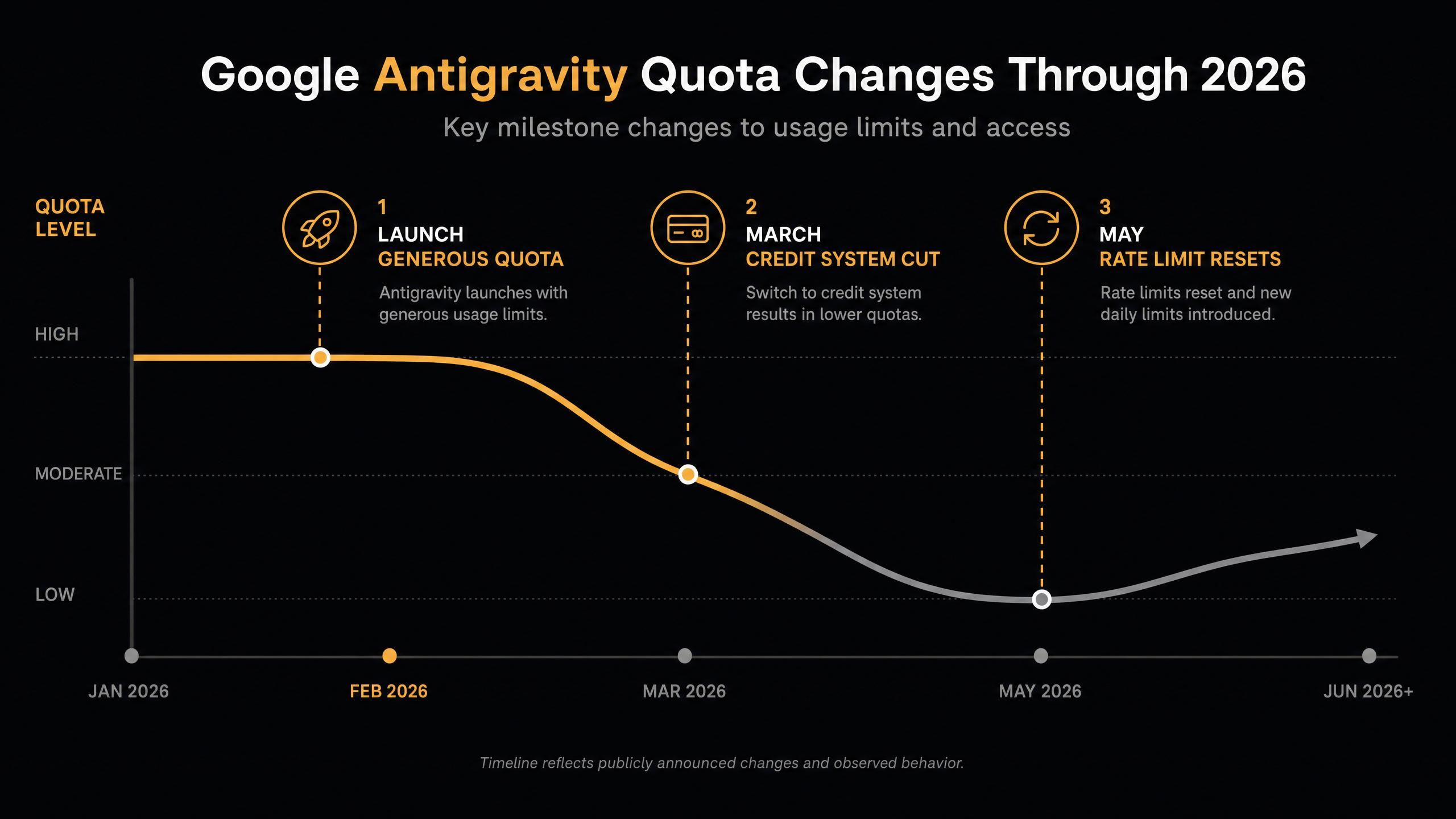
The core issue is not that Antigravity is bad. It is that the quota model became unpredictable. In March 2026, Google restructured Antigravity from a simpler subscription into a credit based system, and the free tier was cut hard while Pro users lost their old 5 hour refresh cycle in favor of a weekly ceiling (vibecoding.app, 2026).
The numbers tell the story. The free tier dropped to roughly 20 requests per day on Gemini Flash, down from about 250 at launch. Pro sits at $20 per month, Ultra at $249.99 per month, and even Ultra users reported running into restrictions. The credit system itself is hard to plan around, because the credit to token conversion rate is not publicly documented.
Google did respond. In late May 2026, the Antigravity team tripled Gemini rate limits twice in a single day and reset quotas for all paid plans, with DeepMind director Varun Mohan confirming the second reset publicly. Still, users pointed out the limits remained lower than before the new system, and some were hitting the ceiling within an hour of focused work.
Here is the honest part. A rate limit exists for a reason, and a single frontier model serving millions of agent calls is expensive to run. The problem for you as a builder is the shape of the limit. A weekly ceiling means one heavy day can lock you out for the rest of the week.
Why Developers Want an Antigravity Quota Alternative
The search volume for an Antigravity quota alternative comes down to one word: predictability. Agentic coding burns tokens fast, because the agent reads files, plans, calls tools, and revises, often looping many times per task. When your quota is a single weekly pool with an undisclosed conversion rate, you cannot budget your week.
Developers in the official forums describe the same pattern over and over: they plan a big build session, the agent is productive, and then a hard stop arrives with a multi day timer. The frustration is not the existence of a limit. It is that the limit is opaque and the lockout is long.
What we keep seeing: the people happiest after switching are not chasing a cheaper bill first. They are chasing a quota that resets tomorrow morning, so a heavy Tuesday does not cost them Wednesday through Sunday.
A good Antigravity quota alternative solves this in two ways at once. It uses cheaper models so each agent loop costs less, and it uses a refresh cadence that matches how people actually work, which is day by day.
What Makes a Good Antigravity Quota Alternative
Three things matter, and most "alternatives" only deliver one. A real Antigravity quota alternative needs all three: capable models, a sane refresh cadence, and compatibility with the tools you already run.
Capability first. If the alternative model cannot hold a long agentic session, you have traded a quota problem for a quality problem. The good news is that open models closed much of the gap in 2026. Between April 7 and April 24 alone, four labs shipped strong open weight coding models: Z.ai's GLM 5.1, MiniMax's M2.7, Moonshot's Kimi K2.6, and DeepSeek's V4 in two variants, all under permissive licenses and all at a small fraction of frontier pricing.
Cadence second. Daily refresh beats weekly ceiling for almost everyone who codes regularly. Tool compatibility third. If you have to abandon Claude Code or Codex, the switching cost may not be worth it.
| Factor | Antigravity quota (current) | What you actually want |
|---|---|---|
| Refresh cadence | Weekly ceiling, up to 7 day lockout | Daily allowance that resets every morning |
| Pricing transparency | Undisclosed credit to token rate | Published per model multipliers |
| Model choice | Mostly Gemini, some others | Swap GLM, Kimi, DeepSeek, MiniMax, Qwen freely |
| Tool lock in | Tied to the Antigravity IDE | Works in Claude Code, Codex, Cursor, more |
Open Models Are the Real Antigravity Quota Alternative
If you strip away branding, the most durable Antigravity quota alternative is simply running open models through a provider that prices them transparently. Open weight coding models in 2026 are not a toy. GLM 5.1, Kimi K2.6, DeepSeek V4 Pro and V4 Flash, MiniMax M2.7, and Qwen3 sit on most serious benchmark shortlists for agentic work, and they ship under Apache 2.0 or MIT style licenses.
The economic argument is strong. Frontier models like Gemini 3 Pro and the top closed models are priced for their ceiling. For a large share of day to day coding, file edits, test writing, refactors, boilerplate, an open model handles the job at a fraction of the cost. You reserve the expensive model for the rare task that truly needs it.
This is where a platform built around open models becomes the natural home for the workflow. Atlas Cloud runs a Coding Plan that covers exactly this lineup, GLM, MiniMax, Kimi, DeepSeek, and Qwen, with new models added as they ship. Each model carries a published input and output credit multiplier, so you can see what a session will cost before you run it, which is the opposite of an undisclosed conversion rate.
How a Credit-Based Antigravity Quota Alternative Saves Money
The money question deserves a direct answer. A credit based Antigravity quota alternative saves money in two layers: the underlying models are cheaper, and a daily refreshing subscription stretches that further than buying tokens one at a time.
Here is how the Coding Plan structures it. Credits are the unit of measure, and consumption is simple math: credits spent equals input tokens times the input multiplier plus output tokens times the output multiplier. Monthly subscription packs hand you a fixed daily allowance that resets at midnight, so a heavy day never borrows from your week. Pay as you go packs are also available for bursty work, valid for 90 days.
The subscription ladder is built to scale with how much you actually code:
| Plan | Price per month | Daily credit allowance |
|---|---|---|
| Starter | $10 | 800K points/day |
| Lite | $20 | 1.8M points/day |
| Plus | $50 | 4.8M points/day |
| Max | $100 | 9.8M points/day |
| Ultra | $200 | 20.8M points/day |
| Enterprise | $500 | 54.8M points/day |
Two details make this practical. Subscriptions on the same model lineup run roughly 41 percent below the pay as you go rate, and because the daily pool refreshes every morning, the planning problem largely disappears. You also keep flexibility: you can hold one monthly subscription plus extra pay as you go packs, and the system spends the subscription allowance first, then the pack that expires soonest.
If your needs grow mid month, upgrades are prorated. Buy Starter, move up to Lite two weeks in, and you pay only the difference for the remaining days rather than starting over. The math is transparent, which is the whole point.
Setting Up an Antigravity Quota Alternative in Your Existing Tools
You do not have to learn a new editor to get off the weekly quota cliff. The cleanest Antigravity quota alternative plugs into the agent tools you already run through a single OpenAI compatible endpoint. The base URL is https://api.atlascloud.ai/v1 for most tools, and the Coding Plan issues its own dedicated API key, separate from your regular account balance.
A quick note before the config: pick a model ID that fits the job. GLM 5.1 is a strong agentic default with a 200K context window. DeepSeek V4 Flash is extremely cheap for high volume edits. Kimi K2.6 carries a 262K context for large repositories.
Claude Code
Claude Code uses a slightly different base URL, without the /v1 suffix. Edit your ~/.claude/settings.json on macOS or Linux, or %USERPROFILE%\.claude\settings.json on Windows, and swap in your key and a model ID.
plaintext1{ 2 "env": { 3 "ANTHROPIC_AUTH_TOKEN": "your-atlas-api-key", 4 "ANTHROPIC_BASE_URL": "https://api.atlascloud.ai", 5 "ANTHROPIC_MODEL": "zai-org/glm-5.1", 6 "ANTHROPIC_DEFAULT_HAIKU_MODEL": "zai-org/glm-5.1", 7 "ANTHROPIC_DEFAULT_SONNET_MODEL": "zai-org/glm-5.1", 8 "CLAUDE_CODE_DISABLE_EXPERIMENTAL_BETAS": "1" 9 } 10}
Codex
Create ~/.codex/config.toml and point the model provider at the endpoint:
plaintext1model_provider = "atlas_coding_plan" 2model = "zai-org/glm-5.1" 3[model_providers.atlas_coding_plan] 4name = "atlascloud" 5base_url = "https://api.atlascloud.ai/v1" 6wire_api = "chat" 7requires_openai_auth = true
Then put your key in ~/.codex/auth.json:
plaintext1{ "OPENAI_API_KEY": "your-atlas-api-key" }
OpenClaw, OpenCode, and Cursor
These tools follow the same pattern. Run openclaw onboard, choose a custom provider, paste the base URL https://api.atlascloud.ai/v1, add your key, paste the model ID, and select the OpenAI compatible protocol. OpenCode and Cursor accept the same base URL and key in their provider settings. When you see the verification succeed, you are done.
Plugging an Antigravity Quota Alternative Into Antigravity Itself
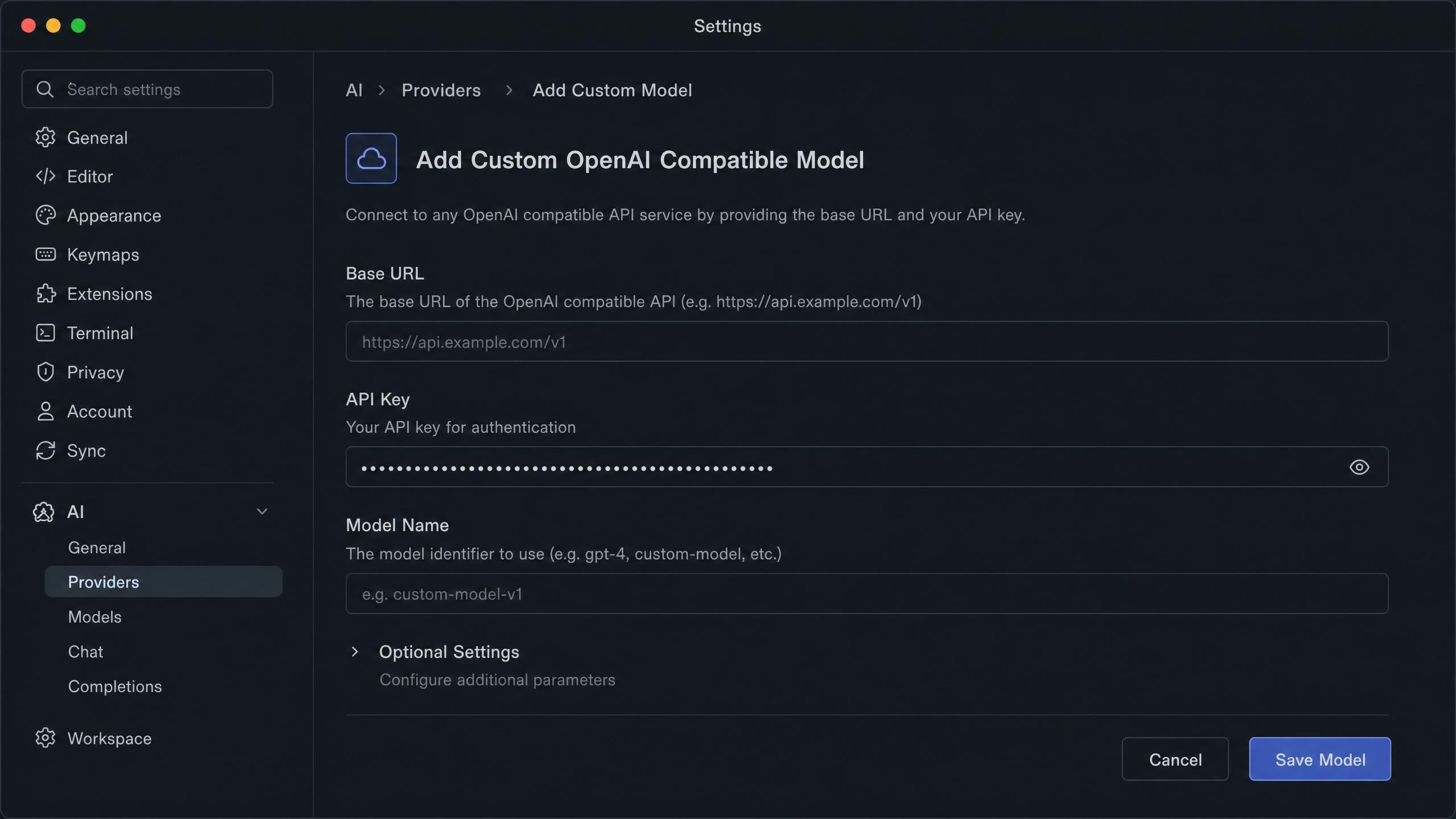
Here is a trick many people miss. You may not have to leave Antigravity at all. The IDE supports OpenAI compatible custom models, which means you can keep the interface you like and point it at a cheaper backend with a daily quota. Add a custom model, choose the OpenAI compatible option, and supply the same base URL and key. You keep the Antigravity workflow and skip the weekly ceiling for everyday tasks.
Who Should Switch to an Antigravity Quota Alternative and Who Should Wait
Be honest with yourself about your workload before switching. An Antigravity quota alternative is a clear win for some people and unnecessary for others.
Switch now if you code most days, run long agentic sessions, and have hit a multi day lockout more than once. The daily refresh and lower per task cost will pay for themselves quickly, and the open models are strong enough for the large majority of real engineering work.
Wait if you are a light user who rarely touches the quota, or if your work depends on one specific frontier capability that open models have not matched yet, such as a particular vision or reasoning edge for your niche. In that case, keep the frontier model for the hard 10 percent and consider routing the routine 90 percent through a cheaper backend. Hybrid is a perfectly good answer.
Frequently Asked Questions
Is an Antigravity quota alternative as capable as Gemini 3 Pro?
For most coding, yes. Open models like GLM 5.1, Kimi K2.6, and DeepSeek V4 now sit on serious benchmark shortlists for agentic work and ship under permissive licenses (kilo.ai, 2026). Frontier models still lead on the hardest tasks, so a hybrid setup is common: open models for routine work, frontier for the rare hard problem.
Will my agent tools work with an Antigravity quota alternative?
Yes. Claude Code, Codex, OpenClaw, OpenCode, and Cursor all accept a custom OpenAI compatible endpoint, so you keep your existing workflow. You change a base URL and an API key, then pick a model ID. Antigravity itself also supports custom OpenAI compatible models, so you can even stay in that IDE.
How much can I save with this Antigravity quota alternative?
Two layers compound. Open models cost a fraction of frontier pricing per token, and a daily refreshing subscription runs roughly 41 percent below pay as you go rates on the same models. The bigger saving is often time, since a daily reset removes the multi day lockouts that stall a whole week of work.
Can I keep using Antigravity and still avoid quota lockouts?
Often, yes. Antigravity supports OpenAI compatible custom models, so you can route everyday tasks through a cheaper backend with a daily quota while keeping the IDE you like. Reserve the built in Gemini quota for the tasks that genuinely need it, and you stop burning the weekly ceiling on routine edits.
The Bottom Line on Finding an Antigravity Quota Alternative
The Antigravity quota problem is really a planning problem. A weekly ceiling with an undisclosed conversion rate makes it impossible to budget your week, and a single heavy day can cost you the next six. The fix is not to wait for the reset timer. It is to move your routine agent work onto open models with a quota that resets every morning.
That combination, capable open models plus a transparent daily credit allowance, is the most durable Antigravity quota alternative available right now. You can set it up inside Claude Code, Codex, Cursor, or even Antigravity itself in a few minutes, keep the model you trust for the hard 10 percent, and stop losing days to a lockout screen. If you want to see the per model rates and daily allowances before committing, the Coding Plan console lays them out in full.





