Most model comparisons hand you a cherry-picked reel and a winner. This one hands you the raw footage.
We took ten briefs, gave each one the exact same prompt, and ran it through three video models at once: Wan 3.0 vs Seedance 2.5 vs MiniMax H3. Every result below is three panels stacked in one frame, same order every time, top to bottom: Wan 3.0, Seedance 2.5, MiniMax H3. No per-model prompt tuning. No re-rolls to make one look good. Watch, and judge for yourself.
That is also the point of this piece. The honest way to pick a video model is not to read a leaderboard, it is to feed all of them the identical prompt and look at the three outputs next to each other. You can do exactly that, on these exact three models, in one browser tab. The last section shows you how.
Key takeaways
- One prompt, three models, three panels is the honest test. No single model wins all ten.
- Seedance 2.5 was strongest on in-frame text and clean product looks; MiniMax H3 held human identity and motion; Wan 3.0 handled the long, multi-shot briefs.
- All three run on Atlas Cloud under one key, and Model Explorer fires the same prompt at all three in parallel with the cost shown before you generate.
- The 64 official Wan 3.0 prompts are copy-paste ready in the Prompt Hub, so you can reproduce any test.
- Wan 3.0 lands on Atlas Cloud on 24 August 2026. Watch all ten tests first, then get in line.
Test 1: Wan 3.0 vs Seedance 2.5 vs MiniMax H3 on a 30-second sea monster
Start with the hardest brief in the set. One 1,758-character prompt, ten shots written out in full, a complete "setup, disturbance, reveal" arc, and a Pacific-Rim-scale creature breaking the surface in heavy rain. It stresses large-scale VFX and water simulation, and it is a brutal test of long-prompt adherence: can the model hold ten scripted beats over 30 seconds without drifting.
One prompt, three models, top to bottom: Wan 3.0, Seedance 2.5, MiniMax H3. Watch the storm build, the water displace, and the "WAN" marking on the fishing boat hold across shots. The clips carry sound, all three models generate native audio.
Notice the prompt-writing move that carries the whole scene: the ship marking is named four separate times, once in the overview and again in three different shots. In a long prompt, the reliable way to make an element recur is not to describe it once in great detail, it is to write it in again at every timestamp it should appear. That single habit is why the label survives the cuts.
Why a same-prompt, three-model test beats any leaderboard
A single-model highlight reel tells you what a model does on its best day with a hand-tuned prompt. It tells you almost nothing about what you will get on a Tuesday, with your prompt, on your deadline.
Feeding the identical brief to Wan 3.0, Seedance 2.5 and MiniMax H3 at the same time removes the two biggest sources of lying: prompt tuning and re-rolls. When the input is fixed and the outputs sit side by side, the differences that matter jump out on their own. Text that renders cleanly in one panel and smears in another. A face that stays the same person in one and morphs in the next. A camera move that holds in one and tears in another.
Across these ten tests, no model swept. Seedance 2.5 kept in-frame text and product surfaces crisp. MiniMax H3 held human identity and natural motion. Wan 3.0 was the one that chewed through the longest, most over-specified briefs. Which of those matters is a question only your own shot list can answer, which is the entire argument for running the comparison yourself.
Wan 3.0 vs Seedance 2.5 vs MiniMax H3: the specs that actually differ
Before the other nine tests, here is where the three models genuinely diverge on paper. These are published capability specs, checked August 2026. Wan 3.0 is the upcoming model here; its Atlas Cloud page is live now for early-access sign-up, while Seedance 2.5 and MiniMax H3 are already available.
| Capability | Wan 3.0 | Seedance 2.5 | MiniMax H3 |
|---|---|---|---|
| Clip length | 2 to 30s, 5s default | 4 to 30s, or auto | 5 to 15s |
| Resolution | 480P / 720P / 1080P | 720p and up, ESR super-res to 4K, up to 60fps | up to 1440p |
| Aspect ratios | adaptive, 16:9, 4:3, 1:1, 3:4, 9:16 | six ratios plus adaptive | 21:9, 16:9, 4:3, 1:1, 3:4, 9:16 |
| Native audio | yes, toggle on or off | yes, generated in the same pass | yes, native stereo |
| Modes | text, image (first / first-last frame), reference to video | text, image, reference to video | text, image, reference to video |
| Reference inputs | image, video, audio, 20 total | up to 50 multi-modal references | up to 12 files |
| Doc / webpage to video | yes: doc, xls, ppt, pdf, md, and web links | not published | not published |
| Prompt limit | 20,000 characters | no hard character cap | 7,000 characters |
| Open weights | no, API only | no, API only | partial: H3-Base weights released, other variants API only |
Three things are easy to misread here. Length and resolution are not the same axis: Wan 3.0 and Seedance 2.5 both top out at 30 seconds while MiniMax H3 caps at 15, but on resolution Seedance 2.5 reaches 4K via super-resolution where the others list 1080P and 1440p. Reference limits are counted differently by each vendor, so the raw numbers are not comparable. And document-to-video, feeding a spreadsheet or a web link straight to the model, is a Wan 3.0 input channel with no equivalent in the other two.
The practical upshot: all three live in the same catalog on Atlas Cloud, behind one API key, which is what makes a same-prompt run possible in the first place. You pick the models, write the prompt once, and fire it at all of them together.
Nine more Wan 3.0 vs Seedance 2.5 vs MiniMax H3 tests
Same format throughout: one prompt, three panels, Wan 3.0 on top, then Seedance 2.5, then MiniMax H3. Each clip carries native audio. The full, copy-paste-ready prompts for all of these live in the Wan 3.0 Prompt Hub, 64 of them with the official reference clips.
Test 2, shopping-cart dimension jump (30s). The most kinetic brief in the set: a single unbroken 30-second take, a kid riding a cart down a California boulevard and crashing through a billboard. It stresses continuous high-speed motion with no cut, color consistency under hard sun, and in-frame text, the "WAN" on the billboard. Watch which panel keeps the letters legible through the crash.
Prompt-craft note: every one of the four time segments opens by restating "no cut, one continuous take." Repeating the constraint at each beat holds the one-take illusion far better than declaring it once at the top.
Test 3, silver-haired girl leaps into a sea of clouds (30s). A Japanese 2D cel-shaded piece. The question is whether flat anime shading survives a full 30 seconds without degrading into mush, plus sky-gradient color and dramatic backlight. 2D is where the three models tend to separate most visibly.
Test 4, CGI biomechanical war (30s). Hard-surface meets organic: bone texture, ceramic cracks, industrial grime, plus English heads-up text on screen. The prompt is only 320 characters and its timeline stops after the first four seconds, so the real test is what each model invents to fill the remaining 26.
Test 5, graduation-gown close-up (30s). A 202-character prompt has to carry a 30-second single-take close-up of one person. This is the toughest duration-stability test in the set: does the face stay the same person, does the skin hold up, does the handheld breathing feel human, does the gaze move naturally from level to down. Here is the full prompt, short enough to copy as-is:
Plain1A front-on medium close-up of a young Black woman, head and upper body, wearing 2a blue graduation gown. The frame is slightly off-center, another person is 3faintly visible at the left but the background is blurred out. She is talking to 4camera, mouth moving, brow slightly furrowed, expression serious and a little 5worried. Light falls from above and shapes her face naturally, real skin 6texture visible. The camera is fixed but carries a faint handheld breathing 7sway, and her gaze slowly shifts from looking ahead to looking down at her hands.
Test 6, five-member girl-group MV (25s). The multi-subject test: five performers, each with a distinct look and position, that have to stay locked without faces swapping or bodies merging, dance moves landing on stop-start drum hits, in a black-and-white hard-light fashion look.
Prompt-craft note: this 930-character prompt has no shot numbers at all. It pins the timeline to the music instead, "on the first drum hit," "on the accented first lyric," "into the bridge." For beat-driven work, hanging cues on the song structure beats slicing by the second.
Test 7, hand-drawn UFO abducts a cow (30s). The lowest-information brief in the whole set, 79 characters, stretched over 30 seconds. It is really a test of how much the model invents on its own and whether it invents the right things, plus holding an oil-painting brushstroke style.
Test 8, city motion-graphics chase (30s). A high-end MG chase between two characters. It stresses motion-graphics texture consistency and keeping both characters on-model through fast motion.
Prompt-craft note: the brief spends a whole paragraph on what the glowing orb must NOT do, only one, stable size, never duplicating, never disappearing. For a prop that has to persist through a long clip, spelling out the forbidden behaviors is more effective than piling on more description of how it looks. One fairness caveat: this brief specifies three reference images, but only one panel used them, so read this as a texture-and-motion test, not a reference-fidelity one.
Test 9, two-part film emotion (30s). Real-person aesthetics with film grain and a warm tone, and a full emotional and time turn inside 30 seconds, from a sunny rose garden to a rainy car window. The prompt is written as four timecoded segments, so timeline adherence is on trial too.
Test 10, "color of summer" fashion film (25s). The closest thing here to a deliverable commercial, and shown as a horizontal three-up so you can read the panels side by side. It fuses live action, hand-drawn motion, and typography: watch the on-screen English title "color of summer" render, the graphics layer over the model, and the outfit and the oversized black die stay consistent. One caveat: the MiniMax H3 panel here is two 15-second clips stitched at the 15-second mark, so do not read it as a single-take length test.
Across the ten, the pattern that keeps showing up: cross-shot consistency is won with explicit negative constraints, "does not change," "keeps the same proportion," not with ever-longer descriptions. That is the single most transferable lesson in the set.
Run your own Wan 3.0 vs Seedance 2.5 vs MiniMax H3 comparison
Ten tests are enough to form an opinion. They are not enough to trust for your shot list. The fix is to run your own brief through the same three models, which takes about a minute to set up.
This is the part you do not have to build a pipeline for. Open the Atlas Cloud Model Explorer, the same tool we used for every clip above, and it fires one prompt at multiple models in parallel and shows them side by side.
- Switch the task to Video, then the Text to Video subtype.
- In the model picker, select
bytedance/seedance-2.5,alibaba/wan-3.0andminimax/h3. The counter reads 3 / 10. - Paste one prompt into the single prompt field, set duration and aspect ratio once, and read the estimate. Then run all three at once.
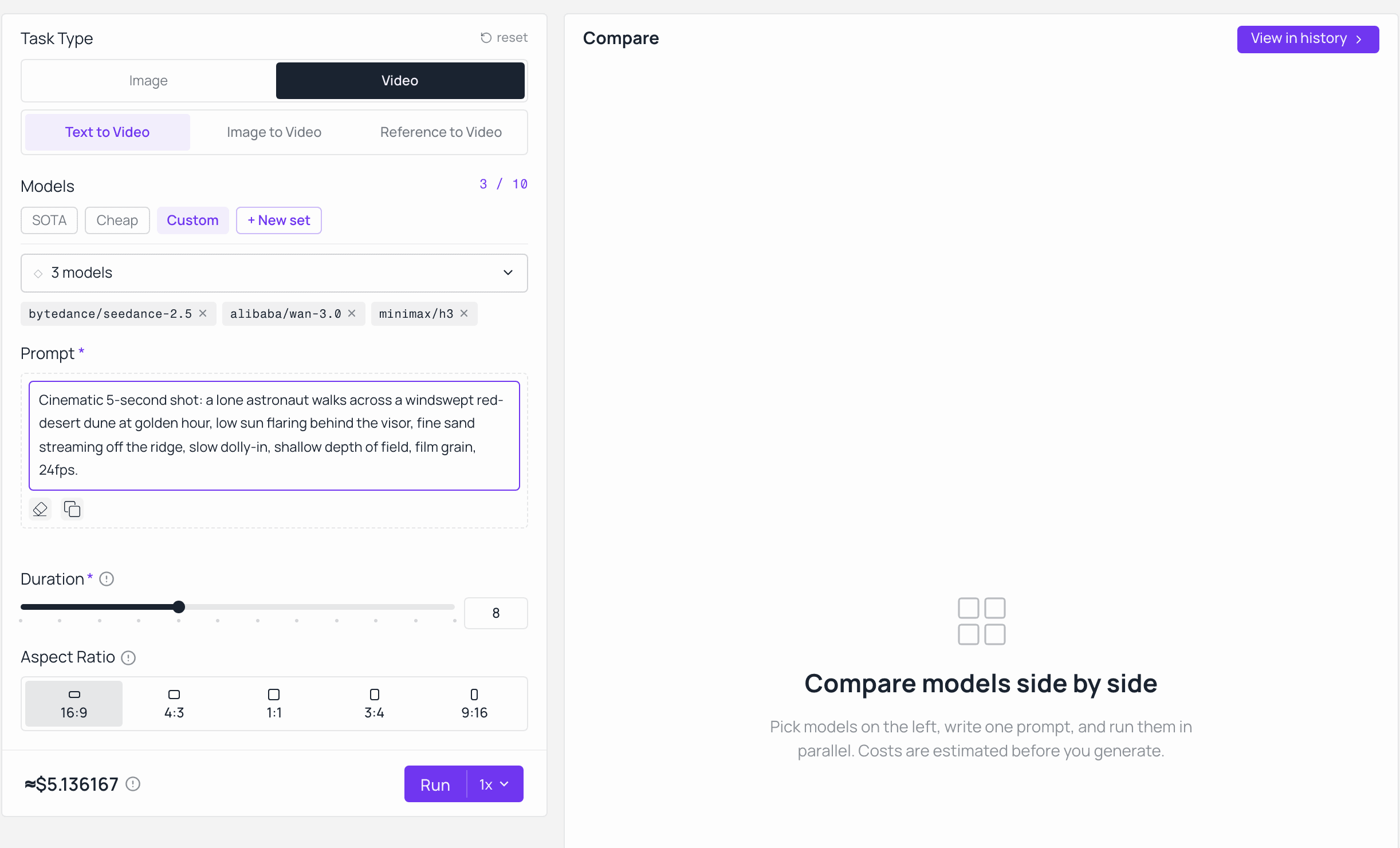
Atlas Cloud Model Explorer set to Text to Video with Seedance 2.5, Wan 3.0 and MiniMax H3 selected, one prompt, and the per-run cost estimated before generating_Three_ video models picked, one prompt written once, and the estimate for all three shown before you generate a single frame. That upfront number is the point: you see what a three-model comparison costs before you spend it.
The cost estimate updates live as you change models and duration, so you commit only after you have seen the number. Write once, run three, compare in one view, with your own brief instead of ours.
Frequently asked questions
Which is better, Wan 3.0, Seedance 2.5 or MiniMax H3?
There is no single winner, which is why this is a ten-test comparison and not a ranking. Across these briefs Seedance 2.5 was strongest on in-frame text and clean product surfaces, MiniMax H3 held human identity and natural motion best, and Wan 3.0 handled the longest, most over-specified multi-shot prompts. The right pick depends on your shot list, so run your own prompt through all three.
When is Wan 3.0 available on Atlas Cloud?
Wan 3.0 lands on Atlas Cloud on 24 August 2026. The model page is live now for early-access sign-up so you get access the day it goes live, and Wan 2.7, 2.6 and 2.5 are already available under the same key today.
Do I need three accounts to compare Wan 3.0, Seedance 2.5 and MiniMax H3?
No. All three sit in one catalog on Atlas Cloud behind a single API key. In Model Explorer you select the models, write the prompt once, and run them in parallel in one browser tab, with the cost estimated before you generate.
Can I get the exact prompts used in these tests?
Yes. All ten come from the official Wan 3.0 creator handbook, and the full set of 64 prompts, each with its official reference clip, is copy-paste ready in the Wan 3.0 Prompt Hub, with an open-source mirror on GitHub. Copy any one, drop it into Model Explorer, and reproduce the comparison.
Do Wan 3.0, Seedance 2.5 and MiniMax H3 generate native sound?
All three generate native audio in the same pass as the picture, so the sound in every clip above came out of the model, not a separate edit. In Wan 3.0 the audio can be toggled off if you want a silent render.
The ten comparison clips were produced on Atlas Cloud. Prompts are from the official Wan 3.0 creator handbook. Model capabilities reflect each vendor's published specs as of August 2026 and are subject to change.