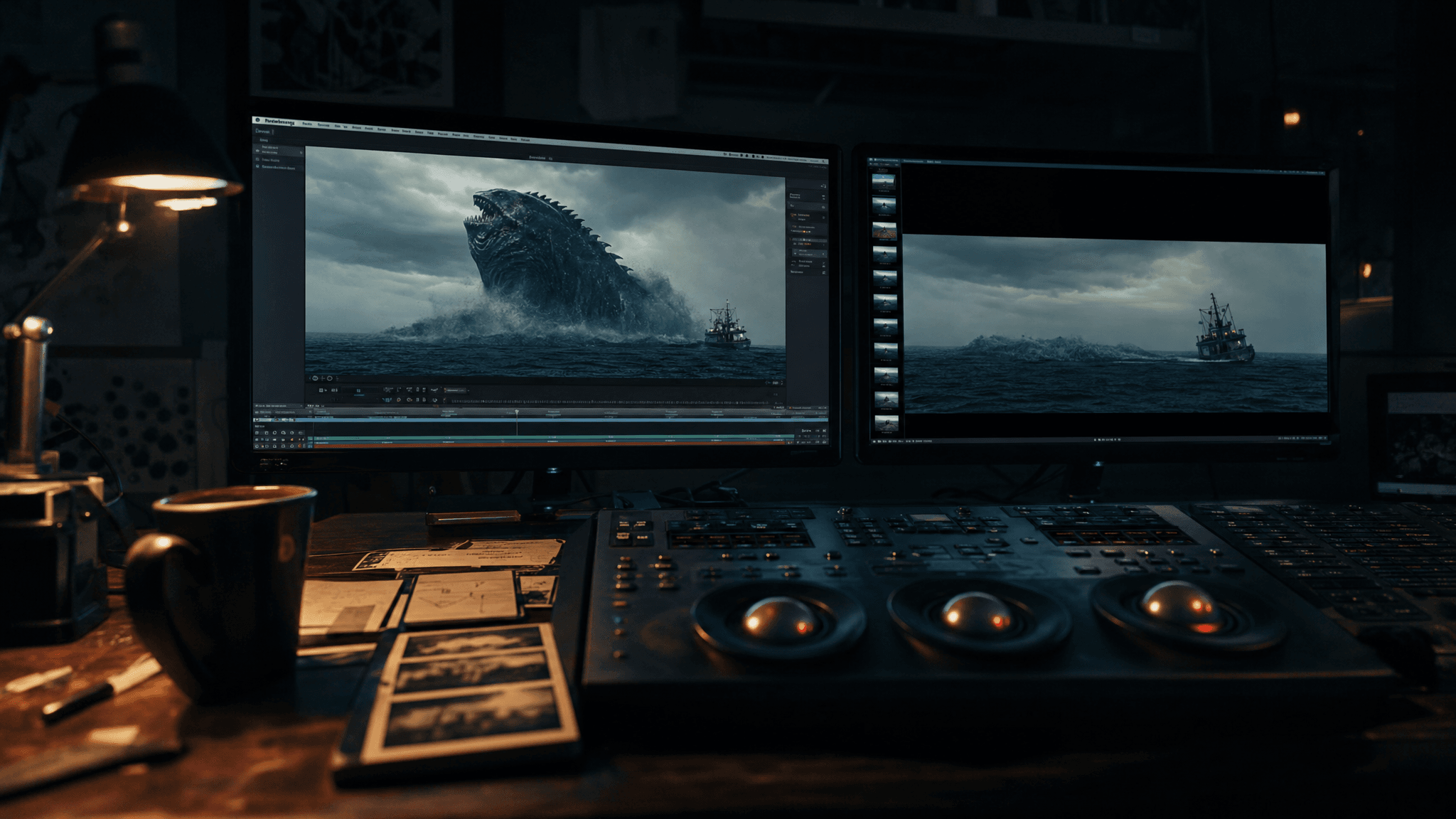
Two editing-suite monitors side by side, the left showing a sea monster breaching a storm, the right showing the same storm cut short
Play the 30-second sea monster clip Alibaba shipped with the Wan 3.0 beta. Fishing trawler, torrential rain, lightning, then the ocean explodes upward. Ten distinct shots. Not one cut. The orchestral score under it was written by the model.
Your first reaction is not "wow." It is "what exactly is my Wan 2.7 missing?"
So I went looking for the answer, and the first thing I found was that most of the internet is answering it wrong. Search wan 3.0 vs wan 2.7 and the top results confidently tell you Wan 3.0 renders native 4K and that the weights are on Hugging Face. Neither is true. I pulled the official demo files onto a laptop and read them with ffmpeg, then checked the model registries and the published price tiers. The real upgrade is big. It just is not the upgrade people are describing.
Wan 3.0 vs Wan 2.7: key takeaways
- Duration is the headline. Wan 3.0 generates 30 seconds in one pass with an automatic "smart duration" recommendation. Wan 2.7 caps at 15 seconds for text-to-video and image-to-video, and 10 seconds for reference-to-video and video editing.
- References jump from a handful to a crowd. Wan 2.7 accepts up to 5 reference items. Wan 3.0 accepts up to 20, and for the first time takes doc, xls, ppt, pdf and md files, plus web pages, as generation inputs.
- There is no 4K. Alibaba's own API price list has exactly three tiers: 480P, 720P and 1080P. On Atlas Cloud, Wan 2.7 actually offers a higher ceiling through its 1080P-SR and 1440P-SR super-resolution options.
- The weights are not open. The Wan-AI organization on Hugging Face still tops out at Wan 2.2. There is no 3.0 repository, no 2.7 repository, and no 2.5 repository.
- Wan 3.0 is beta-only and first-party-only. It runs on Alibaba Cloud Bailian, the Wanxiang site, the Qianwen creation desktop app and a few sibling products. If you need an API you can call in production this week, Wan 2.7 is still the generation that answers.
- Want to see the format before you learn the prompt grammar? Atlas Cloud has a free AI ad skit generator that turns one product description into a 15-second two-character comedy ad with spoken dialogue. One free generation, no watermark.
The full 30-second kaiju sequence, generated by Alibaba on Wan 3.0 during the public beta and published in the official Wan 3.0 creator handbook. We did not generate this clip. Turn the sound on: the score is part of the output, not a music bed added afterwards. File as delivered: 1920x1072, 24fps, 30.07s, 44.1kHz stereo AAC.
Here is the first thing the spec sheets miss. That file is 1920x1072, not 1920x1080. Every "1080p" demo in the official handbook lands on 1072 pixels of height, and several of the other published demos are plain 1280x720. Twelve of the nineteen clips in the handbook run 30.05 to 30.07 seconds, which tells you the 30-second ceiling is a real hard stop and not a marketing round number.
Why the Wan 3.0 vs Wan 2.7 question is harder than it looks
The honest answer is that almost nobody has run both models on the same prompt, because almost nobody can. Wan 3.0 opened for public beta on August 6, 2026 and lives on Alibaba's own surfaces (QbitAI, August 2026). Third-party inference platforms have not picked it up. So the comparison content that exists is spec sheet to spec sheet, and the spec sheets have been copied sideways until the errors calcified.
Three Wan 3.0 vs Wan 2.7 "facts" that are just wrong
"Wan 3.0 is native 4K." It is not. The published API price list runs 480P, 720P and 1080P at ¥0.3, ¥0.6 and ¥1.2 per second. Three tiers, no fourth. Meanwhile Atlas Cloud exposes 1080P-SR and 1440P-SR on Wan 2.7, so on pure pixel ceiling the older generation currently wins.
"The Wan 3.0 weights are open." They are not. Browse Hugging Face and the Wan-AI organization's newest released family is Wan 2.2, including the Animate and S2V variants. The core video line has not shipped weights since 2.2. If you want something for a local ComfyUI graph, 2.1 and 2.2 are your options and that has not changed.
"Prompt grammar carries straight across." This one is half true in a way that will burn you. The words carry. The structure does not. Wan 3.0's official prompts are timestamped multi-shot scripts: the kaiju prompt is ten numbered shots, the billboard prompt is four labelled beats with explicit second ranges. Paste a ten-shot script into a 15-second model and it does not gracefully pick six shots. It compresses.
Why you can't just swap prompts between Wan 3.0 and Wan 2.7
There is a second trap underneath that one, and it is the reason "just stitch two clips" does not rescue you.
Wan 2.7 has a video continuation mode. It looks like a path to 30 seconds. It is not. The source clip you feed it has to be 2 to 10 seconds, so a 15-second generation cannot be the seed. The output re-encodes the source, which eats the tail of the clip you fed in. And chaining continuations tends to drift back toward the opening beat rather than moving the story forward. Fifteen seconds is the hard ceiling for one continuous Wan 2.7 file. Anything longer is an edit, not a generation.
That is the real migration cost between these two generations, and no comparison table will show it to you.
Wan 3.0 vs Wan 2.7 spec sheet, and where to actually run it
To test any of this you need somewhere that runs text-to-video, reference-to-video and video editing on the same account, with per-second billing so a failed take costs you seconds instead of a subscription. Everything on the Wan 2.7 side of this article runs on Atlas Cloud, which hosts the four Wan 2.7 endpoints and the image model used for the reference test. Wan 3.0 is not on Atlas Cloud or any other third-party platform yet, which is exactly why the Wan 3.0 material in this article comes from Alibaba's own beta publications.
Table 1: Wan 3.0 vs Wan 2.7, generation to generation
| Wan 3.0 (public beta) | Wan 2.7 (production) | |
|---|---|---|
| Max duration, one pass | 30s, with smart duration | 15s (t2v, i2v), 10s (r2v, video edit) |
| Reference items | Up to 20 | Up to 5 (1 image per subject, up to 3 videos) |
| Input modalities | Text, image, video, audio, doc/xls/ppt/pdf/md, web pages | Text, image, video, audio |
| Document input | Single file or link, up to 100MB and 50 pages | Not supported |
| Resolution tiers | 480P / 720P / 1080P | 720P / 1080P / 1080P-SR / 1440P-SR |
| Native audio | Yes | Yes |
| Video editing | Instruction and reference editing | Dedicated video-edit endpoint |
| Open weights | No | No |
| Where you can run it | Alibaba first-party surfaces only | Third-party APIs, including Atlas Cloud |
| Listed price | ¥0.3 / ¥0.6 / ¥1.2 per second by tier | $0.1 per second, 720P baseline |
Table 2: the Wan 2.7 endpoints used in this article
| Endpoint | Max duration | Resolutions | Reference limit | Listed price |
|---|---|---|---|---|
| Text-to-video | 2-15s | 720P, 1080P, 1080P-SR, 1440P-SR | n/a | $0.1 / sec |
| Reference-to-video | 2-10s | 720P, 1080P, 1080P-SR, 1440P-SR | 5 items | $0.1 / sec |
| Image-to-video | 2-15s | 720P, 1080P, 1080P-SR, 1440P-SR | source clip 2-10s | $0.1 / sec |
| Video-edit | 2-10s out, 2-10s in | 720P (1.0x), 1080P (1.5x) | 3 images | $0.1 / sec |
One pricing detail worth internalizing before you run anything: the "$0.1 per second" headline is the 720P baseline. The video-edit page documents a 1.5x multiplier for 1080P outright, and the Run button quotes the real number for whatever tier you have selected. Read the button, not the header.
Run the Wan 3.0 vs Wan 2.7 test yourself
Four steps. Two of them use Alibaba's published material as the fixed reference point, two of them are runs you make yourself. Nothing here requires access to the Wan 3.0 beta.
Step 1: Grab the Wan 3.0 clip and its original prompt
The Wan 3.0 side of this test is not something you generate. It is something you read. The full kaiju prompt is published in the official Wan 3.0 creator handbook, along with the finished clip, under the "灾难电影" example. It is a Chinese-language script with ten numbered shots and a separate paragraph describing the score.
Read it once before you do anything else. The structure is the lesson: ten shots, each with its own camera, subject and lighting note, ending with a scoring brief. That is what a 30-second single-pass generation prompt looks like.
Step 2: Run the same prompt through Wan 2.7 text-to-video
Open the Wan 2.7 text-to-video playground and paste the English rendering of that same script. Do not shorten it yet. You want to see what the model does when the intent overruns the ceiling.
Plain1A 30-second, photoreal cinematic sequence: a deep-sea kaiju emerges at night in a raging storm. Open on a small, battered fishing trawler with the white letters "WAN" on its hull, fighting through enormous waves under torrential rain; lightning briefly lights the whole ocean. Push to a mid-close shot on the deck: waves smash over the bow, ropes, nets and metal railings whip in the wind, rain streaks the lens. Then the sea ahead swells unnaturally, an enormous vortex forms, and a vast dark shape passes beneath the boat, lifting it. A crewman in a soaked rain jacket grips the rail, terrified, and turns toward the water. Finally the surface explodes upward and a colossal Pacific-Rim-style sea monster breaches: wet, scarred, ridged skin, huge jaws, tens of meters of spray. Close on its head roaring in the lightning. The trawler is nearly swallowed. End on a wide shot: the kaiju towering over the churning sea, the boat tiny in the foreground, one final lightning strike. Hollywood disaster-movie scoring: low sub-bass rumble and sparse strings building to brass and heavy percussion at the breach, ending on an oppressive sustained low chord. Photoreal scale, volumetric water, high-contrast storm lighting.
Settings: Resolution 1080P, Duration 15s (the maximum), Aspect ratio 16:9, audio left on so the model scores it itself. Leave the reference-audio slot empty.
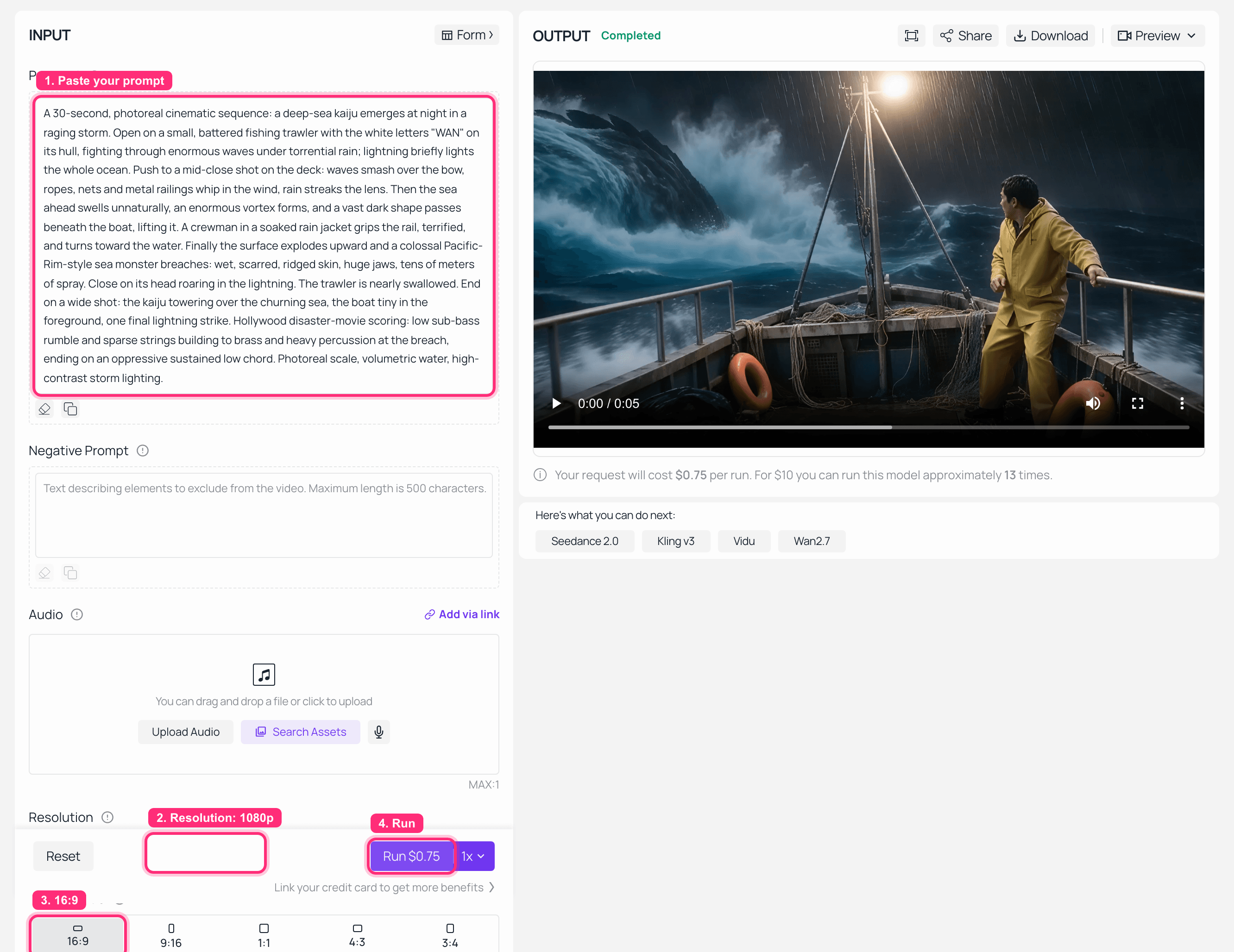
Wan 2.7 text-to-video playground on Atlas Cloud with the kaiju prompt loaded and the finished 15-second clip in the OUTPUT panel
Wan 2.7 text-to-video on Atlas Cloud, prompt pasted, 1080P and 16:9 selected. The Run button quotes $0.75 for this short test take, which works out to $0.15 per second: the 1.5x 1080P multiplier in plain sight, on a model page whose headline number is $0.1.
Then run it a second time with one line appended to the prompt:
Plain1Single continuous take, no cuts. Prioritize the breach moment; compress the setup.
That single line is the migration work in miniature. A 30-second script has to be re-authored as a 15-second intent, and you are the one who decides which seven shots die.
Left: the official Wan 3.0 output, 30 seconds. Right: Wan 2.7 on Atlas Cloud running the same prompt, stopping at its 15-second ceiling.
Step 3: Build the reference images for the Wan 3.0 vs Wan 2.7 identity test
Duration is the loud upgrade. Pixel-level consistency is the one that actually changes production work, and you can test it with two cats.
Alibaba's handbook includes a Wes Anderson pastiche in which the same ragdoll cat and the same black cat have to survive five wildly different environments: a symmetrical hotel corridor, a cutaway side view, a washing machine drum, an airport baggage belt and a red phone box. Both cats are pinned with @Image1 and @Image2 reference tags.
Generate your own two references first. Use GPT Image 2 with quality set to high and a 16:9 frame, and run it twice.
Plain1A studio portrait of a fluffy ragdoll cat with blue eyes and a dark mask, sitting upright facing the camera, evenly lit against a plain pale pink background, sharp fur detail, full body visible, clean reference-sheet framing.
Plain1A studio portrait of a small sleek black cat with bright amber eyes, standing in profile facing right, evenly lit against a plain pale pink background, sharp fur detail, full body visible, clean reference-sheet framing.
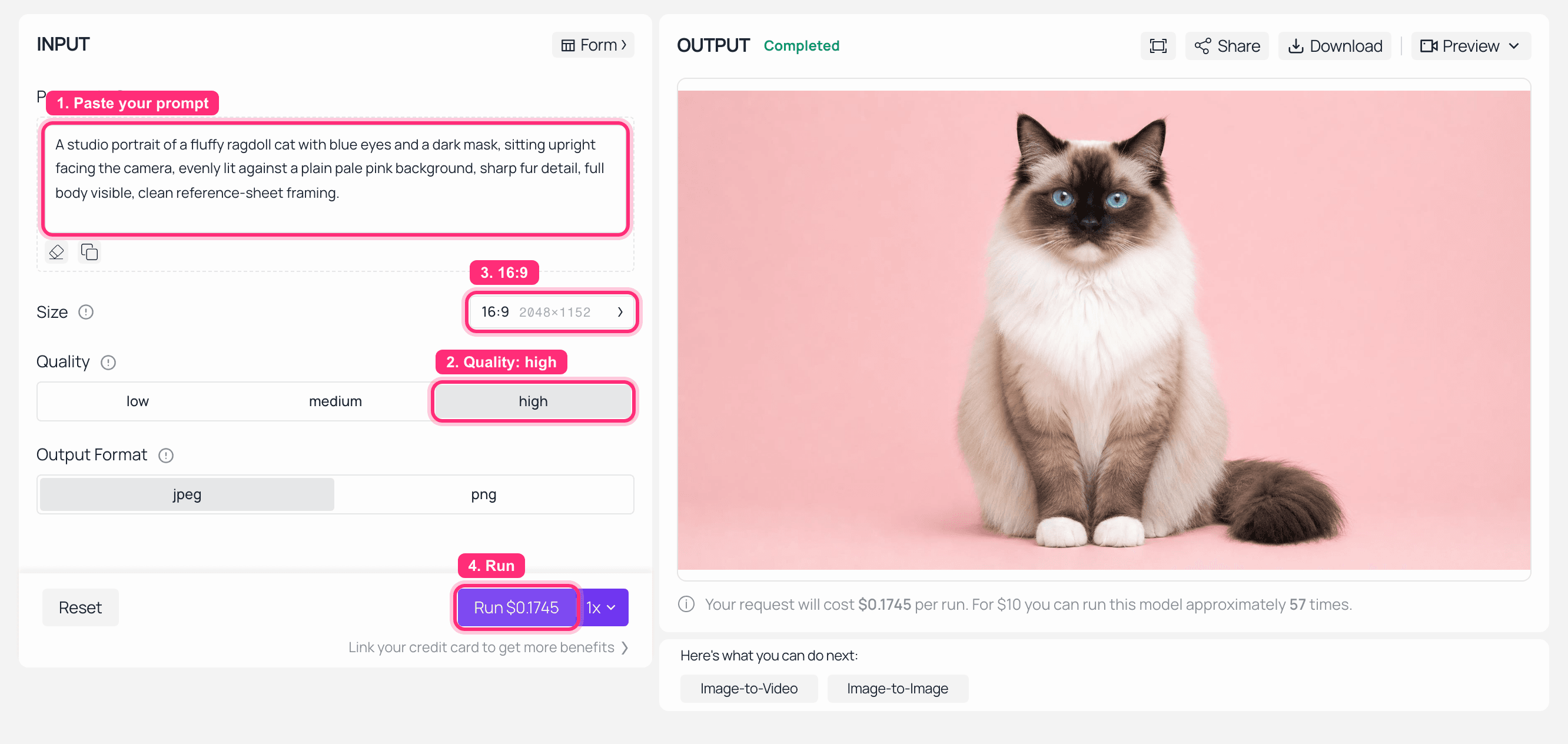
GPT Image 2 playground on Atlas Cloud with quality set to high and the ragdoll cat reference sheet rendered in the OUTPUT panel
GPT Image 2 at quality high, 16:9. Run the second prompt the same way to get the black cat.
Step 4: Run the identity test on Wan 2.7 reference-to-video
Upload both cats to the Wan 2.7 reference-to-video endpoint. Resolution 1080P, aspect ratio 16:9, duration 10 seconds, which is this endpoint's maximum. The prompt below is the handbook's shot list compressed from five beats to three, because ten seconds does not hold five.
Plain1Wes Anderson style, perfectly symmetrical, flat frontal compositions, pastel palette. Reference image 1 is the ragdoll cat, reference image 2 is the black cat; keep both cats identical in every shot. Shot 1: an endless symmetrical hotel corridor, the ragdoll cat running straight toward the camera with a solemn expression, the black cat sprinting away in the background with its head twisted back 180 degrees. Shot 2: a cutaway side view of the corridor, pink patterned wallpaper and gold picture frames, the ragdoll walking left to right and the black cat crossing right to left. Shot 3: frontal macro on a mint-green vintage washing machine door, both cats floating stiffly inside the drum among suds, eyes blank, rainbow-ordered detergent bottles lined up behind. Rigid horizontals and verticals, no camera tilt, deadpan absurd humor.
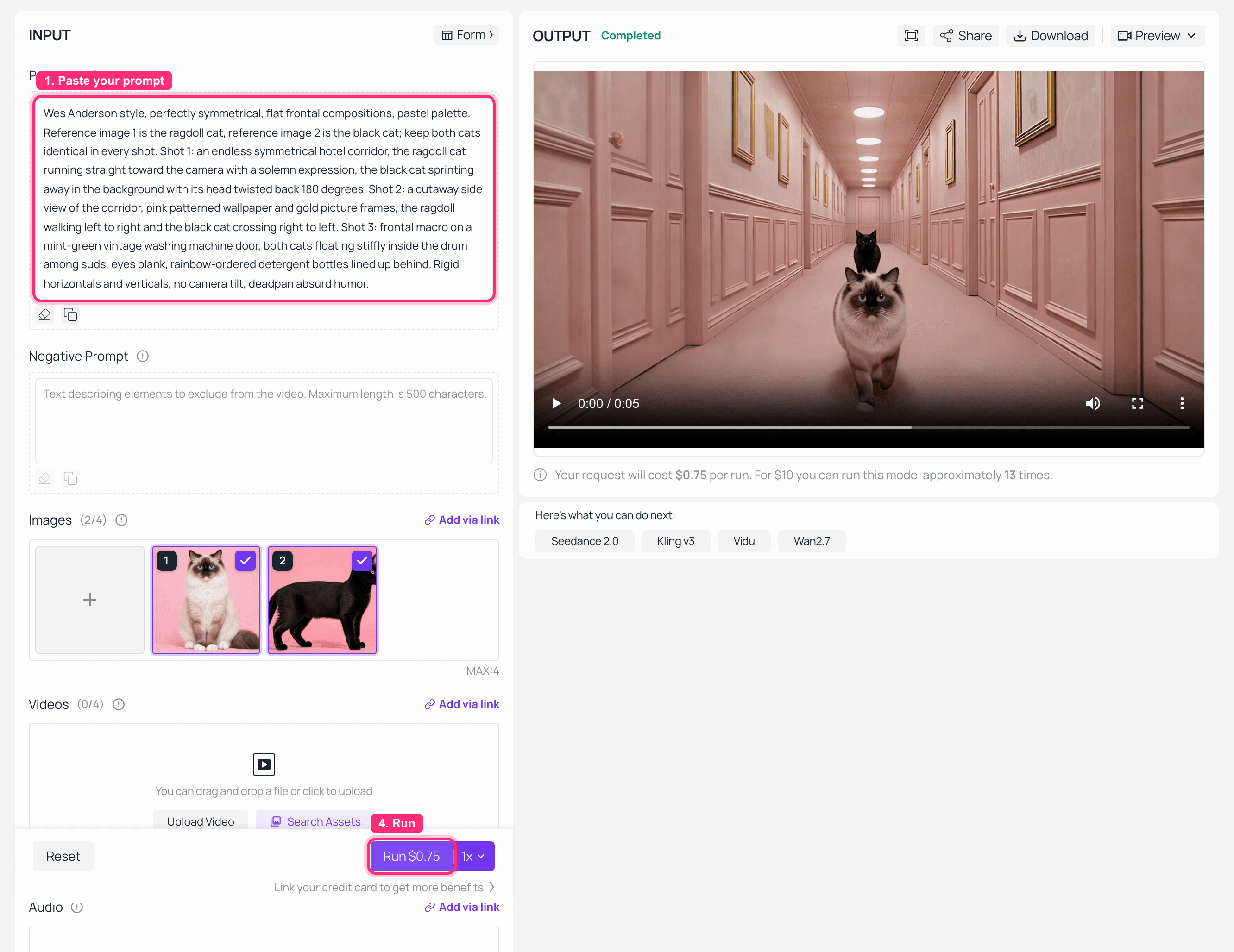
Wan 2.7 reference-to-video playground on Atlas Cloud with both cat references loaded and the finished clip in the OUTPUT panel
Wan 2.7 reference-to-video: both cats loaded into the image reference slots, resolution set to 1080P, and the Run button quoting the take before it starts. Two references is already a meaningful share of what this endpoint accepts. Wan 3.0 takes 20 reference items.
Now put the two side by side.
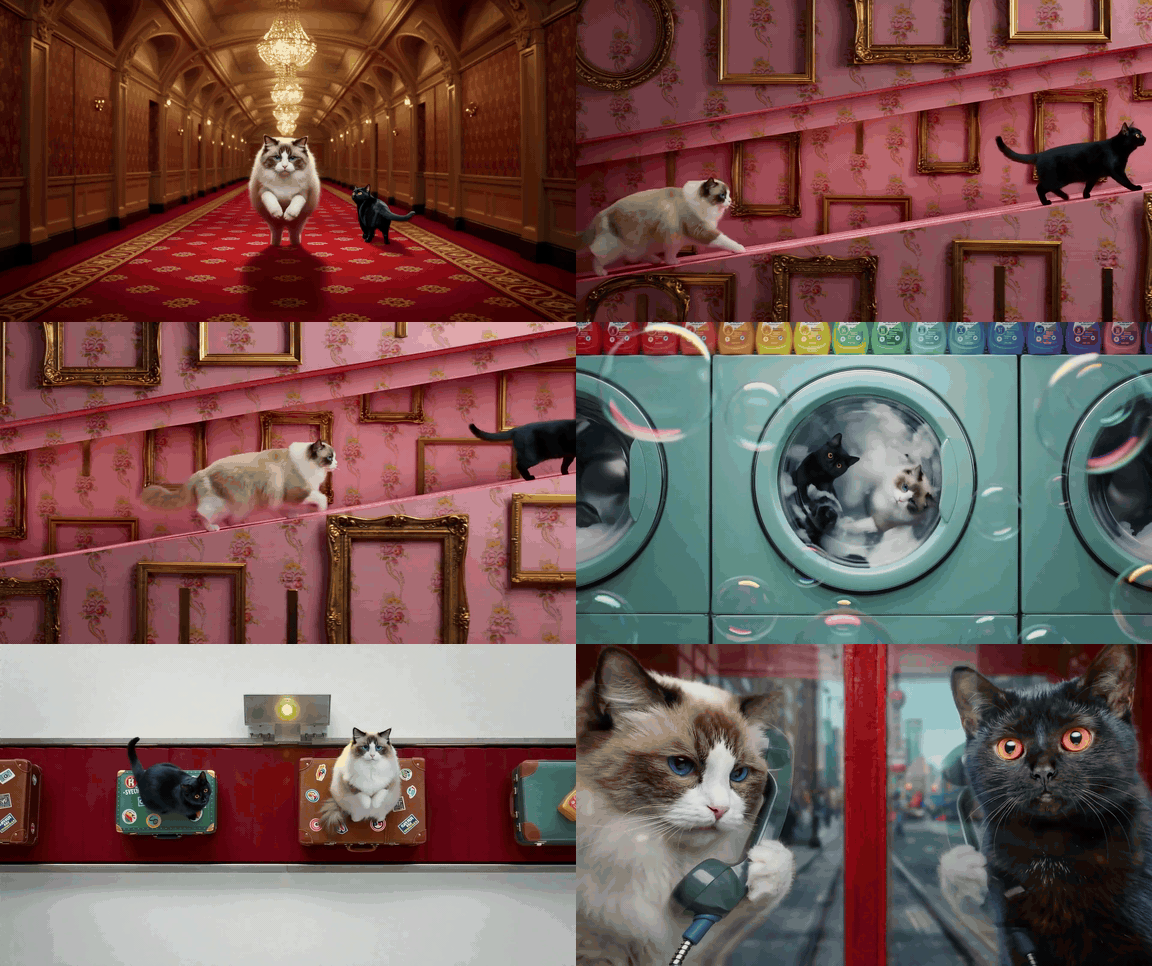
The official Wan 3.0 identity-lock clip: the same ragdoll and black cat held consistent across a hotel corridor, a cutaway wall, a washing machine drum, a baggage belt and a red phone box
Generated by Alibaba on Wan 3.0 during the public beta and published in the official creator handbook. Five environments, 19.9 seconds, both cats pinned by reference tag. Shown here as a silent GIF; the delivered file carries 44.1kHz stereo audio.
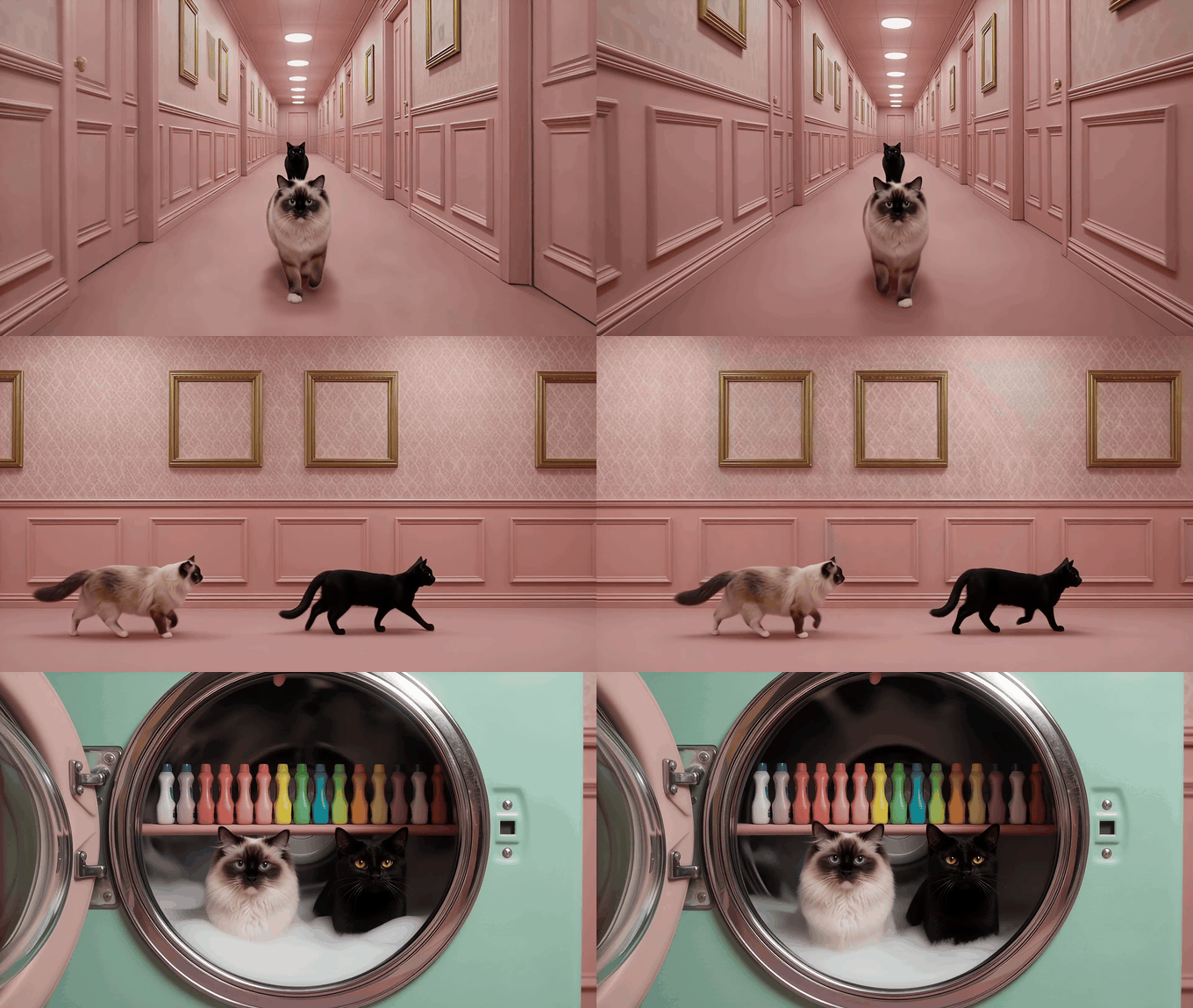
The Wan 2.7 reference-to-video result on the same brief, three shots inside the 10-second ceiling
Wan 2.7 reference-to-video on Atlas Cloud, the same two references, shown here as a silent GIF. This is the endpoint's default 5-second take rather than the full 10: worth knowing that the duration control does not always commit what you set, so read the Run button quote before you press it. Watch the cats' markings and the ragdoll's mask; that is the dimension the "pixel-level consistency" claim is about.
Four more Wan 3.0 vs Wan 2.7 prompts worth re-running
The kaiju clip stresses duration and physics. These three stress different things, and each one collides with a different Wan 2.7 limit. All three are Alibaba's own beta outputs from the official handbook.
Wan 3.0, official beta output: a single 30-second push-back down a fluorescent-lit hospital corridor, pale green monochrome grade, with the actress shouting for help. Sound on. The performance, the footsteps and the equipment hum are all model-generated.
Table 3: what each prompt demands, and where Wan 2.7 caps it
| Prompt | What the script asks for | Wan 2.7's published limit | The dimension being tested |
|---|---|---|---|
| Kaiju breach | 10 numbered shots across 30s, plus a scoring brief | 15s max on text-to-video | Duration and multi-shot narrative |
| Hospital corridor | One 30s continuous take with spoken dialogue | 15s max, native audio available | Performance and dialogue over long takes |
| Gas station cowgirl | 30s comedy arc in four timed acts | 15s max, so two acts have to go | Comic timing that needs runtime |
| Billboard one-take | Four beats with explicit second ranges, no cuts | 15s max, so the ranges need rewriting | Camera physics across a long move |
| Two cats, five rooms | 2 tagged subjects held across 5 environments | 10s max, 5 reference slots | Identity consistency |
A free 15-second version of the same idea
Look at the gas station clip again. That format, a short comedy skit with two characters, a reversal and a punchline, is where Wan 3.0's extra runtime pays off hardest. It is also the format most likely to sell something.
The catch is the prompt. The handbook's comedy examples run 800 words with explicit timestamps and blocking. That is a real skill and it takes a weekend to learn.
If you just want to find out whether the format works for your product before you invest that weekend, Atlas Cloud has a free tool that skips the prompt engineering entirely. You describe the product, optionally upload up to four product photos at 8MB each, pick one of six tones (funny meme, plot twist, sitcom, heartwarming, luxury or hard sell), and it writes the two-character script, casts the voices, generates the dialogue and sound effects, and returns a finished 15-second ad as one continuous scene. Downloads are clean, with no watermark. You need to be signed in, and you get one free generation before you top up credits.
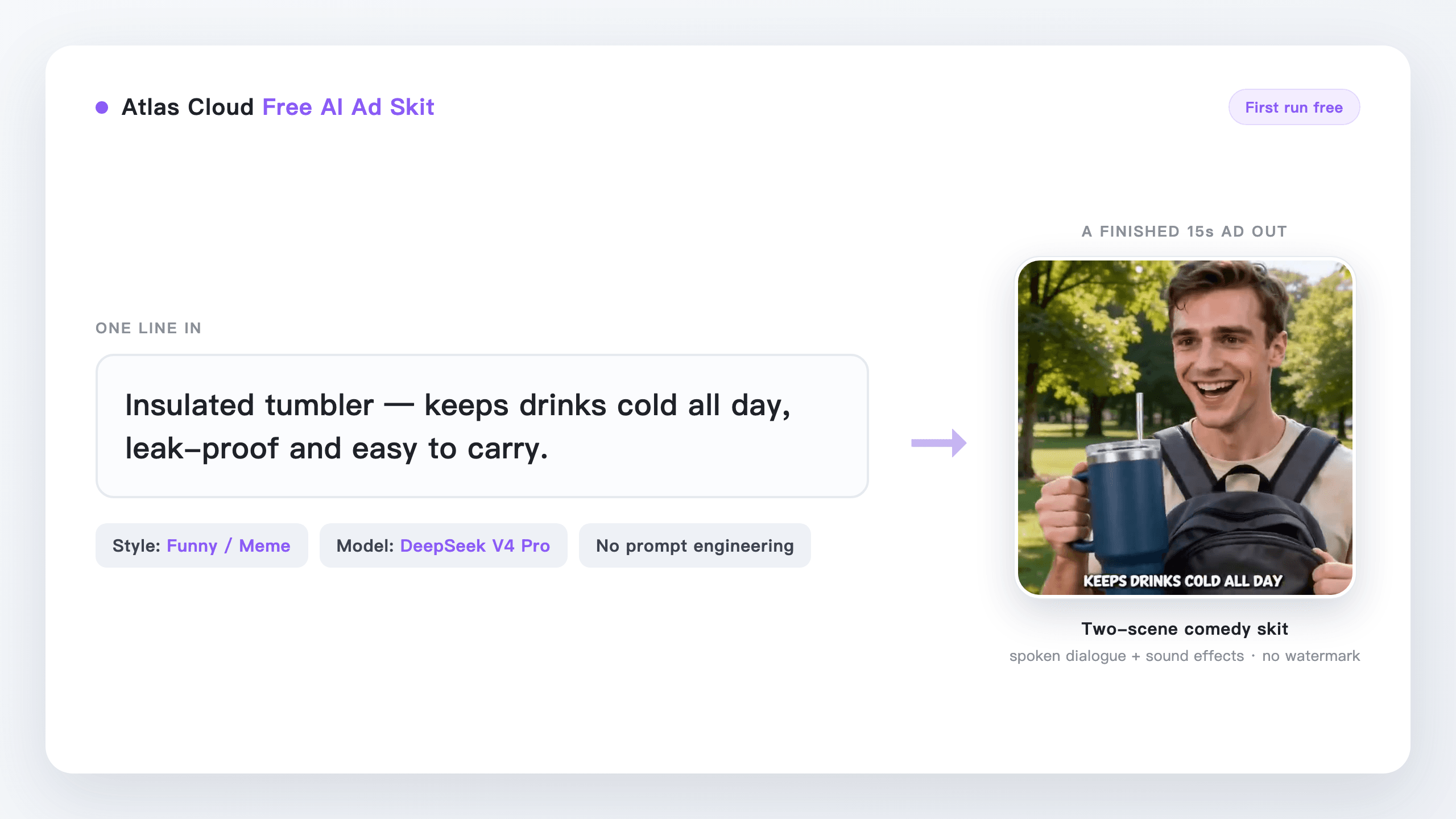
One line of product copy in, a finished 15-second comedy ad out: Atlas Cloud's Free AI Ad Skit generator
The Free AI Ad Skit Generator : one product description in, one 15-second two-character ad out.

A real output from the free generator. Sound on: the script, the two voices and the sound effects all come out of one run.
What a Wan 3.0 vs Wan 2.7 comparison costs to run
Per-second, the two generations are in the same neighbourhood at the 720P tier. The cost difference is structural: a clip that used to be 15 seconds is now 30, so a finished piece roughly doubles.
Table 4: the same kaiju sequence, four ways
| Run | Rate | Total |
|---|---|---|
| Wan 3.0, 30s at 720P | ¥0.6 / sec | ¥18, roughly $2.50 |
| Wan 3.0, 30s at 1080P | ¥1.2 / sec | ¥36, roughly $5.00 |
| Wan 2.7, 15s at 720P | $0.10 / sec | $1.50 |
| Wan 2.7, 15s at 1080P | $0.10 / sec with the 1.5x tier multiplier | $2.25 |
| Wan 2.7, 15s at 1440P-SR | quoted live on the Run button | quoted live |
| Free AI Ad Skit, 15s | free, 1 generation per account | $0.00 |
Two caveats. Beta pricing is not general-availability pricing, and Alibaba has said the API will open more broadly soon, so treat the ¥ figures as a snapshot of the public beta rather than a committed rate. And on the Atlas Cloud side, always read the live quote on the Run button before you commit, because the resolution multiplier is applied there and not in the headline price.
Alibaba has also been unusually direct about where Wan 3.0 is still weak, saying the model "still has room for improvement in sound quality and text accuracy." That matches what the files show: the audio on the official demos is 44.1kHz stereo but encoded at a modest 32 kb/s, which is fine for a preview and thin for a delivery master.
Wan 3.0 vs Wan 2.7 licensing: what you can actually ship
Short version, and please verify it against the current terms yourself before you put anything in front of a client.
Wan 3.0 is in public beta and its commercial terms are not settled. Because the weights are not released, there is no self-hosted path at all; anything you make goes through Alibaba's API or its consumer surfaces, and you are bound by whatever those terms say on the day you generate. Wan 2.7 is the same story on weights, but it has been in production long enough that the platform API terms are stable. If you are running it through a third-party platform, your commercial rights come from that platform's terms of service, so read the ones that actually apply to your account. Neither of these paragraphs is legal advice.
Wan 3.0 vs Wan 2.7 FAQ
Is Wan 3.0 open source? Can I run it in ComfyUI?
No. As of August 2026 there is no Wan 3.0 repository under the Wan-AI organization on Hugging Face, and none on the Wan-Video GitHub either. The newest Wan family with released weights is Wan 2.2, including the Animate and S2V variants. For a local ComfyUI graph you are still on 2.1 or 2.2. Wan 3.0 is API and web only.
Wan 3.0 vs Wan 2.7 resolution: does Wan 3.0 really generate 4K?
No. The published API price list has three resolution tiers: 480P, 720P and 1080P. Several widely-shared comparison posts claim native 4K and they are wrong. On raw output ceiling, Wan 2.7 on Atlas Cloud actually goes higher through its 1080P-SR and 1440P-SR super-resolution options.
Can I get 30 seconds out of Wan 2.7 by extending clips?
Not as one continuous file. The continuation mode requires a source clip of 2 to 10 seconds, so a full 15-second generation cannot seed it. The output re-encodes and trims the tail of whatever you feed in, and chained continuations tend to loop back toward the opening beat. Past 15 seconds you are editing, not generating.
Wan 3.0 vs Wan 2.7: where can I actually run each one today?
Wan 3.0 is in public beta on Alibaba's own surfaces: Alibaba Cloud Bailian, Wanjing Yike, the Wanxiang site, the Qianwen creation desktop client, IF STUDIO and Duiyou, with grayscale access in the Qianwen app. No third-party inference platform hosts it yet. Wan 2.7 is the generation you can still call directly, across text-to-video, image-to-video, reference-to-video and video-edit endpoints.
Wan 3.0 vs Wan 2.7 pricing: which costs more per finished clip?
Per second at the 720P tier they are close. Per finished clip, expect roughly double, because the natural output length went from 15 seconds to 30. Budget for the runtime change rather than the rate change, and remember that beta pricing may not survive general availability.
Do I need to rewrite my Wan 2.7 prompts for Wan 3.0?
Yes, and the rewrite is structural rather than lexical. Wan 2.7 prompts describe one continuous shot in rich detail. Wan 3.0 prompts are timestamped shot lists, sometimes with a separate scoring paragraph, and the model will also read a pdf or a deck as input. Rule of thumb: for Wan 2.7 write one paragraph about one shot; for Wan 3.0 write a numbered scene breakdown with second ranges.





