A fast action prompt exposes whether an AI video model can preserve cause and effect. This kling 4 complex action prompt test is built for that job: 3 repeatable scenes that require an athlete and dog to clear an obstacle, two fencers to make controlled contact, and a woman and cat to remain coherent around a moving umbrella.
Key takeaways
- Flash early access and full Kling 4.0 are separate product states.
- Each scene isolates a chain of visible actions instead of chasing a pretty frame.
- Run each prompt 3 times consecutively and select run 2 unless it has a technical failure.
- Score motion, identity, contact, space, and camera relationship from 0 to 2.
- Atlas Cloud is a place to repeat the available Kling 3.0 baseline, not a claimed Kling 4 access path.
Kling 4 Complex Action Prompt Test: What We Can Verify Today
Kling’s public announcement says that Kling 4.0 Flash opened limited experience on September 28, while the full model is scheduled for October. The same announcement describes longer generation, 4K and 10-bit HDR output, richer reference inputs, and keyframe control for full Kling 4.0. Those are stated capabilities, not evidence that Flash provides every control or that it will pass the scenes below. Treat the interface your account can see as the authority for Flash duration, resolution, audio, references, region, and eligibility. (Kling 4 release notes, September 2026)
For this protocol, “complex action” means a shot that asks the model to maintain at least 3 of these 5 conditions: a time-ordered action, contact and reaction, a recognisable subject, an environmental response, and a clear camera relationship. A person jogging through an empty frame does not qualify. A run, vault, landing, dust reaction, and continuing motion does.
That distinction protects the result from a common error. A polished opening frame cannot prove that the model completed a landing or kept a key prop consistent through a fast move. The test observes the entire action chain. It also does not mix in reference images, multi-keyframes, audio, or automatic multi-shot mode, because each one would change what the result measures.
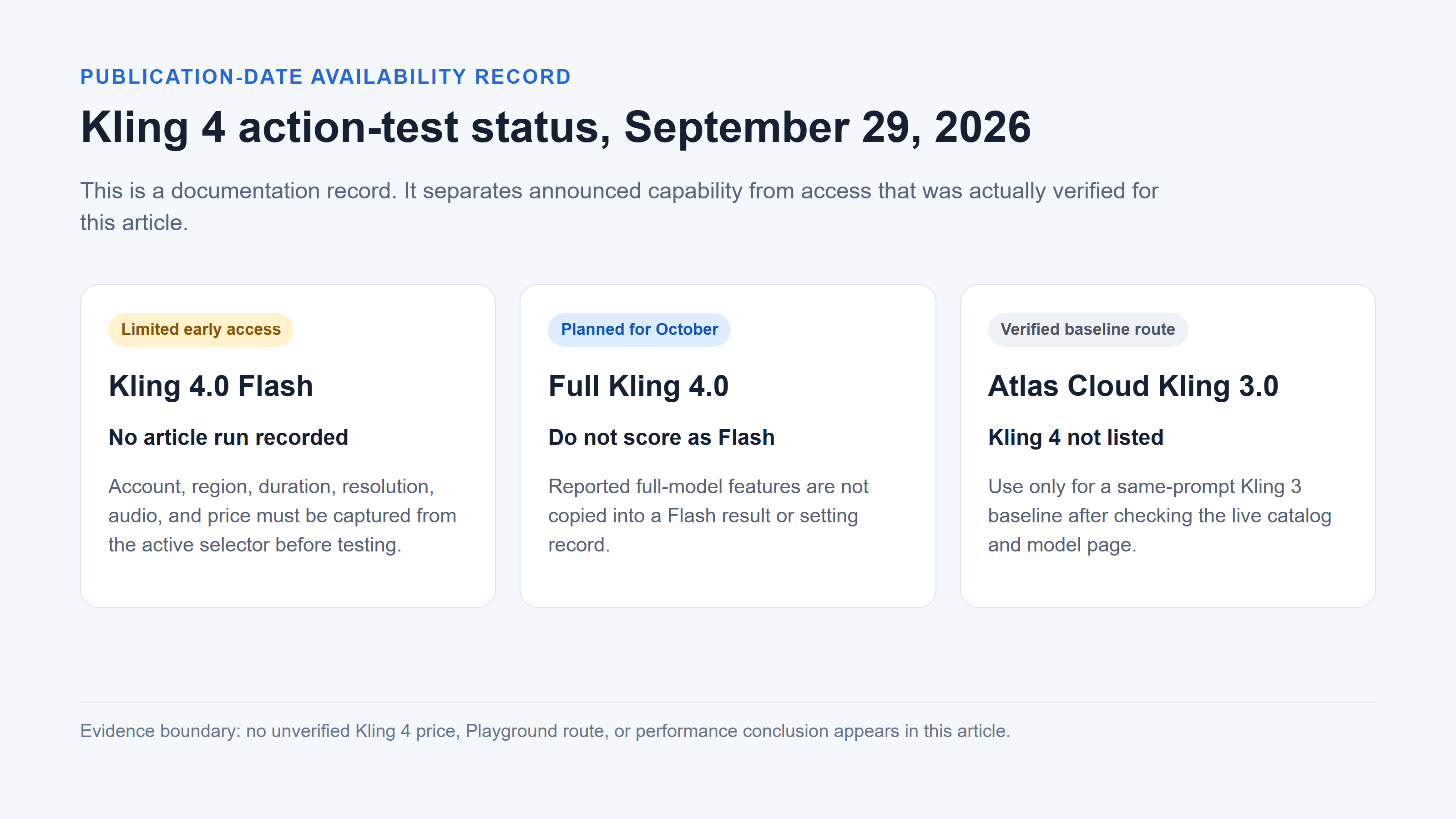
Publication-date availability record for Kling 4 Flash, full Kling 4, and the Atlas Cloud Kling 3 baseline
Publication-date record: Flash is limited early access; full Kling 4.0 is not treated as released. Atlas Cloud is shown only as a Kling 3.0 baseline route.
Kling 4 Complex Action Prompt Test: The 3-Scene Protocol
Use one account, one model selection, the same aspect ratio, and the same duration for all 3 scenes. Start with text-to-video only. Generate each prompt 3 times in immediate sequence, then preserve the raw files, prompt, timestamp, settings, and any failure tag. Do not rerun a scene to chase a more flattering take.
The planned representative clip is run 2. Use run 3 only if run 2 has a technical failure such as an incomplete export or a blank file. State that substitution beside the clip. This prevents a showcase reel from masquerading as a test.
Landing physics under a Kling 4 complex action prompt test
This scene asks for takeoff, airborne motion, landing, impact absorption, and continued running. Score whether both feet visibly meet the ground, whether dust appears at impact rather than in mid-air, and whether clothing and face remain continuous after the landing.
Two-person interaction in a Kling 4 complex action prompt test
Two adult fencers make a limited, non-graphic exchange. The test checks left-right positioning, a single readable blade contact, footwork, and a smooth camera half-circle. It does not test violence or award points for spectacle.
Cat, umbrella, and camera continuity in a Kling 4 complex action prompt test
A rainy street, a woman, a tabby cat, a blue umbrella, and a tracking camera create several chances for the subject or prop to drift. The person and cat should remain recognisable, the umbrella should stay a single consistent object, and the camera should keep the full action readable.
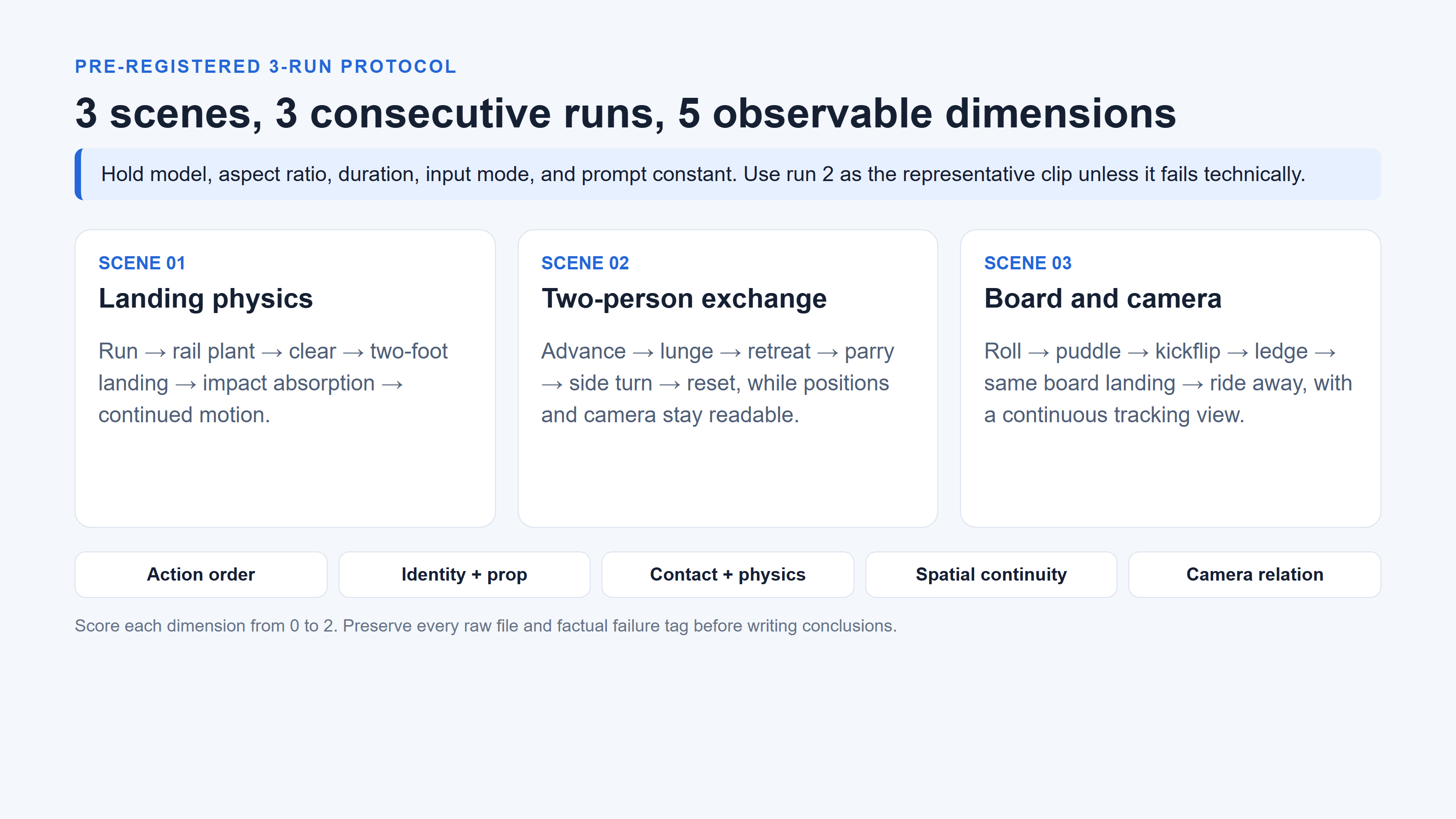
Three-scene Kling 4 complex action prompt test protocol with the 3-run rule and five scoring dimensions
The protocol card records what is held constant and what each scene is designed to reveal. It is a browser-rendered document, not a model result.
How to Score an AI Action Clip Before You Share It
Watch each run at normal speed, then once at 0.5x. Mark only visible events. A clean-looking clip still earns a low score if it skips the requested consequence or substitutes a new object. The 10-point total gives a team a common language without turning the exercise into a model leaderboard.
| Dimension | 0 points | 1 point | 2 points |
|---|---|---|---|
| Action order | A key action is missing or reversed | The chain completes with a visible jump | Cause, main action, and consequence are clear |
| Identity and prop | Subject or prop changes markedly | Minor drift | Subject, clothing, and key prop stay stable |
| Contact and physics | Interpenetration or no contact | Contact with weak reaction | Contact, weight, and reaction are readable |
| Spatial continuity | Direction or position collapses | One noticeable jump | Space, direction, and distance remain coherent |
| Camera relationship | Camera loses the subject | Brief loss of control | Camera serves the action and stays readable |
Write a short factual tag with every deduction: “board changes shape during rotation,” “left-right positions exchange after the parry,” or “dust appears before foot contact.” Avoid vague quality labels. The tag helps the next prompt change one variable rather than pile on more adjectives.
As of the September 29 publication check, this scorecard remains intentionally unfilled because no verified Kling 4 Flash account output was supplied or operated. The three user-supplied Kling Video O3 Standard clips below are illustrative baseline examples, not the nine-run Flash test, so they are not assigned scores here. A future Flash run should add all 9 raw clips and fill every row before any performance conclusion is published.
Kling 4 Complex Action Prompt Test: Copy These Exact Prompts
Use these settings only when they are actually exposed in the Kling interface:
- Model:
Kling 4.0 Flash, only if the selector visibly offers it. - Quality: the highest Flash resolution currently visible. Record the value instead of calling it 4K by default.
- Aspect ratio: 16:9.
- Duration: 12 seconds only if the control permits it. Otherwise use the nearest complete duration and update the test record.
- Generation count: 3 consecutive runs per scene.
- Reference inputs: none. This is text-to-video so identity continuity is not inherited from an image.
- Audio: disabled or excluded from scoring.
- Multi-keyframes: excluded. Reserve them for a separate control-assisted test.
Test 1: landing physics
plaintext1An 8-second single continuous cinematic action shot on a windswept coastal dune at golden hour. One adult female trail runner wears a burnt-orange shell jacket, deep teal running tights, and a chestnut braid. A black-and-white border collie runs parallel to her on the left, always remaining a safe distance away. The runner approaches one low piece of weathered driftwood, plants her left foot once, clears it in one clean leap, lands on both feet on damp sand, absorbs the landing with bent knees, and continues running forward. The border collie keeps pace beside her without crossing her path. A low lateral tracking camera keeps both subjects visible from takeoff through landing. Sand lifts only when the runner’s shoes strike the ground. Warm backlight, realistic wind in hair and jacket, coastal grasses, natural motion, no cuts, no slow motion, no text, no logo, no extra people, no duplicate dog.
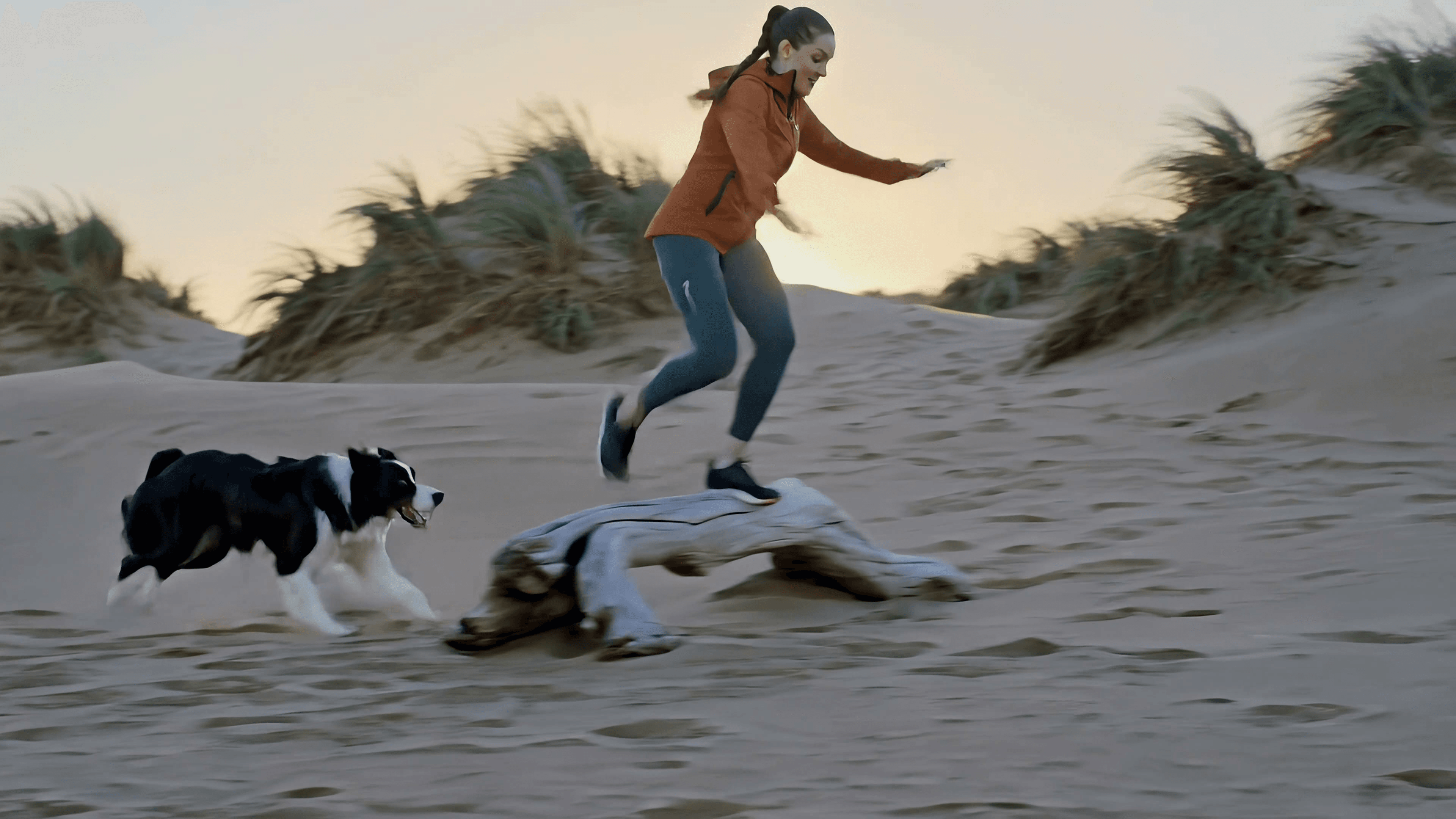 Trail runner in a burnt-orange jacket clears driftwood as a border collie runs beside her
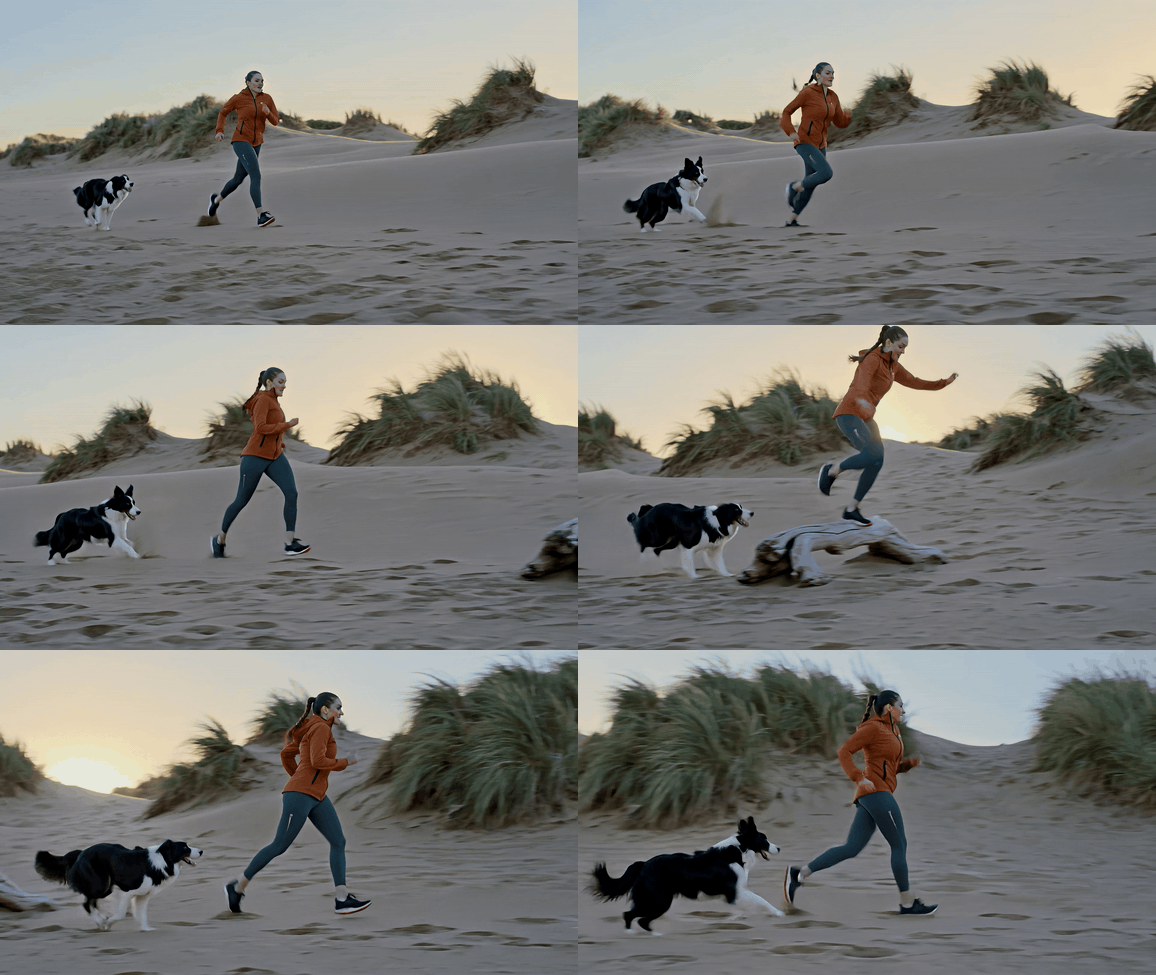
Eight-second runner and border collie obstacle sequence
User-supplied Kling Video O3 Standard example. The clip shows the runner clearing driftwood and continuing forward; check whether the dog stays in frame and whether the landing reads as a two-foot impact.
Test 2: two-person interaction
plaintext1An 8-second single continuous medium-wide cinematic shot inside a historic glass conservatory at golden hour, with tall ferns, climbing ivy, warm sunlight, and long reflections on the stone floor. Two adult fencing athletes wear clean white protective jackets, masks, gloves, and dark navy trousers. Athlete A begins on the left and advances with two controlled steps, then makes one measured lunge. Athlete B begins on the right, retreats one step, parries the blade once, turns slightly sideways, and both athletes reset their distance. Keep both full bodies, both foils, and their left-right positions visible throughout. The camera makes one smooth half-circle around the athletes while preserving readable blade contact and footwork. Elegant cinematic lighting, realistic fabric movement, no collision with camera, no cuts, no text, no logo, no audience, no extra people.
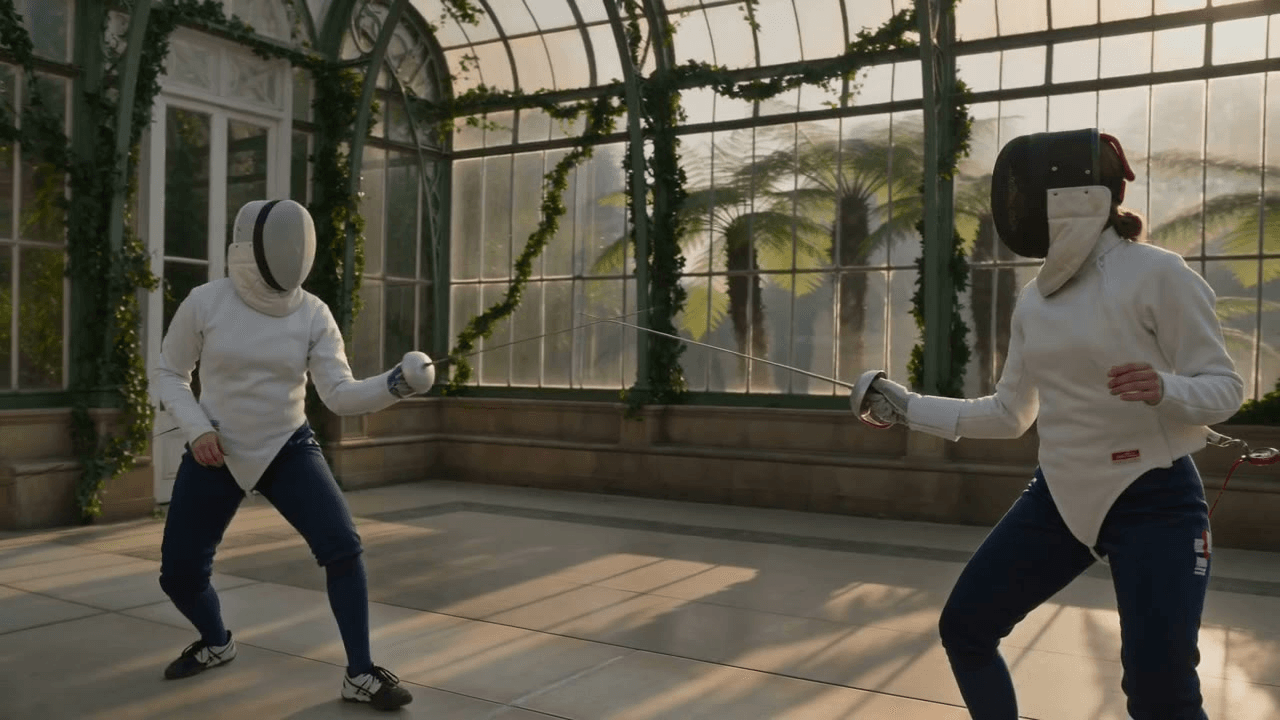 Two masked fencers make a controlled blade contact in a sunlit glass conservatory
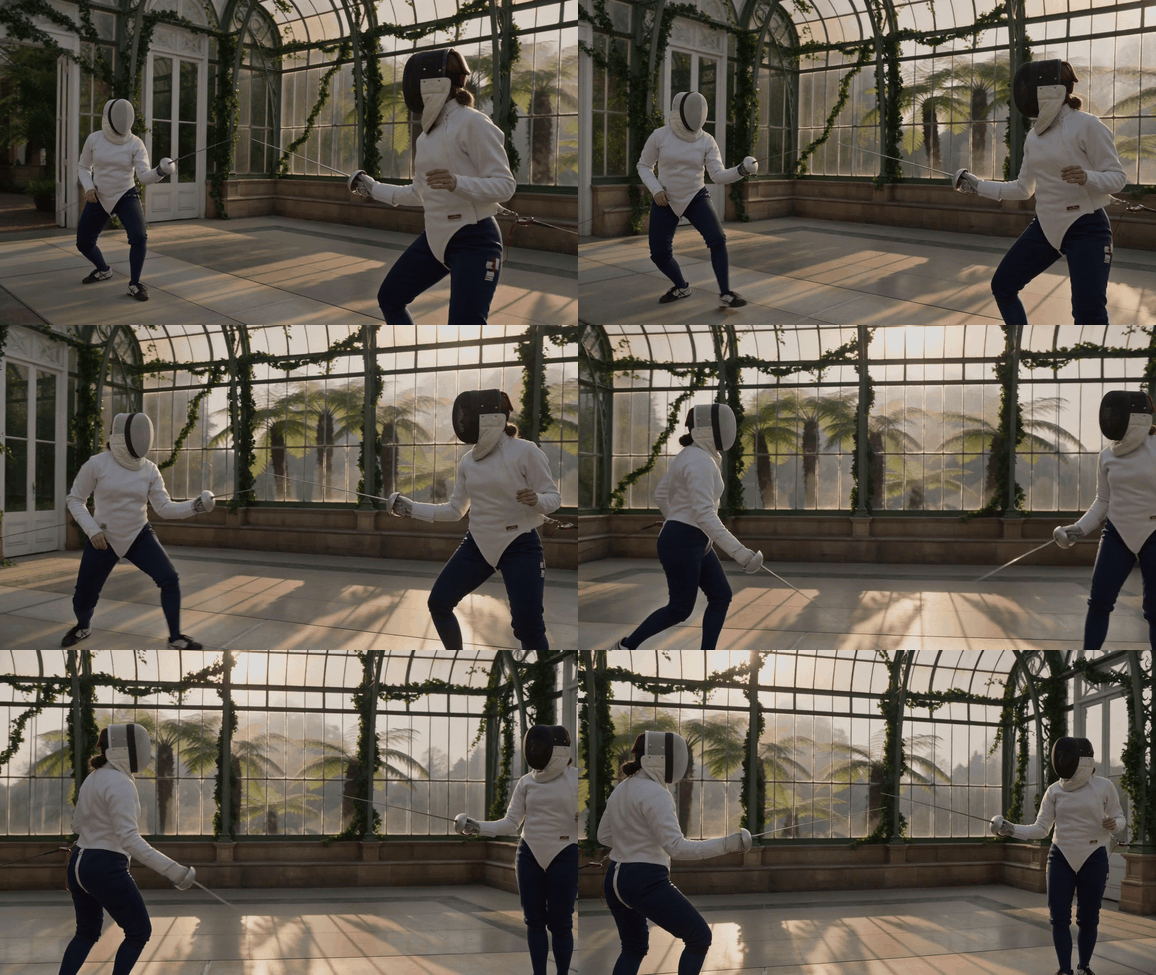
Eight-second fencing exchange with a camera half-circle
User-supplied Kling Video O3 Standard example. The blade contact is visible, but the camera moves far enough that an athlete is cropped near the end. That is a useful camera-relationship failure to record.
Test 3: character, animal, and umbrella continuity
plaintext1An 8-second single continuous cinematic tracking shot in a rain-wet old brick arcade at blue hour. One adult woman wears a mustard-yellow trench coat, dark green scarf, and black ankle boots. A gray tabby cat walks calmly at her left side. She carries one cobalt-blue umbrella with a curved walnut handle, open above her from the beginning of the shot. From 0 to 3 seconds, the woman and cat walk forward beside puddles reflecting warm shop lights. From 3 to 5 seconds, the cat pauses beneath the umbrella and looks up while the woman turns her head toward it. From 5 to 8 seconds, they continue walking together. The camera makes one smooth lateral tracking move from front three-quarter view to side three-quarter view, keeping the woman, cat, and umbrella visible. Keep one umbrella only, with the same cobalt-blue canopy, curved walnut handle, shape, and size throughout. Realistic rain droplets, wet stone reflections, natural cat gait, warm window light against cool blue evening light, no cuts, no slow motion, no text, no logo, no extra person, no duplicate cat, no folded second umbrella, no umbrella shape change.
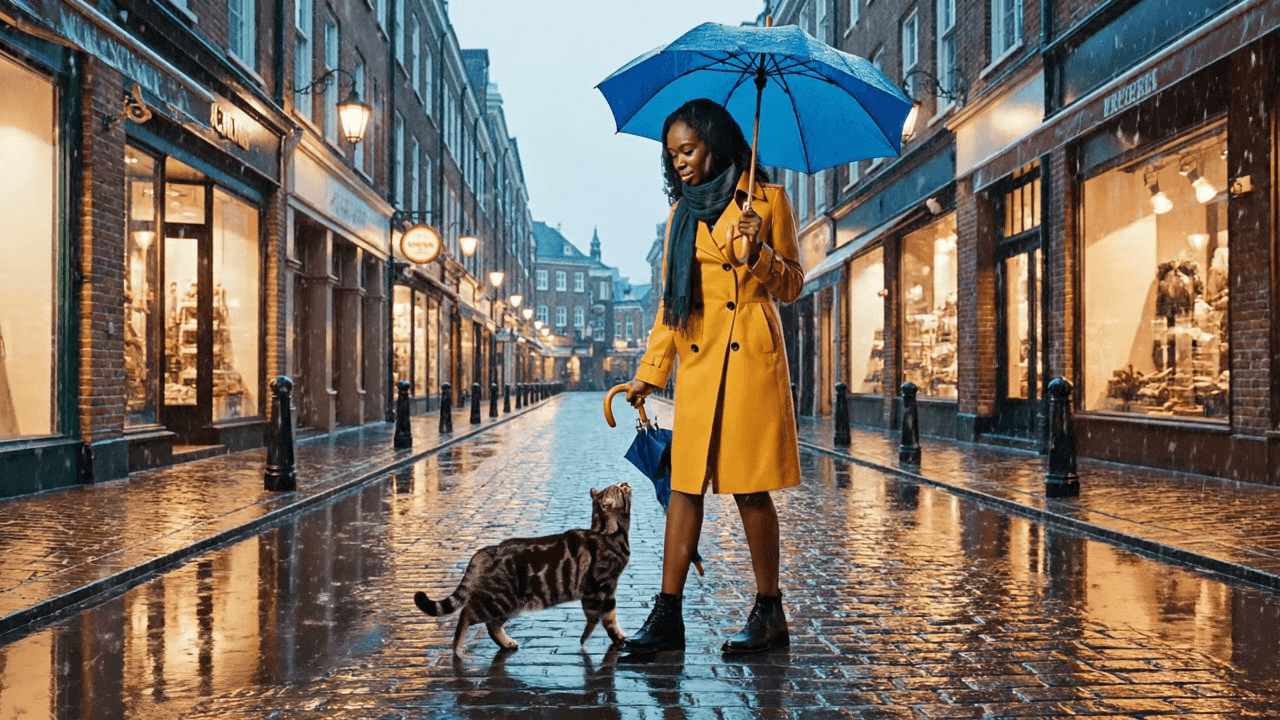 Woman in a mustard coat walks with a gray tabby beneath a cobalt-blue umbrella on a rain-lit street

Eight-second rainy street scene with a woman, tabby cat, and blue umbrella
User-supplied Kling Video O3 Standard example. The cat and rainy street remain readable, while the output visibly carries a second folded umbrella in the woman’s other hand. Count that as a prop-continuity failure, not a successful one-umbrella result.
Each prompt has one camera plan and one bounded action chain. If your account supports a different maximum duration, preserve the order of actions and shorten the distance, not the list of constraints. Keep the original prompt alongside every variation.
Kling 4 Complex Action Prompt Test: What Breaks and How to Fix It
Use the score tag to diagnose the next run. Change one variable, generate another 3-run set, and preserve the first set. A different camera, a shorter chain, and a clearer prop description are separate experiments, so do not change them all at once.
| Symptom | Change in the next set | Do not do this |
|---|---|---|
| Character morphs between jump and landing | Remove the extra camera instruction and keep one action chain | Add more style words and extra actions |
| Fencers pass through each other | Keep one contact and specify its order | Ask for “epic fight choreography” without sequence |
| Camera and subject drift together | Fix one camera direction and one movement | Combine orbit, aerial, push-in, and sudden stop |
| Board changes colour or size | State its colour, location, and before/after condition once | Repeat “perfect consistency” without concrete anchors |
| Clip looks polished but misses the task | Deduct from action order and state the missing event | Substitute cinematic mood for completion |
The current Kling VIDEO 3.0 guide offers a useful baseline for this discipline. It documents flexible 3-to-15-second output, multi-shot controls, and element-reference options. Those controls can help a different production workflow, but mixing them into this plain text-to-video test would erase the comparison. (Kling VIDEO 3.0 Model User Guide, February 2026)
Kling 4 vs Kling 3.0 for Complex Action: A Controlled Baseline
Do not publish a Kling 4-versus-Kling 3.0 conclusion until Kling 4 is actually runnable in the same test record. When it is, run the 3 prompts above with 16:9, the nearest shared duration, 3 consecutive outputs per model, and the same scoring sheet. Report the settings differences before the scores.
| Comparison item | Kling 4 Flash | Kling V3.0 Turbo baseline |
|---|---|---|
| Availability at this publication check | Limited early access, account dependent | Available as an Atlas Cloud model-family baseline |
| Test inputs | Text only, no reference | Same text only, no reference |
| Duration and resolution | Record what Flash permits | Use the nearest available match |
| Result claim here | No verified run published | No matched run published in this article |
Readers who need a current baseline can use the Atlas Cloud model catalog to check live availability, then use the Kling V3.0 model page to repeat the exact prompt. That workflow keeps the Flash question separate from a model you can actually select today.
FAQ: Kling 4 Complex Action Prompt Test
Is Kling 4.0 Flash the same as the full Kling 4.0 model?
No. At this publication check, Flash is limited early access and full Kling 4.0 is scheduled for October. Record the actual selector and settings instead of transferring full-model feature claims to Flash.
What makes an AI video prompt “complex action”?
It combines at least 3 measurable conditions, such as ordered movement, contact, subject continuity, environmental reaction, and a specified camera relationship.
Should I use one long prompt or separate the action into shots?
For this protocol, use one continuous action chain and one camera plan. Use a separate test when you want to evaluate multi-shot or keyframe controls.
Why does a character change appearance during a jump or landing?
The model may lose its subject representation during fast pose changes or when it must satisfy too many simultaneous instructions. Shorten the chain or simplify the camera request, then change only that one variable.
Can I use a reference image for this Kling 4 action test?
Yes, for a separate identity-control test. Do not mix it into this plain text-to-video test because the reference changes what you are measuring.
Is Kling 4 available on Atlas Cloud yet?
It was not verified in Atlas Cloud’s public model catalog during this publication check. The kling 4 complex action prompt test should link to a live model page only after that listing, price, and Playground availability are confirmed.





