A green API test report feels reassuring until you notice that every assertion checks only HTTP 200. The response could contain the wrong customer's record and still pass.
Choose ai tools for api testing around the work you already have. Evaluate Postman Agent Mode if your team maintains collections, KushoAI if a specification is your starting point, and Keploy if you need generated flows or regression tests built from recorded traffic. Review and execute the resulting tests before trusting them.
This guide covers AI assistance for testing ordinary APIs. Testing the accuracy of an AI model's answers is a separate evaluation problem.
Key takeaways
- Supply the contract, request dependencies, and approved business expectations.
- Check whether assertions reject wrong data, missing fields, and broken types.
- Buy only after the reviewed tests run repeatedly in your intended CI environment.
The product comparison below reflects official documentation checked on September 21, 2026. It is not a head-to-head benchmark of three paid accounts.
The worked example uses a pinned Swagger Petstore specification and separates contract expectations, observed behavior, and deliberately modified response copies.
Our local run passed 5 live tests and rejected all 3 deliberately changed response copies. A separate missing-name probe still returned 200, showing why the scope of a green report matters.
What AI Tools for API Testing Actually Do
AI assistance usually enters four parts of API testing. A model reads your specification, proposes scenarios, drafts assertions, and helps explain failures. Each part requires different evidence. A plausible explanation of a failure does not establish that the proposed fix is correct.
For specification review, provide the OpenAPI file and the relevant business rules. For scenario planning, add examples of valid data and known boundaries. For executable scripts, include your runner, authentication setup, and fixture conventions. For diagnosis, provide the actual request, response, and failure message after removing secrets.
Keep these four mechanisms separate when evaluating products:
- LLM generation: proposes tests from language, schemas, and examples. A reviewer must check the expected outcomes.
- Traffic replay: compares later behavior with captured interactions, often using recorded dependency responses.
- Property-based testing: systematically constructs inputs to challenge properties such as schema conformance.
- Test execution: sends requests, evaluates assertions, and returns reports and exit codes.
A product may combine several mechanisms. Ask which mechanism produced each test and what determines its expected result. Recording an incorrect response can preserve the same error as a regression baseline. Generating a polished test name can disguise an unsupported expectation.
Think about assertions at three depths. First, did the server respond successfully? Second, does the body have the documented fields and types? Third, does this body represent the resource and operation you requested?
For a pet lookup, a valid object with an integer ID still fails the third check if that ID belongs to another pet. Conversely, matching the requested ID does not prove that every field satisfies the schema. Use both checks, and add business rules only where the team has an agreed source for them.
The practical output you want is a maintainable test asset with an explainable oracle: a clear reason why each result should pass or fail. Count useful scenarios after review, including the ones you reject, rather than celebrating the length of the initial generated list.
AI Tools for API Testing Compared by Workflow
Start with the artifact your team can supply today. Migrating an established collection, reconstructing missing business rules, and setting up dependency recording are different projects. A tool that suits one starting point can create extra work at another.
| Tool or approach | Useful input | AI or automation role | Execution and CI route | Reviewable output | Main trial question |
|---|---|---|---|---|---|
| Postman Agent Mode | Collections, requests, responses, environments, specs | Drafts and edits test scripts in workspace context | Collection Runner and compatible CLI workflow | Standard Postman JavaScript assertions | Does it preserve your variables and test the contract? |
| KushoAI | OpenAPI, Postman collection, cURL | Generates scenarios and test suites; supports natural-language refinement | Platform execution and documented CI integration; check entitlement | Inspect generated requests, dependencies, and expected outcomes | Can your selected plan run and retain the suite where you need it? |
| Keploy | Specs or request definitions; alternatively real traffic | AI generation and a separate record/replay route | Generated flows or recorded tests in supported local/CI environments | Review test definitions, baselines, and dependency mocks | Which route covers your actual failure modes? |
| Existing runner plus an LLM | Approved matrix, spec, fixture conventions | Drafts code for review | Your pytest or other established runner | Code committed to your repository | Is review cheaper than writing the same tests directly? |
Postman Agent Mode for Existing Collections
Postman is a reasonable first evaluation when your collection already contains useful request order, environment variables, and authentication setup. Agent Mode can use that context to generate standard JavaScript test scripts. Those scripts can enter the existing collection execution workflow rather than requiring a new assertion language.
A focused trial is more revealing than asking it to test everything. Select the request that retrieves a resource created earlier in the collection. Supply its schema and ask for required-field validation, documented field types, and an assertion connecting the returned ID to the stored creation ID.
Then inspect the proposed changes before accepting them. A response example might contain a pet called Milo. Equality with Milo is meaningful if your fixture explicitly created Milo; it is fragile if the generator copied a name from a shared sample record. The same literal can be a valid assertion or an accidental dependency, depending on its source.
Check variable scope carefully. An ID stored in an environment variable must be available to the later request and must belong to that run. Shared variables across concurrent runs can create intermittent failures that resemble server defects. Ask the generator to explain setup and cleanup as well as the assertions.
For the first acceptance test, run the collection twice against isolated data, then inspect the exported or versioned representation. Confirm that a teammate can review the changed scripts without repeating the AI conversation. Also verify that your chosen CLI, reporter, and plan support the execution path you intend to use.
No operated Postman generation is presented here. The useful evaluation question is whether its workspace context reduces your review work on an existing collection. That requires your own collection and an account-level trial, not a conclusion drawn from a product screenshot.
KushoAI for Spec-Based Test Generation
KushoAI accepts Swagger/OpenAPI, Postman, and cURL inputs and documents test generation, natural-language refinement, and CI execution. That makes it a candidate when a team has useful API definitions but a backlog of unwritten tests. These are vendor-described capabilities, not measured defect-detection results. (KushoAI documentation, September 2026)
Choose the input with the richest trustworthy context. A cURL request can describe one valid request, but it usually says little about optional fields, permitted enum values, or documented errors. An OpenAPI file adds structure; an approved scenario matrix adds the intent that the structure may leave ambiguous.
For a Petstore trial, ask for separate cases for a valid pet, a missing required name, an ID with the wrong type, and an invalid status filter. Review whether the tool distinguishes request-body requirements from response-schema requirements. These can look similar in an example while imposing different obligations.
Next, examine a connected create-read-update flow. The read must use the ID associated with the current setup. The update must target the same resource, and a later read must verify the changed field. Four independent requests with attractive test names do not establish that the dependency chain works.
Treat the first generation as a proposal. Keep documented expectations, revise scripts with incorrect data flow, and flag underspecified outcomes for a requirements decision. If the tool suggests several equivalent missing-field cases, retain the useful distinctions instead of paying to maintain duplicates.
Before buying, ask to execute the suite from your intended pipeline and inspect the failure artifact. Confirm current CI permissions, credentials handling, and available export formats on the selected plan. Do not assume that a free interactive trial grants the same automation rights as a team deployment.
Keploy for Generated Tests and Traffic Replay
Keploy's documentation presents two distinct starting paths. AI generation accepts resources such as OpenAPI, Postman, cURL, or endpoints and builds connected API flows. Record and replay captures API interactions and their dependencies for later execution with mocks. The AI flow description and the dependency-recording description should not be treated as identical mechanisms. (Keploy documentation, September 2026)
If your difficulty is reproducing what an application did with a database or upstream service, evaluate the recording route. Capture a small create-read-update journey in an isolated environment, inspect the captured dependencies, and replay after a controlled application change. Check what the runtime supports before planning a larger rollout.
If your difficulty is deriving cases from a specification, evaluate the generation route separately. Ask how its proposed requests obtain credentials, carry IDs between steps, and clean up data. The presence of recording features elsewhere in the product does not answer those questions for a generated suite.
Dynamic values need judgment. A timestamp may legitimately vary; a resource ID may connect two requests and therefore need comparison. Broadly ignoring every changing field can hide errors. Review exclusions field by field and retain comparisons that express meaningful relationships.
Also inspect the baseline before accepting it. A recording that contains the wrong total, an accidental fallback response, or stale data can replay consistently. Consistency helps detect change, but the team still decides whether the captured behavior was correct.
A useful supplement: Schemathesis provides schema-driven property-based API testing. It can challenge an API with generated inputs alongside reviewed examples. Treat it as a different testing mechanism, not a synonym for an LLM test generator. Its findings still need interpretation against the contract and the implementation.
Free AI Tools for API Testing: Limits and Costs
“Free” can describe a client, a limited AI allowance, an open-source runner, or a temporary trial. These offers cover different parts of the workflow. A free client does not establish that automated generation, scheduled execution, or report export is free too.
As checked on September 21, 2026, Postman's Free plan lists 50 AI credits per month. Credits are its billing unit; they do not mean 50 tests or 50 complete suites. Its comparison table distinguishes AI allowance from execution, data-driven features, and result exports. (Postman pricing, September 2026)
KushoAI's current pricing presentation uses Developer Edition and Enterprise. Keploy distinguishes Playground, Pro, and Enterprise, alongside its open-source offering. Use the current purchase screen to confirm the relevant limits. Older tool roundups can describe retired plan names or combine allowances that are billed separately.
| Cost component | What to record in a trial | What can make the bill misleading |
|---|---|---|
| Seats and plan | Editors, reviewers, billing interval, required features | Comparing annual headline prices with monthly commitments |
| AI generation | Credit usage for the same approved task, including retries | Assuming one credit equals one test |
| Execution | Local runs, hosted runs, CI jobs, schedules, reports | Treating interactive runs as permission for every automation path |
| Independent model | Input and output tokens for drafting and review | Ignoring repeated full-spec submissions |
| Engineering time | Review, fixture repair, failure triage, maintenance | Counting initial generation time as total delivery time |
Use a small acceptance task to estimate cost. Give each candidate the same operations and expectations, then record how many scenarios survive review. Keep generation time, hands-on review time, and execution time in separate columns. Waiting for a model and correcting a dangerous assertion impose different costs on the team.
A useful denominator is reviewed, runnable scenarios that your team would keep. It prevents a generator with many redundant cases from appearing cheaper simply because its output is longer. Record unsupported cases that you removed and requirements that remain unresolved.
This article does not claim a measured labor-saving percentage or compare paid-plan throughput. Those figures need a controlled trial with equivalent inputs. For a purchase decision, include one realistic maintenance change, such as adding a required field, so that the estimate covers the next sprint as well as the first demo.
AI Tools for API Testing: OpenAPI to a First Run
Use an isolated local instance of the real Swagger Petstore project. Pin commit d57941e8fe959e508796b27469b1e8bba73392dc; its specification declares OpenAPI 3.0.4 and application version 1.0.29-SNAPSHOT. Read the pinned file rather than an independently updated public demo. (Swagger Petstore specification, September 2026)
1. Prepare the service and record the environment. Obtain the repository through that source page, check out the pinned revision, and install a compatible JDK and Maven. The project's README gives this startup command from the repository directory:
plaintext1git checkout d57941e8fe959e508796b27469b1e8bba73392dc 2mvn package jetty:run
Jetty uses port 8080. Set BASE_URL to your loopback HTTP origin on that port with /api/v3 appended. Confirm that /openapi.json is readable relative to that base before testing.
This run used Temurin JDK 17.0.20.1, Maven 3.9.9, Python 3.12, pytest 9.1.1, and jsonschema 4.26.0. Record your versions too. The source build downloads dependencies and Swagger UI, so a pinned application commit alone is not a fully hermetic build.
2. Import the pinned specification. Select /pet, /pet/{petId}, and /pet/findByStatus. Keep delete available for cleanup. Override the specification's public server location with your local base. Check this setting before sending any write request.
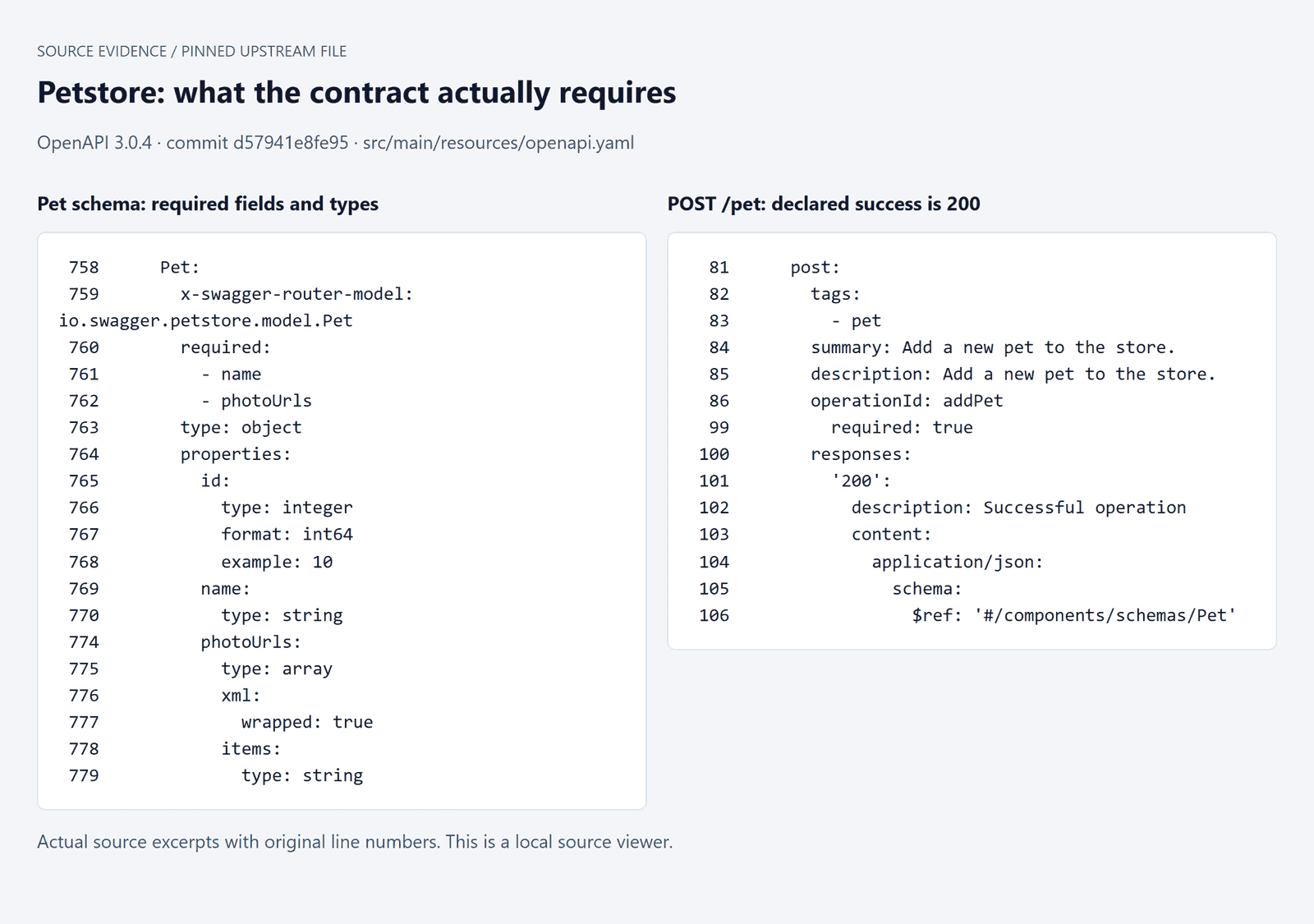 Pinned OpenAPI Petstore source showing required fields and selected operation definitions
Real source excerpts rendered locally: Pet requires name and photoUrls; POST /pet declares 200 for success. Original line numbers are preserved.
3. Generate a matrix before executable code (Prompt A). Attach the specification and paste this prompt into your chosen generator:
plaintext1Review the attached OpenAPI specification for API test planning. 2 3Scope: the operations on /pet, /pet/{petId}, and /pet/findByStatus. 4 5Produce a test matrix with these columns: 6operationId, scenario, setup, request variation, expected outcome, 7specification evidence, assertion, cleanup, and unresolved assumptions. 8 9Cover valid requests, missing required inputs, invalid types, documented 10enum values, documented error responses, and create-read-update flows. 11 12Do not invent endpoints, authentication behavior, status codes, or business 13rules. Separate documented expectations from exploratory hypotheses. 14Do not claim any test has been executed.
4. Review the oracle for each scenario. Petstore documents a successful create as 200. Its Pet schema requires name and photoUrls; id has an integer type but is not in that required list. Missing-field validation and request-response identity therefore need different checks.
| Operation | Input or sequence | Expected-outcome evidence | Assertion to review | Execution status |
|---|---|---|---|---|
| addPet, getPetById | Create, then read current ID | Documented 200 and Pet schema; explicit flow expectation | Validate body and compare returned ID | Passed locally |
| updatePet, getPetById | Change name and read again | Update operation plus approved fixture intent | Same ID, new name, valid schema | Passed locally |
| findPetsByStatus | Query available after setup | Documented enum and successful array response | All returned statuses match; created ID is present | Passed locally |
| getPetById | Non-integer path ID | Documented invalid-ID 400 | Exact status for this documented case | Passed: 400 |
| findPetsByStatus | Undocumented enum value | Documented invalid-status 400 | Exact status, retain any mismatch | Passed: 400 |
| addPet | Omit required name | Required schema field; 400 and 422 descriptions do not map every variation | Record behavior; resolve exact mapping before gating | Returned 200 without name; discrepancy retained |
5. Generate and inspect the execution file (Prompt B). Attach the approved matrix and specification with this prompt:
plaintext1Generate a pytest test suite from the attached approved test matrix and 2OpenAPI specification. 3 4Use Python requests. Read the service URL from BASE_URL. 5Read any required credentials from environment variables. 6Never embed secrets. 7 8Use isolated test data and explicit setup and cleanup. 9Assert documented status codes, relevant response schemas, and the 10relationships between request data and response data. 11Do not hard-code timestamps or assume that generated IDs are constant. 12 13Set explicit request timeouts. Keep product failures visible. 14List unresolved requirements instead of guessing them. 15 16Return the test file, dependency list, run command, and a short explanation 17of each assertion. Do not claim the tests passed.
6. Execute, preserve, and clean up. Use a run-specific pet ID, capture the creation response, and pass its ID into later requests. Validate the update through a fresh read. A successful update response alone does not prove that the server persisted the change.
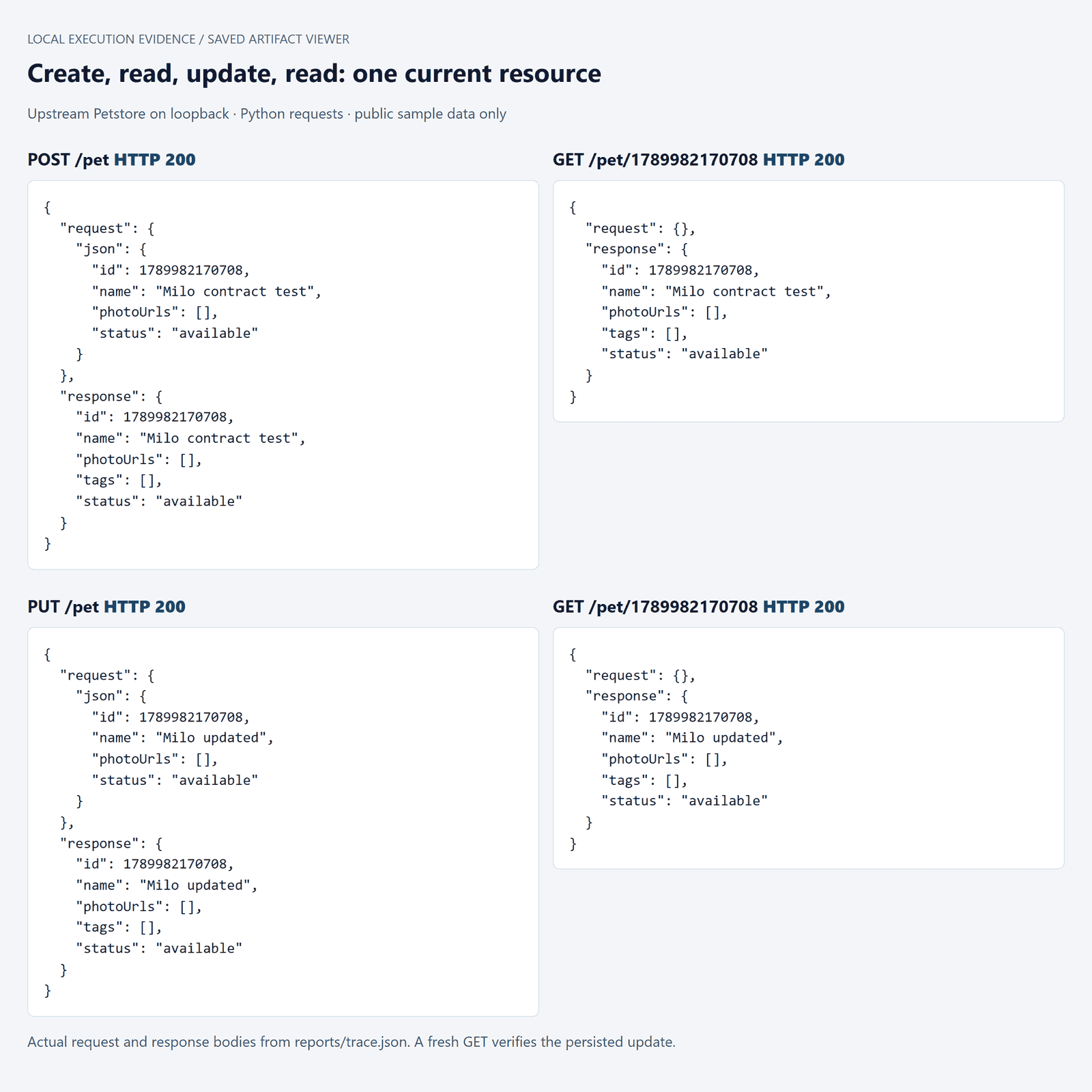 Local Petstore request chain evidence showing creation, lookup, update and ID transfer
Saved local requests and responses: the same run-specific ID survives create, read, update, and a fresh read. All 4 displayed requests returned 200.
Save request bodies, responses, assertion failures, and the cleanup outcome. Restrict deletion to IDs created by this run. Keep unexpected responses as findings, including cases where the demonstration implementation accepts invalid input. Do not adjust assertions just to obtain a green screenshot.
What this run found: the 5 live test functions passed, including invalid-ID and invalid-status checks returning 400. The separate missing-name probe returned 200 and a body without name. We retained that schema discrepancy outside the green suite; its exact intended error mapping still needs clarification. Both created records were deleted successfully.
The local tests were drafted in this article run, independently of the three commercial tools. All 5 live tests were retained; none were removed or had their expectations relaxed after execution. Human review time was not measured. The evidence folder contains the test files, dependency lock, raw responses, and reproduction instructions.
How to Validate AI Tools for API Testing
A useful assertion should reject a relevant wrong answer. You can test that property without changing the running service: save a real successful response, copy it, and deliberately modify one field at a time. These are controlled response mutations, not production vulnerabilities or a full mutation-testing benchmark.
Keep the original status and body together. First run the validator against the unmodified response and verify that it accepts the baseline. Then create three independent copies. Change the ID, change the name's type, and remove the required name. Each copy should fail for a reason that matches the alteration.
| Saved baseline | Controlled modification | Relevant check | Actual result |
|---|---|---|---|
| Successful lookup of current pet | Substitute another integer ID; keep status 200 | Returned ID equals this run's expected ID | Failed: expected and actual IDs differ |
String name | Replace name with a number | Pet schema's string type | Failed: 42 is not a string |
Required name present | Remove name | Pet schema's required list | Failed: name is required |
The ID example exposes a common weakness. A schema validator can accept the wrong integer because the shape remains valid. The relationship assertion supplies the missing constraint. In the other two examples, schema validation supplies constraints that a status-only check cannot see.
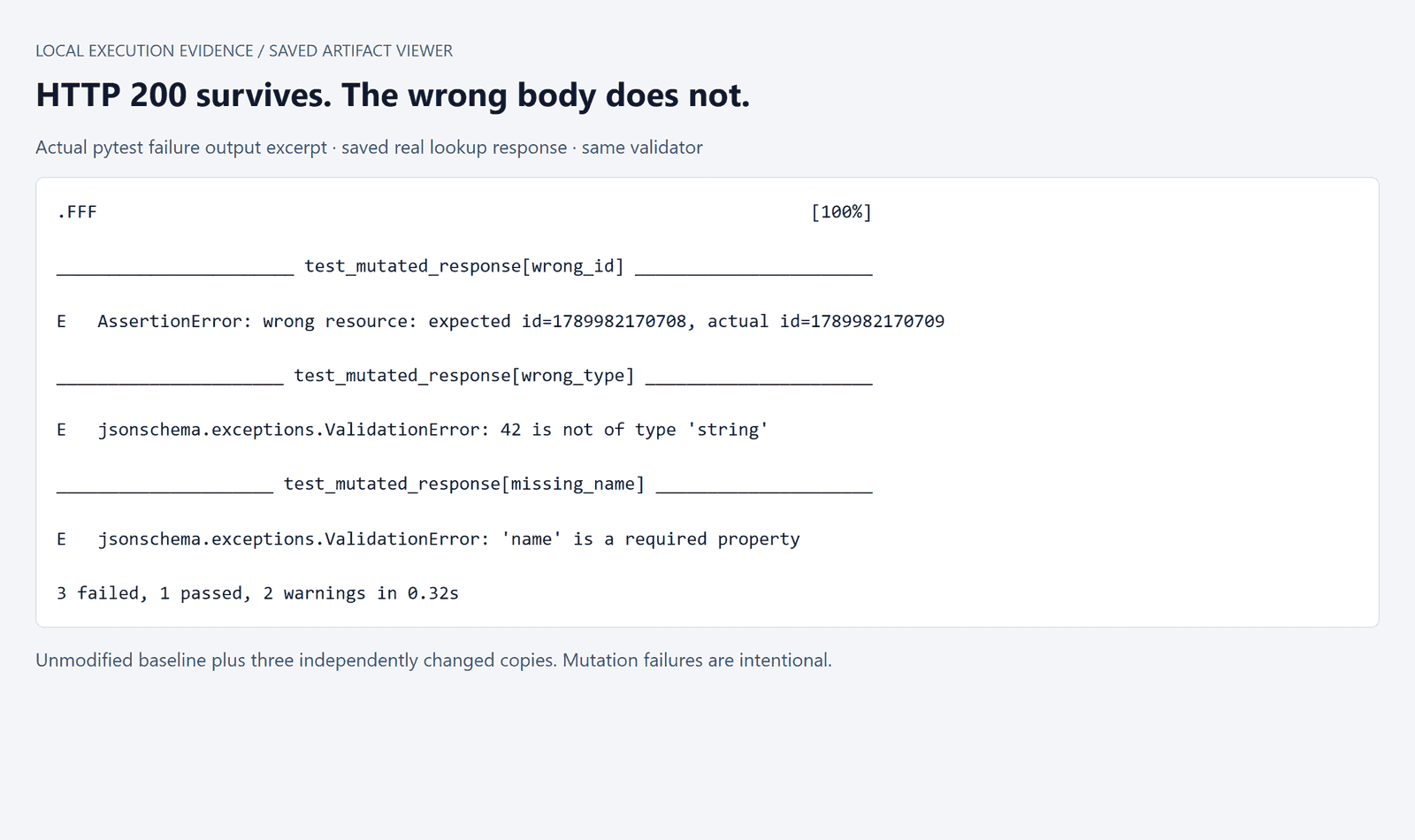 Actual assertion failure output for controlled Petstore response mutations
Actual pytest failure excerpts: the original response passed, and all 3 independent mutations failed. These failures were deliberately induced in saved copies.
In this run, the unchanged baseline passed and 3 of 3 altered copies failed. The mutation run returned exit code 1, preserving the failure signal. The validator applies the Pet schema's relevant structural constraints and a separate ID relationship check; this small demonstration is not a complete OpenAPI conformance validator.
For a repeatable audit, attach the test file and pinned specification to Prompt C:
plaintext1Review the attached test file against the attached OpenAPI specification. 2 3Identify: 41. Assertions that would pass with an incorrect response. 52. Expected outcomes that have no specification evidence. 63. Hard-coded dynamic values. 74. Missing setup, cleanup, or request dependencies. 8 9For each issue, give the file location, the reason, and a proposed change. 10Do not weaken an assertion merely to match an observed response. 11 12Suggest three controlled response mutations that should fail the relevant 13assertions. Clearly label these as proposed checks, not executed results.
Review suggested “self-healing” changes with particular care. Replacing an expected 400 with 200 may hide a regression. A legitimate contract change needs a requirements reference and a reviewed test change. The observed response is evidence for investigation, not automatic permission to redefine correctness.
Separate failure categories before asking AI for a fix. A timeout can indicate an unavailable environment. A lookup failure can come from a broken fixture. An import error belongs to the test code. A reproducible mismatch with the agreed contract may belong to the product. Preserve enough context to distinguish them.
Report the denominator honestly. Detecting three selected response changes proves sensitivity to those three changes. It does not establish endpoint coverage, code coverage, security coverage, or a general defect-detection rate. Likewise, a large test count says little about duplicate scenarios or the strength of their assertions.
Authentication and authorization deserve independent tests in a suitable application: missing credentials, expired credentials, and access to another user's resources. Petstore's demonstration behavior cannot establish that your production access controls work.
AI Tools for API Testing in CI/CD
Once a reviewer accepts the suite, commit that exact version. A build should execute known expectations against the candidate application. Regenerating tests during every build introduces another changing component and makes failures harder to reproduce.
Pin the runner, dependencies, fixtures, and specification. Store a dependency lock alongside the tests and preserve the application revision in the report. Resolve secrets from the CI environment, keep them out of generated files, and check that failure logs do not expose them.
With pytest, the basic reporting shape is simple:
plaintext1python -m pytest tests/test_petstore.py -q --junitxml=reports/petstore.xml
Supply BASE_URL through the job environment. Start the local service in the job lifecycle, wait for readiness, then run the suite. Always collect the report and service log, even on failure. Finish by stopping the job's own service and cleaning its data; avoid process-wide cleanup commands on shared agents.
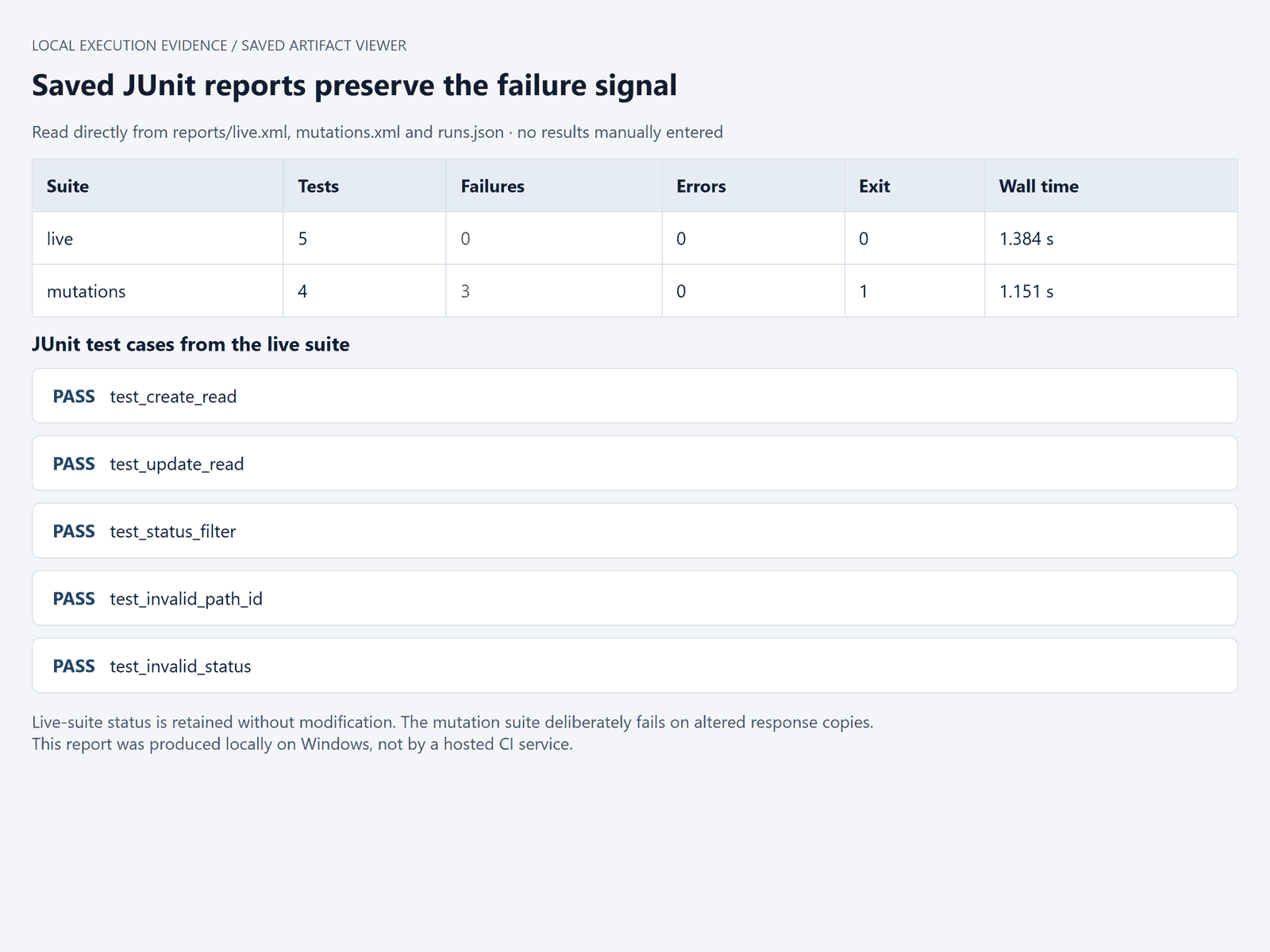 Local pytest JUnit report with separate live-contract and assertion-check resultsActual local
JUnit results: 5 live tests passed; the controlled-copy suite contains 1 passing baseline and 3 intentional failures. No hosted CI run is claimed.
The measured wall times, including Python process startup, were 1.384 seconds for the live suite and 1.151 seconds for the controlled-copy suite. These exclude service build/startup, dependency installation, drafting, and review. JUnit files and the unabridged logs are saved separately.
Test the failure path before relying on the gate. A failed assertion must produce a failing job exit code. Retries should be bounded and justified for known infrastructure transients; repeated retries that eventually hide a product failure make the gate less informative.
Handle cleanup failures explicitly. Keep the primary assertion failure visible, record which resource remains, and let teardown report its own problem. Parallel jobs need separate identifiers or namespaces. A test that passes alone but reads another job's data is not ready for unattended use.
If you already have pytest, you can choose the drafting model separately. Atlas Cloud fits this narrower role: a model layer for a custom workflow whose execution and reporting already exist. It is not presented here as a full API testing platform or a native backend for the three products above.
For that evaluation, open DeepSeek V4.1 Flash, model ID deepseek-ai/deepseek-v4.1-flash, and provide the same public specification and reviewed matrix used locally. Use Prompt B, then save the returned draft separately from the reviewed test. Compare its assumptions with the contract before executing anything.
If exposed by the interface, a temperature of 0.2 is a starting setting for drafting, not a determinism guarantee. Check the available output limit against the size of your suite. Consult the current model catalog for token pricing rather than budgeting from an old article.
The division of work remains explicit: the model proposes code, a reviewer approves expectations, and the runner produces results. The test-environment access gate prevented a completed Atlas run for this article, so this is an evaluation recipe rather than a measured model result. You can evaluate this route without migrating a working test runner or handing its execution responsibilities to a chat model.
Choosing AI Tools for API Testing for Your Team
Choose the smallest evaluation that can change your decision. Use one connected workflow, one documented negative case, and a few controlled wrong responses. Keep inputs equivalent across candidates. A polished onboarding experience should not outweigh a test that cannot identify the wrong resource.
For a mature collection workflow, start by evaluating the AI features in that workspace. Existing environment configuration and request dependencies are valuable context. Measure whether the generated changes save review effort without introducing brittle assumptions.
For a team with a solid specification and a writing backlog, evaluate spec-based generation. Pay attention to what happens when the specification is incomplete. A generator that clearly flags missing expectations is easier to review than one that confidently invents them.
For an application whose failures depend on upstream behavior, evaluate recording and replay. Inspect captured baselines and dependency support before investing in large recordings. Decide which dynamic fields may vary and which relationships must remain intact.
For a team with a stable runner, evaluate an independent model for drafting and review. You retain the execution format you already know, but you also own the integration, fixture design, and maintenance. Include that ownership in the cost calculation.
Before paying for ai tools for api testing, require five concrete demonstrations:
- The reviewed suite runs against your intended environment.
- Relevant controlled errors make the appropriate assertions fail.
- Tests and useful reports can be retained in an acceptable format.
- Repeated runs, including CI execution, preserve isolation and failure signals.
- Generation, execution, and maintenance costs fit the team's budget.
Assign someone to maintain the accepted suite. A specification change should trigger a review of affected assertions, fixtures, and consumers. Keep the old failure evidence until the change is understood. That makes the next release easier to assess and gives the team a reason to trust a green report.
Frequently Asked Questions
Which AI tool should I use for API testing?
Start with your existing inputs. Evaluate Postman Agent Mode for established collections, KushoAI for specification-led generation, and Keploy for its distinct generated-flow and recording routes. If your team already maintains pytest or another runner, a separate drafting model may fit. Use the same small workflow to evaluate each candidate's assertions, execution, and review effort.
Are there free AI tools for API testing?
There are free clients, open-source testing tools, and limited AI allowances. They cover different needs. Postman's Free plan lists 50 monthly AI credits as of September 21, 2026; that is not a test count. Check whether your required export, automation, reporting, and collaboration features are included before treating an interactive trial as a free CI solution.
Can AI generate API tests from an OpenAPI specification?
Yes, a generator can use operations, schemas, parameters, and response definitions to propose tests. The specification may still omit business rules or leave error mappings ambiguous. Supply approved expectations and review the result. In the pinned Petstore example, a successful create is documented as 200, illustrating why familiar REST conventions cannot replace the actual contract.
How do I know whether AI-generated assertions are useful?
Check three things: documented schema constraints, relationships between requests and responses, and sensitivity to deliberately incorrect data. Save a real response, modify one relevant property, and rerun the same validator. Keep the failure message. This gives narrow, reproducible evidence about those assertions while leaving broader coverage and security questions open for separate testing.
Can I run AI-generated API tests in CI/CD?
Yes, when the generated format, runner, environment, and plan support that route. Commit reviewed tests, install pinned dependencies, use isolated fixtures, and export a structured report such as JUnit. Verify that failures return a nonzero exit code. A successful local run prepares the suite for CI; it does not prove that a hosted pipeline has run.
Can AI replace manual API testing?
AI can reduce repetitive drafting and help reviewers find weak assertions. People still decide intended behavior, investigate ambiguous failures, and explore risks outside the supplied examples. Use ai tools for api testing to produce reviewable test assets, then judge them by reproducible evidence. A smaller suite that catches meaningful mistakes is easier to trust than an unexplained collection of green checks.





