You select the photo and reach for BG Remover, and on Canva Free the tool sits behind a paid plan. Or the cut works, and the big file you uploaded comes back with fewer pixels than it went in with.
Both are documented behavior. Canva's Help Center lists three limits on the Canva background remover: it ships with paid plans, it takes photos under 9MB, and it downscales anything over 10MP once the background is gone. The third-party guides we read mention the first limit and skip the other two.
This article puts all three next to a free browser tool that we fed a 6000×3375 photo. The file came back at 6000×3375, and a second run finished after we switched the network off. Canva still wins on bulk folders and video.
Key Takeaways
- Canva's Help Center puts Background Remover on paid plans, with a 9MB file cap and a 10MP downscale after removal.
- The free AI background remover on Atlas Cloud returned a 6000×3375 test photo, 20.25 MP, at the same size, with no account and no watermark.
- The model runs inside the browser tab. In our test the cutout finished with the network switched off.
- Canva keeps bulk folders, video background removal and erase and restore brushes. The free tool does one photo at a time.
- Sheer fabric comes back opaque, so semi-transparent subjects still need manual work in the free tool.
Is Canva Background Remover Free? Three Limits in Canva's Own Help Center
Canva's Help Center article "Remove photo and video backgrounds" settles the free question in its opening lines: "Background remover is included with paid plans." We read the page on September 14, 2026. The same article carries two more limits.
The first is file size. In Canva's words: "Currently, Background Remover only works for photos under 9MB in size. It's not available for Vector images."
The second is pixel count. The article states: "Any uploaded photo with a resolution of more than 10MP will also be downscaled to 10MP after removing its background." Ten megapixels is roughly 3872×2592. A 12MP phone photo, the default on many handsets for years, is already over that line, and a 24MP camera file loses more than half its pixels on the way out.
Canva's Learn page "How to use background remover" adds a volume figure: "You can remove the backgrounds of up to 500 images every 24 hours." For most people that is plenty. It is still a meter.
| Limit | Canva's wording | What it means for your file |
|---|---|---|
| Plan | "Background remover is included with paid plans." | Free accounts do not include the tool. |
| File size | "only works for photos under 9MB in size" | A 10 MB PNG is out before the model runs. |
| Pixel count | "downscaled to 10MP after removing its background" | A 20 MP photo comes back at half its pixels. |
| Vector files | "not available for Vector images" | SVG and other vector uploads are excluded. |
| Daily volume | "up to 500 images every 24 hours" (Learn page) | A ceiling, though a high one. |
None of this is hidden. It sits on Canva's own help pages. It is also missing from the four third-party guides we read while researching this article, which cover the paid plan and not the two file limits; one of them puts the file cap at 10MB, where Canva's page says 9MB.
Canva Background Remover Not Working? The Help Center's Own Checklist
When the button is grayed out or the cut never finishes, Canva's help article already lists the likely causes. In its words, the limitations start with "Paid plans only: Background Remover is available with paid plans." Then the file itself: over 9MB, or a vector. Then folders: "Folders with more than 50 images can't use Background Remover. The option appears grayed out."
One more line covers the connection: "If the background remover isn't loading for you, check your internet connection and try again."
| Symptom | Cause Canva lists |
|---|---|
| BG Remover unavailable on your account | Account is on Canva Free ("Paid plans only") |
| Tool will not process the photo | File is 9MB or larger, or a vector image |
| Remove background grayed out on a folder | Folder holds more than 50 images |
| Tool never loads | Connection dropped; Canva says to check it and retry |
Canva's fix for a stalled remover, then, is a working connection.
The Canva Background Remover Alternative: Free and Full Size in Your Browser
Atlas Cloud runs a small group of browser tools that need no account, listed on its AI tools page. The free AI background remover is the one that replaces this Canva feature. Disclosure: Atlas Cloud publishes this article and operates the tool.
Drop a photo in, press Run Free, download a PNG. There is no plan to pick. Here is the largest file we gave it, a 6000×3375 AI-generated photo of a golden retriever on a lawn, and what came back.
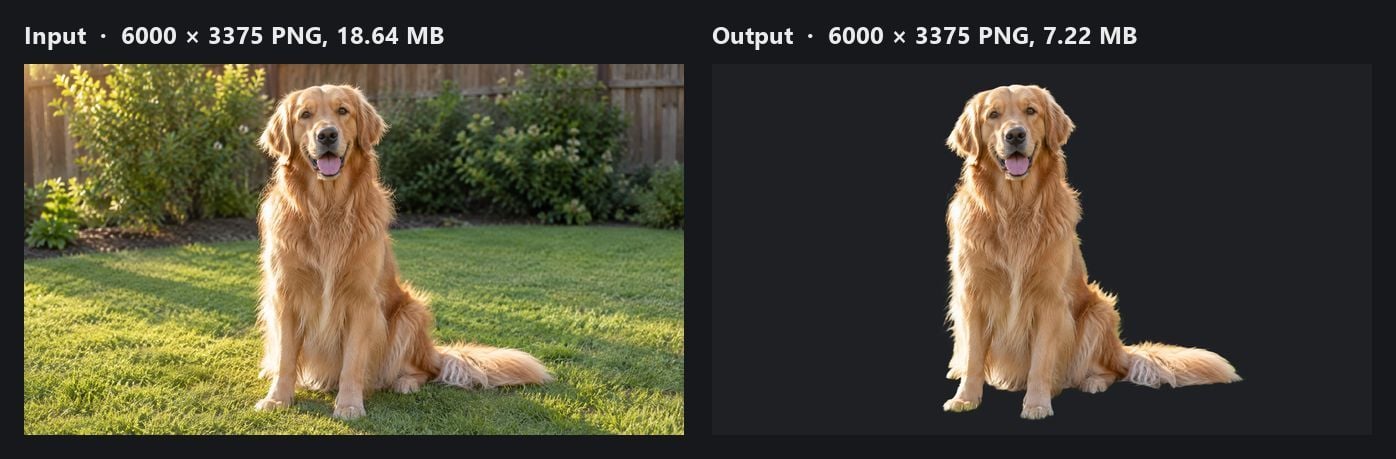
The output is 6000×3375, the same as the input, tested on September 10, 2026 in Chrome on Windows. The tongue edge and the loose fur at the tail tip survive. The lawn and the fence are gone. The tool is not portrait-only, either: in the same session a white sneaker on a wooden table, a handwritten signature on cream paper, a line-art logo, and a white shirt photographed against a white wall each came back as a usable cutout.
Three steps cover the whole process. Add the photo by clicking the drop zone, dragging a file in, or pressing Ctrl+V with a screenshot on the clipboard. Press Run Free. Download the PNG.
Canva BG Remover Limits vs a 20 MP Test File
We ran the retriever photo at three sizes to see whether size changes the result. The middle row is the one that matters. At 4000×2250 the photo is 9.00 MP, under Canva's 10MP downscale point, yet as a PNG it weighs 10.39 MB. By Canva's own wording it would be turned away on size alone.
| Input | Pixels | Input file | Output size | Output file |
|---|---|---|---|---|
| 735×979 | 0.72 MP | not recorded | 735×979 | 0.09 MB |
| 4000×2250 | 9.00 MP | 10.39 MB PNG | 4000×2250 | 3.71 MB |
| 6000×3375 | 20.25 MP | 18.64 MB PNG | 6000×3375 | 7.22 MB |
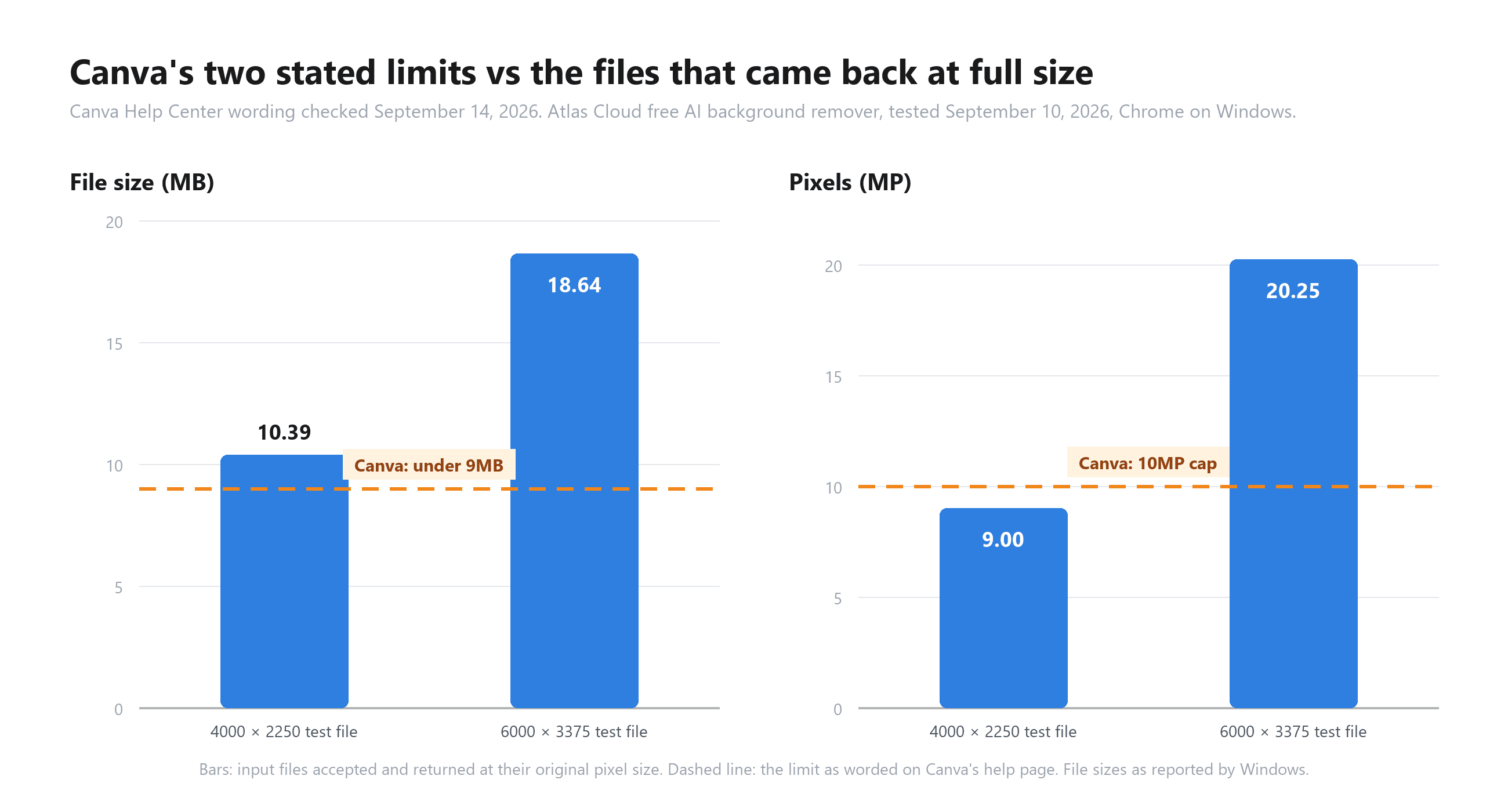
Saving the 6000×3375 photo as a JPG brings it down to about 4 MB, which would clear Canva's 9MB gate. The 10MP downscale would then apply to the result. Shrinking the file does not rescue the pixels.
The alpha channel barely moves across the three sizes. Fully transparent pixels run from 79.26% to 79.27%, the opaque subject from 16.92% to 16.94%, and the semi-transparent edge band from 2.12% to 2.13%. The cutout quality we measured does not degrade as the file grows.
We tested to 20.25 MP and saw no downscale. We did not go beyond that, so treat 20 MP as the verified figure rather than a ceiling. The tool page states that whatever pixel dimensions you upload come back untouched, and our three sizes agree with it.
Transparent Background: Canva's Download Rule vs the PNG You Get Here
Removing the background is half the job. Getting the transparency out of Canva is the other half, and it has a rule of its own. The Help Center article "Download design with transparent background" states: "Downloading with a transparent background is only available to Canva Pro, Canva Teams, Canva Business, Canva Education, and Canva for Nonprofits plans."
A transparent PNG out of Canva is a paid-plan step twice over, once for the remover and once for the download toggle.
The Atlas Cloud tool sidesteps the question by producing one format. The output field offers PNG only, with the note "Transparent backgrounds require PNG format."
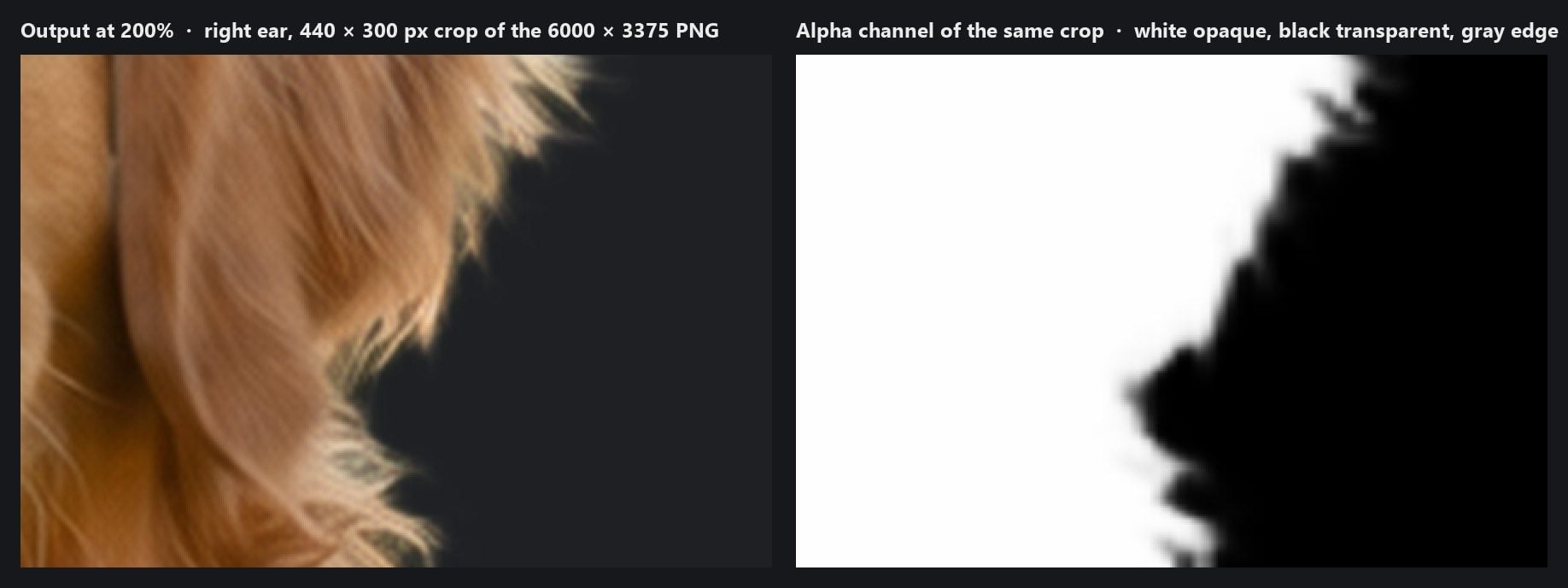
We read the 6000×3375 output pixel by pixel. 79.27% of it is fully transparent: the lawn, the fence, the bushes. 16.94% is the dog, stored at alpha 254 out of 255, a quirk with no visible effect in use.
About 2% of pixels sit in the semi-transparent range, a 1 to 3 pixel anti-aliasing band along the outline that lets fur blend into whatever you put behind it. If the terms are new, our explainer on what an alpha channel is covers why a JPG cannot hold this.
Canva Asks for a Connection. The Alternative Finished Offline
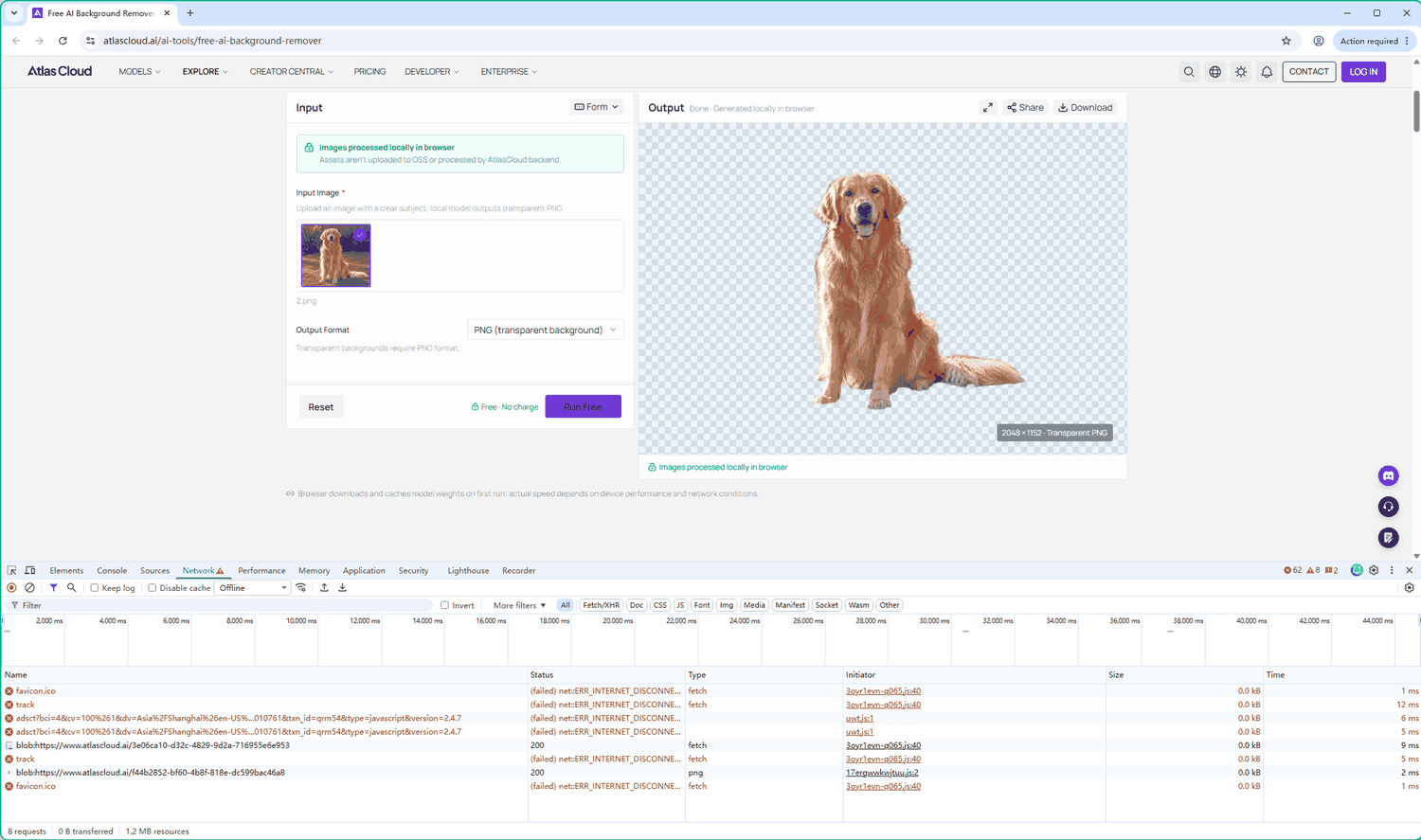
Canva's own troubleshooting advice for a remover that will not load is to check your internet connection. The Atlas Cloud tool describes the opposite arrangement on its page: "Images processed locally in browser" and "Assets aren't uploaded to OSS or processed by AtlasCloud backend."
Page copy is a claim, so we tested it. On September 10, 2026, in Chrome on Windows, we opened the page, let the model weights download, then cut the connection: network disconnected and the VPN tunnel closed. We dropped in a photo and pressed Run Free. The cutout completed.
We repeated it on September 14, 2026 using Chrome's own network throttling set to Offline, which is easier to show in a screenshot than a pulled cable. The run finished in about 36 seconds. Chrome logged eight requests while it ran, every one of them failed with ERR_INTERNET_DISCONNECTED, and the transfer total stayed at 0 B.
The page's front-end code explains how. It uses WebGPU where the browser offers it and falls back to WebAssembly where it does not, so the segmentation runs on your own processor. That is the arrangement a client's unreleased headshot or an embargoed product shot calls for, and once the weights are cached, a dropped connection does not stop a run.
Two caveats. The first run needs a connection to fetch the model, and the page says speed depends on your hardware: "Browser downloads and caches model weights on first run; actual speed depends on device performance and network conditions."
And "processed locally" is what we observed on one machine on one day; we did not audit every network request the site makes, so we describe it as tested offline rather than as a guarantee.
Where Canva Still Wins Over the Free Alternative
A fair alternative article lists what you give up.
Bulk. Canva removes backgrounds from a whole folder of uploads, "Up to 50 images at a time," and its Learn page sets the limit at 500 images every 24 hours. The Atlas Cloud tool takes one image per run. Fifty product shots means fifty drops.
Video. Canva's help article has a "Remove video backgrounds" section. The browser tool is image only.
Brushes. After a Canva cutout you can paint with erase and restore brushes to fix a missed strap or a lost ear. The free tool has no brush; what the model returns is what you download, and any repair happens in your editor.
Input formats. Canva's feature page lists JPG, PNG, HEIC and HEIF. We tested JPG and PNG in the Atlas Cloud tool; its page also lists WebP, which we did not try. HEIC straight off an iPhone is not on its list.
Then two limits of the model itself, measured on our test set. Sheer fabric keeps its shape but loses its transparency: on a veil photo the veil came back at alpha 254, fully opaque, with only 0.73% of pixels truly semi-transparent, so the color of the old background stays baked into the fabric.
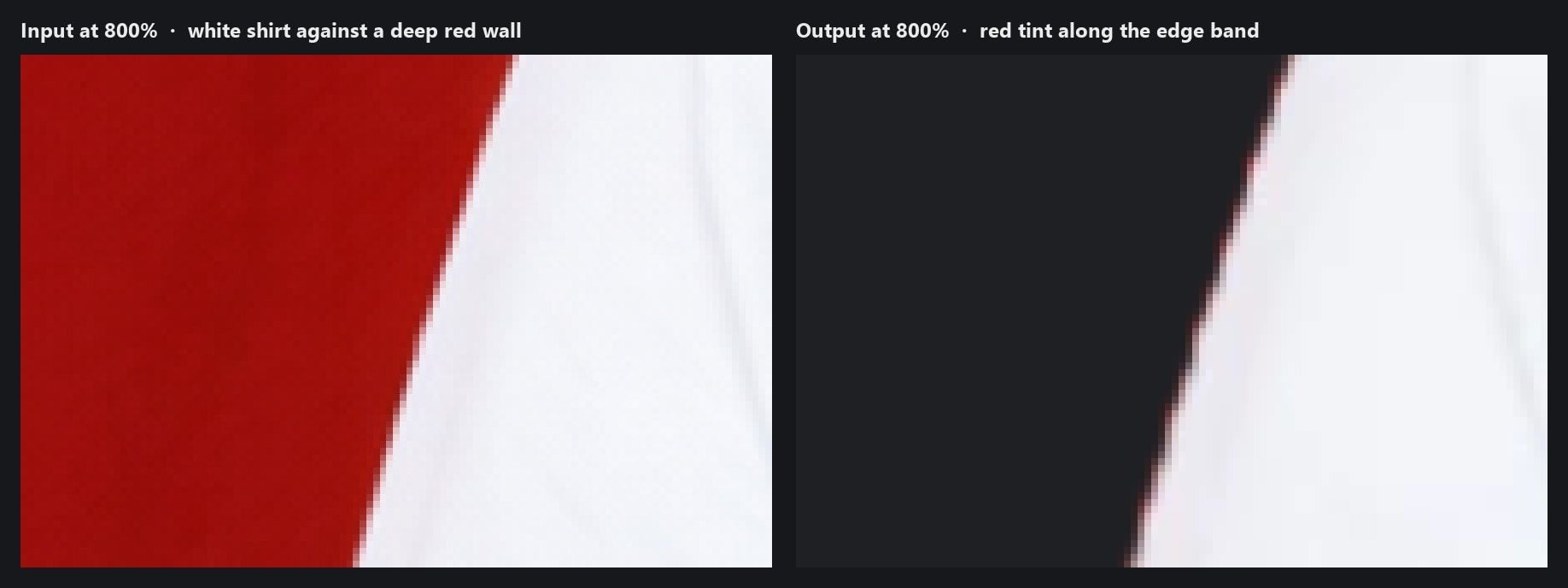
A light subject against a saturated wall picks up the wall along the edge. On a white shirt in front of a deep red wall, 69% of the semi-transparent edge pixels leaned red.
That combination, a saturated single-color background behind a pale subject, is the one to avoid. The retriever on grass measured only a small shift toward green along the edge, a 16 point rise in the green channel that you can pick out at 200% and not at normal size. A one pixel contraction of the edge in your editor removes either tint.
One more gap that is not the model's fault. If the source photo was small and the cutout is headed for a large print, run it through an upscaler after the cut. Our comparison of free image upscalers lists the ones that do it without a watermark.
Canva Background Remover vs Atlas Cloud: Side by Side
Canva's column holds its own published wording or "not stated." The Atlas Cloud column holds what we tested, with page statements marked as such.
| Canva Background Remover | Atlas Cloud free AI background remover | |
|---|---|---|
| Free access | "included with paid plans" (Help Center) | Free to use, no account (tested) |
| File size limit | "under 9MB" | 18.64 MB PNG accepted (tested); no cap stated on the page |
| Pixel limit | "downscaled to 10MP" | 20.25 MP returned at full size (tested) |
| Where it runs | Needs a connection ("check your internet connection") | In the browser tab; a run completed offline (tested) |
| Batch | Folders of up to 50 images; 500 a day (Learn page) | One image per run |
| Video | Help article has a video section | Not supported |
| Edge brushes | Erase and restore | None |
| Input formats | JPG, PNG, HEIC, HEIF (feature page) | JPG and PNG (tested); WebP listed on the page |
| Output | PNG; transparent download on paid plans | Transparent PNG at the input size |
| Watermark | Not stated | None (tested) |
| Sheer fabric | Not stated | Shape kept, transparency lost (tested) |
Should You Switch From Canva?
If your whole workflow already lives in Canva on a paid plan and your photos come off a phone, there is little reason to move. The remover sits one click from the template you are editing, it handles a folder at once, and a 10MP downscale is invisible on a social post.
Switch, or add the free tool alongside Canva, when any of these is true: you are on Canva Free and only need the cutout; the file is over 9MB; the photo is going to print and you need every pixel; or the image should not leave your machine. Download the PNG and drop it into Canva, or any other editor, as a normal upload, then place it over whatever background the design calls for.
| Stay with Canva if | Use the free tool if |
|---|---|
| You already pay for Canva and edit inside it | You are on Canva Free and want the cutout only |
| You process folders of product shots | Your file is over 9MB or over 10MP |
| You need video background removal | The photo is going to print at full resolution |
| You rely on the erase and restore brushes | The image must stay on your machine |
Frequently Asked Questions
How do I remove the background of an image in Canva?
Canva's Help Center article "Remove photo and video backgrounds" covers it: select the photo in the editor, choose BG Remover from the toolbar, wait for the result, then refine it with the erase and restore brushes. The feature is part of Canva's paid plans. Canva's help pages are the authority on the steps and the wording, so check the current page rather than relying on a third-party summary.
Is Canva background remover free?
Not on Canva Free. The Help Center states: "Background remover is included with paid plans." Canva's Pro page offers a free Pro trial; the terms are on Canva's site. If you want the cutout without a plan, the Atlas Cloud tool linked above is free to use and asks for no account.
Why did Canva shrink my photo after removing the background?
Because of the pixel rule. Canva's help page says any photo over 10MP "will also be downscaled to 10MP after removing its background." A 20 MP photo comes back at 10 MP. In our test the Atlas Cloud tool returned a 20.25 MP photo at its original 6000×3375.
Is there a Canva background remover free alternative without a watermark?
Yes. The Atlas Cloud tool added no watermark and required no account in our September 10, 2026 test, and the download was a full-resolution PNG. We describe it as free to use; we do not make promises about pricing forever.
Can the free alternative remove a video background or process a folder?
No. It handles one image per run and does not take video. Canva does both, and the section on where Canva still wins spells that out.
Is my photo really processed in the browser?
The page states that images are processed locally, and the front-end code runs the model through WebGPU with a WebAssembly fallback. Our test finished a cutout with the network off after an earlier run had cached the model weights, the setup described in the offline section above.
Conclusion
Canva's remover is a capable tool wrapped in three rules its own help pages spell out: paid plans, photos under 9MB, and a 10MP downscale after the cut. Canva prints all three on its help pages, and for a subscriber editing phone photos inside a template, none of it bites.
The rules bite when the photo is large, the plan is free, or the file should stay on your machine. In those cases a Canva background remover alternative that runs in the browser, returned our 6000×3375 test file at 6000×3375, and finished a run with the network off is the simpler answer. Keep Canva for the layout. Do the cutout where the pixels stay whole.





