

A cinematic AI video clip — gorgeous lighting, a person walking through Tokyo at night — and then, halfway through, their foot phases through the curb. Or the rain stops mid-frame. Or a coffee cup briefly contains itself.
The illusion was perfect for exactly six seconds, until physics interrupted.
For three years, that's been the unfixable bug at the heart of generative video. The models could fake the look. They couldn't fake the world.
On May 19 at I/O 2026, Google's Gemini Omni made the case that the bug is finally fixable — and quietly handed the audience a single demo that argued the point better than any benchmark could.
The Marble Demo That Broke AI Video Twitter
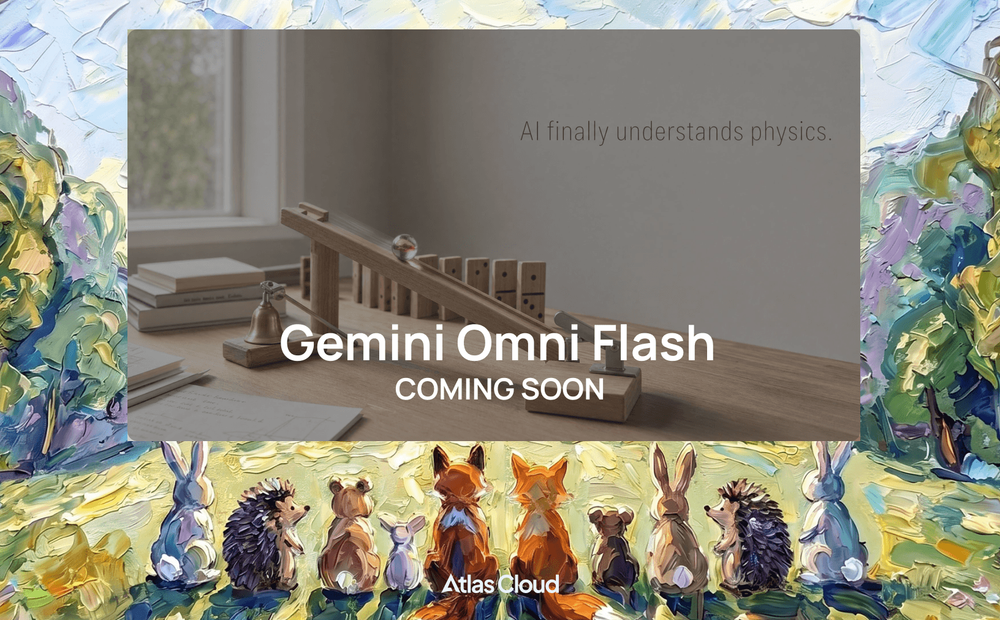
The demo: a single glass marble, rolling down a complex chain-reaction track. Bouncing off plates. Triggering bells. Sliding down inclines. Tipping dominoes that knock over other things. Every contact has a believable reaction force. Every landing has a matched sound.
9to5Google's coverage didn't hide its surprise: "The rolling marble video is a great example, with believable physics for the ball and convincing sound effects for each bounce and the bell ring."
That sentence sounds boring. It is, in fact, an industry milestone.
The demo went viral within hours. Even AI heavyweights couldn't stay quiet — immunologist and AI commentator Dr. Derya Unutmaz tweeted within minutes of the keynote: "Wow! Google DeepMind just dropped an amazing new AI multimodal called Gemini Omni. The videos look super good! Must try ASAP!"
Why "Just Roll a Marble" Was Impossible for Three Years
To understand why a marble demo deserves an industry-milestone label, you have to look at what AI video has been failing at since 2023.
In the Sora era, the visual quality was already there. A model could render a 4K cinematic clip of someone walking through Tokyo at night. But:
- Water in fountains flowed upward
- A spoon would pass through a bowl of cereal
- A character's leg would briefly become transparent mid-stride
- Gravity worked... most of the time
The visuals were 90% there. The world model was 50%. And once a viewer spotted one physics break, they couldn't unsee it. The whole illusion collapsed.
For professional creators, this wasn't a polish issue — it was a usability cliff. You couldn't ship AI video to clients without manually frame-checking for physics breaks. Which meant most enterprise teams ignored the medium entirely.
Google's pitch with Omni cuts right at this gap. The official launch page puts it in one sentence: "Omni has an improved intuitive understanding of forces like gravity, kinetic energy and fluid dynamics, allowing you to create more realistic scenes."
Hassabis Just Said the Quiet Part Out Loud
The most revealing line at I/O 2026 didn't come from a marketing slide. It came from DeepMind CEO Demis Hassabis on stage: he described Omni as "a step towards artificial general intelligence."
As Decrypt reported, Hassabis explicitly tied physics simulation to the broader AGI ambition — calling Gemini "a world model AI that can understand and simulate the world."
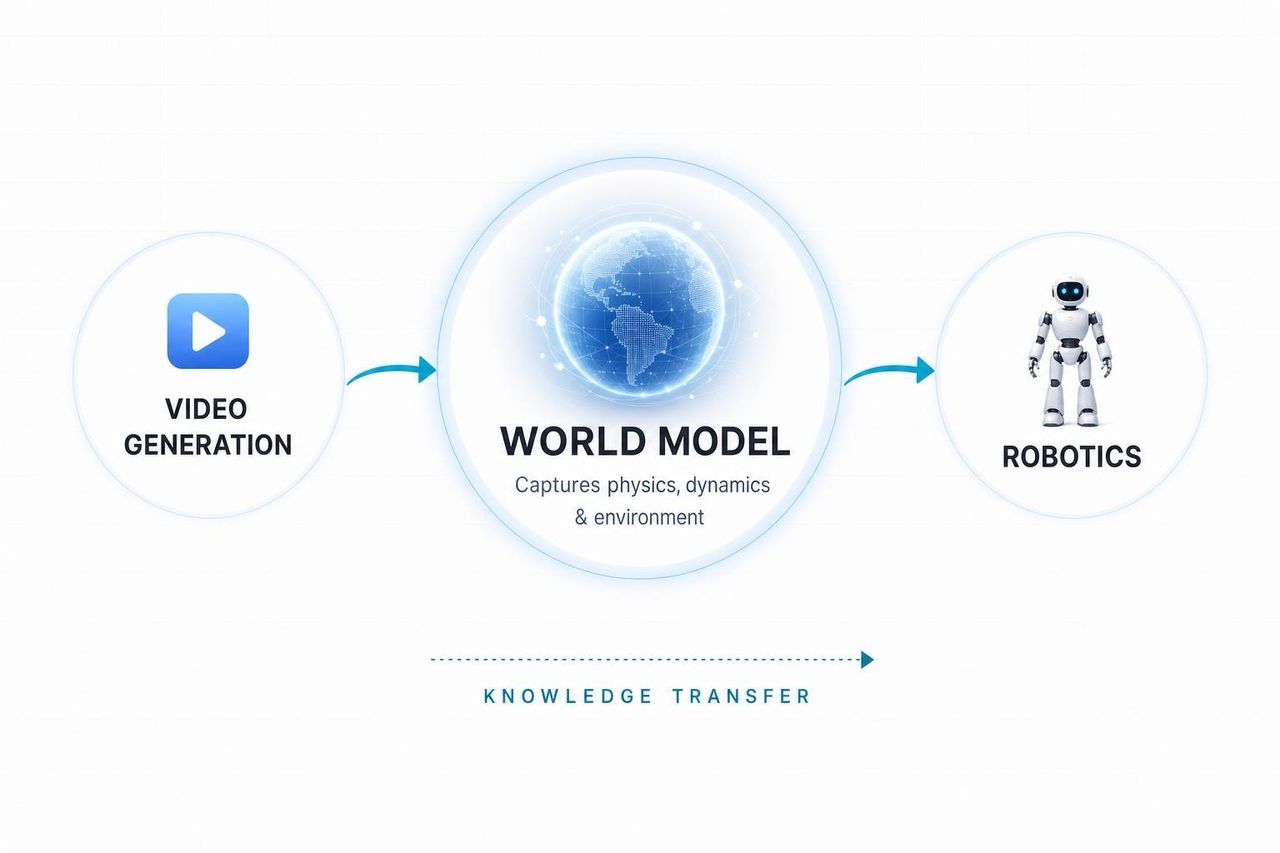
This is the framing that should make people pay attention. Hassabis isn't claiming Omni is a better video toy. He's saying: a model that truly understands physics is a model that can eventually act in the physical world. Which is exactly what robots need.
The Robotics Angle Nobody Outside China Caught
Here's an angle most English-language coverage missed entirely. Chinese tech press caught it first.
According to reporting from Sina Finance citing DeepMind CTO Koray Kavukcuoglu, Omni's physics understanding "has been directly applied to the training of frontier robotics."
Technobezz captured the same framing: Omni carries "a lot more world knowledge than Veo" because it inherits from Gemini's underlying training data — which now includes vast amounts of physical simulation grounding.
Translation: the marble demo isn't a parlor trick for content creators. It's a public preview of the simulator Google is using to teach robots how to grip, throw, balance, and react. The video model is the visible tip of a much larger world-modeling iceberg — one that goes from generated video → physical understanding → embodied AI.
Suddenly, the rolling marble looks different. Not "Google made a cool physics demo." More like "Google quietly showed the world that their robot pre-training pipeline is operational."
The Hidden Evidence Everyone Missed: That Chalkboard Demo
Here's a second piece of physics evidence that's been quietly making the rounds in Chinese tech forums.
Days before I/O 2026, a leaked Omni demo started circulating: a professor at a chalkboard, writing out a complete trigonometric identity proof. As 36Kr's coverage detailed, the formula was mathematically correct, the steps were coherently sequenced, and the handwriting was natural — all generated from a single English prompt.
This sounds like a text-rendering achievement. It's actually a physics achievement in disguise.
Correct handwriting requires the AI to model:
- The mechanics of how a hand moves to form each character
- The sequence in which a proof is normally written
- The physical pressure of chalk on board
- The temporal logic of derivation steps
Sora, by contrast, generated chalkboard text that, in the words of the 36Kr piece, "looked like writing but on close inspection was complete gibberish."
Same root capability — physical and temporal consistency — applied to a different domain. The marble bounces correctly. The chalk hits the board correctly. Both are the same world model showing up in different surface tests.
But Let's Not Crown Anyone Yet
It would be irresponsible to write a love letter without the asterisks.
DataCamp's hands-on review already caught Omni in the act of breaking physics. The reviewer asked for a trebuchet launch — and the projectile flew backwards. The bug was real. It just happened to be funnier than tragic because the reviewer chose a tapestry visual style, so the imperfection blended in like medieval art.
Engadget pushed back on the breathless coverage: "The main problem with Veo 3.1 and other video generator apps is that the video has an 'uncanny valley' look, and is often hated by end users. It'll be interesting to see if the output quality matches Google's breathless claims."
Three other reality checks:
- No benchmarks published. Google didn't release numeric evaluations alongside the launch. Independent third-party benchmarks won't land for several weeks.
- 10-second clip limit. Per TechCrunch's interview with DeepMind, Omni Flash currently caps at 10-second outputs. Longer durations are coming, but for now, this is short-form territory.
- Audio/speech editing held back.Google itself acknowledged the company is "still working to test this and better understand how we can bring this capability to users responsibly" — i.e., the deepfake risk in voice editing is real and Google is intentionally not shipping that capability yet.
Every Omni clip also ships with Google's invisible SynthID watermark plus C2PA Content Credentials, verifiable in the Gemini app, Chrome, and Search. Worth flagging: as physics gets more believable, the case for cryptographic provenance gets stronger, not weaker. The better the fake looks, the more we need to know it's a fake.
How Omni Compares to Sora, Veo, and Seedance on Physics
Here's how the leading AI video models stack up specifically on physics and world understanding as of May 2026:
td {white-space:nowrap;border:0.5pt solid #dee0e3;font-size:10pt;font-style:normal;font-weight:normal;vertical-align:middle;word-break:normal;word-wrap:normal;}
| Model | Physics Realism | World Knowledge | Conversational Editing | Status |
|---|---|---|---|---|
| Gemini Omni Flash | New leader (claimed) | Best — inherits Gemini's training | Yes, multi-turn | Live May 19, 2026 |
| Sora 2 (OpenAI) | Improved but still glitchy | Limited | No | Sora App discontinued; API sunset Sept 2026 |
| Veo 3.1 (Google) | Decent, no world knowledge | Limited | Text + image input only | Live, being deprecated by Omni |
| Seedance 2.0 (ByteDance) | Strong on motion | Good | Limited | Live; ranked #1 on the Artificial Analysis Video Arena |
The honest reading: Omni is making the most aggressive physics claim, Seedance has the strongest current public benchmark, Sora is exiting the consumer race, and Veo is quietly being absorbed.
What This Actually Changes — Industry by Industry
If physics is now solved (or near-solved), here's what unlocks:
For filmmakers and ad creatives: No more frame-by-frame physics QA. The kind of micro-cleanup that used to consume a day of editor time — fixing one glitched object, reanimating one bad bounce — collapses. Pre-production storyboarding gets dramatically faster, and the gap between concept and animatic narrows from weeks to minutes.
For educators: Accurate science explainers without an animator. The protein-folding claymation demo Hassabis showed at I/O isn't a gimmick — it's a glimpse of what every high school physics teacher can soon make for under $20 of compute. Chain reaction tracks, fluid dynamics, planetary motion: all become explainable on demand.
For robotics teams: Confirmation that DeepMind has working physical simulators at scale. Even if you're not using Google's stack, the existence of Omni-level physics from one major lab changes the timeline for embodied AI across the entire industry.
For game studios: AI-generated cutscenes that don't break immersion. Game cinematics have always been the place where physics fidelity mattered most — and where AI video tools have failed hardest. Omni's bar moves the goalposts.
For advertisers: Product videos that don't look fake. The reason brands have avoided AI video isn't quality — it's the uncanny breaks. When a soda pours correctly into a glass, when a sneaker sole bends realistically on impact, AI video becomes commercially shippable.
The New Dividing Line — and Why Locking Into One Model Is Now Risky
Here's the takeaway that matters for anyone building AI products in 2026.
The old benchmark for AI video was visual quality. The new benchmark is world understanding. As that shift happens, the model landscape is fragmenting into hyper-specialized leaders:
- Gemini Omni is now claiming the physics + reasoning crown
- ByteDance's Seedance still leads on cinematic motion and character animation
- Other models lead on long-form generation, real-time editing, audio synchronization, or low-cost batch output
For builders, this fragmentation is a real operational headache. The model best at physics this quarter isn't the one best at character consistency next quarter. The model best at 4K cinematic output today isn't the one best at cost-efficient batch generation six months from now. And every single one of them ships with its own SDK, auth flow, pricing model, and rate-limit quirks. Your team can easily lose an entire engineering sprint per model integration — and another sprint per deprecation.
This is exactly the gap Atlas Cloud was built to close. We give developers a single endpoint with access to 300+ models — every major foundation model, the leading open-source releases, and the fast-moving specialists across image, video, audio, and reasoning. Switch between models with a single line of code. Run side-by-side evaluations without rebuilding your integration. Ship whichever model is strongest for the specific capability you need right now, and swap to the next leader the moment the leaderboard moves — without rewriting a single endpoint.
The math is simple: in a world where physics, character consistency, cinematic motion, and text rendering are each led by a different model, the worst possible architectural decision is to lock yourself to any one of them.
Atlas Cloud is the abstraction layer that makes the fragmenting model landscape navigable — instead of a tax on your team.
One Unified API for Production Video Generation
While Google rolls out Gemini Omni Flash inside the Gemini app and Google Flow for end-users, developers and product teams who want to embed the same multimodal video engine into their own workflows need a stable, predictable API layer.
Atlas Cloud serves Gemini Omni Flash through a unified, OpenAI-compatible API, alongside 300+ other image, video, and LLM models — so you can integrate Google's native multimodal model without juggling separate vendor accounts, billing portals, or SDKs.
Both Gemini Omni Flash variants are live on Atlas Cloud:
td {white-space:nowrap;border:0.5pt solid #dee0e3;font-size:10pt;font-style:normal;font-weight:normal;vertical-align:middle;word-break:normal;word-wrap:normal;}
| Variant | Best For | Inputs | Resolution | Duration | Starting Price |
| Gemini Omni Flash Text-to-Video (Developer) | Pure prompt-driven cinematic generation | Text (up to 20,000 chars) | 720p / 1080p / 4K | 4, 6, 8, 10 s | $0.2 + $0.1/sec |
| Gemini Omni Flash Image-to-Video (Developer) | Subject-consistent video from real references | Text + up to 7 reference images | 720p / 1080p / 4K | 4, 6, 8, 10 s | $0.2 + $0.1/sec |
Quick Start — Generate a Gemini Omni Flash video in 5 lines:
plaintext1curl -X POST https://api.atlascloud.ai/api/v1/model/generateVideo \ 2 -H "Authorization: Bearer $ATLASCLOUD_API_KEY" \ 3 -H "Content-Type: application/json" \ 4 -d '{ 5 "model": "google/gemini-omni-flash/text-to-video-developer", 6 "input": { 7 "prompt": "A misty forest at golden hour, cinematic dolly shot", 8 "resolution": "1080p", 9 "duration": 8, 10 "aspect_ratio": "16:9" 11 } 12 }'
The API returns a prediction ID immediately — poll /api/v1/model/prediction/{id} for the rendered MP4 URL. Full schema, code samples in 7 languages, and a no-code Playground are available on the model pages linked above.
The Real Takeaway
The era of "which AI video looks prettiest" is ending faster than most people realize.
What's beginning is the era of "which AI video actually understands the world." And in that race, a single rolling marble — bouncing predictably, ringing a bell at the right pitch, landing where physics says it should — turns out to be a more important demo than any photorealistic landscape Google could have rendered.
Pretty pixels are out. World models are in.
The next three years of AI video will be decided right here.





