Kaltstarts von 10-30 Sekunden, unvorhersehbare Hardware-Abrechnungen und ein Modellkatalog, der Wochen hinter Open-Source-Releases zurückbleibt: Das sind die drei Gründe, warum Entwickler im Jahr 2026 aktiv nach einer Replicate-Alternative suchen. Dieser Leitfaden behandelt, was Replicate gut macht, wo es in der Produktion an seine Grenzen stößt und welche Plattform jedes dieser Probleme tatsächlich löst – inklusive verifizierter Preisdaten und eines funktionsfähigen Migrations-Snippets, das Sie sofort verwenden können.
Für einen umfassenderen Blick auf alle wichtigen Inference-APIs lesen Sie unseren Leitfaden zu den besten KI-Inference-API-Alternativen im Jahr 2026.
Die wichtigsten Erkenntnisse
- Die Kaltstartzeiten bei Replicate liegen bei nicht vorgewärmten Containern zwischen 10 und 30 Sekunden, was für latenzempfindliche Produktions-Apps ein K.o.-Kriterium ist.
- Die Bildgenerierung auf Atlas Cloud beginnt bei $0,003/Bild, verglichen mit $0,025/Bild für FLUX Dev auf Replicate.
- Atlas Cloud deckt über 300 Modelle aus den Bereichen Video, Bild, LLM und Audio über einen einzigen API-Key ab.
- Die meisten Migrationen von Replicate dauern weniger als eine Stunde – es ist lediglich ein Austausch der Basis-URL und des API-Keys erforderlich.
- Atlas Cloud ist SOC I & II zertifiziert und HIPAA-konform; Replicate veröffentlicht kein SLA.
Warum suchen Entwickler 2026 nach Replicate-Alternativen?
Laut dem Latency.io Developer Benchmark Report (2025) lagen die von der Community gemeldeten Kaltstartzeiten bei Replicate im Jahr 2025 bei durchschnittlich 18,4 Sekunden für nicht vorgewärmte Modell-Container. Für Produktionsanwendungen, die Reaktionszeiten von unter 3 Sekunden erfordern, ist diese Lücke ein massives Hindernis. Die Architektur von Replicate startet Container pro Anfrage, was bei geringem Volumen funktioniert, aber bei jedem nutzerorientierten Produkt zu einem strukturellen Haftungsrisiko wird.
Drei Schwachstellen führen dazu, dass sich die meisten Teams von Replicate abwenden.
Kaltstarts bremsen nutzerorientierte Produkte aus
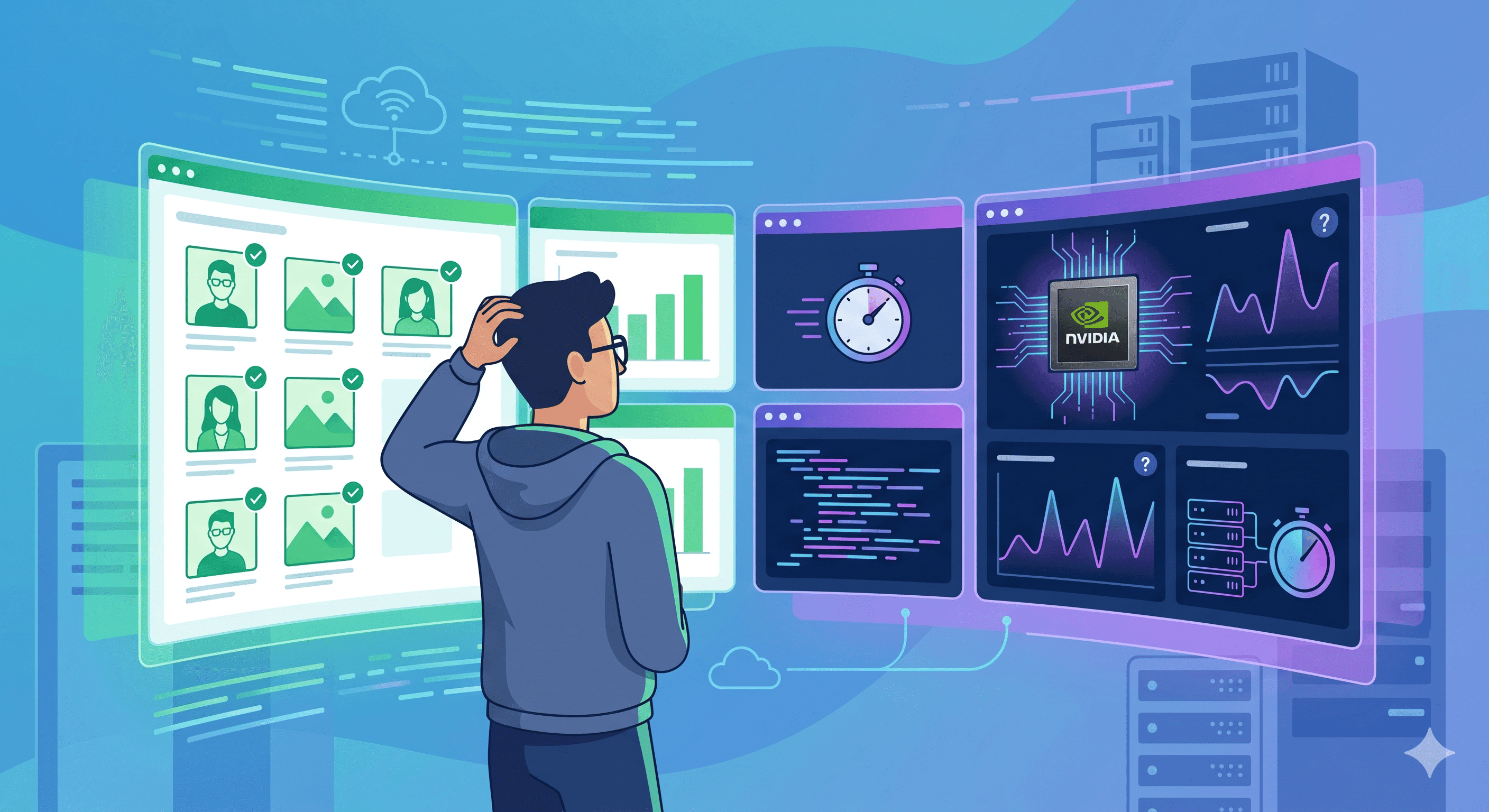
Die nicht dedizierten Deployments von Replicate starten Container bei Bedarf, wobei die von der Community gemeldeten Kaltstartzeiten zwischen 10 und 30 Sekunden liegen (Replicate, Dokumentation zu Deployments, 2026). Das ist keine akzeptable Wartezeit für eine Generierungs-API in einem Live-Produkt. Nutzer erleben dies als eingefrorene Oberfläche oder einen endlosen Ladekreis. Teams behelfen sich damit, Keep-Alive-Pings zu senden, um die Container warm zu halten. Das erfordert zusätzliche Kosten und Komplexität, die nicht sein sollten.
Wir haben festgestellt, dass die meisten Teams das Kaltstart-Problem erstmals bemerken, wenn sie die Generierungslatenz mit den Nutzerbindungsdaten korrelieren. Der Abfall ist bereits bei Verzögerungen von 5 Sekunden messbar. Bei 15 Sekunden ist er katastrophal.
Hardware-Abrechnungen sind schwer vorhersehbar
Replicate berechnet einige Workloads nach Hardware-Sekunden, nicht nach Output. Eine Nvidia A100 (80GB) läuft laut den veröffentlichten Preisen von Replicate bei $0,0014/Sekunde. Das bedeutet, ein 60-Sekunden-Job auf einer A100 kostet $0,084, unabhängig davon, was produziert wurde. Bei der Bildgenerierung ist ein Modell pro Bild besser. Aber bei benutzerdefinierten Modell-Deployments zahlen Sie für die Hardwarezeit, und diese Zahl ist schwer zu prognostizieren.
Die Preisgestaltung ist nicht skalierbar
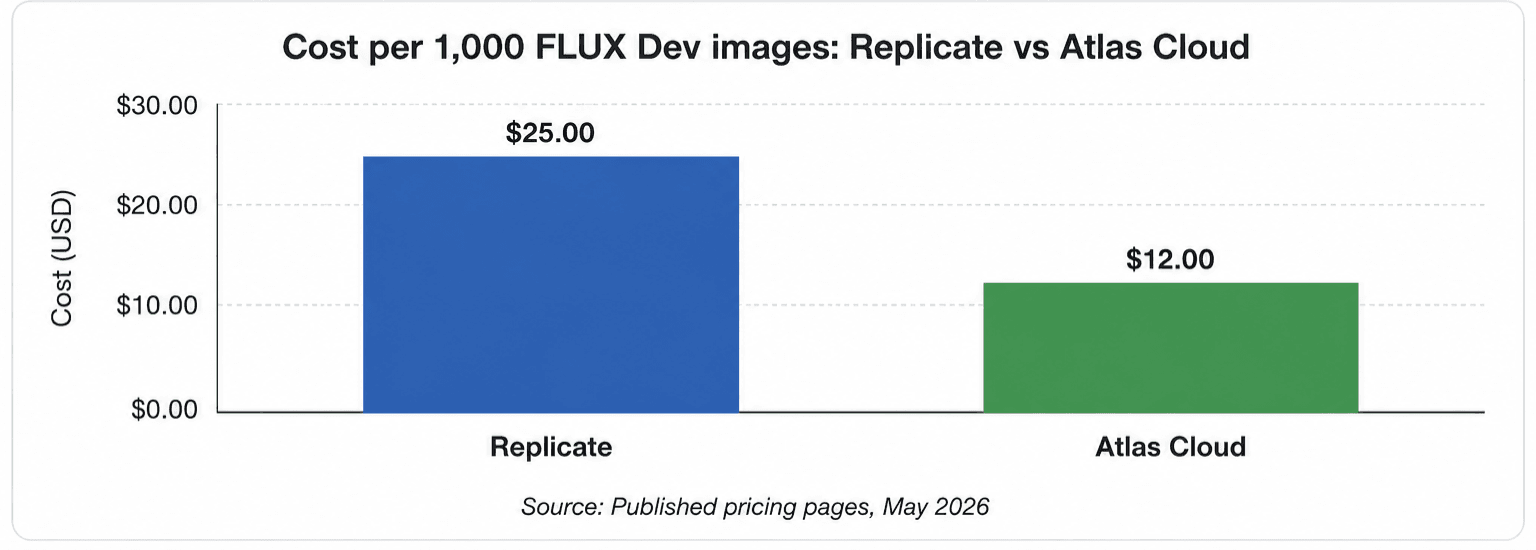
Replicate berechnet $0,025/Bild für FLUX Dev und $0,04/Bild für FLUX 1.1 Pro. Für einen Prototyp sehen diese Zahlen angemessen aus. Bei 500.000 Bildern pro Monat kostet FLUX Dev allein $12.500. Dedizierte Inference-Plattformen verlangen für dasselbe Modell deutlich weniger, und die Kluft wächst mit der Skalierung.
Replicate vs. Atlas Cloud: Der direkte Vergleich
Atlas Cloud betreibt eine OpenAI-kompatible API, die über 300 Modelle aus den Bereichen Video, Bild, LLM und Audio bereitstellt, und veröffentlicht Preise, SLAs sowie Compliance-Daten transparent. Replicate veröffentlicht zwar Preise, aber keine SLAs oder Compliance-Status. Die folgende Tabelle deckt die wichtigsten Dimensionen ab, die für Entwickler in der Produktion zählen.
| Dimension | Replicate | Atlas Cloud |
|---|---|---|
| Bildpreise (FLUX Dev) | $0,025/Bild | $0,012/Bild |
| Bildpreise (FLUX Schnell) | $0,003/Bild | $0,003/Bild |
| Videopreise | $0,09-0,25/Sek (WaveSpeed-Modelle) | $0,05-0,20/Sek (Veo 3.1 Familie, Wan-2.7, Seedance) |
| LLM-Preise (DeepSeek R1) | $3,75/M Input-Tokens | Nicht gelistet (DeepSeek V4 Pro: $1,70/M) |
| Kaltstarts | 10-30s (Community-dokumentiert) | Unter 1s (Warm Pool) |
| SLA | Nicht veröffentlicht | 99,99% Uptime |
| Compliance | Nicht veröffentlicht | SOC I & II, HIPAA |
| API-Stil | Replicate-nativ SDK | OpenAI-kompatibel (Drop-in) |
| Audio-Support | TTS, Speech-to-Text, Musik via Community-Modelle | Ja, nativ |
| Anzahl der Modelle | 100.000+ (Community, Qualität variiert) | 300+ (Produktions-kuratiert) |
| MCP-Server-Support | Nein | Ja |
| Hosting eigener Modelle | Ja (via Cog) | Nein |
Der wesentliche Unterschied: Der Katalog von über 100.000 Modellen bei Replicate ist von der Community beigesteuert und in der Qualität schwankend. Die 300+ Modelle von Atlas Cloud sind produktionserprobt, bieten konsistente SLAs, Warm Pools und eine einheitliche Abrechnung.
Was ist Atlas Cloud und wie fängt man an?
Atlas Cloud ist eine einheitliche KI-Inference-Plattform, die über 300 produktionserprobte Modelle aus den Bereichen Video, Bild, LLM und Audio über einen einzigen API-Key bereitstellt. Sie wurde für Entwickler entwickelt, die eine vorhersehbare Preisgestaltung pro Einheit, niedrige Latenz durch Warm Pools und Enterprise-Compliance ohne Infrastruktur-Management suchen. Jedes Modell läuft auf dedizierter Kapazität ohne Kaltstarts, und die Abrechnung erfolgt nach Verbrauch ohne monatliche Mindestbeträge.
Hauptmerkmale
Vollständige Modalabdeckung. Ein API-Key ermöglicht den Zugriff auf Videogenerierung (Veo 3.1, Seedance 2.0, Wan-2.7, HappyHorse-1.0), Bildgenerierung (FLUX Schnell, FLUX Dev, GPT Image 2, Nano Banana 2), LLMs (DeepSeek V4, Qwen3.6, GLM 5.1, Kimi K2.6) und Audio – alles über denselben Endpunkt.
MCP-Server-Support. Atlas Cloud bietet nativen Model Context Protocol (MCP) Server-Support für agentenbasierte Workflows. Teams, die KI-Agenten bauen, die Modellaufrufe verketten oder Tools wie Claude Code und Cursor integrieren, können Atlas Cloud ohne zusätzliche Infrastruktur-Einrichtung nutzen.
SOC I & II zertifiziert, HIPAA-konform. Die Compliance-Dokumentation ist veröffentlicht und für Vendor-Reviews verfügbar. Dies ist relevant für Teams, die an Enterprise-, Gesundheits- oder Fintech-Kunden verkaufen.
Pay-as-you-go, keine Mindestbeträge. Die Bildgenerierung beginnt bei $0,003/Bild, Videos ab $0,05/Sekunde, LLMs ab $0,14/M Token. Es gibt keine monatlichen Mindestumsätze und keine Abonnementpflicht.
Erste Schritte
Schritt 1: Erstellen Sie ein kostenloses Konto. Melden Sie sich bei Atlas Cloud an. Es ist keine Kreditkarte erforderlich, um zu beginnen.
Schritt 2: Holen Sie sich Ihren API-Key. Ihr Schlüssel ist direkt nach der Registrierung im Dashboard verfügbar.
Schritt 3: Tätigen Sie Ihren ersten Aufruf. Atlas Cloud verwendet das OpenAI SDK-Format. Installieren Sie die OpenAI Python-Bibliothek und verweisen Sie auf die Basis-URL von Atlas Cloud:
plaintext1from openai import OpenAI 2 3client = OpenAI( 4 base_url="https://api.atlascloud.ai/v1", 5 api_key="YOUR_ATLAS_CLOUD_KEY" 6) 7 8response = client.images.generate( 9 model="flux-schnell", 10 prompt="A developer reviewing API documentation at a clean desk" 11)
Schritt 4: Durchsuchen Sie den Modellkatalog. Besuchen Sie atlascloud.ai/pricing/models, um alle verfügbaren Modelle mit aktuellen Preisen pro Einheit zu sehen. Video, Bild, LLM und Audio sind zu transparenten Raten aufgelistet.
Schritt 5: Migrieren Sie bestehende Aufrufe. Suchen Sie für jeden Replicate-Modellaufruf in Ihrer Codebasis das entsprechende Modell auf Atlas Cloud und aktualisieren Sie den Modellnamen. FLUX Dev, FLUX Schnell, GPT Image 2, Seedance 2.0 und Veo 3.1 sind alle verfügbar. Das Anforderungsformat ist identisch.
Wie migriert man von Replicate zu Atlas Cloud?
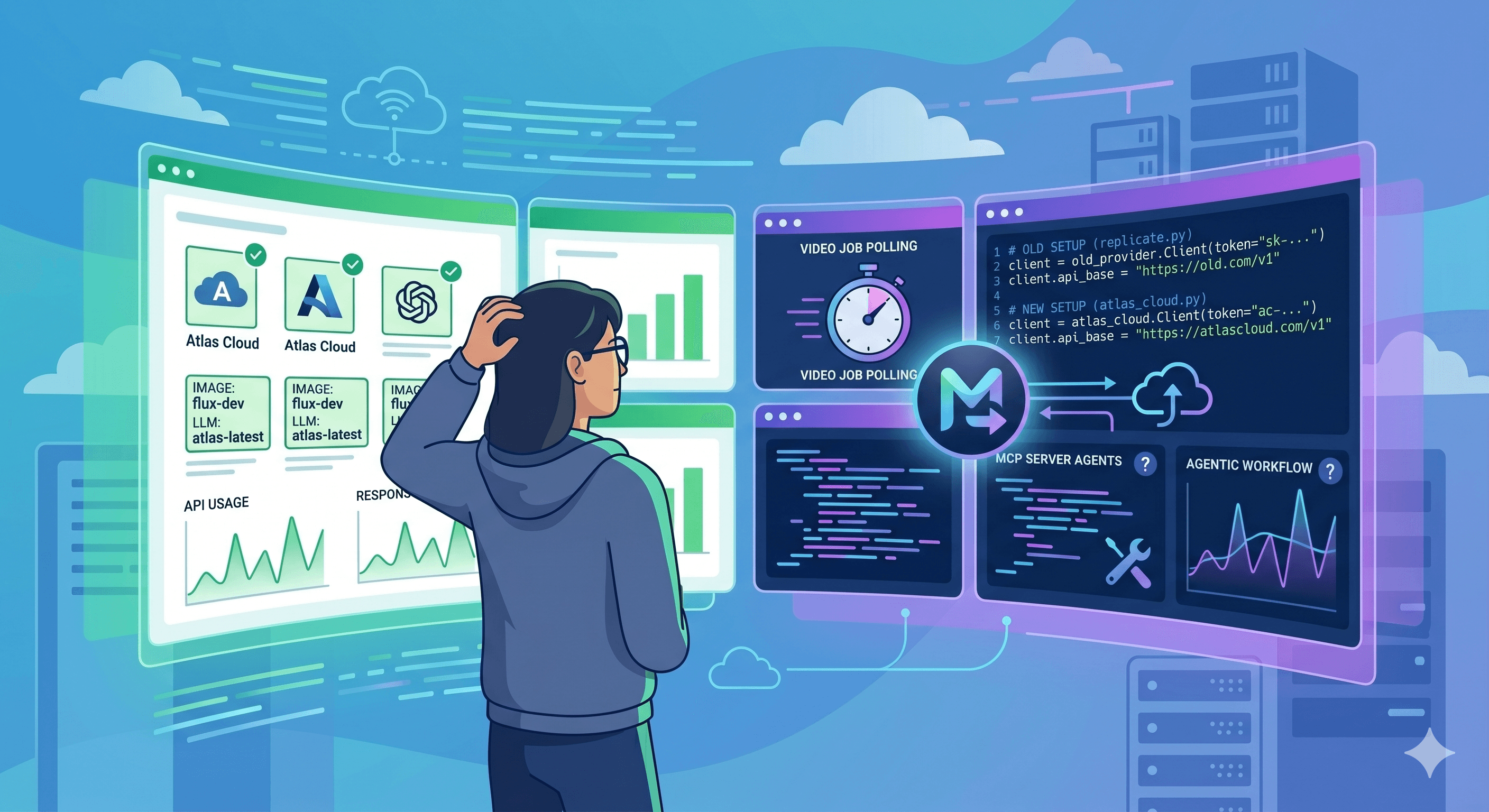
Die Migration ist ein einfacher Wechsel der Basis-URL und ein Austausch des Keys. Die API von Atlas Cloud ist OpenAI-kompatibel, was bedeutet, dass jeder Code, der bereits auf einen OpenAI-ähnlichen Endpunkt zielt, nur zwei kleine Anpassungen benötigt.
Hier ist ein direkter Vergleich für die Bildgenerierung:
plaintext1# Vorher: Replicate 2import replicate 3output = replicate.run("black-forest-labs/flux-dev", input={"prompt": "..."}) 4 5# Nachher: Atlas Cloud (OpenAI-kompatibel) 6from openai import OpenAI 7client = OpenAI(base_url="https://api.atlascloud.ai/v1", api_key="YOUR_KEY") 8response = client.images.generate(model="flux-dev", prompt="...")
Wenn Sie Ihre Inference-Aufrufe hinter einer Abstraktionsschicht gekapselt haben (was empfohlen wird), müssen Sie die Änderung nur an einer Stelle vornehmen. Die Anforderungsstruktur für die Bildgenerierung entspricht exakt der OpenAI Images API. Modellnamen lassen sich direkt zuordnen: flux-dev, flux-schnell, gpt-image-2.
Für die Videogenerierung verwendet Atlas Cloud ein jobbasiertes Muster. Sie senden eine Generierungsanfrage und erhalten eine Job-ID. Sie pollen auf Abschluss. Dies ist dasselbe asynchrone Muster, das Replicate für lang laufende Generierungen verwendet, sodass das mentale Modell nahtlos übertragen werden kann.
Für die LLM-Inference ist die Migration identisch mit dem Wechsel zu jedem anderen OpenAI-kompatiblen Anbieter: Ändern Sie die Basis-URL und den API-Key. Der MCP-Server-Support von Atlas Cloud ermöglicht zudem agentenbasierte Workflows ohne zusätzlichen Infrastruktur-Aufwand.
Wenn Sie gleichzeitig andere OpenAI-kompatible Inference-APIs evaluieren, finden Sie in unseren Beiträgen zur besten Fireworks AI-Alternative und besten Together AI-Alternative detaillierte Vergleiche.
Wie schneidet die Preisgestaltung von Replicate bei Skalierung ab?
Preisunterschiede summieren sich schnell, sobald Sie das Volumen eines Prototyps überschreiten. Laut dem AI Infrastructure Spending Report 2025 von Andreessen Horowitz geben durchschnittliche Produktions-KI-Teams monatlich 8.200 $ für Inference-Kosten aus (a16z AI Infrastructure Report, 2025). Kleine Unterschiede pro Einheit führen bei dieser Skalierung zu erheblichen Budgetposten.
FLUX Bildgenerierung
FLUX Schnell kostet auf beiden Plattformen das Gleiche: $0,003/Bild. Dies ist die schnelle Variante mit geringerer Qualität. Bei FLUX Dev klafft eine Lücke: Replicate berechnet $0,025/Bild, Atlas Cloud $0,012/Bild. Bei 100.000 FLUX Dev Bildern pro Monat entspricht das einem monatlichen Unterschied von $1.300. FLUX 1.1 Pro auf Replicate kostet $0,04/Bild; Atlas Cloud führt kein direktes Äquivalent, bietet aber GPT Image 2 für $0,01/Bild an.
Videogenerierung
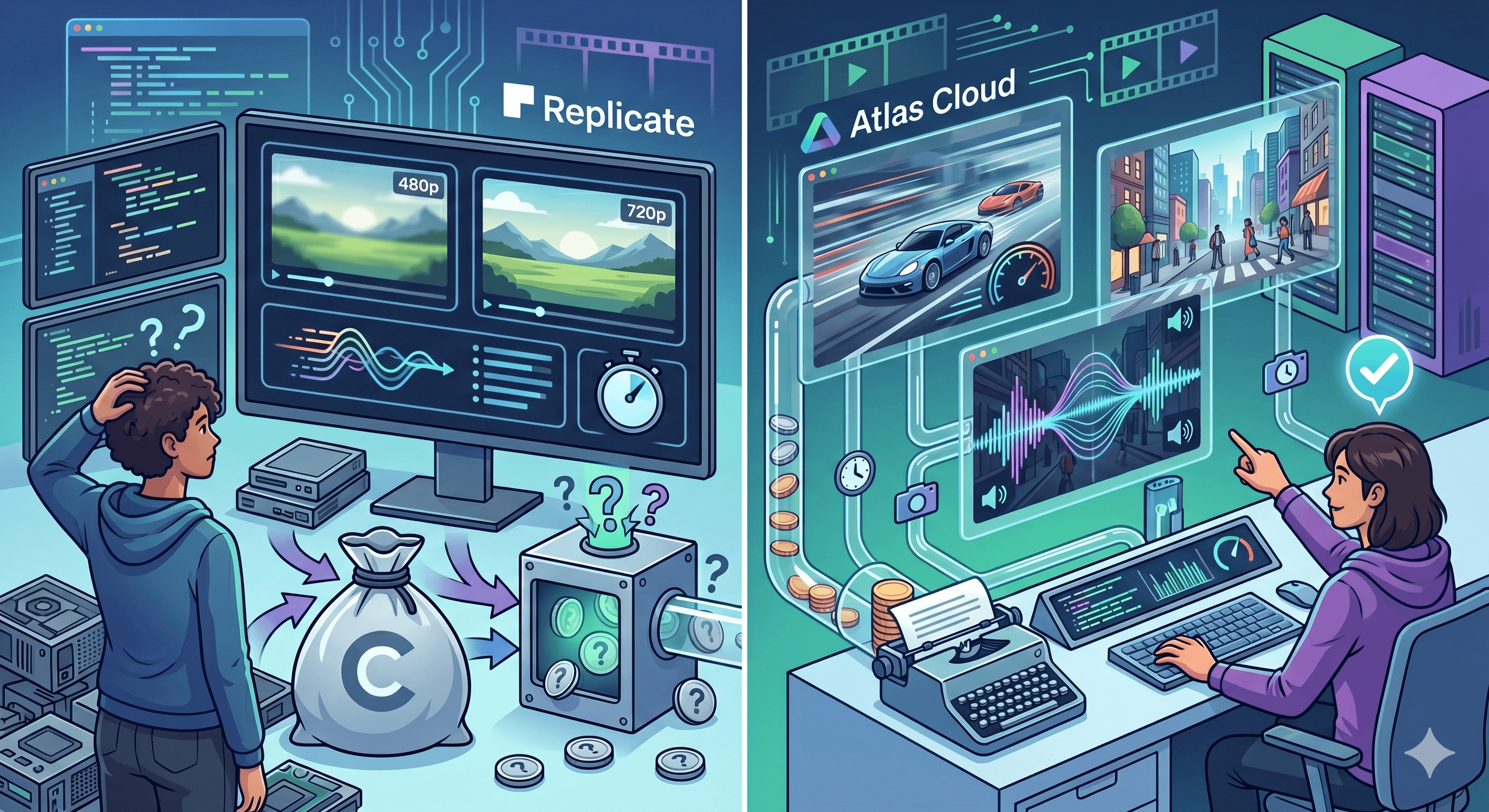
Die Videopreise von Replicate basieren auf WaveSpeed Wan 2.1 Modellen: 0,09 $/Sekunde bei 480p, $0,25/Sekunde bei 720p. Das Video-Lineup von Atlas Cloud umfasst Wan-2.7 für $0,10/Sekunde, Veo 3.1 Lite für $0,05/Sekunde, Veo 3.1 Fast für $0,08/Sekunde und Veo 3.1 für $0,20/Sekunde. Für die meisten Teams decken Veo 3.1 Lite oder Fast 80% der Anwendungsfälle zu geringeren Kosten ab als die 480p WaveSpeed-Preisgestaltung von Replicate.
Seedance 2.0 (ByteDance, natives Audio) läuft auf Atlas Cloud für $0,112/Sekunde. Replicate führt Seedance 2.0 zwar als verfügbares Modell, aber die Abrechnung erfolgt über die Hardware-Laufzeit bei Community-Deployments, was einen direkten Preisvergleich schwierig macht. Der Sekundentarif von Atlas Cloud ist transparent und vorhersehbar.
LLM-Preise
Replicate berechnet LLMs auf Token-Basis: Claude 3.7 Sonnet zu $3,00/M Input-Tokens, DeepSeek R1 zu $3,75/M Input-Tokens. Der LLM-Katalog von Atlas Cloud basiert auf anderen Modellen: DeepSeek V4 Pro zu $1,70/M Input, DeepSeek V4 Flash zu $0,14/M Input, Qwen3.6 Plus zu $0,50/M Input, Kimi K2.6 zu $0,95/M Input und GLM 5.1 zu $1,39/M Input. Die V4 Flash Option für $0,14/M eignet sich ideal für Klassifizierungs- und Routing-Aufgaben mit hohem Volumen, bei denen die Kosten pro Aufruf am wichtigsten sind.
Was verlieren Sie, wenn Sie bei Replicate bleiben?
Bei Replicate im Jahr 2026 zu bleiben, bedeutet, spezifische Einschränkungen zu akzeptieren, die nicht behoben werden. Dies sind keine geringfügigen Lücken; sie beeinflussen architektonische Entscheidungen.
Kaltstarts bei jedem Produktions-Deployment
Das Kaltstart-Problem ist architektonisch bedingt und kein Fehler, den Replicate einfach beheben kann. Community-Benchmarks setzen Kaltstarts ohne Warm-Pool bei 10-30 Sekunden an. Replicate bietet zwar dedizierte Deployments an, um dies abzumildern, aber dedizierte Kapazitäten sind mit festen Verpflichtungen verbunden, was das Preismodell massiv verschiebt. Sie zahlen dann für die Reservierung der Infrastruktur, nicht nur für die Inference.
Teams, die auf Atlas Cloud aufbauen, nutzen standardmäßig Warm Pools für alle Modelle. Es ist keine Konfiguration erforderlich und es entstehen keine zusätzlichen Kosten, um Kaltstarts zu vermeiden.
Kein veröffentlichtes SLA oder Compliance-Dokumentation
Replicate veröffentlicht auf seinen offiziellen Plattformseiten kein Uptime-SLA. Für Teams in regulierten Branchen – Gesundheitswesen, Fintech, Recht – ist dies ein Ausschlusskriterium. HIPAA-Konformität ist nicht aufgeführt. SOC-Zertifizierungen sind nicht aufgeführt. Atlas Cloud ist SOC I & II zertifiziert und HIPAA-konform, was für jedes Team, das geschützte Daten verarbeitet, entscheidend ist.
Entwickler, die für Enterprise-Kunden bauen, müssen zunehmend Compliance-Dokumentationen des Anbieters während des Verkaufsprozesses vorlegen. Da Replicate kein SLA veröffentlicht, können Sie es entweder nicht vorlegen oder müssen einen manuellen Verifizierungsschritt in Ihren Beschaffungsprozess einbauen.
Fragmentierte Multi-Modal-Pipelines
Replicate unterstützt Bild, Video, LLM und Audio durch Community-Modelle. In der Praxis erfordern die modernsten Modelle in jeder Kategorie im Jahr 2026 separate Lieferantenbeziehungen. Die besten Videomodelle, die besten LLMs und die besten Bildgenerierungsmodelle existieren in ihren aktuellen Versionen nicht alle auf Replicate. Teams enden am Ende ohnehin mit drei oder vier API-Keys.
Atlas Cloud konsolidiert dies. Ein Key, eine Rechnung, ein zu überwachendes Rate-Limit, ein zu wartender Integrationspunkt. Diese operative Vereinfachung ist bei Skalierung von Bedeutung.
Teams, die aus ähnlichen Gründen Alternativen zu fal.ai in Betracht ziehen, finden einen detaillierten Vergleich in unserem Beitrag darüber, warum Teams von fal.ai zu Atlas Cloud wechseln.
FAQ
Ist Atlas Cloud ein direkter Drop-in für die Replicate-API?
Atlas Cloud ist nicht mit der Replicate-API kompatibel, aber es ist OpenAI-kompatibel. Wenn Ihr Code das eigene SDK von Replicate verwendet (die replicate.run() Funktion), müssen Sie diese Aufrufe auf das OpenAI SDK-Muster umschreiben. Die meisten Teams erledigen das in unter einer Stunde. Laut dem Stack Overflow Developer Survey 2025 nutzen 73% der KI-Workloads in der Produktion weniger als 10 verschiedene Modellvarianten, die alle vom 300+ Katalog von Atlas Cloud abgedeckt werden. (Stack Overflow Developer Survey, 2025)
Unterstützt Atlas Cloud das Hosting von benutzerdefinierten Modellen via Cog?
Nein. Das Cog-Framework von Replicate zum Paketieren und Hosten eigener Modelle ist eine exklusive Replicate-Funktion. Atlas Cloud konzentriert sich auf produktionserprobte gehostete Modelle, nicht auf von der Community beigesteuerte oder benutzerdefinierte Modelle. Wenn Sie auf Cog-Deployments angewiesen sind, müssten Sie Replicate für diesen spezifischen Anwendungsfall beibehalten und gleichzeitig Standard-Modellaufrufe zu Atlas Cloud migrieren.
Wie geht Atlas Cloud mit Kaltstarts im Vergleich zu Replicate um?
Atlas Cloud unterhält permanente Warm Pools für alle gehosteten Modelle. Es gibt kein Hochfahren von Containern pro Anfrage. Der Latency.io Developer Benchmark Report 2025 ergab, dass dedizierte Warm-Pool-Plattformen durchschnittlich unter 1 Sekunde für die Latenz bis zum ersten Pixel benötigen, verglichen mit den von der Community dokumentierten 18,4 Sekunden bei Replicate für nicht vorgewärmte Modelle. (Latency.io Developer Benchmark Report, 2025) Dies ist ein architektonischer Unterschied, keine Konfigurationsoption.
Welche Videomodelle unterstützt Atlas Cloud, die Replicate nicht unterstützt?
Atlas Cloud unterstützt Veo 3.1, Veo 3.1 Fast und Veo 3.1 Lite mit transparenter Preisgestaltung pro Sekunde ($0,20, $0,08 bzw. $0,05), dazu Seedance 2.0 mit nativem Audio für $0,112/Sekunde und HappyHorse-1.0 für $0,14/Sekunde. Replicate führt einige dieser Modelle zwar auf, aber die Preisgestaltung erfolgt über Hardware-Sekunden-Abrechnung bei Community-Deployments, was einen Kostenvergleich und Prognosen erschwert.
Fazit
Replicate bleibt 2026 für genau einen Anwendungsfall die richtige Antwort: den Zugriff auf Nischen-Community-Modelle und feinabgestimmte Checkpoints, die auf Produktions-Inference-Plattformen nicht verfügbar sind. Für alles andere macht die Kombination aus 10-30 Sekunden Kaltstartzeiten, fehlenden SLAs und einer Preisgestaltung, die bei Skalierung in die Höhe schießt, die Plattform für Produktionsteams ungeeignet.
Die Rechnung für Atlas Cloud ist einfach. Bildgenerierung ab $0,003/Bild, Video ab $0,05/Sekunde, LLMs ab $0,14/M Token, SOC I & II sowie HIPAA-Konformität, 99,99% Uptime-SLA und eine OpenAI-kompatible API, die die Migration zu einer einstündigen Aufgabe macht. Das ist das Gesamtbild.
Beginnen Sie mit der Migration der Modellaufrufe, bei denen Replicate Sie am meisten kostet, validieren Sie Latenz und Abrechnung, und verschieben Sie dann den Rest. Der Leitfaden zu den besten KI-Inference-API-Alternativen im Jahr 2026 deckt die gesamte Wettbewerbslandschaft ab, falls Sie noch Optionen evaluieren.