The landscape of generative media has undergone a seismic shift. We moved past the era of simple "clip generators" into the age of end-to-end production APIs. Developers no longer seek mere novelty; they require scalable, stable infrastructure that integrates directly into automated workflows.
This year’s market is dominated by a few key companies, each carving out a specific niche:
- The Titan (Google Veo 3.1): Known for deep integration with Google Cloud and superior 4K consistency.
- The Efficiency King (Kling 3.0): Offers the highest throughput for high-volume social content.
- The Cinematic Standard (Sora 2): Despite its announced sunset phase, it remains the benchmark for physical world modeling.
- The Disruptors (Vidu Q3 & Wan 2.7): Aggressive challengers focusing on low-latency and synchronized audio.
| Provider / Model | Primary Core Strength | Native Resolution | Base Price $ (CPS) | DX / SDK Maturity | Best Business Case |
|---|---|---|---|---|---|
| Google Veo 3.1 | Spatial Audio & Physics | 1080p / 4K | 0.10 - 0.20 | High (Vertex AI) | Enterprise Ads & Cinema |
| Kling 3.0 | 60fps Motion Fluidity | Native HD | 0.07-0.143 | Medium | Viral Social & Marketing |
| Vidu Q3 | Narrative Dialogue Sync | 1080p | 0.034-0.106 | Medium | High-Volume UGC / TikTok |
| Wan 2.7 | FLF2V Character Control | 1080p | 0.03 - 0.1 | Medium | Indie SaaS & Storytelling |
| Seedance 2.0 | Product Physics Consistency | 1080p | 0.1 - 0.13 | Emerging | E-commerce / Virtual Try-on |
| Sora 2 | Spatiotemporal Coherence | 720p / 1080p | 0.1 | Legacy | Prototyping (Sunset Phase) |
Performance metrics like "vibe" are secondary to Cost-per-Second (CPS). For any SaaS looking to scale, CPS is the definitive unit of economic viability; also it requires a deep dive into how these models perform under production loads.
Fidelity & Performance: Beyond the "Vibe Check"
While a creative "vibe" is subjective, production-grade AI Video API selection in 2026 relies on quantifiable performance metrics. Developers are moving beyond simple aesthetic tests to evaluate how these models handle the complex physics and multi-shot requirements of professional workflows.
Physics & Coherence: The Battle for Realism
In the realm of physical world modeling, Sora 2 remains the industry gold standard for "World State" memory. Sora 2 excels at spatiotemporal coherence—ensuring a character emerging from behind an object maintains identical lighting and clothing. In contrast, Kling 3.0 prioritizes "Elements Locking," a granular approach that delivers 60fps motion fluidity, making it ideal for fast-paced content where smoothness outweighs complex physical logic.
While Sora 2 has long been the "cinematic standard," real-world stress tests—especially for high-stakes User-Generated Content (UGC)—reveal that "coherence" is often a double-edged sword.
The "Breakdown" Test: Sora 2 vs. Kling 3.0
| Feature | Sora 2 (The Legacy Giant) | Kling 3.0 (The UGC Powerhouse) |
| Instruction Following | Often ignores specific movement prompts; tends to "jump cut" between scenes rather than animate complex actions. | Superior adherence to complex prompts; animates difficult motions like "unscrewing a bottle" with higher success. |
| Physical Anomalies | Notorious for "creepy" or "horror-like" ending frames and occasional "third-hand" glitches. | More grounded; while it may struggle with tiny text, the character's facial expressions and movements feel more natural. |
| Generation Speed | Significantly slower; wait times can disrupt the creative feedback loop. | Rapid generation, optimized for high-volume content creators and ad testing. |
The "Sora Alternative": Seedance 2.0
For developers and marketers looking for a way out of the Sora ecosystem, Seedance 2.0 has emerged as a specialized contender.
- The Strength: It is widely considered "incredible" for high-end product videos, offering physics-accurate renders of inanimate objects.
- The Weakness: It currently lacks robust human-face reference capabilities. If your project relies on a consistent AI influencer or recurring human character, Seedance is less effective than Kling 3.0.
Pro Tip: While Sora 2 is sunsetting, creators shouldn't panic. The shift to Kling 3.0 offers better prompt adherence for character-driven ads, while Seedance 2.0 is the superior pick for standalone product showcases where a human face isn't the primary focus.
The Audio-Visual Frontier
The latest API updates have introduced native, phoneme-level audio integration.
- Google Veo 3.1: Features state-of-the-art spatial audio with approximately 10ms latency between visual triggers and environmental sound effects.
- Vidu Q3: Best at matching story and sound. In a single run, it creates 16-second clips with several characters talking naturally.
Let's test their performance:
Vidu Q3: The standout feature here is the lip-sync precision. Observe the Detective as he speaks the line, "Tell me the truth, Clara!" The labial tension and the movement of the jaw muscles align perfectly with the explosive "T" and "B" sounds. There is zero "mushiness" typical of legacy models. Maintaining consistency under high-contrast Chiaroscuro lighting is a nightmare for AI, yet Vidu Q3 holds firm.
Vidu Q3 is still the top pick for stories led by characters. It excels at tense dialogue where capturing every small emotion is vital.
Google Veo 3.1: As the motorcycle streaks across the rainy Tokyo alley, the Doppler Effect is rendered in real-time. The soundstage transitions seamlessly from left-rear to front-right, synchronized with the visual trigger of the motor’s light trail. Veo 3.1 excels at simulating complex physical environments. The reflection of neon signs on the wet asphalt and the interaction of rain with the moving vehicle demonstrate a deep understanding of world-state physics.
Google Veo 3.1 is the definitive enterprise-grade engine for high-action commercial work and cinematic world-building where physical accuracy is the primary benchmark.
Consistency & Resolution: Professional Benchmarks
Maintaining character identity across multiple clips—the "Multi-shot" test—is now a core API capability. Wan 2.7 utilizes a first-and-last-frame specification system to bridge scenes, while Kling 3.0’s Elements 3.0 engine allows for hyper-persistent identity locking through multi-layered reference anchors, maintaining consistent geometry even across its native 15-second multi-shot output.
Regarding visual clarity, the market is split between native rendering and post-process reconstruction:
| Model | Native Resolution | Enhancement Capability | Best For |
|---|---|---|---|
| Google Veo 3.1 | 1080p / 4K (Standard) | AI-Powered 4K Reconstruction | Enterprise Productions & High-End Ads |
| Kling 3.0 | Native 4K (Ultra) | 60fps Native Fluidity | High-Fidelity Marketing & Social UGC |
| Vidu Q3 | 1080p | Real-time Turbo Rendering | Rapid Social Media Testing & Viral Clips |
| Seedance 2.0 | 1080p | Motion-Consistency Engine | Fashion E-commerce & Virtual Try-on |
| Wan 2.7 | 1080p | FLF2V Path Control | Storyboarding & Sequential Animation |
The 4K Premium: When evaluating AI video API pricing, it is essential to note that true native 4K output often carries a 2.5x to 4x cost premium due to the massive compute overhead.
Operational Strategy: For apps like TikTok or Instagram, pros now use "Efficiency-First" methods. Upscaling 1080p clips from Veo 3.1 (Lite) or Wan 2.7 hits the sweet spot. It keeps quality high while keeping the cost per second (CPS) low and sustainable.
The True Cost of Production: API Pricing Breakdown
Navigating the financial landscape of generative media requires a shift in perspective. In 2026, the industry has largely abandoned opaque subscription tiers in favor of granular, usage-based consumption. For developers, the only metric that dictates the viability of a project is the Cost-per-Second (CPS).
The Pay-as-You-Go Leaderboard
Understanding ai video api pricing starts with a direct comparison of the base rates across the primary contenders. While some providers offer "Turbo" models for rapid prototyping, others command a premium for high-bitrate 4K outputs.
| Provider | Model Tier | Base Price (per sec) | 10s Clip Cost |
|---|---|---|---|
| Vidu Q3 | Turbo | $0.03 | $0.30 |
| Kling 3.0 | Standard | $0.07 | $0.70 |
| Sora 2 | Standard | $0.10 | $1.00 |
| Google Veo 3.1 | Fast | $0.10 | $1.00 |
| Google Veo 3.1 | Standard | $0.20 | $2.00 |
| Seedance 2.0 | fast | $0.10 | $1.00 |
| Seedance 2.0 | Standard | $0.13 | $1.30 |
API pricing referenced from Atlas Cloud. Rates may vary, please check official website for the latest pricing tiers.
As shown, Vidu Q3 currently leads the market in affordability for high-volume workflows, while Google Veo 3.1 positions itself as a premium enterprise solution, particularly when native 4K rendering is required.
Decoding "Hidden" Surcharges
The base price is rarely the final cost. Most AI Video API providers implement a variable credit system based on the complexity of the generation request. To ensure accurate budgeting, developers must account for these three common multipliers:
- Audio-Visual Sync: Enabling native spatial audio (standard in Veo 3.1) or synchronized dialogue often incurs a 15% to 25% surcharge per generation.
- Frame Referencing: Utilizing "Start-End" frame specification—a critical feature for character consistency—can consume additional compute credits. For instance, according to recent developer documentation, using dual-frame references often counts as a "Complex Request," increasing the base CPS.
- Resolution Premiums: Moving from 720p to 4K costs much more than you think. For Google Veo, switching from 'Fast' to 'Standard' mode spikes the price by 100%. This change effectively doubles your total spend for every second produced.
For a sustainable production environment, it is recommended to prototype with lower-cost APIs like Vidu Q3 and reserve premium credits for final, consumer-facing assets. Successful scaling in 2026 depends on mastering these micro-economic variables.
Developer Experience (DX): Documentation & Integration
The quality of an AI Video API is often judged not by its output alone, but by how quickly a developer can reach "Hello World." As engineering teams move toward automated content pipelines, the friction of integration becomes a major factor in ai video api pricing—specifically regarding the internal labor costs of maintenance.
Modern SDKs have moved away from manual polling. Here is how you trigger a high-fidelity generation in Google Veo 3.1 using the latest GenAI Python SDK:
plaintext1from google import genai 2from google.genai import types 3 4client = genai.Client(api_key="YOUR_API_KEY") 5 6# Triggering a 4K generation with native spatial audio 7operation = client.models.generate_videos( 8 model="veo-3.1-standard", 9 prompt="A neon detective office, 1940s noir, cinematic lighting", 10 config=types.GenerateVideosConfig( 11 resolution="4k", 12 generate_audio=True, 13 aspect_ratio="16:9" 14 ) 15) 16 17# 2026 standard: The SDK handles the polling logic internally 18print("Generation started. Stand by for the magic...") 19result = operation.result() 20print(f"Video ready at: {result.generated_clips[0].uri}")
Documentation Quality & Transparency
High-quality documentation in 2026 needs more than simple code examples. Leading companies now provide:
- Rate-Limit Transparency: They use clear headers like X-RateLimit-Limit and set firm wait times.
- Error Code Granularity: They swap vague 400 errors for specific alerts like "Safety Filter Triggered" or "Compute Capacity Reached."
Top brands like Vidu and Veo show your live compute limits right inside the HTTP response headers:
plaintext1HTTP/1.1 200 OK 2Content-Type: application/json 3X-RateLimit-Limit-Video-Seconds: 3600 # Monthly quota: 1 hour 4X-RateLimit-Remaining-Video-Seconds: 452 # Only 7.5 mins left 5X-RateLimit-Reset: 1713824000 # Resets at this Unix timestamp 6X-Compute-Cost-Per-Second: 0.10 # Real-time CPS for this request
Tip: High-quality documentation explains these headers on page one, enabling developers to build automated "safety brakes" for their spending.
The "Workflow" Advantage
Choosing an API often comes down to the surrounding ecosystem. Google Vertex AI provides a distinct advantage for enterprise teams already within the Google Cloud environment, offering seamless logging, monitoring, and IAM (Identity and Access Management) integration.
Conversely, for agile startups looking to avoid vendor lock-in, "Unified API" aggregators like Fal.ai and Atlas Cloud are becoming the preferred choice. These platforms allow developers to swap underlying models, e.g., switching from Kling to Vidu, by changing a single parameter in the API call. This architectural flexibility is a critical safeguard in a year where models like Sora are transitioning out of the market, as they provide a unified billing layer for complex AI Video API requirements.
The true cost of an API includes the labor spent debugging. Compare how different providers handle common failures in 2026:
| Error Code | Legacy Response (2024) | 2026 Modern Response (Veo/Vidu) | Developer Action |
| 400 | Bad Request | SAFETY_FILTER_PEOPLE_TRIGGERED | Refine prompt to remove human figures. |
| 429 | Too Many Requests | RATE_LIMIT_RESETS_IN_12S | Script automatically pauses for 12s. |
| 503 | Service Unavailable | COMPUTE_REGION_OVERLOAD_US_EAST | Failover to US-WEST cluster instantly. |
Strategic Use Cases: Which API for Which Product?
Choosing the right AI Video API is no longer about finding the "best" model, but the best ROI for your specific business model. The market has bifurcated into high-volume efficiency and high-fidelity boutique production.
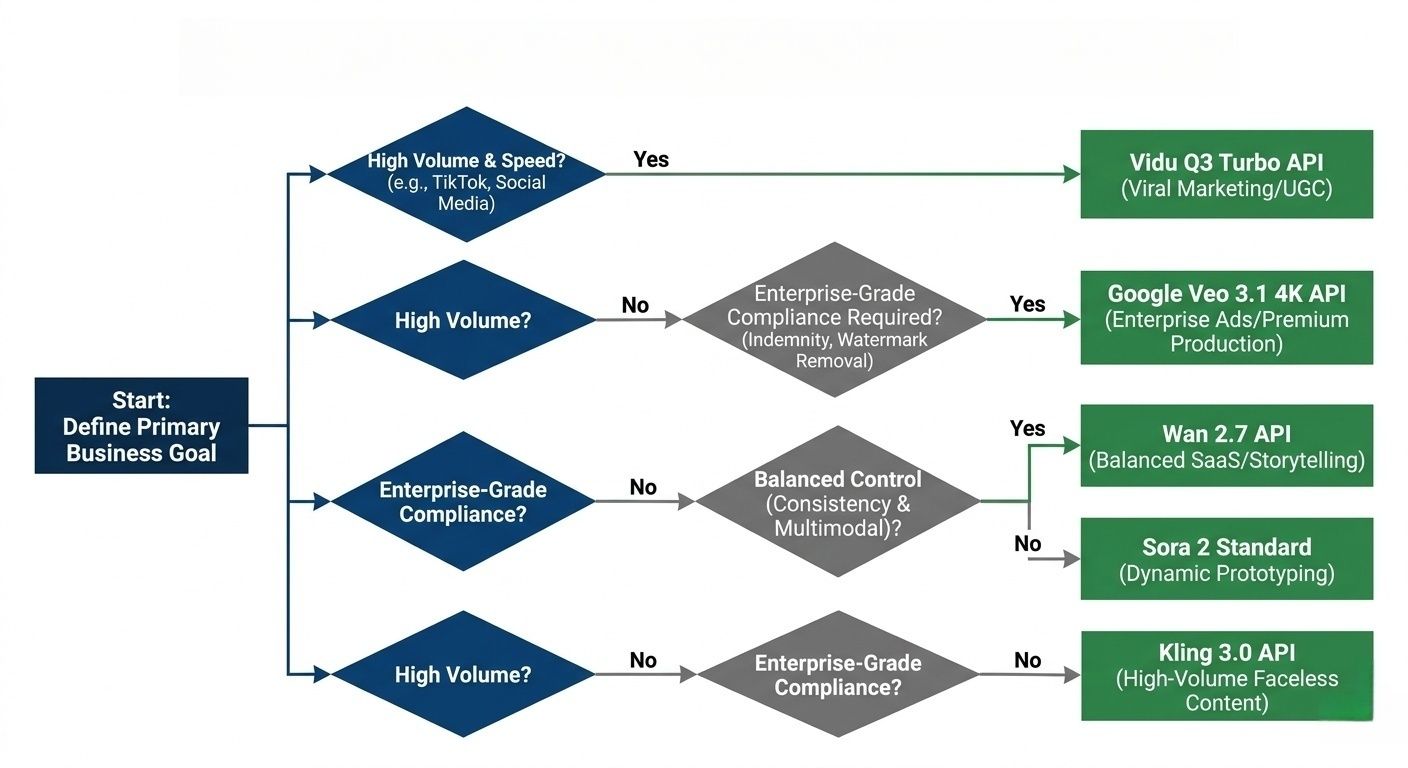
The "Social Media Factory"
For platforms generating thousands of daily clips—such as faceless YouTube channels or automated TikTok marketing—Kling 3.0 and Vidu Q3 are the clear winners. Their aggressive ai video api pricing allows for high-frequency testing without ballooning overhead.
- Best For: Viral content, rapid A/B testing, and short-form UGC.
- Key Advantage: Lowest cost-per-second with 60fps fluidity.
The "Enterprise Ad Agency"
When the output is destined for streaming services or cinema-grade advertising, the $249/mo premium for Google Veo 3.1 Ultra becomes a logical investment. This tier provides:
- Native 4K Rendering: Eliminating the need for third-party upscalers.
- Watermark Removal & Legal Indemnity: Essential for corporate compliance and brand safety.
- Advanced Spatial Audio: Professional-grade soundscapes that match the visual fidelity.
The "Indie SaaS"
For independent developers building creative tools like "AI storybook" apps, Wan 2.7 offers a balanced entry point. It is a cost-effective, multi-modal powerhouse that allows for consistent character generation without the enterprise price tag of Google or the prompt-complexity often required by Kling.
Conclusion:
As we look toward the second half of 2026, the industry is pivoting toward Real-time Latency updates. We expect to see "streaming" video APIs that allow for interactive, AI-generated environments. Keeping an eye on your ai video api pricing strategy now will ensure you have the capital to pivot when the next "Live-Video" revolution hits this autumn.
FAQ
Which AI Video API offers the best balance between cost and consistency?
Wan 2.7 is the top contender for "Indie SaaS" developers. While Google Veo 3.1 leads in fidelity, Wan 2.7’s FLF2V system provides superior character consistency at nearly half the "Standard" 4K price point, making it ideal for storytelling apps.
Can I switch between Kling 3.0 and Vidu Q3 without rewriting my backend?
Yes, if you use a "Unified API" gateway like Atlas Cloud. These platforms normalize the disparate schemas of providers into a single OpenAI-compatible request. You can switch the base model by just updating the model field in your JSON file. This helps you avoid being dependent on one provider and makes changing tools simple.
Is native 4K rendering worth the 2x price premium over upscaled 1080p?
For mobile apps like TikTok, the answer is no. Sharp 1080p clips from Vidu Q3 boosted by AI get the same views for half the price. Only use native 4K for movie ads or huge office screens. Those cases need perfect pixels to meet brand rules or legal standards.
How do I handle safety filters and error handling in automated pipelines?
Top-tier APIs now provide granular error codes. Instead of generic 400 errors, look for providers like Google Veo that return specific headers, e.g., SAFETY_FILTER_TRIGGERED. This allows your code to automatically "retry with a modified prompt" or switch to a less restrictive model like Kling 3.0 for creative flexibility.





