Two models, two very different price tags. DeepSeek V4 Pro and Claude Opus 4.7 both target the same kind of developer: engineers running complex reasoning tasks, agentic coding workflows, and code generation pipelines. The cost gap between them is hard to ignore, and the question most teams end up asking is whether the performance difference actually justifies that delta.
This comparison breaks down where each model genuinely excels, where the tradeoffs are real versus overstated, and what the choice looks like in practice. It also covers the integration side: how to actually run DeepSeek V4 Pro inside the coding tools you're already using.
DeepSeek V4 Pro vs Opus 4.7: The Comparison Worth Reading
Before going into specifics, it helps to understand what each model is actually optimized for.
DeepSeek V4 Pro is DeepSeek's current flagship open-source model. It uses a Mixture of Experts (MoE) architecture, which activates only relevant parameters per forward pass. This design allows high capability at lower compute cost, which is part of why the pricing is so much lower than proprietary alternatives. Its 1M context window is one of the headline specs, and it's among the most capable open-source models for code generation and structured reasoning tasks.
Claude Opus 4.7 is Anthropic's top-tier model in the Claude 4.x family. Anthropic builds Opus for complex, multi-step tasks where instruction accuracy and careful reasoning matter. It integrates natively with Claude Code and reflects Anthropic's priorities around alignment and enterprise reliability.
The obvious question is: if DeepSeek V4 Pro is open-source and considerably cheaper, what's the case for Opus 4.7? The answer depends on your workload, and it's worth being honest about where the gap is real.
What Each Model Is Built For
DeepSeek V4 Pro vs Opus 4.7 on Reasoning and Instruction Following
Both models handle complex reasoning tasks, but their strengths come from different design philosophies. DeepSeek V4 Pro's MoE architecture tends to produce strong, consistent results on structured problems like coding, math, and logic. It's designed for high throughput at low cost without sacrificing top-end capability.
Opus 4.7 has Anthropic's alignment research built deeply into its training. For tasks that require careful handling of ambiguous or multi-part instructions where misinterpretation has real consequences, Opus 4.7 is more reliable. Use cases like interpreting complex specifications, navigating edge cases in long regulatory documents, or handling tasks where tone and nuance matter show this difference most clearly.
For the vast majority of developer workflows, both models are capable. The gap shows up in tasks that depend on subtle judgment rather than raw technical execution.
DeepSeek V4 Pro vs Claude Opus 4.7 for Code Generation
Code generation is where DeepSeek V4 Pro has built the strongest case against proprietary models. DeepSeek has consistently placed near the top of public coding benchmarks across its model generations, and V4 Pro continues that track record (DeepSeek Technical Report, May 2025).
Opus 4.7 is also a strong coder. Where it tends to pull ahead is on tasks where code correctness requires understanding complex context spread across large files, or where a model needs to interpret a nuanced specification accurately before writing anything. The native Claude Code integration matters here: the tool was designed to work with Claude models, which means fewer edge cases in long agentic sessions.
The practical takeaway for most teams: if native Claude Code compatibility with zero configuration overhead is important, Opus 4.7 is the simpler path. If you're comparing code generation quality on a range of tasks and cost efficiency is a factor, DeepSeek V4 Pro holds up as a serious alternative.
DeepSeek V4 Pro vs Opus 4.7: The Cost Gap Is Significant
This is where the two models diverge most sharply in practical terms, and it's worth being direct about the numbers.
Claude Opus 4.7 sits at Anthropic's premium pricing tier. It's priced for teams where quality justifies the cost, and it reflects the investment in safety research, alignment work, and enterprise-grade infrastructure.
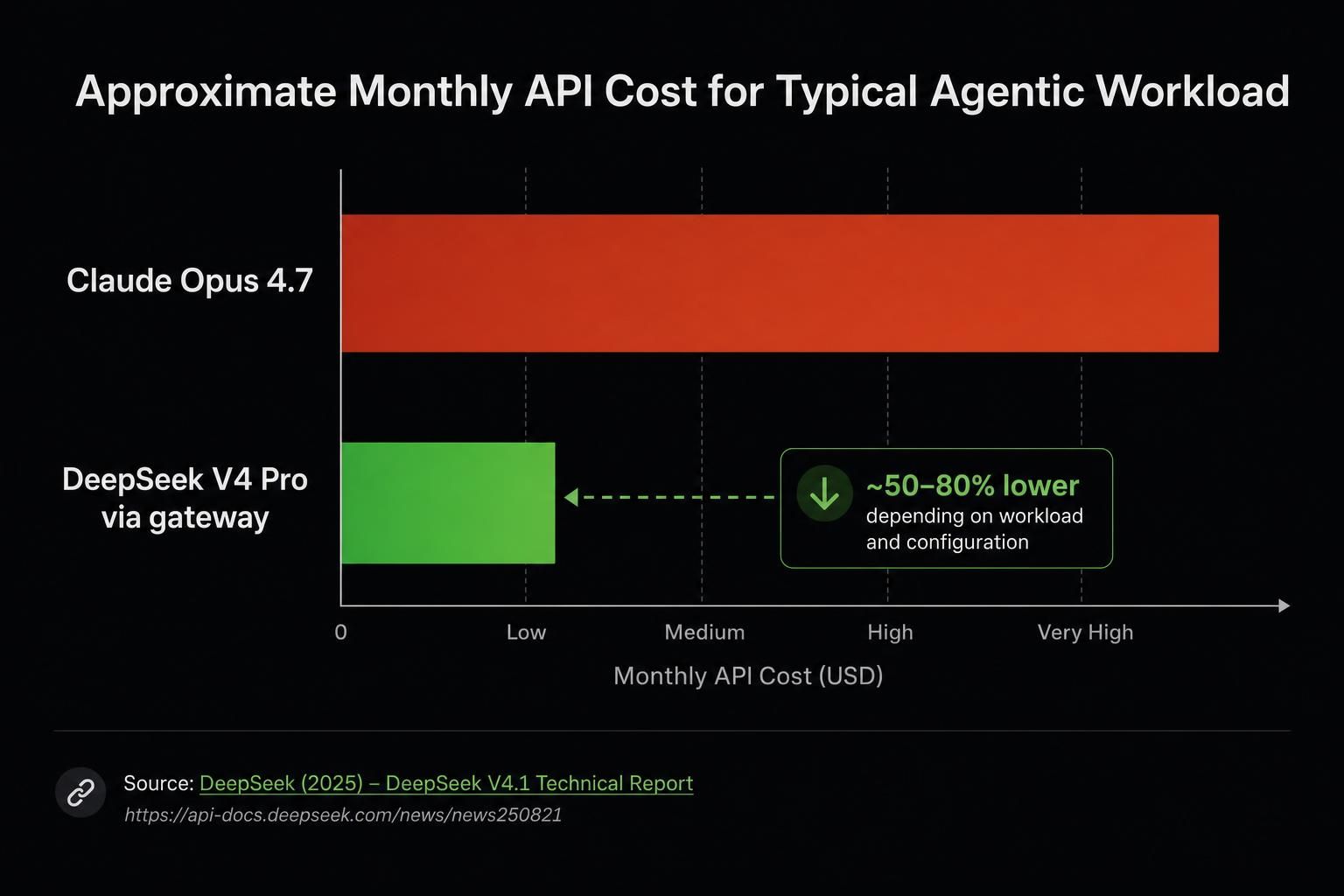
DeepSeek V4 Pro, as an open-source model, comes in at a fraction of that. Through the official DeepSeek API, pricing is already considerably lower than Opus 4.7. Developers using third-party gateway providers can reduce that further. Running DeepSeek V4 Pro through Atlas Cloud Coding Plan, for instance, comes in at 50% below the standard DeepSeek API rate (Atlas Cloud Coding Plan, May 2026).
In agentic workflows where a single task triggers dozens or hundreds of API calls, this difference is not a rounding error. A pipeline that costs $500/month on Opus 4.7 could cost under $100/month on DeepSeek V4 Pro through a discounted gateway. For teams running continuous coding assistants or multi-agent pipelines, it's the kind of budget difference that changes what's feasible to build.
Context Window: 1M Tokens and What It Actually Changes
DeepSeek V4 Pro's 1M token context window is one of its most practically useful specs. At that scale, you can fit an entire large codebase into a single context, process long conversation histories without truncation, or analyze extensive documentation in one request.
For most day-to-day coding tasks, neither model hits its context limit. But for long agentic sessions involving large-scale refactoring, codebases that span tens of thousands of lines, or analysis tasks over large document sets, the 1M window gives DeepSeek V4 Pro real room to work with.
Opus 4.7 handles long-context inputs well within its window, and for tasks where quality of reasoning over long inputs matters more than window size itself, it remains competitive. The question is what your actual use cases demand: if you're regularly running into context limits with other models, the 1M window in DeepSeek V4 Pro is a concrete and measurable advantage.
DeepSeek V4 Pro vs Opus 4.7 in Agentic Coding Workflows
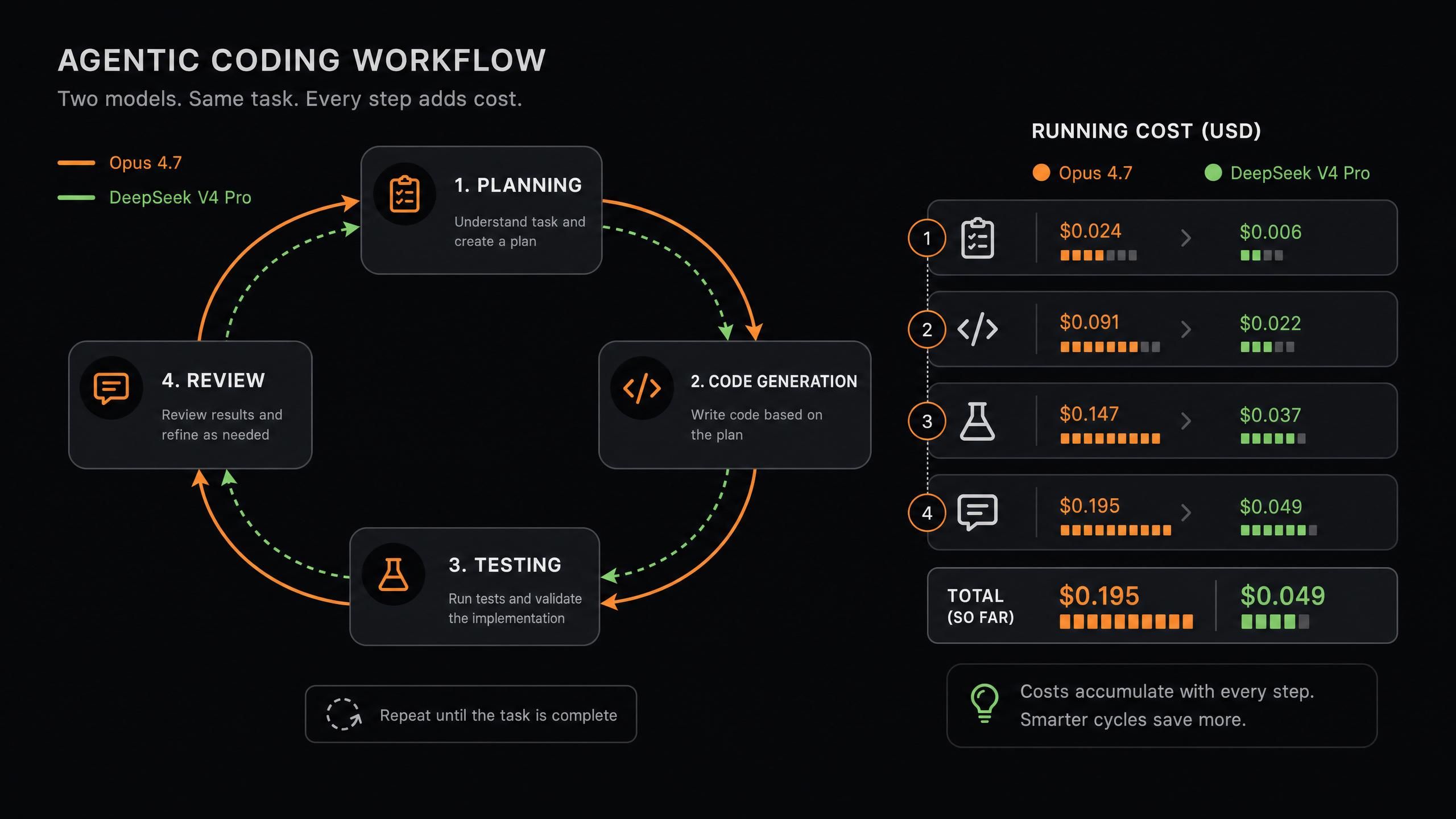
Agentic workflows magnify every cost and compatibility difference. When a single task triggers 30 or 50 API calls, a 5x price difference becomes a 5x bill difference. When each call needs to handle tool use, multi-step reasoning, and context accumulation correctly, reliability matters more than in simple chat interactions.
Here is where the DeepSeek V4 Pro vs Opus 4.7 decision gets more task-specific:
Claude Code workflows: Claude Code was optimized for Claude models. Running it natively with Opus 4.7 means no compatibility configuration and access to the full feature set. If you're deep in the Claude Code ecosystem and the native experience matters, Opus 4.7 has a real edge here.
Multi-tool setups with Codex, Cursor, or OpenClaw: These tools use OpenAI-compatible API formats, and DeepSeek V4 Pro fits naturally within that standard. For teams using these tools, switching to DeepSeek V4 Pro is a configuration change, not a rebuild.
Cost-sensitive, high-volume pipelines: For pipelines running hundreds or thousands of requests daily, the cost structure of DeepSeek V4 Pro is a different category entirely. At scale, that's a budget impact that changes what you can afford to run.
Running DeepSeek V4 Pro Without the Integration Friction
DeepSeek V4 Pro vs Opus 4.7: Which One Actually Fits Your Budget
The switch from Opus 4.7 to DeepSeek V4 Pro is a pricing decision first and a capability decision second for most workloads. If your tasks fit what DeepSeek V4 Pro handles well, which covers the large majority of coding and reasoning scenarios, the economics usually favor the change.
The integration side is where teams sometimes hesitate. Setting up direct DeepSeek API access works fine for API-first workflows. For tools like Claude Code, Codex, and OpenClaw, a unified API gateway makes the connection straightforward: one base URL, one API key, and model selection is just a parameter change.
Atlas Cloud Coding Plan supports DeepSeek V4 Pro alongside nine other open-source models through a single OpenAI-compatible endpoint. The credit system prices DeepSeek V4 Pro at 50% below the official API rate, and the configs for Claude Code, Codex, and OpenClaw are ready to drop in.
For Claude Code on macOS or Linux, edit ~/.claude/settings.json:
plaintext1{ 2 "env": { 3 "ANTHROPIC_AUTH_TOKEN": "your-atlas-api-key", 4 "ANTHROPIC_BASE_URL": "https://api.atlascloud.ai", 5 "ANTHROPIC_MODEL": "deepseek-ai/deepseek-v4-pro", 6 "ANTHROPIC_DEFAULT_HAIKU_MODEL": "deepseek-ai/deepseek-v4-pro", 7 "ANTHROPIC_DEFAULT_SONNET_MODEL": "deepseek-ai/deepseek-v4-pro", 8 "CLAUDE_CODE_DISABLE_EXPERIMENTAL_BETAS": "1" 9 } 10}
Note: Claude Code's base URL is https://api.atlascloud.ai without a /v1 suffix. Adding /v1 breaks the connection.
For Codex, two files handle the config. First, ~/.codex/config.toml:
plaintext1model_provider = "atlas_coding_plan" 2model = "deepseek-ai/deepseek-v4-pro" 3 4[model_providers.atlas_coding_plan] 5name = "atlascloud" 6base_url = "https://api.atlascloud.ai/v1" 7wire_api = "chat" 8requires_openai_auth = true
Then ~/.codex/auth.json for the key:
plaintext1{ 2 "OPENAI_API_KEY": "your-atlas-api-key" 3}
For OpenClaw, run openclaw onboard, select QuickStart then Custom Provider, enter https://api.atlascloud.ai/v1 as the base URL, and paste your Atlas key when prompted.
Both plan types are available: a monthly subscription with daily credit refresh, and a pay-as-you-go pack with a 90-day window. The monthly plan makes more sense for consistent daily usage. For variable workloads, the pay-as-you-go option gives flexibility without commitment.
Frequently Asked Questions About DeepSeek V4 Pro vs Opus 4.7
Is DeepSeek V4 Pro actually competitive with Claude Opus 4.7 on coding tasks?
For most coding scenarios including generation, debugging, refactoring, and review, DeepSeek V4 Pro is genuinely competitive. The gap between top open-source and top proprietary models has narrowed considerably. Where Opus 4.7 still has an edge is on tasks requiring very nuanced instruction interpretation or tasks that benefit from Anthropic's native tooling integration.
What does a 1M context window mean in practice?
It means you can send very large inputs in a single request. For a developer working with a large codebase, that might mean passing tens of thousands of lines in one call for analysis or refactoring, without any chunking logic. For everyday tasks, context limits rarely matter. But for long agentic sessions or large-scale codebase work, that headroom is a real, measurable advantage.
Can DeepSeek V4 Pro actually work inside Claude Code?
Yes, through a gateway configuration. Claude Code reads ANTHROPIC_AUTH_TOKEN and ANTHROPIC_BASE_URL from ~/.claude/settings.json. Point those to a gateway that serves DeepSeek V4 Pro over an OpenAI-compatible format, and it connects. The config example earlier in this post covers the exact setup.
Why is DeepSeek V4 Pro so much cheaper than Opus 4.7?
Several factors contribute: DeepSeek V4 Pro is open-source with no licensing overhead, the MoE architecture is computationally more efficient per request, and competition among API providers for open-source models keeps margins thin. Opus 4.7 reflects Anthropic's investment in safety research, proprietary training infrastructure, and enterprise support.
Should I switch completely from Opus 4.7 to DeepSeek V4 Pro?
For most coding and reasoning tasks, DeepSeek V4 Pro is a capable alternative at significantly lower cost. If your team depends on native Claude Code features, Anthropic's enterprise support, or tasks where Opus 4.7's alignment properties are specifically required, you don't need to make a full switch. Many teams run both: Opus 4.7 for high-stakes or compliance-sensitive work, DeepSeek V4 Pro for the broader workload.
The Bottom Line
The DeepSeek V4 Pro vs Opus 4.7 question doesn't have a universal answer. It has the right answer for your workload and your budget.
DeepSeek V4 Pro wins on cost, context window size, and open-source flexibility. Opus 4.7 wins on native Anthropic tooling integration and tasks that require very careful interpretation of complex instructions.
If you're spending significantly on Opus 4.7 for workloads that are mostly code generation and standard reasoning, it's worth running DeepSeek V4 Pro in parallel and comparing output quality on your actual use cases. The cost difference is large enough that even a partial shift to DeepSeek V4 Pro for appropriate tasks pays off quickly.
For developers who want to try DeepSeek V4 Pro through their existing coding tools without managing separate API accounts, Atlas Cloud Coding Plan offers DeepSeek V4 Pro at 50% below the standard API rate, with ready-made configs for Claude Code, Codex, and OpenClaw.
Model specifications and pricing based on publicly available documentation and Atlas Cloud Coding Plan data as of May 2026. API rates are subject to change; verify current figures with each provider directly.





