OpenRouter is one of the easiest ways to reach hundreds of models through a single API, and that convenience is genuinely useful. The catch shows up on your invoice once your coding agents start running all day. If you spend most of your tokens on heavy, repetitive agent work, you may be paying full provider rates plus a credit fee, with no volume leverage at all. That is the moment people start hunting for an OpenRouter alternative cheaper than straight pass through pricing.
This guide breaks down exactly what OpenRouter costs, where the money actually goes, and how a subscription built on open models can come out cheaper for steady coding workloads. No hand waving, just the pricing math and a five minute setup.
Key Takeaways
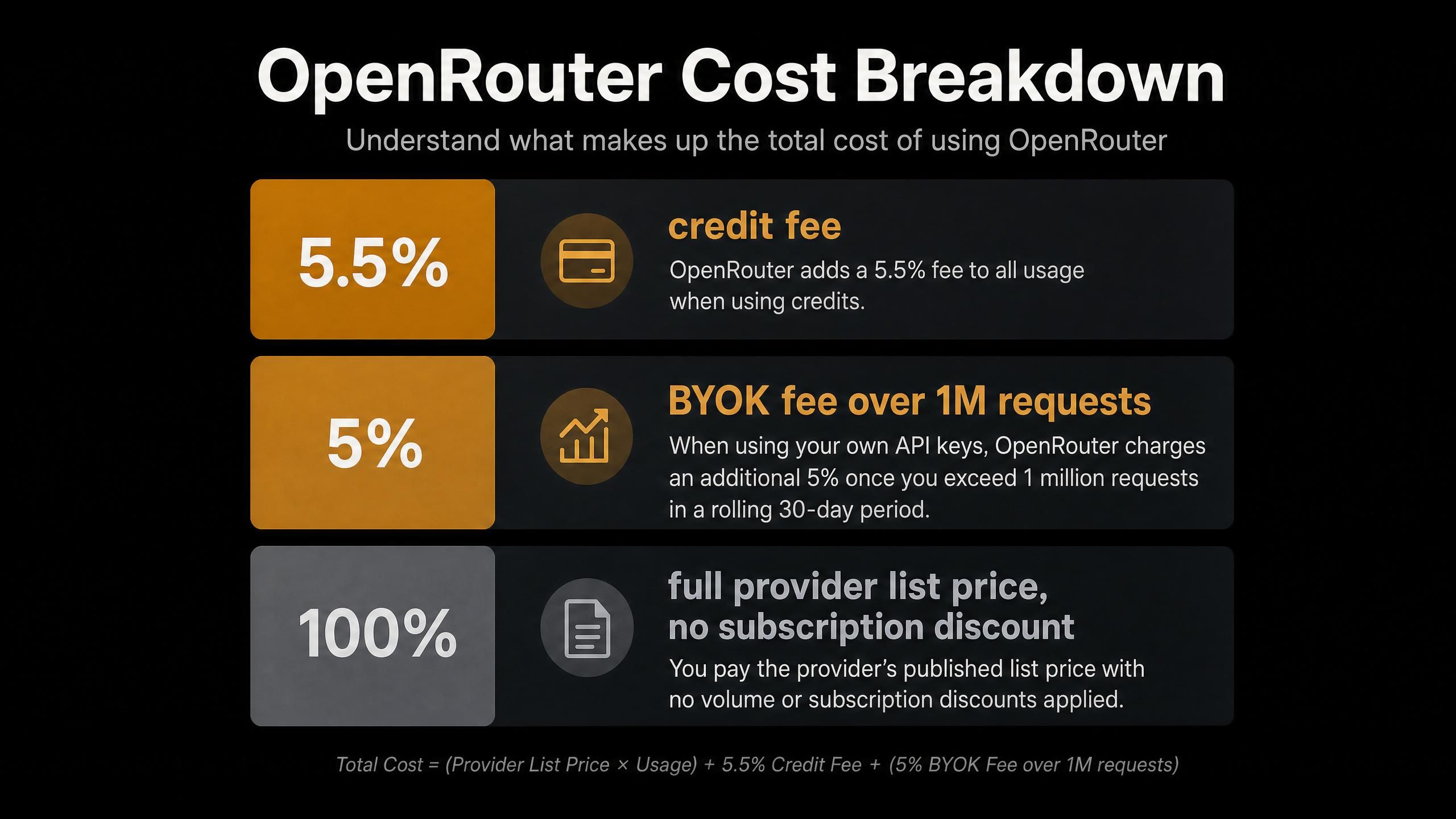
- OpenRouter does not mark up per token inference, but it adds a 5.5% fee on credit purchases with a $0.80 minimum, plus a 5% fee on BYOK requests above 1M per month
- Because it is pay as you go only, you pay full provider list prices with no subscription discount, which hurts heavy daily users most
- The cheaper OpenRouter alternative for coding is open models like GLM, Kimi, DeepSeek, and MiniMax, which run at a fraction of frontier prices
- A daily-refreshing credit subscription can beat full-rate pass-through for anyone running agents every day, and it works in Claude Code, Codex, Cursor, and more
How OpenRouter Pricing Actually Works
Let's be fair to OpenRouter before critiquing it. The platform passes through each model's per token price at the same rate the underlying provider charges, so there is no hidden per token markup on inference (Morph, 2026). That is an honest model and worth acknowledging, because plenty of blog posts get this wrong.
Where the cost actually lives is in three places. First, a 5.5% platform fee on every non crypto credit purchase, with an $0.80 minimum. Second, a 5% fee on Bring Your Own Key requests once you pass 1M requests per month. Third, and most important for heavy users, it is pay as you go only, so you always pay full provider list prices with no subscription discount, and unused credits expire one year after purchase.
None of this is predatory. For low volume or highly varied usage, OpenRouter is often the right tool. The problem is specific: if you run coding agents that hammer the same one or two models all day, you are paying retail rates on a usage pattern that should qualify for a wholesale deal. That gap is the opening every OpenRouter alternative tries to fill.
Why People Look for a Cheaper OpenRouter Alternative
The search for a cheaper OpenRouter alternative is almost always driven by one usage pattern: high volume, low variety. Agentic coding is the textbook case. The agent reads files, plans, edits, runs tests, and revises, looping many times per task, and it usually does all of that on a single workhorse model.
When your usage is concentrated like that, two facts work against you on a pure pass-through service. You pay full provider list price on every one of those millions of tokens, and you get no subscription tier to bring the unit cost down. Going direct to a provider saves at least the 5.5% credit fee, and switching to a cheaper provider for the same model can save far more, up to around 62% on specific models according to one comparison.
What this really means: if your spend is steady and predictable, you are the ideal customer for a subscription, and a pay-as-you-go router is the one pricing model that gives you no reward for that predictability.
So the goal is not to dunk on OpenRouter. It is to match your pricing model to your usage. Steady, heavy, single model coding wants a subscription on cheap models. That is the whole thesis.
What to Look for in a Cheaper OpenRouter Alternative
A real cheaper OpenRouter alternative has to clear three bars, not just one. Plenty of "alternatives" win on price and then lose on capability or compatibility, which erases the savings.
First, capable models. If the cheaper model cannot sustain a long agent session, you have swapped a cost problem for a quality problem. Second, a pricing structure that rewards your actual usage, which for heavy users means a subscription or discounted rate rather than full retail per token. Third, drop-in compatibility, so you keep Claude Code, Codex, Cursor, and your other tools instead of rebuilding your workflow.
| What you are comparing | OpenRouter | A cheaper alternative for coding |
|---|---|---|
| Inference markup | None on tokens, but 5.5% credit fee | Discounted open-model rates |
| Pricing model | Pay as you go only | Subscription with daily credits |
| Best fit | Low volume, many models | High volume, few models |
| Credit expiry | Credits expire after 1 year | Daily allowance refreshes each day |
| Tool compatibility | Broad | Broad via OpenAI compatible API |
The landscape of alternatives is crowded, from self-hosted proxies like LiteLLM to gateway products with free tiers (Eden AI, 2026). For coding specifically, the cleanest win usually comes from the model layer, not the gateway layer.
Open Models: The Foundation of Any Cheaper OpenRouter Alternative
If you strip the problem down, the most reliable way to build a cheaper OpenRouter alternative is to run open models from a provider that prices them aggressively. Open weight coding models in 2026 are strong enough for real work. GLM 5.1, Kimi K2.6, DeepSeek V4 Pro and V4 Flash, MiniMax M2.7, and Qwen3 all sit on serious shortlists for agentic coding, and they ship under permissive licenses at a small fraction of frontier pricing (kilo.ai, 2026).
This matters because of how coding work actually distributes. The large majority of agent tasks, file edits, test writing, refactors, boilerplate, do not need a frontier model. They need a competent, fast, cheap one. You reserve the expensive model for the rare hard problem and run everything else on open models, which is where the real savings come from.
This is where a platform built specifically around open models fits the workflow. Atlas Cloud runs a Coding Plan covering exactly this lineup, GLM, MiniMax, Kimi, DeepSeek, and Qwen, with new models added as they ship. Each model has a published input and output credit multiplier, so you can see the cost of a session before you run it, and the effective rates land below what the same open models cost on a full-rate pass-through service.
Subscription vs Pass-Through: The Cheaper OpenRouter Alternative Math
Here is the part that decides everything. The cheaper OpenRouter alternative for a daily coder is almost always a subscription, because a subscription converts your predictable usage into a flat, discounted rate instead of charging retail on every token.
The Coding Plan works on credits. Consumption is simple: credits spent equals input tokens times the input multiplier plus output tokens times the output multiplier. Monthly subscriptions give you a fixed daily allowance that resets at midnight, so heavy days do not drain a shrinking pool, and the per model rates run roughly 41% below the pay-as-you-go rate on the same models. Pay-as-you-go packs exist too for bursty work, valid for 90 days.
The subscription ladder scales with how much you code:
| Plan | Price per month | Daily credit allowance |
|---|---|---|
| Starter | $10 | 800K points/day |
| Lite | $20 | 1.8M points/day |
| Plus | $50 | 4.8M points/day |
| Max | $100 | 9.8M points/day |
| Ultra | $200 | 20.8M points/day |
| Enterprise | $500 | 54.8M points/day |
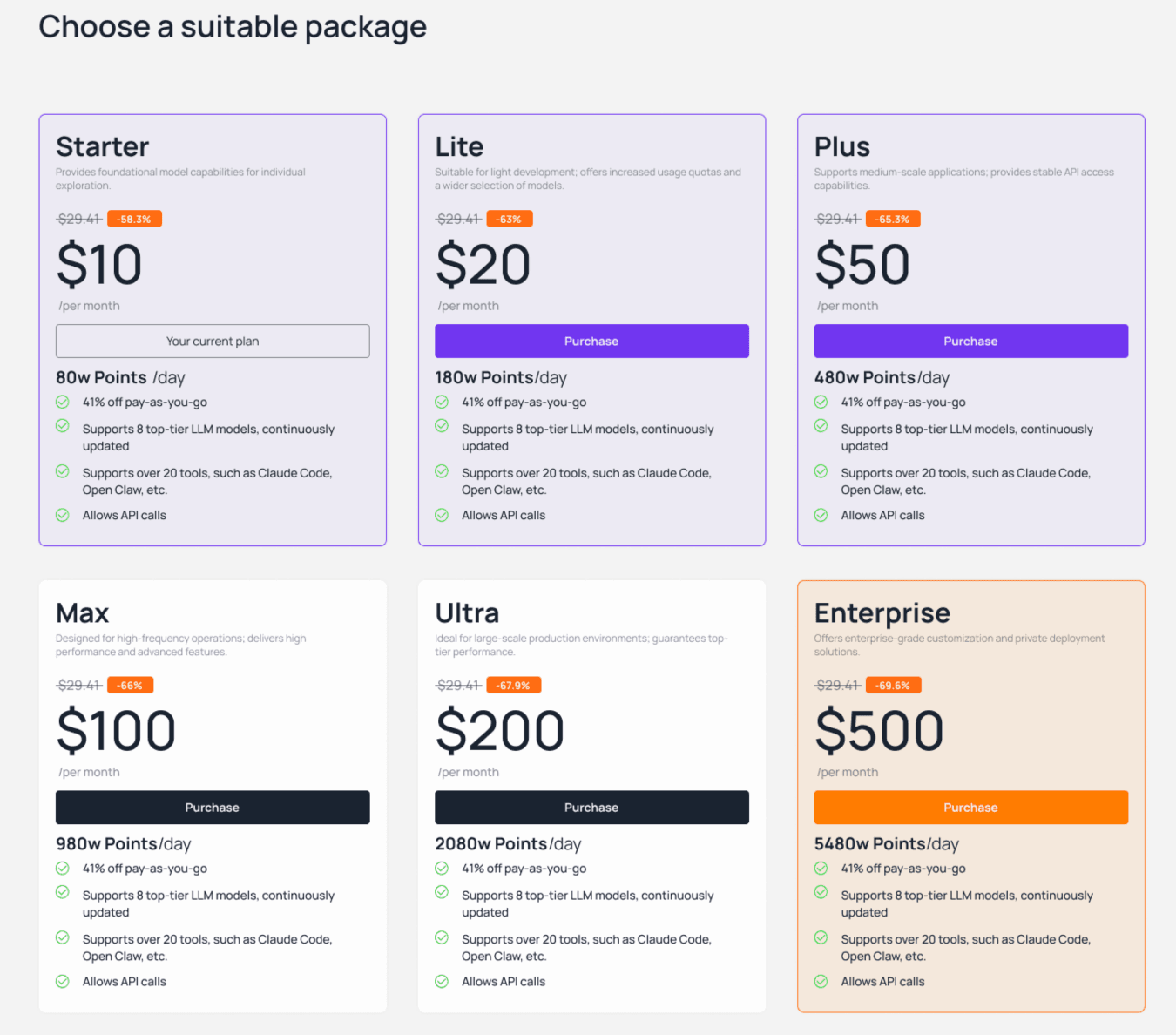
Two practical details make this flexible. You can hold one monthly subscription plus extra pay-as-you-go packs, and the system spends the subscription allowance first, then the pack expiring soonest. And if your needs grow mid month, upgrades are prorated, so moving from Starter to Lite two weeks in costs only the difference for the remaining days, roughly $4.67 in the platform's own example, not a fresh full charge.
Put the two models side by side. On pass-through, 30 days of heavy single-model coding bills at full provider rates plus the credit fee, every day, forever. On a subscription, that same daily load draws from a fixed allowance you already paid a discounted flat rate for. For steady heavy use, the subscription wins, which is exactly why it is the cheaper option for this audience.
Setting Up a Cheaper OpenRouter Alternative in Your Tools
You do not need to rebuild your stack to get a cheaper OpenRouter alternative running. The Coding Plan exposes a single OpenAI compatible endpoint, so your existing agent tools connect with a base URL and a key. That base URL is https://api.atlascloud.ai/v1 for most tools, and the plan issues its own dedicated API key, separate from your regular account balance.
Quick model tip before the config. GLM 5.1 is a strong agentic default with a 200K context window. DeepSeek V4 Flash is extremely cheap for high volume edits. Kimi K2.6 offers a 262K context for large repositories.
Claude Code
Claude Code uses the base URL without the /v1 suffix. Edit ~/.claude/settings.json on macOS or Linux, or %USERPROFILE%\.claude\settings.json on Windows.
plaintext1{ 2 "env": { 3 "ANTHROPIC_AUTH_TOKEN": "your-atlas-api-key", 4 "ANTHROPIC_BASE_URL": "https://api.atlascloud.ai", 5 "ANTHROPIC_MODEL": "zai-org/glm-5.1", 6 "ANTHROPIC_DEFAULT_HAIKU_MODEL": "zai-org/glm-5.1", 7 "ANTHROPIC_DEFAULT_SONNET_MODEL": "zai-org/glm-5.1", 8 "CLAUDE_CODE_DISABLE_EXPERIMENTAL_BETAS": "1" 9 } 10}
Codex
Create ~/.codex/config.toml and point the provider at the endpoint:
plaintext1model_provider = "atlas_coding_plan" 2model = "zai-org/glm-5.1" 3[model_providers.atlas_coding_plan] 4name = "atlascloud" 5base_url = "https://api.atlascloud.ai/v1" 6wire_api = "chat" 7requires_openai_auth = true
Then add your key in ~/.codex/auth.json:
plaintext1{ "OPENAI_API_KEY": "your-atlas-api-key" }
OpenClaw, OpenCode, and Cursor
These follow the same pattern. Run openclaw onboard, choose a custom provider, paste the base URL https://api.atlascloud.ai/v1, add your key, paste the model ID, and pick the OpenAI compatible protocol. OpenCode and Cursor accept the same base URL and key in their provider settings. When verification succeeds, you are live.
Direct API Access
Prefer calling the API yourself? The endpoint is OpenAI compatible, so any existing OpenAI SDK works by swapping the base URL to https://api.atlascloud.ai/v1 and the key to your Coding Plan key. Set the model field to an ID like zai-org/glm-5.1 and the rest of your code stays the same.
Who Should Switch to a Cheaper OpenRouter Alternative
Be honest about your usage before you move, because the right answer depends on it.
Switch if you run coding agents most days on one or two main models. Your usage is exactly the predictable, high volume pattern that a discounted subscription rewards and a pass-through router does not. The open models are strong enough for the large majority of engineering work, and the daily refresh keeps costs flat.
Stay on OpenRouter, or run both, if your usage is genuinely varied across many models, if you need a specific frontier capability open models have not matched yet, or if your monthly volume is low enough that the 5.5% credit fee is noise. A hybrid setup is common and sensible: route the routine 90% of coding through cheap open models on a subscription, and keep a pass-through key for the occasional exotic model.
Frequently Asked Questions
Is a cheaper OpenRouter alternative as reliable for coding?
For the bulk of coding work, yes. Open models like GLM 5.1, Kimi K2.6, and DeepSeek V4 now sit on serious agentic coding shortlists under permissive licenses. Frontier models still lead on the hardest tasks, so many teams run a hybrid setup and reserve the expensive model for the rare hard problem.
Will my tools work with a cheaper OpenRouter alternative?
Yes. Claude Code, Codex, OpenClaw, OpenCode, and Cursor all accept a custom OpenAI compatible endpoint, so you keep your existing workflow. You change a base URL and an API key, then choose a model ID. Direct API calls work the same way with any OpenAI SDK by swapping the base URL.
How much cheaper is this OpenRouter alternative?
Two layers stack. Open models cost a fraction of frontier pricing per token, and a daily-refreshing subscription runs roughly 41% below pay-as-you-go rates on the same models. Against OpenRouter, you also skip paying full provider list prices plus the 5.5% credit fee on steady high volume work.
Do I lose model variety with a cheaper OpenRouter alternative?
Somewhat, and that is the honest tradeoff. A coding-focused plan covers the major open models, GLM, Kimi, DeepSeek, MiniMax, and Qwen, rather than hundreds. If you genuinely need broad model variety, keep an OpenRouter key alongside it and route only your heavy coding to the cheaper subscription.
The Bottom Line on a Cheaper OpenRouter Alternative
OpenRouter is not overpriced for what it is. It is a fair pass-through router with a small credit fee, and for low volume or highly varied usage it is hard to beat. The mismatch appears when your usage is the opposite of that: heavy, daily, and concentrated on one or two models, paying full retail with no subscription leverage.
For that pattern, the cheaper OpenRouter alternative is a subscription built on open models with a daily-refreshing credit pool. You get strong models at a fraction of frontier cost, a flat discounted rate instead of full retail, and a setup that drops into Claude Code, Codex, Cursor, or a plain API call in about five minutes. Keep a pass-through key for the exotic stuff if you need it, and move the heavy coding where it is cheaper. If you want to check the per-model rates and daily allowances first, the Coding Plan console lays them out in full.





