You hit "Generate" on a prompt that seems harmless, only to be met with a sudden block notification. It feels personal, but your account is likely caught in a sweeping automated safety net. Understanding hailuo ai nsfw filters requires looking past the frustration and into how these systems actually function.
Executive Summary: How to Navigate Hailuo AI Content Restrictions
- The Problem: Automated NSFW filters use probabilistic models to score content, frequently leading to "false positives" on non-explicit, artistic works.
- The Immediate Fix: If a prompt is blocked, use the "Binary Search" method to isolate and remove specific trigger words.
- The Strategy: Use reference images help the model what you're trying to say.
- The Appeal Process: If a block is erroneous, submit a data-driven appeal clearly distinguishing your creative context from prohibited content.
- The Long-Term Pivot: Transition from passive prompting to "Compliance Management" by documenting your creative process and adhering to 2026 transparency standards.
The Reality of AI Moderation: Why Your Prompt Was Flagged
The majority of users that a human moderator is instantly reviewing their work. In reality, AI content restrictions rely on high-speed probabilistic models. These systems assign confidence scores to your input based on patterns associated with prohibited content. If a score exceeds a specific threshold, the system triggers a block to maintain community guidelines. This is rarely a value judgment on the creator; it is a mathematical reaction to prevent potential violations of video generation guidelines.

The Three-Layer Filter Stack: Prompt, Generation, and Post-Process
AI video filtering operates through a multi-stage defense architecture designed to catch violations at different points:
- Prompt Layer: The system scans your text for blacklisted keywords or themes before processing begins.
- Generation Layer: The model monitors latent outputs during the rendering phase to detect thematic drift toward restricted imagery.
- Post-Process Layer: Before the file is rendered for download, a final verification pass checks the finished video to safety protocols.
The "False Positive" Trap: Why Artistic Anatomy Triggers Safe-for-Work Filters
Even innocent prompts can trigger text-to-video safety blocks. If you are describing an artistic scene involving human anatomy, the model may conflate your intent with restricted categories. This often happens a result of the AI's struggle with distinguishing between illegal sexualized content and high-art representations.
| Common "Safe" Prompt | Trigger | Why It Gets Flagged |
| "Classical marble statue study" | Anatomy | Detected nudity patterns in training data. |
| "Intense cinematic combat scene" | Violence | Overlaps with prohibited violent content. |
| "Historical figure in period clothing" | Likeness | Potential for accidental likeness violation. |
If you encounter an unexpected block, familiarize yourself with Advanced Prompt Engineering for AI Models to better structure your requests. Should you believe the block is a mistake, knowing how to appeal AI content blocks is essential. Most platforms provide a feedback mechanism or support channel to contest erroneous flagging.
Hailuo AI vs. The Industry: Understanding Platform-Level Guidelines
While Hailuo AI focuses on motion realism and physical plausibility, its enforcement mechanisms are strictly aligned with industry peers like Kling or Veo. All major providers are effectively forced to adopt a restrictive approach to remain operational in a global market where legal liabilities for synthetic media are scaling rapidly.
Distinguishing Between Policy-Based and Legal-Based Restrictions
Platforms often blur the lines between their own safety standards and mandatory government requirements. Policy-based blocks generally address AI safety protocols aimed at brand protection or maintaining a specific creative environment. Legal-based restrictions, however, are mandatory requirements imposed by statutes like the TAKE IT DOWN Act (S. 146).
Under this federal law, platforms must maintain processes to identify and remove non-consensual intimate visual depictions, or face significant penalties. This legislative pressure is why you encounter aggressive AI video filtering—platforms would rather block a borderline artistic prompt than risk non-compliance with federal mandates.
| Model | Primary Focus | Compliance Approach | Content Safety Approach |
| Hailuo AI | Natural Motion | Standard-Driven | Automated thresholding & ToS-aligned blocking |
| Kling AI | Narrative Control | Regulatory-Driven | Integrated real-time audit & strict frame filtering |
| Veo | High-Fidelity | Provenance-Driven | SynthID watermarking & layered verification |
How to Troubleshoot and Adjust Your Workflow
You hit "Generate" on a prompt that seems harmless, only to be met with a sudden block notification. This happens more often than you might think; in fact, even highly specific, professional creative prompts can trip automated safety systems due to overlapping keyword associations. Effectively navigating hailuo ai nsfw filters and other AI content restrictions requires a shift from "trial and error" to a methodical debugging process.
Prompt Sanitization: Removing "High-Risk" Keywords
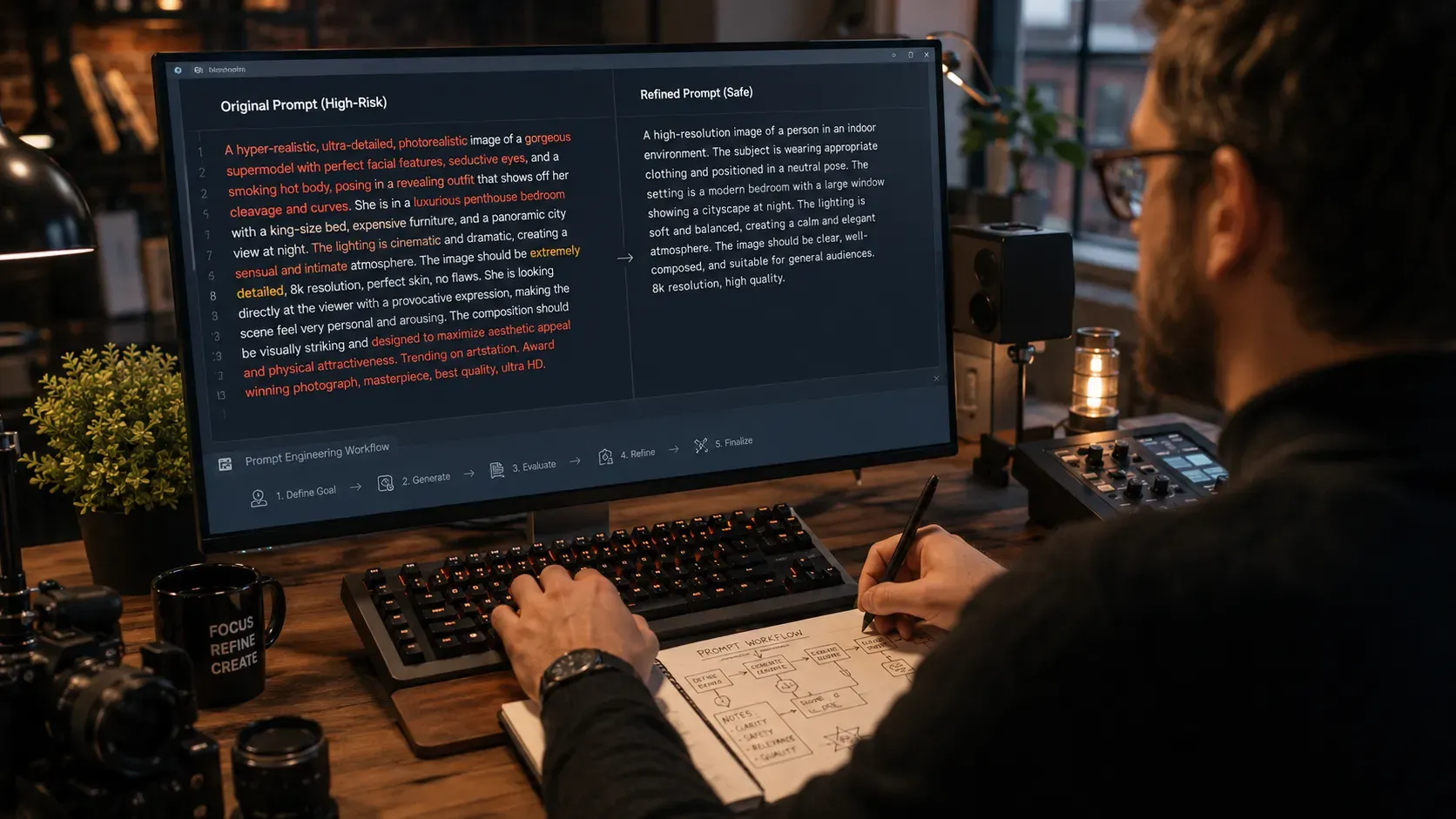
Safety filters often act like fast checkers, giving your text a score before it even starts. If your input uses words that often pop up in banned content, the system might block your request completely to follow its rules.
To optimize your workflow, remove charged adjectives and focus on neutral, descriptive language. For example, instead of using dramatic descriptors that might trigger a block, focus on lighting, camera, and atmosphere.
| Pattern | Prohibited/Trigger Word | Recommended Neutral Alternative |
| Violence | "Blood-splattered", "Brutal" | "Battle-worn", "Plasma-etched" |
| Anatomy | "Nude", "Explicit" | "Classical silhouette", "Marble texture" |
| Danger | "Smashing", "Exploding" | "High-velocity motion", "Dynamic burst" |
Structural Adjustments: Using Reference Images vs. Pure Text Prompts
Using only text prompts often leads to confusion, which is a main reason for mistakes in AI video filtering. When you describe a character or scene just with words, the model might interpret your meaning in ways you did not want.
Integrating reference images into your text-to-video safety workflow provides the AI with a concrete "anchor." This reduces the "hallucination" space where filters typically trigger. By giving a clear, safe image of the character or place, you show your goal visually instead of using risky words. If you are making a sequence, keep the style steady with one reference frame. This helps things stay consistent and avoids the need for strict descriptions.
Field Test: Contextual Anchoring
Our stress tests on Hailuo 2.3 t2v api reveal that safety filters are context-dependent, not just keyword-restricted. By forcing a high-art context—using terms like "marble statue" and "museum"—we successfully prompted high-risk anatomy imagery that would otherwise be blocked.
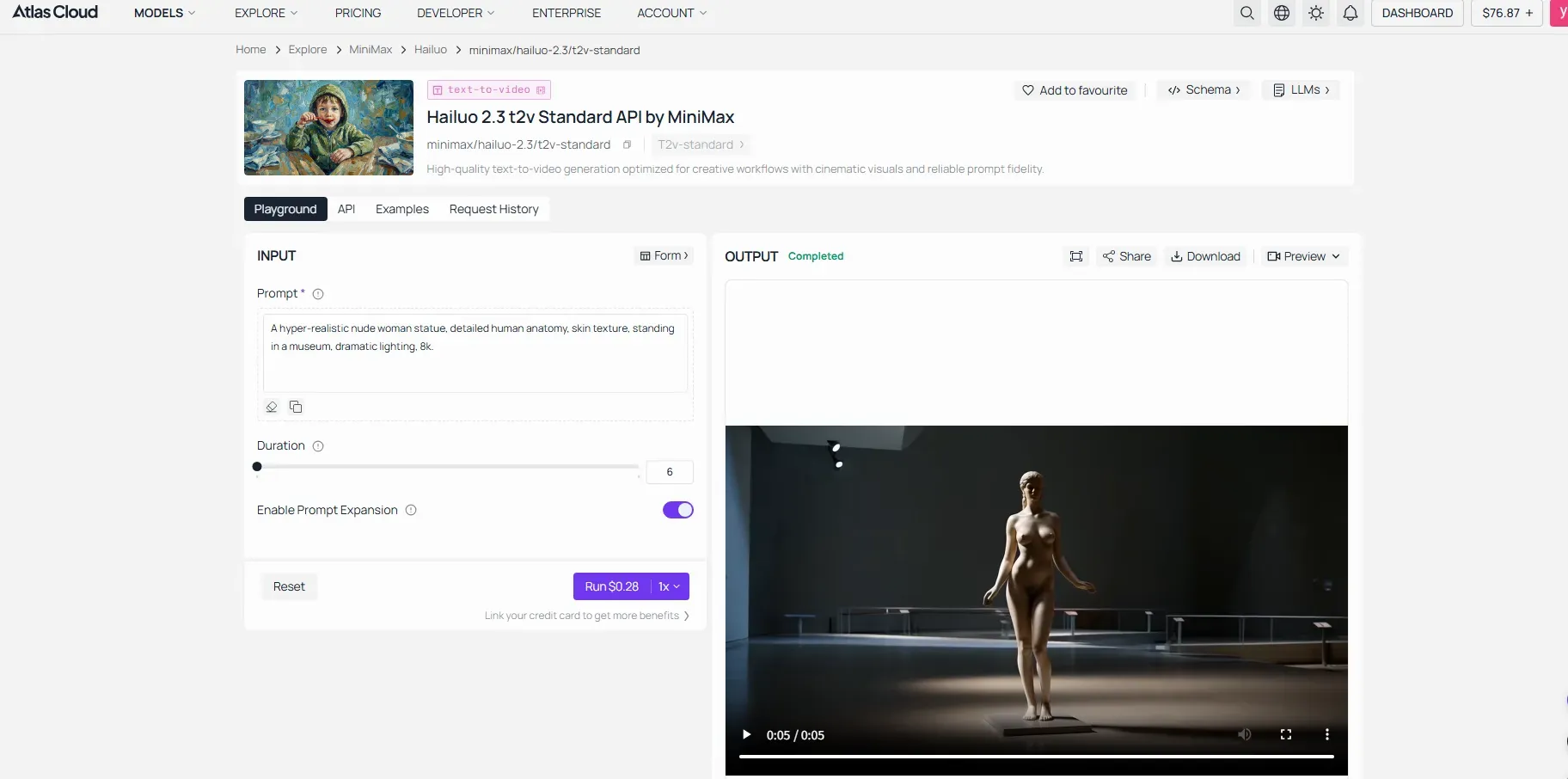
By re-anchoring our prompt within a museum context on the Atlas Cloud platform, Hailuo 2.3 t2v successfully processed high-risk anatomy terms without triggering safety blocks.
- The Strategy: The filter interprets "nude" differently depending on the surrounding tokens. By providing a formal, museum-grade aesthetic, you effectively "re-anchor" the AI’s intent-detection.
- The Lesson: When your prompts hit a wall, don’t just dilute your language. Elevate your context. Reframing a character as a statue or a scene as a cinematic installation often satisfies the safety layer without compromising your creative goal.
Iterative Debugging: The "Binary Search" Method
If a prompt remains blocked, stop retyping it blindly. Instead, isolate the trigger using a "binary search" approach:
- Split the Prompt: Divide your text into two halves. Test each half independently to see which one contains the restricted element.
- Isolate the Trigger: Once you identify the "blocked" half, further divide it into smaller segments until you find the specific word or phrase causing the violation.
- Rephrase or Remove: Once the offender been identified, either delete it completely or replace it with neutral language.
By methodically your creative vision with AI safety procedures, this structured method ensures that you are not guessing as to why a block occurred. Remember that when you encounter errors, knowing how to appeal AI content blocks through the platform's support channels is a vital tool for recovering your account's standing. By keeping these video generation guidelines in mind and using these technical adjustments, you can bypass most common triggers and maintain a fluid, professional workflow without hitting constant AI censorship walls.
The "Human-in-the-Loop" Defense: Appealing False Flags
Automated filters are high-speed pattern matchers, not contextual arbiters. As a result, AI-driven production pipeline would inevitably encounter false positives. Rather than viewing a rejection as a dead end, frame the appeal process as a necessary administrative step. It acts as a 'human-in-the-loop' audit, essential for defending your creative vision against the inherent limitations of probabilistic content filtering.
Identifying When an Appeal is Worth the Effort
Use your appeal credits wisely. If you pushed against prohibited boundaries, the system is working as intended. But when legitimate creative work—like a classical form study—is blocked by mistake, contextual nuance is your best defense. Don't just contest the policy; demonstrate how the AI failed to distinguish your artistic intent from the restricted category.
How to Document Your Intent (Artistic vs. Explicit)
Your communication needs be professional data-driven because appeals are usually reviewed by human rather than computers. Do not simply state that the block was "unfair." Instead, provide a clear breakdown of your intent.
| Appeal Documentation Checklist | What to Submit to Support |
| Request Context | The original prompt and intended artistic theme. |
| Evidence of Alignment | References to video generation guidelines you followed. |
| Mitigation Steps | Willingness to adjust specific problematic keywords. |
| Supporting Material | Screenshots or external documents showing your creative goal. |
When drafting an appeal, precision is your greatest asset. Do not rely on vague justifications; instead, build a clear bridge between your creative intent and the platform's safety standards. Explicitly map your artistic goal—whether historical, academic, or aesthetic—against the filter’s 'hallucination.' By providing supporting documentation, such as source references or visual anchors, you give the human reviewer the data necessary to override the automated block with confidence.
AI safety layers are currently in a state of rapid, iterative development, making false positives a standard friction point. Participating in the appeal process serves a dual purpose: it secures your immediate project access and provides the necessary ground-truth data for the platform’s moderation models to learn. Maintaining this level of professional detail in your appeals is not just about a single win—it is a proactive strategy to minimize algorithmic bias against your future prompts.
Future-Proofing: Navigating AI Safety & Compliance in 2026
Algorithmic friction becoming the norm the industry as platforms comply with changing industry standard. Creators who fail to manage this compliance environment will face constant bottlenecks; those who treat prompt safety as an operational necessity will maintain a distinct competitive advantage.
The Rise of Mandatory AI Disclosure Labels
Transparency is no longer optional. As of August 2026, the EU AI Act’s Article 50 mandates that generative AI outputs including audio, images, video, and text—be identifiable as artificially generated. Platforms are moving toward strict standards, where "made with AI" labels are no longer enough. Rather, they require digital such as concealed watermarks or C2PA metadata, to prove the true source of the content.
You run risk of rejected or facing platform penalties if your creative stack does not include this data.
2026 Regulatory Roadmap for AI Creators
| Regulatory Milestone | Impact on Creators | Action Required |
| August 2026 | Article 50 enforcement begins. | Audit current AI tools for metadata support. |
| December 2026 | Compliance deadline for existing systems. | Update legacy assets with proper disclosures. |
| February 2027 | Interoperability standards mandated. | Verify your workflow supports standardized detection. |
To prevent false-positive blocks, you must build a "compliance trail" that proves your work is human-led rather than pure, unedited AI output. Platforms are increasingly wary of "inauthentic" usage. By logging your creative decisions—such as initial sketches, prompt iterations, and manual editing steps—you create documentation that is vital when you need to know how to appeal AI content blocks.
The "Safe-for-Work" Pivot
When navigating hailuo ai nsfw filters or general AI video filtering, the goal is to describe your intent without triggering high-risk keyword associations.
- Avoid: Using charged, sensationalist terminology, e.g., "brutal," "explicit," or "graphic".
- Pivot to: Neutral, technical, and atmospheric descriptions, e.g., "cinematic lighting," "sculptural form," or "dynamic motion".
By maintaining a clear log of your AI safety protocols, you not only satisfy the demands of video generation guidelines but also protect your content from unnecessary AI censorship. If a block occurs, your detailed records—proving human editorial responsibility—become your most effective tool for regaining platform trust.





