

Most AI video tools hand you a clip and walk away. You wait, you get ten seconds of footage, and that's the end of the conversation. PixVerse R1 doesn't stop talking back. It keeps generating, keeps listening, and keeps reacting to whatever you throw at it, for as long as you stay inside it.
That's a genuinely different product category, not just a faster version of the same thing. This guide covers what PixVerse R1 is, how its real-time engine actually works under the hood, what changed across three updates in 2026, and where the marketing claims and the shipped product still don't quite line up.
Key Takeaways
- PixVerse R1 launched January 12, 2026, as what PixVerse calls the first real-time world model, generating a continuous interactive video stream instead of a fixed clip.
- Its Instantaneous Response Engine cuts sampling from dozens of steps down to just one to four, which is the actual mechanism behind the "instant" feel.
- Launch marketing advertised 1080p, but PixVerse's own February 2026 update describes the shipped resolution as an upgrade "up from 480p," with anything past 1080p still listed as unsupported.
- An April 2026 update removed the previous 5-minute session cap for shared multiplayer worlds and added personal avatars built from one to three uploaded photos.
- Atlas Cloud doesn't host R1 itself, but it does host PixVerse's V6 and C1 models on a metered, pay-as-you-go API for developers who want programmatic access to the same lineage today.
PixVerse R1 AI: From Rendered Clips to a World That Talks Back
A PixVerse R1 launch post describes it plainly: R1 is built to keep producing a live audiovisual stream that responds while the session runs, rather than rendering a fixed clip and stopping. PixVerse advertised the launch as real-time 1080p output with near-instant response to typed or spoken input.
That's the pitch behind the pixverse r1 ai label. Instead of a prompt-to-clip pipeline, you're steering an ongoing scene the way you'd nudge a game character, except every frame is generated on the fly rather than pulled from pre-rendered assets.
Can You Build on PixVerse R1? What Atlas Cloud Actually Offers
Here's the honest answer: not yet, not directly. R1 today runs as a consumer web experience at realtime.pixverse.ai, plus a rolling-review API partner program open to gaming, streaming, and XR teams that apply for it. There's no public R1 endpoint you can call from your own code without going through that review.
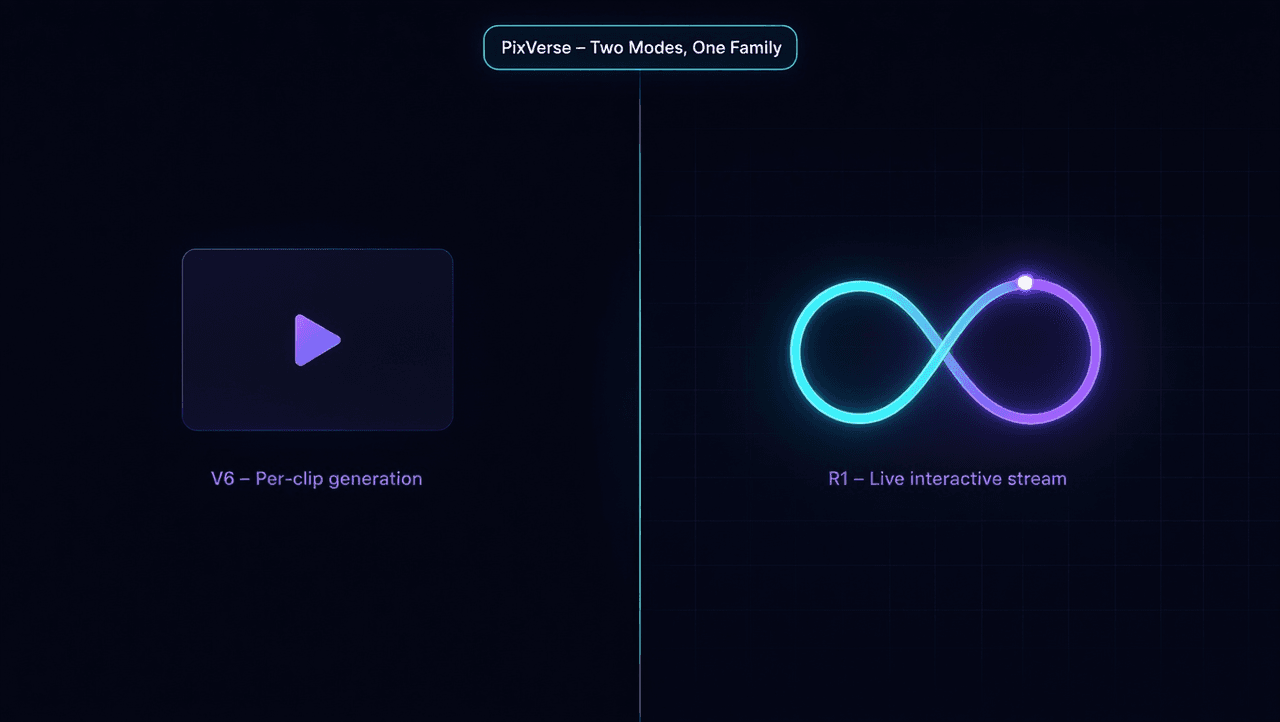
What developers can already build on is the rest of the PixVerse catalog. Atlas Cloud hosts the PixVerse model family, including V6 and C1, on one metered API alongside every other model on the platform. If your project needs fast, repeatable clip generation rather than a live interactive stream, PixVerse V6 text-to-video is the closest thing available to build with right now, billed per second with no subscription tier to commit to first.
So the split is simple. R1 is where PixVerse is testing the interactive, world-model idea in public. V6 and C1 are what you can actually wire into a product this week, and the [PixVerse V6 review](pixverse-v6-review.md) covers that model's full pricing and feature breakdown for anyone deciding between the two. Worth checking back on the family page as PixVerse's API partner program matures, since that's the path most likely to eventually bring R1 itself onto a broader developer API.
Inside the PixVerse R1 Real-Time World Model's Three-Part Engine
Real-time generation isn't one trick, it's three systems working together. According to PixVerse's own technical breakdown of R1, the pixverse r1 real-time world model rests on an Omni Native Multimodal Foundation Model, a Consistency-aware Autoregressive Framework, and an Instantaneous Response Engine.
| Component | What It Does | Why It Matters |
|---|---|---|
| Omni Native Multimodal Foundation Model | Processes text, image, video, and audio as one unified token stream | Lets a typed prompt, a spoken instruction, and an uploaded photo all steer the same scene at once |
| Consistency-aware Autoregressive Framework | Predicts each new frame from what came before, with memory-augmented attention | Keeps objects, scenes, and motion consistent instead of resetting between frames |
| Instantaneous Response Engine | Cuts sampling from dozens of steps to just one to four | Fewer steps means less compute per frame, keeping latency low enough to feel live |
The foundation model treats text, image, video, and audio as one unified token stream rather than four separate pipelines bolted together. That matters practically because it's why a spoken instruction, an uploaded photo, and a typed prompt can all steer the same scene without a translation layer slowing things down. PixVerse also builds in native-resolution processing here, which is what keeps compression artifacts from stacking up as the stream runs.
The autoregressive framework is what makes the stream continuous instead of clip-shaped. It predicts each new frame from what came before, and memory-augmented attention holds onto object, scene, and motion continuity so a character doesn't randomly change shirts three seconds later. This is also the piece that removes the fixed-length ceiling entirely: because every frame is generated from the frames before it rather than from a single upfront plan, there's no hardcoded clip length to run out of.
The Instantaneous Response Engine is the piece that actually explains the "instant" in real time. It uses temporal trajectory folding, guidance rectification, and adaptive sparse attention to cut sampling from dozens of steps down to just one to four. Fewer steps means less compute per frame, which is the entire trick behind keeping latency low enough for a live session to feel responsive rather than laggy.
Put together, the three pieces cover three different jobs. The foundation model is what lets you interrupt the stream with any kind of input. The autoregressive framework is what keeps the world from forgetting itself between frames. The response engine is what makes the first two fast enough to feel live instead of laggy. Take any one away and R1 turns back into a slow, forgetful, single-input video generator.
Shared Worlds and Avatars: What the PixVerse R1 World Model Lets You Do Today
R1 shipped fast, then kept shipping. Three updates in four months changed what the product actually does:
- January 12, 2026: Launch, with real-time 1080p advertised as the headline spec.
- February 10, 2026: A resolution and access update. PixVerse's own 720p API partner announcement describes native HD output "up from 480p," adds synchronized real-time audio, and opens the API partner program mentioned above with RESTful endpoints and documentation for approved teams.
- April 1, 2026: An update adding shared worlds and avatars. Multiple users can now drop prompts into one common live feed that everyone watching can see shape the same stream, with a live chat layer running alongside it. Session limits, previously capped at five minutes per person, were removed entirely for shared sessions.
The avatar feature is the most personal addition. Upload one to three photos, front, side, and back, and R1 builds a digital stand-in you can drop into the generated world, where it responds to movement and animation cues. Combined with shared worlds, that's PixVerse betting on R1 as a social space, not just a solo creative tool. Access is currently free for PixVerse users, though PixVerse frames that as a limited-time arrangement rather than a permanent price.

Where PixVerse R1 Still Falls Short
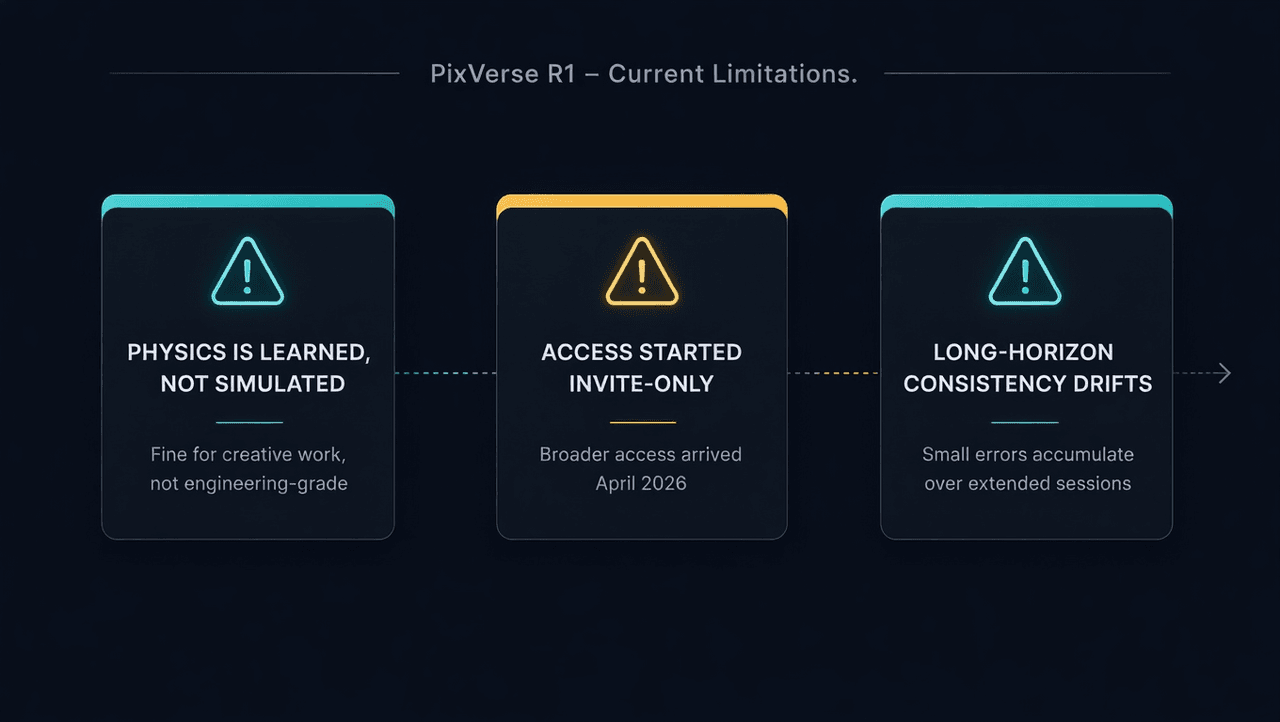
None of this makes R1 finished technology, and the honest gaps matter more than the highlight reel. Independent coverage from VP Land points out that R1's physics comes from patterns learned in training data rather than genuine simulation, which is fine for creative work but not precise enough for anything engineering-grade. VP Land also noted the platform ran invite-only during its early scaling phase, before the April 2026 update opened broader access.
PixVerse's own architecture post adds a limit the company admits directly: long-horizon consistency can drift over extended sessions as small prediction errors accumulate frame by frame. That's the same autoregressive framework that makes the stream possible in the first place, so the strength and the weak point come from the same design choice.
Who Is PixVerse R1 Actually Built For?
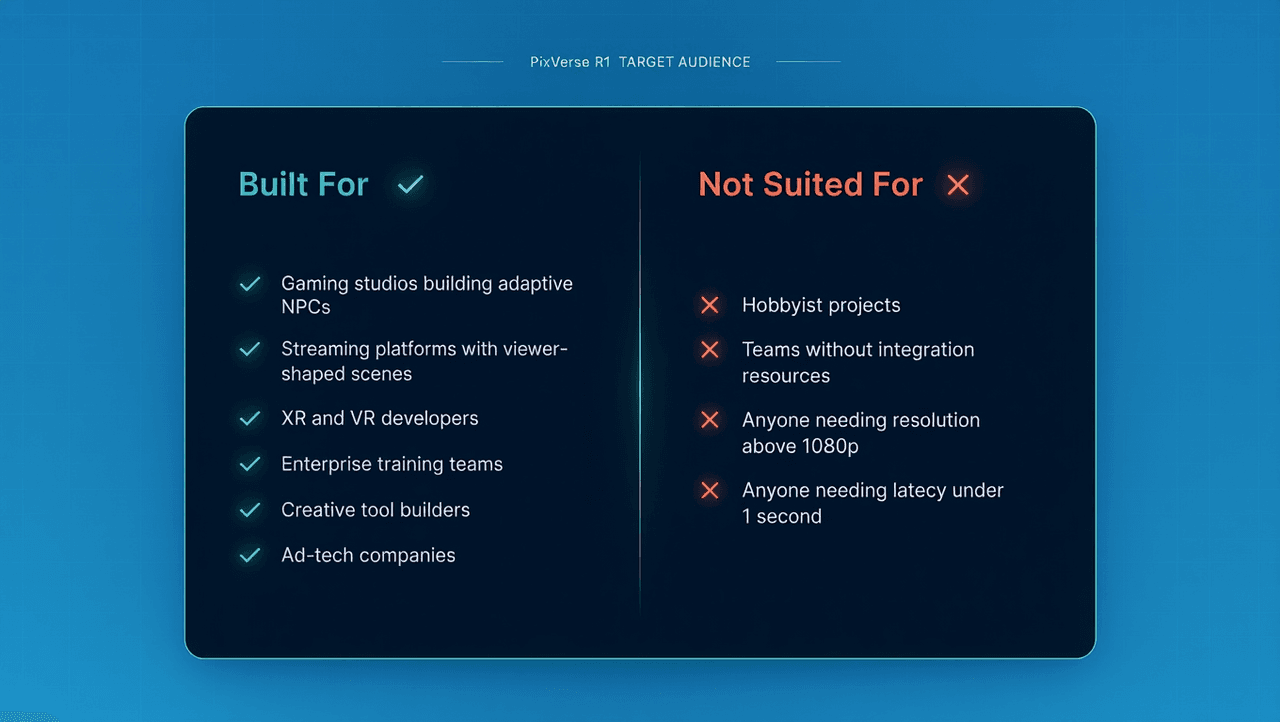
Not everyone. PixVerse's own API partner program page is unusually direct about this, listing both who it wants and who it doesn't. On the creative side, R1 targets AI-native gaming with NPCs that adapt on the fly, live streams where viewer input shapes the scene, XR and immersive simulation, interactive training, and open-ended creative exploration.
On the partner side, the program is aimed squarely at gaming studios, streaming platforms, XR and VR developers, enterprise training teams, creative tool builders, and ad-tech companies, specifically ones with a clear production timeline and engineering capacity to integrate a real-time API.
Just as telling is who PixVerse says to skip it. That's a rare bit of honesty from a vendor, and worth taking at face value since it costs PixVerse nothing to admit.
Frequently Asked Questions
What is pixverse-r1?
PixVerse R1 is PixVerse's real-time world model, launched January 12, 2026. Instead of generating a fixed clip from a prompt, it produces a continuous interactive video stream that responds to text, image, or audio input while the session is running.
Is PixVerse R1 free to use?
Yes, for now. PixVerse offers R1 free to its users at realtime.pixverse.ai, though the company describes this as a limited-time arrangement rather than a permanent price. API partners are promised grandfathered pricing once commercial rates eventually launch.
How do I get access to PixVerse R1?
Consumers can try it directly at realtime.pixverse.ai at no cost today. Businesses that want programmatic access instead apply through PixVerse's API partner program, which reviews applications on a rolling basis and is aimed at gaming, streaming, XR, training, and ad-tech teams with real integration capacity.
Conclusion
PixVerse R1 is a real attempt at something few companies have shipped outside a research paper: a video model you can talk to while it's still generating. The three-part engine behind it, the Omni multimodal foundation, the consistency-aware autoregressive framework, and the Instantaneous Response Engine, is a coherent technical answer to a hard problem, not just a marketing label.
It's also not finished, and the gap between what launched and what actually shipped is worth remembering before you take any single spec PixVerse publishes at face value. Treat R1 as a fast-moving preview of where interactive video is heading, test it directly at realtime.pixverse.ai before assuming it fits a production use case, and if you need something to build into a product today, PixVerse's V6 and C1 models are the part of this lineage you can actually call through an API right now.





