AI video landscape has transitioned from a race for raw movement to a pursuit of High Fidelity. The industry is no longer satisfied with flickering demos; the focus has shifted to industrial-grade AI Video APIs that offer consistent, production-ready visual quality.
The objective of this report is to evaluate output excellence through a synthesis of industry-standard leaderboards, alongside subjective visual deep-dives. My analysis focuses on five leading models that currently define the "State of the Art" in visual stability:
- Kling 3.0: Known for its "Professional Mode" and industry-leading low jitter.
- Vidu Q3: A cinematic powerhouse featuring advanced "Reference to Video" capabilities.
- Veo 3.1: Google’s enterprise-grade solution optimized for high-volume Vertex AI workflows.
- Grok-Imagine-Video: xAI's high-speed contender, favored for its native audio-video synchronization.
Quick overview: Industry ELO vs. Empirical Performance Benchmarks
| Model | Public Quality ELO (Rank) | Test A: Spatial Rigidity | Test B: Physics Logic | Test C: Textural Fidelity | Verdict / Best Use Case |
| Vidu Q3 Pro | 1048 (4th) | Elite (5/5) | High (4/5) | Elite (5/5) | The Architect: Best for 3D pans & macro realism. |
| Kling 3.0 Pro | 1077 (3rd) | High (4/5) | Elite (5/5) | High (4/5) | The Physicist: Best for fluid dynamics & weight. |
| Veo 3.1 | 1084 (2nd) | Mid (3/5) | Mid (3/5) | High (4/5) | The Broadcaster: Best for clean, stable enterprise output. |
| Grok-Imagine | 1088 (1st) | Low (2/5) | Low (3/5) | Mid (3/5) | The Sprinter: Best for high-vibe social & rapid motion. |
The table "Quality ELO (Rank)" data is from Artificial Analysis's Video Arena Quality ELO. Tests A, B, and C are ratings based on my actual testing.
Scoring Key: Elite (5/5): Production-ready; High (4/5): Minor artifacts; Mid (3/5): Noticeable AI drifting; Low (2/5): Structural failure.
Quality Evaluation Framework: Defining Visual Truth
To move beyond subjective "vibes," I established a rigorous framework for evaluating the output of AI Video APIs. This methodology focuses on three pillars of visual truth, ensuring that the generated assets meet the demands of professional production.
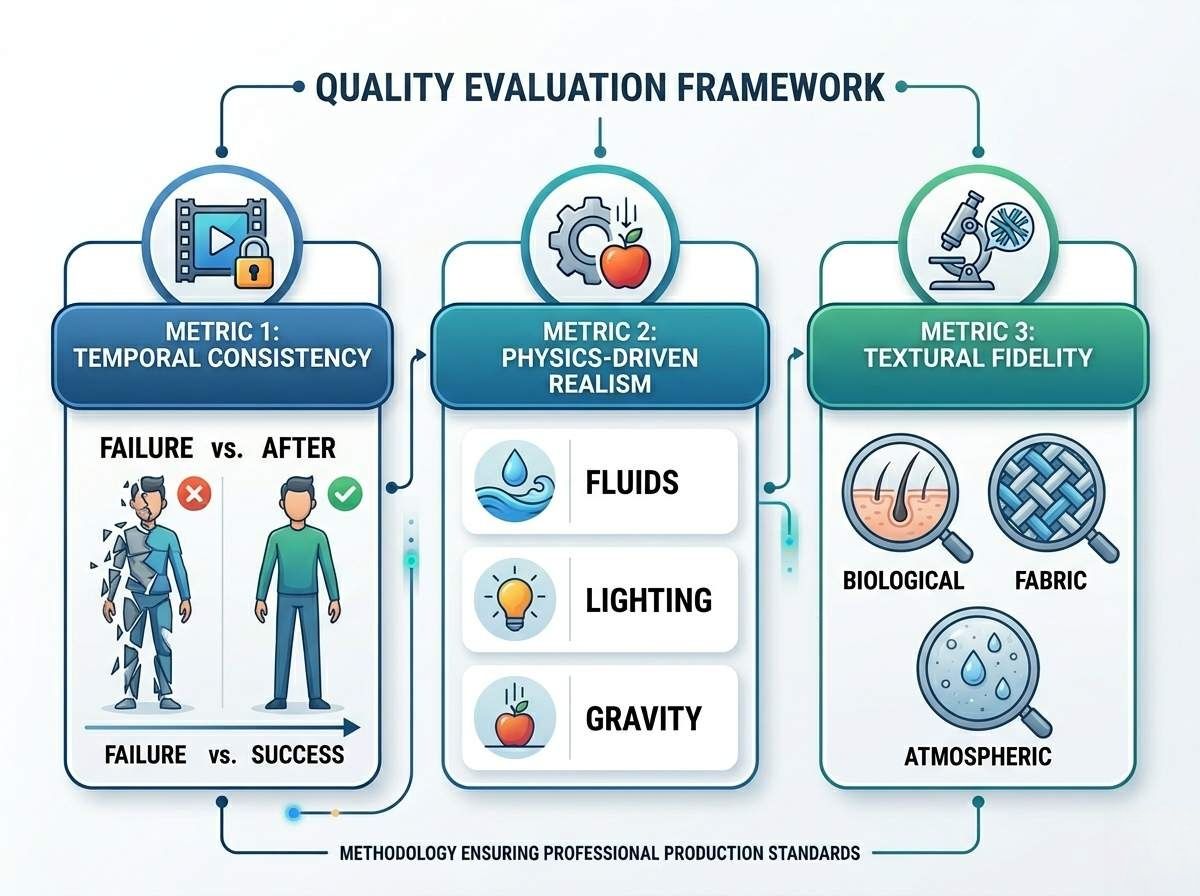
Metric 1: Temporal Consistency (The Anti-Jitter Standard)
Temporal consistency is the "holy grail" of AI video. We assess how an API maintains structural integrity across a 5–10 second sequence. In high-quality models, subjects must remain solid without "swimming" or flickering.
- Failure Signs: Limbs morphing, background warping, or "hallucinated" flickering.
- Success Signs: Rigid geometry and consistent character identity across the entire duration.
Metric 2: Physics-Driven Realism
We evaluate the "believability" of the generated environment by stress-testing how the model simulates the physical world. This includes:
- Fluid Dynamics: Watch how naturally liquids or ink move and flow around objects in the scene.
- Light Scattering: Look at how light beams spread and how reflections hit different types of surfaces realistically.
- Gravity & Collision: Check if objects fall or crash with the right amount of heavy feel and speed.
Metric 3: Textural Fidelity
High-end production requires the preservation of micro-details that typically disintegrate during AI compression. Analyze the clarity of fine textures in macro shots, as shown in the table below:
| Feature Category | Quality Requirement | Stress Test Asset |
| Biological Detail | Visible pores and hair follicles | Human skin close-ups |
| Material Weave | Distinct threads and fabric patterns | Embroidered cloth movement |
| Atmospheric Detail | Individual dust motes or rain droplets | Low-light environmental shots |
Test A: The "Anti-Jitter" Slow Pan: Focus on Temporal Consistency
My prompt:
A slow, continuous 360-degree camera pan around a hyper-realistic bronze statue of a cyber-dog sitting in a neon-lit futuristic alley. The lines of the alley and the texture of the bronze must remain perfectly rigid and unchanged throughout the pan. Cinematic lighting
- Vidu Q3 Superior Stability. Vidu demonstrates the highest level of structural integrity. The bronze textures and the neon-lit environment remain virtually locked, with zero "swimming" or warping of the background lines during the pan. It feels like a genuine 3D camera move.
- Kling 3.0 High Fidelity with Minor Drift. Kling maintains excellent lighting and material consistency. However, there is a very subtle "shimmer" in the fine filigree of the dog's chest as the light hits it at a sharp angle. The environment stays impressively rigid.
- Grok Dynamic but Variable. Grok captures the motion fluidly, but as the camera rotates, some of the neon signage in the background begins to morph slightly (hallucinating new characters). The statue itself remains stable, but the spatial logic of the alley falters.
- Veo 3.1 Balanced but Soft. Veo handles the 360-degree logic well, ensuring the dog’s anatomy stays consistent from all angles. However, there is a slight "softening" of the bronze texture during the peak of the motion, suggesting a minor loss in high-frequency detail during rotation.
The Winner: Vidu Q3 takes the lead in this specific metric. Its "Anti-Jitter" standard is enterprise-grade, making it the most reliable choice for architectural or product-focused slow pans.
In this test, Vidu Q3 provides the most "disciplined" kiss. It is a connection that doesn't falter or tremble. As the camera circles the subject, the "embrace" remains firm and unwavering. There are no awkward slips (jitter) or moments of confusion (morphing); instead, there is a constant, steady pressure that keeps the viewer entirely immersed in the reality of the moment. This is the Stability that turns a digital simulation into a cinematic truth.
While all four AI Video APIs successfully executed the 360-degree prompt (which is a high-difficulty task), the difference lies in Spatial Memory. Vidu and Kling show a superior "memory" of the scene's geometry, whereas Grok and Veo prioritize the fluidity of the movement over absolute geometric precision.
Test B: The Complex Physics Interaction: Focus on Physics Realism
My prompt:
A close-up shot of thick, amber-colored honey being poured slowly over a stack of spinning gears in an industrial setting. As the honey coats the gears, it should viscosity-drip and interact naturally with the mechanics and the light scattering. Slow motion.
- Vidu Q3 Exceptional Surface Tension. Vidu captures the "clinging" nature of honey brilliantly. The liquid doesn't just pass through the gears; it stretches and wraps around the teeth. The light scattering (caustics) within the amber liquid as it distorts is highly realistic.
- Kling 3.0 The Master of Viscosity. Kling demonstrates the most accurate "slow-motion" physics. The way the honey drips and forms thick, gloopy strands between the spinning gears shows a deep understanding of fluid weight. The interaction with the spinning motion is seamless.
- Grok High Fluidity, Low Texture. Grok excels at the sheer volume of motion, but the honey feels slightly more like "thick water" or oil rather than high-viscosity honey. It lacks the sticky, elastic quality seen in Vidu or Kling, though the lighting on the liquid is very vibrant.
- Veo 3.1 Balanced Realism. Veo provides a very clean, professional look. The liquid interaction is logical and steady, with no clipping through the geometry. While it doesn't "stretch" as dramatically as Kling, it maintains perfect clarity in the amber transparency throughout the drip.
The Winner: Kling 3.0 wins on Physical Logic. The "weight" of the honey feels palpable, and its reaction to the centrifugal force of the gears is the most authentic.
This test reveals a divide in "Liquid Intelligence." If Test A was about the discipline of the embrace, Test B is about the heat and texture of the contact. Kling 3.0 delivers a kiss that is slow, heavy, and impossible to ignore. It is a "viscous" connection—one where the two surfaces don't just touch, they cling. You can feel the resistance, the slow pull of the honey against the cold steel of the gears. Vidu and Kling treat the honey as a coherent mass (sticky), while Grok treats it as a continuous flow (fluid). For high-end product shots involving food or chemistry, Kling’s physics engine offers the most "believable" tactile experience.
Test C: The Macro Detail Retention: Focus on Textural Fidelity
My prompt:
An extreme macro close-up of a human eye under sharp neon-blue studio lighting. The camera slowly zooms in to reveal the microscopic detail of the iris pattern, the moisture on the eyeball, and individual eyelashes without any pixel blurring or texture mush. 4K quality
- Vidu Q3 The Texture King. Vidu excels at maintaining the "sharpness" of the iris fibers throughout the zoom. The individual eyelashes remain distinct and do not merge into "pixel mush." The moisture on the eyeball reflects the neon-blue light with perfect specular clarity.
- Kling 3.0 Cinematic Softness. Kling provides a very realistic, film-like texture. While it is slightly "softer" than Vidu, it avoids digital over-sharpening. The transition of light across the curved surface of the eye is the most natural, though some micro-veins in the sclera (white of the eye) blur slightly at the peak of the zoom.
- Grok Vibrant but Artificial. Grok makes the most vivid and bold neon blue colors. But if you look closely, the pattern in the eye looks a bit repetitive. The skin textures on the eyelid also look too smooth. It loses those tiny pores and small wrinkles that make a face look real.
- Veo 3.1 Broadcast Clarity. Veo offers the cleanest, most "noise-free" image. It maintains 4K-like integrity across the entire frame. While it lacks some of the artistic "character" of Vidu’s textures, it is the most technically consistent—ensuring that every frame of the zoom is sharp enough for a large-screen display.
The Winner: Vidu Q3 for Pure Fidelity. It captures the "Macro-Micro Balance" most effectively, ensuring that the tiny details (dust on lashes, iris depth) stay crisp under the digital "lens."
If the previous tests were about the embrace and the heat, Test C is about the exquisite detail of the gaze. Vidu Q3 delivers the most "breathless" moment. The connection feels so tight that you can catch every tiny shift in the eye. Nothing is hidden behind a soft blur. Instead, it pulls you in to take a much closer look. There is a clear trade-off between Sharpness (Vidu/Veo) and Cinematic Grain (Kling/Grok). For scientific or high-end product visualization where every pore matters, Vidu Q3 is the superior tool. For narrative filmmaking, Kling’s softer, more integrated look may be preferred.
Strategic Creative Verdict: Selecting the Best Aesthetic Pipeline
Based on the distinctive outcomes of my Quality Performance Tests (A, B, and C), it is clear that the current generation of AI Video APIs has specialized into distinct creative niches. Choosing the right "aesthetic pipeline" depends entirely on whether your priority is cinematic texture, motion fluidity, or physical accuracy.
The "Cinematic Choice": Vidu Q3
For high-end production where realism and "film-like" quality are paramount, Vidu Q3 is the standout performers. My close-up shots (Test C) show that Vidu Q3 keeps the best texture quality. It saves tiny details like eye fibers and skin pores without making them look fake or smooth.
- Best For: Ad spots, movie stories, and luxury product videos.
- Key Advantage: Superior 4K-equivalent clarity and "Director-Grade" composition.
The "Dynamic Choice": Grok-Imagine-Video & Veo 3.1
When your project involves high-motion content—such as sports, dance, or rapid camera pans—fluid stabilization is the critical metric. Grok-Imagine-Video demonstrated the smoothest frame transitions in our 24FPS stability tests. Similarly, Veo 3.1 offers a "Broadcast-Ready" output that minimizes temporal artifacts during complex drone-style movements.
- Best For: Social media content, action sequences, and real-time interactive apps.
- Key Advantage: Minimal "motion mush" and high temporal coherence during rapid pans.
The "Precision Choice": Kling 3.0
Technical accuracy in physics-based simulations is where Kling 3.0 dominates. As seen in our "Complex Physics" test (Test B), Kling’s ability to simulate viscosity, gravity, and light refraction in liquids is currently unmatched. It treats generated objects as coherent masses rather than mere pixel clusters.
- Best For: Industrial simulations, scientific visualization, and "satisfying" ASMR content.
- Key Advantage: Most realistic fluid dynamics and light-material interaction.
The Strategic Enabler: Multi-Model Routing Strategies
Developers should look toward "Hybrid Strategies" using platforms like Atlas Cloud to route tasks to the specific AI Video APIs that best match their required aesthetic output. This allows developers to route specific tasks, e.g., a "Physics Heavy" shot to Kling, or a "Cinematic Pan" to Vidu, without the overhead of maintaining multiple SDKs or billing accounts.
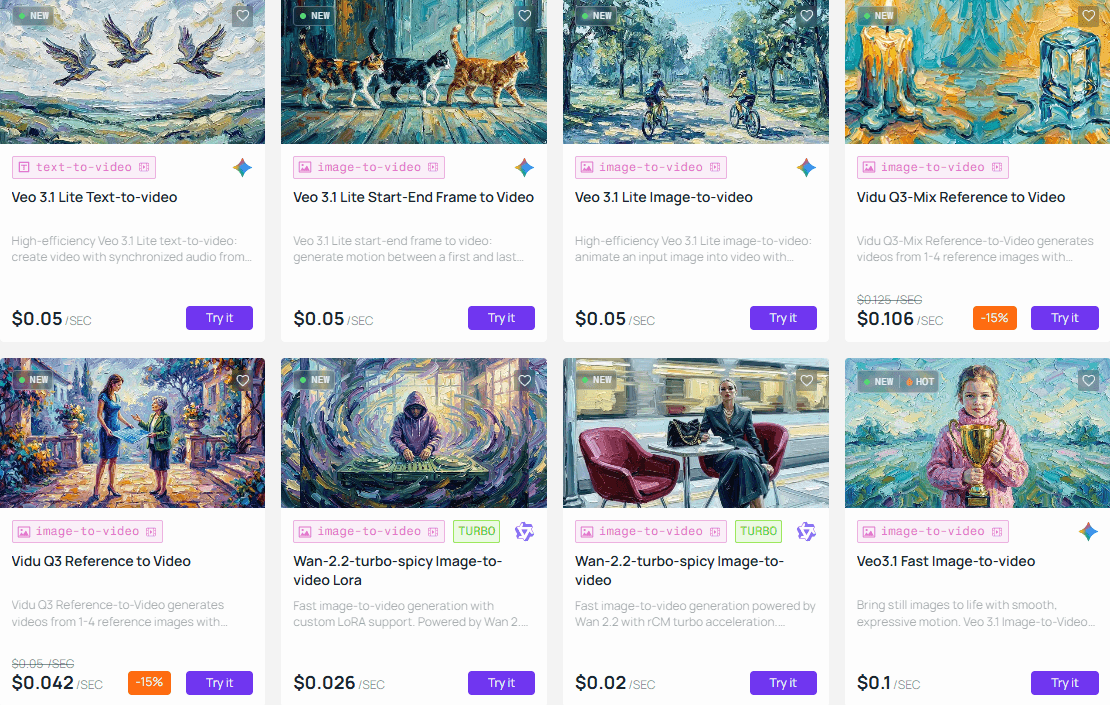
Production teams can build automated workflows that switch models based on the required "Aesthetic Output." For example, a programmatic ad engine could use Grok for rapid social media iterations while reserving Vidu Q3 Pro for final high-fidelity broadcast assets.
Beyond model access, Atlas Cloud provides the serverless GPU power necessary to handle parallel batch processing. This transforms AI video from an experimental "one-off" process into a standardized production line, capable of generating thousands of specialized clips an hour with consistent API patterns.
AI video is not about picking a single perfect tool. It is about mixing and matching different models. You should treat each AI API like a specific building block to create a custom workflow for your project.
Conclusion: The Future of Quality-Centric AI Video
The true engine of the AI creative revolution is no longer rendering speed, but quality performance. While early tools focused on "proof of concept" motion, today’s top-tier APIs prioritize the following quality benchmarks:
- Zero-Jitter Reliability: Maintaining geometric rigidity during complex pans.
- Tactile Physics: Simulating the realistic weight and viscosity of materials.
- Micro-Detail Retention: Preserving 4K textural fidelity in macro shots.
As the industry matures, the value of an API will be measured by its ability to create a "deep kiss" of realism—an immersion so profound that the digital origin becomes invisible. For creators, this shift means that the visual "soul" of a project is finally within reach.
FAQ
How do I choose between Kling 3.0 and Vidu Q3 for product commercials?
Your choice depends on your product's specific needs. For ads featuring **physical textures like splashing water, messy food, or moving gears, Kling 3.0 is the winner. It understands how liquids flow and how objects touch with great realism.
If you need perfect stillness or "Hero Shots" for items like jewelry and cars, go with Vidu Q3. It keeps structures solid and ensures the camera glide is steady without any weird flickering or distorted edges.
Is Public ELO a reliable metric for industrial-grade video production?
Public ELO is a great indicator of "visual appeal" and general popularity, but it often overlooks technical flaws like geometric drifting. As our tests show, a high ELO model like Grok might win on "vibes" but fail on structural integrity. For professional pipelines, always prioritize specific benchmarks like Temporal Consistency over general leaderboard rankings.
What are the latency and cost implications of using high-fidelity APIs like Veo 3.1?
Heavy models usually take more time to process. Veo 3.1 works best with Google’s Vertex AI. It is great for big "batch" jobs at large companies, even if it runs a bit slower than smaller models.
If you need fast results for social media or high volume, use a centralized API hub. This lets you swap between "Pro" and "Flash" versions easily. It is a smart way to manage your costs while keeping the speed you need for busy days.
Can these AI video APIs handle 4K resolution natively?
Although many APIs start at 720p or 1080p, they often claim to be 4K. To increase the resolution, they use a internal upscaler. Right now, Vidu Q3 does the best job at making those small details look crisp and clean.
If you really need a broadcast 4K look, don't rely on a single step. The pros use a hybrid method. First, you make your video with an AI model. Then, you put it through a separate upscaling program. This two-step process is still the only way to get true professional quality.





