The last time Jerry the mouse had a dance partner worth talking about, it was Gene Kelly in 1945's Anchors Aweigh. Eighty-one years later, the partner is an AI model with dance in its name. Seedance 2.0 just made Tom and Jerry dance — first as pitch-perfect cartoon gags on Bilibili, then as unsettling live-action rebuilds that spread across X, TikTok, and Facebook.
This piece traces the whole arc: where the clips came from, why this exact cat and mouse keep ending up inside AI research, what a clip costs to render, and why Warner Bros. lawyers already know these characters by name.
Key Takeaways
- The first notable Tom and Jerry Seedance 2.0 clip hit Bilibili on February 11, 2026 — 86 years and a day after the duo's February 10, 1940 debut — and shows 40,467 views as of July 2026. Its entire prompt was one sentence.
- A second wave arrived June 25, 2026: a 13-second live-action Tom and Jerry rebuild posted by AI-film account el.cine drew 7,749 likes on X, with reposts crediting Seedance 2.0.
- Tom and Jerry were an AI benchmark before this model existed: an April 2025 NVIDIA-Stanford paper trained on 81 episodes to crack one-minute cartoon generation.
- On Atlas Cloud, Seedance 2.0 starts around $0.09/second with a 20% limited-time discount; a 10-second 720p clip runs $1.93536.
- None of it is licensed. Warner Bros. named Tom and Jerry in its 2025 Midjourney complaint and was among five studios that sent ByteDance legal threats within Seedance 2.0's launch week.
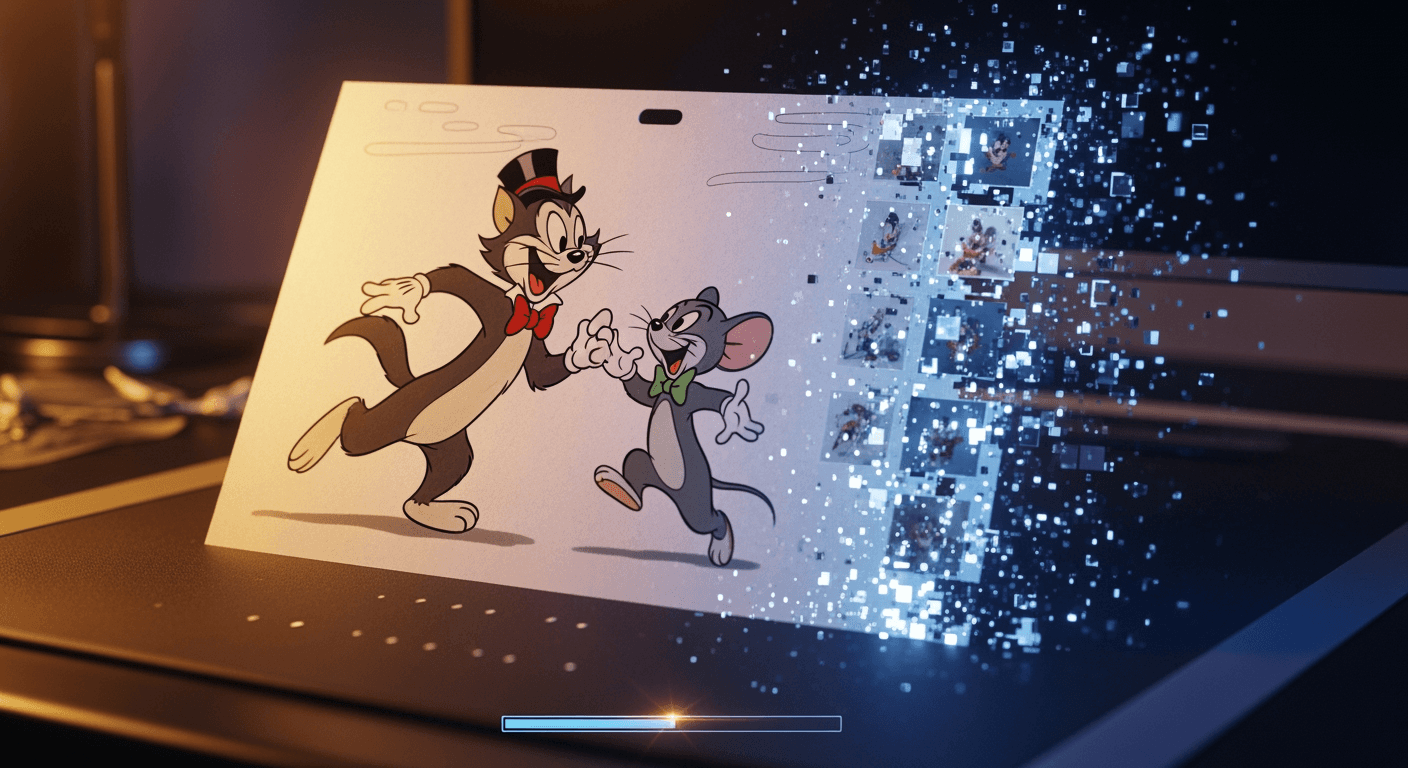
What "Seedance 2.0 Just Made Tom and Jerry Dance" Actually Means
Two separate waves, four months apart, share that one caption energy. The first was cartoon-native. On February 11, 2026, Beijing time — a day before ByteDance officially launched Seedance 2.0, while early access ran through the Jimeng app — Bilibili user 江上火种 posted a generated Tom and Jerry short. The upload's description is the prompt itself, one sentence long, translated from Chinese: "Generate a Tom and Jerry cartoon: Tom sets cheese on a giant trap. Jerry takes the cheese with ease; Tom steps on the trap, gets launched into the air, and comes down wedged in the chandelier." One line in, a complete three-beat gag out. The timing was poetic: Tom and Jerry's first short, Puss Gets the Boot, opened on February 10, 1940.
The second wave went the other direction — out of animation entirely. On June 25, 2026, the AI-film account el.cine posted a 13-second clip captioned "AI turned Tom and Jerry into live action." Tom as a real cat, Jerry with photorealistic fur, the classic chase restaged like wildlife footage. Reposts across TikTok and Facebook credited the rebuild to Seedance 2.0; one widely shared repost put it plainly: "Tom looks like a real cat. Jerry has photorealistic fur and expressions."
The receipts, checked July 17, 2026 (Chinese titles translated):
| Date | Artifact | Platform | Numbers |
|---|---|---|---|
| Feb 11, 2026 | "Seedance 2.0 generates Tom and Jerry," a one-sentence-prompt chase gag | Bilibili, 江上火种 | 40,467 views, 367 likes |
| Jun 25, 2026 | "AI turned Tom and Jerry into live action," hyperreal rebuild | X, el.cine (@EHuanglu) | 7,749 likes, 315 replies |
| Late Jun 2026 | Reposts crediting the rebuild to Seedance 2.0 | TikTok, Facebook | TikTok now runs a "Seedance 2 Tom" discovery hub |
| Early Jul 2026 | Copycat live-action shorts, including a dinner-scene remake | YouTube Shorts | Long-tail uploads within two weeks |
Worth noting what the dance framing sits on. Tom and Jerry dance memes were already a TikTok genre before any of this — the platform's own discover pages collect shoulder-shake and Coffin Dance edits that rack up millions of views. Seedance 2.0 turned a remix genre into a generative one: now the moves come from a prompt, not from cutting old footage.
Tom and Jerry Were Teaching AI to Animate Before Seedance 2.0 Existed
The Seedance 2.0 Tom and Jerry wave didn't pick its mascots at random. This franchise has been AI video's favorite stress test for over a year. In April 2025, researchers from NVIDIA, Stanford, UC Berkeley, UCSD, and UT Austin published a paper on one-minute video generation with test-time training — and their entire demo corpus was Tom and Jerry. The team fine-tuned on 81 classic episodes and generated one-minute cartoons in a single pass, no stitching, beating baseline architectures by 34 Elo points in human evaluation, as The Decoder reported. The paper went modestly viral itself: MattVidPro's breakdown passed 30K views, and Varun Mayya's one-prompt Tom and Jerry episode video reached 83K.
Why does this one franchise keep getting drafted into AI research? Because it is almost pure visual storytelling. The classic shorts have virtually no dialogue — every joke is physics, timing, and a music score doing the talking. For 2025's silent models, that meant no lip-sync to fail at. For Seedance 2.0, it flipped into an advantage on the other side: a model that generates audio natively can finally score the gag, not just draw it.
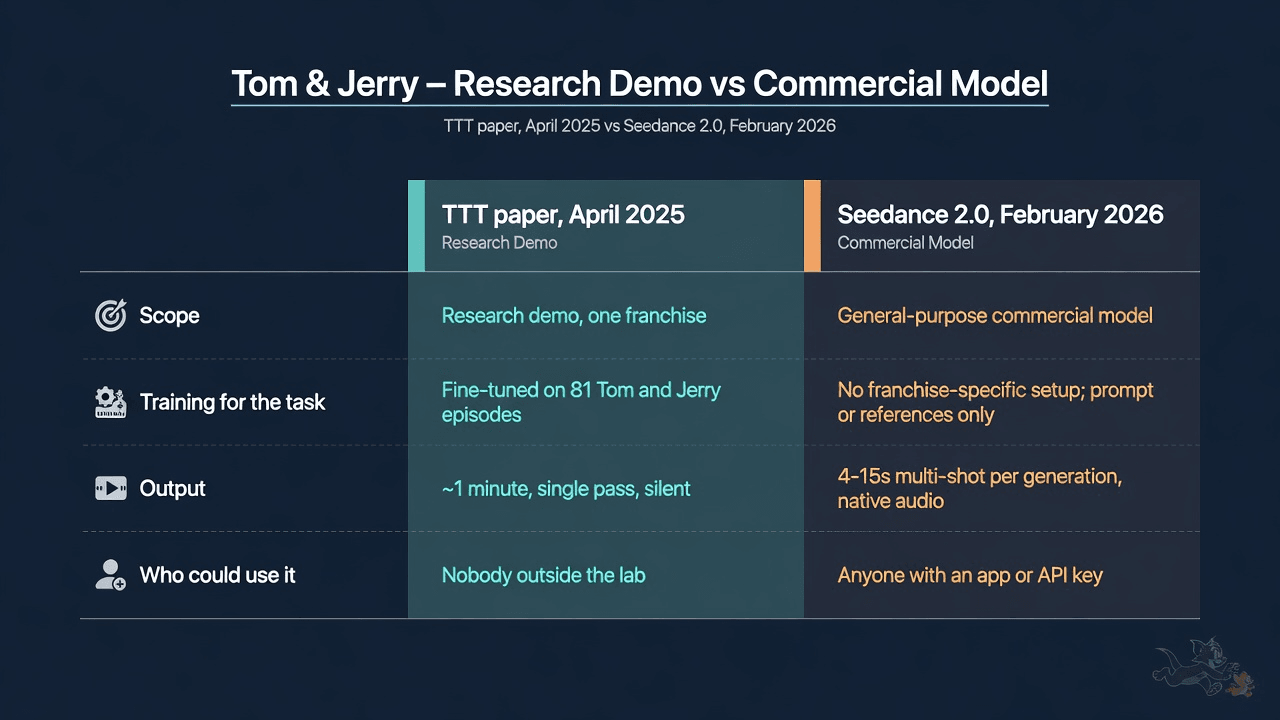
That last row is the whole story. In ten months, "make Tom and Jerry move" went from a five-university research result to a one-sentence prompt on a consumer app.
Rendering the Tom and Jerry Look on Atlas Cloud
The Bilibili clip was made in Jimeng, ByteDance's own consumer app — but building this look with real control (consistent characters, your own soundtrack, repeatable output, no waitlist) is what the API is for. Atlas Cloud hosts the ByteDance model family, and the Seedance 2.0 reference-to-video endpoint is the one built for this workflow: it accepts the images, video clips, and audio that keep a character consistent shot after shot, and it supports video editing and extension on top of plain generation. A 20% limited-time discount is running in July 2026.
What the render bill looks like:
| Job | Discounted price | List price |
|---|---|---|
| Draft pass, 480p, per second | ≈$0.09 | ≈$0.112 |
| Final pass, 720p, per second | ≈$0.1935 | $0.2419 |
| 10-second 720p clip, total | $1.93536 | $2.4192 |
| Fast variant for iteration, 480p, per second | ≈$0.072 | ≈$0.09 |
Two cost habits separate cheap experiments from expensive ones. Draft at 480p and re-render keepers at 720p — the rate roughly halves at draft resolution. And watch your reference clips: billing counts input seconds plus output seconds, so a 15-second reference video attached to every generation quietly costs more than the output itself. Trim references short.
How to Make Tom and Jerry Dance in Seedance 2.0, Step by Step
The dance trick is really a reference trick. Seedance 2.0 takes up to 9 images, 3 video clips, and 3 audio clips — each up to 15 seconds — alongside the text prompt, with an @-mention system that binds each asset to a subject in the scene. And motion is the model's home turf: ByteDance's own launch demos lean on choreography, including a Charleston routine with "the fringe swinging wildly with every kick."
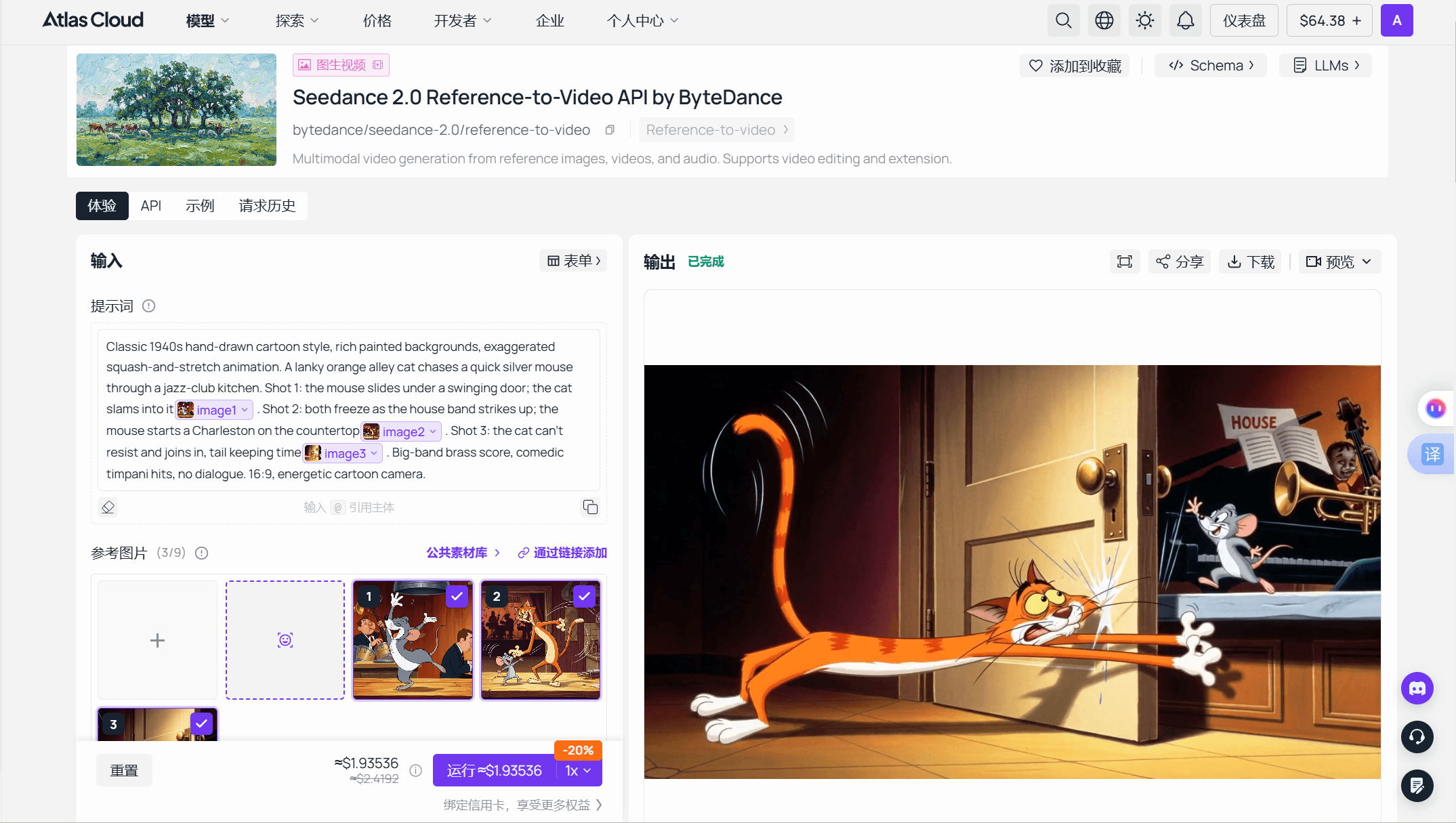
Here's the actual workflow in the Atlas Cloud playground, from blank form to finished clip:
- Open the reference-to-video playground. The Seedance 2.0 reference-to-video endpoint is the one wired for image, video, and audio inputs. Go prompt-only? The text-to-video endpoint is lighter.
- Write the gag as beats, art style first. Lead with the style line ("classic 1940s hand-drawn cartoon"), then number your shots — one action each. The Bilibili viral clip proved a single sentence can carry a three-beat gag.
- Load references and @-tag them. Drop character sheets into the image slots (up to 9), then use the @ control to bind each asset to a subject in the prompt, so "the cat" always renders as your cat. Add a music clip to an audio slot to drive the dance.
- Set duration and frame, but draft at 480p. Leave duration on Auto or pick 4–15 seconds, choose an aspect ratio (16:9 through 9:16), and drop resolution from the 720p default to 480p for the first pass — the cheapest way to test timing and composition before you commit.
- Turn native audio on; set the watermark. Flip "Generate audio" so the score renders with the motion instead of being added later, and set the watermark toggle to what your use case needs.
- Read the live price, then run. The form shows the metered cost with the discount already folded in, so there are no billing surprises — then hit run.
- Lock keepers, then extend. Re-render the shots you like at 720p or higher, feed an approved shot back in as a video reference to carry identity forward, and use the endpoint's extend feature to grow a single clip into a sequence.
The recipe, by goal:
| You want | Feed the model | Why it works |
|---|---|---|
| The classic cartoon look | Text prompt alone, gag written in beats | The 1940s style is deeply represented in the model's training |
| A dance sequence | Character images + a music clip | Native audio generation times motion to the score it's making |
| The live-action rebuild | Stills of the scene + "photorealistic" style language | The el.cine wave: same beats, new visual language |
| A consistent series | Your approved earlier shot as a video reference | Carries motion style and identity across generations |
A safer skeleton — original characters, same energy:
Classic 1940s hand-drawn cartoon style, rich painted backgrounds, exaggerated squash-and-stretch animation. A lanky orange alley cat chases a quick silver mouse through a jazz-club kitchen. Shot 1: the mouse slides under a swinging door; the cat slams into it. Shot 2: both freeze as the house band strikes up; the mouse starts a Charleston on the countertop. Shot 3: the cat can't resist and joins in, tail keeping time. Big-band brass score, comedic timpani hits, no dialogue. 16:9, energetic cartoon camera.
Note what the prompt does: declares the era's art style first, keeps one action per shot, and writes the music into the scene. Dialogue-free is period-accurate — and it sidesteps lip-sync entirely, which is one less thing to break.
The Legal Cat and Mouse: Warner Bros. and the Seedance 2.0 Problem
Every Tom and Jerry clip in this wave is unlicensed. The duo was born at MGM in 1940 and lives in Warner Bros.' vault today, and no studio has a Seedance deal. This isn't hypothetical exposure, either — these two characters are already named in active AI litigation. Warner Bros.' September 2025 complaint against Midjourney lists the infringed characters, per IPWatchdog's analysis: "Superman, Batman, Wonder Woman, Bugs Bunny, Scooby-Doo, Tom and Jerry, Powerpuff Girls, and Rick and Morty." Few cartoon characters anywhere have that distinction.
Seedance 2.0 collected its own letters fast. Disney's cease-and-desist landed one day after launch, per TheWrap's report, and within the week The Hollywood Reporter counted Netflix, Warner Bros., Paramount, and Sony alongside. ByteDance pledged to "strengthen current safeguards," per Al Jazeera's coverage, paused its global rollout in March, then relaunched in phases with IP-character filters, real-face blocks, and watermarking — CapCut's newsroom confirmed the US return on April 7, 2026. Our Hollywood standoff timeline covers it letter by letter.
Here's the tension this article's receipts expose: the guardrails predate the live-action Tom and Jerry wave. El.cine's rebuild and its copycats spread in late June and July — months after the filters shipped. Enforcement is real but uneven, and as of mid-July 2026 no studio has actually sued ByteDance over Seedance; the Midjourney cases, filed back in 2025, were still in discovery this summer. The letters framed an opening position. The negotiation continues, and clips keep publishing into that gray zone.
If you're building rather than spectating:
- Treat Tom and Jerry as radioactive for anything monetized. They are literally named in a federal AI complaint.
- An original cat-and-mouse duo in the same 1940s style carries the nostalgia without the named-character exposure.
- Label AI-generated work as such on every platform. The accounts driving this wave do.
- Assume capability shrinks over time. Filters have tightened once already; clips that render today may not render in October.

Frequently Asked Questions
Did Seedance 2.0 really make Tom and Jerry dance?
Yes, in both senses. Creators generate dance and gag sequences with the characters directly — the first viral Bilibili clip came from a one-sentence prompt in February 2026 — and the broader wave revived the duo across TikTok's existing Tom and Jerry dance-meme scene. The June 2026 live-action rebuild credited to Seedance 2.0 is the wave's biggest single artifact, at 7,749 likes on X.
Who owns Tom and Jerry, and is any of the Seedance 2.0 content licensed?
Warner Bros. owns the characters, which originated at MGM in 1940, and none of the Seedance 2.0 fan content is licensed. Warner Bros. named Tom and Jerry in its 2025 copyright complaint against Midjourney and sent ByteDance its own legal threat during Seedance 2.0's launch week.
What does a Tom and Jerry-style Seedance 2.0 clip cost to generate?
On Atlas Cloud, a 10-second 720p Seedance 2.0 generation costs $1.93536 with July 2026's 20% discount ($2.4192 at list). Draft-quality 480p runs about $0.09 per second, and remember that attached reference-video seconds are billed on top of output seconds.
Will Seedance 2.0 still generate Tom and Jerry after the April 2026 guardrails?
Unevenly. ByteDance's relaunch added IP-character filters, yet the live-action Tom and Jerry rebuilds spread in late June 2026, well after the filters shipped. Expect enforcement to keep tightening — and expect the safest long-term play to be original characters in the same style.
Conclusion
Eighty-six years of chase scenes, one year as AI research's favorite lab animal, and now a second life as the internet's proof that Seedance 2.0 can animate anything with a pulse or a punchline. The characters belong to Warner Bros., and that fact is already sitting in a federal docket. But the technique — one-sentence gag prompts, music-driven motion, style transplants from cel to photoreal — belongs to whoever renders next. Swap in your own cat and mouse, and the dance floor is open.





