Stop wasting premium tokens on trivial execution tasks. Software development requires multi-tiered cognitive orchestration; by decoupling high-level planning from low-level execution via smart agent routing, developers can drop API expenses by up to 60% without sacrificing code quality.
We have all been sold a lie. The marketing departments of top-tier AI labs want you to believe that software engineering is a linear problem solved by a single, monolithic brain. They want you to dump your entire codebase into one ultra-expensive flagship model and watch it magically spit out a flawless pull request.
If you have actually tried this on a production repository, you already know the frustrating reality.
You fire up a premium cloud interface, ask it to refactor a modular service, and it starts chewing through hundreds of thousands of tokens. It runs a grep command—that costs you flagship tokens. It reads a configuration file—more flagship tokens. It writes three lines of boilerplate unit tests—premium tokens again. By the time it encounters a context-length bottleneck, it starts dropping subtle variables, hallucinates an internal import path, and leaves you with a corrupted terminal session and a hefty API bill.
The problem isn't the model's IQ. The problem is your architecture. Complex software engineering is fundamentally multi-paradigm. Forcing a single omnipotent model to handle high-level architectural design, low-level file manipulation, and repetitive unit testing is the economic equivalent of hiring a Principal Architect to manually fix syntax typos.
The Special Forces Method: Enter Heterogeneous Agent Routing
The elite tier of engineering productivity has moved past the single-model paradigm. The future belongs to granular, automated task delegation, a design pattern natively realized by Gitlawb/openclaude.
OpenClaude is an open-source, terminal-first coding agent CLI built on Bun that abstracts your tool-calling loops (Bash execution, file operations, grep, and Model Context Protocol) away from any single provider constraint. Instead of acting as a simple wrapper, its architecture introduces a dedicated routing layer: agentRouting.
The Core Insight: There is no single perfect AI model for coding; there is only a perfect combination of routed models. Real engineering efficiency means running a mixed-model pipeline: leveraging maximum reasoning capabilities exclusively for high-level tactical planning, while offloading structural modifications and predictable boilerplate to highly optimized, lightning-fast execution engines.
By breaking down the software development lifecycle into distinct agent roles—such as Explore, Plan, Execute, and Review—you match the cognitive difficulty of the task to the exact cost-to-performance sweet spot of the model.
Showcase: Spinning Up Your "All-Star" Coding Team in 3 Minutes
Let’s build a local multi-agent development terminal. We will configure an automated workflow that scans a repository, plans a structural refactor, and executes code generation across multiple modules using precise routing.
Step 1: Global Environment Initialization
Install the OpenClaude CLI globally using your package manager:
Bash
plaintext1npm install -g @gitlawb/openclaude@latest
(Note: Ensure ripgrep is installed on your local system path so the agent can execute deep code indexing via rg natively).
Step 2: Injecting the Heterogeneous Routing Matrix
As an officially integrated OpenAI-compatible provider within the OpenClaude ecosystem, Atlas Cloud provisions a static, pre-configured model catalog out of the box. You no longer need to manage five separate platform accounts, deal with disparate authentication schemes, or scatter plain-text keys across your machine.
Open your local configuration profile at ~/.openclaude.json and inject the specialized agent routing matrix. Using a single, unified Atlas Cloud access token, we can instantly orchestrate diverse backend architectures simultaneously:
JSON
plaintext1{ 2 "agentModels": { 3 "atlas-reasoning": { 4 "provider": "atlas-cloud", 5 "model": "deepseek-ai/deepseek-r1-0528", 6 "api_key": "at_sk_live_prod_89e1a3cf" 7 }, 8 "atlas-flash": { 9 "provider": "atlas-cloud", 10 "model": "deepseek-ai/deepseek-v4-flash", 11 "api_key": "at_sk_live_prod_89e1a3cf" 12 }, 13 "local-sandbox": { 14 "provider": "ollama", 15 "model": "qwen2.5-coder:7b" 16 } 17 }, 18 "agentRouting": { 19 "Plan": "atlas-reasoning", 20 "Explore": "atlas-flash", 21 "Execute": "atlas-flash", 22 "Review": "local-sandbox", 23 "default": "atlas-flash" 24 } 25}
Step 3: Launching the Agentic Refactor Task
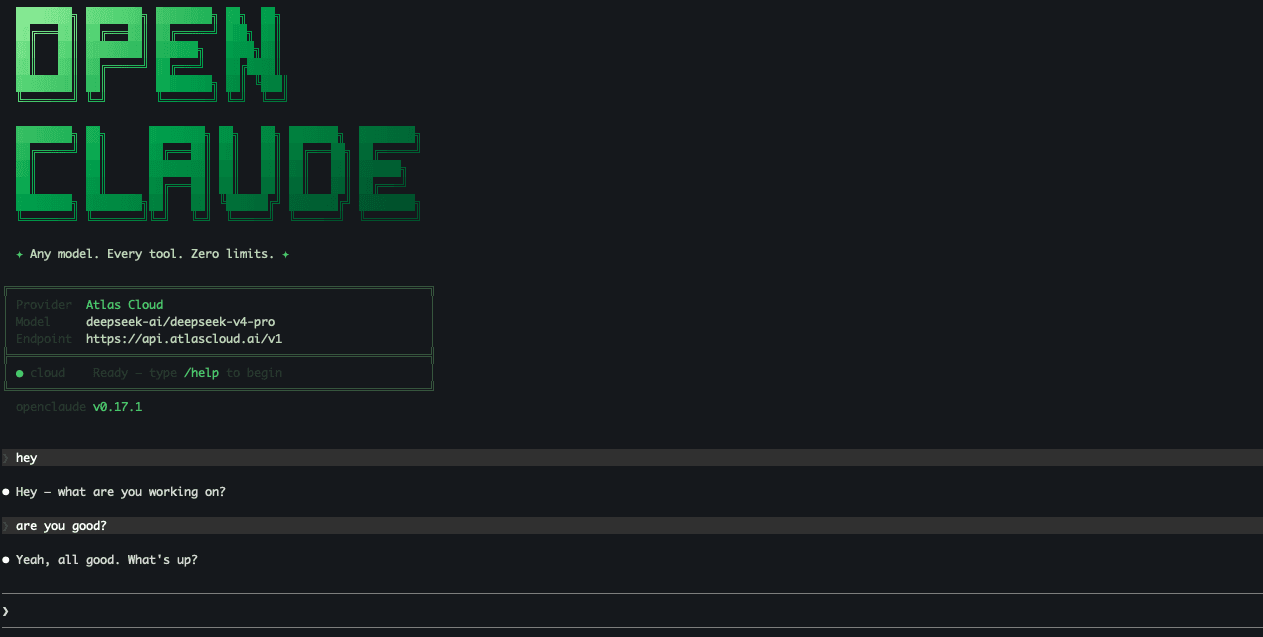
Run the command within your project root to enter the interactive terminal UI environment:
Bash
plaintext1openclaude
Pass a complex, cross-module refactoring prompt straight into the session:
Plaintext
plaintext1/task "Scan the current /src directory for deprecated telemetry components, map their dependency chains, refactor them to use the new V2 asynchronous signature, and verify that the changes do not break existing export bindings."
The Multi-Agent Execution Lifecycle:
- The Explore Phase (~12 seconds): The agent switches to the atlas-flash route, invoking deepseek-ai/deepseek-v4-flash via Atlas Cloud. It fires local system tools (grep, glob) to index code cross-references. This phase ingests substantial context, but because it relies on an optimized flash engine, token costs are negligible.
- The Plan Phase (~25 seconds): After collecting the context, the agent switches roles to Plan and spins up deepseek-ai/deepseek-r1-0528. This reasoning powerhouse computes the dependency graph, isolates edge cases, and produces an exact step-by-step modification blueprint.
- The Execute Phase (~18 seconds): Once the plan is approved, the agent returns to atlas-flash to execute rapid, structural line patches (incremental file writes) across the target modules.
- The Review Phase (~10 seconds): Finally, the local local-sandbox (Ollama running Qwen Coder) wakes up to execute local linting, syntax validation, and compilation tests, ensuring no dangling brackets slip through.
Total Task Duration: ~65 seconds.
The Economic Breakdown: By keeping heavy context gathering and raw file manipulation locked within fast, cost-effective infrastructure—and only utilizing premium reasoning capabilities during the critical 25-second planning window—overall API expenses drop radically compared to traditional single-model interactions.
Designing Your Agent Routing Strategy
To optimize your terminal environment, use this reference blueprint for mapping development roles to backend profiles inside your routing configurations:
| Agent Role | Primary Toolchain | Cognitive Load Type | Optimal Model Profile (Atlas Cloud Endpoints) |
|---|---|---|---|
| Plan / Architect | MCP Schema Reads, Dep-Tree Mapping | High-level abstraction, architectural safety enforcement, complex long-context reasoning | deepseek-ai/deepseek-r1-0528 |
| Explore / Search | File System Reads, grep, glob Indexing | Context ingestion, token-heavy lookups, raw codebase text scanning | deepseek-ai/deepseek-v4-flash |
| Execute / CodeGen | File Write/Patch, Bash Script Generation | Structured boilerplate, accurate translation of abstract specifications to syntax | deepseek-ai/deepseek-v4-flash |
| Review / Test | Local Compilation, Linter Runs, Test Suite Execution | Syntax tree validation, regression mapping, code compliance verification | Local Specialized Models (e.g., qwen2.5-coder) |
Frequently Asked Questions (FAQ)
OpenClaude how to configure custom API keys for third-party providers?
Execute the /provider command directly within your interactive terminal session. This opens an interactive CLI configuration wizard that automatically formats your endpoint variables, verifies API connections, and safely updates your local ~/.openclaude.json file. If you are using Atlas Cloud, simply export the dedicated key to your shell environment using export ATLAS_CLOUD_API_KEY="your_key", and the system's integration driver will automatically detect and authenticate the entire cloud model catalog.
Multi-model routing (agentRouting) how to configure to optimize total token cost?
Explicitly assign your default route to an optimized, low-cost flash model. Ensure you decouple your high-level "Plan" configuration from your routine "Explore" and "Execute" tasks. This ensures token-heavy codebase lookups and mundane file writes use affordable compute resources, reserving expensive reasoning instances exclusively for critical algorithmic decision-making.
Is it safe to grant an AI agent full Bash execution permissions in my terminal?
Yes, because OpenClaude requires explicit human-in-the-loop validation gates by default. Whenever a coding agent attempts to execute an operating system terminal command or write modifications to files, the streaming TUI environment halts and displays an explicit (y/n) confirmation prompt. Unless you pass override flags to bypass auth blocks, every step the agent takes remains under your direct observation.