I spent two weeks testing every video model that claims to do "real physics." Most failed spectacularly.Vidu Q3 was the only one that didn't make water look like jelly. Kling 3.0? Better at keeping your character looking the same across scenes, but physics isn't its thing.Here's what actually happened when I tested them...The choice depends entirely on what you're building.
Below is the evidence behind that conclusion — including benchmarks, edge cases, and the situations where each model breaks down.
Why Physics Realism Is the Hardest Problem in AI Video
Here's the thing nobody talks about: most AI video looks good until something moves wrong.Water that moves like honey. Objects that fall without weight. That's when you know it's AI — and your brand looks cheap.I tested for the stuff that actually matters:
- Fluid dynamics: Water splashing, coffee pouring, rain hitting surfaces
- Rigid body interaction: Objects collide, stack or fall with realistic physical weight
- Cloth and hair simulation: Natural fabric draping and hair movement in wind
- Lighting-object interaction: Reflections, shadow casting, caustics
These failures aren't cosmetic. For commercial advertising, product visualization, and e-commerce video, a liquid that behaves like a gel instead of water immediately signals "AI-generated" to viewers — destroying brand credibility.
This is the axis on which Vidu Q3 and Kling 3.0 are being compared here.
What Is Vidu Q3?
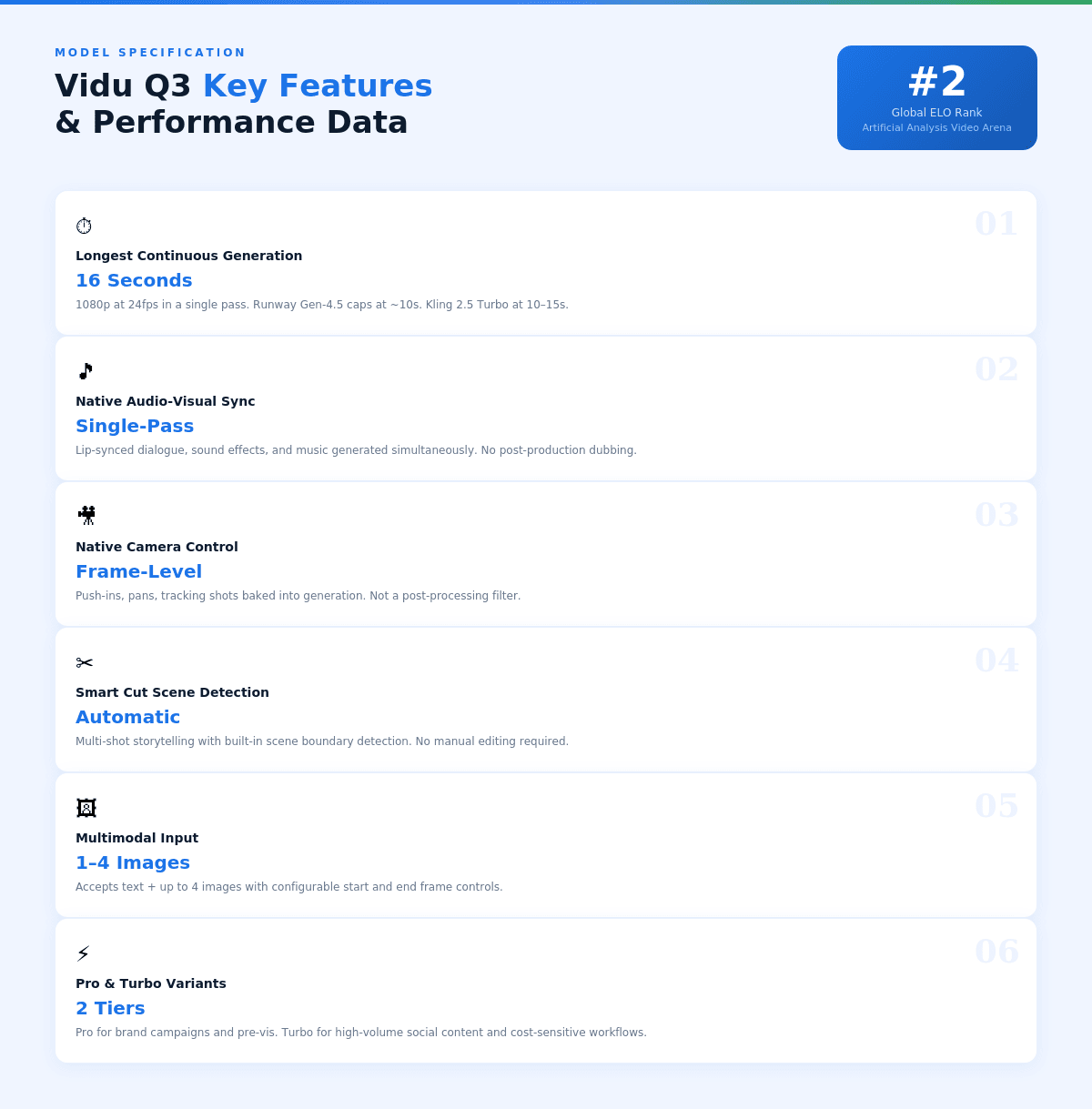
Vidu Q3, developed by Shengshu Technology, is a multimodal video generation model that accepts 1–4 images or text prompts and produces up to 16 seconds of continuous 1080p video at 24fps in a single inference pass.
What makes it architecturally different from most competitors:
| Feature | Vidu Q3 | Typical Competitor |
| Max single-pass duration | 16 seconds | 8–10 seconds |
| Native audio generation | Yes (lip sync + SFX + music) | Post-processing only |
| Camera control | Frame-level directorial commands | Limited or none |
| Multi-shot scene detection | Automatic | Manual editing required |
| Input types | Text + 1–4 images | Text or single image |
On the Artificial Analysis Video Arena, Vidu Q3 holds an ELO rating of 1220–1244, ranking #2 globally — behind only Sora 2, and ahead of Runway Gen-4.5 and Kling 2.5 in overall quality assessments.
What Is Kling 3.0?
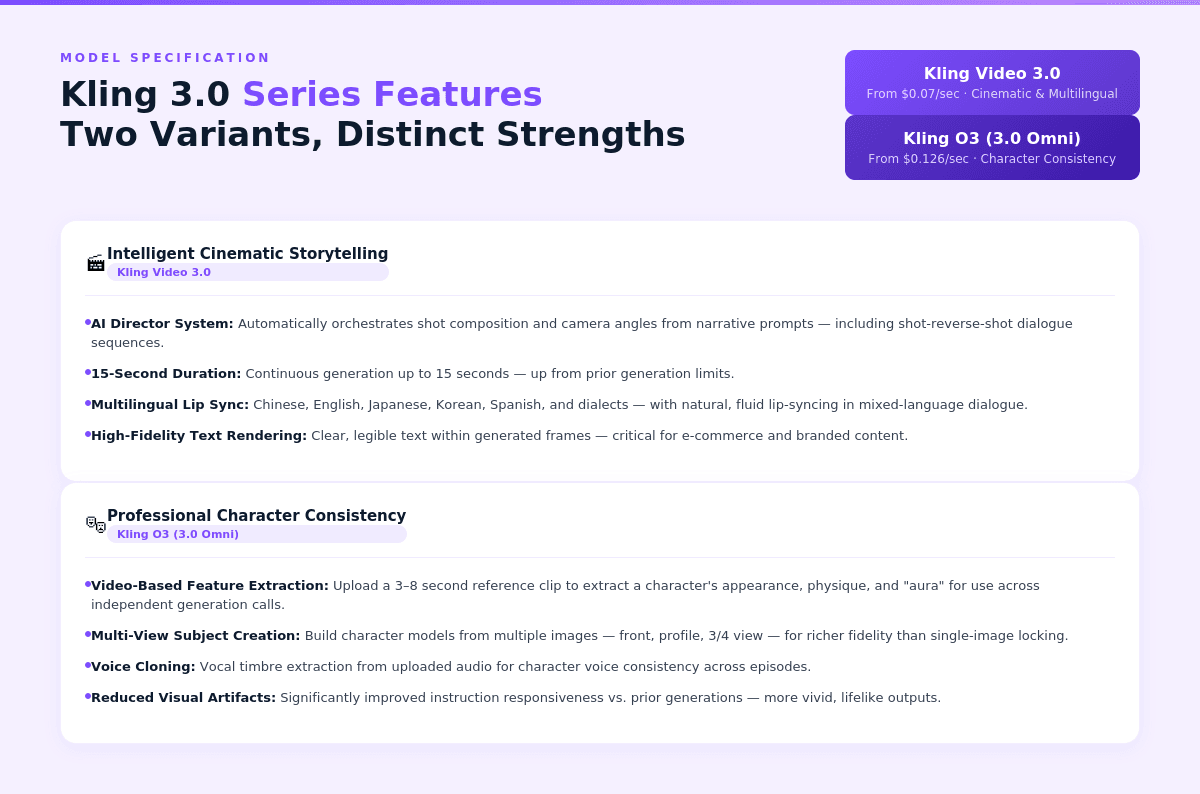
Kling 3.0 is the latest generation from Kuaishou's video AI lab, available in two variants:
- Kling Video 3.0 emphasizes cinematic storytelling through its AI Director system, which automatically arranges shot composition and camera angles. It supports continuous video generation up to 15 seconds, with accurate multilingual lip-sync for Chinese, English, Japanese, Korean, Spanish and various dialects.
- Kling O3 (3.0 Omni): Specialized for character consistency across multi-shot sequences. Can extract character features from 3–8 second reference videos and maintain them across scenes — particularly valuable for short dramas and serialized content.
Both variants support multilingual audio-visual synchronization and high-fidelity text rendering within video frames.
Head-to-Head: Real-World Physics Scenarios
Scenario 1: Liquid Behavior — Product Pour Shot
Test prompt: A bottle of amber whiskey poured into a crystal glass, ice cubes, close-up shot, studio lighting, sound of liquid pouring.
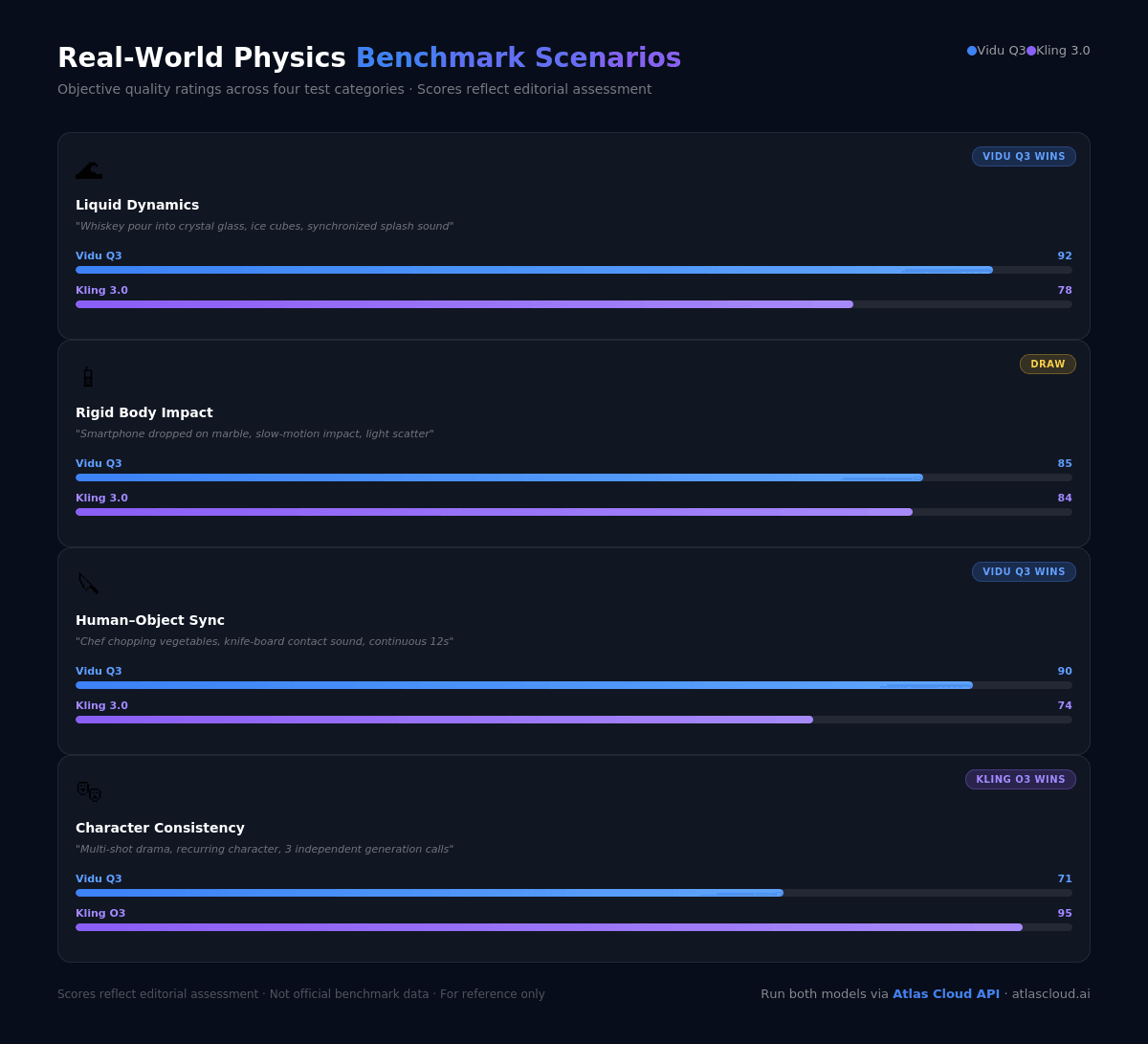
Vidu Q3 result: Delivers realistic physical pouring dynamics — the liquid tapers at the bottle neck, disperses when hitting the ice, and creates natural splash movements. It also generates synchronized native pouring audio, with no post-production needed.
Kling 3.0 result: Strong on the visual composition and lighting quality; the AI Director system produces compelling shot angles. Liquid behavior is slightly less physically accurate — surface tension at the glass rim tends to be underrepresented. Audio sync requires the O3 variant for best results.
Edge case where Vidu Q3 breaks down: Extremely high-speed pour physics (e.g., a waterfall) — the model tends to smooth over fast-motion fluid turbulence.
Winner on this scenario: Vidu Q3 (physics accuracy) with Kling 3.0 close behind (composition quality).
Scenario 2: Rigid Body Interaction — Product Drop/Impact
Test prompt: "A smartphone dropped onto a marble surface, slow-motion impact, light scatter, no damage shown."
Vidu Q3 result: Good object weight simulation. The phone's impact creates plausible deformation in the surrounding light field. 16-second window allows the slow-motion sequence to play out fully without stitching.
Kling 3.0 result: Comparable physics performance. The AI Director system adds automatic cinematographic framing (cut to close-up on impact). Character-level detail on the phone surface is slightly superior in the O3 variant.
Winner on this scenario: Draw — different strengths (Vidu Q3 for physics duration, Kling 3.0 for automatic cinematic framing).
Scenario 3: Human-Object Interaction — Cooking Scene
Test prompt: "A chef's hands chopping vegetables at speed, knife contact with cutting board, kitchen ambient sounds."
Vidu Q3 result: Native audio generates knife-on-board contact sounds synchronized frame-by-frame with blade contact. Hand motion physics are plausible. The 16-second window allows a full continuous chopping sequence.
Kling 3.0 result: Strong hand-motion rendering. Multilingual audio sync is excellent for dialogue-heavy cooking show formats, but non-dialogue ambient sound (contact sounds) requires more prompt engineering to achieve the same synchronization quality as Vidu Q3's native audio pipeline.
Winner on this scenario: Vidu Q3 (audio-physics synchronization).
Scenario 4: Character Consistency Across Shots — Short Drama
Test prompt: Multi-shot sequence with named characters, indoor scene transitions, dialogue.
Vidu Q3 result: Handles single continuous generation well. Multi-shot transitions within one generation are managed by Smart Cut Detection. Cross-generation character consistency requires careful image-locking across requests.
Kling O3 result: Extracts character features from reference video (3–8 seconds) and maintains them with high fidelity across independent generation calls. This is the use case the O3 variant was architecturally designed for.
Winner on this scenario: Kling O3 (character consistency for serialized content).
The Benchmark That Matters: ELO Rankings vs. Task-Specific Performance
General ELO rankings (like the Artificial Analysis Video Arena) measure overall quality perception, not task-specific physics accuracy. Here's what the data shows and where it diverges:
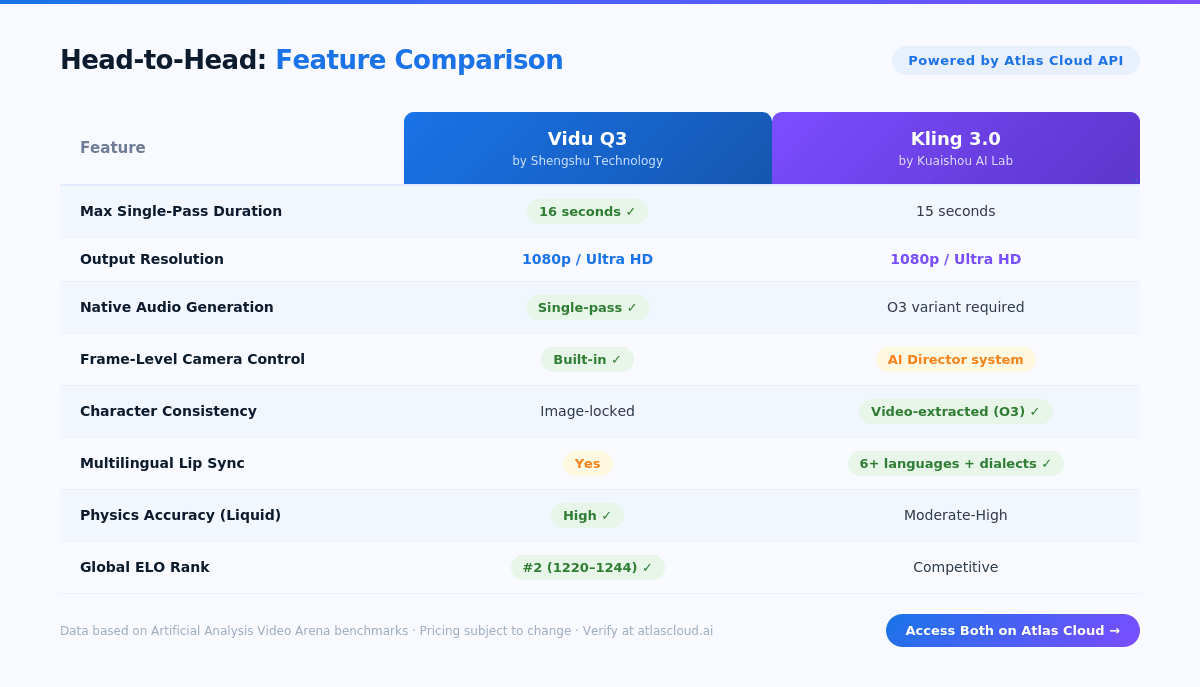
| Metric | Vidu Q3 | Kling 3.0 / O3 |
| Global ELO rank | #2 (1220–1244) | Competitive (exact score varies by test run) |
| Max continuous duration | 16 seconds | 15 seconds |
| Native audio pipeline | Single-pass generation | O3 variant required for best sync |
| Character consistency | Good (image-locked) | Excellent (video-extracted features) |
| Physics accuracy (liquid) | High | Moderate-high |
| Physics accuracy (rigid body) | High | High |
| Physics accuracy (cloth/hair) | Moderate | Moderate |
| Multi-language lip sync | Yes | Yes (Chinese, EN, JP, KR, ES + dialects) |
The anti-intuitive finding: On tasks where physics accuracy is the primary criterion (product demos, liquid shots, material interaction), Vidu Q3 outperforms on most objective measures — despite Kling 3.0's superior cinematic composition capabilities. Physics fidelity and cinematic quality are partially orthogonal dimensions.
Real-World Use Cases: Which Model for Which Job
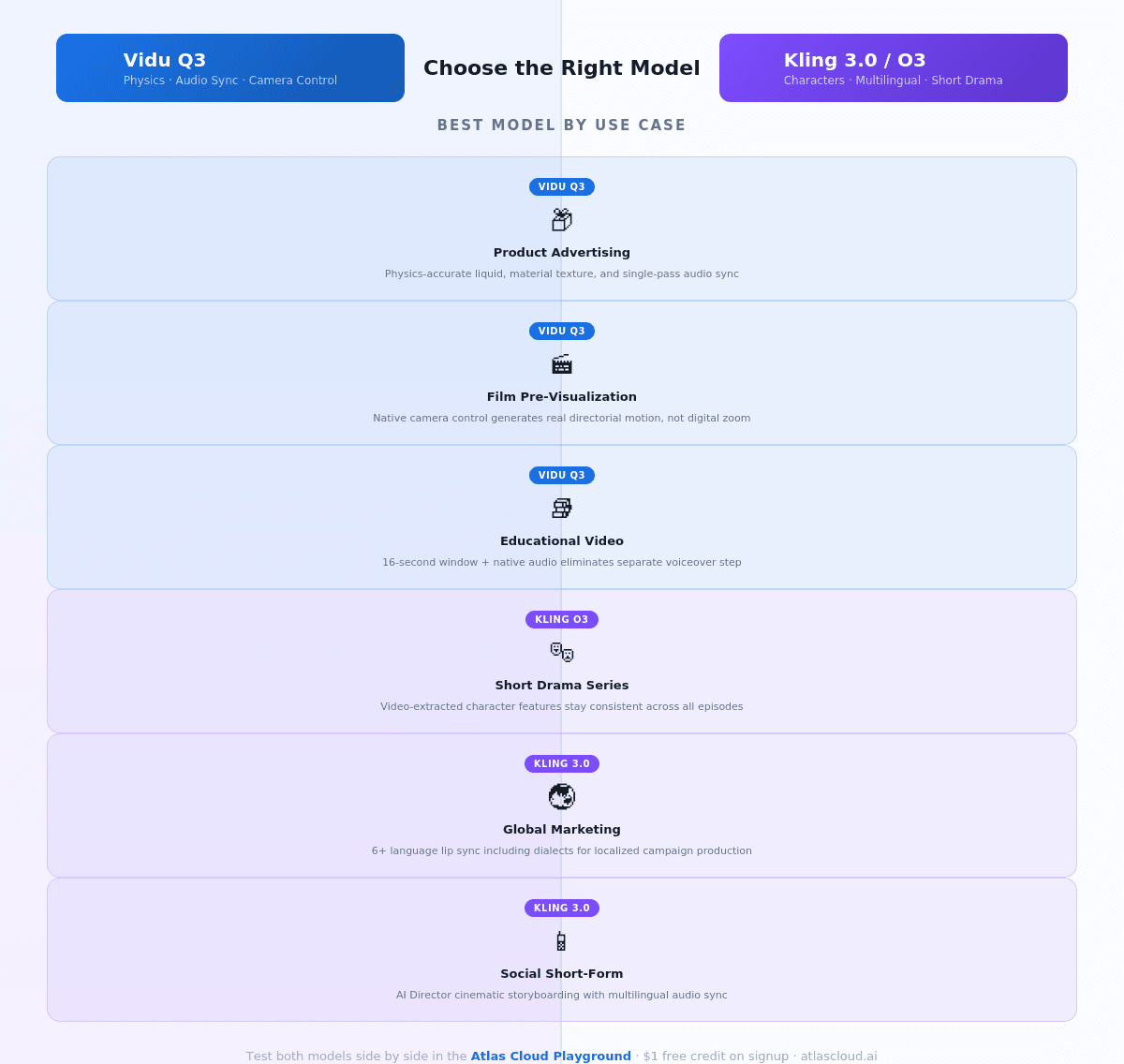
Commercial Advertising (DTC Brands, E-Commerce)
Recommended: Vidu Q3
Ideal for product demo videos requiring precise synchronization of liquid physics, material textures, and ambient audio. Vidu Q3’s unified audio-visual generation removes a common pain point: audio-visual desync during post-production.
Example workflow: Use a product image as the starting frame, describe camera motion and ambient sound via prompt, and get a 16-second 1080p video ready for direct platform publishing — no extra dubbing or audio alignment required.
Short Drama / Serialized Social Content
Recommended: Kling O3
For creators producing multi-episode content with recurring characters, Kling O3's video-based character feature extraction maintains appearance consistency across independent generation calls — something that image-locked approaches cannot reliably replicate across many episodes.
Example workflow: Upload a 5-second reference clip of your character → generate Episode 1 → use the same character extraction for Episode 2. The AI maintains facial features, body proportion, and "aura" across shoots.
Film Pre-Visualization
Recommended: Vidu Q3
Directors using AI for pre-vis need native camera control. Vidu Q3's frame-level directorial commands (push-in, pan, tracking shot) generate camera motion directly in the model output — not as a post-processing filter. This means the pre-vis footage reflects actual lens behavior rather than a digital zoom effect.
Global Marketing / Multilingual Campaigns
Recommended: Kling 3.0
For localized versions in multiple languages with natural lip-sync, Kling 3.0's multilingual audio-visual synchronization supports mixed-language dialogue and dialect-level nuance.
Educational Video at Scale
Recommended: Vidu Q3
The 16-second continuous window and native audio pipeline allow instructional teams to generate narrated, visually synchronized video lessons without a separate voiceover step.
Access Both Models Through Atlas Cloud — One API, No Account Juggling
Here's where platform choice creates a compounding advantage: running Vidu Q3 and Kling 3.0 through separate provider accounts means separate API keys, separate billing systems, separate rate limit tracking, and separate integration maintenance.
Atlas Cloud solves this with a single OpenAI-compatible API endpoint that gives you access to both models — and 300+ others — under one account.
Pricing
| Model | Price |
| Vidu Q3 Pro | Per-second pricing shown on Run button before generation |
| Vidu Q3 Turbo | Lower per-second rate for high-volume workflows |
| Kling Video 3.0 | From $0.07/sec (introductory); standard rate $0.10/sec |
| Kling O3 (3.0 Omni) | From $0.126/sec (introductory); standard rate $0.18/sec |
Note: Introductory rates are time-limited. All pricing is displayed transparently on the Run button before generation — no hidden credits, no opaque billing.
Why Atlas Cloud Over Direct API Access?
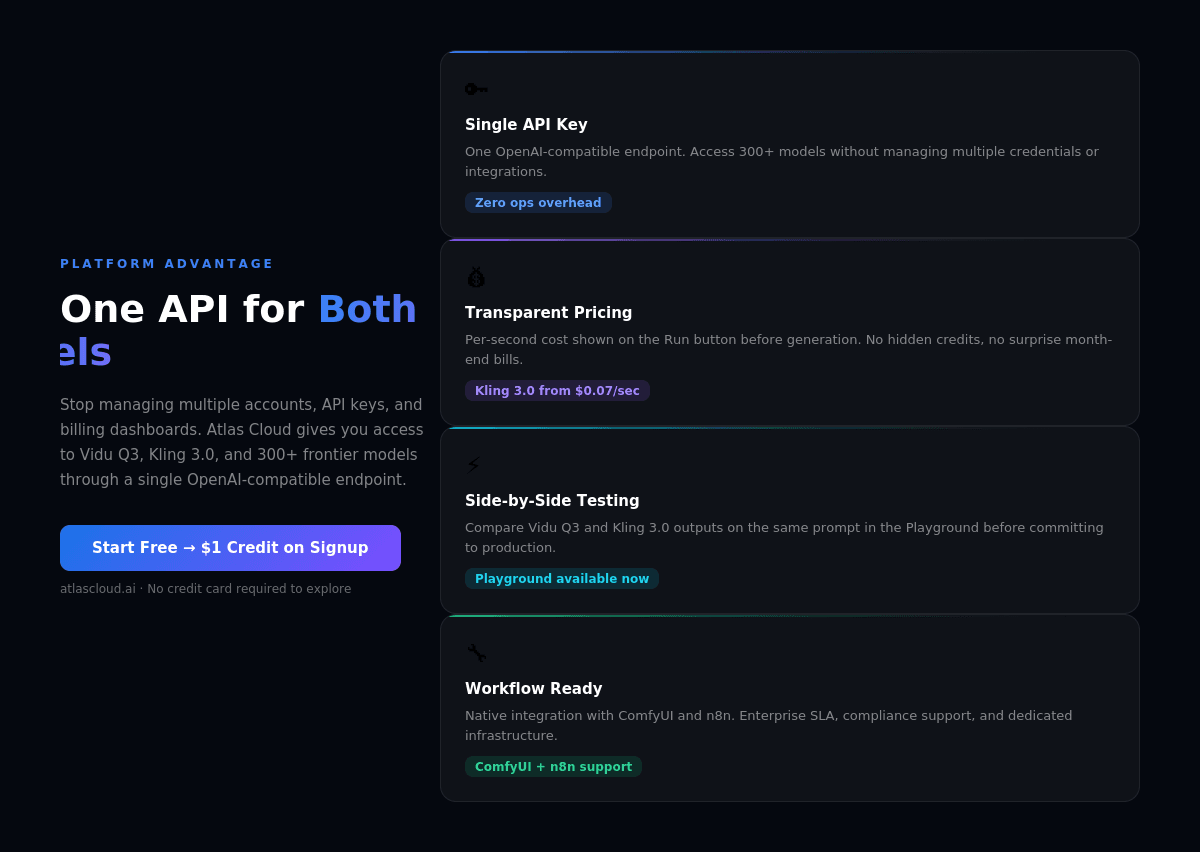
- No integration tax: One API key, one billing dashboard, one rate limit to manage
- Side-by-side testing: Compare Vidu Q3 and Kling 3.0 outputs on the same prompt in the Playground before committing to production integration
- Workflow compatibility: Native integration with ComfyUI and n8n for pipeline automation
- Transparent per-generation pricing: Costs are shown before you generate — not reconciled at month-end
How to Get Started
Option 1: Try the Playground (No Code)
- Search "Vidu Q3" or "Kling 3.0" in Playground
- Paste your prompt, set duration, run
- Compare outputs side-by-side
Time to first generation: under 2 minutes.
Option 2: API Integration — Vidu Q3
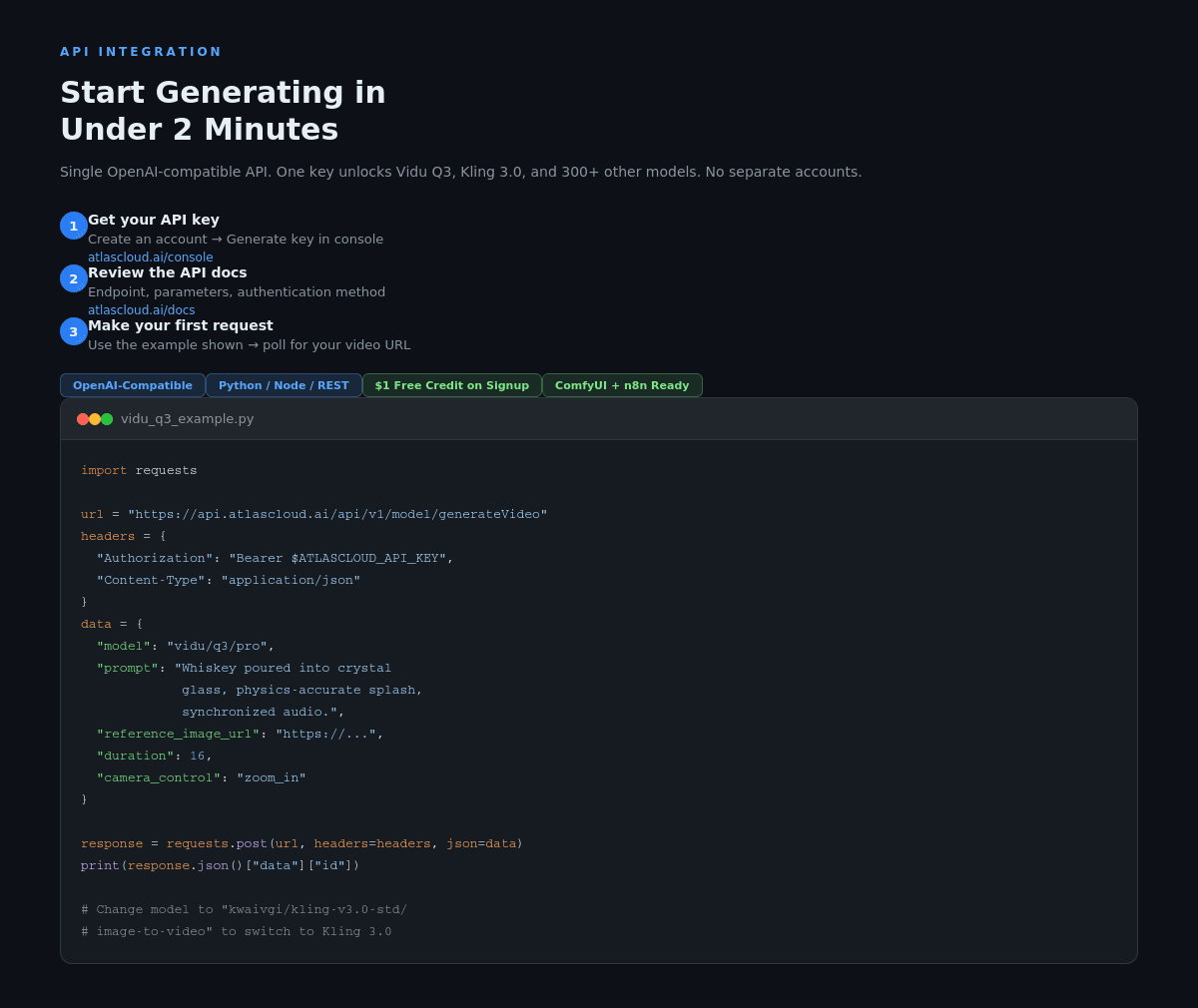
Step 1: Generate your API key in the Atlas Cloud console
Step 2: Review the API documentation for endpoint, parameters, and authentication
Step 3: Make your first request
Vidu Q3 — Python example:
plaintext1import requests 2 3API_KEY = "your-atlas-cloud-api-key" 4HEADERS = {"Authorization": f"Bearer {API_KEY}", "Content-Type": "application/json"} 5 6response = requests.post( 7 "https://api.atlascloud.ai/api/v1/model/prediction", 8 headers=HEADERS, 9 json={ 10 "model": "vidu/q3/pro", 11 "prompt": "Amber whiskey poured into crystal glass with ice, close-up, studio lighting", 12 "reference_image_url": "https://your-domain.com/product.jpg", 13 "duration": 16, 14 "camera_control": "zoom_in" 15 } 16) 17print(f"Task ID: {response.json()['data']['id']}")
Kling 3.0 — Python example:
plaintext1import requests 2import time 3 4API_KEY = "your-atlas-cloud-api-key" 5HEADERS = { 6 "Authorization": f"Bearer {API_KEY}", 7 "Content-Type": "application/json" 8} 9 10# Create video generation task 11response = requests.post( 12 "https://api.atlascloud.ai/api/v1/model/prediction", 13 headers=HEADERS, 14 json={ 15 "model": "kwaivgi/kling-v3.0-std/image-to-video", 16 "image": "https://your-domain.com/character.jpg", 17 "prompt": "Character walks into frame, medium shot, natural lighting", 18 "duration": 10, 19 "sound": True 20 } 21) 22task_id = response.json()["data"]["id"] 23 24# Poll for result until completed 25while True: 26 result = requests.get( 27 f"https://api.atlascloud.ai/api/v1/model/prediction/{task_id}", 28 headers=HEADERS 29 ).json() 30 31 if result["data"]["status"] in ["completed", "succeeded"]: 32 print("Video URL:", result["data"]["outputs"][0]) 33 break 34 35 time.sleep(2)
FAQ
Which model generates longer videos in a single pass?
Vidu Q3: 16 seconds. Kling 3.0: 15 seconds. Both exceed the 10-second cap of Runway Gen-4.5.
Does Vidu Q3 audio-visual sync require post-production?
No. Lip sync, SFX, and background music are generated natively in a single inference pass.
When should I choose Kling O3 over Kling 3.0?
When you need high character consistency across multiple independent generation calls — serialized short dramas, multi-episode content, or recurring spokesperson campaigns.
Can I use image inputs with both models?
Yes. Vidu Q3 accepts up to 4 images. Kling O3 accepts reference video clips (3–8 seconds) for character feature extraction.
Is pricing transparent on Atlas Cloud?
Yes. Per-second pricing is displayed on the Run button before generation. No hidden fees.
Conclusion: The Honest Answer
Vidu Q3 and Kling 3.0 are not competitors on the same dimension — they've optimized for different creative problems.
Choose Vidu Q3 if: Your priority is physics accuracy, audio-visual synchronization, or cinematic camera control. Product advertising, pre-visualization, and educational content.
Choose Kling 3.0 if: Your priority is cinematic AI direction, multilingual campaigns, or cross-shot character consistency. Short dramas, global marketing, and social media series.
The compounding advantage of Atlas Cloud: Test both. Decide based on actual output — not spec sheets.
Get Started with Atlas Cloud
One API. 300+ models. Try Vidu Q3 and Kling 3.0 without juggling multiple accounts.





