Newly Update:d Seedance 2.5 officially launched on July 31, 2026, following its preview at the 2026 Volcano Engine FORCE conference. The rollout opened through Jimeng AI and Doubao's pro tier, with Volcano Ark API access following. For what the shipped model accepts and how to prompt it, see our Seedance 2.5 prompt guide .
The launch email never came. On July 9, the email that did go out said something else entirely: Seedance 2.5 was off, no new date, no reason given. Five days later, a second date slipped too. And while everyone stared at the calendar, Seedance 2.0 users started posting the same complaint from every timezone: the current model suddenly feels dumber.
ByteDance never explained why. The community evidence still sketches a coherent picture, built from delay notices, "nerf" reports, and the sheer physics of what Seedance 2.5 promised. Here is the verified timeline, the two delay theories the evidence actually supports, and how the whole thing resolved.
Key Takeaways
- Seedance 2.5 shipped on July 31, 2026, three weeks after the launch ByteDance cancelled by email on July 9.
- Two dates came and went in between, July 14 and July 20. ByteDance announced neither one and met neither one.
- The slip ran alongside a fresh wave of Seedance 2.0 "nerf" reports. One tracker called it "in full effect globally" on July 15. ByteDance confirmed nothing.
- The hardware math is steep. By Seedance 2.0's published token formula, one native 30-second 4K clip costs roughly 27× the compute of a typical 10-second 720p job.
- API access sidesteps the wobble: endpoints are versioned and don't get silently swapped, and Seedance 2.0 is still served from $0.112 per second.
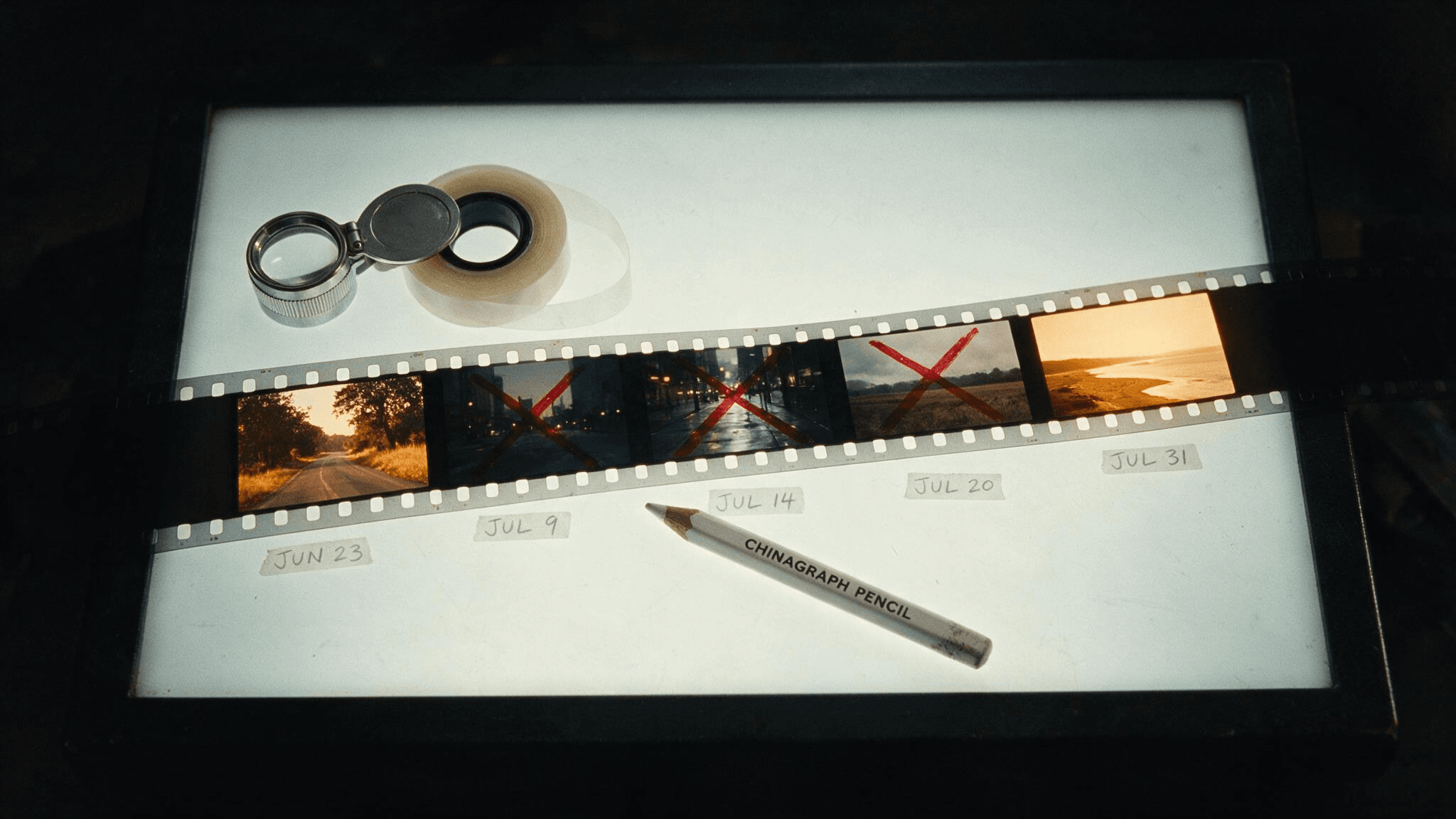
Seedance 2.5 Delay Timeline: Two Slips in Ten Days
Seedance 2.5 was unveiled on June 23, 2026 at ByteDance's Volcano Engine FORCE conference with three headline promises: a native 30-second clip in a single pass, up to 50 multimodal reference inputs, and native 4K arriving across the Seedance 2.0 series, per BigGo's coverage of the event. The public window was "early July."
Then the window kept moving.
| Date (2026) | What happened | Source |
|---|---|---|
| Jun 23 | Seedance 2.5 unveiled at FORCE: 30s native output, 50 references, 4K push | Event coverage |
| Early Jul | Phased rollout expected: consumer apps first, API access later; reports differ on the exact order | Contemporaneous reports |
| Jul 9 | Last-minute delay; an email goes out with "no further ETA or reason" | Kol Tregaskes |
| Jul 10 | "There are rumors the delay is copyright related" | Andrew Curran |
| Jul 14 | Release re-set from July 14 to July 20, attributed to "the official partner" | Mega Lion |
| Jul 15 | "Nerfing is in full effect globally" on Seedance 2.0 | Mega Lion |
| Jul 17 | Japanese AI media frame the delay as fixing the nerf before shipping | Ai-Hakase |
| Jul 31 | Seedance 2.5 launches in Jimeng AI and Doubao's pro tier | Chinese tech press |
Two details matter here. First, the July 9 cancellation was abrupt. AI-news tracker Kol Tregaskes reported that "an email has just been sent out" with no ETA and no explanation, a post Andrew Curran amplified hours later. Second, accounts differ on what July 14 was. Mega Lion's update says the tester release moved to July 20, while Anil Chandra Naidu Matcha framed July 20 as the new official date. Both camps converged on the same number, and both were wrong by eleven days.
One more telling detail from the waiting period: as of July 17, ByteDance's official Seedance page still listed only Seedance 1.0 and 2.0. No 2.5 section, no waitlist, no spec sheet. For a model publicly unveiled three weeks earlier, that silence was a choice. The Seedance 2.5 model page went live only around the launch itself, where ByteDance now describes 30-second single-pass generation "with the option to extend twice." If you want the full spec rundown and rollout order as announced at FORCE, our release-date guide covers it. This article is about why the date kept moving.
What the Seedance 2.0 Nerf Reports Actually Say
"Nerf" is community shorthand, not an engineering term. In Seedance threads it means one thing: outputs that used to be sharp now come back mushy, with worse realism, weaker prompt adherence, and more artifacts, all with no version change announced. The July wave was loud. On July 15, Mega Lion reported an "extreme loss of intelligence and quality" on Seedance 2.0 and declared nerfing "in full effect globally."
Here's the fuller record, and note the dates. This is the second wave, not the first:
| Date (2026) | Account | Report |
|---|---|---|
| Feb 14 | @JSFILMZ0412 | "I think they nerfed Seedance 2.0 as far as realism goes. RIP" |
| Feb 14 | @gavinpurcell | "even when they nerf it, the world now understands that basically anything can be prompted" |
| Feb 23 | @zabiisuto | Seedance 2.0 "seems 'slightly' nerfed (to say it politely)" |
| Mar 8 | @jordandchesney | Counterpoint, relaying a partner-platform CEO: "Are there content restrictions from ByteDance? Yes. Is it nerfed? No!" |
| Jul 14 | @Megalion_ent | Tester date slips to July 20; users "experiencing sharp nerfs on the 2.0 model" |
| Jul 15 | @Megalion_ent | Asks whether ByteDance will "kill Seedance 2.0 for 2.5 completely" |
Treat every row for what it is: user perception, not telemetry. Nobody outside ByteDance can diff the weights. But the February wave taught us that these reports track something real. It arrived exactly as ByteDance tightened safeguards under Hollywood pressure, and the company did later admit it was strengthening filters. When the same chorus starts up days before a major launch, it's worth asking what was competing for the model's resources this time.
Run Seedance 2.0 on a Versioned API While 2.5 Lands
A nerf, by definition, needs a serving stack that can change behind your button without notice. Consumer apps work exactly that way. API access doesn't, because endpoints are versioned, so the model you call today is the model you call tomorrow.
That's the practical hedge while 2.5 rolls out. Atlas Cloud serves the full ByteDance model family through one OpenAI-compatible key, including the Seedance 2.0 text-to-video endpoint from $0.112 per second of video. The Fast tier starts at $0.09 per second and Mini at $0.056 for high-volume work. Atlas Cloud's stated policy is day-0 access to every ByteDance release, and the Seedance 2.5 family page is already up and marked coming soon, so those endpoints will arrive without a migration.
Method 1: Generate Seedance 2.0 Video in the Browser
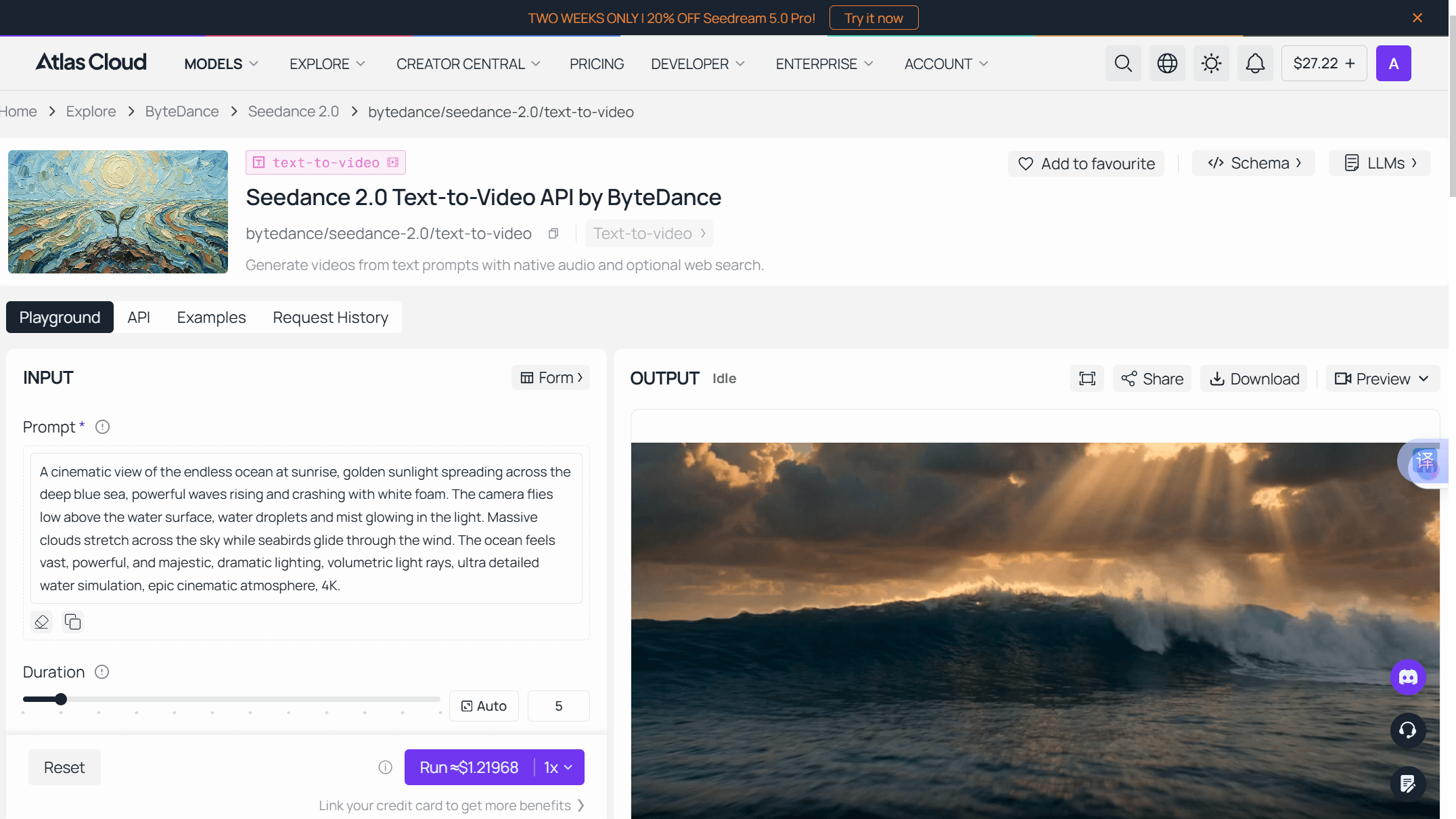
Log in and generate straight from the Seedance hub. Seedance 2.0 with native 4K is live in the playground today, with no setup and no waitlist.
- Pick an endpoint. Text-to-video, image-to-video, or reference-to-video, depending on what you're feeding it.
- Write the prompt and set duration, resolution, and aspect ratio. Audio generation and watermarking are toggles, not separate jobs.
- Read the Run button before you commit. It quotes the exact price of the current settings, so you can see what a resolution bump costs before paying for it.
Method 2: Call the Seedance 2.0 API
Once a prompt behaves in the playground, production is two HTTP calls.
Step 1: Get your API key. Create a key in the Atlas Cloud console and store it as an environment variable, never in client-side code.
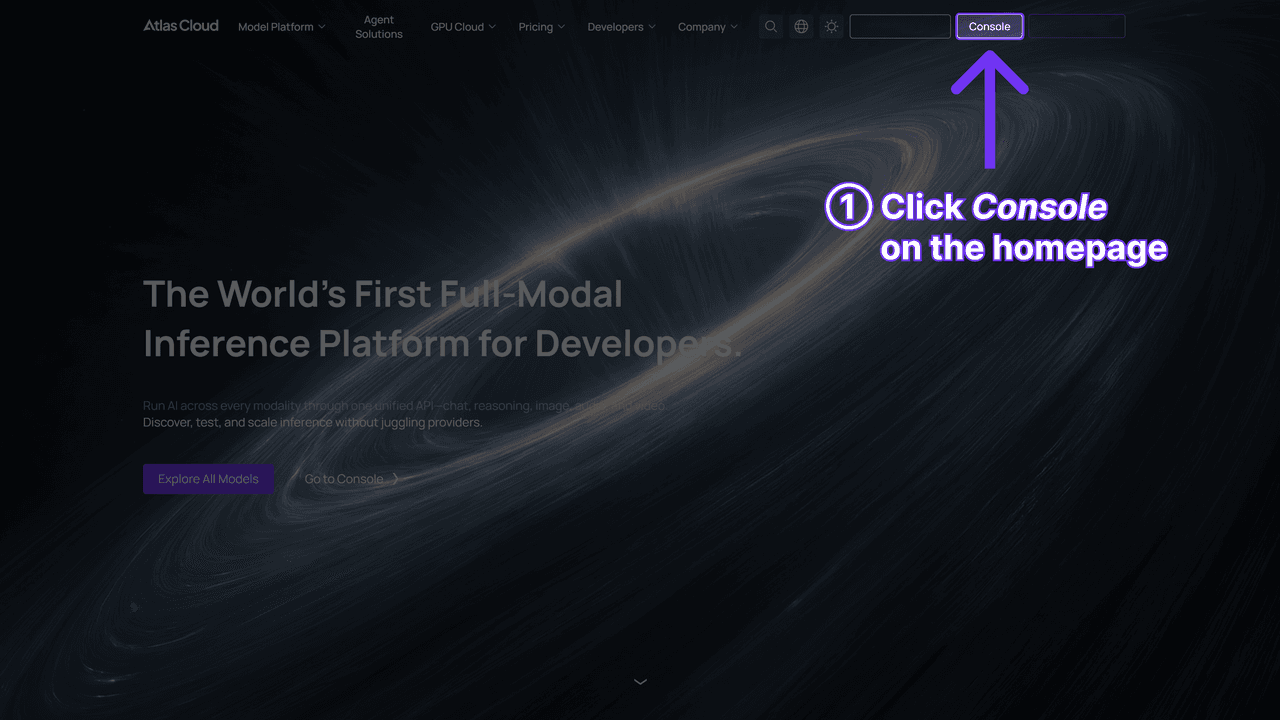
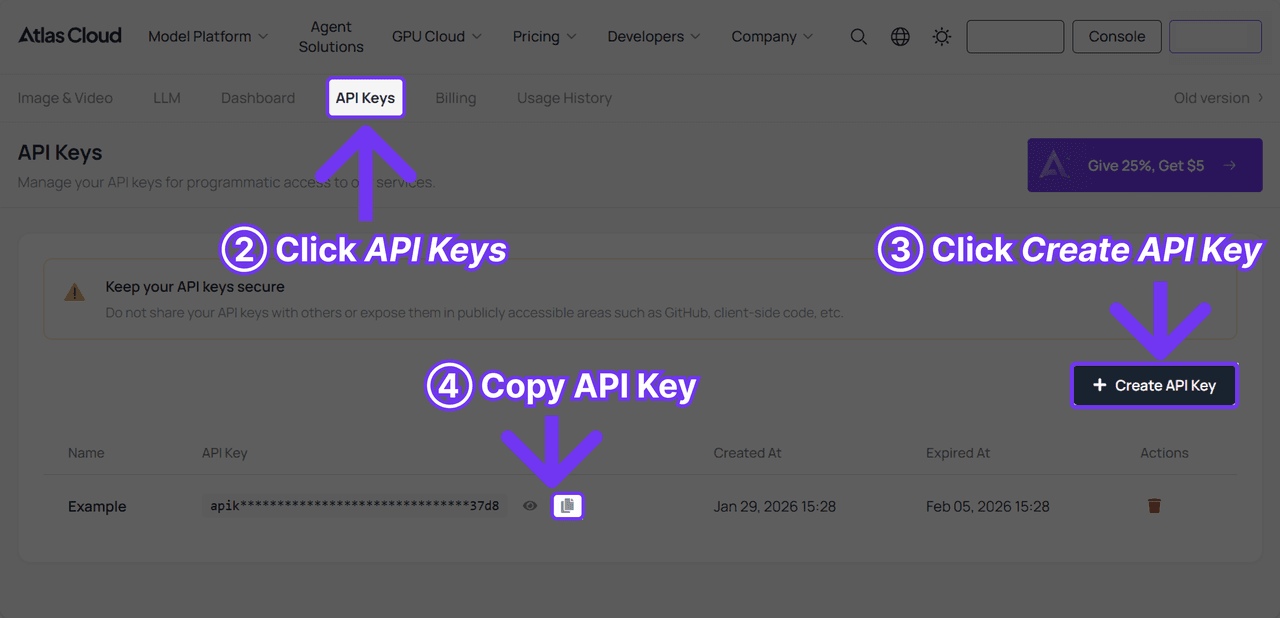
Step 2: Check the API docs. Endpoints, parameters, and authentication live in the API documentation.
Step 3: Make your first request. Submit the job:
Bash1curl -X POST https://api.atlascloud.ai/api/v1/model/generateVideo \ 2 -H "Content-Type: application/json" \ 3 -H "Authorization: Bearer $ATLASCLOUD_API_KEY" \ 4 -d '{ 5 "model": "bytedance/seedance-2.0/text-to-video", 6 "prompt": "A slow push-in on a rain-soaked neon alley at night, steam rising from a grate, reflections rippling in the puddles", 7 "duration": 10, 8 "resolution": "720p", 9 "ratio": "16:9", 10 "generate_audio": true 11 }'
The response returns a prediction ID. Poll it until the status reads completed:
Bash1curl https://api.atlascloud.ai/api/v1/model/prediction/<prediction_id> \ 2 -H "Authorization: Bearer $ATLASCLOUD_API_KEY"
The completed response carries the hosted video URL. The request shape is the long-term payoff. Atlas Cloud runs one API across the platform, so one key, one auth header, and one submit-and-poll loop cover every model. When the Seedance 2.5 endpoints open, you swap the model string and keep the rest of the integration untouched.
Hardware Pressure: The Compute Math Behind Seedance 2.5
Now to the delay theories, starting with the one you can actually calculate. Seedance 2.5's headline features are, computationally, a monster. Atlas Cloud publishes Seedance 2.0's billing formula, where tokens = width × height × seconds × 24 ÷ 1024 at a list rate of $0.0112 per 1K tokens, and tokens are a clean proxy for the compute a clip consumes. Apply that same math to what 2.5 promises and the curve gets steep fast.
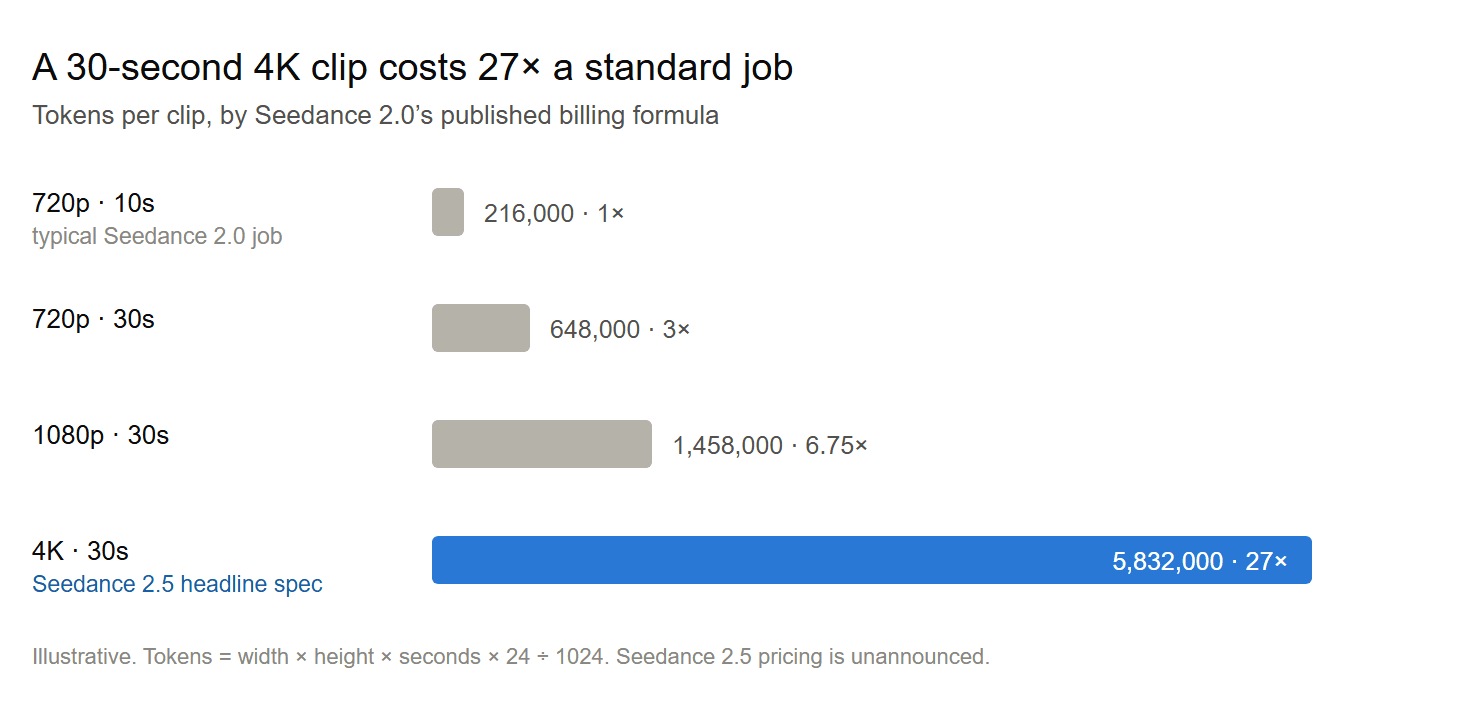
In list-rate dollars that is roughly $2.42 for the standard 10-second 720p job against roughly $65 for a single 30-second 4K clip. And 27× is the floor, not the ceiling. Attention cost in a diffusion transformer grows faster than linearly with sequence length, so tripling the frames of a clip more than triples the raw compute. The reference side scales too. On Seedance 2.0, billed duration counts input plus output, so a padded reference clip can cost more than the video it produces. Seedance 2.5 raises the reference ceiling from 12 mixed files to 50, and every one of those assets gets encoded and attended to at generation time.
This is where the delay and the nerf reports may be the same story. Mega Lion's July 14 post connected them directly: the sharp 2.0 nerfs are "proving 2.5 is still being stabilized." A GPU fleet is a fixed pie. If 2.5's stabilization runs were eating a bigger slice, the 2.0 serving pool got leaner, meaning fewer sampling steps, more distilled fallbacks, more aggressive batching. Users experience that as a nerf. ByteDance hasn't confirmed this mechanism, but it requires no conspiracy, just capacity arithmetic.
Nobody can see under the hood. If the compute theory is right, though, the two nerf waves should at least leave different fingerprints on the outside. They do.
| February 2026 wave | July 2026 wave | |
|---|---|---|
| Context | Hollywood C&Ds land within days of launch | Seedance 2.5 launch window opens |
| Sample report | "nerfed... as far as realism goes. RIP" | "extreme loss of intelligence and quality" |
| Community read | Guardrails tightening under legal pressure | Compute drained by 2.5 stabilization |
| Official word | Pledge to "strengthen current safeguards" | Nothing |
February's dip had a named cause. ByteDance publicly promised stronger safeguards while five studios sent legal threats, and the model got visibly more conservative. July's dip had no such admission, which is partly why the compute-reallocation theory dominated the threads, and why Ai-Hakase's Japanese recap framed the delay as ByteDance taking time to overcome the nerf and ship at higher quality rather than rush out a wobbly model.
Two honest caveats before you fully buy either narrative. Quality perception drifts: a model feels magical in week one and ordinary in month five, with zero weight changes. And serving quality genuinely varies with load, region, and app version, so some of the "global nerf" was probably three different local problems wearing one hashtag. The March counterpoint above (restrictions yes, nerf no) came from someone with API-side visibility, and it aged fine for months.
The Copyright Factor: Seedance 2.5's Other Bottleneck
The second delay theory is quieter but has better precedent. When the July 9 cancellation hit, Andrew Curran noted that "there are rumors the delay is copyright related," recalling the Tom Cruise and Brad Pitt bridge fight and the flood of Hollywood IP that defined Seedance 2.0's early rollout. Note what this theory explains: the delay, not the nerf. The two can have different causes, and ByteDance can be working both problems at once.
That history is expensive to repeat. Seedance 2.0's launch triggered legal threats from five studios, a bipartisan Senate letter demanding a shutdown, and a paused global rollout. The model only returned, with US access on April 7, wearing a full guardrail stack: real-face input blocking, IP-character filters, visible watermarks, and C2PA metadata. Every piece of that stack had to be ported to 2.5, red-teamed, and proven before global exposure rather than patched in afterward under subpoena-adjacent pressure.
And 2.5 makes the filtering problem strictly harder. Fifty reference slots means fifty chances to smuggle a franchise character, a real face, or a copyrighted soundtrack into a single generation. An input filter that scans 12 assets adequately might leak at 50. If ByteDance's July looks like a company re-testing its safety perimeter against a much bigger attack surface, the last-minute email with "no reason given" reads less mysterious.
Seedance 2.5's Optimization Path: How ByteDance Shipped It
Delays end. What mattered was which levers ByteDance pulled to make 30-second 4K video servable at TikTok-parent scale. The Seedance stack already showed its habits:
| Lever | Precedent in the Seedance stack | What it buys 2.5 |
|---|---|---|
| Distilled tiers | Seedance 2.0 Fast (from $0.09/s) and a lighter Mini below it | A cheap default that shields the flagship pool |
| Render low, upscale | 2.0's SR tiers generate 720p, then upscale to 1080p/1440p | 4K delivery without 4K diffusion cost |
| Draft-then-final | 3D white-box preview shown at FORCE; reports of 30s/90s/180s output tiers | Users iterate on cheap drafts, render once |
| Staged rollout | 2.0's relaunch went region by region over two weeks | Capacity ramps instead of spiking |
| Input-side guardrails | April's filter stack: face blocking, IP filters, C2PA | Copyright clearance before global exposure |
The draft-tier reports deserve a flag. TestingCatalog's reporting describes an extended mode reaching 180 seconds via a beta long-video pipeline, alongside the 30-second native tier. That was single-outlet reporting rather than confirmed spec, but it fit the pattern: if you can't make every generation cheap, make the cheap generations good enough that users rarely pay for the expensive one.
The prediction that followed from all this was a staged arrival rather than a firehose, and July 31 matched it. Seedance 2.5 opened inside ByteDance's own consumer surfaces first, Jimeng AI and Doubao's pro tier, with Volcano Ark API access queued behind them. That is the same consumer-before-API order 2.0 followed. The open question now sits with the 2.0 serving pool.
Frequently Asked Questions
Is Seedance 2.5 officially delayed, and when is the new release date?
It was, and it resolved on July 31, 2026, when ByteDance released the model. The delay itself was never formally announced. A cancellation email went out around July 9 with no reason given, multiple trackers independently reported a new target of July 20, and that date passed quietly too before the July 31 launch.
Did ByteDance confirm the Seedance 2.0 nerf?
No. The July "nerf" was entirely user-reported. The strongest evidence is the volume and consistency of complaints across regions. The February precedent shows such waves can track real changes, since ByteDance did tighten safeguards then, but no weight change, filter update, or serving downgrade has ever been confirmed for July.
Will Seedance 2.5 replace Seedance 2.0?
Not so far. Speculation that 2.0 would be killed came from the same community threads reporting the nerf, and 2.0 is still commercially live after the 2.5 launch. The API picture argues against a sudden shutoff: 2.0 endpoints are versioned and were only fully opened to API customers this spring. Running both tiers in parallel matches how the Seedance family has always shipped.
How much does Seedance 2.5 cost to run?
ByteDance has not published 2.5 pricing. The grounded anchor is Seedance 2.0's current API pricing, from $0.112 per second on Atlas Cloud, with the Fast tier at $0.09 and Mini at $0.056. If 2.5 keeps a per-second token formula, longer and higher-resolution clips will multiply cost roughly with pixel count and duration, which is exactly why draft tiers and upscaling matter.
Can I try Seedance 2.5 today?
Yes. Seedance 2.5 went live on July 31, 2026 through Jimeng AI and Doubao's pro tier, with Volcano Ark API access following rather than arriving the same day. Before that, the community reports above were accurate: the July 9 launch was cancelled and the tester release moved to July 20, which also passed. Seedance 2.0, including its native 4K output, stays available in parallel.
Conclusion
Strip away the hashtag drama and the story is mundane in the best way. ByteDance promised a model whose headline clip runs 27× the compute, hit the wall every lab hits between demo and deployment, and chose a slip over a stumble. Three weeks later it shipped, in the staged consumer-first order its own 2.0 rollout had already used. The nerf reports read best as instrumentation: a public, crowd-sourced load gauge on ByteDance's GPU fleet. That gauge is still worth watching. If Seedance 2.0 starts feeling sharp again now that 2.5 has capacity of its own, you'll know exactly where the compute was going.





