Build one enterprise AI workflow in 14 days
Choose one recurring production job. Score API readiness, inventory providers, assign primary and fallback models, map the connection plan and run one 14-day production pilot. Get the guide + Excel toolkit here.
Built from the operating patterns Atlas sees across teams running generative-media workflows.
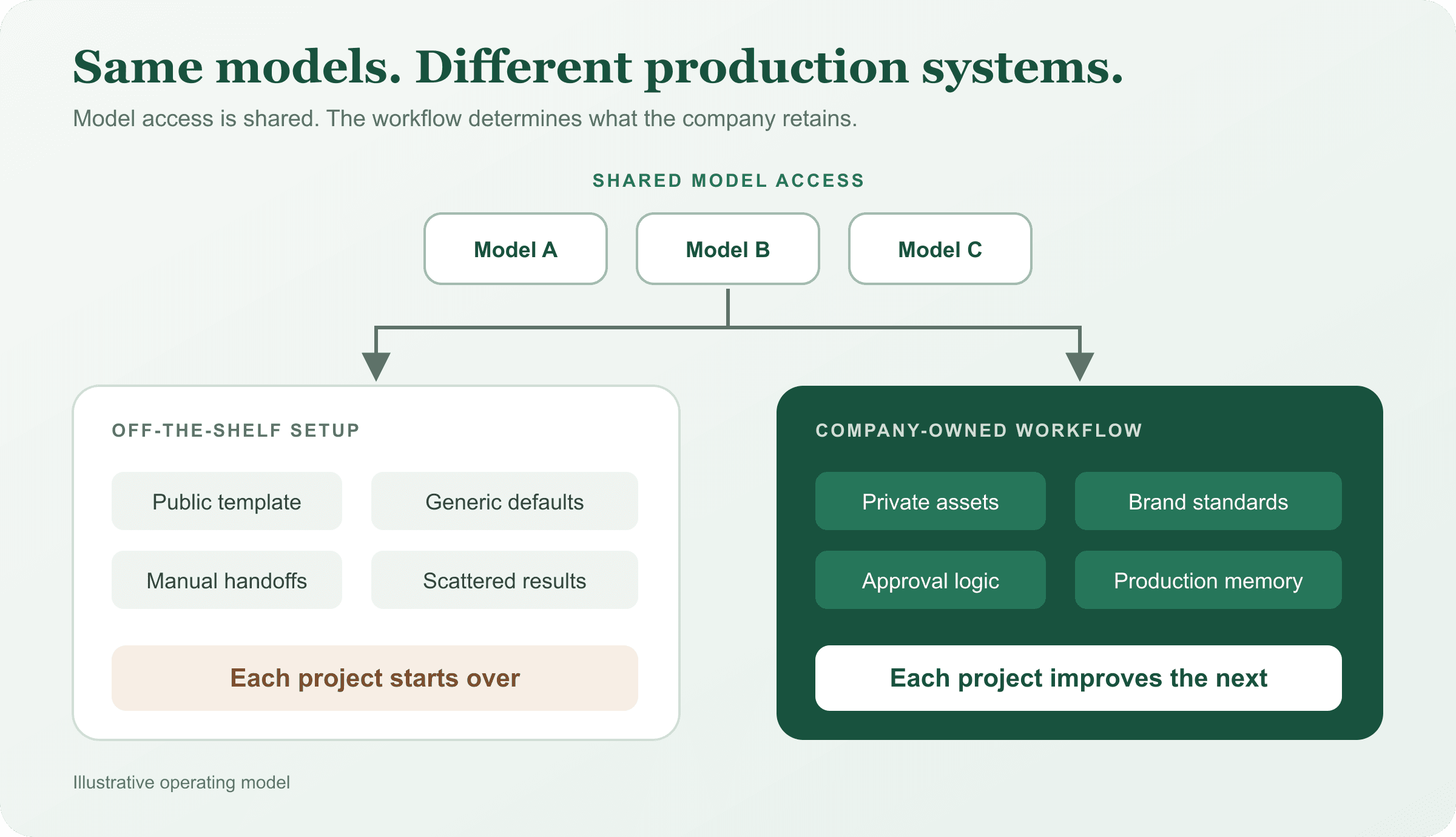
The same generative AI models are available to you and your competitors. Some companies are still pulling ahead.
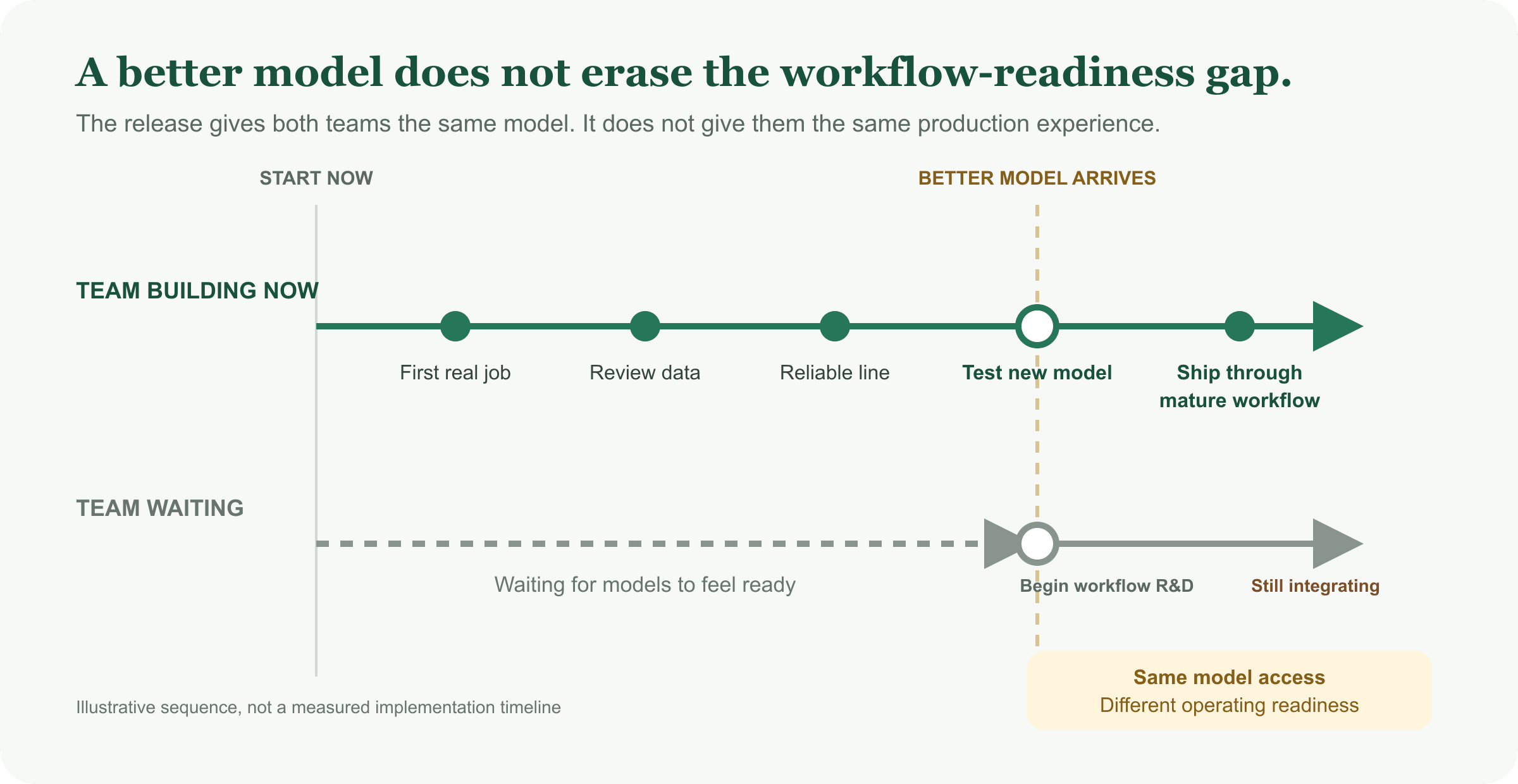
They have spent months turning those models into production systems built around their assets, brand standards, approval rules and operating data. When a better model arrives, they can test it inside a process their teams already know. A company starting on that same day still has to build the process.
For companies that produce visual content at scale, the competitive advantage is moving from model access to workflow knowledge.
Generative media has moved beyond the blank prompt
Atlas Cloud usage shows how quickly image and video generation is moving toward controlled production. From January 1 through June 30, 2026, 86 percent of image generations on Atlas Cloud were edits. About 88 percent of video generations began with an image or reference.
These figures describe activity on Atlas Cloud, not the entire market. They support a narrow conclusion: most visual generation on the platform starts with an existing asset and a defined change.
That kind of work needs more than a good prompt. A team has to choose the right source material, define what may change, preserve what must remain fixed and decide who can approve the result. The company also needs to store what happened so the next project starts with the previous project's learning.
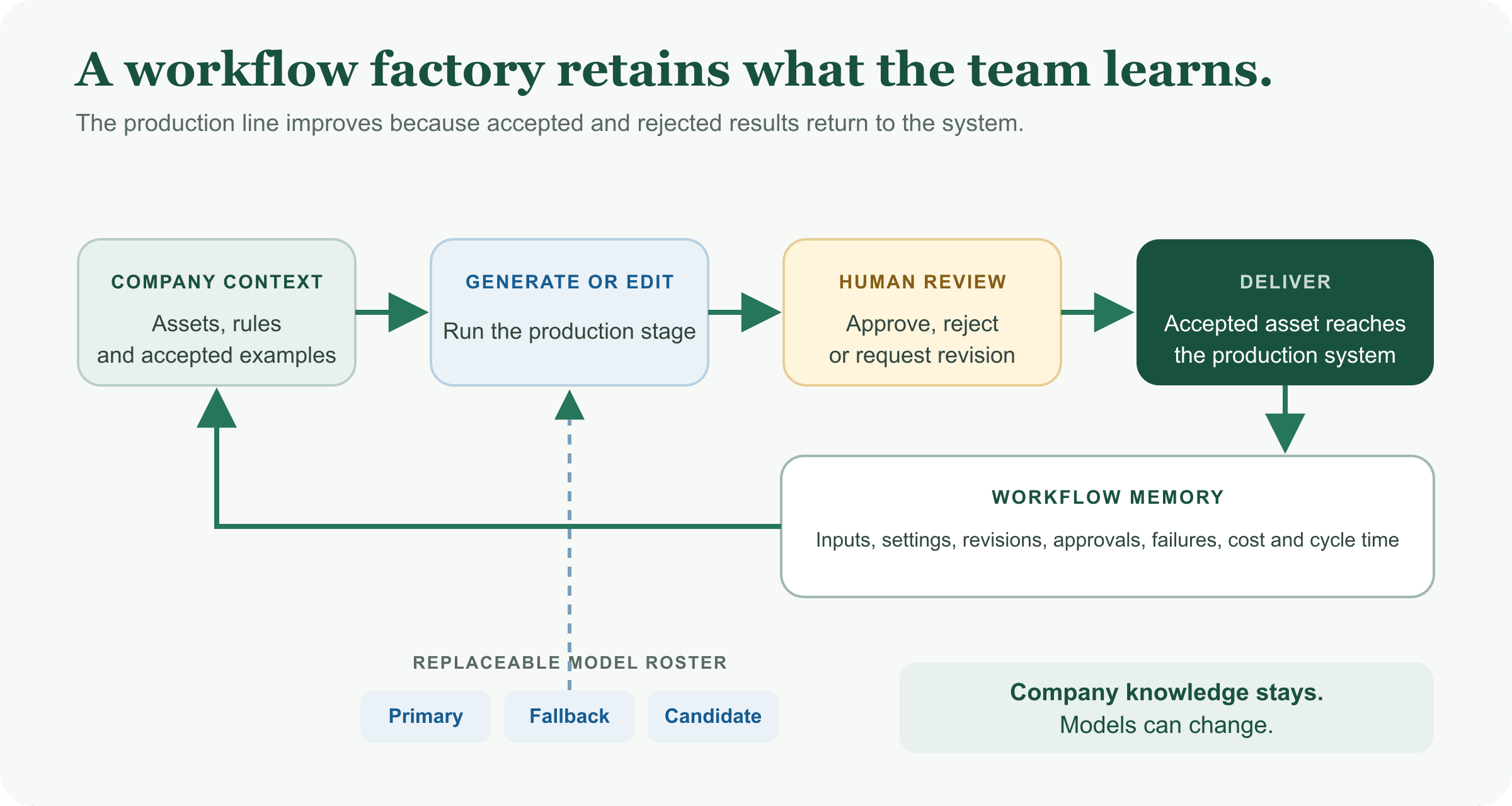
This operating layer is an AI workflow factory: the company-owned system of assets, brand rules, approvals and production history that turns a shared AI model into a repeatable, governed production process.
The factory contains the knowledge a model does not
The model performs one or more jobs inside the production line. Your company builds the system around it:
- A defined input and accepted output
- Approved company and client assets
- Brand, product and compliance rules
- A sequence of production stages
- Human approval and revision decisions
- A record of models, settings, costs and results
- Connections to storage, review and delivery systems
None of those elements come from the model provider. They come from your employees, previous projects and business operations.
A public workflow template can shorten the first build. It cannot supply your brand judgment, client restrictions or history of accepted work. Teams earn that knowledge by running real production, recording failures and improving the system.
Waiting for a perfect model creates a different problem
Many executives still frame the decision as: "Are AI image and video models good enough for us yet?"
That question misses the gap between a capable model and a business-ready production system. The models have already reached useful quality for controlled tasks such as campaign localization, product-scene variation, social-video adaptation, background replacement and storyboard development.
The harder work happens inside the company. Teams must assemble approved context, define review criteria, connect production systems and learn which combinations produce acceptable results.
A competitor that starts now accumulates that operating knowledge with every completed project. When the next model improves quality or lowers cost, that competitor replaces one component inside a working line. A late entrant receives access to the same model but starts without the factory.
Plug-and-play products will make baseline production easier. They will also give every buyer the same defaults and starting workflow. Companies that want a distinct result still need to build the layer specific to their brand and operations.
Model choice should remain replaceable
Workflow knowledge compounds. Model leadership changes.
In Atlas video traffic, the most-used model changed twice during the first half of 2026. About seven models covered 80 percent of weekly work. A production system tied to one model or provider can turn a temporary technical choice into an operating constraint.
Companies should keep their context, approvals, lineage and performance history outside the model layer. They can then test a new model against the same inputs and acceptance criteria without rebuilding the production system.
The model roster creates an integration decision. Every direct provider relationship adds credentials, billing, monitoring, error handling and another interface for engineering to maintain. Teams that expect to use several models should map that burden before writing the first integration.
One Atlas customer added six frontier models within weeks without adding a new vendor. The model roster changed. The integration did not.
Atlas Cloud provides one API across more than 350 models, giving teams a stable distribution layer beneath the workflows they own.
Choose one production line
The first workflow should be narrow enough to build and frequent enough to teach the team something.
Look for a recurring job that:
- Consumes meaningful employee or vendor time
- Produces repeated revisions
- Uses stable company assets or rules
- Ends with a result a human can review and accept
Do not begin with a company-wide AI mandate. Choose one production job, establish its current cost and cycle time, then run representative work through a repeatable path.
The goal is evidence. Your team should know whether the workflow can produce an accepted result, where it fails, what it costs and which operating gaps must close before wider use.
Build one workflow and integration plan in 14 days
The 14-Day Enterprise AI Workflow Implementation Guide + Toolkit turns this operating model into a bounded implementation project for one recurring production job.
The gated package includes:
- An API-readiness assessment
- A workflow-selection scorecard
- The Workflow Factory Canvas
- A model, provider and fallback roster
- A stage-by-stage API integration plan
- A baseline and sprint economics model
- A day-by-day implementation plan
- A production acceptance test
- A one-page executive readout
Use it to finish the sprint with a Proceed, Harden or Stop decision based on real work. Your business and technical owners will also know whether the workload needs one direct integration, several provider APIs or a unified model gateway.
Common questions
What is an AI workflow factory?
An AI workflow factory is the company-owned system of assets, brand rules, approvals and production history that turns a shared AI model into a repeatable, governed production process. The model is replaceable. The factory is not.
Do we need a developer to run the 14-day sprint?
The sprint works best with a business owner and a technical owner working together. You do not need a dedicated AI engineering team to start, but someone on your side should be able to evaluate API integration options.
Does this apply to a specific AI model or provider?
No. The framework applies across image and video generation models. Atlas Cloud provides one API across more than 350 models, so the toolkit is not built around one vendor.
Is the 14-day sprint the same as a company-wide rollout?
No. The sprint covers a working production pilot and integration decision for one defined, recurring job. It does not promise a mature enterprise-wide workflow factory, legal approval, security certification or a company-wide deployment in two weeks.
Is there a cost or a sales call to get the guide?
No. There is no cost and no sales call required. Submit the form and Atlas emails the guide and toolkit right away.
Tell us which recurring production job you want to improve. We will email the guide and Excel toolkit after you submit the form.
Build one enterprise AI workflow in 14 days
Choose one recurring production job. Score API readiness, inventory providers, assign primary and fallback models, map the connection plan and run one 14-day production pilot. Get the guide + Excel toolkit here.
Built from the operating patterns Atlas sees across teams running generative-media workflows.