You type a prompt, hit enter, and Midjourney asks for a card number before it draws a single pixel. Its help center says it plainly: "All Midjourney plans are subscriptions." So the search for Midjourney alternatives usually starts with one question, which is what you can make without paying.
We read the official pricing, plan and license pages of ten tools in November 2026, ran our own pick end to end, and ranked them on what a free account actually unlocks. Then we looked at the part most lists skip: who owns the image once it exists.
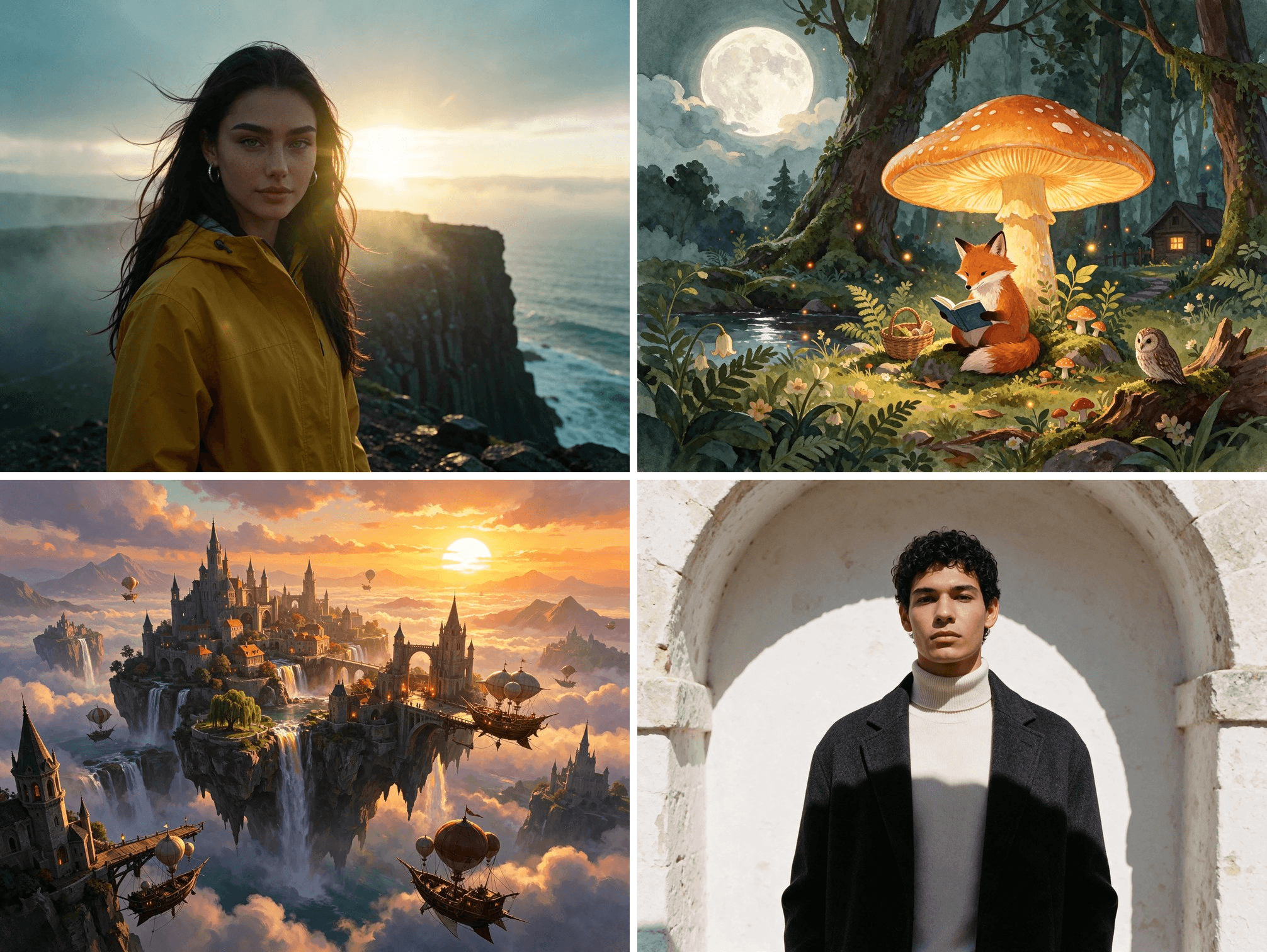
Four Seedream v5.5 images made on Atlas Cloud, none carrying a watermark. The two portraits started from a reference photo in the Image Edit tab; the fox and the sky city are text-to-image.
Key Takeaways
- Midjourney has no free plan, so each free alternative here trades limits, public galleries or setup time for zero cost.
- Atlas Cloud's image generator runs Seedream v5.5 per image with no subscription, plus an API Midjourney itself doesn't offer.
- Stable Diffusion 3.5 and FLUX 3 Image Klein run free on your own GPU, within each license's revenue cap.
- Leonardo and Ideogram publish free-plan images publicly, so keepclient work ona private paid tier.
- The US Copyright Office says prompts alone don't make you the author, whichever Midjourney alternative you pick.
Midjourney Alternatives Comparison Table
Nine of the ten tools below have some way to make images at no cost, whether that's a daily allowance, a weekly credit drop or free weights you run yourself. The tenth, Atlas Cloud, opens with a $1 credit once a payment method is on file. Among the subscriptions that publish an entry price, the cheapest tiers run from $4.99 (Google AI Plus) to $20 (Ideogram Plus), a 4x spread, with Midjourney's $10 Basic plan sitting in the middle.
| Tool | Best for | Free tier | Entry paid plan | Billing | Official API |
|---|---|---|---|---|---|
| Atlas Cloud (Seedream v5.5) | Accurate small text and transparent PNGs, billed per image | $1 credit after adding a payment method | Pay per image | Pay per use | Yes |
| ChatGPT | Editing an image by talking to it | "Limited image creation" (no number published) | Go, $8/month | Subscription | Yes (OpenAI API) |
| Google Gemini | Free photo edits with a Google account | "Standard limits" (no number published) | Google AI Plus, $4.99/month | Subscription | Yes (Gemini API) |
| Leonardo AI | A fixed daily allowance | 150 fast tokens a day, creations public | Essential, $12/month | Subscription | Yes |
| Stable Diffusion 3.5 | Running locally for free | Free license under $1M annual revenue | Stability API, 1 credit = $0.01 | Free license + pay per use | Yes |
| Adobe Firefly | Commercially safe output | "Limited free daily generations" | Standard, $9.99/month | Subscription | Yes (Firefly API) |
| Ideogram | Type-heavy designs | 30 credits a week (Google or Apple sign-up) | Plus, $20/month | Subscription | Yes |
| FLUX 3 | Open weights plus a metered API | Klein weights free under $5M revenue | Pay as you go | Pay per use | Yes |
| Bing Image Creator | Unlimited free standard-speed runs | 10 Fast creations, then unlimited Standard | None listed | Free | Not listed |
| Krea | Many models in one app | 100 units a day, no card | Basic, $9/month | Subscription | Yes |
| Midjourney (for reference) | Stylized art from short prompts | None | Basic, $10/month | Subscription | No official API |
How We Tested Every Midjourney Alternative on This List
Every price and free allowance below comes from the vendor's own pricing page, help center, plan documentation or license page, read on November 17 and 18, 2026. App ratings come from the US App Store on the same dates.
Atlas Cloud we ran ourselves: the hero grid and the book cover in the next section came out of its image generator. For the other nine we report what the vendor publishes rather than what a single free session happened to allow, because those allowances shift by account and by week.
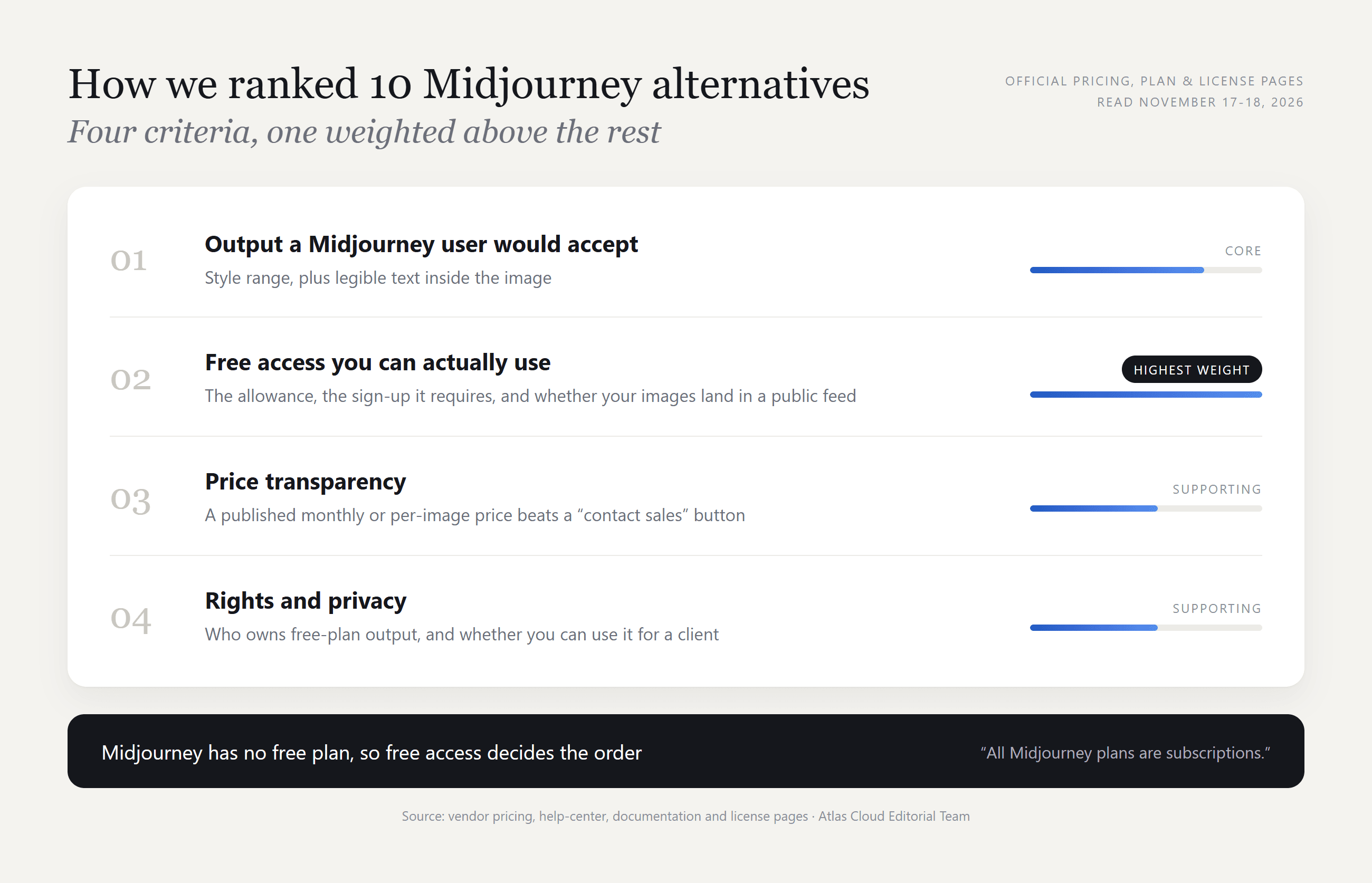
Four criteria decided the ranking:
- Output a Midjourney user would accept. Style range, plus legible text inside the image, since lettering is where many generators still slip.
- Free access you can actually use. The allowance, the sign-up it requires, and whether your images go into a public feed.
- Price transparency. A published monthly or per-image price beats a "contact sales" button.
- Rights and privacy. Who owns free-plan output, and whether you can use it for a client.
Free access carried the most weight. Midjourney has no free plan, so a Midjourney alternative that charges from the first image only solves half the problem for most readers.
Disclosure: Atlas Cloud publishes this article and operates the first tool on the list. None of the other vendors paid for placement, and each is described from its own public pages.
1. Atlas Cloud: Best Midjourney Alternative Overall
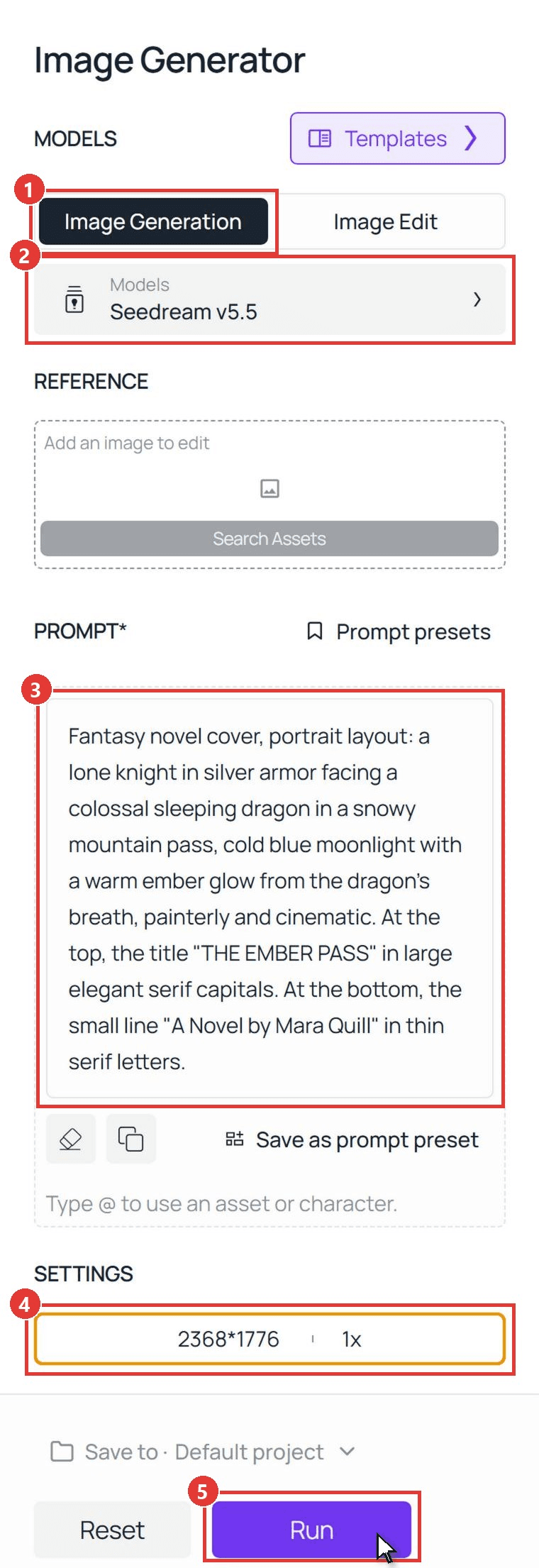
In our October 2026 poster test, Midjourney V8.1 got all four lines of text right in only one of its four images. The cover below is a single Seedream v5.5 run, and both lines of type came out exactly as written: the title "THE EMBER PASS" across the top, and the small byline "A Novel by Mara Quill" at the bottom.
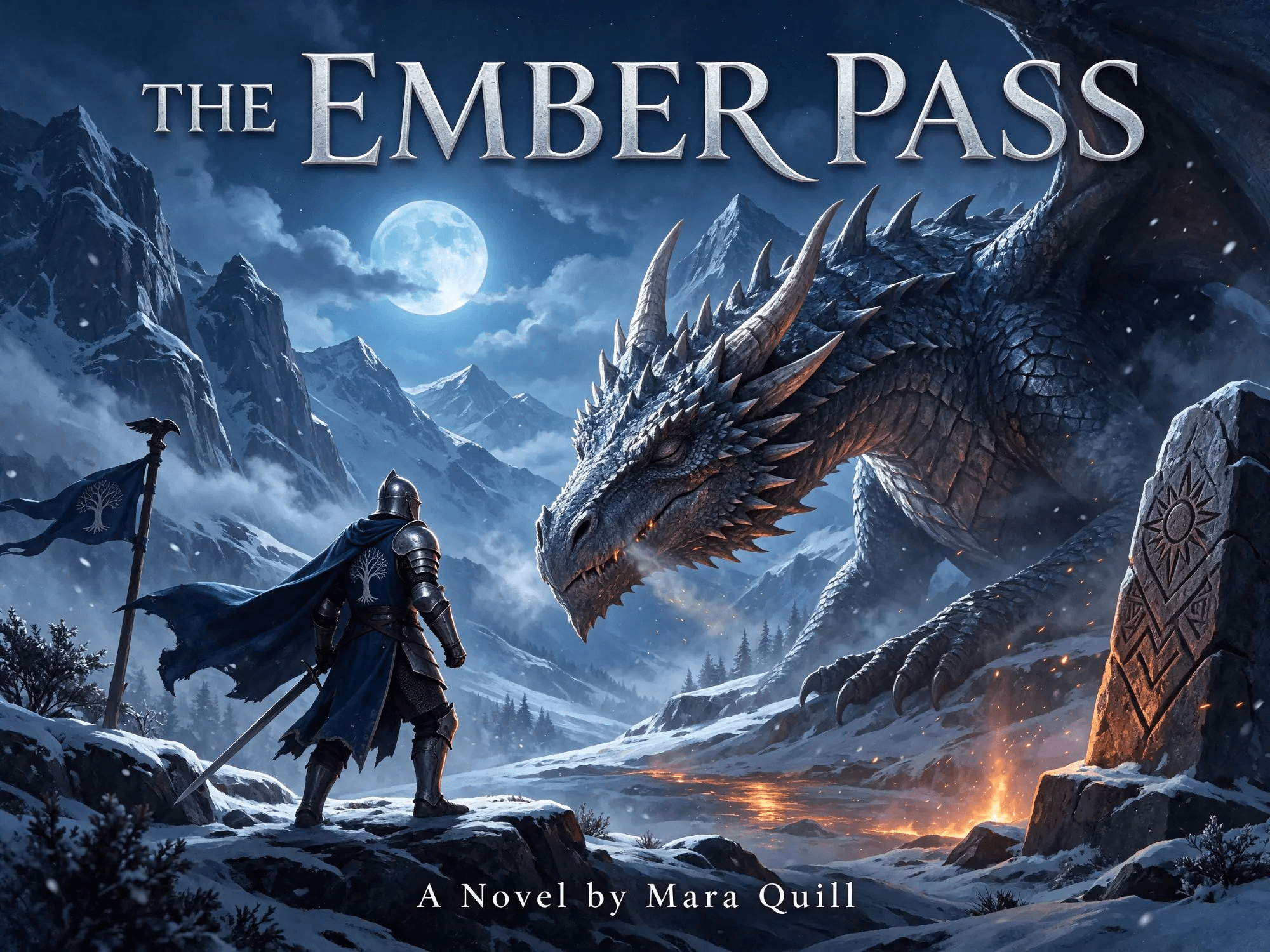
One Seedream v5.5 text-to-image run on Atlas Cloud. Both text lines match the prompt letter for letter.
Seedream v5.5 runs in the Atlas Cloud image generator, so there's nothing to install and no server to join.
Why it stands out: The model page describes Seedream v5.5 as generating "accurate small and multilingual text and native transparent (RGBA) PNG output." The cover above shows the first half.
For the second, the generator's Additional Settings panel offers PNG output and a background control, so a sticker or a logo mark can arrive on a transparent background instead of needing a cutout afterward.
The same Atlas account also runs Midjourney V8.2 itself, billed per run, if you want both looks side by side. Our Seedream 5.0 Pro vs Midjourney comparison goes deeper on where each family shines.
Best for: Covers, posters, packaging mockups and anything else where the words in the image have to be right on the first pass. It also suits anyone who generates in bursts and would rather not keep a monthly plan running between projects.
Pricing: New accounts unlock a $1 free credit after adding a payment method. After that you pay per image, with no monthly plan to cancel. The per-image figure is in the FAQ below.
To make the cover above yourself:
- Open the Image Generation tab.
- Click Models and pick Seedream v5.5.
- Paste your prompt. Put any text you want on the image inside quotation marks.
- Open Settings and choose a size. The cover used 2368×1776 (4:3 at the 2K tier).
- Click Run.
2. ChatGPT: Best Midjourney Alternative for Conversational Edits
Midjourney vs ChatGPT is less a quality contest than a workflow one. ChatGPT treats an image like a draft in a conversation: you ask for a change in plain language and it redraws, with the earlier version still in the thread for context.
Where the free tier stops you: OpenAI's pricing page lists "Limited image creation" for the Free plan and gives no number. We ran 22 requests on a free account to see where the wall sits; the ChatGPT image limit test has the full log.
What one usable image actually costs: Go is $8 a month and lists "More image creation" than Free, with a note that the plan may include ads. Plus is $20 a month for more complex and accurate image creation. Only Pro, from $100 a month, reads "Unlimited and faster image creation."
What users report: The ChatGPT app holds a 4.8 rating from about 12.3 million ratings on the US App Store (November 18, 2026).
Where it falls short for Midjourney users: If you generate in volume, the published plans leave a gap: unlimited image creation starts at the $100 Pro tier, ten times what Midjourney's Basic plan costs.
Fits: writers, marketers and anyone who refines one image through several rounds of feedback. Not for you if: you need dozens of variations per hour on a fixed budget.
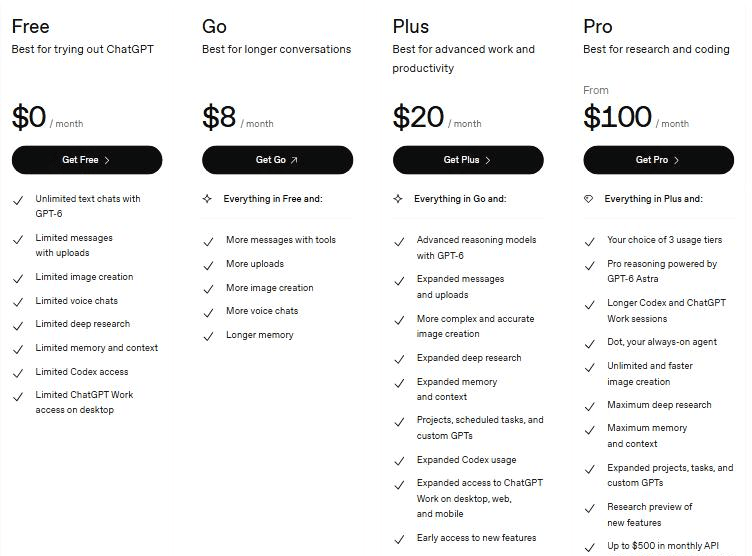
Screenshot from ChatGPT's official pricing page, November 2026
3. Google Gemini: Best Free Midjourney Alternative for Photo Edits
If the photo you want to change is already on your phone, Gemini is the shortest path. The Free plan, "$0/month with a Google Account," includes image generation and editing in the Gemini app.
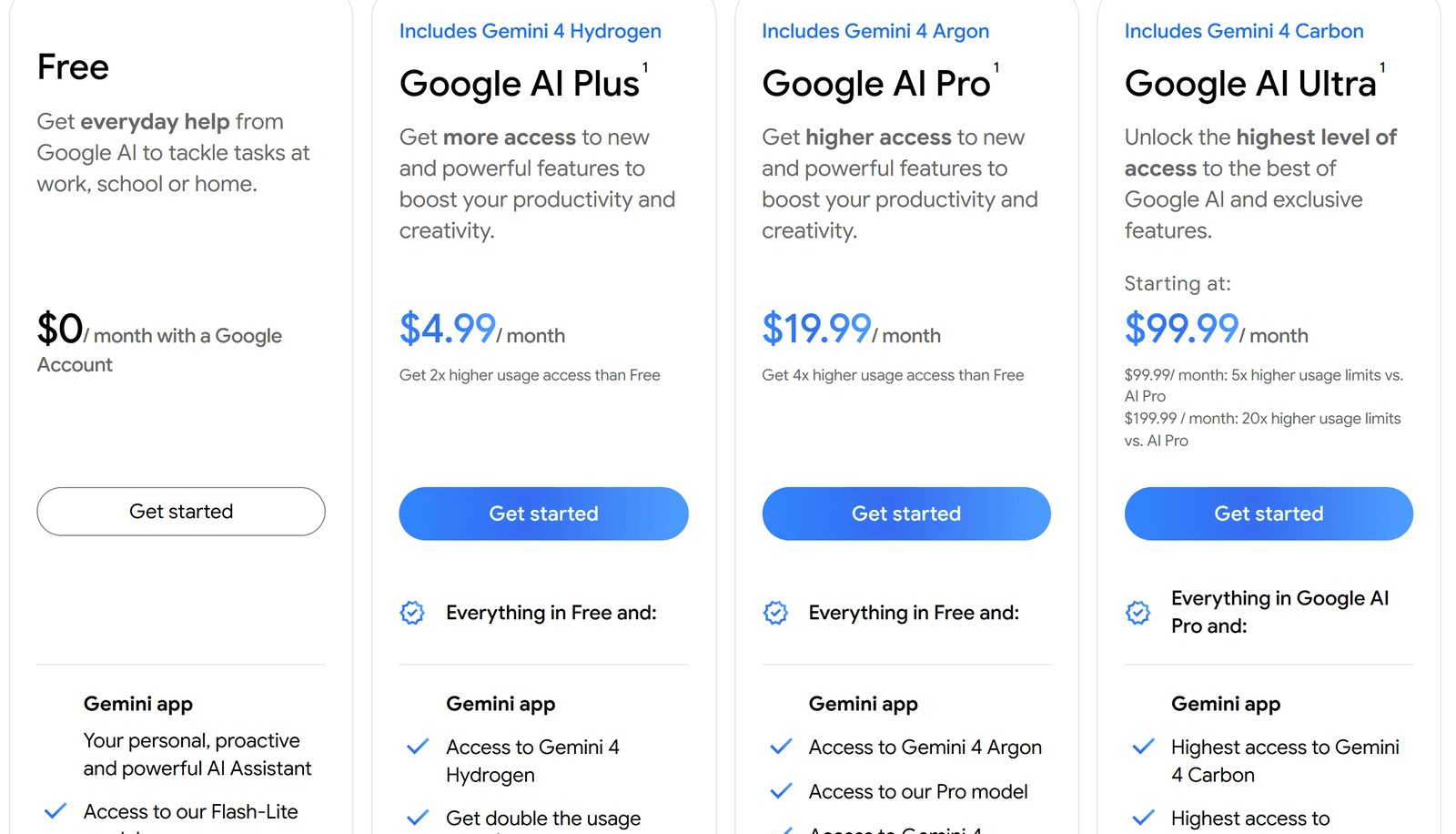
Screenshot from Google's official Gemini subscriptions page, November 2026
Where the free tier stops you: Google describes the free allowance only as "Standard limits." The paid plans are defined as multiples of it, so you know the ratio but never the count.
What one usable image actually costs: Google AI Plus is $4.99 a month for 2x the free usage, and Google AI Pro is $19.99 a month for 4x.
What users report: The Google Gemini app holds a 4.7 rating from about 2.4 million ratings on the US App Store (November 18, 2026).
Where it falls short for Midjourney users: With no published daily number, you can't plan a 50-image batch and know it will finish. Our Nano Banana 2.1 vs Midjourney test covers how Google's image model and Midjourney handle the same prompts.
Fits: quick edits to real photos you already have. Not for you if : you need a guaranteed volume each day.
4. Leonardo AI: Best Midjourney Alternative for Daily Free Credits
Anyone weighing Midjourney vs Leonardo gets one thing Midjourney doesn't offer at all: a free allowance with a number on it. Leonardo's pricing page gives free accounts 150 fast tokens a day.
Where the free tier stops you: Model access on the free plan reads "Auto Only," so Leonardo picks the model for you. The same column lists creations access as "Public."
What one usable image actually costs: Essential is $12 a month billed monthly for 8,500 fast tokens, access to 80+ models, and private creations.
What users report: The Leonardo.Ai app holds a 4.8 rating from 11,448 ratings on the US App Store (November 18, 2026).
Where it falls short for Midjourney users: On the free plan you can't choose the model, which matters if you're trying to match a specific look.
Fits: hobbyists who make a few images most days and don't mind sharing them. Not for you if: your images belong to a client or an unreleased project.
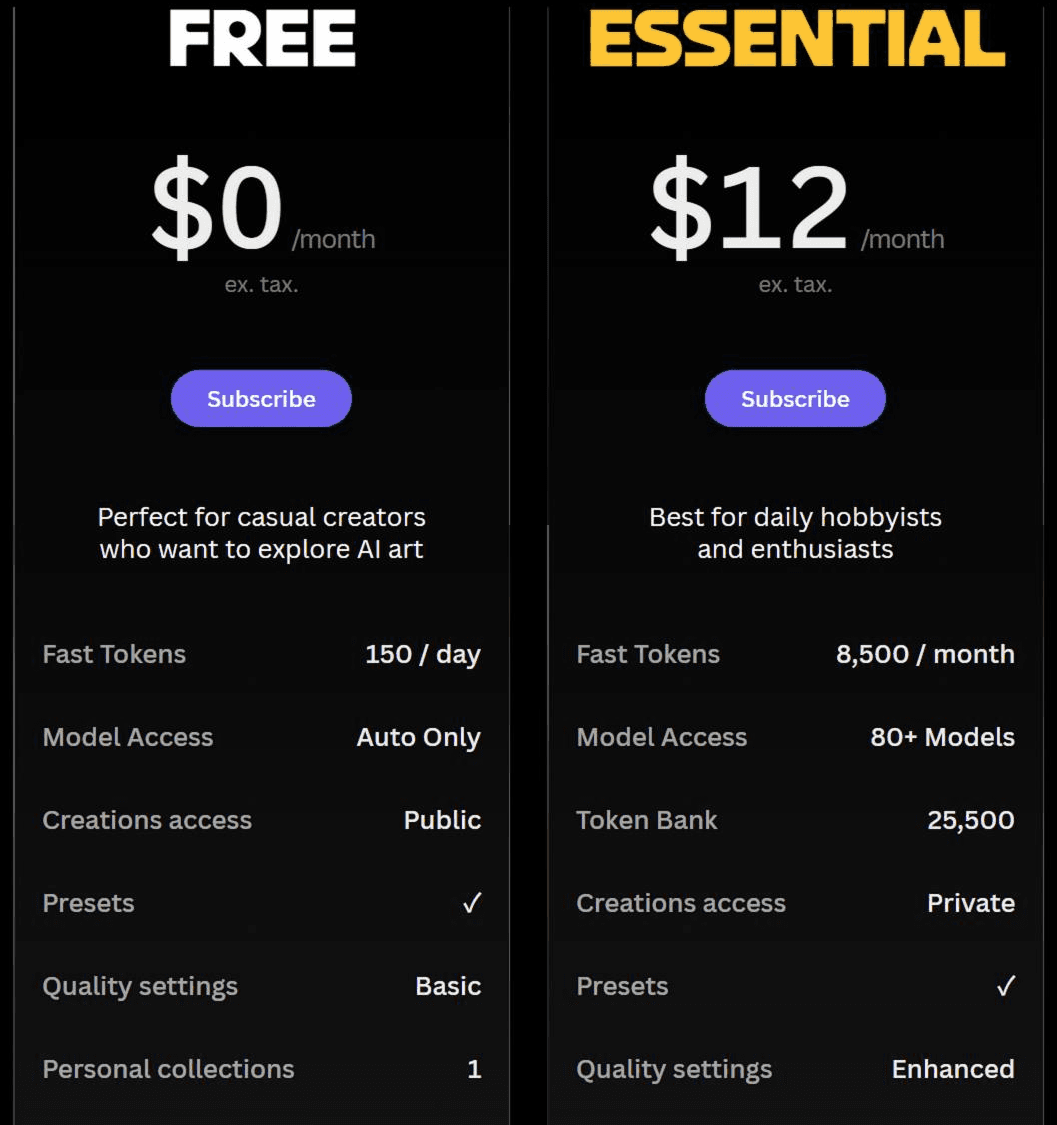
Screenshot from Leonardo.Ai's official pricing page, November 2026
5. Stable Diffusion 3.5: Best Open-Source Midjourney Alternative
The Midjourney vs Stable Diffusion question comes down to ownership of the whole stack. Stable Diffusion 3.5 is a model you download and run on your own GPU, and Stability AI's Community License covers "researchers, developers, small businesses, and creators with less than $1M in annual revenue," commercial use included.
Where the free tier stops you: Your hardware is the limit. Cross $1M in annual revenue and Stability's license page points you to a paid Enterprise license.
What one usable image actually costs: Locally, the electricity. Through Stability's hosted API, "1 credit = $0.01," and a Stable Diffusion 3.5 Large image costs 6.5 credits. New API accounts start with 25 free credits.
What users report: We found no official Stability AI app in the US App Store, so there is no store rating to cite. The working community lives in r/StableDiffusion.
Where it falls short for Midjourney users: You install it, choose checkpoints and tune settings yourself. Midjourney's selling point is that it handles all of that for you.
Fits: developers, tinkerers and studios that want full control and no per-image bill. Not for you if : you want results from a browser tab in the next five minutes.
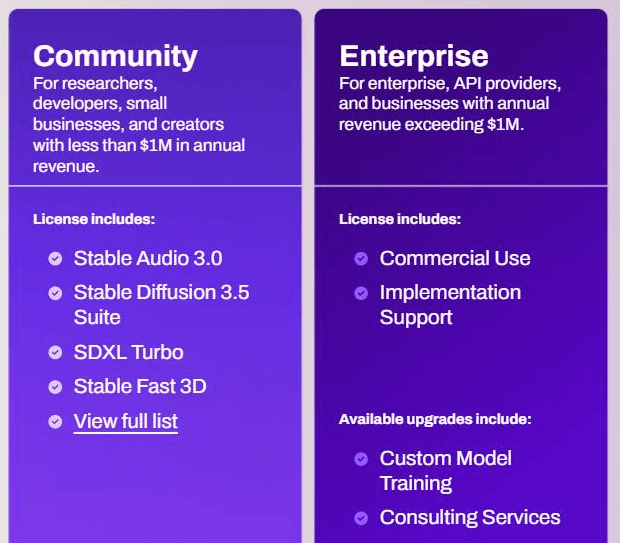
Screenshot from Stability AI's official license page, November 2026
The Other Five Midjourney Competitors Worth Knowing
These five didn't make the top half because each solves one slice of the problem rather than most of it. Still, if your need matches the slice, any of them can be the right Midjourney competitor for you.
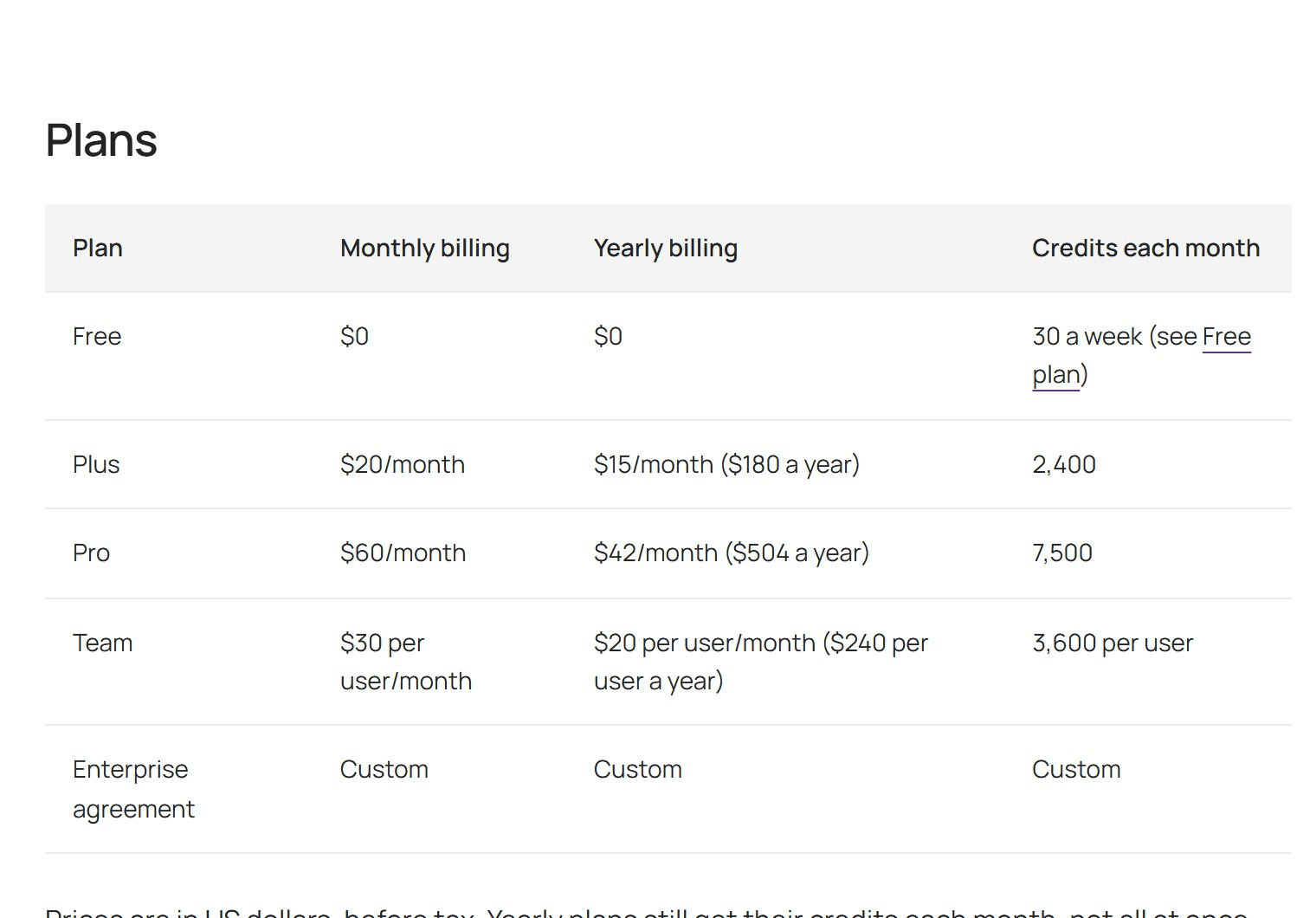
Screenshot from Ideogram's official documentation, November 2026
6. Adobe Firefly
Adobe sells Firefly on safety: its FAQ states that "Outputs from Adobe Firefly AI models are safe for commercial use," and it attaches Content Credentials automatically. The free plan offers "Limited free daily generations." Standard costs $9.99 a month for 2,000 credits, which Adobe says covers up to 400 images. Read the commercial line closely, though. It applies to Firefly's own models, not every partner model inside the app.
7. Ideogram
Ideogram's latest model is Ideogram 4.5, and its focus on type makes it a natural pick for posters and logos. Free accounts get 30 credits a week, but only if they signed up with Google or Apple. The catch is visibility: "On the free plan, everything you generate is public." Plus, at $20 a month, keeps new images private until you publish them. Ideogram no longer sells its old $8 Basic plan.
8. FLUX 3
Black Forest Labs released FLUX 3 Image Klein as open weights on October 15, 2026, and its license "allows free commercial use for individuals and companies with annual revenue under $5M." That cap is five times Stability's. The full FLUX 3 Image model runs through BFL's API at a metered price, with "No subscriptions, no seat fees." BFL's site lists an API, a playground and the downloadable weights rather than a consumer app, so expect a more technical setup.
9. Bing Image Creator
Microsoft's Image Creator is still live and still free: 10 creations in Fast mode, then unlimited creations in Standard mode. The model menu shows MAI-Image-2.6-Flash. There's nothing to install and nothing to pay, with the trade-off that Standard mode is the slower lane.
10. Krea
Krea bundles 20+ tools for image, video, 3D and audio into one app, and its free plan gives 100 units a day with no credit card required. Basic is $9 a month, or $5 a month billed yearly at the discount Krea's page showed in November 2026, for 5,000 units, which Krea's page equates to 138 Krea 3 images or 64 Nano Banana Pro images. It works best for people who like switching between models rather than learning one deeply.
Who Owns an Image From a Free Midjourney Alternative?
Every tool above will hand you a file. Whether you can stop someone else from using that file is a different matter, and no pricing page settles it. In its January 2025 copyrightability report, the US Copyright Office concluded that "prompts alone do not provide sufficient human control to make users of an AI system the authors of the output." That holds whichever tool you use, paid or free.
What each vendor controls is privacy and permission. Here's what the official pages say:
| Tool | Free-plan images | What the official page says about use |
|---|---|---|
| Midjourney | No free plan | Stealth Mode, which keeps images private, "is only available on the Pro and Mega Plans"; companies above $1M in gross revenue must buy Pro or Mega |
| Leonardo AI | Public | Essential, the first paid plan, lists creations access as private |
| Ideogram | Public | Plus, Pro, Team and Enterprise keep new images private until you publish |
| Recraft | Owned by Recraft | "Images generated on the Free plan are owned by Recraft"; paid plans grant full ownership and commercial rights |
| Adobe Firefly | Not stated on the plan page | Firefly model outputs are described as safe for commercial use |
| Stable Diffusion 3.5 | Stay on your machine | Commercial use free under $1M annual revenue |
| FLUX 3 Image Klein | Stay on your machine | Commercial use free under $5M annual revenue |
| Atlas Cloud | Pay per image (no free plan) | Atlas's data retention policy says it does not use customer content to train Atlas-hosted models unless the customer authorizes it in writing |
What to do instead: For client work, use a plan that keeps images private and whose terms you've actually read. Then put a human hand in the final piece. The same report says human authors are entitled to copyright in "the creative selection, coordination, or arrangement of material in the outputs, or creative modifications of the outputs," so a composited, retouched cover is on firmer ground than a raw generation.
What Does Reddit Say About Free Midjourney Alternatives?
Reddit's answer to the free-alternative question has moved with the tools. In a 2023 r/StableDiffusion thread, the poster didn't want to pay and was stuck on a weak laptop. The top answer Google surfaces from it lists BlueWillow, Happy Accidents, Stable Horde and Google Colab. None of those four made this list in 2026.
Two years later, a newcomer asked the same thing in a 2025 r/midjourney thread, and the advice had shifted to model hubs. One reply points to Civitai and Tensor Art, which hand out free tokens for logging in each day to spend on open-source models and LoRAs, and notes that they're more technical than Midjourney or ChatGPT.
Both threads land on the trade this article keeps returning to. The free routes Redditors recommend mostly run on open models, and they ask for more setup and more trial and error than typing a prompt into Midjourney.
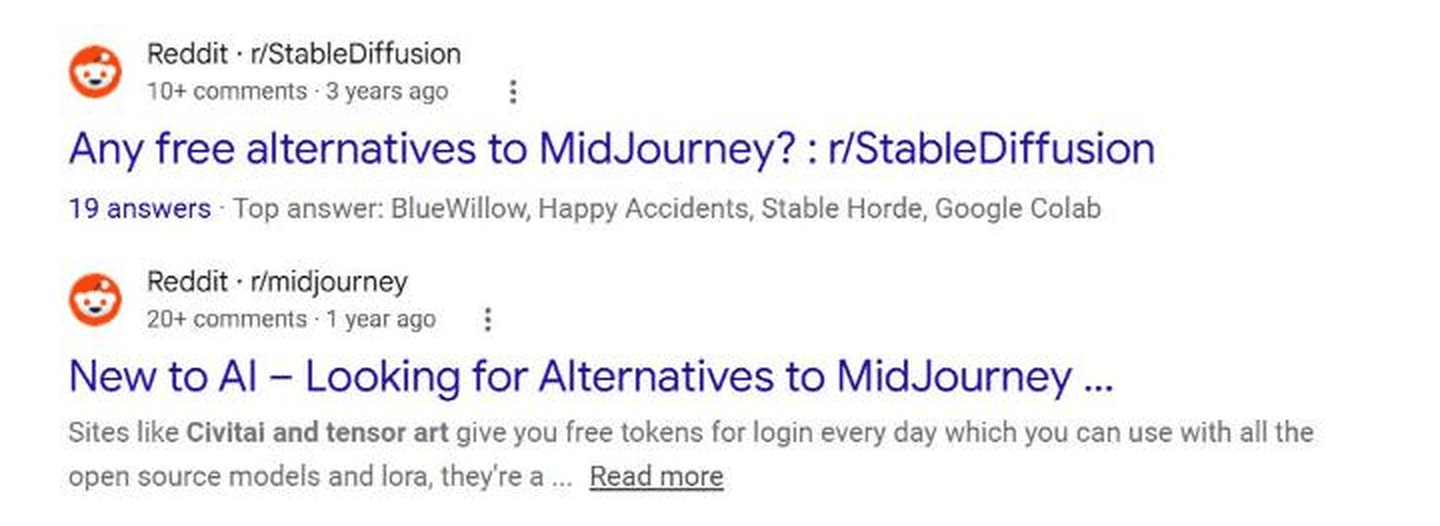
Screenshot of Google search results for the two threads, November 2026
Frequently Asked Questions
Is Midjourney free in 2026?
No. Midjourney's plan comparison page states that "All Midjourney plans are subscriptions" and lists no free tier. The cheapest option is Basic at $10 a month, or $96 a year, which includes 3.3 hours of Fast GPU time (200 minutes) per month.
What is the best free Midjourney alternative?
It depends on which limit you can live with. Bing Image Creator gives unlimited Standard-mode creations at no cost. Gemini's free plan handles quick edits to a photo you already have. Stable Diffusion 3.5 and FLUX 3 Image Klein cost nothing beyond your own hardware and allow commercial use under their revenue caps. If public images are a problem, skip the free tiers of Leonardo and Ideogram.
Is Stable Diffusion better than Midjourney?
They're built for different people. Stable Diffusion 3.5 is free to run locally and free for commercial use under $1M in annual revenue, but you handle installation and tuning. Midjourney gives a finished look from short prompts and asks for a subscription in return. If control and cost matter most, Stable Diffusion wins; if speed to a polished image matters most, Midjourney does.
Is there a Midjourney alternative with an API?
Yes, several. OpenAI, Google, Stability AI, Ideogram, Leonardo, Adobe and Black Forest Labs all offer image APIs.
On Atlas Cloud, one API key calls Seedream v5.5 at $0.016 per image for 1K and 1.5K sizes and $0.028 for 2K sizes like the 2368×1776 book cover in this article. Those are prices after a 20% discount running as of November 18, 2026; the list prices are $0.02 and $0.035. The same key also runs Midjourney V8.2 at $0.0857 per run of four images, billed per run with no Midjourney subscription.
Conclusion
A Midjourney subscription buys a look and a queue. The alternatives above split that bundle apart: some give you the free allowance, some give you the license to run the model yourself, and some give you the privacy or the commercial terms that a free Midjourney account never had, because there isn't one. Read the free-plan line and the public-gallery line before you read the sample images.
If you want the words in your image spelled right and a bill that stops when you stop generating, start with Seedream v5.5 on Atlas Cloud. If cost is the only constraint, Bing Image Creator, Stable Diffusion 3.5 and FLUX 3 Image Klein cover the free end of the Midjourney alternatives list.