The clip is eleven years old, shot on a phone that topped out at 480p, and it is the only footage of that birthday anyone kept. On a modern screen it looks like it was filmed through a shower door.
That is usually when someone searches for the best video upscaler, lands on a roundup, and finds a list of desktop apps labelled free. Read the fine print and free turns out to mean a watermark, a 30 second export cap, or a trial that runs out before the render finishes.
So we put ten upscalers under three plain questions. What leaves the tool on a free account. Where your footage is processed. What one clean export actually costs once the trial ends.
Every price and limit below came off each vendor's own pages in September 2026. The table is first, then the tools in order.
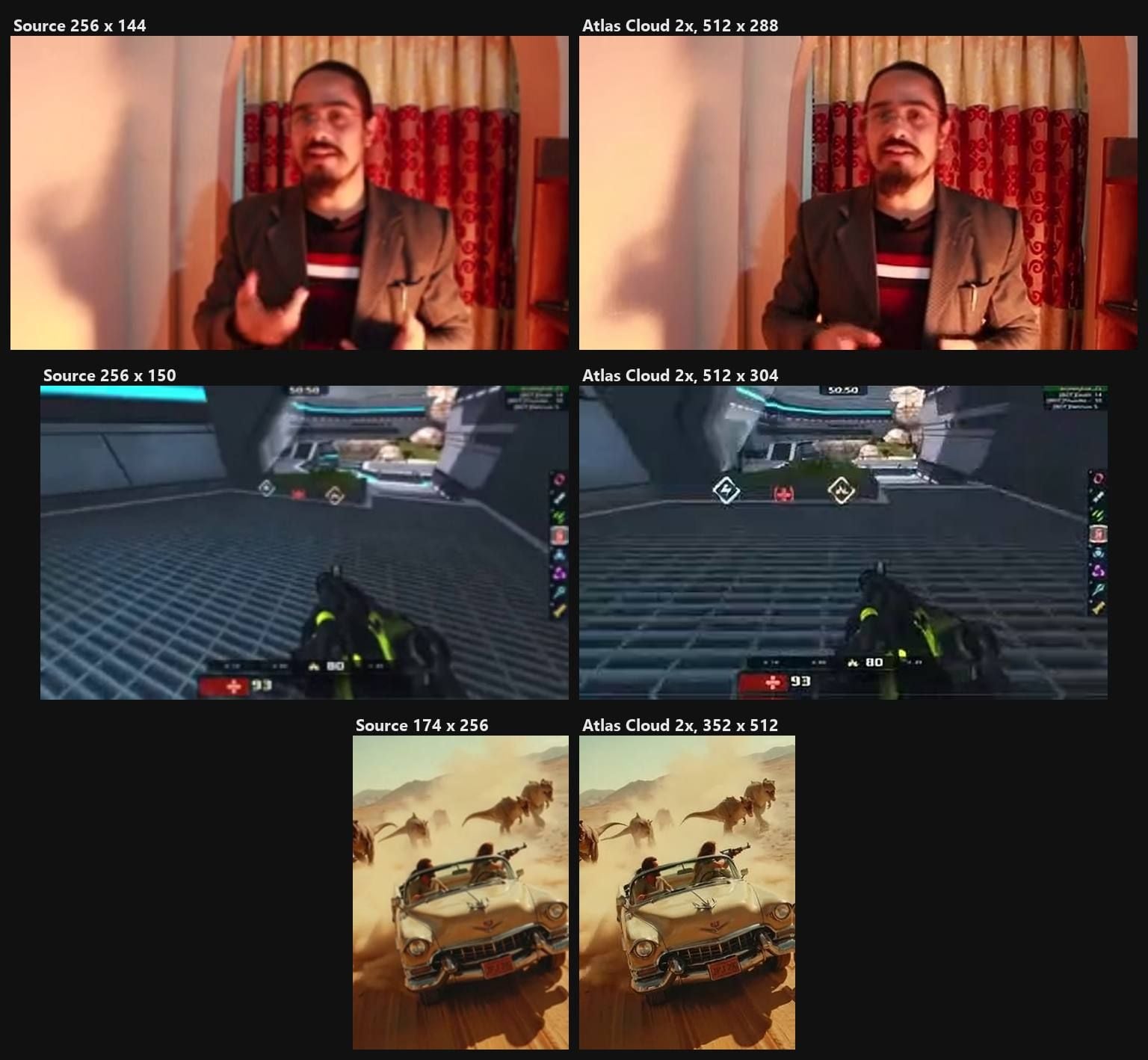
Frames from our three test runs on the free browser tool at its default settings. Left, the 256 pixel sources enlarged the way a player would enlarge them. Right, the 2x WebM the tool returned: no account, no upload, no watermark.
Key Takeaways
- Free means four different things across these ten tools: unmetered, export counted, watermarked, or a trial that cannot export at all.
- Atlas Cloud and Video2X return an unwatermarked file with no account, no export counter and no trial clock, and the free browser video upscaler is the one of the two that needs no install.
- Six of the ten render on your own graphics card, and the published minimums start at 4 GB of video memory.
- Detail an upscaler adds is detail it invented, and Topaz's own documentation describes its creative mode as trading realism for artistic quality.
- An upscaled clip is only as sharp as the bitrate you export it at, and YouTube publishes the numbers.
Best Video Upscaler Comparison Table
The ten tools split three ways on where the work happens. Six render on your own graphics card: Topaz Video AI, Video2X, VideoProc Converter AI, AVCLabs, HitPaw VikPea and UniFab. Three send your file to the vendor's servers: TensorPix, CapCut and Pixop. One does the work inside your browser tab without an upload, and that is Atlas Cloud. On the money side, Atlas Cloud and Video2X run unmetered with no watermark, VideoProc counts your free exports, AVCLabs and HitPaw watermark the trial, Topaz has no trial at all, and Pixop will not process a single frame until you add a payment method. Published entry prices run from $5.5 a month billed annually to $299 a year.
| Tool | Best for | Free tier | Entry paid plan | Max output | Runs on |
|---|---|---|---|---|---|
| Atlas Cloud | Short clips, nothing to install | Unlimited 2x runs, no account, no watermark | Cloud model billed per second, no plan | 512 px wide by default, 640 px at most in the browser, 1080p or 2K through the cloud model | Your browser tab |
| Topaz Video AI | Long footage restoration | No trial for the current desktop version | $299/yr Personal | 4K and above | Your computer, 6 GB VRAM minimum |
| Video2X | Unlimited local runs, anime sources | Free and open source, no account | None | Any factor you set, 2x by default | Your computer, a Vulkan GPU from 2012 on |
| VideoProc Converter AI | Cheapest desktop route | 5 watermark-free exports, files under 5 minutes | $34.95/yr for 3 devices | 4K, up to 4x | Your computer, Vulkan 1.2 GPU |
| TensorPix | Cloud jobs from a browser | Signup credits for about 5 minutes, 720p input cap | $5.5/mo billed annually | 4x, 4K input on paid plans | TensorPix's servers |
| AVCLabs Video Enhancer AI | Buying a perpetual license | Watermarked trial, 30 second exports | $39.95/mo, perpetual from $149.90 | 4K or 8K | Your computer, 4 GB GPU memory |
| HitPaw VikPea | 8K targets with a cloud add-on | Watermarked until you buy | $43.19/mo, or $81.24/yr on promo | 8K | Your computer, or paid cloud credits |
| CapCut | Editors already inside CapCut | Free tool page, limits not stated | Pro $19.99/mo, varies by region | 4K in the tool | CapCut's servers and apps |
| UniFab Video Upscaler AI | One module, one lifetime fee | 30 day trial, no watermark | $129.99 lifetime | 16K claimed | Your computer, 8 GB VRAM recommended |
| Pixop | Broadcast archives, pay per gigapixel | None, the trial cannot process | $10 minimum credit purchase | No stated ceiling | Pixop's cloud |
How We Tested Every Video Upscaler on This List
Every price, cap and limit in this article was read off the vendor's own pricing, feature or documentation pages in September 2026. Review scores came from Trustpilot, Capterra, the App Store and Google Play, read the same month. The hands-on part is narrow and worth stating: we ran three clips of our own, each under 8 seconds, through the free browser route to watch what a 2x pass returns, and those runs sit in the Atlas Cloud section below. We did not render the same footage through all ten tools, and this article does not claim a picture quality ranking.
One more thing about the category. Video vendors do not separate enhancement from upscaling the way photo tools do. CapCut calls its tool an upscaler and enhancer in the same breath, and Topaz sells both inside one app. For stills we drew that line in photo enhancer vs upscaler, and the same logic applies here: an upscaler adds pixels, an enhancer changes the ones you have.
Four criteria decided the ranking:
- What leaves the tool on a free account. A watermark, a clip length cap, an export counter or a blocked download all mean the same thing in practice: you do not have your file yet.
- Upscaler specific controls. A published target resolution or factor, a model choice for real footage versus animation, whether the original frame rate survives, and a stated input ceiling.
- Price transparency. Whether the number is printed on the site, hidden behind a signup, or shown as a strike-through promotion that may not be there next month.
- Where your footage goes. Local rendering, an upload to the vendor's cloud, or processing inside the browser, and whether the vendor says how long it keeps your file.
The first one carries the most weight. A tool that renders a beautiful 4K result and then hands you a watermarked preview has not solved the problem you came with, AVCLabs and HitPaw VikPea do exactly that, and Topaz Video and Pixop will not render a free frame at all.
The three clips, scaled to the tool's default 256 pixel edge before the run:
| Test clip | What is in it | Source size | Length | Origin |
|---|---|---|---|---|
| Portrait | A man talking to the camera in front of a patterned curtain | 256 x 144 | 7 s | Stock footage under the Pexels License |
| Game capture | Xonotic deathmatch with health and armour numbers and a scoreboard | 256 x 150 | 7 s | Open source game recording from Wikimedia Commons |
| AI clip | Dinosaurs chasing a vintage convertible through a desert | 174 x 256 | 5.4 s | Demo clip from the Atlas Cloud video upscaler model page |
Disclosure: Atlas Cloud publishes this article and operates the tool ranked first. No other tool here paid for placement, and every one of them is described from its own published pages.
1. Atlas Cloud: Best AI Video Upscaler Overall
Drop a clip under 8 seconds onto the page, press the run button that reads Free, no charge, and a WebM at twice the edge length you picked comes back from your own machine: 512 pixels wide at the default setting, 640 at the top one. Nothing is stamped on it, and there is no account to make first. It sits first for that reason alone: the free run ends with a file you can use.
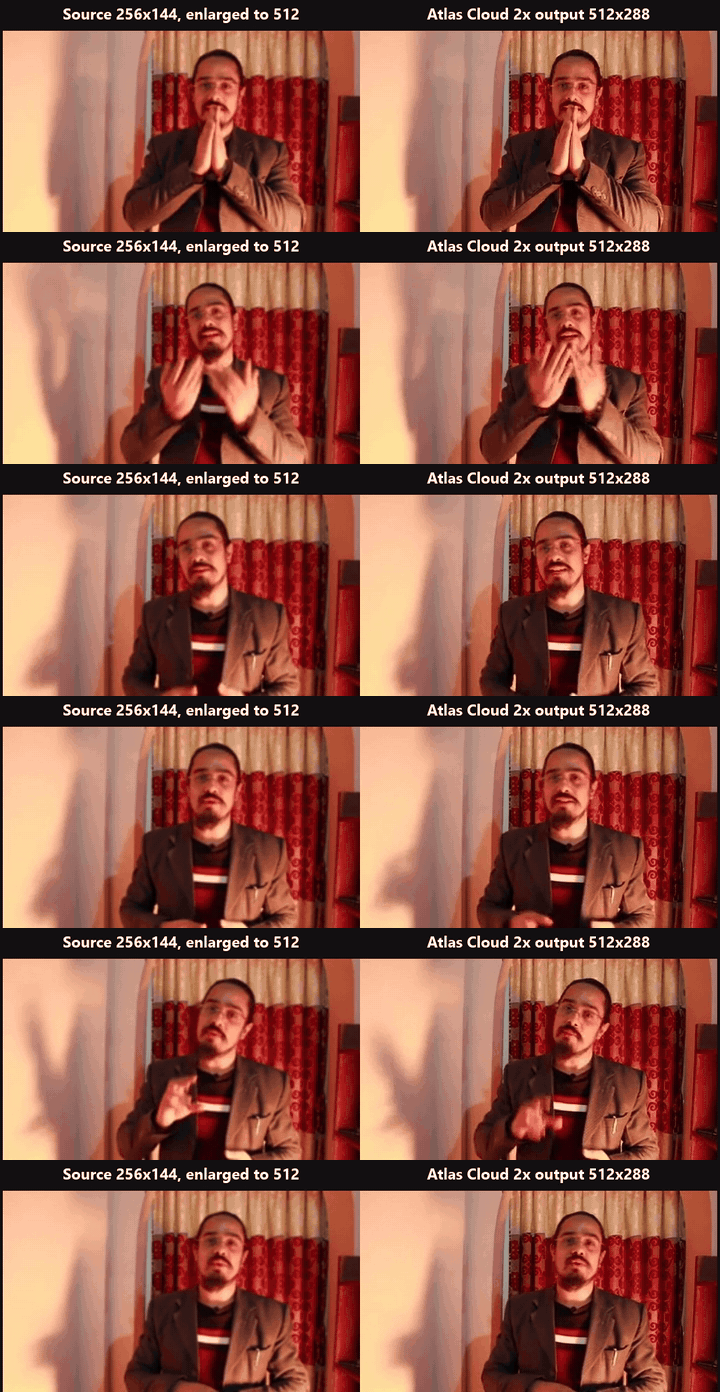
The loop below is that run, side by side. On the left is our 256 by 144 source, a man talking to the camera in front of a patterned curtain, enlarged to 512 pixels the way a video player would enlarge it. On the right is the 512 by 288 WebM the tool returned on its default settings, both sides at a matched frame rate so the only difference you are looking at is the pixels. Watch the rim of the glasses, the beard and the curtain pattern: the right side holds a cleaner line.
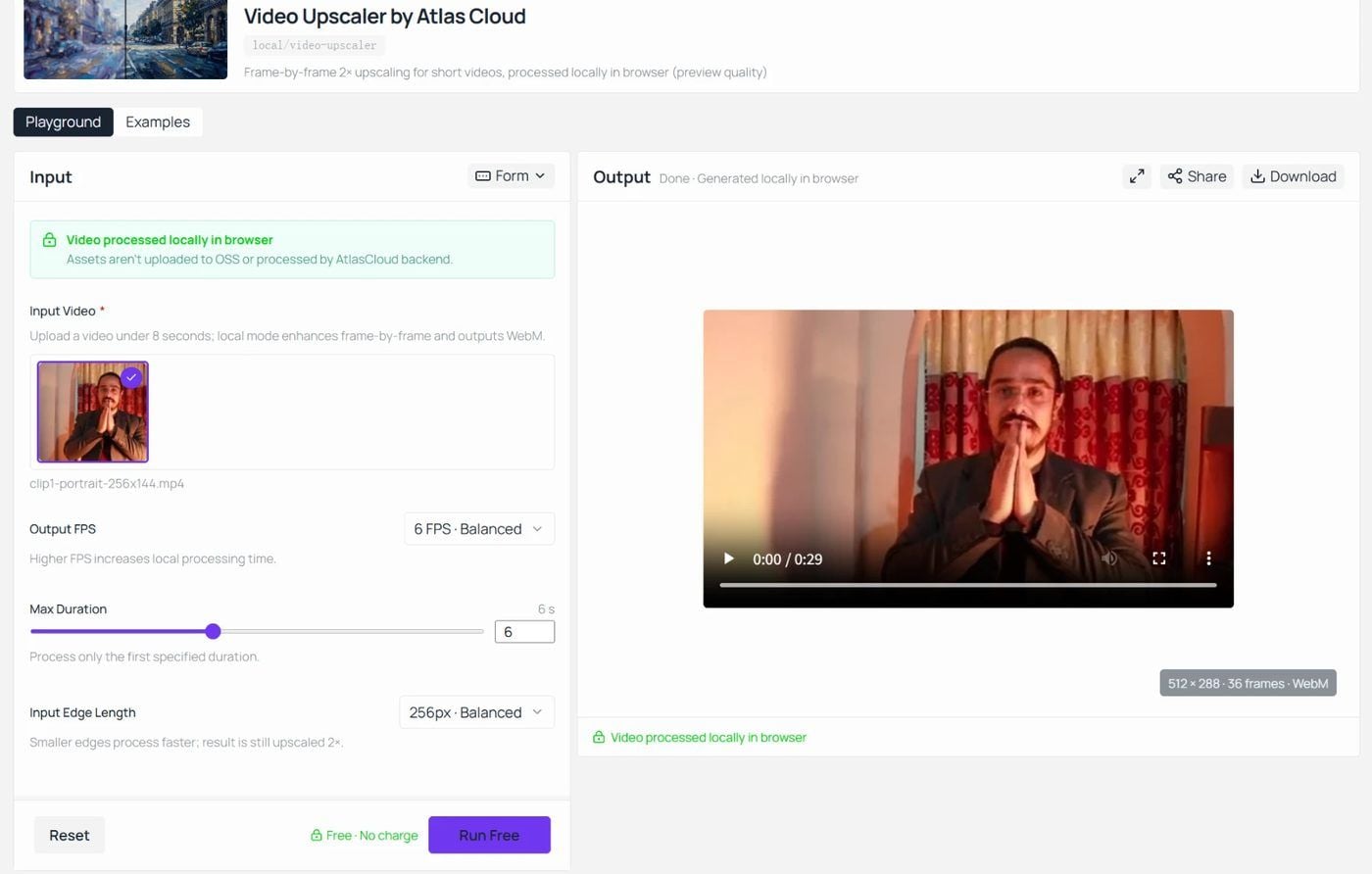
Atlas Cloud runs this upscaler on a super resolution model that downloads into your tab once and then processes every frame with WebGPU on your own hardware. It is one of the company's free AI tools, a small group that also covers image upscaling and background removal, and this one asks for no sign-in.
The page is direct about the boundary that follows from running in a browser. The Input Edge Length field offers 192, 256 or 320 pixels and defaults to 256 on a setting labelled Balanced. The clip is scaled to that long edge before the model sees it, and the output is twice it: our 636 by 360 test clip came back at 512 by 304 on the default, and the top setting tops out at 640. Treat this as a sharpening pass for clips up to 320 pixels wide rather than a route to full HD, since the downscale to your chosen edge happens before the model runs. Output FPS offers 4, 6 or 8 frames per second and defaults to 6: pick 8 when the clip has motion, and the lower settings when you want the render back faster. Max Duration defaults to 6 seconds, runs up to 12, and processes only the first stretch of the clip, while the upload field itself asks for clips under 8 seconds.
The same default pass on the game capture, where the HUD numbers and the floor grid are the tell:
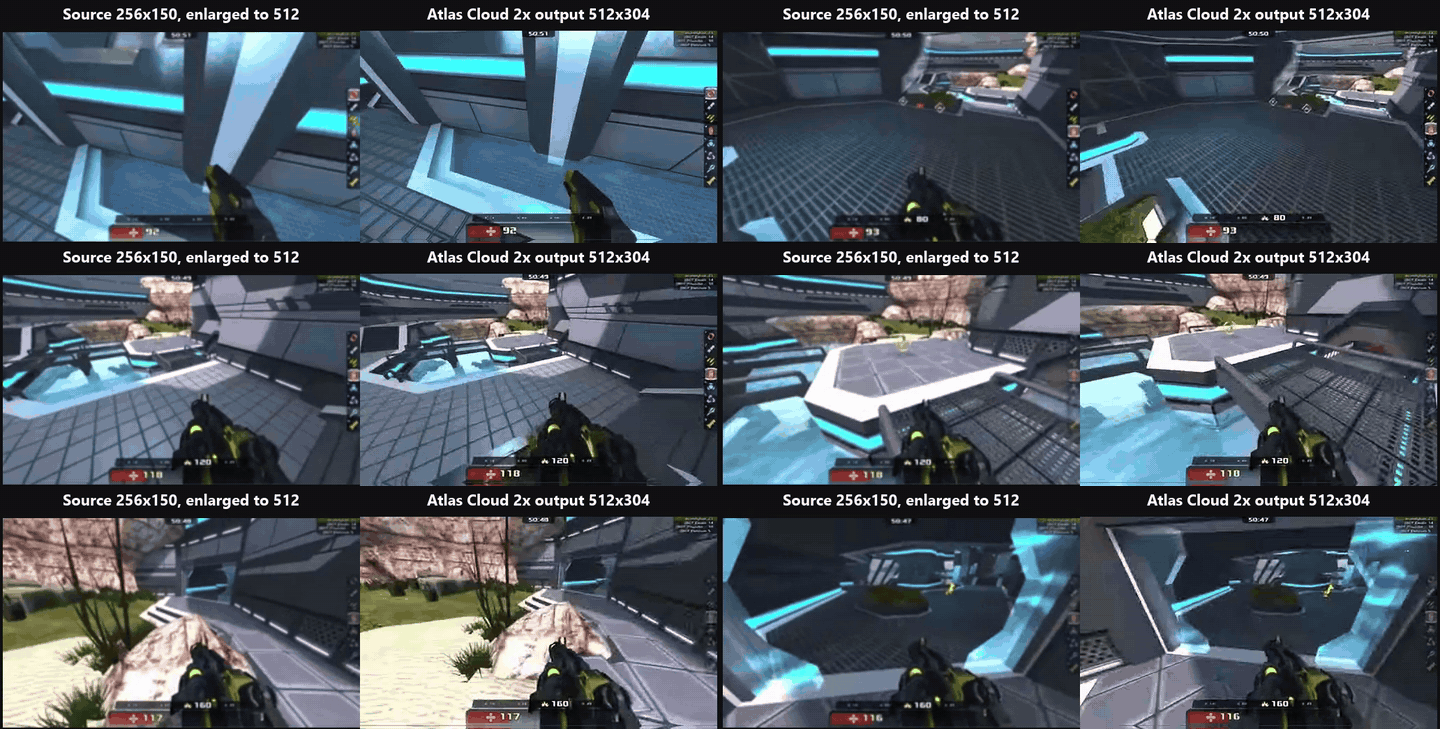
Those defaults describe the job this tool is built for: a sharper pass on an old phone video before it goes into a family archive, a game capture whose HUD text has gone fuzzy, a clip out of an AI video generator that came back softer than expected. The page names those cases itself.
For footage past that line, the video upscaler model in the Atlas Cloud playground takes a video URL and a target resolution of 1080p or 2K, which the model documentation defines as 2560 by 1440. The 1080p setting accepts clips up to 53 seconds, the 2K setting up to 23 seconds, and input has to be 30 frames per second or under. The original frame rate is kept, with no interpolation. The same documentation lists 4K as planned for a later release, so we do not count it.
Why it stands out: The free route and the paid route are the same idea at two sizes. You learn what super resolution does to your kind of footage on a short clip in the browser, with nothing uploaded, and send the longer clip to the hosted model once you know the result is worth paying for.
Best for: Anyone whose problem is a short clip rather than a long one. Family videos from an old phone, retro game captures, screen recordings with small text, AI generated clips that need one more pass before they go anywhere.
Pricing: The browser tool is free with no account to create, no cap on how many clips you run, no watermark on the download, and no upload of your footage. The hosted model bills per second of input from the same Atlas Cloud balance that covers every other model on the platform.
2. Topaz Video AI: Best Video Upscaling Software for Long Footage
Topaz Video is the name that comes up first in most of the r/VideoEditing threads we read about restoring old footage, and the product page leans on the same point: local rendering, with your files never leaving your computer. The model list on the pricing page runs from Proteus and Iris to Starlight Precise, and the app exists to grind through hours of material rather than seconds.
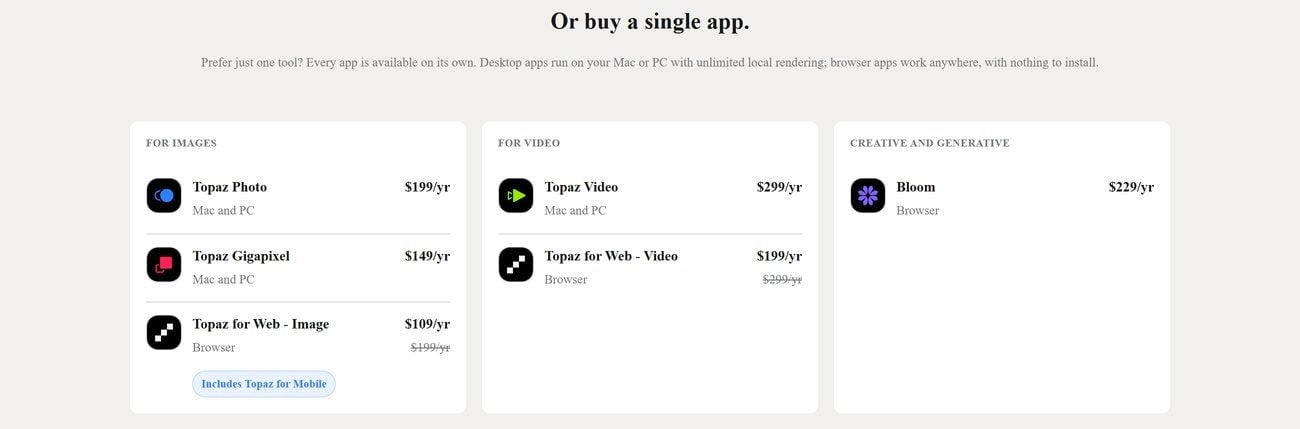
Screenshot from Topaz Labs' official pricing page, September 2026.
Where the free tier stops you: Before it starts. A Topaz staff reply on the company's community forum, read in September 2026, says the current desktop version of Topaz Video does not offer a free trial. Topaz Labs also stopped selling perpetual licenses on 3 October 2025, a change reported by CG Channel and Digital Production at the time, so the only way in is a subscription.
What one usable video actually costs: The Personal plan is $299 a year, or $39 a month on an annual commitment, or $59 month to month. The Pro license, which adds full commercial rights for organisations over $1 million in revenue, is $699 a year. The Topaz Studio bundle of every Topaz app is $399 a year.
What users report: Trustpilot shows 3.7 out of 5 from 56,525 reviews on the company wide Topaz Labs profile, which covers the photo apps as well as video.
Where it falls short for video upscaling: Hardware. The system requirements page asks for 6 GB of video memory on NVIDIA, AMD or Intel graphics and 16 GB of system RAM, and on Mac it supports Apple Silicon only. Render time is the other cost: one r/VideoEditing poster described a 22 minute episode taking about 36 minutes to reach 4K on an RTX 4090, and another asked how to batch clips on an M3 Pro MacBook without thermal throttling.
Fits: Anyone with a drawer of tapes, a capable GPU and a year of restoration work ahead. Not for you if: you have a handful of short clips and no appetite for a $299 annual line item.
3. Video2X: Best Free Video Upscaler for Local GPU Runs
Video2X is an open source project under the AGPL 3.0 license with 21.7 thousand GitHub stars as of September 2026, and it is the tool r/VideoEditing posters reach for when the word free has to mean free. It wraps four engines behind one interface: Real-ESRGAN and Real-CUGAN for upscaling, RIFE for frame interpolation, and Anime4K version 4 through libplacebo shaders.
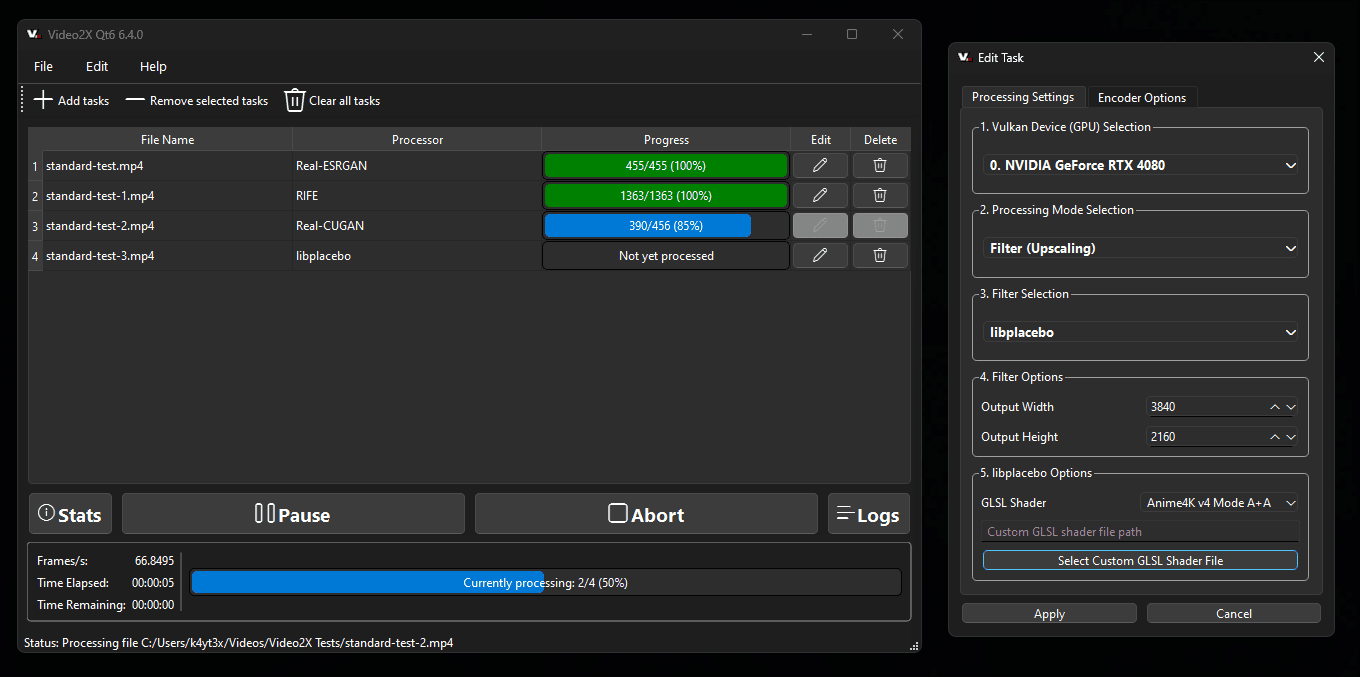
Screenshot from the Video2X project README, September 2026.
Where the free tier stops you: Nowhere on price. There is no account, no watermark, no counter and no time limit. It stops at hardware. The project asks for a Vulkan capable GPU, which reaches back to NVIDIA Kepler cards from 2012, AMD GCN 1.0 and Intel HD Graphics 4000, and the GUI installer ships for Windows. Elsewhere it is a command line.
What one usable video actually costs: Zero dollars and a lot of GPU time. In a 2023 r/VideoEditing thread, a user running an RTX 3080 said a 10 minute video took about a day and a half, and still called the output the best they had tried. That was an older release, the current version adds the libplacebo shader path, and nobody publishes a benchmark you can hold them to.
What users report: No Trustpilot or app store listing exists for a self hosted tool, so the 21.7 thousand stars are the closest thing to a rating. The recurring praise in the r/VideoEditing threads we read is output quality, and the recurring complaint is speed.
Where it falls short for video upscaling: The scale factor is a flag you set yourself, 2x by default and 4x in the documentation's example, with no guardrail if you ask for more than your source can carry. Real footage goes through Real-ESRGAN or Real-CUGAN, and none of the four engines is tuned specifically for faces, so results on people vary with the source.
Fits: Anyone with a discrete GPU, a folder of anime or game footage and time to leave the machine running overnight. Not for you if : you want a clip back in a minute or you are on a laptop with integrated graphics.
4. VideoProc Converter AI: Best Video Upscaling Software on a Budget
VideoProc Converter AI is a converter first, with an AI Super Resolution module bolted on, and its free version lets you export without a watermark, five times.
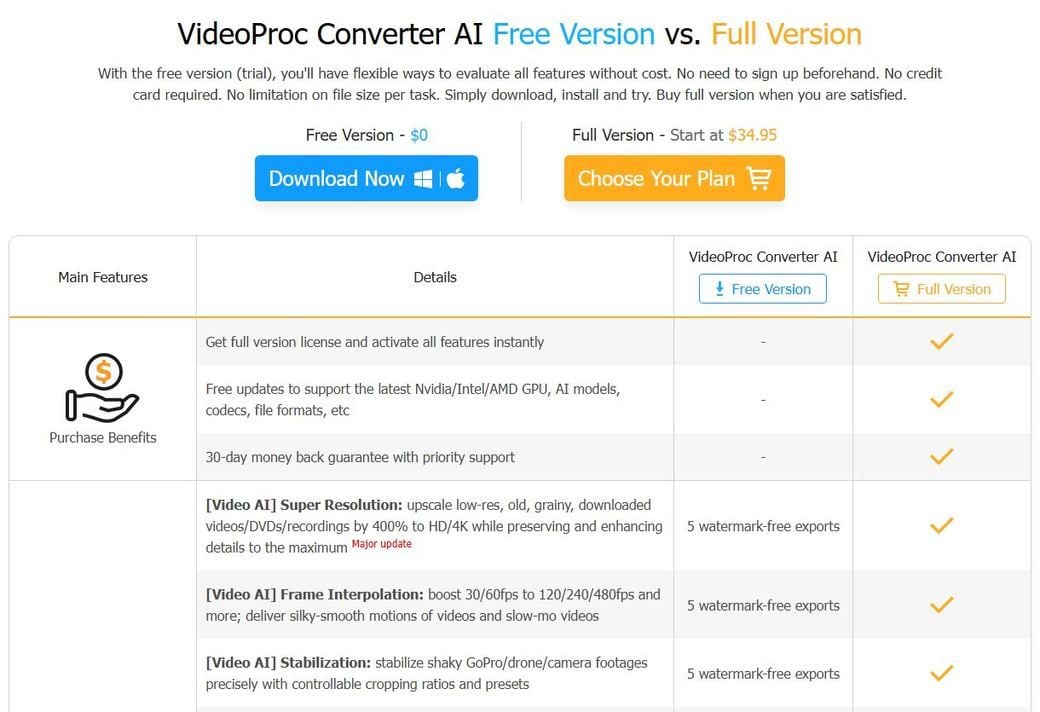
Screenshot from VideoProc's official free vs full version page, September 2026.
Where the free tier stops you: At the sixth export. The comparison page lists 5 watermark-free exports for AI Super Resolution, and the trial caps files at under 5 minutes. After that the module needs a license.
What one usable video actually costs: The Premium 365 plan is $34.95 a year for three devices, shown as a discount from $59.95, and the renewal price is listed as $39.95. A lifetime license for one device is $54.95, and a family license for three to five devices is $79.95. All three carry a 30 day money back guarantee.
What users report: Trustpilot shows 4.2 out of 5 from 513 reviews, and Capterra 4.1 out of 5 from 21.
Where it falls short for video upscaling: The ceiling is 4K and 4x, which covers phone and camcorder footage and stops short of the 8K claims elsewhere on this list. It needs a GPU with Vulkan 1.2 support for the AI features. And on the question of where your footage goes, the company's safety page says only that it detects hardware information for optimisation; we could not find a sentence that says footage stays on your machine.
Fits: Anyone who wants a permanent desktop tool for under $60 and does not need more than 4K. Not for you if : five free exports will not cover the test you want to run before paying.
5. TensorPix: Best Online Video Upscaler for Cloud Jobs
TensorPix runs in the cloud, so the machine you are on does not matter, and its pricing page prints the numbers you need to work out a per minute cost.
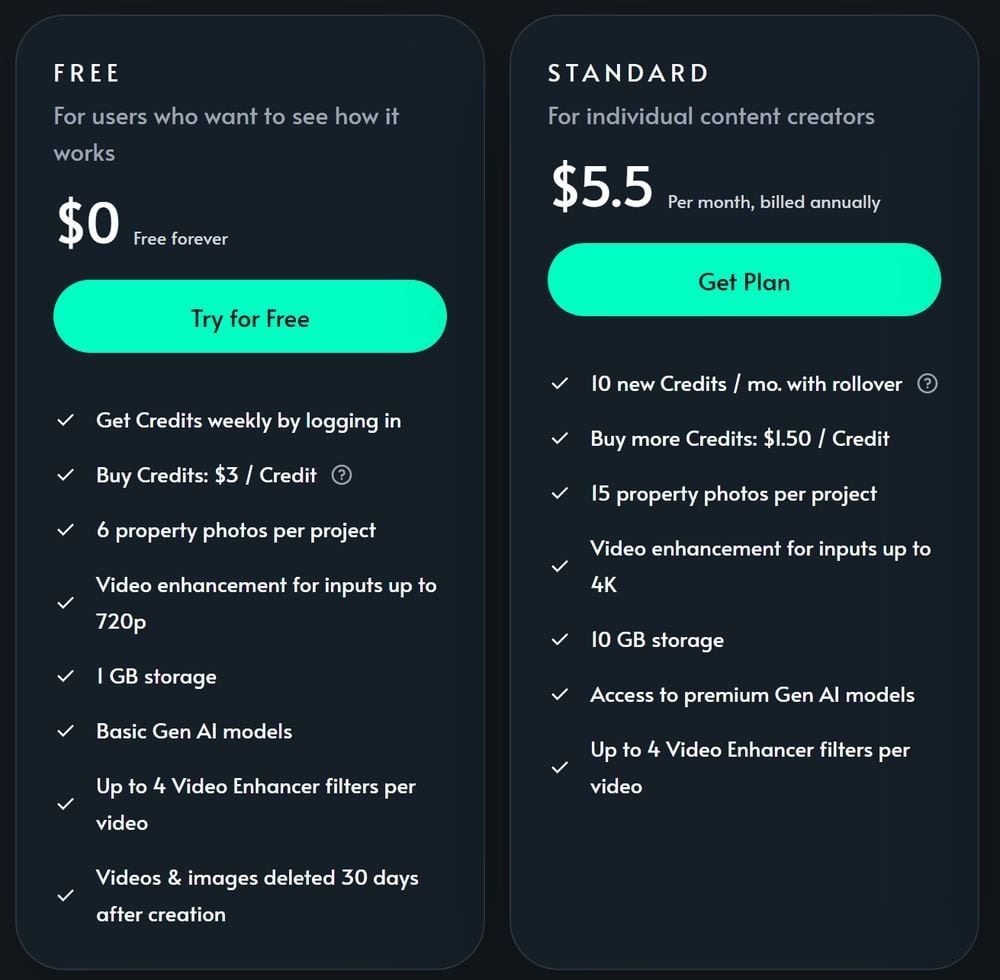
Screenshot from TensorPix's official pricing page, September 2026.
Where the free tier stops you: When the signup credits run out, which the pricing page puts at roughly five minutes of enhancement. Input is capped at 720p, storage is 1 GB, and the pricing page says free tier files are deleted 30 days after creation. Processing requires an account.
What one usable video actually costs: The Standard plan is $5.5 a month billed annually and includes 10 credits a month with rollover. The page defines one credit as about 2 minutes of enhanced video, so the plan covers roughly 20 minutes a month, which works out to about $0.28 per minute. Extra credits are $1.50 each, or about $0.75 per minute.
What users report: Trustpilot shows 4.2 out of 5 from 121 reviews.
Where it falls short for video upscaling: Everything is an upload, so confidential footage is a conversation with your client first. The 4K input tier is paid only. And a long project turns the per minute math against you fast: an hour of footage on plan credits is three months of allowance.
Fits: Anyone on a laptop without a GPU who has a few minutes of footage a month. Not for you if: the footage cannot leave your building, or you have hours of it.
The Other Five Video Upscalers Worth Knowing
These five did not make the top half for one of five reasons: the trial watermarks everything, the price on the page is a countdown promotion, the pricing is not published at all, the recommended hardware is a desktop gaming card, or there is no free processing to test with. Each is still the right tool for someone, so here is where the free tier stops and what the entry price buys.
6. AVCLabs Video Enhancer AI: Perpetual License, Watermarked Trial
AVCLabs sells a desktop upscaler that processes locally, with a product page promising no uploads and no cloud dependencies. The trial is full featured, but every export is watermarked and capped at 30 seconds, with no limit on how many you run. Pricing is $39.95 a month, $119.95 a year shown as $95.96, or a perpetual license at $299.90 shown as $149.90. The page claims 4K or 8K output and up to 400 percent scaling. The hardware story is muddled: one official requirements page asks for 4 GB of GPU memory and a GTX 1060 or better, while the tech spec page only names NVIDIA Kepler or AMD GCN generation cards. Trustpilot shows 4.1 out of 5 from 553 reviews. The trade-off is a true buy once price against a trial that never shows you a clean frame.
7. HitPaw VikPea: 8K Claims With an Optional Cloud Add-On
HitPaw renamed its Video Enhancer to VikPea in late 2024 and markets 4K and 8K output. The free trial page is plain: enhanced videos carry a watermark until you buy. The purchase page in September 2026 showed $43.19 a month, $99.99 a year discounted to $81.24, and a perpetual license at $350.39 discounted to $284.69, all under a 35 percent off banner with a countdown timer. Processing is local by default, and a paid cloud acceleration option burns credits. What gives us pause is the review page: Trustpilot displays a notice that the company's rating is unavailable due to a breach of its guidelines, with 2,730 reviews on file, and the VikPea listing on Capterra has none. The trade-off is a big resolution number against a price you have to catch on the right day.
8. CapCut: AI Video Upscaler Inside an Editor
CapCut's web tool page offers HD, UHD and 4K output and describes itself as free, but neither tool page states whether the free export is watermarked or capped, and CapCut publishes no fixed pricing page. Its own comparison article puts Pro at $19.99 a month or $179.99 a year, says advanced video enhancement tools are Pro only, and warns that prices vary by region and platform. The ratings tell two stories: 4.6 out of 5 from 1.1 million App Store ratings and 3.6 from 13 million on Google Play, against 1.2 out of 5 from 1,292 Trustpilot reviews. The trade-off is convenience inside an editor you may already use against limits you only discover at the export button.
9. UniFab Video Upscaler AI: One Module, One Lifetime Price
UniFab sells its upscaler as a standalone module at $129.99 for a lifetime license, or inside a 26 tool All-In-One bundle at $429.99. The 30 day trial is described as full access with no watermark. The product page claims output up to 16K and recommends 16 GB of RAM, 8 GB of video memory and an RTX 30 series card or better on Windows; the Mac requirements ask for 32 GB of RAM. Processing is local, with an optional FabCloud path at 0.5 credits a minute. Trustpilot shows 4.1 out of 5 from 178 reviews. The trade-off is a clean trial and a fixed price against a hardware recommendation aimed at desktop gaming cards.
10. Pixop: Pay-Per-Gigapixel Video Upscaling for Archives
Pixop is built for broadcasters and archives, and it does not pretend to have a free tier. The 14 day trial lets you look at the interface, and the help center says you cannot upload, download or process until a payment method is on file, with a $10 minimum credit purchase. Pricing is per gigapixel of processed video: the Super Resolution filter is $0.079 per gigapixel, which at 1080p and 24 frames per second works out to roughly $0.24 per minute for the upscale alone before encoding, and about four times that at 4K. Trustpilot shows 3.8 out of 5 from 29 reviews. The trade-off is transparent metered pricing and an on premises option against a bill that scales with every pixel you touch.
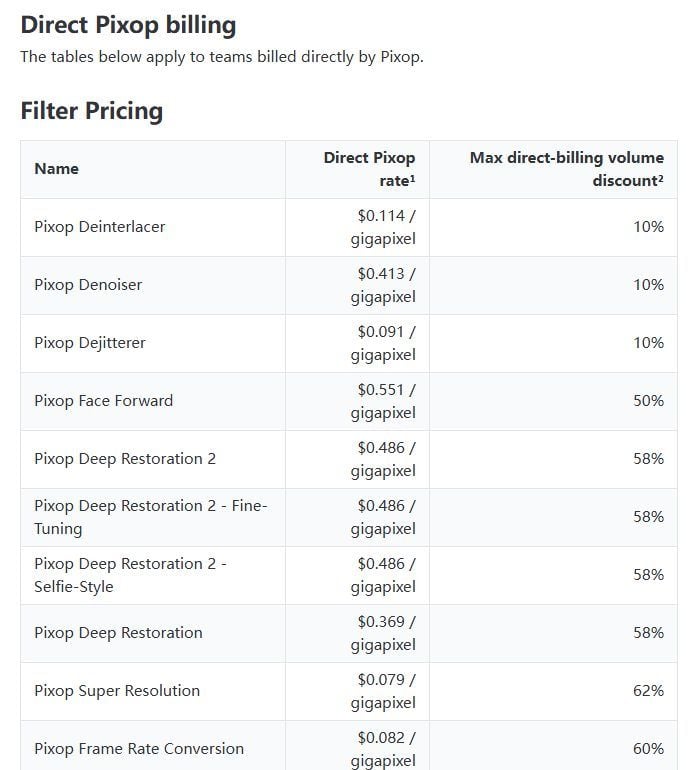
Screenshot from Pixop's official pricing documentation, September 2026.
Will YouTube Keep Your Upscaled Video Sharp?
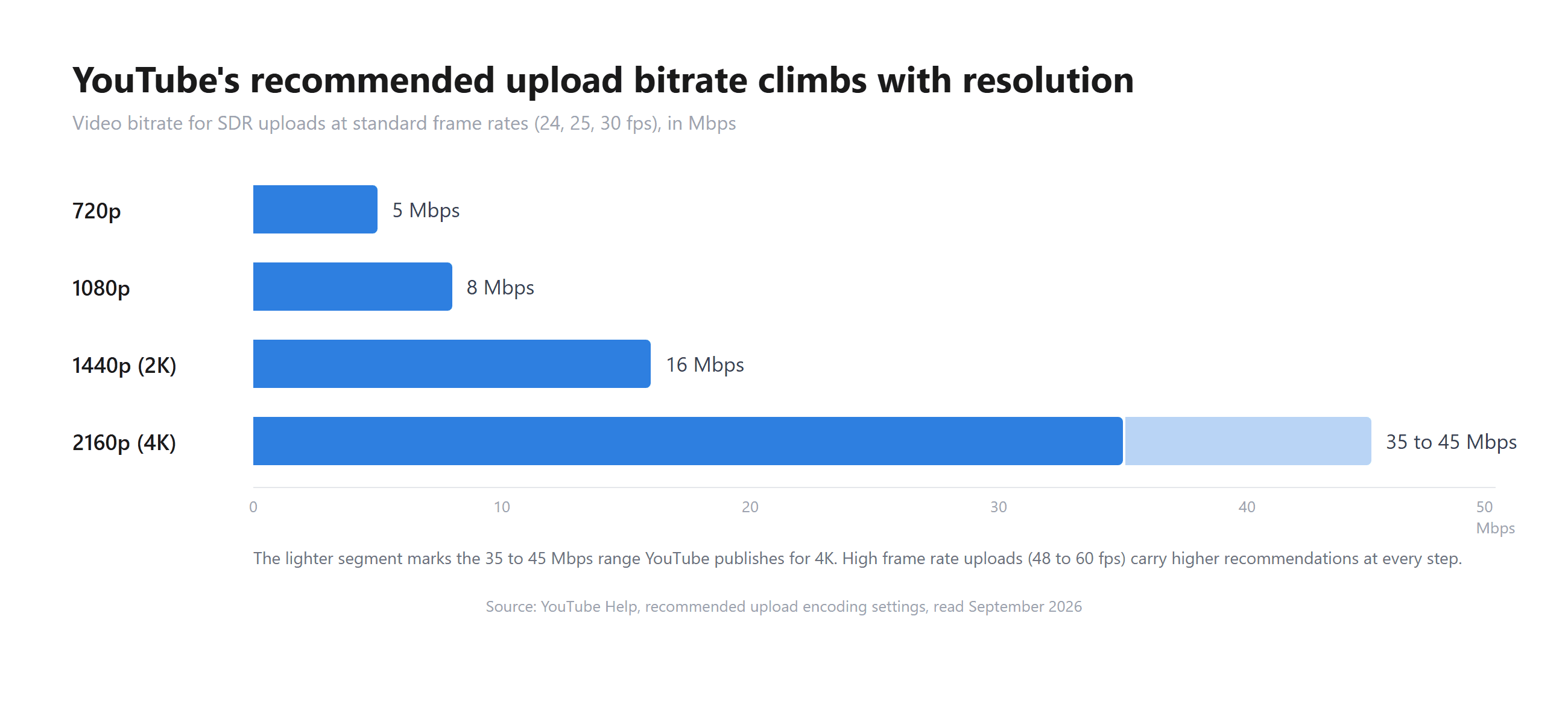
Three of the four vendor roundups that rank for this search skip what happens after the export, and it decides whether the upscale was worth doing. Filmmaker and Premiere Pro author Jarle Leirpoll wrote in a 2024 Frame.io piece on export myths that "the file you upload to YouTube and other social media is never seen by the users." YouTube re-encodes everything, and it re-encodes by resolution tier.
The tiers are public. YouTube's recommended upload settings list 8 Mbps for 1080p, 16 Mbps for 1440p and 35 to 45 Mbps for 2160p at standard frame rates in SDR. The same page adds that viewing new 4K uploads in 4K needs a browser or device that supports VP9, and Leirpoll's article notes that YouTube uses a more modern codec for 4K uploads, which is why some editors upscale HD to 4K before uploading. A 2x pass from 720p lands at 1440p, and YouTube's recommendation for that tier is double the 1080p figure.
The other constraint is what the upscaler invents on the way up. Topaz's own documentation for its Astra web app describes Creative Mode as prioritising artistic quality over strict realism, and pairs it with a Precise Mode for detail preserving work. That is the split a generative upscaler lives with: detail the model adds is detail the model chose.
What to do instead: Export the upscaled clip at the bitrate YouTube recommends for its new resolution, not the bitrate of the source. Keep the source frame rate unless you are deliberately interpolating. For footage that has to stay faithful, an interview, a product demo, evidence of anything, pick the precise or standard model over the creative one, and keep the original file next to the upscale.
What Does Reddit Say About the Best Video Upscaler?
The r/VideoEditing community, with roughly half a million members, has been answering this question for years, and the answers now come with a caveat about Topaz's subscription. In a December 2025 thread titled around finding a non subscription alternative to Topaz Video for old family videos, the replies pointed to open model libraries and to the AI Super Scale feature inside DaVinci Resolve Studio rather than to another paid upscaler.
Price is not the only complaint. A November 2024 thread asked for a free Windows upscaler with no watermarks and no trials beyond Topaz and Video2X. Shutter Encoder came up as a free option with 2x and 4x AI scaling, and the original poster's follow up was that even good source footage came back with visible AI artifacts. A June 2025 thread on the same subreddit had one member calling the latest Topaz a few steps ahead of anything else, with a caveat that a batch of clips set to 1080p meant coming back in a couple of days, while others recommended Resolve Studio and the open source QualityScaler.
The pattern across those threads is consistent. Topaz is still the quality reference for long, real footage. Video2X and its open source cousins are the free answer, with speed and artifacts as the cost. Browser tools barely come up, because the short clip case is not the case people are posting about.
| Thread ask, r/VideoEditing | What got recommended | What got warned about |
|---|---|---|
| Non subscription alternative to Topaz Video, December 2025 | Open model libraries, DaVinci Resolve Studio Super Scale | Topaz moving to subscription only |
| Free Windows upscaler, no watermark, no trial, November 2024 | Shutter Encoder, ComfyUI setups | AI artifacts even on clean sources |
| Best tools to upscale a lot of video to 1080p, June 2025 | Topaz, Resolve Studio, QualityScaler, After Effects Detail-preserving Upscale | Multi day render times on Topaz batches |
| Faster options than Video2X, May 2023 | Topaz | A 10 minute clip taking about a day and a half on an RTX 3080 |
Frequently Asked Questions
What Is the Best Free Video Upscaler With No Watermark?
Atlas Cloud and Video2X return an unwatermarked file with no account, no export counter and no trial clock. The free AI video upscaler from Atlas Cloud does a 2x pass on clips under 8 seconds inside your browser, and Video2X does any factor you set on your own GPU with no time limit. VideoProc Converter AI gives you five watermark-free exports before it asks for a license. AVCLabs and HitPaw VikPea watermark every trial export, and Topaz Video has no trial at all.
Can I Upscale Video to 1080p for Free?
Free and at full 1080p, only with a local GPU: Video2X will take a 540p source to 1080p at no cost if you set the factor to 2 and have a Vulkan card. The Atlas Cloud browser tool scales your clip to a chosen long edge, 256 pixels by default and 320 at most, and returns twice that, so its ceiling is 640 pixels wide: a free sharpening step for small clips rather than a way to reach 1080p. For a clip that has to land at 1080p without a GPU, the hosted Atlas Cloud video upscaler model takes a 1080p target on clips up to 53 seconds and bills per second.
How Much Does AI Video Upscaling Software Cost?
Desktop upscalers in this roundup run from $34.95 a year for VideoProc Converter AI to $299 a year for Topaz Video AI, with lifetime licenses from $54.95 at VideoProc to $284.69 at HitPaw VikPea on its September 2026 promotion. Cloud tools meter instead: TensorPix works out to about $0.28 per minute on its annual plan and Pixop charges $0.079 per gigapixel, roughly $0.24 per minute of 1080p for the upscale filter alone. The hosted Atlas Cloud video upscaler bills $0.018 per second of input at 1080p and $0.024 per second at 2K, with a five second minimum, so a 5 second clip costs $0.09 at 1080p and $0.12 at 2K, with no discount applied at the time of writing.
Does a Video Upscaler Need a Dedicated GPU?
The desktop tools do. Topaz Video asks for 6 GB of video memory, AVCLabs for 4 GB, and UniFab recommends 8 GB and an RTX 30 series card. Video2X runs on any GPU with Vulkan support, which includes NVIDIA cards back to 2012, though older hardware means longer renders. Cloud tools such as TensorPix and Pixop use their own servers, so your laptop only needs a browser. The Atlas Cloud browser tool uses WebGPU on whatever graphics your device has, and its parameter notes say a higher frame rate or a larger input edge means longer local processing.
Conclusion
Ten upscalers, and the word free meant something different at nearly every one. Atlas Cloud and Video2X hand you a clean file with no strings, VideoProc counts to five, AVCLabs and HitPaw watermark the trial, Topaz has no trial, Pixop wants a card before it renders a frame, and the rest sit somewhere in between. The desktop apps still own long footage, and they charge for it in subscriptions, GPU memory and overnight renders. The cloud tools trade privacy for convenience and meter what you upload. If the same question comes up for stills, we ran the image upscaler roundup under the same three questions.
So the best video upscaler depends on the length of the clip in front of you more than on any leaderboard. A tape archive belongs in Topaz or Video2X. A ten second phone video from a birthday eleven years ago belongs in a browser tab, sharpened and downloaded from the same page, with nothing uploaded and nothing owed.





