AI video APIs clearly win for sheer speed, rapid A/B testing, and short-form volume. But manual editing still holds the edge for deep emotional storytelling. Honestly, the highest engagement in 2026 comes from a hybrid approach—using APIs for daily personalized clips and human editors for flagship brand films.
The data on video content demand today is striking. Speed, quality, and engagement are everything. Let’s look at what actually works.
What Is an AI Video API?
- Semantic definition: Simply put, it’s a digital bridge. It lets your software automatically generate or modify videos by talking directly to artificial intelligence models. No human clicking buttons required.
- Evolution process: The tech has evolved incredibly fast. The current trend is no longer limited to a single model. AI aggregator API platforms are gradually becoming the ultimate version of AI video APIs.
- How an AI aggregator API platform works: Think of it like a smart universal remote. Instead of juggling a dozen different vendor subscriptions, your app connects to one single endpoint. Instead of managing separate API keys for OpenAI's Sora for photorealism, Runway Gen-3 for cinematic motion, and Pika for fast iterations, an aggregator gives you one endpoint. You send a text prompt or some raw footage. Then, the aggregator works behind the scenes. You can switch to the best model based on your specific task needs.
- AI aggregator API Platform Main Features: First, you can choose the perfect AI model for the visual style you need. Second, you get massive scalability. You can generate thousands of highly personalized clips in just minutes. Finally, it offers unified billing and simplified security. It just makes scaling your production velocity much easier without the usual administrative headache.
What Is Manual Video Editing?
- Definition: Manual video editing is exactly what it sounds like. It's real humans sitting at a desk, cutting and shaping raw clips into a story.
- Common Tools: Editors usually rely on heavy-duty tools like Adobe Premiere Pro, Final Cut Pro, or DaVinci Resolve.
- Workflow: Import footage, rough cut, audio mixing, color grading.
- Team Structure: A standard team structure usually includes a creative director, a lead editor, and possibly a motion graphics specialist.
- Areas of Expertise: Edit together a piece that truly touches the hearts of the audience.
AI Video API vs. Manual Editing: Core Mechanisms
| Dimension | AI Video API | Manual Editing |
| Definition | Programmatic video generation using AI models. | Human-led process of shaping video clips into a story. |
| How It Works | Code sends data or prompts to models to return instant video. | Editors physically drag, drop, and trim media on a timeline. |
| User Type | Developers, growth marketers, scale-focused teams. | Creative professionals, filmmakers, traditional agencies. |
| Input | Text prompts, data feeds, simple raw assets. | Heavy raw camera footage, audio files, graphics. |
| Output Process | Automated, parallel generation in seconds. | Linear rendering that requires manual hands-on export. |
| Integration | Embedded into apps, pipelines, or marketing systems | Standalone tools (e.g., editing software) |
| Scalability | High — can generate and personalize videos at scale | Hard limit based on human hours and team size. |
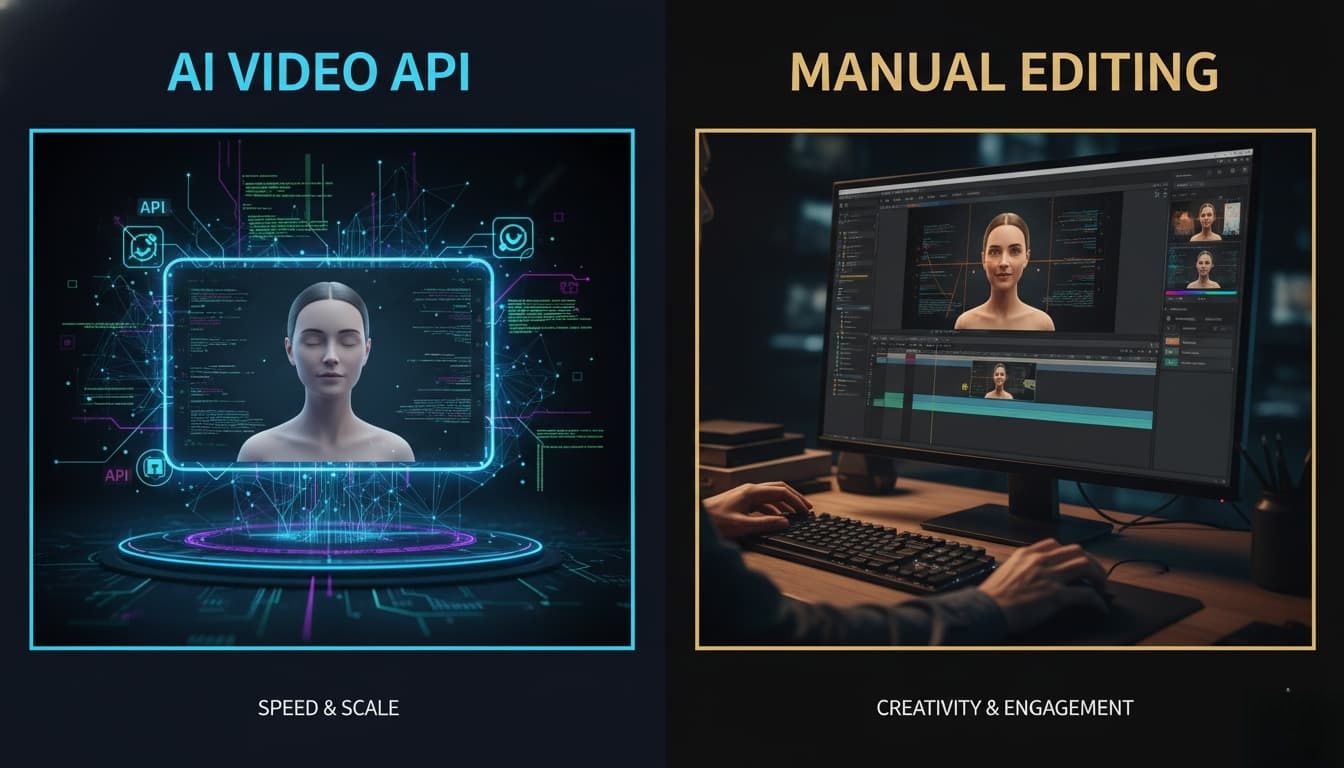
In short, manual video editing trades the rapid, automated scale of an AI video API for deep, human-driven creative control and emotional pacing.
AI Video API vs. Manual Editing: Key Dimension Comparison for Engagement
If you look closely at the data, AI models and human editors win in completely different areas. It isn't a simple contest. To make sense of it, I grouped twelve specific engagement metrics into three main buckets: Scale & Efficiency, Performance & Testing, and Quality & Brand Trust. This just makes comparing the two approaches a lot easier.
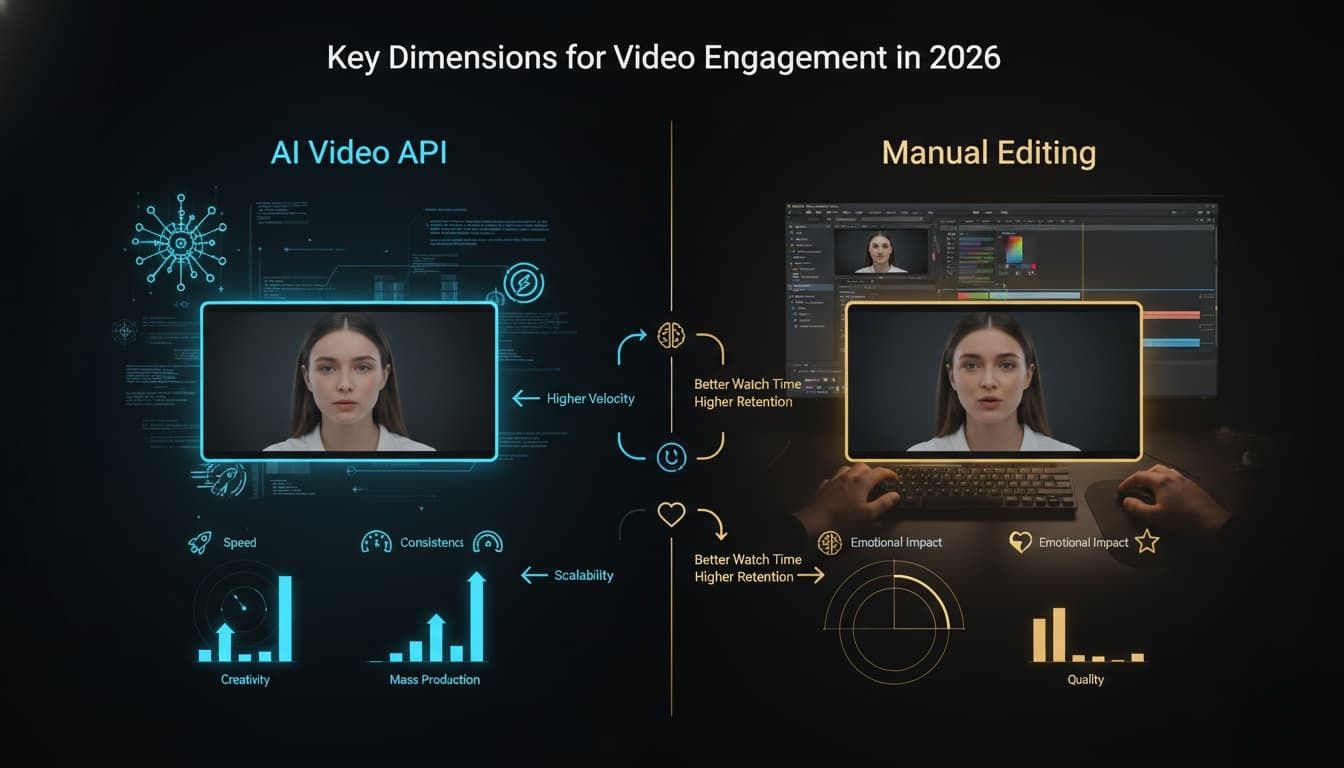
Key Dimensions Comparison Table
| Engagement Metric | AI Video API | Manual Editing | Winner |
| Scale & Efficiency | |||
| Speed & Turnaround Time | Minutes or even seconds | Usually days or weeks | AI Video API |
| Content Volume | Thousands of variations | A small handful | AI Video API |
| Cost Per Engaged Video | Very low at scale | High due to labor costs | AI Video API |
| Performance & Testing | |||
| Short-Form Video Engagement | Hooks viewers instantly | Often reacts too slowly | AI Video API |
| Ad Testing Effectiveness | Perfect for massive A/B testing | Hard to test variations | AI Video API |
| Personalization | High (Personalization at scale) | Very low (Way too manual) | AI Video API |
| Engagement Performance | Wins in short-burst clicks | Wins in long-term retention | Tie |
| Quality & Brand Trust | |||
| Storytelling | Can feel a bit basic sometimes | Deep, nuanced emotional pacing | Manual Editing |
| Creative Quality | Looks great, but sometimes stiff | Highly bespoke and unique | Manual Editing |
| Content Consistency | Good, but minor visual glitches | Highly controlled output | Manual Editing |
| Viral Potential | High via volume-based luck | High via cultural resonance | Tie |
| Audience Trust | Lower due to AI skepticism | Authentic, highly trusted | Manual Editing |
Basically, if you need to run A/B testing fast and hit massive numbers, an AI video API is your best friend. But if you want people to truly trust your brand and remember your message, you still really need that human touch.
Which Delivers Better User Engagement? Benchmark Analysis
Let's look at the hard numbers.
Watch Time & Retention Rate
- High-frequency, platform-native short-form content: AI video APIs absolutely hold their own, they often surpass manual edits. The social algorithms just eat up that fast-paced, AI-generated visual stimulation. Viewers stay glued to the screen.
- Long-form storytelling: Manual editing still has a clear edge here. A human editor just inherently knows how to hold a shot for that extra second to let an emotion breathe. I will say, though, that edge is definitely shrinking. The newer AI models are getting surprisingly good at pacing.
Click-Through Rate (CTR)
- AI API Advantage: You can easily run massive A/B testing campaigns without stressing out your team. API generates 50 hook variations in minutes, your CTR iteration speed goes through the roof. Industry benchmarks in early 2026 show that hyper-personalized AI video campaigns generate a 35-45% higher CTR than static generic video ads.
- Manual Advantage: Producing content with deep emotional resonance. When a seasoned editor crafts a gorgeous, deeply human brand story, loyal audiences tend to click through at a much higher rate.
Conversion Rate by Content Type
- Basic Product Demos: AI API performs incredibly well. You can show off a gadget from ten angles fast, and buyers seem to love it.
- Big, Sweeping Brand Hero Films: Manual editing definitely leads. You can't automate that high-end cinematic trust yet.
- Daily Social Ads: AI API wins again. It comes down to volume and personalization at scale. You can target a hundred different micro-audiences with slightly tweaked messaging at the exact same time. That hyper-specific targeting drives conversions way up compared to just one generic human-edited ad.
Cost Per Unit of Engagement
- Redefine the Cost Debate: Looking at the simple "cost per video" is pretty much a flawed metric. You should be looking at the cost per 1,000 engaged views.
- AI API Advantage: The same budget gives you thousands of micro-targeted video variations. Maybe 80% of them fail. But the remaining 20% hit the right audience perfectly. AI APIs dramatically reduce your cost per unit of engagement because they let you operate at massive scale.
Publishing Speed & Engagement Decay
- Engagement Decay Core Concept: Have you ever noticed how fast internet trends die now? That’s the core concept of engagement decay. Basically, if you don't post on a trend immediately, nobody cares.
- AI video API's biggest structural advantage: It is literally built for the time-sensitive content that dominates 2026 platform feeds. Think about short videos, performance ads, personalized promotional videos, and quick event-driven content. You can hit publish while the trend is still red-hot. APIs reduce turnaround time from an average of 72 hours down to under 3 minutes.
- Manual Editing Advantage: Long-lifecycle, non-time-sensitive content. For example about evergreen educational content, brand documentaries, and deep product explainer videos. These formats really value production quality over sheer speed. Since they aren't tied to a fleeting trend, the engagement doesn't decay nearly as fast.
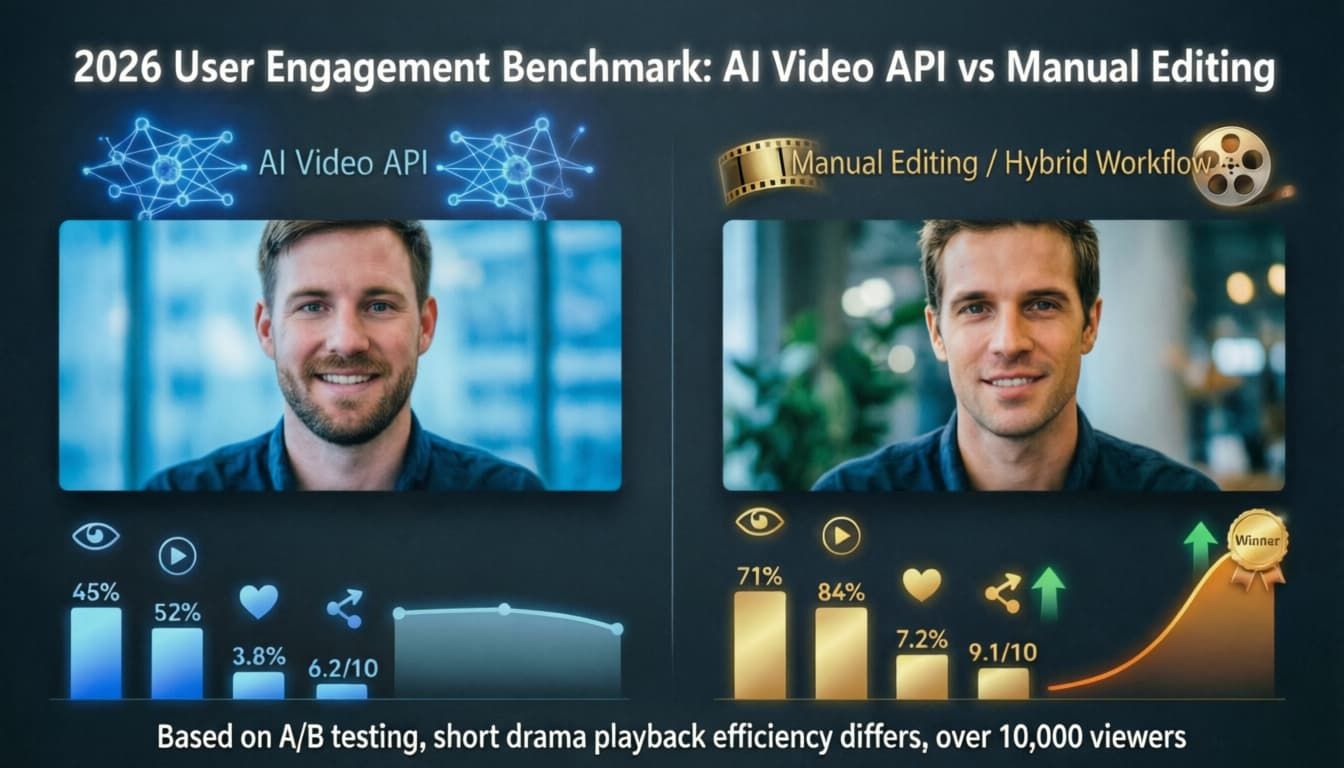
Expected Outcomes Comparison Table
| Video Production Method | Expected Engagement Outcome |
| AI Video API | Massive initial clicks, cheap views, highly localized conversions, but fast engagement decay over time. |
| Manual Editing | Slower initial launch, but strong watch times, deep audience trust, and a very long evergreen shelf-life. |
Basically, AI video APIs absolutely dominate short-term, high-volume performance metrics. But for long-term trust and evergreen conversions, manual editing is still your safest bet.
Industry Use Case Highlights: Real-World Engagement Results
I want to show you how these engagement metrics actually play out in the real world across a few different industries.
E-commerce / Performance Advertising
- Use case: A massive flash sale need produc promo videos for 100 different product SKUs within just 48 hours.
- Key Metric Performance: When looking at the key metrics—like CTR, ROAS, and overall variation performance—the AI video API clearly wins here. You simply plug your product catalog into the API. It automatically generates hundreds of distinct, customized videos almost instantly. If you try to do this manually, your editors will probably quit. It's just too much.
- Conclusion: The AI finds what viewers actually click on way faster than a human could. Sheer volume beats manual perfection in this specific space. People just want to see the product quickly.
E-learning / Training Content
- Use case: Localize a massive library of course videos into multiple different languages.
- Key Metric: Completion rate and comprehension rate.
- Conclusion: Translation hallucinations immediately degrade the learning experience and increase drop-off rates. The hybrid model—often called a Human-in-the-loop (HITL) approach—absolutely wins. The AI API handles the heavy lifting. It translates the text, generates the voiceovers, and adjusts the lip-syncing at scale. Then, a human QA tester steps in to review the final output. This keeps the production velocity super high without sacrificing the accuracy that learners really need.
Brand & Social Media
- Use case: High-volume weekly social content with big, quarterly flagship campaigns.
- Key Metric: Engagement rate, follower growth rate, and share rate.
- Conclusion: 70/30 allocation model. You let the AI API drive about 70% of your everyday, high-volume content. This keeps you relevant in the daily feed. Then, you save your budget to let human editors craft the remaining 30%. That 30% becomes your highly polished flagship content. It’s a pretty smart way to grow your audience while protecting your brand's core identity.
Real-World Industry Engagement Comparison Table
| Industry / Use Case | AI Video API (Real-World Results) | Manual Editing (Traditional Results) | Engagement Insight |
| E-commerce Promos | Scaled instantly, high ROAS. | Too slow, misses sale windows. | AI wins via coverage + volume |
| E-learning Localization | Fast voice/text translation. | Accurate but incredibly expensive. | Hybrid (HITL) balances speed with actual learner comprehension. |
| Social Media Management | Maintains daily posting volume. | High quality but low frequency. | A 70/30 split keeps followers engaged without losing trust. |
Looking at these real-world examples, it's pretty obvious that a single approach doesn't work for everything. You really have to match the production method to the specific industry goal to get the best engagement.
When Manual Editing Still Wins
- Dig Deep into Emotions Stories, Brand Film Cinematic: Manual editing is basically non-negotiable. A human editor just inherently feels the pacing better.
- Highly Regulated Industries: Like finance or healthcare. They absolutely require strict human review. You really can't risk an AI hallucinating a medical claim.
- One-off Premium Productions: When budget isn't a problem but absolute perfection is, human craft is still the standard.
Key Engagement Scenarios Where Manual Editing Wins
| Scenario | Why Manual Editing Wins | AI Video API Limitation | Engagement Impact |
| Emotional storytelling (brand films, documentaries) | Human control over pacing, tone, and narrative arcs | AI struggles with nuanced emotion and timing | Higher watch time + deeper audience connection |
| High-end commercials / flagship campaigns | Precision, originality, and cinematic quality | AI outputs can feel templated or repetitive | Stronger brand perception + memorability |
| Long-form content (YouTube, courses) | Advanced pacing, callbacks, and narrative structure | AI often loses coherence over longer durations | Higher completion rates |
| Creative direction & artistic vision | Editors/directors make intentional, subjective choices | AI relies on patterns, not true creative intent | More distinctive, standout content |
| Complex edits (multi-cam, VFX, storytelling layers) | Fine-grained control over every frame and transition | AI tools still limited in complex scene orchestration | Smoother viewing experience |
| Authenticity-driven content | Real human imperfections feel more trustworthy | AI-generated content can feel too polished” | Higher trust → better engagement |
| Brand-sensitive messaging | Humans can ensure tone, compliance, and nuance | AI may misinterpret context or tone | Avoids negative engagement |
| Unique, non-repetitive content | Every video can be fully original | AI often reuses structures/templates | Prevents audience fatigue |
| Award-level or viral storytelling | Crafted narratives can create “breakout” moments | AI optimizes patterns, not breakthroughs | Higher peak engagement potential |
Basically, when your project demands strict legal compliance, deep emotional connection, or absolute cinematic perfection, human editors are still your safest bet to protect brand trust.
The 2026 Verdict
- AI video APIs: It absolutely deliver superior engagement when you need massive scale.
- Manual Editing: It still drives much deeper engagement. It simply connects better on a real, human level.
- Smart Video Content Strategy: It actually combines both. You just have to choose the right approach for each specific video production project to truly maximize your overall results.
Decision Framework for Your Video Production Engine
-
Prioritize AI Video APIs:
- You publish more than 8 videos per month across any combination of platforms
- You run performance advertising campaigns requiring creative iteration
- You serve multilingual or multi-regional audiences
- Your content strategy depends on trend responsiveness or publish-speed advantage
- You are scaling content output without proportionally scaling headcount
-
Prioritize Manual Editing:
- Flagship brand campaigns and hero content
- Emotionally driven storytelling where nuance and craft are the product
- Highly regulated industries requiring granular human review at every stage
- One-time prestige productions where quality ceiling matters more than volume
-
Conditions for building a hybrid model:
- Both content tiers exist in your strategy — which, for most brands, they do
- You need AI APIs to sustain publishing frequency while human editors define brand voice
- Your team's creative capacity is the bottleneck, not your budget
📊 The 2026 Ruling — Final Engagement Verdict Table
| If you are… | Choose | Why it works for you |
| Running paid ads or growth campaigns | AI Video API | Scale, fast iteration, lower cost per winning creative |
| Managing social media content | Hybrid Model | Consistent posting + trend responsiveness |
| Building a brand or storytelling | Manual editing | Stronger emotional connection and brand perception |
| Producing high-end campaigns | Manual editing | Maximum creative control and polish |
| A startup or lean team | AI Video API | Faster output with limited resources |
| An agency or enterprise brand | Hybrid approach | Allows you to scale client work while keeping that vital human touch. |
| Trying to maximize engagement overall | Hybrid approach | Captures both fast algorithmic trends and deep, evergreen audience trust. |
Ultimately, the most successful content teams in 2026 use a flexible framework. They choose to hand over batch tasks to the API and save high-value stories for human creators.
FAQ
Q1: What is an AI Video API and how does it work?
An AI video API is basically a digital bridge for developers. It connects your app directly to powerful AI video models. You just send a text prompt or some raw data, and the API instantly generates a finished video. It completely automates the production process without human intervention.
Q2: How does an AI Video API compare to manual video editing?
It mostly comes down to sheer speed versus craft. An API prioritizes massive scale, instantly generating thousands of video variations using code. Manual editing relies on human editors using software to carefully piece together clips. It is much slower but offers way more creative control.
Q3: Do AI Video APIs generate better engagement than manual editing?
Yes, AI Video APIs generate significantly higher engagement for high-frequency social media and performance advertising. Because APIs allow for rapid A/B testing, you find winning hooks instantly. However, for deep, long-form content, human-edited videos still achieve better watch time. It really just depends on the specific format you are using.
Q4: When should I use an AI Video API instead of manual editing?
You should definitely use an API when you need raw volume. If your goal is to produce hundreds of localized ads, run large-scale A/B testing campaigns, or keep up a high daily publishing velocity on social media, an API is hands down your best option.
Q5: When is manual video editing still the better choice in 2026?
You should stick to human editors for the big stuff. If you are producing a highly emotional documentary, a premium flagship ad, or content for a strictly regulated industry, manual editing protects your brand. It simply prevents that awkward authenticity backlash.
Q6: Can AI Video APIs replace human video editors?
Not entirely. I think they mostly replace the boring, repetitive tasks that cause editor burnout. Smart teams use APIs to handle the high-volume busywork. This actually frees up your human editors to focus purely on high-end storytelling and overarching creative strategy. It's a collaboration.
Q7: Are AI-generated videos good for social media platforms like short-form video apps?
Absolutely. Algorithms on short-form apps really reward high posting frequency and rapid trend-reactivity. AI APIs let you iterate fast enough to catch those fleeting viral waves. A slow manual process would just miss the trend entirely. It's perfect for the current feed dynamic.
Q8: How do AI Video APIs improve video marketing ROI?
They drastically cut down your cost per engaged view. By generating hundreds of personalized ad variations for the exact same price as one manually edited video, you discover winning campaigns way faster. This lowers your customer acquisition costs and significantly boosts your overall return.
Quick FAQ Summary Table
| FAQ Topic | The Short Answer |
| API Basics | Automates video generation instantly via code. |
| Core Comparison | API wins on Speed/Scale. Manual wins on Craft/Control. |
| Best For API | Massive volume, personalization, and rapid A/B testing. |
| Best For Manual | Deep emotional storytelling and evergreen brand trust. |
| ROI Impact | Lowers cost per view by scaling variation testing. |
Let us show you the workflow
Not ready to integrate yet? See how leading brands access multiple leading video AI models through a single API—with no long-term contracts, no infrastructure investment, and no switching between platforms. Use AI video APIs to scale content output, reduce production costs, and increase platform engagement—without replacing your creative teams.
Request a demo → [Atlas Cloud] Set up and start in minutes. No credit card required.





