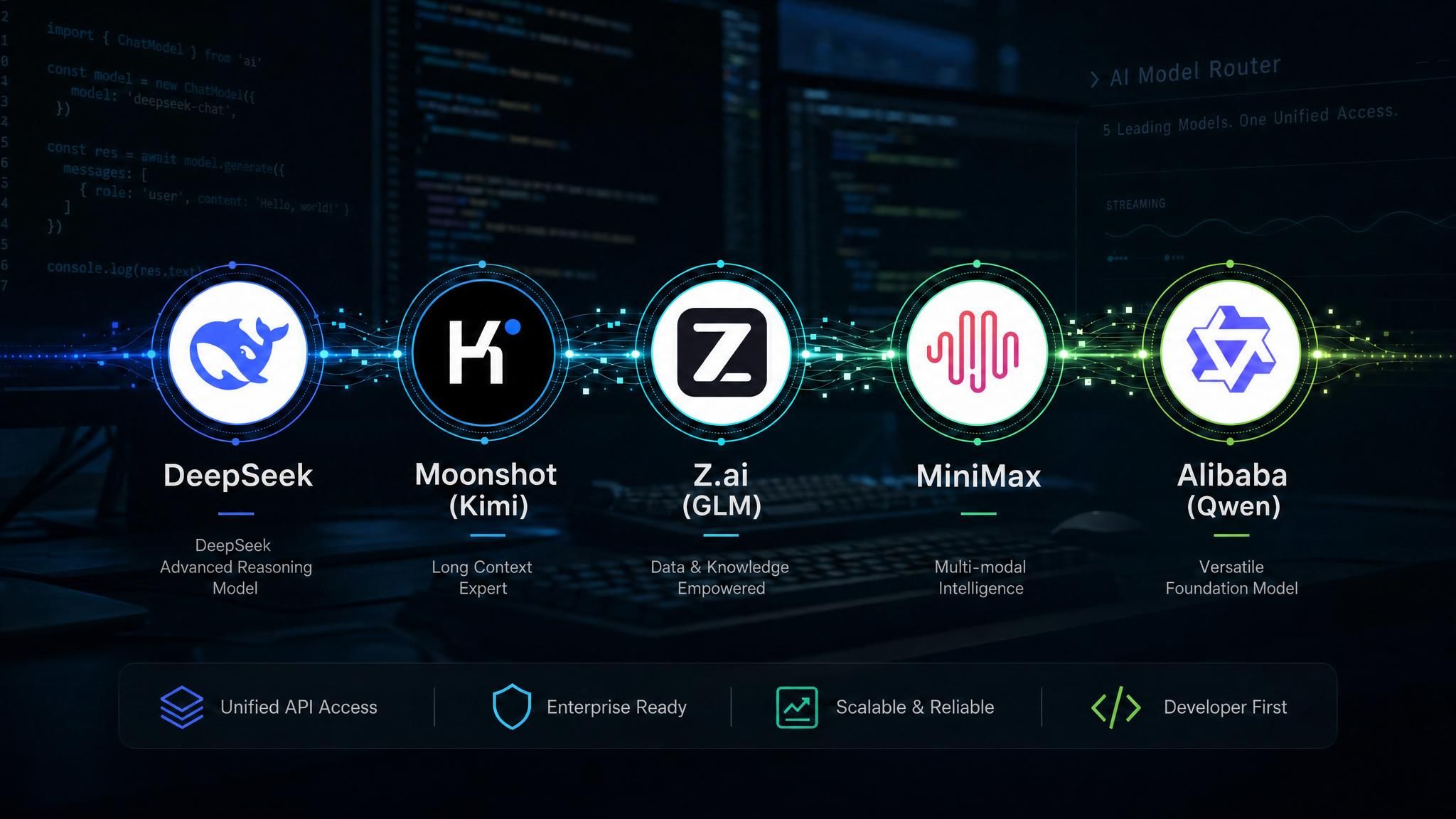
Chinese AI labs have quietly built some of the most capable open-source coding models available today. For developers who've only tracked the Anthropic and OpenAI side of the market, the breadth of what's now available from DeepSeek, Moonshot, Zhipu, MiniMax, and Alibaba is genuinely surprising.
The question worth asking in 2026 isn't whether these models are good. It's which one fits which workload, what it costs to run them at scale, and how to wire them into the tools you're already using. This guide covers all three: a lab-by-lab profile, a full specs and cost table, a practical use-case routing guide, and the setup configs for Claude Code, Codex, and OpenClaw.
Why the Best Open Source Coding LLMs Are Getting Serious Attention
The turning point was DeepSeek V3, released December 2024. It scored 89.1% on HumanEval and 42.0% on SWE-bench Verified, competitive with Claude 3.5 Sonnet and GPT-4o at the time, despite being open-source and using a Mixture of Experts architecture that activated only 37 billion of its 671 billion total parameters per forward pass (DeepSeek-V3 Technical Report, December 2024). The efficiency implied by that architecture explained why the inference costs were so dramatically lower.
That result pulled developer attention toward the broader Chinese open-source ecosystem. It turned out DeepSeek wasn't an anomaly. Moonshot AI's Kimi K2 series had been quietly leading on long-context benchmarks. Alibaba's Qwen2.5-Coder series was topping code-specific leaderboards. Zhipu's GLM-5 line was producing precise structured outputs that mattered for agentic pipelines.
The practical consequence for developers: five separate labs now ship models capable of handling production coding workloads, with open weights or commercial API access, at rates well below proprietary alternatives.
The Labs Behind the Best Open Source Coding LLMs
DeepSeek: Coding-First Design and MoE Efficiency
DeepSeek AI, founded in 2023 and backed by High-Flyer Capital (a Chinese quantitative hedge fund), built their coding focus into the model from the start. DeepSeek-Coder was among the first dedicated code generation models to draw serious attention from the open-source community. The V3 and V4 series broadened this into general reasoning while keeping the coding benchmark performance strong.
The MoE architecture is worth understanding because it explains the pricing. By activating only a fraction of parameters per token, the compute cost per request is significantly lower than a dense model of equivalent quality. That efficiency gets passed through to API pricing, which is why DeepSeek V4 Flash's input rate of 0.23 credits per thousand tokens is achievable without sacrificing quality on simpler tasks.
Moonshot AI (Kimi), Zhipu AI (GLM), MiniMax, and Alibaba (Qwen)
Moonshot AI (founded 2023, Beijing) built its reputation on long-context inference. The Kimi K2 series carries a 262K token context window and is designed for document-heavy and code-heavy tasks where fitting a large codebase into a single call matters.
Zhipu AI (founded 2019, spinout from Tsinghua University's KEG Lab) is one of the oldest Chinese AI companies. The GLM series has gone through five generations, each iteration improving structured output reliability and instruction following. GLM-5.1 reflects years of alignment work on precise task execution.
MiniMax (founded 2021) expanded from multi-modal work into coding models with the M2 series. MiniMax M2.5 and M2.7 cover a cost-to-quality range that fills the mid-tier well.
Alibaba's Qwen team built Qwen3.6-plus on top of a strong lineage of coding-focused models. The series has been consistently strong on multilingual code generation, and the 256K+ context window sits at the top end of available options (QwenLM GitHub, 2025).
Best Open Source Coding LLM Comparison: Context, Cost, and Specs
Here's the full table of current models sorted by input rate, so the cost structure is immediately readable:
| Model | Lab | Context | Input Rate | Output Rate | Cache Write | vs Official |
| DeepSeek V4 Flash | DeepSeek AI | 1M | 0.23 | 0.46 | 0.046 | -50% |
| DeepSeek V3.2 | DeepSeek AI | 160K | 0.42 | 0.62 | 0.193 | -55% |
| MiniMax M2.5 | MiniMax | 200K | 0.65 | 2.18 | 0.109 | -45% |
| Kimi K2.5 | Moonshot AI | 262K | 1.09 | 5.45 | 0.182 | -45% |
| Kimi K2.6 | Moonshot AI | 262K | 1.72 | 7.26 | 0.290 | -45% |
| GLM-5 | Zhipu AI | 200K | 1.82 | 5.81 | 0.363 | -45% |
| MiniMax M2.7 | MiniMax | 200K | 2.36 | 4.00 | 0.109 | -45% |
| GLM-5.1 | Zhipu AI | 200K | 2.54 | 7.99 | 0.472 | -45% |
| DeepSeek V4 Pro | DeepSeek AI | 1M | 2.87 | 5.75 | 0.231 | -50% |
| Qwen3.6-plus | Alibaba | 256K+ | 3.30 | 9.90 | 0.660 | -50% |
Rates are credits per 1,000 tokens. "vs Official" is the saving compared to each model's direct API rate.
A few things jump out. First, DeepSeek V4 Flash at 0.23 input and V4 Pro at 2.87 are from the same lab, making the difference a 12.5x multiplier between the cheapest and most capable tier within a single model family. Second, Kimi K2.5 at 1.09 input gives you a 262K context window at a mid-tier price, making it attractive for long-context work without jumping to the full V4 Pro rate. Third, the Qwen3.6-plus output rate at 9.90 is the highest in the group, suggesting longer, more thorough completions as a design characteristic.
Where Each Chinese Open Source Coding LLM Fits Best
This is the practical section. The rates above translate to real routing decisions when you're running an agentic coding session.
Lightweight and background tasks: DeepSeek V4 Flash
Docstrings, variable renaming, simple completions, format conversions, and all the utility calls that a coding agent makes automatically in the background. At 0.23 input and 0.46 output, this is the cheapest model in the group by a wide margin. When Claude Code routes background tasks through the Haiku model slot, pointing that slot to DeepSeek V4 Flash keeps the background noise cheap while your main session uses a more capable model.
Budget coding with solid performance: DeepSeek V3.2 and MiniMax M2.5
DeepSeek V3.2 carries the V3 architecture at a 55% discount off official rates with a 160K context window. For developers who want solid coding capability without paying full V4 Pro prices, V3.2 is a practical option. MiniMax M2.5 at 0.65 input fills a similar slot with a 200K window, useful when context matters more than the absolute lowest price.
Long-context workloads: Kimi K2.5 and K2.6
Both Kimi models offer 262K context windows. For passing large portions of a codebase, analyzing long conversation histories, or multi-file refactoring tasks where you need everything in one context, Kimi K2.5 at 1.09 input gives you the window without paying flagship prices. K2.6 (1.72 input) adds capability on top of K2.5's context advantage for cases where quality matters more than pure cost.
Structured output and instruction precision: GLM-5 and GLM-5.1
GLM models from Zhipu AI have a particular strength on instruction adherence. For pipelines that need reliable structured output (specific JSON schemas, formatted code artifacts, consistent API response shapes), GLM-5 at 1.82 and GLM-5.1 at 2.54 are worth testing against other models on these tasks. Their output rates are on the higher end, which reflects their tendency toward thorough, detailed completions.
Flagship reasoning: DeepSeek V4 Pro and Qwen3.6-plus
For complex architecture decisions, debugging multi-system interactions, or tasks where the quality of the first generation matters (because bad first drafts cause expensive retry loops), V4 Pro and Qwen3.6-plus are the top tier. V4 Pro's 1M context window is its headline spec; Qwen3.6-plus at 256K+ sits at the upper end outside the DeepSeek family.
Model Routing: The Most Underused Open Source Coding LLM Strategy
The highest-leverage optimization for developers using any of these Chinese open source coding LLMs isn't picking the best single model. It's routing different task types to different tiers within the same session.
Consider a typical agentic coding session: planning the approach (complex, needs V4 Pro), writing a core algorithm (complex, V4 Pro), generating test cases (mid-tier, MiniMax M2.5 or Kimi K2.5), writing docstrings for new functions (lightweight, V4 Flash), running file-read observations (lightweight, V4 Flash). If you used V4 Pro for everything, each of those flash-tier steps would cost 12.5x more than necessary.
The math gets concrete fast. Suppose 60% of your session's 50 API calls are simple tasks at an average of 2,000 input + 500 output tokens each. Running those on V4 Flash:
- Cost: 30 calls × (2,000 × 0.23 + 500 × 0.46) = 30 × (460 + 230) = 20,700 credits
Running the same 30 calls on V4 Pro:
- Cost: 30 calls × (2,000 × 2.87 + 500 × 5.75) = 30 × (5,740 + 2,875) = 258,450 credits
That's a 12.5x difference on those 30 calls alone. Model routing pays for itself immediately.
How to Pick the Best Open Source Coding LLM for Your Workflow
A decision tree that covers most developer situations:
You need maximum context per request: DeepSeek V4 Pro (1M) or Qwen3.6-plus (256K+). Both handle large codebase inputs without chunking.
Cost is the primary constraint: DeepSeek V4 Flash for simple tasks, DeepSeek V3.2 or MiniMax M2.5 for mid-complexity work.
You need reliable structured output: Start with GLM-5.1 and test it against your specific schema requirements.
You're building a multi-step agentic pipeline: Route by step complexity. Use Flash for utility steps, Kimi K2.5 or GLM-5 for mid-tier reasoning, V4 Pro for planning and debugging.
You want a single model to try first: DeepSeek V4 Pro is the natural default for developers evaluating Chinese LLMs for the first time. It's well-documented, has the broadest community coverage on (r/LocalLLaMA), and delivers flagship coding quality.
The practical catch: routing between models efficiently requires that all of them sit behind the same API key and base URL. Maintaining ten separate API accounts is not feasible. This is what a unified gateway solves: one endpoint, one key, model selection is a parameter.
Running the Best Open Source Coding LLM in Your Coding Tools
Atlas Cloud Coding Plan puts all ten models covered in this guide behind a single API key and base URL, at 45-55% below their direct API rates. The setup for each major coding tool follows.
The base URL note to save you a debugging session: Claude Code uses https://api.atlascloud.ai without the /v1 suffix. Every other tool (Codex, OpenClaw, OpenCode, Cursor) uses https://api.atlascloud.ai/v1 with the suffix. Getting this wrong produces authentication errors that don't point directly at the cause.
Claude Code (~/.claude/settings.json on macOS/Linux):
plaintext1{ 2 "env": { 3 "ANTHROPIC_AUTH_TOKEN": "your-atlas-api-key", 4 "ANTHROPIC_BASE_URL": "https://api.atlascloud.ai", 5 "ANTHROPIC_MODEL": "deepseek-ai/deepseek-v4-pro", 6 "ANTHROPIC_DEFAULT_HAIKU_MODEL": "deepseek-ai/deepseek-v4-flash", 7 "ANTHROPIC_DEFAULT_SONNET_MODEL": "deepseek-ai/deepseek-v4-pro", 8 "CLAUDE_CODE_DISABLE_EXPERIMENTAL_BETAS": "1" 9 } 10}
The ANTHROPIC_DEFAULT_HAIKU_MODEL field maps to Claude Code's background task slot. DeepSeek V4 Flash there means all automatic utility calls (file reads, status checks, observations) use the cheapest available model. Your main prompts use V4 Pro. You get automatic model routing without any routing logic.
To swap to GLM-5.1 instead of V4 Pro, change deepseek-ai/deepseek-v4-pro to zai-org/glm-5.1 in the two Sonnet/main fields.
Codex (~/.codex/config.toml + ~/.codex/auth.json):
plaintext1model_provider = "atlas_coding_plan" 2model = "deepseek-ai/deepseek-v4-pro" 3 4[model_providers.atlas_coding_plan] 5name = "atlascloud" 6base_url = "https://api.atlascloud.ai/v1" 7wire_api = "chat" 8requires_openai_auth = true
plaintext1{ 2 "OPENAI_API_KEY": "your-atlas-api-key" 3}
OpenClaw: Run openclaw onboard, select QuickStart, then Custom Provider. Enter https://api.atlascloud.ai/v1 as the base URL, paste your key, then enter the model ID (e.g. moonshotai/kimi-k2.5) and choose OpenAI-compatible protocol.
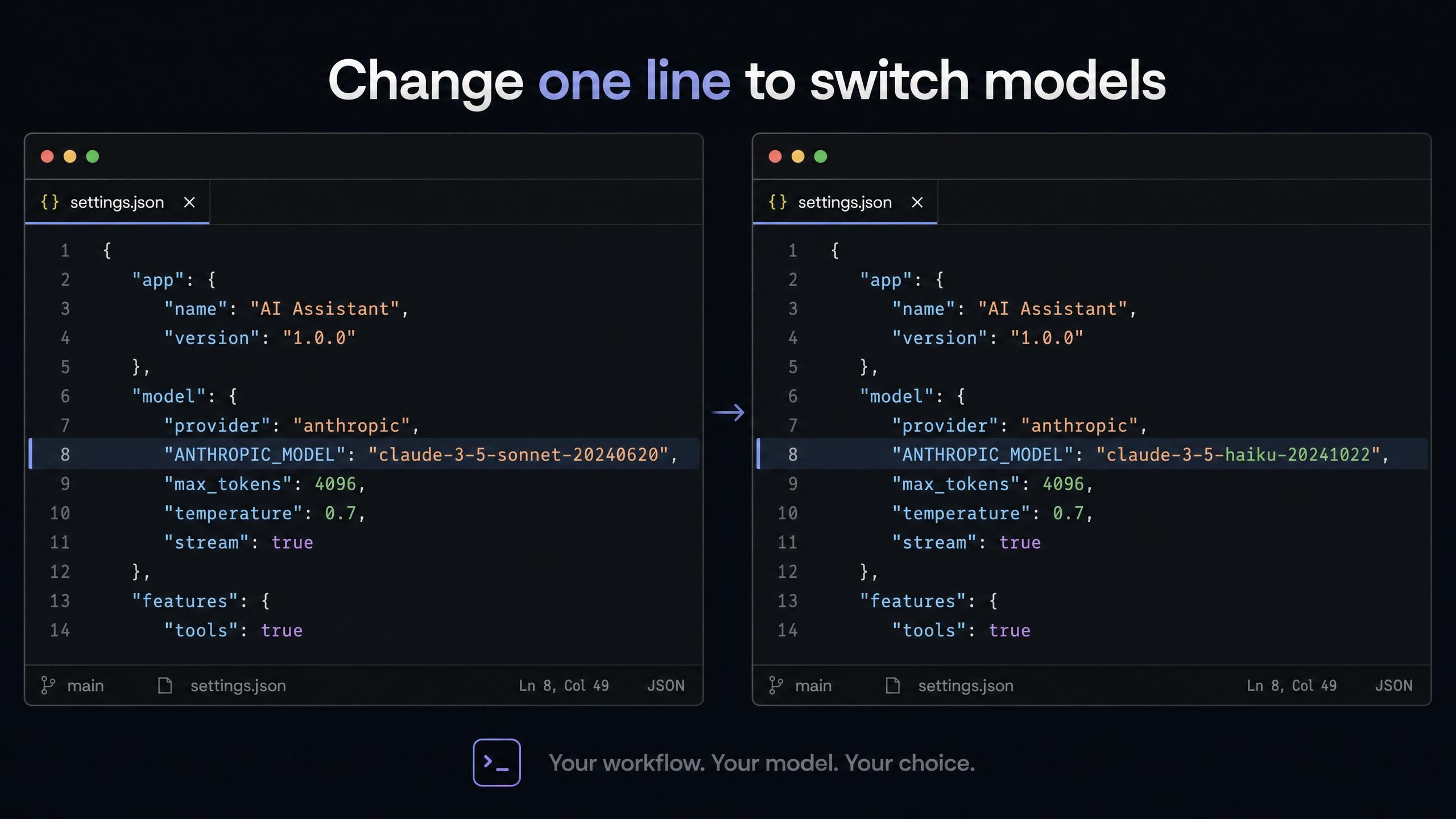
Switching models in any of these setups is a one-line change. The API key and base URL stay the same regardless of which model you select.
Best Open Source Coding LLM: Common Questions
Is DeepSeek actually the best open source coding LLM?
For most developers starting out, DeepSeek V4 Pro is the natural first choice based on community coverage, benchmark track record, and the combination of a 1M context window with competitive pricing. But "best" depends heavily on your task type. For long-context work, Kimi K2.5 or K2.6 offers 262K tokens at a lower rate. For structured output tasks, GLM-5.1 deserves testing. The point is that "best" changes depending on what you're building.
How do these models compare to Claude Sonnet or GPT-4o on coding?
On standard coding benchmarks, the gap between top open-source models and proprietary US models has narrowed considerably since 2024. DeepSeek V3 matched Claude 3.5 Sonnet on several benchmarks at its release. Where proprietary models still hold an edge is on nuanced instruction interpretation and tasks that benefit from extensive RLHF tuning. For the large majority of code generation, refactoring, and debugging tasks, the practical difference for most developers is small.
Can I use multiple open source coding LLMs in the same pipeline?
Yes. When all models share a base URL and API key through a gateway, you can specify a different model ID per request. In practice this means you can use DeepSeek V4 Flash for one step, Kimi K2.5 for another, and V4 Pro for a third, all within a single automated workflow, without managing multiple accounts or authentication contexts.
Which model should I try first if I've never used a open source LLM?
Start with DeepSeek V4 Pro. It has the most documentation, the broadest community discussion, and the clearest performance profile. Once you've established a baseline on your actual tasks, test Kimi K2.5 on context-heavy steps and DeepSeek V4 Flash on background utility calls. The cost difference between those two tests will show you whether model routing makes sense for your workflow.
Are open source LLMs safe to use for enterprise code?
This depends on your deployment model. For API-based access through a third-party gateway, the data handling policies of that gateway apply. Open weights models that can be self-hosted give you complete control over where code goes. Developers on r/LocalLLaMA have discussed this extensively, and the consensus is that API-based use needs the same data handling scrutiny you'd apply to any third-party API, not a special category of concern.
The Bottom Line on the Best Open Source Coding LLMs
Five labs now ship models capable of handling serious production coding work, and they span a wide enough cost and capability range that one-size-fits-all model selection is leaving money on the table.
The practical playbook: pick a gateway that gives you access to all of them under one key, establish your baseline on DeepSeek V4 Pro, then use the routing guide above to shift simpler tasks to cheaper tiers. For most developers running agentic coding sessions, that routing alone cuts costs significantly without changing output quality on the tasks that matter.
Model specs and rates based on Atlas Cloud Coding Plan documentation as of May 2026. DeepSeek V3 benchmark figures from the DeepSeek-V3 Technical Report, December 2024. Rates are subject to change; verify current figures with each provider before committing to a billing decision.





