We have moved past the era of simple "vibe checks," where a single impressive cinematic shot was enough to justify a subscription. Today, enterprise success depends on transitioning from manual prompt-to-video experimentation to a programmatic, cost-efficient pipeline.
The stakes of choosing the wrong provider are higher than ever. A poorly vetted API doesn't just result in "third-hand glitches" or distorted physics; it can lead to catastrophic financial drain. Without a rigorous evaluation of token usage and concurrency, businesses often face "bill shocks"—with some reporting surprise compute invoices exceeding $5,000 in a single month due to inefficient scaling.
AI API Evaluation Checklist
Before you pay your first major bill, ensure your chosen vendor checks these critical boxes:
| Category | Primary Metric | "Red Flag" (Avoid) | 2026 Gold Standard | Priority |
| Financial | True CPS (Cost-Per-Second) | Opaque "Credits" or hidden egress/polling fees. | Dynamic, transparent pricing for 1080p vs. Native 4K. | Critical |
| Technical | Temporal Coherence | "Soap opera" artifacts; merging textures; identity drift. | DiT architecture; 100% "Physical Logic" pass. | High |
| Performance | Concurrency & TTFB | High latency (>5s) or queuing during peak load. | <2.4s TTFB; H200/B200 high-throughput infra. | High |
| Legal | Digital Provenance | No IP indemnity; no C2PA metadata support. | SynthID watermarking + Enterprise IP Indemnity. | Critical |
| Operations | SDK Maturity | Raw REST only; generic "500" errors; polling-based. | Type-safe SDKs; Asynchronous webhooks; Support SLAs. | Moderate |
| Multimodal | AV Integration | Flat mono audio; visible lip-sync lag/desync. | Native 3D Spatial Audio; Cinematic Lip-Sync. | Moderate |
| Strategy | Exit Path / ROI | Proprietary JSON schemas; no ProRes export. | Multi-API redundancy; Open standard containers. | High |
To avoid the "Shiny Object" tax, you must look beyond the marketing reel and audit the infrastructure that powers the pixels.
No. 1 The "True CPS": Cost-Per-Second Model
Transparency is the biggest hurdle when picking an AI video API. Many providers hide actual costs behind vague "credits." Using a solid AI API evaluation checklist is the only way to build an honest budget.
Strategic Shift:
Moving from Abstract Credit Burning: where costs are hidden behind proprietary tokens → Unit Economics Precision: calculating exact Cost-Per-Second to forecast margins at scale.
Beyond Credits: The Real-World Currency: API providers often charge "5 credits" per generation, but if 100 credits cost $10, you are effectively paying $0.50 per clip. To conduct a proper API vendor risk assessment, you must convert these units into a Cost-Per-Second (CPS) metric. This allows you to compare vendors on an even playing field, regardless of their internal currency.
The 4K Premium vs. Upscaling: Higher resolution directly impacts your bill. In 2026, native 4K rendering typically carries a 2.5x–4x overhead compared to 1080p. For many applications, a more cost-effective strategy involves generating at 1080p and utilizing a separate upscaling pass.
| Resolution | Typical CPS Multiplier | Recommended Use Case |
| 720p (Draft) | 0.5x | Rapid prototyping |
| 1080p (Standard) | 1.0x | Most social media / Web |
| 4K (Native) | 2.5x - 4.0x | High-end production |
Identifying Hidden Surcharges: The headline price rarely tells the whole story. To avoid "bill shock," developers must audit for:
- Hidden egress fees: Charges for moving generated video data out of the vendor’s cloud.
- Polling fees: Costs associated with repeatedly hitting an endpoint to check if a video is finished.
- Storage retention: Fees for hosting your generated assets on their servers beyond 24 hours.
Prioritize vendors with transparent Data privacy (GDPR/SOC2) standards that don't monetize your data as a "hidden" discount. Always verify if the Rate limiting tiers align with your projected growth to ensure the API scales as fast as your user base.
No. 2 Temporal Coherence & "Physical Logic" Stress Tests
As models converge on visual fidelity, the true differentiator is temporal coherence—the ability to maintain structural integrity and physical logic over time. A high-quality API must pass rigorous "stress tests" to ensure it can handle the complexity of professional workflows.
Strategic Shift:
Moving from Visual Aesthetics: judging a still frame’s beauty → Physical Intelligence: auditing the model’s ability to respect gravity, torque, and structural persistence.
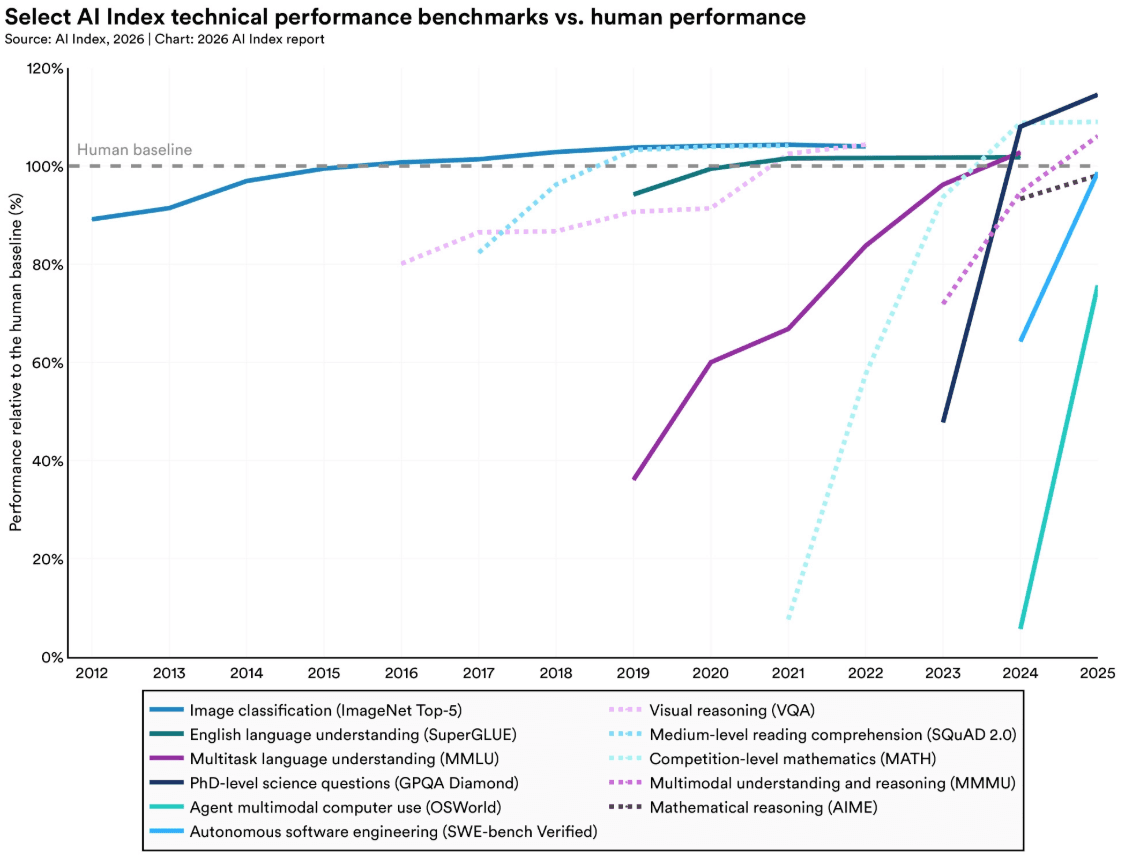
The "Unscrewing a Bottle" Test: Many APIs struggle with "hand-object" logic, leading to clipping or merging textures. High-performing models, such as Google’s Veo 3.1, now utilize diffusion transformer (DiT) architectures to simulate buoyancy and torque with startling accuracy. According to the 2026 AI Index Report, frontier models have improved their "physical reasoning" scores by nearly 30% in the last year alone.
Character Consistency & "Agentic AI": For Agentic AI storytelling, the API must maintain a character’s identity across multiple calls. When conducting an API vendor risk assessment, test for "identity drift." Can the model hold a consistent facial structure across five separate generations? Leading platforms like Kling 3.0 currently lead this category, offering specific "character lock" parameters in their API payloads.
Motion Smoothing vs. Raw Generation: Distinguish between raw temporal stability and post-process motion smoothing. Some vendors hide jittery outputs behind built-in frame interpolation. This helps keep the API stable and the video smooth, but it often causes weird "soap opera" glitches. You should check the raw frames in your evaluation. Make sure the movement looks natural and natural rather than just a digital blur.
No. 3 Latency vs. Throughput: The Developer’s Dilemma
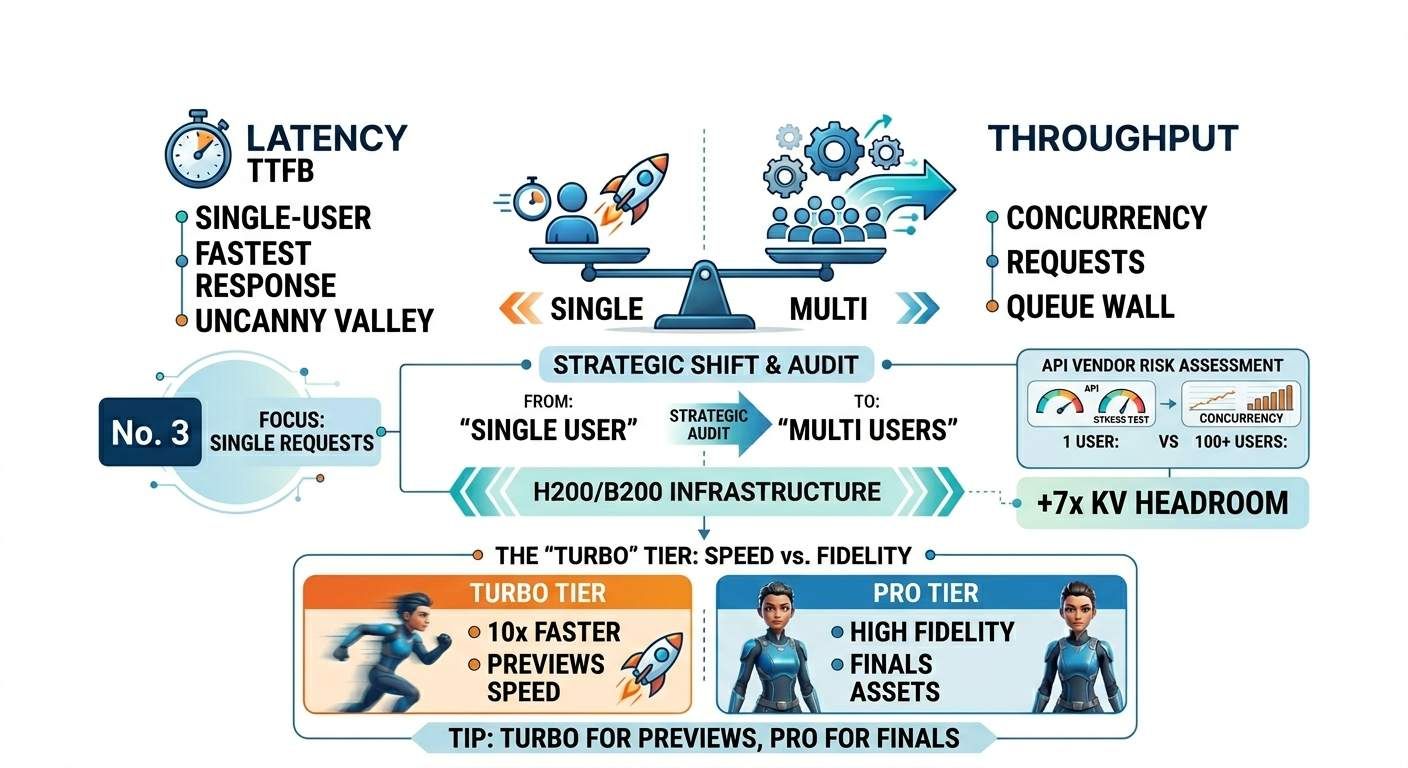
Developers have to balance latency and throughput. Latency is just how fast one request kicks off. Throughput is how much work the system does at the same time. Finding that middle ground is a big part of the job. Failing to audit these can lead to a broken user experience or hitting a "queue wall" during peak traffic.
Strategic Shift:
Moving from "How fast is one clip?": Single-user speed → "How deep is the queue?": Concurrency resilience and KV cache headroom during traffic spikes.
TTFB and the "Real-Time" Avatar Standard: For interactive applications like live digital twins or "Agentic AI" customer service, Time to First Byte (TTFB) is the critical metric. Any latency exceeding this threshold risks breaking the "uncanny valley" of real-time interaction.
Concurrency Limits & Scalability: Risk check for any API vendor has to include a real stress test. When 100 people arrive at once, a provider's claim of a 10-second wait time for one person may not hold true. Top-tier platforms use H200 or B200 hardware to stay fast. These newer chips handle much more data at once than older ones. This keeps your users from getting stuck in long lines when the app gets busy.
The "Turbo" Tier: Speed vs. Fidelity: Most vendors offer a dual-tier model: a "Standard" or "Pro" tier for final production and a "Turbo" or "Flash" tier for rapid iteration. While Turbo tiers can be up to 10x faster, they often sacrifice temporal stability and fine-motor physics.
Tip: Prioritize a "Turbo" workflow for real-time previews and reserve the "Pro" tier for high-bitrate, finalized assets to balance cost and performance.
No. 4 Legal Indemnity & Digital Provenance
With the EU AI Act’s Article 50 transparency obligations now in full effect as of 2026, failing to audit a provider’s legal and provenance standards can expose an enterprise to secondary liability for "orphaned data" or secondary copyright infringement.
Strategic Shift:
Moving from "Move fast and break things": Risking IP litigation → Immutable Compliance: Enforcing C2PA metadata and SynthID watermarking as a prerequisite for distribution.
Copyright Safety & Enterprise Indemnity: When performing an API vendor risk assessment, the presence of a "Copyright Indemnification" clause is non-negotiable. Major 2026 providers like the Adobe Firefly API offer solid business-grade safety. They promise to back you up if a third party makes an IP claim against your work. Just remember, this deal usually only stays valid if you don't change the final file yourself.

SynthID & C2PA: The "Provenace Stack": To comply with the Ethical AI Reporting Act (2026), APIs must support a two-layer identification system.
- C2PA Metadata: A cryptographic manifest that records the "chain of custody." While essential, C2PA can be stripped; therefore, it must be paired with invisible watermarking.
- Invisible Watermarking SynthID: Integrated into Google’s Veo models, SynthID embeds an algorithmic signature directly into pixels, making it resilient to cropping and compression.
The Data "Opt-Out" Audit: To protect proprietary brand assets and actor likenesses, verify the provider’s Data Privacy (GDPR/SOC2) training policy. Leading enterprise licenses now default to "Opt-Out of Training," ensuring your uploaded creative briefs or logo files are not ingested into the vendor's next foundation model. Always confirm this "training toggle" is contractually locked in your Support SLA.
No. 5 The Documentation "Health Check"
The quality of documentation is often the best predictor of your long-term engineering overhead. A "shiny" demo is meaningless if your developers spend weeks troubleshooting a raw REST endpoint without a proper SDK.
Strategic Shift:
Moving from Wrapper-Style API Keys: Basic REST calls → Production-Grade SDKs: Type-safe, asynchronous architectures with granular error handling for 99.9% uptime.
SDK Maturity and Developer Experience: A robust AI API evaluation checklist must prioritize SDK maturity. Top-tier providers offer native, type-safe libraries for Python and Node.js. Platforms with dedicated SDKs reduce "time-to-first-render" by an average of 65% compared to raw HTTP implementations.
Precision in Error Handling: Generic "500 Internal Server Error" codes are unacceptable for production-grade scaling. Your API vendor risk assessment should verify that the API distinguishes between different failure modes.
| Error Category | Expected Code/Detail | Significance |
| Content Safety | SAFETY_FILTER_TRIGGERED | Indicates prompt or output violates policy. |
| Infrastructure | GPU_TIMEOUT / CAPACITY_EXCEEDED | Signals provider-side scaling issues. |
| Financial | INSUFFICIENT_CREDITS | Essential for automated billing alerts. |
Asynchronous Webhook Support: "Polling"—manually checking if a video is finished—is an anti-pattern that leads to unnecessary latency and hidden costs. Reliable APIs must support asynchronous webhooks. This architecture ensures that once a render is complete, the server "calls" your application immediately. This reduces server load and is a standard requirement for maintaining high API uptime and meeting rigorous Support SLAs.
Tip: Ensure the provider offers a sandbox environment to test these webhooks and check for Developer community support via active Discord or GitHub channels. This ecosystem is vital for resolving edge cases that aren't covered in the static docs.
No. 6 Native Audio-Visual Integration
Top AI video APIs now include built-in sound and video syncing. This stops you from having to fix audio in a bunch of different tools later. Still, some providers do this much better than others. You really need to put this at the top of your testing list before you commit.
Strategic Shift:
Moving from Fragmented Post-Production: Manually syncing audio in external tools → Multimodal Synchronicity: Native, zero-latency alignment of cinematic soundscapes and lip-syncing.
Lip-Sync Accuracy and Latency: The hardest test for native audio is how well the lips sync up. You have to check if the sounds in the track match the mouth movements exactly. Make sure the speech and the video stay perfectly in step during your testing. Veo 3.1 currently leads in cinematic realism and native dialogue synchronization, whereas models like Kling 3.0 are favored for rapid iteration in social-first "Agentic AI" content.
Spatial Audio and 3D Soundscapes: Basic APIs only give you flat mono or simple stereo sound. Better tools like Sora 2 Pro create 3D audio that changes with the camera and object depth. This "room sound" makes sure that a car moving from left to right sounds like it is actually traveling that way. It uses real timing to make sure the noise matches what you see on the screen perfectly.
Multi-Language Nuance and Cultural Context: High-quality APIs do more than just translate English prompts. They respect local culture, like the right clothes, gestures, and building styles. AI models are improving, but they still miss the mark on rare languages and local vibes. You really need to double-check if the API's training data fits the actual people you are trying to reach. Always make sure the tool understands the specific culture of your global audience before you dive in.
Tip: Before committing to a vendor, request a sample of "complex interaction" audio—such as a character speaking while eating—to ensure the physical logic of the mouth remains consistent with the audio output.
No. 7 The "Scale-Down" Path (Fallback Strategy)
The final pillar of a robust API vendor risk assessment is the exit strategy. In the shaky 2026 AI market, getting stuck with just one provider is a big risk for your business. Your setup needs to be flexible enough to switch fast if a service goes down or prices suddenly jump. You have to stay ready to move so your work doesn't stop when a vendor has problems.
Strategic Shift:
Moving from Vendor Lock-in: Being hostage to one provider’s pricing → Infrastructure Portability: Maintaining a multi-API redundancy layer with a clear Human-vs-AI ROI threshold.
Multi-API Redundancy and Portability: Check how much custom code you need to write to make things work. Some providers use secret prompt rules or weird file formats that lock you in. If that happens, switching from Veo 3.1 to Kling 3.0 during a crash could take weeks. Look for vendors that use open standards or simple tools that work with everything. This keeps your system running smoothly even if one provider goes down.
To avoid vendor lock-in, leading enterprises are migrating to Atlas Cloud’s unified inference layer. By decoupling the AI model from the compute provider, Atlas Cloud allows developers to swap between different video APIs, e.g., transitioning from a high-cost model to a 'Turbo' tier, via a single integration point, maintaining high API uptime even if a primary vendor faces a regional outage.
Export Flexibility: Avoiding Data Silos: Verify that you own the raw assets. Some platforms attempt to lock users in by offering optimized playback only through their proprietary web players. Ensure your AI API evaluation checklist confirms support for industry-standard containers:
- Production: ProRes 422 or 4444 for high-end color grading.
- Distribution: H.265 (HEVC) or AV1 for efficient web delivery.
- Metadata: Pick sidecar files for C2PA tracking and perfect subtitle timing.
The AI vs. Human ROI Calculator: Before paying a recurring bill, calculate your "Break-Even Volume." While APIs reduce time-to-market, high hidden costs and hidden egress fees can erode margins for low-volume projects.
| Feature | AI API Workflow | Professional Freelancer |
| Cost Basis | ~$0.15 - $0.40 / Second | $50 - $150 / Hour |
| Turnaround | Minutes (Scalable) | Days (Linear) |
| Best For | High-volume Social/Ads | Bespoke/Artistic Direction |
A simple ROI formula to follow:

If the API cost exceeds this threshold, you may need to scale down to a "Turbo" tier or reconsider a hybrid human-AI workflow to maintain profitability.
Conclusion: The "Pilot First" Mandate
Selecting the right infrastructure is a foundational decision that dictates your product's reliability and margin. In the 2026 landscape, the "Pilot First" mandate is essential: never commit to an annual contract without a 30-day "burn-in" period. This phase should include a 1,000-clip stress test to identify edge cases in physical logic and late-month rate limiting behavior that short demos often hide.
By treating your API vendor risk assessment as a technical audit rather than a creative experiment, you protect your workflow from "bill shock" and ensure your AI video pipeline remains a scalable asset rather than a financial liability.
FAQ
How do I calculate the "True CPS" if a vendor only provides credit-based pricing?
To avoid "bill shock," you must deconstruct the credit system into a time-based metric. Use the following formula to normalize your costs:

Enterprises using this formula discovered that "Standard" tiers often carry a hidden ~22% premium over "Turbo" tiers due to inefficient credit rounding.
What is the minimum legal requirement for AI video provenance in the EU?
Under Article 50 of the EU AI Act, providers must ensure outputs are machine-readable. In practice, this requires a dual-stack approach:
- C2PA Metadata: For cryptographic tracking of the asset's origin.
- SynthID Watermarking: For pixel-level identification that survives compression.
Can I run these APIs on my own infrastructure to save costs?
While most models are closed-source, platforms like Atlas Cloud offer a "Middle-Ground" solution. By using Atlas Cloud’s unified inference layer, you can:
- Reduce Latency: Leverage distributed B200 clusters.
- Avoid Lock-in: Switch between providers like Veo 3.1 and Kling 3.0 via a single API endpoint.
- Optimize ROI: This architecture can reduce egress fees by up to ~15%.
How do I test for "Physical Logic" before committing to a contract?
Request a "Stress Test" sandbox and run these three benchmarks:
| Test Name | Success Criteria |
| Torque Test | Objects (e.g., a wrench) must rotate without texture warping. |
| Fluid Dynamics | Liquid pouring must maintain volume and realistic splashes. |
| Identity Lock | Character features must remain constant across 5+ sequential calls. |