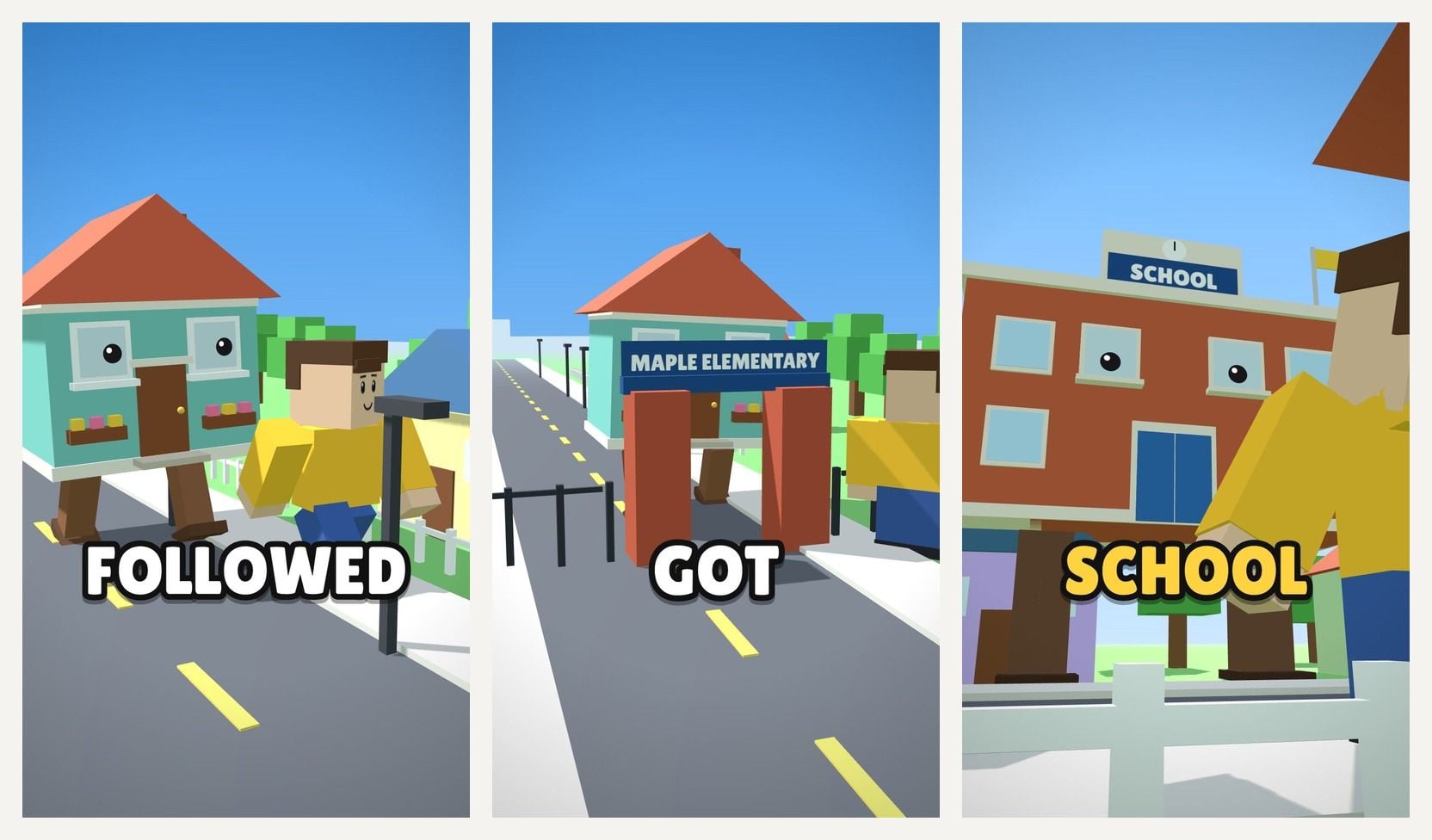
A blocky house stands up on two wooden legs and tiptoes after a boy all the way to school. It gets stuck in the gate. Twice. Nobody drew a single frame of it. Claude wrote the town, the characters, the camera moves and the captions as code, and an ordinary PC turned that code into 1,350 frames.
So, can Claude make animations? Yes, once you let it write code instead of asking it for a video file. That is how a fast-growing batch of Roblox-style "What if" shorts on TikTok and YouTube Shorts gets made this month. Below: where the trend came from, the free skills people use, how to add a narrator, and the full brief behind our own 45-second short.
Key Takeaways
- Yes, Claude can make animations by writing three.js or Canvas code, with no AI video model in the loop.
- The Claude-made Roblox "What if" shorts are drawn by code and rendered frame by frame on a home computer.
- Free Claude animation skills on GitHub supply the blocky look, the shot rules and the render scripts.
- When a setup pays for anything beyond Claude, it is usually the voice, and the ElevenLabs v4 playground covers it per request.
- Our test short took about 800 lines of code, six rounds of stills and zero hand-drawn frames.
Can Claude Make Animations? Yes, by Writing Code
Claude has no video model inside it. Ask for "an animation" and it writes a program that draws every frame: HTML and CSS, SVG, a Canvas script, a three.js scene, or Python that drives Blender. A renderer plays that program back one frame at a time and saves an MP4.
That is a different tool from an AI video generator, and the two are good at different things:
| Code animation (Claude writes it) | AI video model | |
|---|---|---|
| How a shot is made | Claude writes the scene, a renderer draws it | A prompt or photo goes to the model |
| Cost per render | Your computer's time | A per-second generation fee |
| Strongest at | Blocky, flat or graphic styles, charts, text | Realistic motion, light, skin and fabric |
| Repeat a character | Exactly, it is the same 3D model every time | Guided by reference images |
| Change one detail | Edit a number, render again | Write a new prompt, generate again |
Anthropic also has Claude Motion, which builds short explainer animations inside the Claude app. It sits on the Team and Enterprise plans, and our Claude video guide covers it. The Roblox trend runs on the code route through Claude Code.
The Roblox Animation Story Trend Behind the "What If" Shorts
You have probably scrolled past one. A blocky kid. One strange rule: "In this town, everyone has a clock on their chest," or "What if the internet shut down for 7 days?" A narrator who never stops talking, captions that pop one word at a time, one upbeat track under everything.
The format grew up inside Roblox, with scenes staged in the game. Much of the new wave fakes the Roblox look with code and never opens the game.
The "$0" part comes from one account. What If Sim describes itself as "3D what-ifs, made with Claude Code," and on November 3, 2026 it posted a Roblox-style short about its own process.
Five cards walk through it: one line typed into Claude Code, every shot plus the voice, "3D code, not AI video," every shot checked, then the laptop renders. The last card reads "Claude Code · paid plan" above "$0 extra per video." The caption counts 75 shots, 102 sound effects and zero animators.
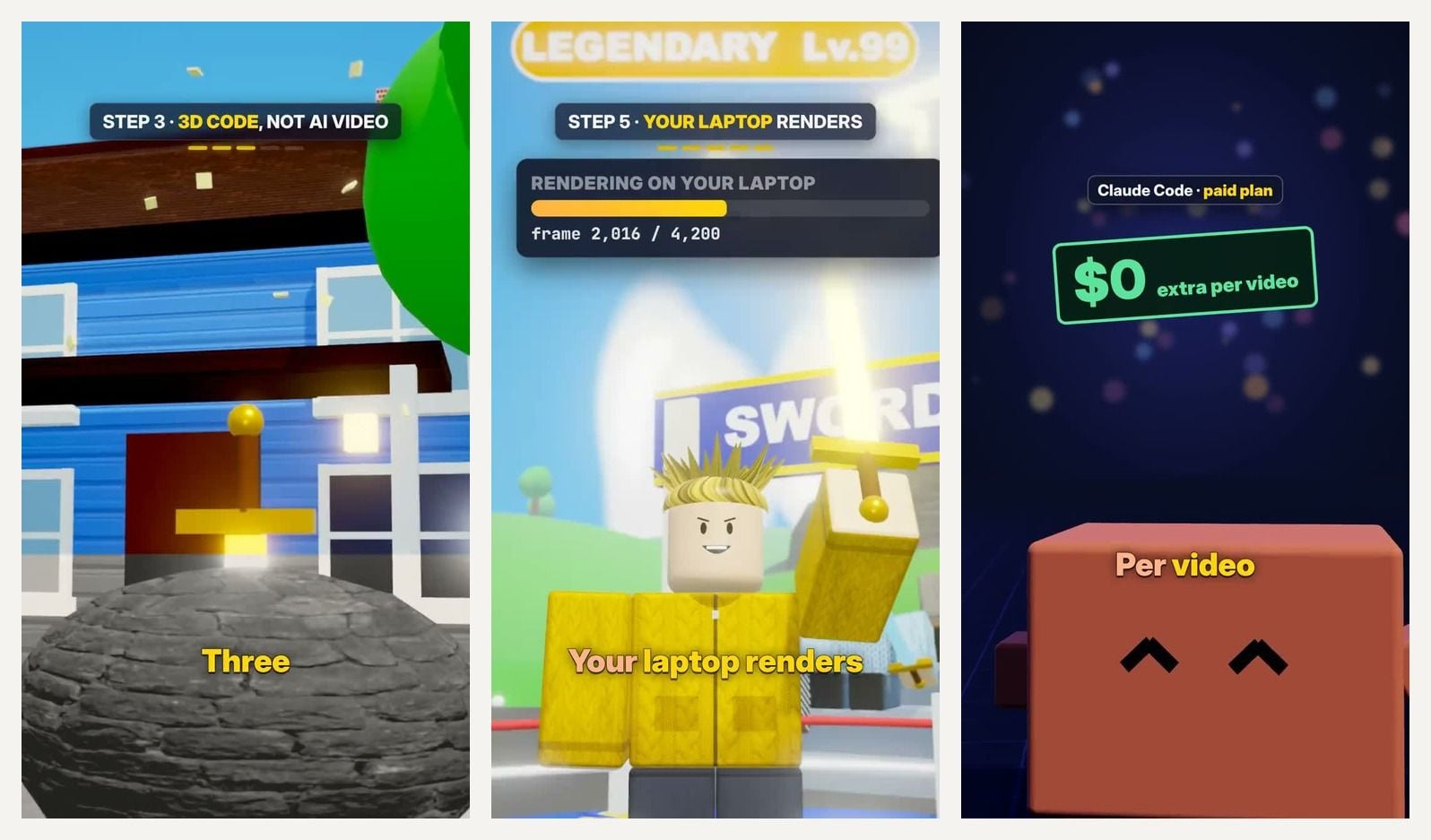
Frames from What If Sim's November 3, 2026 TikTok video, used for commentary.
Three days later the YouTube channel What If Animator posted a full Roblox workflow for Claude. Its description says the example short was "built 100% in code by Claude Opus 5.5," avatars and town included. The video had 119,000 views by November 25.
A brand-new TikTok account whose hero, Ben, visits a different town every day posted a short on November 12 that now has 1.4 million plays, and the account passed 310,000 followers about two weeks after its first post.
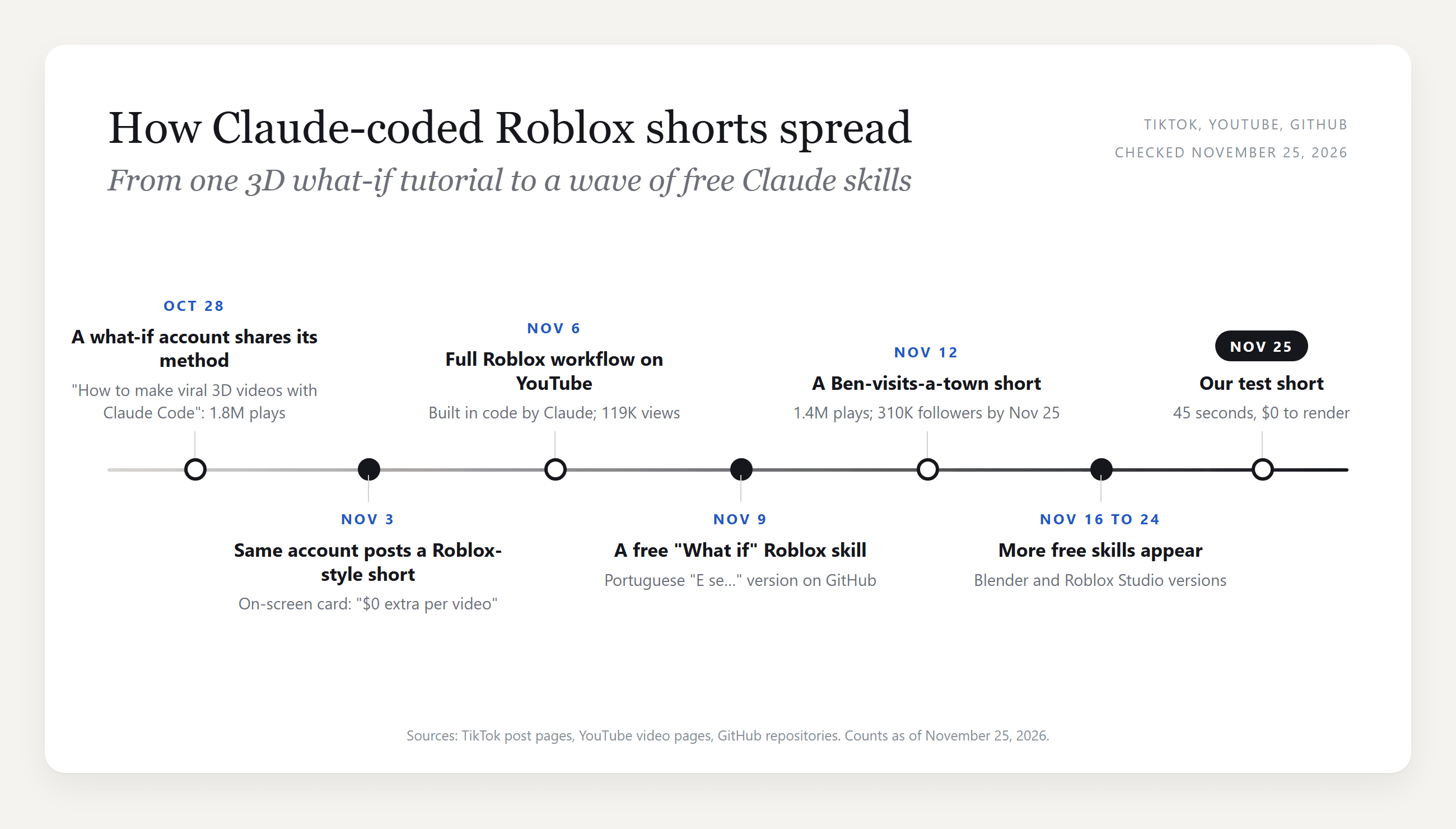
Read the "$0" carefully. It means no fee per generated video. Claude Code itself comes with the paid Claude plans and not the Free one, and several of the popular setups pay for the narrator's voice.
Give Your Claude Animation a Narrator With ElevenLabs v4 on Atlas Cloud
The picture can cost nothing. The voice is where these workflows usually spend money: What If Animator's kit lists a paid ElevenLabs plan as a requirement, and so does the Blender-based skill further down. Here is the narrator from our short, made in one request on Atlas Cloud:
The model is ElevenLabs v4, and you pay per request with no monthly plan. The script takes delivery tags in square brackets, so we opened with [excited], dropped to [softly] for the line about eleven years of watching, and went back to [excited] for the twist. The narration then sets the clock for the whole video: every new sentence in our short starts a new shot.
Method 1: Generate the Narration in the ElevenLabs v4 Playground
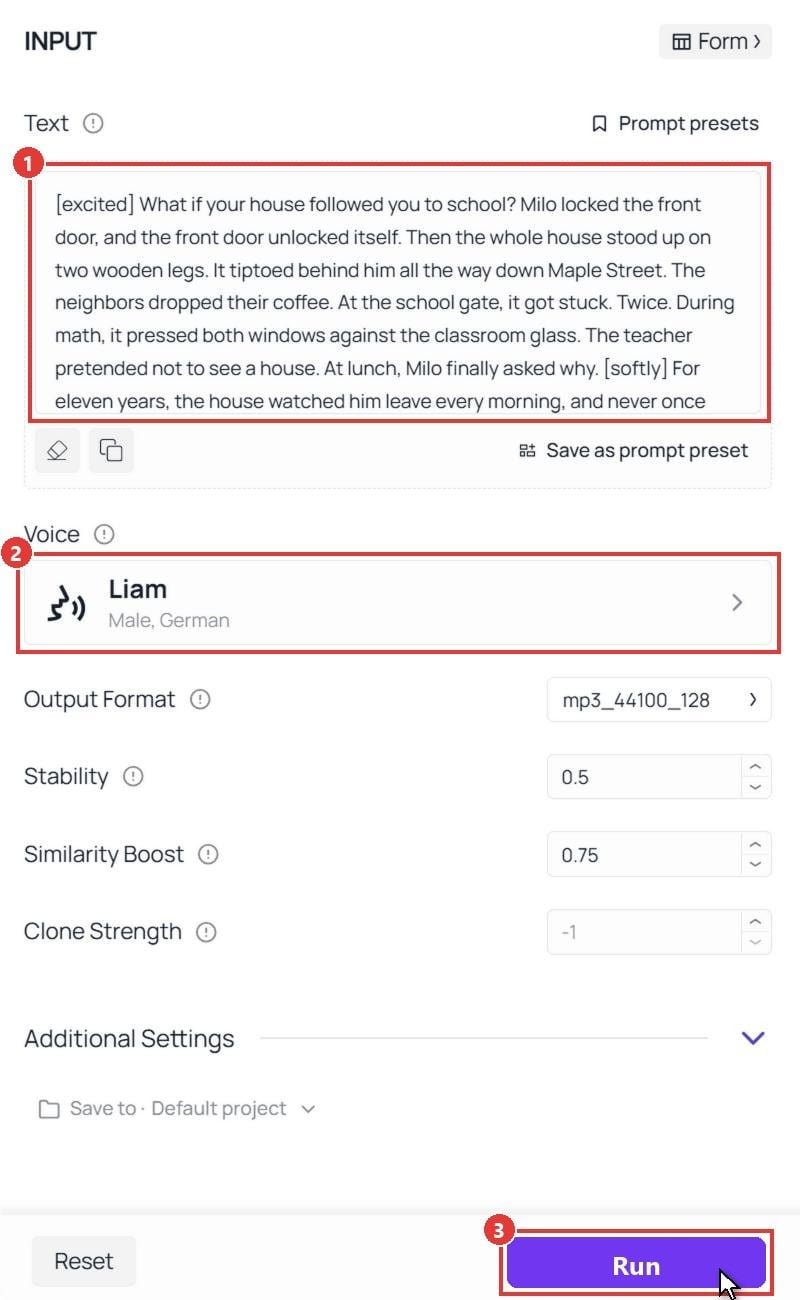
- Paste your script, delivery tags included, into the Text box of the ElevenLabs v4 text-to-speech page.
- Open the Voice picker and choose a voice. We used Liam, one of 21 presets.
- Click Run, then download the MP3 into your animation project folder.
Method 2: Let Claude Code Call ElevenLabs v4 Through the API
Claude Code can run these calls for you in the same session where it builds the scene.
Step 1: Create an API key. In the console, open Settings and create a key under API Keys.
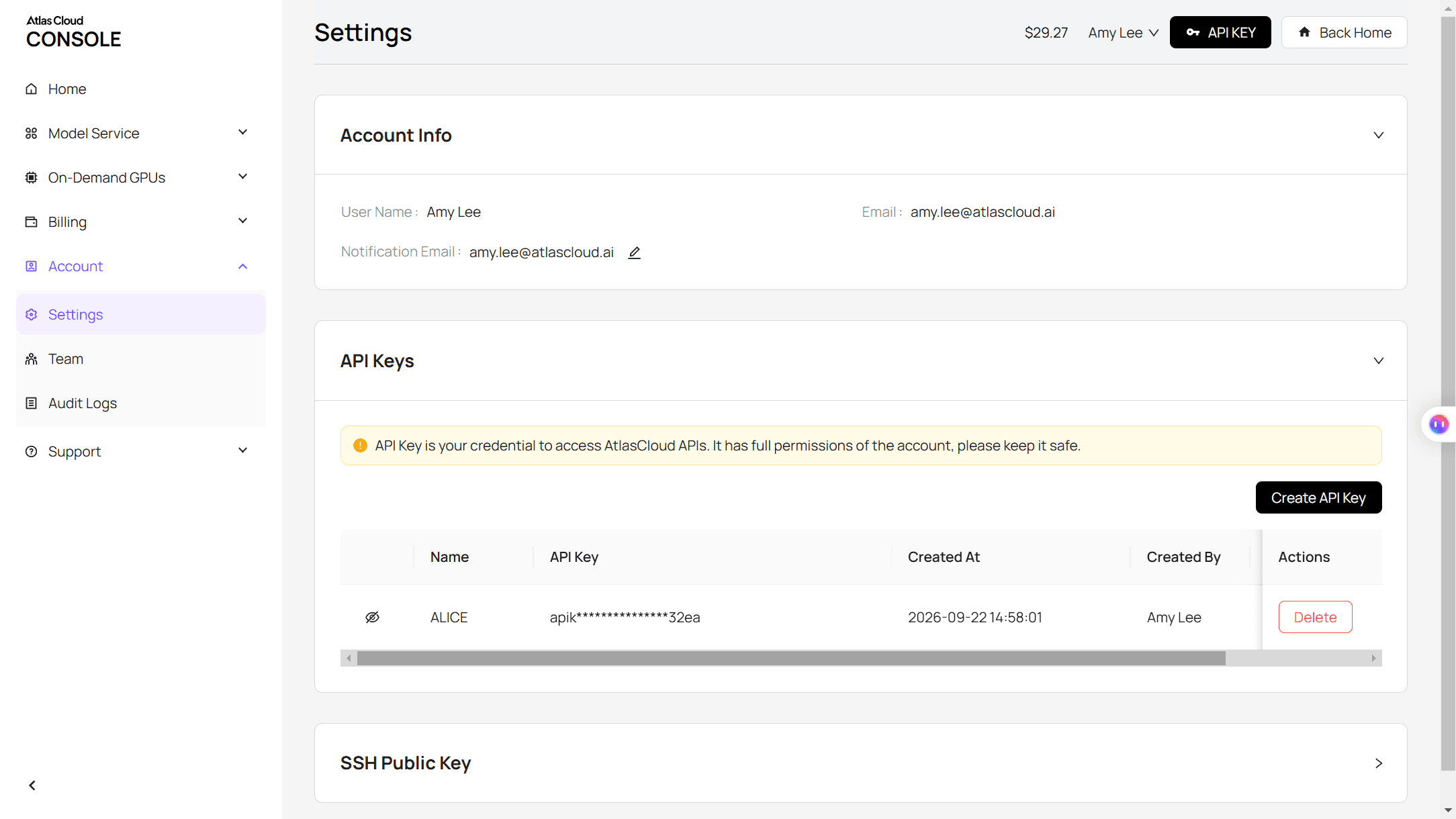
Step 2: Check the request format. The Atlas Cloud docs cover authentication and the request flow, and the API tab on the ElevenLabs v4 page lists every field. Keep one request under about 3,000 characters.
Step 3: Send the script and poll.
plaintext1curl -X POST https://api.atlascloud.ai/api/v1/model/generateAudio \ 2 -H "Authorization: Bearer $ATLASCLOUD_API_KEY" \ 3 -H "Content-Type: application/json" \ 4 -d '{ 5 "model": "elevenlabs/v4/text-to-speech", 6 "text": "[excited] What if your house followed you to school? ...", 7 "voice": "Liam", 8 "stability": 0.4, 9 "output_format": "mp3_44100_128" 10 }'
Poll the returned prediction ID until the status reads completed, then download the MP3 from the outputs array:
plaintext1curl https://api.atlascloud.ai/api/v1/model/prediction/<prediction_id> \ 2 -H "Authorization: Bearer $ATLASCLOUD_API_KEY"
Prefer to let Claude call the model without pasting commands? Add the Atlas Cloud MCP server once, and our MCP setup guide for Claude Code has the exact command. The same key and endpoint also reach the music models, so switching is a change to the model string.
How to Make a Roblox Animation Video With Claude Code
You need a paid Claude plan with Claude Code, Python, FFmpeg and Chrome. Plan on an afternoon for the first short. Most of that time is Claude building the town once; the next episode reuses it.
Step 1: Pick a skill or write a brief. A skill is a folder of instructions and scripts that Claude Code follows. The closest free match to this trend is Matheus Celtic's "E se…" skill, Portuguese for "What if."
It draws the blocky characters with code, uses the free edge-tts voice and renders 1080 by 1920 at 60 fps. The last section compares four more skills and our own brief. You can also skip skills and paste a brief like ours, further down.
Step 2: Lock the script and the voice before any 3D. Keep it near 120 words. The first sentence is the title and the rule.
What If Animator's formula hides the reason for the rule around 70 percent of the way in. End on a twist, then ask viewers a question they can answer in the comments. Generate the narration, then run it through speech-to-text with word timestamps. Those timestamps tell Claude where each cut falls and when each caption word pops.
Step 3: Build the town, then check a contact sheet. A Roblox-style person is six boxes: head, torso, two arms, two legs. Claude draws the face on a canvas texture, so a shocked face is a different drawing on the same head.
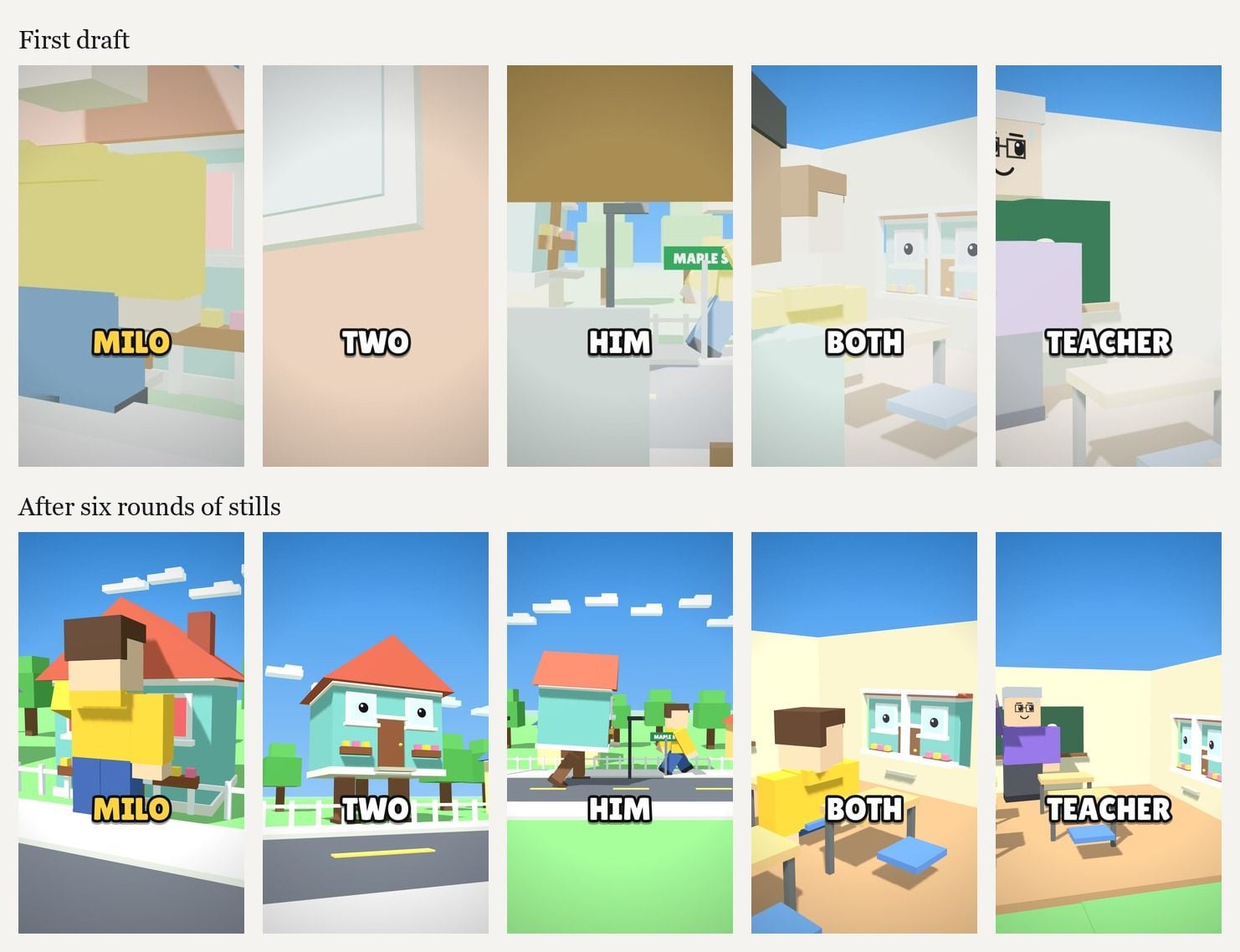
Before anything renders in full, ask for 15 to 20 stills in one grid. Our grids caught washed-out colors, cameras staring at walls and a school model parked in the middle of two shots. Six rounds of stills fixed all of it, each under a minute.
Step 4: Render every frame and mix the sound. Claude exposes a function that draws the scene at any time in seconds. A small script opens the page in headless Chrome, asks for each frame in turn and pipes the images straight into FFmpeg. Music and sound effects can be code as well: ours are numpy waveforms, with the music ducked under the voice whenever it talks.
Our Test: A Roblox-Style What If Short Claude Coded From Scratch
Here is the finished short. Turn the sound on.
The numbers: 45 seconds, 15 shots, 1,350 frames at 1080 by 1920 and 30 fps. Claude wrote a 592-line page for the scene, a 71-line render script and a 148-line sound script. The full render took 19 minutes on an ordinary PC using Chrome's software renderer, with no graphics card involved, under a second a frame. Nothing in the picture came from an image or video model.
What the contact sheets caught, so you can ask for these checks up front:
- Pale colors. three.js treated our hex colors as linear light. Turning on color management made the town look like a toy box.
- Narrow framing. A 9:16 frame sees far less side to side than its height suggests. Claude switched to framing each shot by how much of the world should fit across the screen.
- Floating heads. Every head hovered a clear gap above its shoulders until one number changed.
- A camera behind the houses. Wide street shots sat behind the row of houses across the road, so those houses now hide for those shots.
- Backwards text. The school's arch sign read in mirror image from the camera side.
Paste this brief into Claude Code to rebuild the same pipeline. It is our run written out as one prompt, and every number in it comes from the short above:
plaintext1Make a 45-second vertical Roblox-style "What if" short, 1080x1920 at 30 fps, drawn entirely in code. Do not use any AI image or video model. 2 3Story: "What if your house followed you to school?" Use this narration word for word: 4[excited] What if your house followed you to school? Milo locked the front door, and the front door unlocked itself. Then the whole house stood up on two wooden legs. It tiptoed behind him all the way down Maple Street. The neighbors dropped their coffee. At the school gate, it got stuck. Twice. During math, it pressed both windows against the classroom glass. The teacher pretended not to see a house. At lunch, Milo finally asked why. [softly] For eleven years, the house watched him leave every morning, and never once saw where he went. So they walked home together, slowly, under an orange sky. [excited] The next morning, Milo opened the door, and the school was standing in his yard. Which building should follow Milo next? 5 61. Voice first. Generate the narration with ElevenLabs v4 on Atlas Cloud (voice Liam, stability 0.4), then run speech-to-text with word timestamps. Save every word with its start and end time to timeline.json. Start a new shot on every sentence. 72. Build one HTML page with three.js. Characters are blocky: head, torso, two arms, two legs, with faces drawn on a canvas texture (neutral, smile, shock, worried, sad, question). The house is a character too: its two upstairs windows are eyes with pupils and a curtain that blinks, and two wooden legs grow out from under it. Add a red brick school that can also stand on legs. Pastel town: street, sidewalks, fences, box trees, block clouds. Turn on color management. 83. One shot per sentence, plus a close-up of Milo's shocked face for the reveal. Frame every shot for 9:16 by the width of world you want on screen. 94. Captions: one word at a time in Lilita One, white with a thick black outline, key words in yellow or red, a small pop on each word. End card: "Which building follows Milo next?" with a Comment below button. 105. Expose window.frameAt(t) that renders time t and returns a JPEG. Before the full render, show me a contact sheet of 20 stills and check it for cameras inside walls, cut-off characters, floating parts and mirrored text. Fix, then render every frame in headless Chrome and pipe the frames into ffmpeg. 116. Write the music and sound effects in numpy: a bouncy chiptune loop that drops to a soft pad for the sad line, house footsteps, two cartoon bonks at the gate, a mug crash, a door creak and a sting for the reveal. Keep the music about 12 dB under the voice and duck it while the narrator talks. Mux everything into one MP4.
Which Claude Animation Skill Fits Your Roblox Story?
Every option below is free to download. They differ in what draws the picture, what the voice costs and what else you have to install. The star count comes from GitHub on November 25, 2026.
| Skill | Draws the picture with | Voice | Also needs | Format |
|---|---|---|---|---|
| claude-shorts-roblox (Matheus Celtic) | Canvas code, rendered in Edge | edge-tts, free | Python, FFmpeg, Edge | "E se…" (What if), in Portuguese |
| roblox-in-this-town | Real Roblox Studio through its built-in MCP server | Free local voice or your own recording | Roblox Studio; first setup takes several hours | In this town |
| rblx-animates-skill | Blender 5.3 | ElevenLabs paid plan | Blender, tested on a Mac; about 5 hours per episode | Blox City, In this town |
| what-if-animation | SVG and Remotion | ElevenLabs | Node, Remotion | What If episodes of 15 to 25 seconds |
| claude-animated-shorts (4,825 stars) | three.js inside Remotion | Synthesized music and effects | Node, Remotion | 2D characters in a painted 3D town |
| Our brief above | three.js in headless Chrome | ElevenLabs v4 on Atlas Cloud | Python, FFmpeg, Chrome | What if |
Want the whole short at no cost beyond your Claude plan? The Celtic skill pairs a free voice with nothing more than Python, FFmpeg and a browser. Want real Roblox avatars and maps? roblox-in-this-town works inside Roblox Studio. Want the "What If" pacing without the blocky look? what-if-animation draws in SVG, and claude-animated-shorts puts 2D characters in a painted town.
Frequently Asked Questions
Is Claude good at making animations?
For styles that code can draw, yes. Blocky characters, flat graphics, charts and captions come out sharp, and a character looks identical in every shot because it is the same model. Our town needed six rounds of stills before it looked right, so plan on checking a contact sheet rather than rendering on the first try.
Can Claude Code make Roblox animations?
Two different things share that name. Roblox Studio has a built-in MCP server, so Claude Code can write Luau scripts and edit the place you are building. A code-drawn Roblox-style video, like our short, never opens Roblox: Claude draws lookalike blocky characters in three.js or Blender and renders a video file.
Which AI is best for animation?
It depends on the look. Code from Claude suits blocky, flat and graphic styles, and anything you will want to repeat exactly in the next episode. For realistic motion, people and lighting, an AI video model such as Seedance 2.5 is the better fit.
How much does a Claude animation cost?
Claude Code is included with Claude Pro at $20 a month, or $17 a month billed yearly, and it is not on the Free plan. Rendering on your own computer costs nothing per video. ElevenLabs v4 on Atlas Cloud was $0.08 per 1,000 characters as of November 25, 2026 (20% off the $0.10 list price), so our 732-character narration cost about six cents.
Can I use real Roblox characters and logos in these videos?
The code-drawn skills avoid them. Their instructions call for original characters and ask you to leave out real Roblox logos and other creators' characters, and the Portuguese skill labels its output fan animation with no tie to Roblox Corporation. Filming real avatars inside Roblox Studio is a separate case: the Roblox Studio skill notes that Roblox lets creators make and monetize videos of Roblox content, and tells you to check the current terms first.
Conclusion
The house that follows Milo to school was never filmed, hand-drawn or generated by a video model. It is about 800 lines of code that Claude wrote, a narration that sets the timing of every shot, and a contact sheet that caught the mistakes before the render did. That is the whole trick behind the Roblox "What if" wave.
Start small: one rule, about 120 words, one voice. Generate the narrator in the ElevenLabs v4 playground, paste our brief into Claude Code, and swap in your own story. When a friend asks whether Claude can make animations, send them the short you made this way.