MiniMax LLM Models
As a premier suite of Large Language Models (LLMs) developed by MiniMax AI, MiniMax is engineered to redefine real-world productivity through cutting-edge artificial intelligence. The ecosystem features MiniMax M2.5, which is purpose-built for high-efficiency professional environments, and MiniMax M2.1, a model that offers significantly enhanced multi-language programming capabilities to master complex, large-scale technical tasks. By achieving SOTA performance in coding, agentic tool use, intelligent search, and office workflow automation, MiniMax empowers users to streamline a wide range of economically valuable operations with unparalleled precision and reliability.
Explore the Leading MiniMax LLM Models
Atlas Cloud provides you with the latest industry-leading creative models.
What Makes MiniMax LLM Models Stand Out
Atlas Cloud provides you with the latest industry-leading creative models.
Frontier-Scale Reasoning
State-of-the-art language models built for deep reasoning, complex problem-solving, and multi-step planning.
Ultra Long-Context Understanding
Lightning-style attention and optimized architecture enable MiniMax models to process and retain long contexts,
Cost-Efficient MoE Performance
Mixture-of-Experts designs deliver high intelligence, low latency, and significantly better price-performance.
Versatile Model Family
From powerful general-purpose models to coding- and agent-optimized variants.
Enterprise-Ready Reliability
Stable, scalable infrastructure with monitoring and safety for production use.
Open & Developer-Friendly
Rich APIs, SDKs, and open-weight releases give builders flexibility to integrate, fine-tune, or self-host.
Peak speed
Lowest cost
| Model | Description |
|---|---|
| MiniMax M2.5 | MiniMax M2.5 is a flagship LLM optimized for real-world productivity, integrating advanced inference architectures with expansive 196.61K context processing capabilities; boasting SOTA performance in office automation and intelligent search, it serves as a high-efficiency engine for managing economically valuable tasks and complex general reasoning in professional environments. |
| MiniMax M2.1 | MiniMax M2.1 is a high-performance LLM tailored for complex technical challenges, integrating significantly enhanced multi-language programming with robust 196.61K context processing; boasting exceptional precision in agentic tool use, it serves as the foundation for building sophisticated task-scheduling Agents and solving intricate, large-scale engineering problems. |
| MiniMax M2 | MiniMax M2 is a SOTA general-purpose LLM, integrating highly efficient reasoning modules with expansive 196.61K context processing capabilities; boasting competitive versatility across coding, search, and professional workflows, it serves as a reliable cornerstone for daily enterprise operations requiring seamless integration of multi-step task execution. |
New features of MiniMax LLM Models + Showcase
Combining advanced models with Atlas Cloud's GPU-accelerated platform delivers unmatched speed, scalability, and creative control for image and video generation.
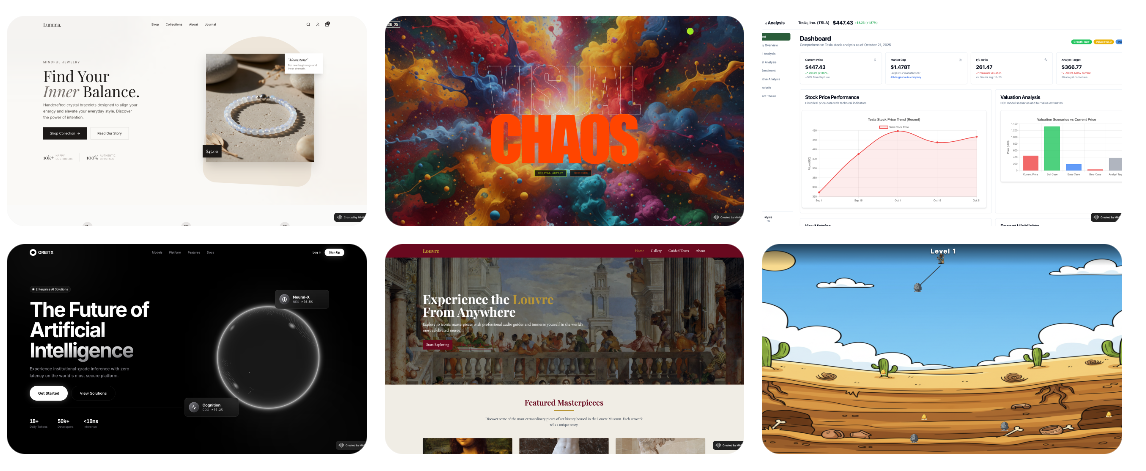
Advanced Coding and Agent Planning using MiniMax M2.5
MiniMax M2.5 supports over 10 programming languages, including Rust, Go, and Python, to facilitate comprehensive full-stack development across Web, mobile, and desktop platforms. By integrating deep industry knowledge for professional document formatting and financial modeling, it enables seamless transitions from system architecture design to final deliverable testing. It is the definitive solution for complex software engineering and high-stakes office productivity workflows.
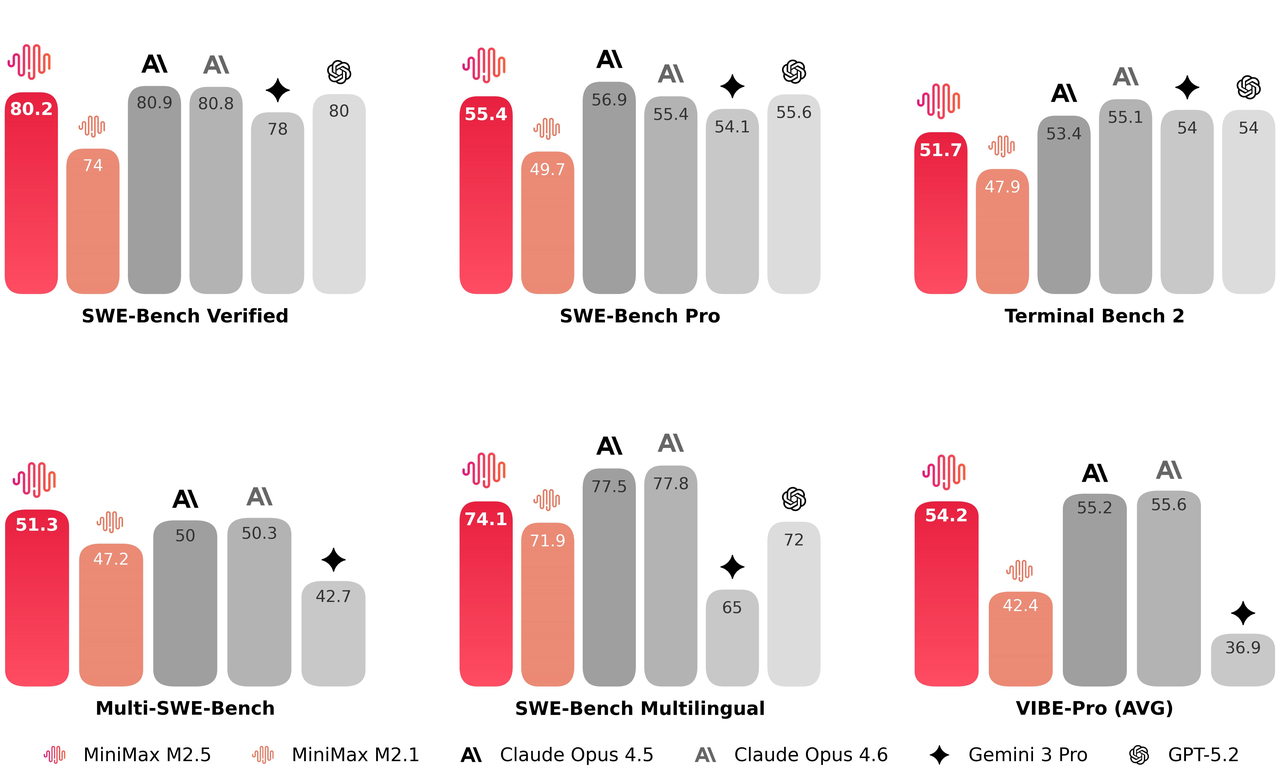
Rapid Response and Task Decision Efficiency using MiniMax M2.5
The M2.5 architecture achieves a 37% speed increase in end-to-end execution, significantly reducing complex task durations from 31.3 to 22.8 minutes on the SWE-bench. By optimizing task decomposition logic, the model requires 20% fewer tokens and search rounds to reach objectives in benchmarks like BrowseComp. It offers a streamlined solution for high-velocity decision-making while eliminating redundant computational overhead.
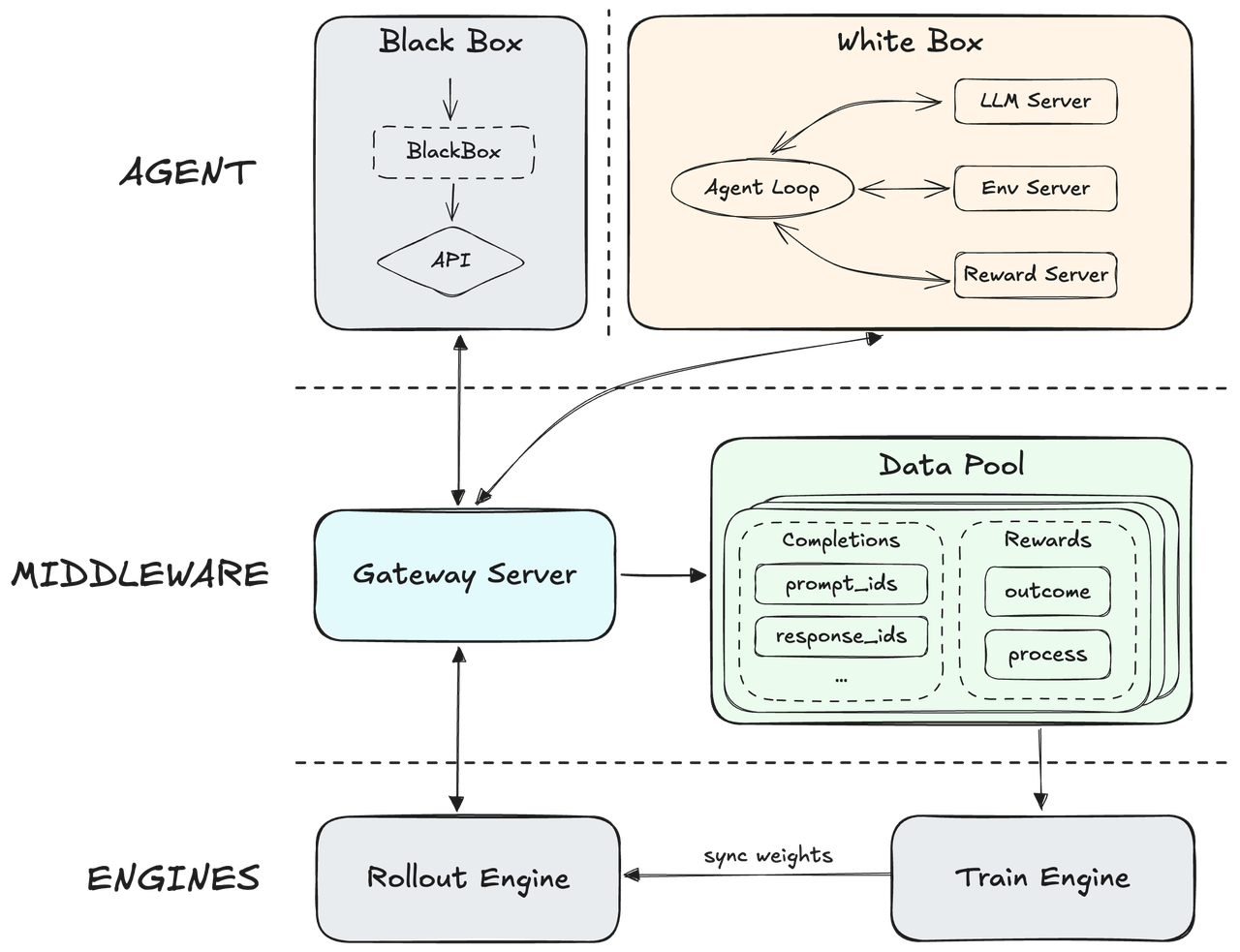
Evolutionary Architecture through Large-Scale RL using MiniMax M2.5
Built on a native Agent RL framework, MiniMax decouples its core engine from agent scaffolding to generalize across hundreds of thousands of diverse real-world environments. It incorporates a sophisticated process reward mechanism that utilizes real-time execution feedback to refine reasoning paths and ensure elite output quality. This creates a highly adaptive system capable of maintaining superior accuracy while maximizing overall operational response speed.
What You Can Do with MiniMax LLM Models
Discover practical use cases and workflows you can build with this model family — from content creation and automation to production-grade applications.
Production-Ready Full-Stack Debugging with MiniMax M2.5
MiniMax M2.5 acts as a senior technical architect, tracing logic errors across backend APIs, databases, and frontend frameworks like React or Swift. Instead of simple snippets, it refactors entire modules to ensure system-wide compatibility. Ideal for rapid prototyping, the API handles everything from environment setup to edge-case testing and legacy code modernization for enterprise systems.
Professional Financial Modeling and Reporting Using MiniMax M2.5
For analysts requiring absolute precision, the API automates complex Excel financial modeling and generates publication-ready research reports following professional investment frameworks. It interprets raw data to construct risk-control logic and professional slide decks with standardized formatting. This fits high-stakes consulting and banking environments where accuracy and adherence to formal reporting standards are non-negotiable.
Autonomous Multi-Step Web Research with MiniMax M2.5
MiniMax M2.5 executes complex, multi-round search tasks to synthesize disparate web information into cohesive executive briefs. By intelligently decomposing broad queries and browsing with minimal token redundancy, it avoids circular reasoning to deliver verified facts. It is a powerful tool for market researchers and strategy teams needing deep-dive intelligence without manually filtering through hundreds of sources.
Model Comparison
See how models from different providers stack up — compare performance, pricing, and unique strengths to make an informed decision.
| Model | Context | Max Output | Input | Positioning |
|---|---|---|---|---|
| MiniMax M2.5 | 196.61K | 196.61K | Text | SOTA Agentic Coding |
| MiniMax M2 | 196.61K | 196.61K | Text | High-performance Model |
| MiniMax M2 | 196.61K | 196.61K | Text | Flagship General |
| GLM-5 | 202.75K | 202.75K | Text | Flagship Foundation Model |
| DeepSeek V3.2 | 163.84K | 163.84K | Text | Flagship General |
How to Use MiniMax LLM Models on Atlas Cloud
Get started in minutes — follow these simple steps to integrate and deploy models through Atlas Cloud's platform.
Create an Atlas Cloud Account
Sign up at atlascloud.ai and complete verification. New users receive free credits to explore the platform and test models.
Why Use MiniMax LLM Models on Atlas Cloud
Combining the advanced MiniMax LLM Models models with Atlas Cloud's GPU-accelerated platform provides unmatched performance, scalability, and developer experience.
Performance & flexibility
Low Latency:
GPU-optimized inference for real-time reasoning.
Unified API:
Run MiniMax LLM Models, GPT, Gemini, and DeepSeek with one integration.
Transparent Pricing:
Predictable per-token billing with serverless options.
Enterprise & Scale
Developer Experience:
SDKs, analytics, fine-tuning tools, and templates.
Reliability:
99.99% uptime, RBAC, and compliance-ready logging.
Security & Compliance:
SOC 2 Type II, HIPAA alignment, data sovereignty in US.
Frequently Asked Questions about MiniMax LLM Models
We offer three primary versions: MiniMax M2.5 (flagship for office productivity and search), MiniMax M2.1 (enhanced for coding and complex logic), and MiniMax M2 (the balanced general-purpose model).
The MiniMax M2 series uniformly supports an ultra-long context of 196.61K, allowing it to process hundreds of pages of technical documentation or massive engineering codebases in a single request.
In SWE-bench end-to-end testing, M2.5 reduced the processing time for complex tasks from 31.3 minutes to 22.8 minutes, marking a 37% increase in overall task completion speed.
Explore More Families
Seedance 2.0 Models
Seedance 2.0(by Bytedance) is a multimodal video generation model that redefines "controllable creation," moving beyond the limitations of text or start/end frames. It supports quad-modal inputs—text, image, video, and audio—and introduces an industry-leading "Universal Reference" system. By precisely replicating the composition, camera movement, and character actions from reference assets, Seedance 2.0 solves critical issues with character consistency and physical coherence, empowering creators to act as true "directors" with deep control over their output.

Grok-Imagine Models
Grok Imagine Image Quality is xAI's latest AI image generation model, delivering studio-grade visuals with up to 2K resolution and razor-sharp detail. It offers best-in-class text rendering across multiple languages, photorealistic outputs with natural lighting, rich textures, and believable physics, plus tighter prompt following and image editing with reference inputs for precise creative control. Ideal for hero images, ad creatives, product renders, and brand-grade visuals.
Gemini Omni
Gemini Omni (by Google DeepMind) is a video generation and editing model launched on May 20, 2026 at Google I/O that redefines the standard for "reasoning-driven creation," built specifically to solve the core challenge of AI video: making output that actually understands what you mean, not just what you type. It fuses Gemini's reasoning engine with generative capability, accepting any mix of images, text, video, and audio to produce consistent, knowledge-grounded output. Unlike models that start from scratch each time, Omni lets you edit through natural conversation — swapping objects, rewriting scenes, shifting styles — while keeping physics, characters, and continuity intact across every turn.
GPT Image 2 Models
GPT Image 2 is a state-of-the-art multimodal foundation model engineered for exceptional text-to-image generation with unprecedented photorealism and creative versatility. Developed by OpenAI as the evolution of the DALL-E lineage, it transforms detailed natural language descriptions into hyper-realistic imagery at up to 4K resolution. With proprietary "Neural Rendering Engine" technology for precise visual control, GPT Image 2 delivers studio-quality results with accurate anatomy, lighting, and composition—making it the premier AI tool for professional creators, enterprises, and developers demanding production-ready visual assets.
Happy Horse 1.0
HappyHorse-1.0 is a unified multimodal AI video generation model that climbed to the top of the Artificial Analysis Video Arena blind-test leaderboard for both text-to-video and image-to-video generation. CNBC Alibaba Group confirmed ownership of HappyHorse, developed under its Alibaba Token Hub (ATH) business unit, where it leads benchmarks outperforming ByteDance's Seedance 2.0 and others. Caixin Global Led by Zhang Di — the former VP of Kuaishou who architected Kling AI — the 15-billion parameter model generates 1080p video with synchronized audio in a single pass using a unified transformer architecture that bypasses the multi-stage pipelines used by every major competitor.
Wan2.7 Models
Launching this March, Wan2.7 is the latest powerhouse in the Qwen ecosystem, delivering a massive upgrade in visual fidelity, audio synchronization, and motion consistency over version 2.6. This all-in-one AI video generator supports advanced features like first-and-last frame control, 3x3 grid synthesis, and instruction-based video editing. Outperforming competitors like Jimeng, Wan2.7 offers superior flexibility with support for real-person image inputs, up to five video references, and 1080P high-definition outputs spanning 2 to 15 seconds, making it the premier choice for professional digital storytelling and high-end content marketing.
Veo3.1 Models
Google DeepMind’s Veo 3.1 represents a paradigm shift in AI video generation, empowering creators with director-level narrative control and cinematic-grade audio quality that seamlessly integrates with its enhanced visual realism. By bridging the gap between imaginative concepts and photorealistic execution, this advanced model offers a transformative solution for a wide range of application scenarios, from professional filmmaking and high-end advertising to immersive digital content creation.
ERNIE Image Models
ERNIE-Image is an open-weight text-to-image model developed by the ERNIE-Image Team at Baidu, built on a single-stream Diffusion Transformer (DiT) with 8B parameters and paired with a lightweight Prompt Enhancer that rewrites short prompts into richer, more structured descriptions before passing them to the diffusion backbone. NYU Shanghai RITS Released on April 15, 2026 under the Apache 2.0 license, it transforms natural language descriptions into detailed imagery with particular strength in text rendering and structured layout generation. ERNIE-Image is designed not only for strong visual quality, but for controllability in practical generation scenarios where accurate content realization matters as much as aesthetics — making it well-suited for commercial posters, comics, multi-panel layouts, and other content creation tasks that require both visual quality and precise control.
GPT Image Models
The GPT Image Family is OpenAI's latest suite of multimodal image generation and editing models, built on the powerful GPT architecture. This family includes three tiers — GPT Image-1, GPT Image-1.5, and GPT Image-1 Mini — each available in both Text-to-Image and Image-to-Image variants. Combining GPT's world-class language understanding with DALL·E-class visual synthesis, these models deliver exceptional prompt adherence, photorealistic rendering, and creative versatility across illustration, photography, design, and visualization tasks. The series offers flexible pricing and quality tiers to match any workflow — from rapid prototyping and high-volume content production to professional-grade final deliverables. Whether you need ultra-fast iterations at minimal cost or maximum quality for brand campaigns, the GPT Image Family has a solution tailored to your needs.
Nano Banana2 Models
Nano Banana 2 (by Google), is a generative image model that perfectly balances lightning-fast rendering with exceptional visual quality. With an improved price-performance ratio, it achieves breakthrough micro-detail depiction, accurate native text rendering, and complex physical structure reconstruction. It serves as a highly efficient, commercial-grade visual production tool for developers, marketing teams, and content creators.
Seedream5.0 Models
Seedream 5.0, developed by ByteDance’s Jimeng AI, is a high-performance AI image generation model that integrates real-time search with intelligent reasoning. Purpose-built for time-sensitive content and complex visual logic, it excels at professional infographics, architectural design, and UI assistance. By blending live web insights with creative precision, Seedream 5.0 empowers commercial branding and marketing with a seamless, logic-driven workflow that turns sophisticated data into stunning, high-fidelity visuals.
Kling3.0 Models
Kuaishou’s flagship video generation suite, Kling 3.0, features two powerhouse models—Kling 3.0 (Upgraded from Kling 2.6) and Kling 3.0 Omni (Kling O3, Upgraded from Kling O1)—both offering high-fidelity native audio integration. While Kling 3.0 excels in intelligent cinematic storytelling, multilingual lip-syncing, and precision text rendering, Kling O3 sets a new standard for professional-grade subject consistency by supporting custom subjects and voice clones derived from video or image inputs. Together, these models provide a comprehensive solution tailored for cinematic narratives, global marketing campaigns, social media content, and digital skit production.



