請AI產生摘要
日食圖解可能看起來已準備好進教室,卻仍會教錯觀念,如果它把月球放在地球的遠側。若要讓 使用 MiniMax H3 Image 製作的教育資訊圖表 真正有用,應先確定事實與閱讀順序,再請模型安排。然後把它的圖像視為草稿:對照來源檢查每個標籤、箭頭、持續時間與科學關係。本指南為教師與課程設計者提供 5 個可複製的提示詞,以及一份事實表和發布前檢查。MiniMax H3 Image 可生成與編輯靜態圖像。MiniMax H3 也指一個影片模型,那是不同的工具。以下範例將來源參考與建立的草稿及可複製提示詞配對。這些草稿僅供審閱;其模型來源與科學準確性並未在此獨立驗證。
重點摘要
- 選擇符合知識結構的版面:循環、空間關係、動作序列或網絡。
- 在要求 MiniMax H3 Image 設計之前,先提供核可文字與明確關係。
- 以教學尺寸檢查輸出,包括標籤、箭頭、陰影與時間標示。
- 若某項關係仍然錯誤,請使用權威圖示,而非 AI 草稿。
MiniMax H3 Image 能為教育資訊圖表做什麼
MiniMax 將其 MiniMax H3 Image 模型描述為可根據文字或參考圖生成與編輯靜態圖像的工具。其公布選項包括 1K、2K 與 4K 輸出,以及最多 16 張參考圖像。那些是製作選項,不保證日食陰影或洗手指示會準確。簡短標題與標籤是合理的目標;密集段落應放在投影片備忘稿或圖像旁。(MiniMax H3 Image 模型資訊,2026 年 11 月)
教師可以從簡報開始,提供已核可的圖作為參考,並要求修改標籤或面板。為每個參考指派一項任務。來源圖解可引導幾何;先前的教室海報可引導色彩與字體。兩者都不能取代檢查輸出。模型可能保留來源風格,卻移動關鍵箭頭。
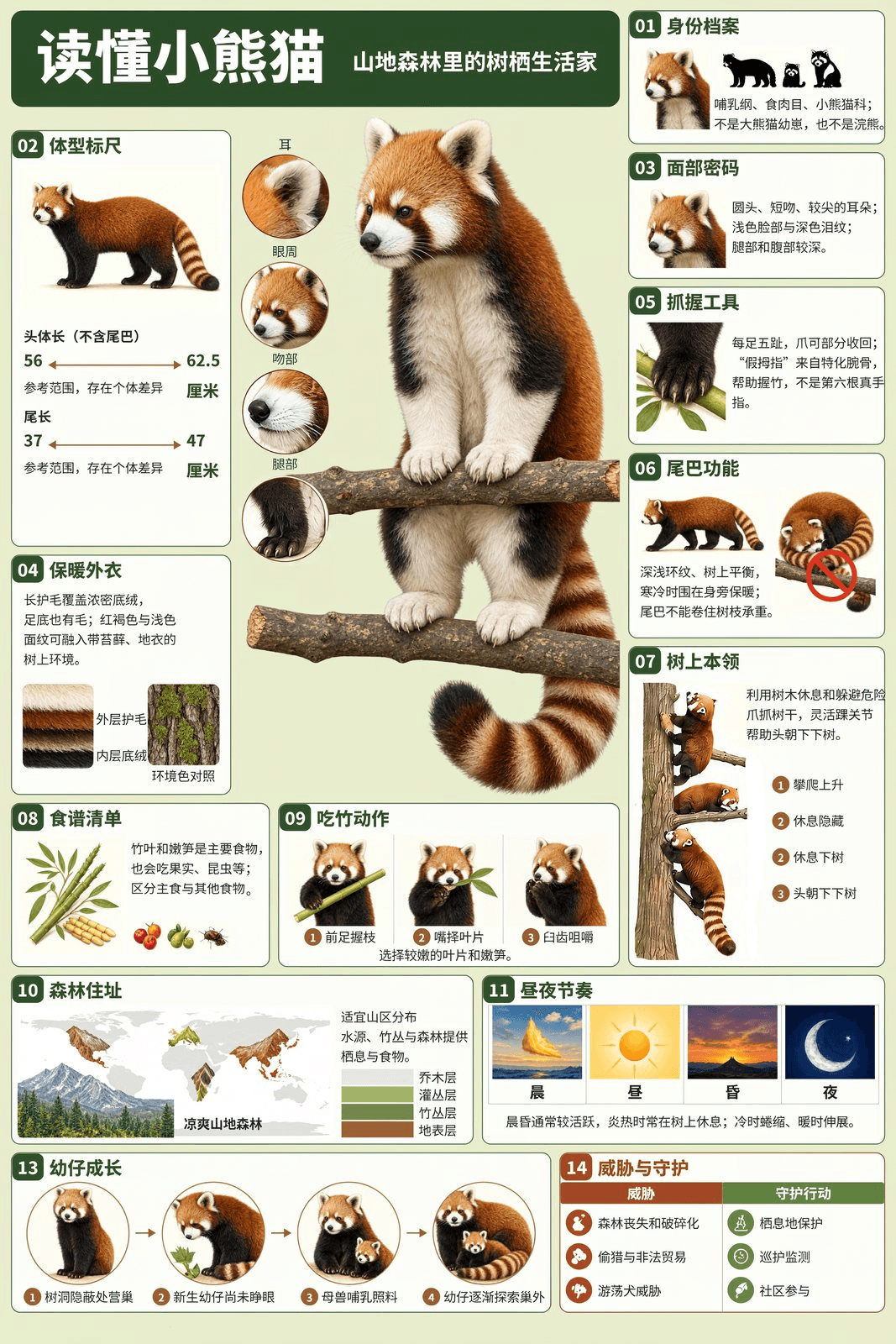
MiniMax 公布的小熊貓範例顯示密集的面板版面。它是官方展示,不是驗證過的生物學參考,也不是對本文提示詞的測試。
先選資訊結構,再選顏色。水循環圖描述水庫之間的移動。日食圖解描述某一時刻的位置與陰影區域。洗手海報描述固定順序的動作。月相圖解將軌道位置與從地球看到的樣貌連結起來。食物網描繪攝食關係。它們的箭頭可能代表物理流動、光線方向、閱讀順序、軌道運動或能量流動。這項區別應決定頁面設計。
| 圖表類型 | 最適合 | 應驗證的關係 | 起始比例 |
|---|---|---|---|
| 流程圖 | 水在相連階段間移動 | 箭頭起點、終點與連續性 | 16:9 投影片 |
| 空間圖 | 太陽、月球、地球與陰影區域 | 物體順序與陰影幾何 | 16:9 投影片 |
| 動作海報 | 洗手步驟 | 面板順序、動作與時間 | 3:4 海報 |
| 軌道與觀測圖 | 月球位置與從地球所見外觀 | 相位順序與受光側 | 方形教室圖 |
| 食物網 | 同一棲地的攝食關係 | 箭頭由食物指向消費者 | 16:9 投影片 |
將比例視為畫布選擇,而非科學規則。寬投影片可容納風景或一排天體。直式海報讓孩童在較近距離掃視較大的動作。方形版面讓軌道圖四周都有空間。模型的控制項可能因介面而異,因此渲染前請確認提供的比例。一旦選定結構,就把事實留在模型的想像之外。
撰寫圖像提示詞前先從事實表開始
撰寫一份含 4 個欄位的簡短事實表。主張說明學生應學到什麼。核可文字是允許出現在圖像內的確切文字。視覺關係說明物體或箭頭必須置於何處。來源告訴審閱者到何處查核。這份文件比完成的插圖更容易核可,也讓同事有明確理由拒絕不正確的草稿。
| 主張 | 核可文字 | 視覺關係 | 來源 |
|---|---|---|---|
| 水會經由多條路徑返回 | 蒸發、蒸散、凝結、降水、入滲 | 水氣從水體與植物上升;雨落下;部分水進入土壤 | USGS 水循環教學圖 |
| 日食是月球位於太陽與地球之間 | 太陽、月球、地球、本影、半影 | 月球陰影朝地球延伸;本影居中,半影環繞其外 | NASA 日食幾何 |
| 洗手遵循 5 個動作 | 弄濕、搓揉起泡、刷洗、沖淨、擦乾 | 面板依動作順序排列;刷洗至少持續 20 秒 | CDC 洗手指示 |
| 月相反映觀看幾何 | 新月、娥眉月、上弦月、盈凸月、滿月、虧凸月、下弦月、殘月 | 每個面向地球的外觀都與其軌道位置及單一陽光方向相符 | NASA 月相圖 |
| 食物網顯示能量傳遞 | 浮游植物、磷蝦、鯡魚、鯖魚、鮪魚、海豹 | 每個箭頭都從被吃的生物指向其消費者 | NOAA 水生食物網 |
USGS 水循環圖包含本課 5 個標籤以外的許多過程。簡化的教室圖是精選的教學視圖,不是地球水系統的完整清單。其箭頭仍應代表實際移動。在範例景觀中,蒸發從海洋上升,蒸散從植物上升,凝結屬於雲中,降水落下,入滲進入土壤。水也會經由地表與地下水路徑返回,即使簡報將顯著標籤限制為 5 個。
對於日食,事實表需要的不只是物體清單。NASA 解釋,日食發生於月球從太陽與地球之間通過時。月球朝地球投射較小的中央本影與較寬的半影。如果天體順序正確,但陰影指向太陽,圖像就會教錯關係。(NASA 日食幾何,取用於 2026 年 11 月)
就洗手而言,核可事實具順序性:弄濕、搓揉起泡、刷洗、沖淨、擦乾。CDC 表示應刷洗至少 20 秒,並將泡沫搓揉到手背、指縫與指甲下。若海報正確印出「20 秒」卻放在沖淨旁,就是把時間標示移到錯誤動作。將其視為事實錯誤,而非排版問題。(CDC 洗手步驟,2024 年 2 月)
也要列出排除項目。在這些範例中,禁止捏造的百分比、額外行星、距離、溫度,以及未經要求的醫療建議。限制顯示標籤,然後仍要檢查輸出是否新增內容。事實表是給人類審閱者的編輯契約。它無法強迫模型完全遵守。
5 個可複製的 MiniMax H3 Image 資訊圖表提示詞
在 MiniMax 官方圖像入口選擇 MiniMax H3 Image,挑選最接近各提示詞目標形狀的可用畫布,並使用符合你工作流程的最高解析度。4K 匯出讓你有空間檢查小字,但學生是以投影片或印刷尺寸觀看圖表。分別執行每個提示詞。若加入參考圖,請說明它引導的是事實幾何或視覺風格,然後在用它教學之前審閱實際輸出。
水循環流程圖
此提示詞將每個過程放在單一景觀的具體部位,並要求順時針閱讀順序。箭頭負責教學工作。若雲朵把降水指向上方,即使每個字都拼對也不合格。對照 USGS 來源審閱圖解,尤其是進入土壤的路徑與返回地表水的路徑。
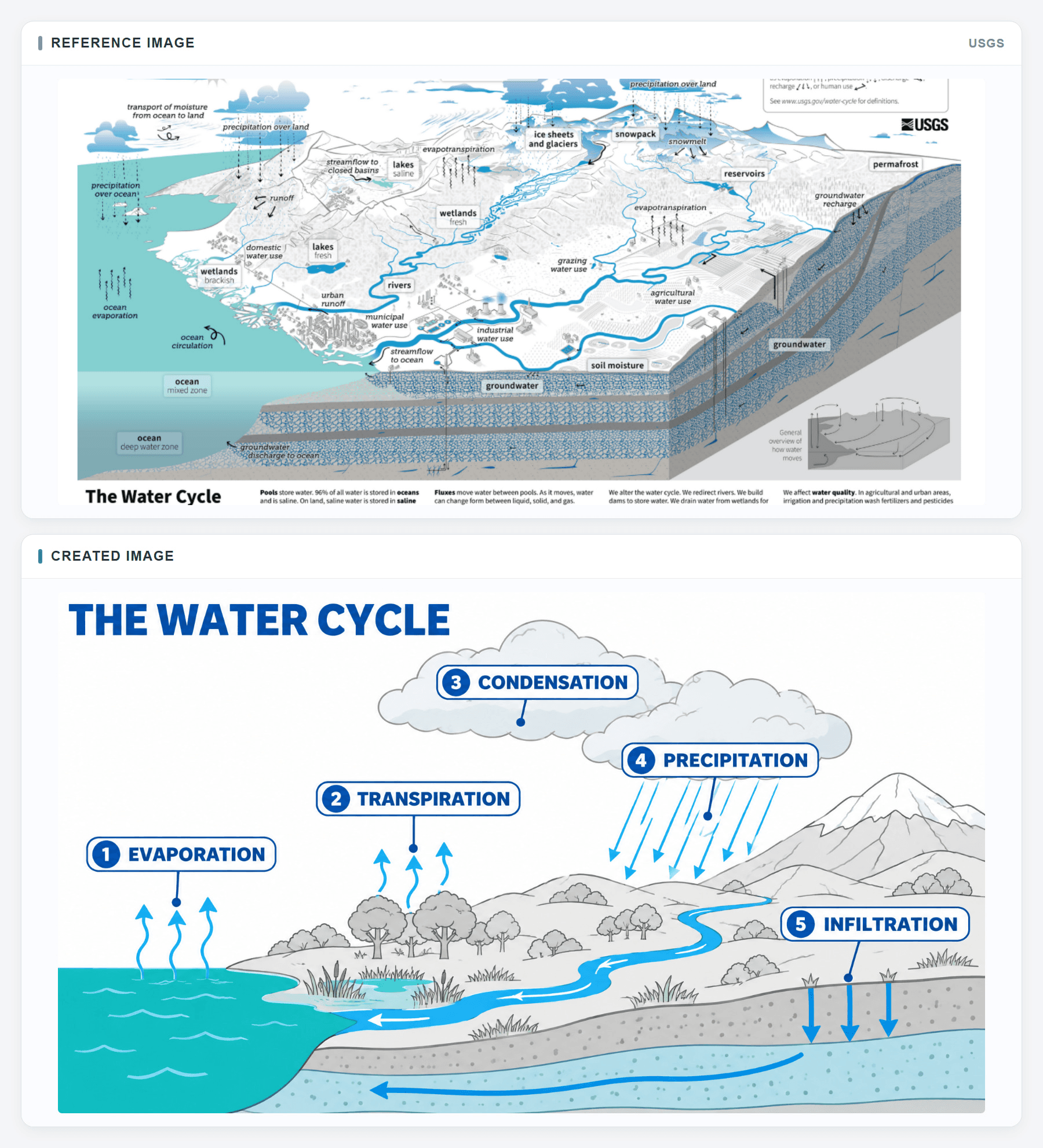
上:USGS 來源參考。下:建立的草稿。在教室使用前,比較地表與地下水路徑的方向。
plaintext1Create a 16:9 classroom infographic titled "THE WATER CYCLE" for middle-school students. Use the supplied USGS diagram as a reference for its panoramic land-and-water cutaway, restrained scientific linework, pale gray terrain, turquoise ocean, and vivid blue water paths. Redraw an original, simpler teaching graphic; do not copy the USGS logo or fine print. COMPOSITION: Show the ocean across the left foreground, a shoreline with wetlands and a river through the middle, hills and a snowy mountain toward the back right, and a visible soil-and-aquifer cross-section beneath the land. Leave generous white sky above the scene. Use thin gray contour lines for land and only blue or teal for water, vapor, rain, rivers, and underground flow. Keep the surface and underground layers visibly connected. CONTENT: Set exactly five prominent numbered process labels in a clockwise reading path: 1 EVAPORATION above the ocean with small upward vapor arrows; 2 TRANSPIRATION above vegetation with upward vapor arrows; 3 CONDENSATION inside or immediately beside a cloud where vapor gathers; 4 PRECIPITATION below a cloud with rain arrows falling onto land and water; 5 INFILTRATION at the soil surface with arrows continuing downward into the aquifer. The numbers guide the reader; they do not claim that every drop follows one fixed route. Show a blue river returning surface water toward the ocean and a subtle underground water path, without adding extra process labels or a large decorative cycle arrow. DESIGN CHECK: Use crisp typography, short leader lines, enough space between labels, and strong contrast at slide size. Every arrow must start and end in a physically plausible place. Do not add statistics, temperatures, invented reservoirs, extra numbered stages, logos, a photo frame, or a mockup scene. Output the complete flat infographic.
編號是閱讀輔助,不是主張每個水分子都以單一固定順序完成這些階段。學生應能跟隨一個箭頭,說出水接下來往哪裡去。如果箭頭彎過標籤,或似乎源自山丘而非水體或植被,請重繪或移除。除非徑流與地下水的較長解釋屬於核可目標,否則將其保留在課程文字中。
日食空間圖
日食是幾何問題。將太陽、月球與地球放在水平線上,月球居中。顯示光朝地球移動。在月球朝地球的一側標示較暗的內側本影與較亮的周圍半影。參考有幫助,但生成的陰影在進入課堂前必須對照 NASA 的實際圖解檢查。
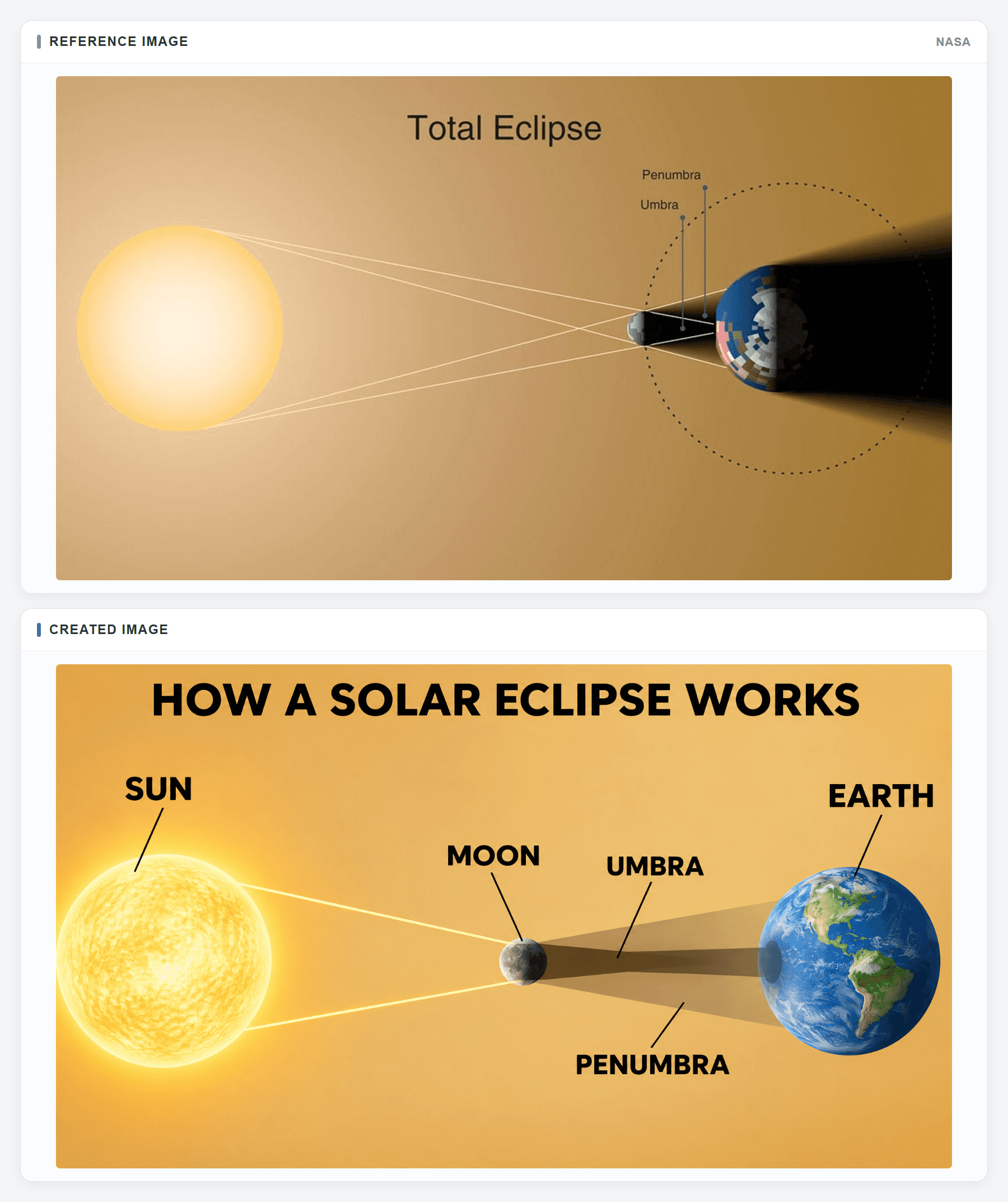
上:NASA 日食幾何參考。下:建立的草稿。檢查物體順序與兩個陰影區域的方向。
plaintext1Create a 16:9 educational diagram titled "HOW A SOLAR ECLIPSE WORKS" for a classroom slide. Use the supplied NASA eclipse graphic as the visual reference: a warm sand-to-gold background, a luminous pale-yellow Sun on the far left, a small dark Moon between the Sun and Earth, a blue Earth on the far right, and clean geometric shadow boundaries. Make an original scientific redraw without agency marks or source text. COMPOSITION: Arrange SUN, MOON, and EARTH on one horizontal axis with clear negative space around each body. Show a few thin, straight light rays traveling left to right from the Sun and skimming the Moon's upper and lower edges. Behind the Moon, draw a narrow, dark central UMBRA that reaches a small area on Earth's day side, surrounded by a broader, translucent PENUMBRA. Use soft shading for the spheres and shadows, but keep the ray and shadow geometry precise and easy to trace. Put small, high-contrast leader labels outside the cones so no text blocks the boundaries. TEXT AND FACTS: Use only the title and these five labels: SUN, MOON, EARTH, UMBRA, PENUMBRA. The Moon must be between Sun and Earth; both shadow regions extend toward Earth, never back toward the Sun. The umbra is the darker inner region and the penumbra is the lighter outer region. The image is schematic, so imply no true size or distance scale. Do not add extra planets, dates, eclipse percentages, ornate rays, a photograph, a UI, or a poster mockup. Output one complete diagram for factual review.
圖解不必聲稱按比例繪製。教室投影片常放大月球,讓學習者能看見。唯有在圖說或教學備註避免暗示真實距離與相對大小時,這才可以接受。檢查兩個陰影標籤各自指向一個區域。如果模型畫出從未到達地球的暗錐,而標題承諾日全食,核心課程就被破壞了。
五步洗手海報
對較年幼的觀眾而言,直式海報能比密集的一排圖示給每個動作更多視覺空間。第三個面板必須將動作與其持續時間連結。CDC 的公開海報為 5 步順序提供來源成品;其文字可能與所選短標籤不同,因此要驗證動作,而非要求裝飾完全相同。
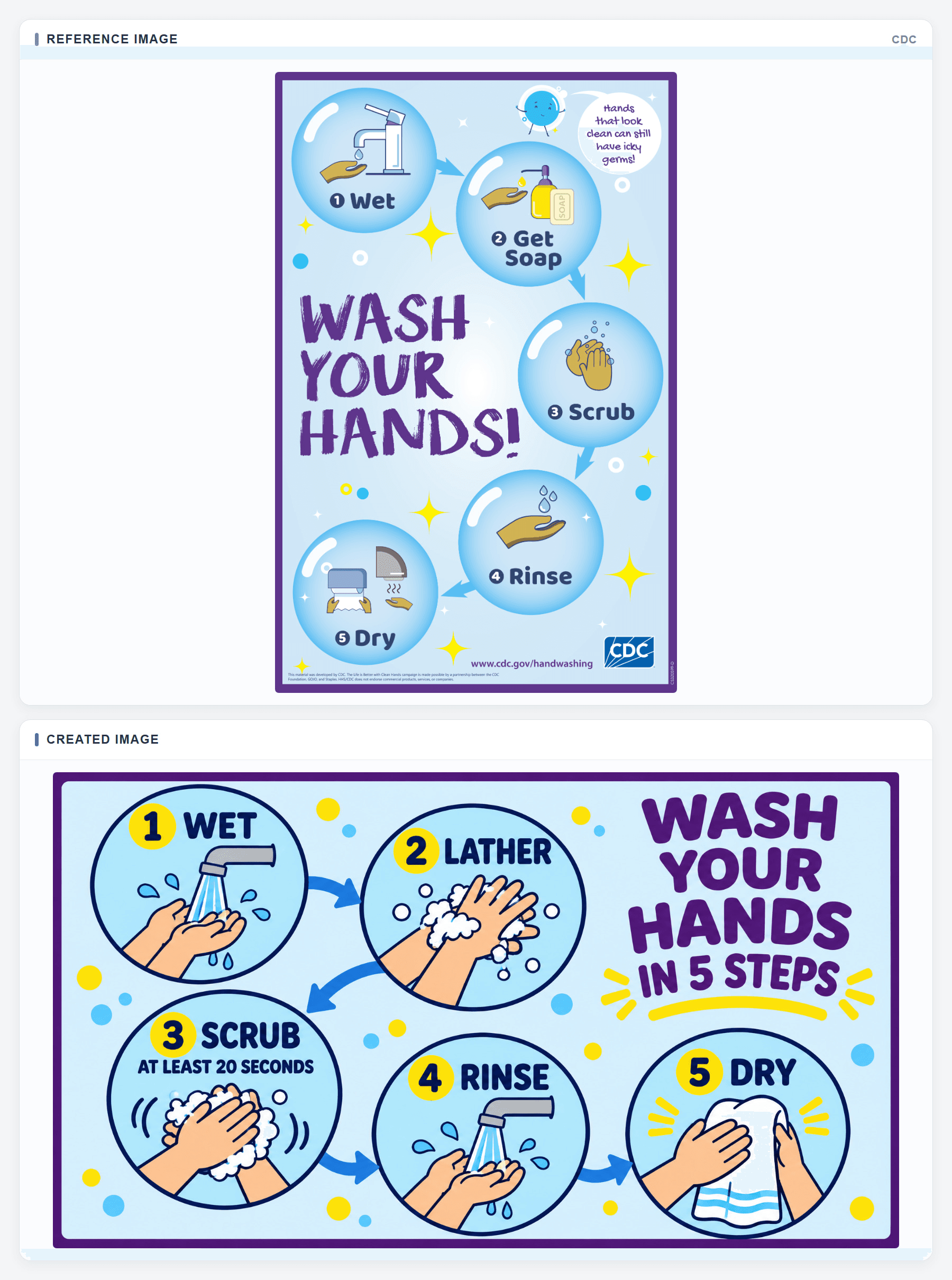
上:CDC 海報參考。下:建立的草稿。五個動作應保持順序,並將「至少 20 秒」附在刷洗上。
plaintext1Create a 3:4 portrait classroom poster titled "WASH YOUR HANDS IN 5 STEPS" for young children. Use the supplied CDC poster as a visual reference for its cheerful pale-blue background, deep-purple outer border, large sky-blue circular step panels, navy outlines, small yellow accents, and simple hand illustrations. Make an original poster without the CDC logo, website address, mascot, speech bubble, or any copied campaign wording. LAYOUT: Place five large circles in a clear zigzag path from upper left to lower right, linked by broad but unobtrusive blue arrows. Give each circle one large step number, one short bold label, and one unmistakable action drawing. Keep an open area for the large purple title without covering a circle. Use consistent hand shapes, soap and faucet symbols, high contrast, and generous margins. Decorative dots may support the playful style, but they must not compete with the steps. EXACT SEQUENCE: 1 WET shows hands under clean running water. 2 LATHER shows soap and lather over the backs of hands and between fingers. 3 SCRUB shows hands rubbing together; place the smaller line "AT LEAST 20 SECONDS" inside this circle directly below SCRUB. 4 RINSE shows hands under running water again. 5 DRY shows a clean towel and dry hands. Make the arrow from each step lead to the next numbered step, never skip a panel. Do not add a sixth step, germ-reduction numbers, medical claims, tiny paragraphs, logos, a wall scene, or a mockup frame. Keep all labels readable at printed poster size and output the finished flat poster.
以孩童掃視的順序閱讀完成的海報。若格狀版面從面板 2 跳到面板 4,可能毀掉原本正確的內容。在一般螢幕或印刷紙上,以預定觀看距離測試海報。如果第三個標籤縮小才能放入,請將其時間標示移到動作下方的短行,或在設計工具中放大面板。
月相軌道與視圖圖解
月相需要兩個相連視圖:月球位於地球周圍何處,以及從地球看其受光面是什麼樣子。NASA 的月相來源圖將這些視圖配對。給模型單一陽光方向與明確的相位順序,以免它把地球陰影當成一般月相的成因。
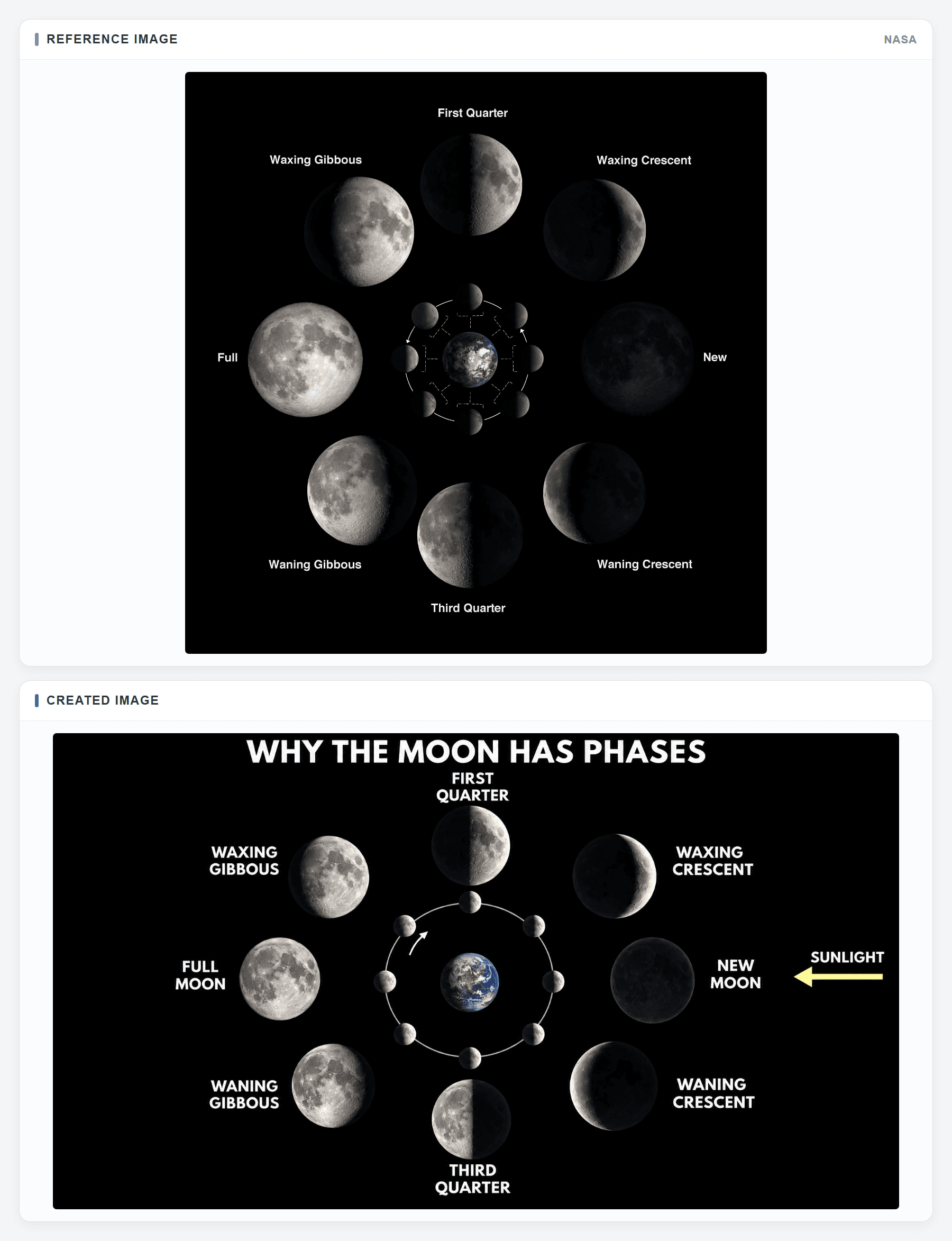
上:NASA 月相參考。下:建立的草稿。將每個命名的相位與其軌道位置及面向地球的外觀配對。
plaintext1Create a square educational infographic titled "WHY THE MOON HAS PHASES" for middle-school students. Use the supplied NASA Moon phases chart as a reference for its black background, luminous realistic Moon discs, small central Earth-and-orbit view, larger phase portraits around the outside, and simple white labels. Rebuild the diagram as an original, uncluttered scientific illustration without agency branding. COMPOSITION: Put a small Earth at the center. Around it, draw a thin circular orbit with eight small Moon positions as viewed from above Earth's north pole. Incoming sunlight comes consistently from the right; a restrained arrow labeled SUNLIGHT may show that direction. Surround the orbit with eight larger Earth-facing Moon portraits. Connect each inner position to its matching outer portrait by radial alignment, not by crossing connector lines. Use one subtle counterclockwise reading arrow on the inner orbit. Give every portrait similar diameter, realistic lunar texture, and a clear lit-versus-dark boundary. Leave enough black space for bright white phase names. PHASE ORDER: Starting at the right and moving counterclockwise, place NEW MOON at right, WAXING CRESCENT upper right, FIRST QUARTER top, WAXING GIBBOUS upper left, FULL MOON left, WANING GIBBOUS lower left, THIRD QUARTER bottom, and WANING CRESCENT lower right. The lit side of every inner Moon must face the right-hand sunlight. The larger outer view must show the matching phase as seen from Earth: waxing lit on the right, waning lit on the left. New Moon is dark from Earth and Full Moon is bright. Use only the title, the eight phase names, and optional SUNLIGHT label. Do not show Earth's shadow as the cause of ordinary phases, add dates, suggest true scale, add extra phases, or turn the diagram into a night-sky photograph. Output the complete readable infographic, not a mockup.
一次一對,檢查小型軌道月球與較大面向地球視圖。新月應接近太陽方向;滿月應在其對面。若相位名稱、受光側或位置與 NASA 圖表不符,請先在課堂使用該圖像前修正關係。
海洋食物網圖解
食物網教的是連結,不是單一直線鏈。NOAA 的水生食物網參考在緬因灣範例中顯示數條獵物到掠食者的路徑。此提示詞從該來源選出六種生物與一組少量關係,讓教室投影片保持可讀。
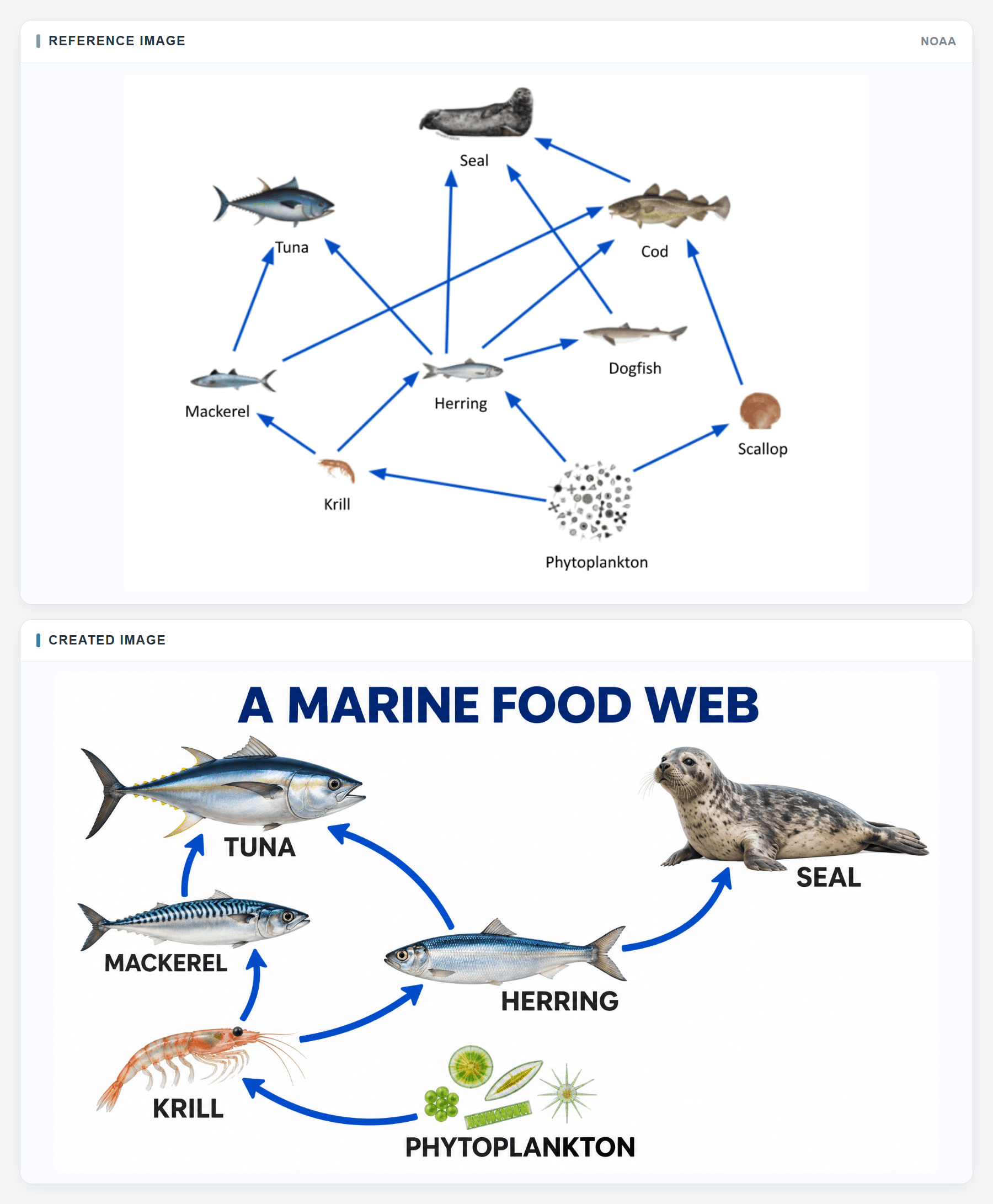
上:NOAA 食物網參考。下:建立的六生物草稿。檢查每個選定的箭頭都從食物指向消費者。
plaintext1Create a 16:9 educational infographic titled "A MARINE FOOD WEB" for middle-school students. Use the supplied NOAA food-web diagram as a visual reference for its open white background, realistic cutout-style sea-life illustrations, short dark species labels, and strong blue directional arrows. Make a simpler original teaching graphic with six organisms; do not copy the NOAA credit or add a decorative ocean backdrop. COMPOSITION: Place PHYTOPLANKTON at bottom center as a small visible cluster, KRILL at lower left, HERRING at the center, MACKEREL at middle left, TUNA at upper left, and SEAL at upper right. Give each organism enough white space and draw it at a recognizable relative size for the page, without implying biological scale. Use a consistent specimen-illustration treatment, subtle natural colors, and one clear label near each image. Route the arrows around illustrations and words; avoid crowded crossings and keep all arrowheads visible. DRAW EXACTLY SIX BLUE ARROWS: PHYTOPLANKTON to KRILL; KRILL to HERRING; KRILL to MACKEREL; HERRING to TUNA; MACKEREL to TUNA; HERRING to SEAL. An arrow starts at the organism being eaten and points to its consumer, showing energy flow. Arrange the paths as a branching web rather than a single vertical chain. Do not draw arrows from predators back to prey or invent other feeding links. Keep the title and six species labels large enough for a slide. Use no trophic-level percentages, extra animals, decorative arrows, colored boxes, logos, UI elements, or mockup frame. Output one complete, legible infographic.
追蹤每個從食物到消費者的箭頭,然後將每個選定連結與 NOAA 圖解比較。通往鮪魚與海豹的分支,唯有從正確獵物開始才有用。如果箭頭穿過標籤,或箭頭方向不明,請在用它教學前移動節點或簡化版面。
修正標籤與版面,但不改變課程
從一個可觀察的錯誤開始:「半影指向黑暗中央區域」,或「刷洗面板寫著 2 秒」。說明替換內容,並指出所有必須保持不變的事物。只要求「更科學準確」的編輯請求,會讓模型自由重排課程。先複製核可草稿,以便將編輯與起始狀態比較。
plaintext1Edit the uploaded educational infographic using the approved reference figure and fact sheet as constraints. This is a precise local correction, not a redesign. ERROR TO FIX: [QUOTE THE EXACT WRONG LABEL, ARROW, SHADOW, NUMBER, OR RELATIONSHIP]. REQUIRED REPLACEMENT: [STATE THE EXACT CORRECT TEXT OR GEOMETRY]. LOCATION: [DESCRIBE THE PANEL, OBJECT, OR REGION TO CHANGE]. SOURCE CHECK: [NAME THE APPROVED SOURCE OR FACT-SHEET ENTRY]. Change only that identified element. Preserve the canvas ratio, crop, title, composition, object positions, illustration treatment, background, colors, lighting, typography hierarchy, label sizes, panel order, and every other word and arrow. If the correction is a label, keep its leader line attached to the right object. If it is an arrow or shadow, keep its origin, destination, and surrounding geometry physically consistent with the source. Do not add new claims, species, steps, numbers, or decorative elements. Return one complete corrected infographic at the original resolution, with no before-and-after frame or mockup.
將編輯版本與原始版本及事實表並排比較。先檢查修正的元素,然後掃描其他每個標籤與箭頭是否有非預期變更。如果變更後的標籤與陰影邊界重疊,即使拼字已修正,修復仍不完整。請主題審閱者檢查關係,而不只是文字。
當局部編輯反覆移動幾何時,用更簡單的構圖從事實表重新生成。對於小型文字錯誤,在版面工具中覆蓋生成的文字,並自行排版核可文字,可能更快且更安全。唯有在關係仍然正確時,才將插圖保留為背景。對於精確的科學圖解,權威來源圖示可能是最佳最終視覺。圖像編輯能力不保證能精確控制幾何。
在學生看到之前檢查 AI 資訊圖表
發布前檢查應針對學習者將推論出的內容。拼字檢查是必要的,但拼寫正確的標籤可能指向錯誤物體。以 100% 檢查圖像缺陷,再以實際教室尺寸檢查一次。邀請未撰寫提示詞的同事僅根據箭頭解釋圖解;他們的解讀會迅速暴露版面歧義。
| 檢查項目 | 通過條件 | 若失敗 |
|---|---|---|
| 事實 | 每項主張都符合核可來源 | 修正或移除該主張 |
| 標籤 | 每個標籤命名一個可見物體或區域 | 移動或替換標籤 |
| 箭頭與陰影 | 方向與終點符合所教關係 | 重繪、重新生成或使用來源圖示 |
| 數字與單位 | 刷洗標示至少 20 秒;未出現捏造數值 | 修正文字並重新檢查面板 |
| 閱讀順序 | 學生能不需猜測地遵循每個步驟 | 重新排序面板或簡化版面 |
| 可讀性與揭露 | 文字在實際顯示尺寸下仍可讀;圖說標明來源與審閱狀態 | 放大文字並加上誠實圖說 |
就日食而言,確認月球位於太陽與地球之間,且其陰影朝地球延伸。區分狹窄本影與較寬半影。就水循環而言,追蹤從蒸發進入大氣、經雲形成與降水,然後向下進入土壤的路徑。就洗手而言,閱讀全部 5 個動作,並確認「至少 20 秒」明確位於刷洗上。
記錄人類實際檢查了什麼。「AI 生成草稿;標籤與幾何已對照 NASA 審閱」唯有在該審閱發生後才有用。若無主題審閱者可用,將結果保留為草稿,或使用 NASA、USGS 或 CDC 來源視覺教學。乾淨的輸出面板證明圖像已產生。並不證明課程正確。
在何處製作與匯出圖表
MiniMax 的圖像工具是直接試用 MiniMax H3 Image 的地方。執行前,請在帳戶中確認所選模型、可用比例、匯出解析度、檔案類型與目前價格。當標籤需要仔細審閱時,匯出 PNG。將事實表放在匯出檔旁,讓未來的編輯者能看到哪些陳述已核可。
Atlas Cloud 將 GPT Image 2.6 Sunburst 列為託管圖像模型。GPT Image 2.6 Sunburst 與 MiniMax H3 Image 是分開的,因此若你特別需要 MiniMax H3 Image,請查看目前的 Atlas Cloud 目錄。若你使用 GPT Image 2.6 Sunburst 作為替代方案,請在該處貼上相同的水循環提示詞,選擇支援的寬畫布與品質設定,並對照相同 USGS 事實審核輸出。以實際產生該圖的模型標示圖表。模型頁面顯示起始價格;品質設定可能改變最終費用,因此提交前請確認報價。
為你的下一堂課,選擇 5 個提示詞結構之一,完成 4 欄位事實表,並渲染一份草稿。使用 MiniMax H3 Image 製作的教育資訊圖表 的價值,取決於圖像與核可課程之間的最終比較,尤其是當一個錯誤箭頭可能改變學生所學時。
常見問題
MiniMax H3 Image 能一次就做出可直接進教室的資訊圖表嗎?
它能產生靜態圖像草稿,但草稿在學生看到之前需要人工審閱。以學生實際觀看的尺寸,對照核可來源檢查每個標籤、箭頭、數字與視覺關係。
教育資訊圖表提示詞應包含什麼?
從課程主張、確切核可標籤、必要位置或順序,以及用來驗證它們的來源開始。然後指定受眾、畫布、閱讀順序,以及模型必須省略的內容。將長篇解釋留在圖表之外。
我要如何檢查生成的水循環圖?
從起點到終點追蹤每個箭頭。蒸發應從水體上升,降水應從雲中落下,進入土壤的水應連接到合理的返回路徑。將草稿與 USGS 來源比較,而非只憑外觀判斷。
什麼會讓日食圖解在科學上出錯?
月球必須位於太陽與地球之間,且其陰影必須朝地球延伸。較暗的本影位於較寬的半影之內。文字正確但光線或陰影方向相反的圖解,仍會教錯關係。
洗手海報上的 20 秒指示應放在哪裡?
將「至少 20 秒」放在刷洗動作旁,而非沖淨或擦乾。讓五個動作保持順序:弄濕、搓揉起泡、刷洗、沖淨、擦乾。若該指示變得太小無法閱讀,請放大刷洗面板,或將時間標示設為其下方的短行。


