撞击看起来可能很有说服力。片刻之后,场景仍然合理吗? 评估 Genie 4 的有效方式是观察一次清晰的碰撞,然后检查接触之后会发生什么。本指南关于用于碰撞和物体运动的 Genie 4 物理模拟,为你提供一套可重复的观察协议,用于记录物体身份、方向变化和场景连续性。它还说明了生成视图能展示什么,以及它无法证明关于质量、速度或物理定律的哪些内容。
关键要点
- Genie 4 是一个交互式生成世界模型,而不是一个暴露状态变量的传统物理引擎。
- 固定场景和一次碰撞,更容易判断接触、撞击后运动和物体连续性。
- 一段有说服力的视频片段并不能确立数值准确性,也不足以证明其适合工程和安全测试。
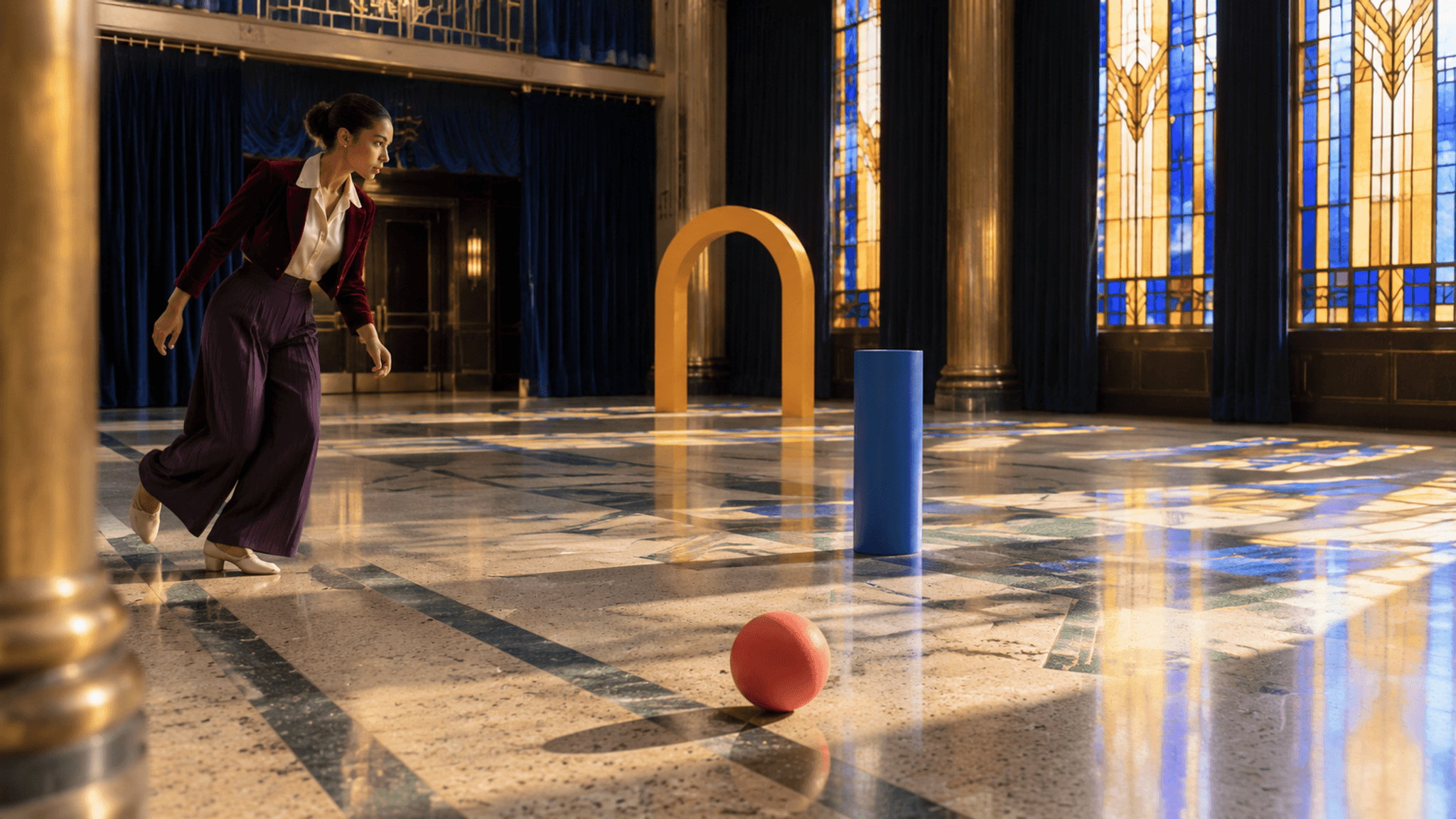
Art Deco 门厅案例的参考帧:运动开始前的舞者、球、圆柱和拱门。
Genie 4 中的“物理模拟”意味着什么
传统物理引擎会根据配置规则更新显式量,例如位置、速度、碰撞几何和材质属性。世界模型则生成交互式场景,并对用户操作或指令作出响应。它的输出可能描绘因果关系,但可见结果不会自动暴露这种描绘背后的数字或规则。
Google 将 Genie 4 描述为一个世界模型,可以生成物体碰撞、水流和树木摇曳的环境。它还描述了通过自然语言进行的实时更改,例如更改摄像机或添加物体。这使得该模型对于探索场景并追问接下来会发生什么很有吸引力。但这本身并不会让每一次描绘出的碰撞都成为经过测量的物理结果(Google DeepMind, Genie 4)。
对于开发者来说,这种区别很实际。你可以使用交互式生成世界来探索一种机制、寻找视觉方向,或提示后续事件。传统引擎仍然是调节恢复系数、摩擦、质量和碰撞形状的正确场所,因为这些在那里是显式且可检查的输入。除非系统暴露这些值和验证方法,否则请把“真实物理”当作视觉描述,而不是基准声明。
如何设计 Genie 4 碰撞测试
从一个简单到观看者能判断其是否发生的事件开始。一个球撞击一个静止方块,比繁忙场景中的一堆移动物体更容易评估。保持摄像机稳定、两个物体都可见,地面保持简单。给每个物体不同的颜色和形状,以便容易发现身份变化。
这就是用于碰撞和物体运动的 Genie 4 物理模拟测试的核心:一个简单事件,并带有可在多次运行间比较的后续结果。
Google 的 Project Genie 提示词指南建议用直接的语言描述环境和角色或物体动作。该指南针对的是 Project Genie,而不是已发布的 Genie 4 提示词语法。它仍然是一个清晰测试简报的合理起点:指定场景、物体、初始状态、事件,以及你想检查的时刻(Google,Project Genie 提示词技巧,2026 年 3 月)。
一个建议的测试提示词可以写成:
plaintext1In a plain studio with a flat floor, show one red ball rolling from left to right toward one stationary blue block. Keep both objects fully visible from a fixed side view. The ball contacts the center of the block. Continue the same view after contact so the ball and block remain visible. Keep their colors and shapes consistent. No extra objects or scene changes.
这是一个测试规范,并不声称 Genie 4 接受这些确切控制,或会产生特定结果。在可用的会话中测试时,保存措辞、可见控制项和屏幕录制。如果系统提供实时操控,记录每条指令以及你输入它的时间。这些细节有助于将模型行为与提示词变化或摄像机移动区分开来。
每次运行使用一张碰撞观察卡:
| 观察项 | 记录 |
|---|---|
| 起始状态 | 表面、物体位置、初始运动、摄像机角度 |
| 接触 | 接触是否可见,以及撞击时任一物体是否被遮挡 |
| 即时响应 | 可见的方向变化、弹跳、滚动、倾倒、滑动或停止 |
| 连续性 | 颜色、形状、数量和相对位置是否保持可识别 |
| 重复运行 | 相同提示词下哪些保持相似,哪些发生变化 |
一次只改变一个条件。例如,先保持方块静止,然后用一个单独测试让方块已经处于运动状态。如果你同时还改变了摄像机、表面或措辞,就不要把这些结果当作隔离了一个变量来比较。当每个变化都有明确原因时,小测试集提供的信息更多。
如何解读撞击后的物体运动
将接触前一刻、接触本身以及接触后的片刻作为独立观察来审视。一个球明显碰到墙壁并改变方向,提供了场景描绘碰撞响应的证据。一个球穿过墙壁、变色、消失或出现在别处,则引发连续性问题。在解释原因之前,先记录屏幕上发生了什么。
观察卡刻意采用定性描述。“球在接触后向左移动”是一种可见描述。“球守恒了动量”则是关于渲染片段本身可能无法提供的量的声明。要支持这一声明,你需要对相关状态进行可靠测量、定义单位和条件,以及一种重复并分析事件的方法。透视中的表观压缩、弹跳高度或移动距离都可能产生误导。
如果访问权限允许,将同一测试重复多次。多次运行之间的一致性可以告诉你,该提示词是否倾向于生成相似场景。它仍不能确立单次运行遵循物理定律:重复输出可能共享视觉模式,却不暴露底层计算。分别记录事件清晰度、物体连续性和可重复性。这些是有用的原型观察,而不是一个合并的“物理评分”。
要与引擎进行公平比较,请保持场景描述不变,并写下每个系统实际暴露的内容。引擎可能提供坐标和速度;生成世界可能提供实时视觉交互。将输出与你需要回答的问题进行比较,而不是把视频和数值模拟当作可互换的证据。
Genie 4 能证明什么、不能证明什么
可以将 Genie 4 作为创建和操控交互式场景的方式来探索。官方材料展示了生成环境,并描述了直接复杂事件,同时也列出了围绕一致性和交互的研究限制。这些演示确立了产品的预期能力,而不是经过测量的碰撞准确性基准。官方页面描述了当前状态和限制;当访问权限或能力对你的工作很重要时,请再次查看。
官方页面还指出,复杂事件和物体持久性仍是研究挑战。这直接关系到碰撞测试:一个干净的撞击帧之后,物体仍可能改变形状、消失或失去先前位置。在把连续性视为可靠行为之前,检查后续结果并重复运行。产品演示说明可能的结果,而支持准确性声明则需要独立测量。
这种边界提示了一种有用的分工:
- 早期游戏或电影构思: 探索碰撞可能看起来如何,或交互式场景可能如何展开。
- 机制实现: 使用你的游戏引擎的碰撞系统,并检查其参数和状态。
- 科学或工程分析: 使用适合该问题的经验证模拟器或测量设置。
- 机器人安全或部署: 不要依赖生成的视觉场景作为唯一验证方法。
世界模型可以帮助团队发现有前景的场景或传达想法。它不能替代必须计算或验证行为的系统。与队友分享时,将生成材料标记为视觉原型,这样就不会有人把说明性结果误认为经验证的模拟结果。
一个视觉案例:Art Deco 门厅碰撞
视觉参考发生在一个空旷的 Art Deco 剧院门厅,而不是花园。午后的光线穿过几何彩绘玻璃照在玉色与奶油色水磨石上;靛蓝丝绒窗帘和黄铜柱子围出一条清晰的地面路径。一位舞者身穿短款酒红色天鹅绒夹克、象牙白丝绸衬衫、深紫色阔腿裤和奶油色皮革舞鞋,将一只珊瑚色橡胶球扫向一个钴蓝色木质圆柱。圆柱轻推一个藏红花色木质拱门。她的表情从专注期待变为惊讶,然后随着她绕开移动的物体而变成俏皮的宽慰。提供的六段十秒片段展示了这条链的不同部分。它们是生成的视频故事板,不是 Genie 4 输出,也不是完成的物理测试。注意观察成功的运动以及连续性失败。
使用 Seedream v5.0 Pro Text-to-Image(bytedance/seedream-v5.0-pro/text-to-image)创建共享开场帧。对于重复运行,使用 Seedance 2.5 Image-to-Video(bytedance/seedance-2.5/image-to-video,16:9 首帧)生成十秒片段。对于重复运行,使用前一片段清晰的最终帧作为下一片段的首帧。将原始角色和地点参考放在旁边。本文提供的六个已下载 MP4 已转换为 GIF 并置于下方。它们嵌入的元数据不标识生成模型或原始提示词,因此这里的模型名称和书面提示词是可复现建议,而非这些文件的已验证来源。这些片段不是交互式 Genie 4 录音,也不是经过测量的模拟。
Seedream v5.0 Pro 的共享首帧提示词:
plaintext1Wide 16:9 cinematic photograph inside an empty 1930s Art Deco theater foyer, designed as a clear stage for a kinetic collision scene. Cream-and-jade terrazzo floor with long geometric inlay lines, two brass-clad columns, deep indigo velvet curtains, and tall amber-and-cobalt stained-glass windows. Late-afternoon sun enters from camera right, casting sharply defined colored window shapes across the floor. At frame left stands one young adult dancer with warm brown skin, expressive dark eyes, and hair in a secure sculpted bun. She wears a cropped burgundy velvet jacket over an ivory silk blouse, deep-plum pleated wide-leg trousers, and cream leather dance shoes. Her posture is coiled for movement, one heel lifted, gaze fixed on one matte coral-red rubber ball in the foreground. A single cobalt-painted wooden cylinder stands three meters ahead on the ball's path; a single lightweight saffron-painted wooden arch stands behind it. All three movable objects are fully visible and clearly separated. Low 35 mm camera, strong floor leading lines, one softly blurred brass column at the edge, tactile velvet, silk, wood, and terrazzo, controlled coral-cobalt-saffron accents against rich indigo and warm ivory. Elegant photographic realism, natural shadows and slight film grain. No garden, plants, crowd, stage performance, text, signage, logos, extra balls, extra dancers, floating objects, or UI.
镜头 1:第一次触碰
检查内容: 起始位置、脚与球的接触,以及球的初始方向。
plaintext1Use the supplied Art Deco foyer still as the exact first frame. Ten seconds of continuous, expressive movement. From 0-3 seconds, track laterally at knee height as the dancer glides diagonally along the jade-and-cream terrazzo toward the single coral ball. Her gaze stays on the ball; her expression shifts from focused anticipation to a quick playful smile, while her burgundy velvet jacket and deep-plum pleated trousers move with natural inertia. From 3-6 seconds, she makes a precise side step, rotates her shoulders and hips, and sweeps one cream dance shoe into clear contact with the ball exactly once. The ball begins rolling toward the stationary cobalt cylinder. Pan smoothly from her foot to the rolling ball without hiding the touch. From 6-10 seconds, follow the ball in a low three-quarter view while the dancer completes a controlled turn, catches her balance, and raises her eyebrows as she watches its path. Keep the ball, cylinder, and saffron arch distinct and spatially stable. Amber-and-cobalt stained-glass light, indigo curtains, brass columns, crisp shadows, natural 35 mm motion, rich but controlled color. No dialogue, text, crowd, plants, extra props, duplicated limbs, teleportation, or zoom-only motion. Wide 16:9.
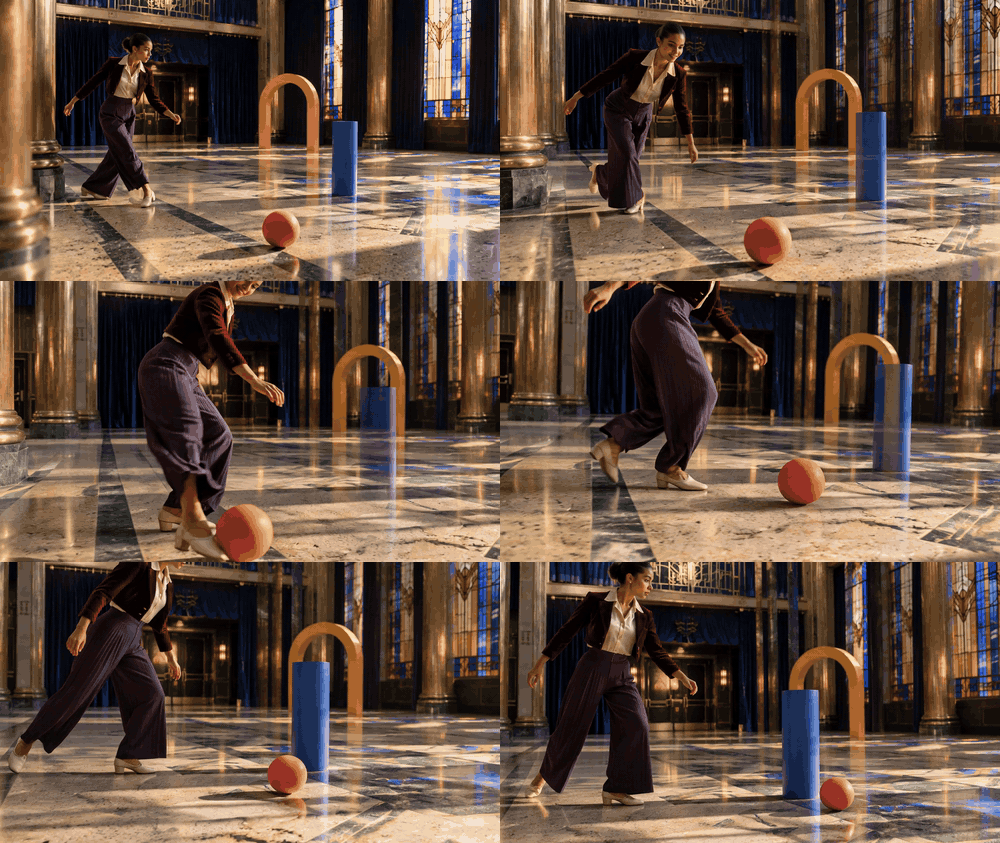
舞者靠近,并似乎让球开始运动。脚与球的接触很短暂,因此该片段是视觉参考,而不是受控冲量的证明。
镜头 2:主碰撞
检查内容: 球与圆柱的接触、球改变的方向,以及圆柱的首次响应。
plaintext1Begin from the chosen final frame of shot one in the identical empty Art Deco theater foyer. Preserve the dancer's warm brown skin, sculpted bun, burgundy velvet jacket, ivory blouse, deep-plum trousers, cream dance shoes, and the exact coral ball, cobalt cylinder, and saffron arch. Ten seconds. From 0-3 seconds, a low front three-quarter tracking view follows the ball across the terrazzo inlay lines toward the still cylinder; show a clean gap until contact. From 3-5 seconds, the camera arcs to a clear side angle while staying wide enough to show both complete objects. The coral ball strikes the cylinder once at its lower half. The ball deflects diagonally left; the cylinder tips and begins rotating right. Make the contact point visible and do not let either object pass through the other. From 5-10 seconds, track laterally to hold both resulting motions in one frame. In the background, the dancer reacts with widened eyes and an open-mouthed smile, then pivots sharply around the cylinder's path. Stained-glass sunlight moves across real terrazzo texture, brass surfaces remain fixed, indigo curtains stay in place. Smooth cinematic 35 mm motion, believable gravity, no hidden impact, dialogue, text, crowd, plants, duplicate objects, or slow push-in. Wide 16:9.
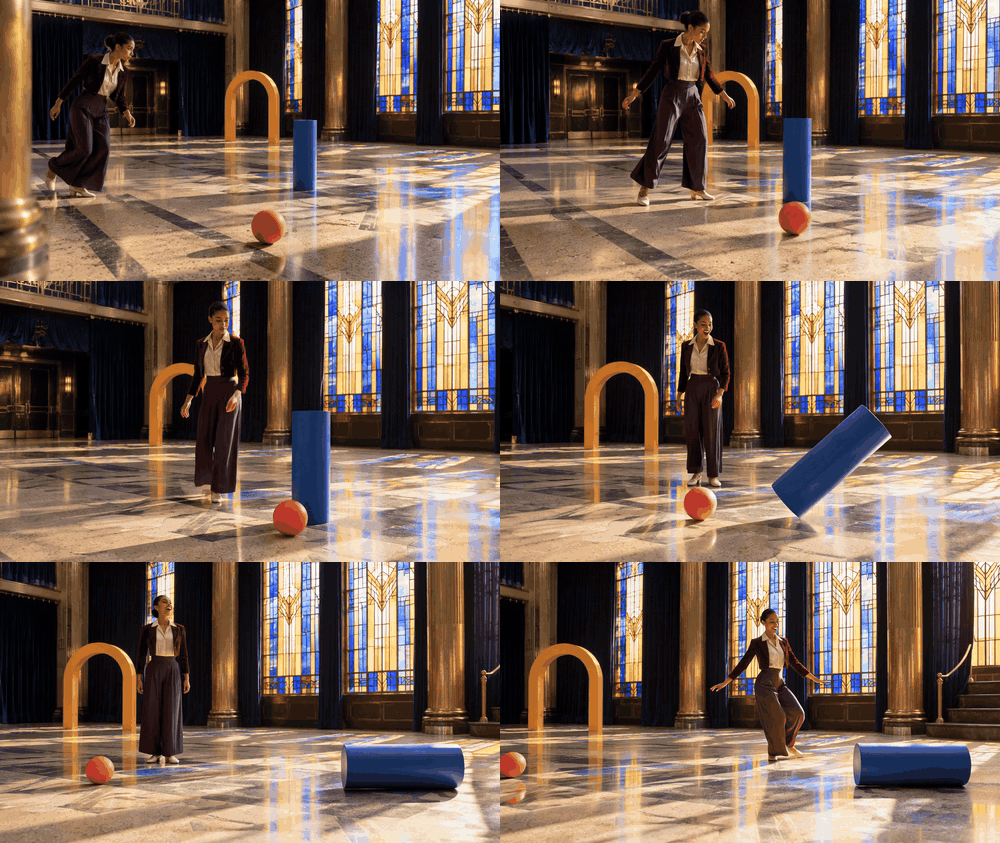
球到达时圆柱倾斜。在声称这是经过测量的碰撞响应之前,检查接触帧。
镜头 3:圆柱后续运动
检查内容: 蓝色圆柱在第一次撞击后是否保持相同形状并连贯移动。这个额外提供的片段不属于原始五镜头提示词计划。确切的原始生成提示词不可用;以下是为重复运行建议的提示词。
plaintext1Continue from the final frame of the ball-to-cylinder impact in the same empty Art Deco theater foyer. Ten seconds. Keep one coral rubber ball, one cobalt-painted wooden cylinder, one saffron wooden arch, and the same dancer in a burgundy velvet jacket, ivory blouse, deep-plum wide-leg trousers, and cream dance shoes. From 0-3 seconds, track low beside the ball as it rolls away from the cylinder on the cream-and-jade terrazzo. From 3-7 seconds, shift to a clear three-quarter side angle as the cylinder tips, rocks on its edge, and gradually falls to the floor, keeping its blue color, size, and solid shape. From 7-10 seconds, widen the view to show the ball, fallen cylinder, arch, and dancer together; she crosses the background in two quick dance steps, then turns her head toward the moving cylinder with a surprised expression. Preserve the stained-glass light pattern, brass columns, indigo curtains, gravity, and object count. Smooth camera movement, no hidden collision, extra objects, text, plants, teleportation, or zoom-only motion. Wide 16:9.
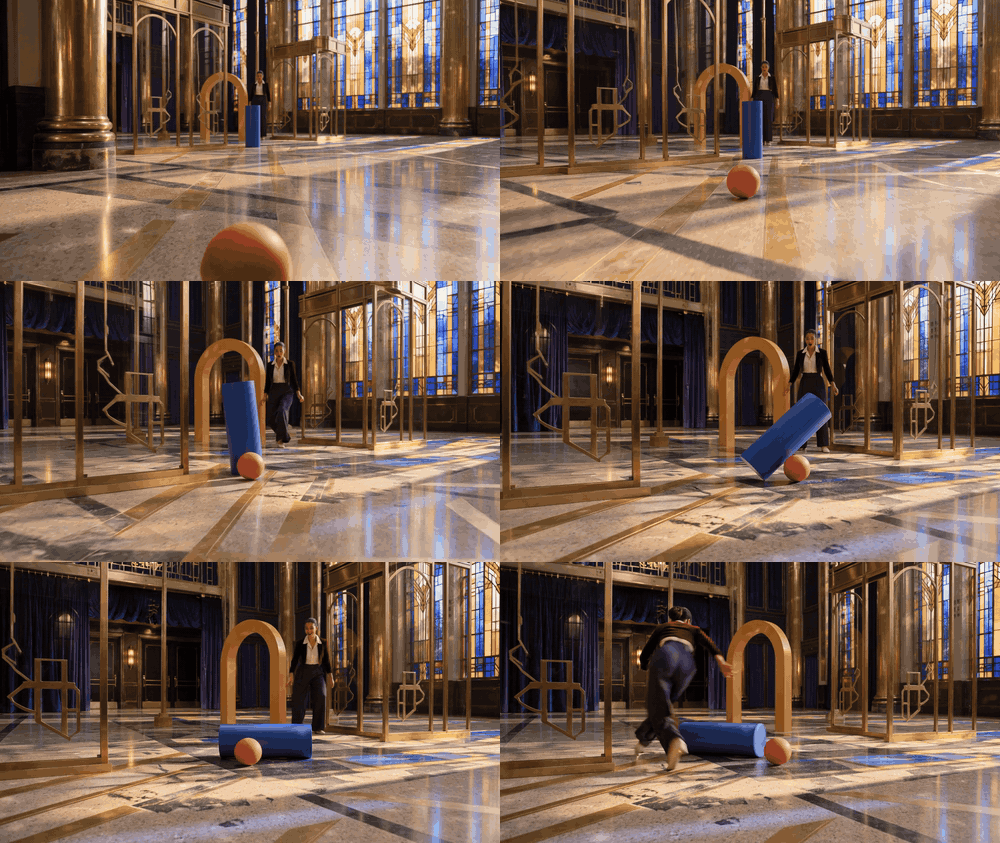
圆柱倾斜并稳定下来,同时球仍在视野中。在把这两个片段当作连续镜头之前,将其起始位置与片段 02 进行比较。
镜头 4:二次碰撞
检查内容: 运动从圆柱传递到拱门,同时所有物体保持其身份。
plaintext1Use the selected final frame of shot two as the first frame in the same Art Deco foyer. Maintain the exact burgundy-and-plum outfit, dancer's face and bun, coral ball, cobalt cylinder, saffron arch, terrazzo pattern, brass columns, indigo curtains, and light direction. Ten seconds. The cylinder is already rotating toward the stationary arch. From 0-3 seconds, track at waist height beside the cylinder while the dancer crosses behind it in a quick, elegant chasse step; her expression tightens from delight to alert concentration. From 3-6 seconds, drop to a low three-quarter angle and show the cobalt cylinder making one clear contact with the arch's lower left side. The light wooden arch rocks back, while the cylinder rolls a short additional distance; neither changes shape or color. From 6-10 seconds, orbit gently to keep both objects and their slowing motion visible as the dancer makes a small airborne turn, lands softly beyond them, and steadies herself with one extended hand. The pleated trousers and velvet jacket settle naturally. Colored stained-glass light cuts across cream-and-jade terrazzo, warm brass glints remain restrained, realistic 35 mm film texture. No shattering, magical sparks, speech, captions, crowd, plants, teleports, duplicate objects, or zoom-only motion. Wide 16:9.
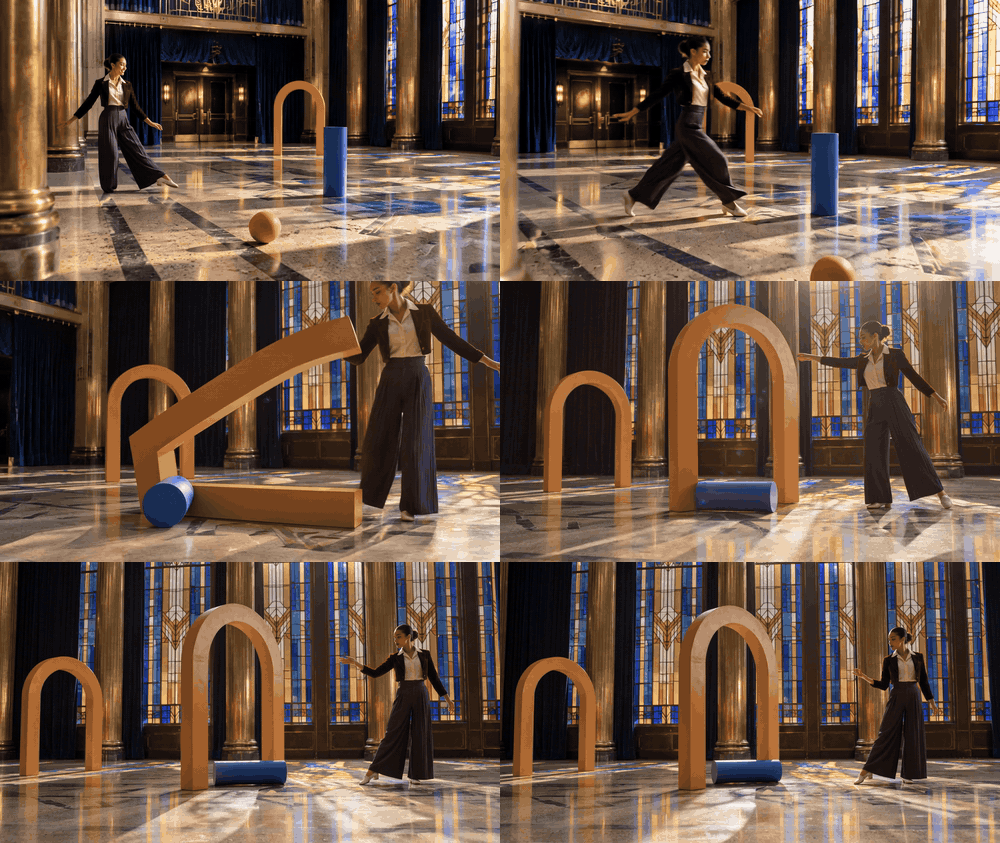
拱门在圆柱附近倾斜,但确切接触点不清楚。这是预期二次碰撞的故事板,并不证明所描绘的传递在物理上正确。
镜头 5:遮挡与恢复
检查内容: 同一个球在经过固定柱子后方后是否重新出现。
plaintext1Continue from the preceding shot's final frame in the same empty Art Deco foyer. The single coral ball is still rolling slowly; the cobalt cylinder has shifted, and the saffron arch is rocking toward rest. Ten seconds. From 0-3 seconds, follow the dancer from slightly behind as she takes two fast, fluid dance steps across the geometric terrazzo and spots the ball. Her brows draw together in concentration, then one corner of her mouth lifts. From 3-6 seconds, slide the camera behind a fixed brass-clad column so the ball becomes briefly hidden by the column itself. Keep the column, floor pattern, and dancer spatially consistent while the ball continues its established direction. From 6-10 seconds, emerge at a low three-quarter angle as the same single coral ball rolls out from the far side with unchanged size, color, and direction. The dancer turns her shoulders, reaches toward it, stops short, and lets it pass, breaking into a delighted grin. Keep the cylinder and arch in plausible background positions. Amber-and-cobalt stained-glass light, indigo velvet curtains, tactile silk and terrazzo, smooth 35 mm camera movement. No speech, titles, crowd, plants, duplicate ball, object morphing, location jump, or empty slow zoom. Wide 16:9.
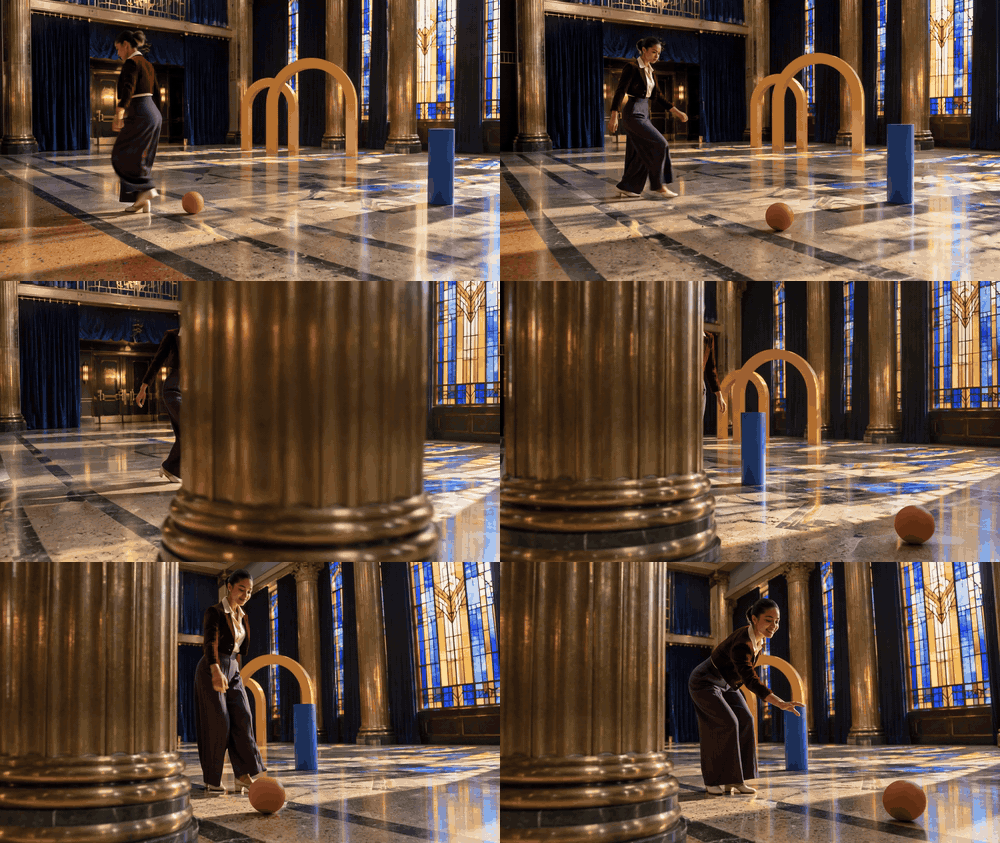
球短暂地被一根固定柱子遮住。比较其在遮挡两侧的颜色、大小和方向。
镜头 6:后续结果
检查内容: 最终相对位置、稳定运动,以及完整场景的连续性。
plaintext1Use the final frame of shot four as the first frame, preserving the dancer's burgundy cropped velvet jacket, ivory silk blouse, deep-plum wide-leg trousers, cream dance shoes, the same coral ball, cobalt cylinder, saffron arch, brass columns, indigo curtains, stained-glass windows, and terrazzo floor. Ten seconds. From 0-3 seconds, begin low beside the coral ball as it decelerates along the floor inlay lines; the saffron arch completes a small believable rocking motion farther back. From 3-6 seconds, crane smoothly into a wide three-quarter view that reveals all three objects at once in their changed positions. Do not reset them to their starting places. The dancer travels around the settled cylinder with two flowing steps and a full controlled spin, her pleated trousers describing a clear arc. From 6-10 seconds, arc the camera to face her as she catches her balance, checks the ball and arch, exhales, then smiles with visible relief and playful pride. Hold the final composition long enough to read every object's position. Warm directional window light and colored glass shapes, cream-and-jade terrazzo, rich indigo and burgundy, restrained film grain, physically plausible settling. No speech, captions, crowd, plants, duplicate props, sudden camera teleport, or push-in-only movement. Wide 16:9.
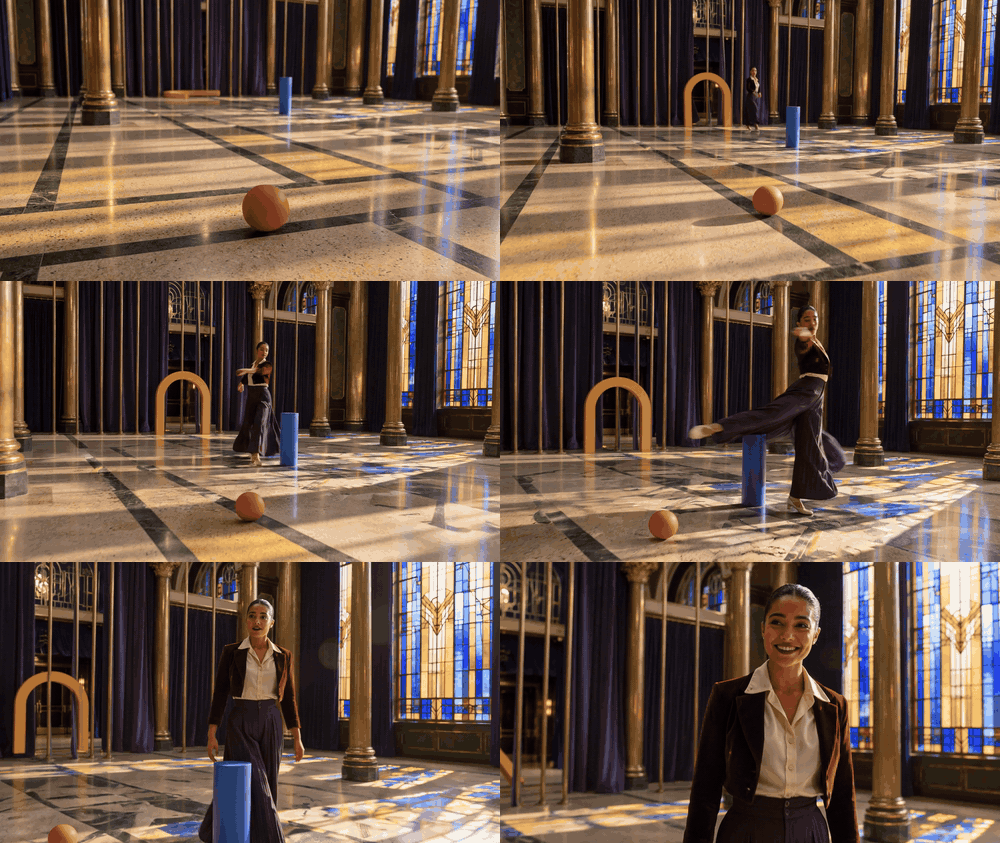
宽幅结尾展示了舞者的旋转和最终场景。将拱门的位置与片段 04 进行比较;明显的重置将是连续性失败。
将这六个提供的结果作为一个案例来审视。如果脚部接触不可见、偏转在镜头之间改变、物体重复,或最终位置跳变,就直白地记录失败。故事板可以传达想法,但不能验证数值物理。对于真实的 Genie 4 会话,使用上文更简单的固定摄像机协议,保存实际交互,并用同一张观察卡比较其可见后续结果。
访问权限和后续步骤
Google 的公告将 Genie 4 描述为从可信测试者开始的研究预览,更广泛的可用性计划与 Project Genie 和选定合作伙伴相关。这是一个不断变化的推出过程,因此请查阅当前官方 Genie 页面以了解访问权限,而不是假设每位读者今天都能试用。Project Genie 早期的公开提示词建议是有用的背景,但它并不保证 Genie 4 访问权限或相同控制项。
如果你可以访问 Genie 4,从一次固定摄像机碰撞开始,并保存提示词和录像。在得出结论之前填写观察卡。如果你无法访问,你仍然可以现在准备协议,或使用文本到视频模型制作一个明确标注的视频参考。对于用于碰撞和物体运动的 Genie 4 物理模拟,核心问题不是一次撞击看起来是否有说服力。而是接触之后场景是否仍然可解释,以及证据是否足够强,足以支持你需要做出的决定。
常见问题
Genie 4 是物理引擎吗?
Google 将 Genie 4 描述为用于生成模拟环境并与之交互的世界模型。传统物理引擎会暴露场景的配置属性和计算状态。不要假设生成世界会暴露相同数据,或提供经验证的数值模拟。
Genie 4 能展示球弹跳或两个物体碰撞吗?
官方 Genie 材料描述了具有物体碰撞的环境。特定提示词或会话可能有所不同,因此评估实际运行,并记录接触和撞击后运动是否保持可见。产品演示并不保证每一次请求的碰撞。
Genie 4 对游戏或工程物理足够准确吗?
生成场景可以支持视觉探索,但仅凭渲染结果不能证明数值准确性。对于实现、工程分析和安全决策,请使用游戏引擎或合适的经验证模拟器。
AI 视频生成器可以测试物体运动吗?
它可以帮助为提议的运动创建视觉参考。生成片段不提供与物理引擎相同的交互或可测量状态,并且除非它确实来自 Genie 4,否则不应作为 Genie 4 输出来呈现。


