Blocked. No preview, no partial render, just a policy notice.
Whether you typed the prompt yourself or just wondered if PixVerse AI does NSFW at all, you've met the wall thousands of people hit every week. The answer takes one word. The useful part takes longer: which document blocks you, which layer of the stack fires, and why the entire "bypass" economy built around this question is selling smoke.
Key Takeaways
- PixVerse prohibits sexually explicit content at three levels: the consumer Terms of Service (updated May 7, 2026), the Community Guidelines (March 2025), and the Platform Terms covering all API use (January 2025).
- Two bans are absolute and named: any content sexualizing minors, and sexually explicit or suggestive content of real people without their consent.
- Moderation is documented at two layers: input screening (API error 500063, "Text moderation failed") and review of the rendered clip itself (generation status 7) — what slips past intake still faces review after rendering.
- Pushing has a documented cost: per PixVerse's API FAQ, accounts that repeatedly trip moderation get suspended, and the consumer sanction ladder ends at permanent ban.
- Filters tuned for NSFW also misfire on SFW work. Telling a policy block from a false positive is the practical half of this article.
Does PixVerse Allow NSFW? The 2026 Policy, Document by Document
No. Not in the app, not through the API, not in the community feed. "PixVerse" is really three surfaces — the consumer app, the developer API, and the official community spaces — and each answers to its own policy document. All three draw the same line. Even the official PixVerse account on Reddit lists "No NSFW content" in its community rules, and no tier, toggle, or paid plan changes any of it.
Most write-ups guess at the details anyway. Reading the three documents takes ten minutes and settles them. Here's the record, with dates:
| Document | Date | Exact prohibition | Stated consequence |
|---|---|---|---|
| Terms of Service, §5 | Updated May 7, 2026 | No content that "in any way sexualises children"; no "sexually explicit or sexually suggestive content of other people without the subject's consent" | Access terminated or blocked "without prior notification" (§14) |
| Community Guidelines | Updated March 20, 2025 | "Sexually Explicit Content — Graphic sexual content or inappropriate adult material" | Ladder: warning → content removal → temporary restrictions → suspension → permanent ban |
| Platform Terms of Service (API) | Updated January 5, 2025 | No "disseminating pornographic, erotic" content; PixVerse "has the right to conduct compliance reviews on the video content generated by users through the API" | API rights restricted, service suspended or terminated, violations reportable to regulators |
Read together, the three documents form a strict superset, not a contradiction. The Community Guidelines ban the whole category. The Terms of Service then name two absolutes in unusually specific language: minors, and real people without consent. Those two aren't moderation-tuning questions that might drift looser in an update. They're the lines that end accounts in one step — and in the real-person case, the exposure isn't only contractual. Since May 2025, the US TAKE IT DOWN Act makes knowingly publishing non-consensual intimate imagery, AI-generated included, a federal crime. The Platform Terms even reserve the right to report violations "to relevant regulatory authorities" — language you rarely see in Silicon Valley terms.
The dates also answer anyone wondering whether the policy loosened between 2025 and 2026. It didn't — the API terms date to January 2025, the guidelines to March 2025, and the May 2026 Terms refresh keeps every explicit-content prohibition in force.
Where the PixVerse Filter Fires, and the Cheapest Clean Test
A blocked generation isn't one event, and you don't have to guess at the layers — PixVerse documents them. In the official API error-code reference, error 500063 fires on inputs: "Text moderation failed: The text contains sensitive information," with parallel variants for uploaded images and input video. What survives intake can still die after rendering: generation status 7 means "Content moderation failure," and the docs' advice is simply to modify the prompt. Input screen first, then review of the finished clip — the Platform Terms' "automated technology and manual review," wearing error codes.
The platform FAQ adds two details worth knowing. On PixVerse's own API platform, credits for generations that fail moderation are refunded automatically. And right next to that sits a plainer sentence: "If your account makes too many requests that get moderated, we will suspend your account." The retry is free; the pattern isn't.
Why does the layer matter? Because many people don't meet PixVerse at pixverse.ai at all — they meet it inside third-party apps and aggregators that can bolt their own filters on top. From inside a wrapper, you can't tell whose wall you hit. You need a baseline that runs the official model with nothing added.
Atlas Cloud is a multimodal AI inference platform hosting 300+ video, image, audio, and language models behind one API key, pay-as-you-go with no subscription — PixVerse endpoints bill per second of output. Its PixVerse family page carries the current lineup — V6 and C1, across text-to-video, image-to-video, reference-to-video, and frame-control endpoints — and the PixVerse V6 text-to-video playground runs the official model in the browser before you've written a line of integration code.
To be clear about what that buys you: Atlas Cloud serves the official PixVerse API, so PixVerse's moderation applies in full. It will not render NSFW. What it gives you is a clean reference point, at per-second prices that make systematic testing trivial:
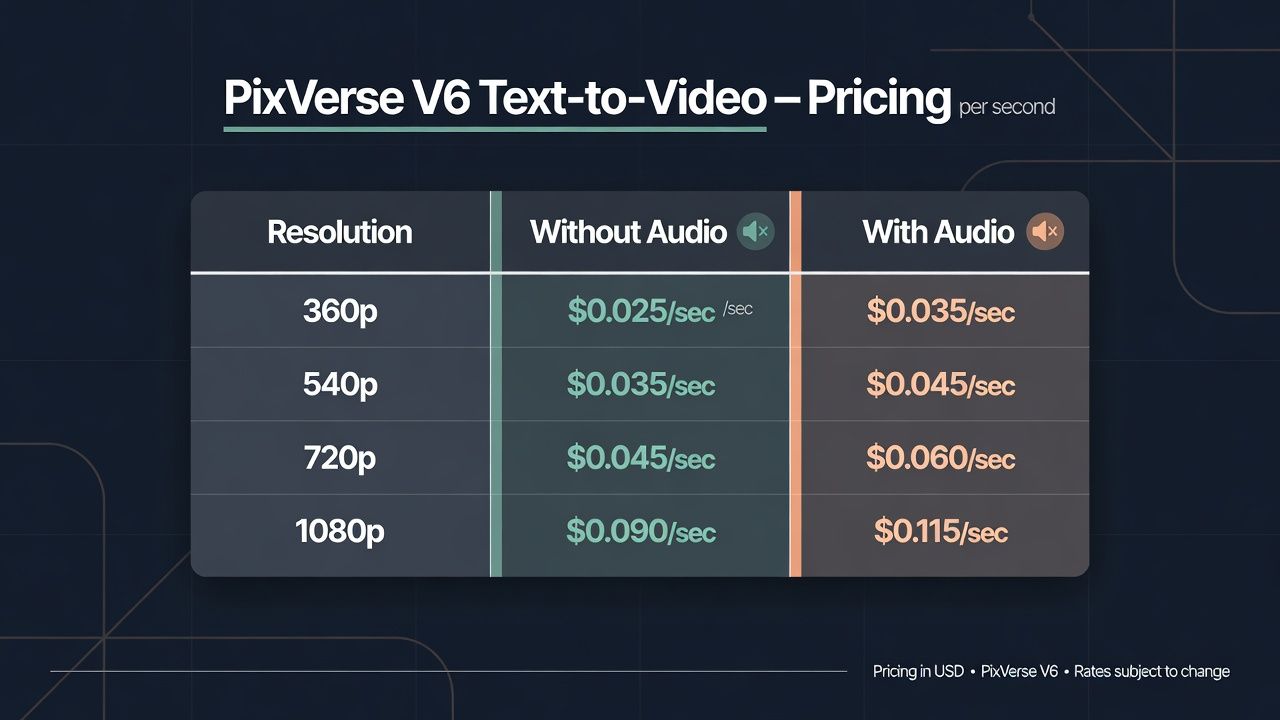
A 5-second 360p probe costs $0.125 without audio, so screening eight production prompts for false positives costs a dollar. C1 endpoints start slightly higher, at $0.03/sec for 360p without audio. If a prompt passes on the official endpoint but fails in your app of choice, the block was never PixVerse's.
Why PixVerse NSFW Prompts Fail (and When the Filter Is Wrong)
The predictable failures are the ones the documents already cover. The confusion in community threads comes from everything else, and one distinction untangles most of it. NSFW names a category of content. Censored names the act of blocking — any content. Filters tuned to catch NSFW routinely misfire on things that aren't: dance clips, fitness footage, harmless phrasing. A refused SFW prompt is an overtuned-filter problem, and it has different fixes than a policy block.
| What you see | What probably fired | What to do |
|---|---|---|
| Instant refusal, zero render time | Input screening (API error 500063 covers text, uploaded image, and input video) | If your prompt is SFW, rephrase: state adult ages explicitly, name the garment, cut ambiguous descriptors |
| Clip renders, then fails or disappears | Output review (generation status 7, "Content moderation failure") | If SFW, retry and report it; if borderline, that's the policy line, not bad luck |
| Same prompt passes Monday, fails Friday | A filter update between attempts | Expect drift; moderation tightens after slips, it doesn't loosen |
| Passes on the official endpoint, fails in your app | The wrapper's own filter | Take it up with the wrapper; the model isn't your problem |
Blocked on a fully clothed choreography clip? That's not the PixVerse NSFW policy at work. Based on community reports across video platforms, the classic trigger is ambiguity — age words, unnamed skin, suggestive framing language — and the fix is precision, not persistence.
PixVerse NSFW Bypass, Discord Servers, and Prompt Packs: A Tour of Dead Ends
Every route in the bypass economy fails the same test: none of it changes what PixVerse's output review will approve. The evidence tour is short but instructive.
The most-cited "proof" is a June 2025 BlackHatWorld thread in which a poster claimed one NSFW clip had rendered — and then couldn't reproduce it with another image, even while asking the forum for help. That's not a crack in the wall. That's what output-layer moderation looks like from outside: wording occasionally slips past the prompt screen, the rendered result gets caught or reported, and the gap closes behind it.
The "PixVerse NSFW Discord" ecosystem is thinner still. The subreddits that advertise those servers have follower counts in the double digits and exist mostly to post invite links. Galleries of "pixverse nsfw prompts" on prompt-sharing sites prove someone typed a prompt — not that PixVerse rendered it, or would today.
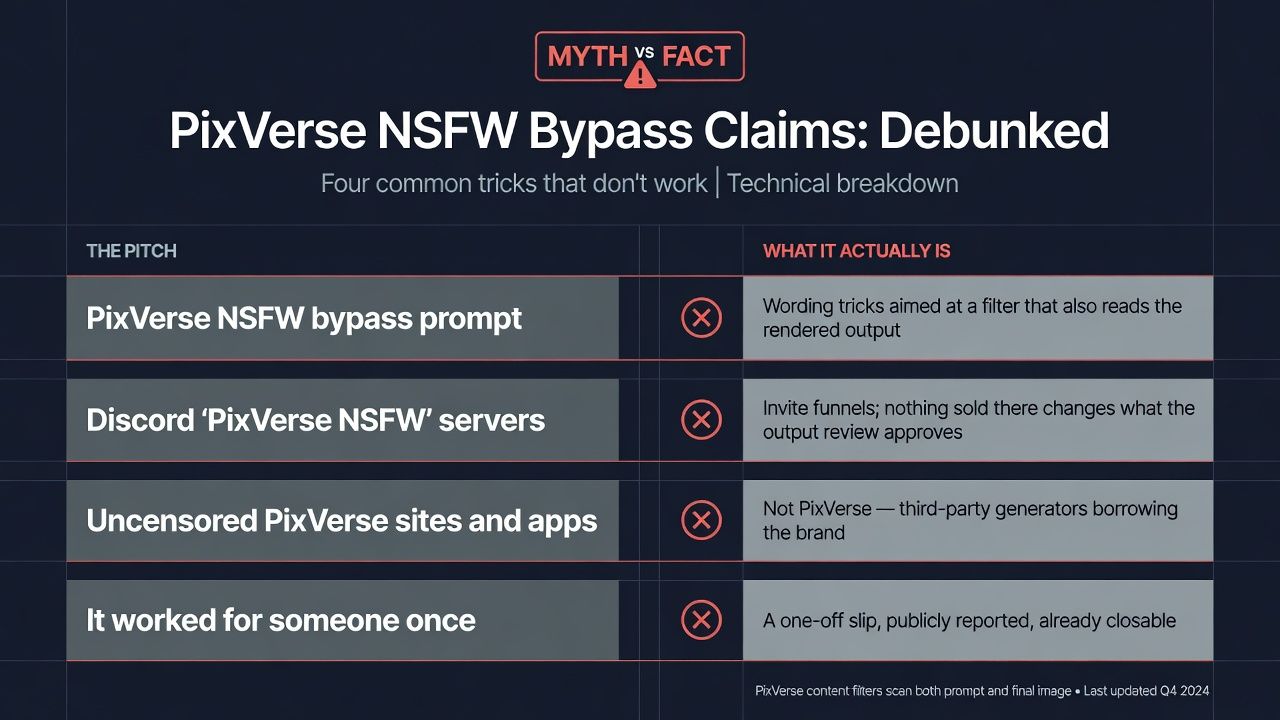
The downside isn't hypothetical either: suspension for repeated moderation hits and termination without notice are both in writing, and real-person content without consent walks into federal territory, not just policy. Even in communities with no love for content filters, the verdict is blunt: when PixVerse came up on r/grok as a video-tool alternative, the reply was that it simply isn't NSFW and that people claiming otherwise are misleading you.
What PixVerse Will Happily Render: Working Near the Line
Here's the part the affiliate reviews never tell you: PixVerse's own effect shelf is the clearest map of where the line actually sits. The app ships and heavily promotes templates like AI Kiss, AI Hug, and Muscle Surge — romance, physical closeness, and bare-torso physique content are sanctioned, in-catalog use cases. Skin is not the line. Explicitness and consent are.
That matters for the creators who live near the filter legitimately — dance, fitness, swimwear, stage costume, body-transformation content. Your work is allowed; your wording decides whether the classifier believes it. Four habits keep near-line SFW prompts on the right side of the false-positive table above:
- State ages as adult, explicitly: "adult professional dancer, mid-30s." Ambiguous youth descriptors are the classic misfire trigger.
- Name the garment: swimwear, sportswear, stage costume. Unlabeled skin reads as risk to a classifier.
- Describe the camera and the choreography, not anatomy.
- For real faces, use likenesses you hold rights to, and expect the consent rule to be enforced hardest on anything remotely suggestive. The full prompt grammar, subject first, motion second, camera last, is covered in the PixVerse prompt structure guide.
Frequently Asked Questions
Does PixVerse AI allow NSFW content?
No. The Community Guidelines prohibit "graphic sexual content or inappropriate adult material," the Terms of Service name child-sexualizing content and non-consensual sexual content of real people as absolute bans, and the Platform Terms bar pornographic content and subject API-generated video to compliance review. Every official surface gives the same answer.
Is there an uncensored version of PixVerse?
No official one, on any plan or tier. Anything marketed as "PixVerse uncensored" is a third-party tool borrowing the name, or a funnel to a different generator entirely. Moderation is part of the service itself, including through the API and every platform that resells it.
Do PixVerse NSFW prompt packs from Discord actually work?
There's no reproducible public evidence that they do. The most-cited forum slip, from June 2025, couldn't be repeated by its own poster. Because PixVerse reviews rendered output as well as prompts, wording tricks age badly. What the packs reliably produce is revenue for the seller and ban risk for the buyer.
Will PixVerse ban my account for NSFW prompts?
Repeat attempts can get you suspended, and that's not an inference — the API FAQ states it directly: "If your account makes too many requests that get moderated, we will suspend your account." The consumer ladder runs warning → content removal → temporary restrictions → suspension → permanent ban, and anything touching minors or non-consensual real-person content skips the soft end entirely.
Is PixAI the same thing as PixVerse for NSFW rules?
No, and search results blur them constantly. PixAI is an anime-focused image generator with its own filter debates; PixVerse is AISphere's video platform. Google routinely surfaces r/Pixai_Official threads in PixVerse NSFW search results, even though they describe a different product's rules. Check which name a thread is actually about before applying its advice.
Did the PixVerse NSFW policy change between 2025 and 2026?
The document dates show continuity, not loosening: Platform Terms updated January 5, 2025, Community Guidelines updated March 20, 2025, and the Terms of Service refresh of May 7, 2026 keeps every explicit-content prohibition in force. Nothing in the current record points to a permissive turn.
Conclusion
"Does PixVerse allow NSFW" has a one-word answer, and everything useful lives underneath it. Three documents draw the same line from three directions. Output review means wording tricks expire fast, which is why the bypass economy can only sell prompts, packs, and invites — never results. The two named absolutes, minors and non-consensual real-person content, carry consequences that reach well past an account ban.
If your work is legitimate and just lives near the filter, the play is precision: adult ages stated, garments named, cameras described, and a cheap baseline test against the official endpoints before you blame the model. And if you're deciding whether PixVerse belongs in your production stack at all, the PixVerse V6 review covers what it's actually good at — which was never this.





