Kling AI is one of the most capable video generation models available in 2026, with versions 2.6 and 3.0 achieving photorealistic motion quality that rivals professional production tools. Before you build a product or workflow on top of it, one question comes up repeatedly in developer forums: does Kling AI allow NSFW content?
The search volume for "kling ai nsfw policy 2026" has grown significantly since Kling 3.0 launched in May 2026, as teams evaluating the model for commercial use need clear answers before committing engineering resources. Developers accessing Kling through platforms like Atlas Cloud ask this question constantly, and the existing documentation does not always give a direct answer.
This FAQ covers 12 of the most common questions about Kling AI's content policy, organized into four categories: the core policy, how moderation works, API-specific behavior, and what it means for production use.
Key Takeaways
- Kling AI does not allow NSFW content in any form in 2026. There is no adult mode, no toggle, and no API bypass.
- Moderation runs at three layers: prompt screening, real-time generation constraints, and output checks.
- The policy applies equally to text-to-video, image-to-video, and reference-to-video modes.
- Atlas Cloud does not add extra content filtering on top of Kling. The policy experience is identical whether you use Kling directly or via Atlas Cloud.
Category 1: The Core NSFW Policy Question
Does Kling AI Allow NSFW Content in 2026?
No. Kling AI does not allow NSFW content in 2026. The platform operates as a fully safe-for-work environment with no adult mode, no NSFW toggle, and no API parameter to unlock explicit generation. This is a deliberate product decision, not a limitation waiting to be patched. Kling AI's moderation is among the strictest of any major video generation model currently available, reflecting both the platform's design philosophy and the regulatory environment under which Kuaishou, Kling's developer, operates.
Unlike some image generation tools that offer separate professional or uncensored tiers, Kling AI offers no such option at any subscription level. The restrictions apply to all users, all plans, and all access methods including the API.
The strictness of Kling AI's content policy is an engineering choice embedded in the model architecture, not just a terms-of-service overlay. Community testing shows that moderation occurs at the generation stage itself, not only at the output review stage — which means you can't prompt-inject around it the way you might with a purely output-level filter. For a wider view of the platform beyond its content rules, our full Kling AI guide walks through its models, features, and pricing in one place.
What Is Kling AI's Content Policy in 2026?
Kling AI's content policy prohibits six major categories of content, based on the platform's published terms and community guidelines active as of 2026-04-21 (the last update date shown in their Terms of Service).
The 6 blocked categories are:
| Category | Examples of Blocked Content |
|---|---|
| Explicit and adult content | Nudity, pornography, fetish material, highly suggestive scenes |
| Graphic violence | Gore, executions, self-harm, extreme cruelty |
| Political and social sensitivity | Government criticism, territorial disputes, protests, public figures in sensitive contexts |
| Illegal and harmful activity | Drug production guides, weapons trafficking, terrorism planning |
| Misinformation | Deepfake-style propaganda, fabricated news, harmful rumors |
| Hate speech | Content targeting individuals or groups based on protected characteristics |
The kling ai content policy is intentionally broad. Sensitive political content and social commentary face restrictions that go beyond what most Western platforms apply, a distinction that matters for developers building news, documentary, or editorial video workflows.
In practice, the kling ai content restrictions that cause the most friction for legitimate creators fall into three areas.
Realistic human skin exposure. Swimwear, lingerie, or any prompt involving significant skin exposure in a realistic human context is frequently flagged. Sports and fitness content sometimes triggers false positives if the prompt involves close-up body shots or minimal clothing.
Violence in realistic contexts. Action scenes involving realistic weapons fire, blood, or physical impact are commonly rejected. Stylized or clearly animated violence is treated differently from photorealistic violence.
Political and public figure content. Any generation featuring recognizable public figures or political imagery is high-risk. This category is the least predictable because the model applies contextual judgment, not just keyword matching.
For the clearest summary: kling ai nsfw restrictions in 2026 mean the platform is appropriate for commercial, educational, entertainment, and narrative content that would comfortably appear on a mainstream video platform. If your use case requires anything beyond that, Kling AI is not the right tool.
Does the Kling AI NSFW Policy Apply to Image-to-Video Mode?
Yes. The kling ai nsfw policy 2026 image to video restrictions are identical to text-to-video. When you upload a reference image to the image-to-video endpoint, that image passes through Kling's content moderation layer before generation begins. Images containing nudity, explicit material, graphic violence, or sensitive political imagery are rejected at the input stage.
This is a meaningful distinction from some competing models where image-to-video input checks are less strict than text prompt checks. With Kling AI, the kling ai content restrictions apply uniformly across all input modalities.
Developers using Atlas Cloud's Kling 3.0 image-to-video endpoint should test their reference image pipeline against the content policy before scaling. A reference image that passes visual inspection may still trigger moderation if it contains contextual signals the model interprets as policy-violating.
Category 2: How Kling AI's Moderation System Works
How Does Kling AI's Content Moderation Work?
Kling AI's kling ai nsfw content policy is enforced through a three-layer moderation system that runs on every generation request regardless of input type.
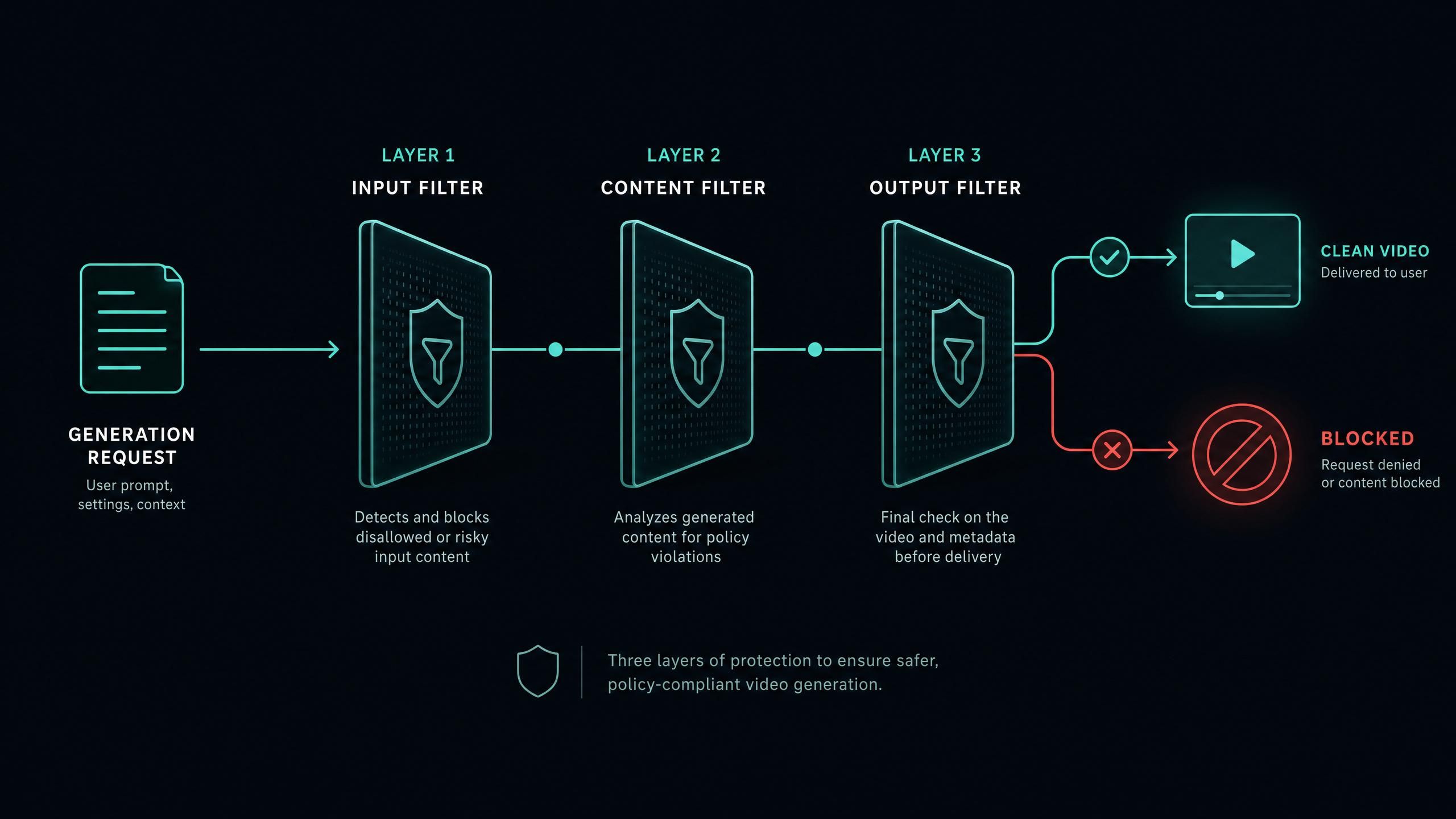
Layer 1: Prompt screening. Before any generation begins, the text prompt is scanned against a prohibited content classifier. Prompts containing keywords, phrases, or semantic patterns associated with blocked categories are rejected before any compute is spent on generation. This layer handles the majority of explicit content attempts.
Layer 2: Real-time generation constraints. During the diffusion process itself, Kling applies policy-aware generation constraints that steer the model away from producing certain visual outputs even when the prompt doesn't explicitly request them. This is why seemingly neutral prompts sometimes produce unexpected results: the model is actively steering away from outputs that fall near policy boundaries.
Layer 3: Output review. The completed video or frame sequence passes through a final content classifier before being returned to the user. Content that passed the first two layers but still produced a flagged output is blocked at this stage.
Developers on the Atlas Cloud platform report that layer 3 rejections are the most frustrating because they consume generation credits and return a generic error rather than an explanation. This is a known behavior pattern in Kling AI's API response design.
The system is designed to produce either a clean generation or a rejection, not a "safe" substitution. In practice, some edge-case prompts receive a toned-down output instead of an error, but this behavior isn't documented and can't be relied on.
What Content Does Kling AI Block?
Kling AI blocks content across the six categories listed in the policy table above. In practice, the kling ai content restrictions that cause the most friction for legitimate creators fall into three areas.
Realistic human skin exposure. Swimwear, lingerie, or any prompt involving significant skin exposure in a realistic human context is frequently flagged. Sports and fitness content sometimes triggers false positives if the prompt involves close-up body shots or minimal clothing.
Violence in realistic contexts. Action scenes involving realistic weapons fire, blood, or physical impact are commonly rejected. Stylized or clearly animated violence is treated differently from photorealistic violence.
Political and public figure content. Any generation featuring recognizable public figures or political imagery is high-risk. This category is the least predictable because the model applies contextual judgment, not just keyword matching.
For the clearest summary: kling ai nsfw restrictions in 2026 mean the platform is appropriate for commercial, educational, entertainment, and narrative content that would comfortably appear on a mainstream video platform. If your use case requires anything beyond that, Kling AI is not the right tool.
What Error Does Kling AI Return When Content Is Blocked?
When Kling AI's moderation system rejects a request, the API returns a generic error rather than a specific content policy violation code. The error message typically indicates generation failure without identifying which policy category was triggered.
This is different from how some other platforms handle rejections, where the error response includes a category code (such as content_filter_sexual or content_filter_violence). Kling AI's error responses do not include this level of detail, which makes debugging blocked prompts difficult when the reason for rejection isn't obvious.
The practical implication for developers: build a retry and logging layer that captures the full request alongside the error response. Without it, you can't distinguish between a content policy rejection, a model capacity error, or a parameter validation failure. Atlas Cloud's API documentation covers the error response schema for video generation endpoints.
Category 3: API and Developer Behavior
Does the Kling AI NSFW Policy Apply to API Requests?
Yes. The kling ai nsfw policy applies identically to API requests and web app usage. There is no developer-tier bypass, no enterprise unlock, and no API parameter that disables content moderation. This is a hard constraint at the model level, not a UI-layer enforcement.
Some developers assume that API access implies fewer restrictions than consumer-facing tools. With Kling AI, that assumption is incorrect. The same three-layer moderation system that runs in the web interface runs on every API call.
When you access Kling AI through Atlas Cloud's unified API, the content policy that runs is Kling AI's own moderation system. Atlas Cloud does not add a separate content filter on top of it. Your request goes directly to the model, and the same three-layer moderation applies as it would if you called Kling AI directly.
Does Atlas Cloud Add Additional Content Filtering on Top of Kling AI?
No. Atlas Cloud does not add a separate content filtering layer on top of Kling AI's native moderation. When you call Kling through Atlas Cloud's unified API, the content policy that runs is Kling AI's own three-layer moderation system. Atlas Cloud passes your request directly to the model without inserting an additional content classifier.
Atlas Cloud does operate an acceptable use policy that governs platform-level conduct. It prohibits uses like building competing AI products with the API, systematic data scraping, and generating malware or phishing material. But these are platform conduct rules, not additional content filters applied to your video generation requests.
The practical implication: if a generation request passes Kling AI's native moderation, Atlas Cloud will not block it on content grounds. The content policy experience when using Kling via Atlas Cloud is identical to using Kling directly.
How Should Developers Handle Content Policy Errors in Production?
Developers building video generation pipelines on Kling AI via Atlas Cloud should implement four practices to handle kling ai content restrictions gracefully in production.
1. Pre-validate prompts. Build a prompt pre-screening step that checks against known high-risk keyword patterns before sending the API request. This reduces wasted credit spend on predictable rejections.
2. Log the full request context on failure. Since Kling AI's error responses don't include a policy category, the only way to diagnose repeated failures is to log the full prompt, parameters, and reference image details alongside the error response.
3. Implement exponential backoff for generation errors. Some generation failures are transient and will succeed on retry. Others are policy rejections that will fail every time. Without retry logic, you can't distinguish between the two.
4. Test edge cases before launch. Any content category adjacent to the policy boundaries (sports with skin exposure, action scenes, editorial content with public figures) should be tested against your specific prompts before you commit to a production deployment.
Category 4: What This Means for Production Use
Is Kling AI Appropriate for Commercial Video Production?
Yes, for most commercial use cases. Kling AI's kling ai content policy in 2026 is restrictive around adult content, graphic violence, and political material, but the vast majority of commercial video production doesn't require any of those categories. Brand advertising, product demonstrations, narrative short films, educational content, social media video, and corporate communications all fall well within the policy boundaries.
The kling ai nsfw policy 2026 adult content restrictions are absolute, but the policy is otherwise calibrated for professional use. Kling 3.0's cinematic quality and physical realism make it one of the strongest choices for commercial production teams that want AI-generated video at scale. Content rules are only one of the boundaries production teams should plan around, so it also helps to review the Kling AI video length limits before you scope a project.
Teams using Atlas Cloud's Kling 3.0 can generate text-to-video, image-to-video, and reference-to-video content with consistent quality across a pay-as-you-go pricing model.
Does the Kling AI Content Policy Differ Between Model Versions?
The core restrictions are consistent across Kling AI versions. Kling 1.6, 2.0, 2.1, 2.5, 2.6, and 3.0 all operate under the same fundamental content policy framework. What has changed across versions is the sensitivity of the moderation system, not the categories of blocked content.
Community testing has consistently found that each new Kling version applies stricter moderation than the previous one, particularly around realistic human content. Analysis of Kling's censorship across versions has described the pattern as "filters keep getting stricter across every model version."
This trend is relevant for developers upgrading between versions. A prompt that worked reliably on Kling 2.6 may trigger false positives on Kling 3.0 due to the upgraded model's more sensitive content classifiers. Always re-test your prompt library when migrating to a new Kling version.
Frequently Asked Questions
Does Kling AI allow adult content in 2026?
No. Kling AI does not allow adult content in 2026. The platform has no adult mode, no NSFW toggle, and no API parameter that enables explicit content generation. This policy applies to all input types including text prompts, uploaded reference images, and video extension requests. Attempts to generate adult content result in a generation error or a toned-down safe output.
What happens if I try to generate NSFW content with Kling AI?
When you submit a prompt or reference image that violates Kling AI's content policy, the API returns a generic generation error without specifying which policy category was triggered. The request consumes credits if the rejection occurs at the output review stage rather than the prompt screening stage. Repeated policy violations may flag your account for review under both Kling AI's terms and Atlas Cloud's acceptable use policy.
Does Kling AI's content policy apply to the image-to-video mode?
Yes. Kling AI's NSFW policy applies equally to image-to-video generation. Reference images are scanned before generation begins. Images containing nudity, explicit material, or sensitive political content are rejected at the input stage. The policy covers all three input modes: text-to-video, image-to-video, and reference-to-video with audio.
Is Kling AI safe for work (SFW)?
Yes. Kling AI is fully safe for work. The platform is designed as an SFW environment across all features and API endpoints. It is appropriate for commercial use, enterprise deployments, and consumer-facing products without any additional content filtering from the developer's side. Because the same policy applies to every tier, you can safely test the workflow first by using Kling AI for free before moving to a paid plan.
How does Kling AI's content policy compare to other video generation models?
Kling AI's content policy is among the strictest of the major video generation models available in 2026, particularly around realistic human content and political sensitivity. The strictness reflects Kuaishou's regulatory context as a Chinese company. Other models vary significantly in how they handle edge cases. Developers evaluating multiple models for a production use case should test their specific prompt library against each model's policy rather than relying on general reputation.





