For four days at the end of August 2025, every PixVerse user on the web generated video for free. No credit meter, no paywall. That giveaway was the launch of PixVerse V5, a model that debuted at #2 on a global image-to-video leaderboard.
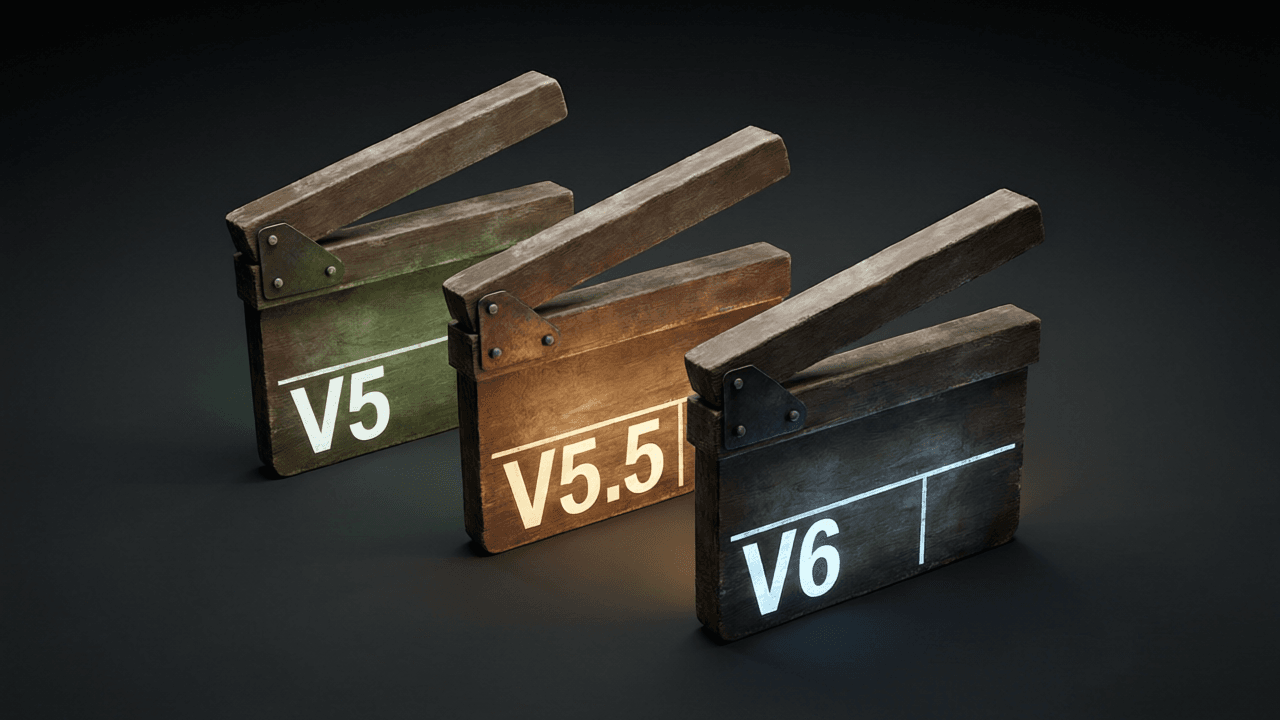
The V5 generation ran for seven months and three releases: V5 itself, then PixVerse V5.5 with native audio, then V5.6 with a steep price cut. Here is the whole record, with the credit math that most write-ups skip.
Key Takeaways
- PixVerse V5 launched August 28, 2025, free for all web users through September 1, and debuted at #2 in image-to-video on the Artificial Analysis leaderboard.
- The base PixVerse V5 model generates 5- or 8-second clips with no audio. Sound, 10-second clips, and multi-shot sequences arrived with V5.5 on December 1, 2025.
- V5.6 (January 26, 2026) cut per-clip credit costs by 22% to 37.5% depending on resolution.
- The V5 line remains callable on PixVerse's official API alongside V3.5 through V6.
- Atlas Cloud hosts the successor V6 generation on a per-second API, from $0.025 per second with no subscription.
PixVerse V5 Launch: Free Week Debut in August 2025
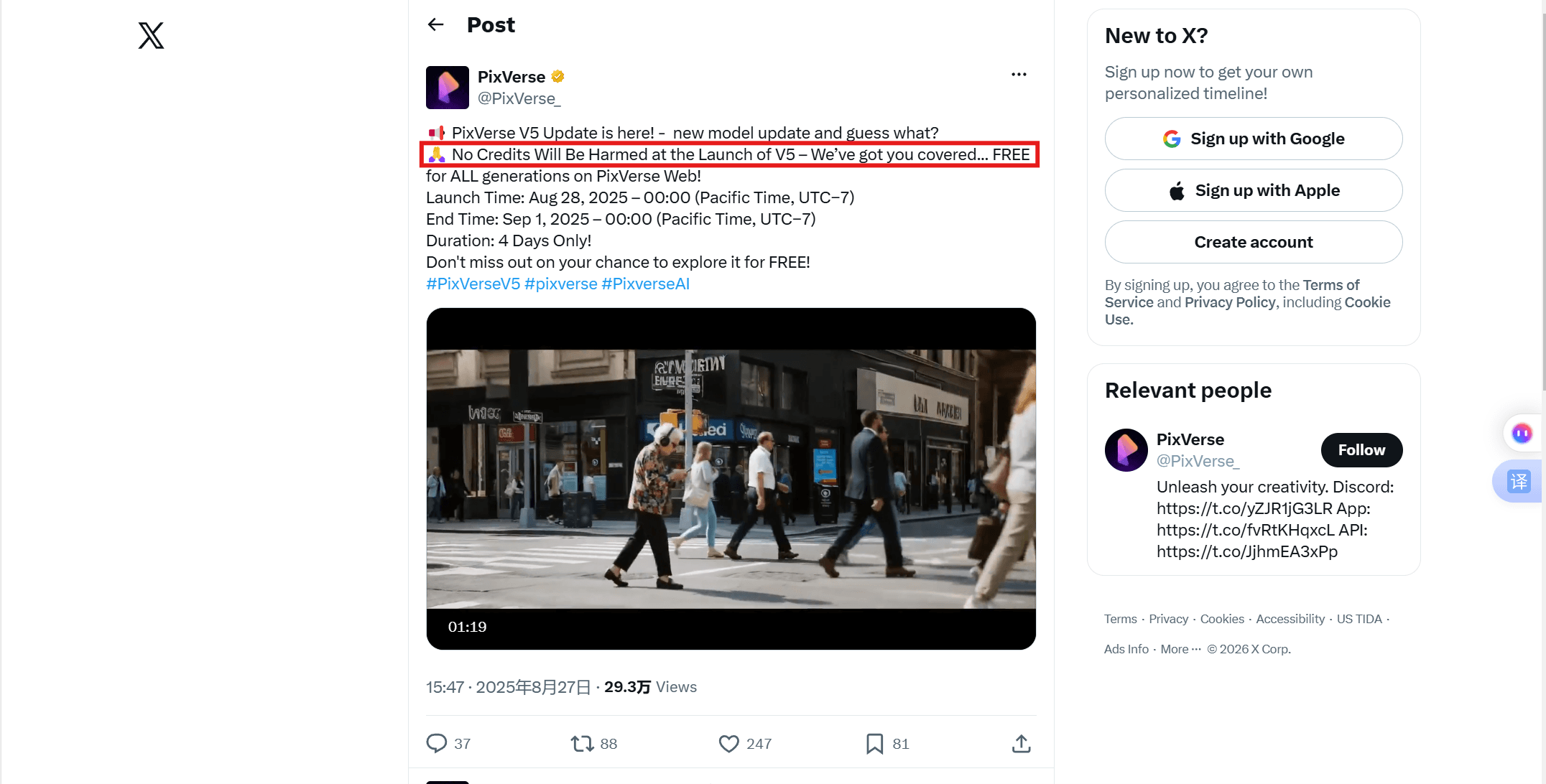
PixVerse V5 went live on August 28, 2025 at 00:00 Pacific Time. The company announced it with an unusual promise in its launch post: "No Credits Will Be Harmed at the Launch of V5." Every generation on PixVerse Web was free until September 1. Launch weeks usually mean a discount. A full free window for all users was a bigger bet, made from a position of scale; the press release paired the model news with the platform's milestone numbers.
| Launch fact | Detail |
|---|---|
| Release date | August 28, 2025, 00:00 PT |
| Free access window | Aug 28 to Sep 1, 2025, all PixVerse Web users |
| Registered users | 100M+ |
| Monthly active users | 16M+ |
| Videos generated platform-wide | 800M+ |
| New companion feature | Agent: one photo in, 5-30 second clip out |
The model itself improved four things over V4.5: motion trajectories, texture detail, cross-frame consistency in style and lighting, and prompt adherence for characters and environments. PixVerse also quoted generation speed of five seconds for a 360p clip and about a minute for 1080p. Alongside V5, the Agent feature let casual users upload a single photo and get a finished video without writing a real prompt.
The benchmark result gave the launch its weight. Artificial Analysis placed PixVerse V5 at #2 in image-to-video and #3 in text-to-video worldwide, alongside Google's Veo 3, ByteDance's Seedance 1.0, and MiniMax's Hailuo 02 Pro. For a company that had been shipping a major version roughly every quarter since V2, this was the first time a release sat that close to the frontier on a neutral scoreboard.
PixVerse V5 Model Specs on the Official API
The PixVerse V5 model is a fixed-tier generator: you pick a resolution and one of two durations, 5 or 8 seconds. There is no audio option. Clips render silent, and the official credit table has no audio column for V5. Anyone who remembers "PixVerse caps out at 8 seconds" is remembering the V4-to-V5 era; the duration rules changed later.
Credit costs from the platform pricing page, with dollar equivalents at the $10-for-1,000-credits pack rate:
| Quality | 5s clip | 8s clip | 5s cost in dollars |
|---|---|---|---|
| Turbo (360p) | 45 credits | 90 credits | $0.45 |
| 540p | 45 credits | 90 credits | $0.45 |
| 720p | 60 credits | 120 credits | $0.60 |
| 1080p | 120 credits | 240 credits | $1.20 |
Three details in that table stand out. The 360p tier carries the Turbo label, the same naming used across the V4-era models. The 8-second option costs exactly double the 5-second one at every tier, so there is no per-clip discount for longer output. And V5 matches the V4.5, V4, and V3.5 price grid in normal motion mode while adding a 1080p 8-second tier those older models never listed; the upgrade to V5 quality came at zero price increase.
One quiet difference: the fast motion mode that doubled credit costs on V4.5 and earlier does not appear in V5's pricing rows at all.
The whole V5 line is still live for developers. PixVerse's current API reference lists the model parameter as supporting v3.5, v4, v4.5, v5, v5.5, v5.6, v6, and c1. A pixverse v5 ai video is one API call away in 2026, silent 8-second cap and all.
Where the PixVerse Lineage Runs by API Today
Everything above still runs on PixVerse's own platform. For anyone building on the family now, though, the practical entry point is the generation that replaced V5. Atlas Cloud hosts the current PixVerse model family, which covers V6 and the storyboard-focused C1 across text-to-video, image-to-video, start-end, reference, and video-extend endpoints. The V6 text-to-video playground is the fastest way to feel the difference: durations run 1 to 15 seconds instead of V5's two fixed stops, audio generates in the same pass, and billing is per second of output.
Atlas Cloud's V6 rates as of July 2026, no discount active:
| Quality | Without audio | With audio |
|---|---|---|
| 360p | $0.025 / sec | $0.035 / sec |
| 540p | $0.035 / sec | $0.045 / sec |
| 720p | $0.045 / sec | $0.060 / sec |
| 1080p | $0.090 / sec | $0.115 / sec |
The comparison against credits is direct. A 720p 5-second V6 clip without audio costs 45 credits through PixVerse's own credit packs, about $0.45 at the $10 pack rate. The same clip meters at $0.225 on Atlas Cloud, with no subscription tier deciding whether your output carries a watermark.
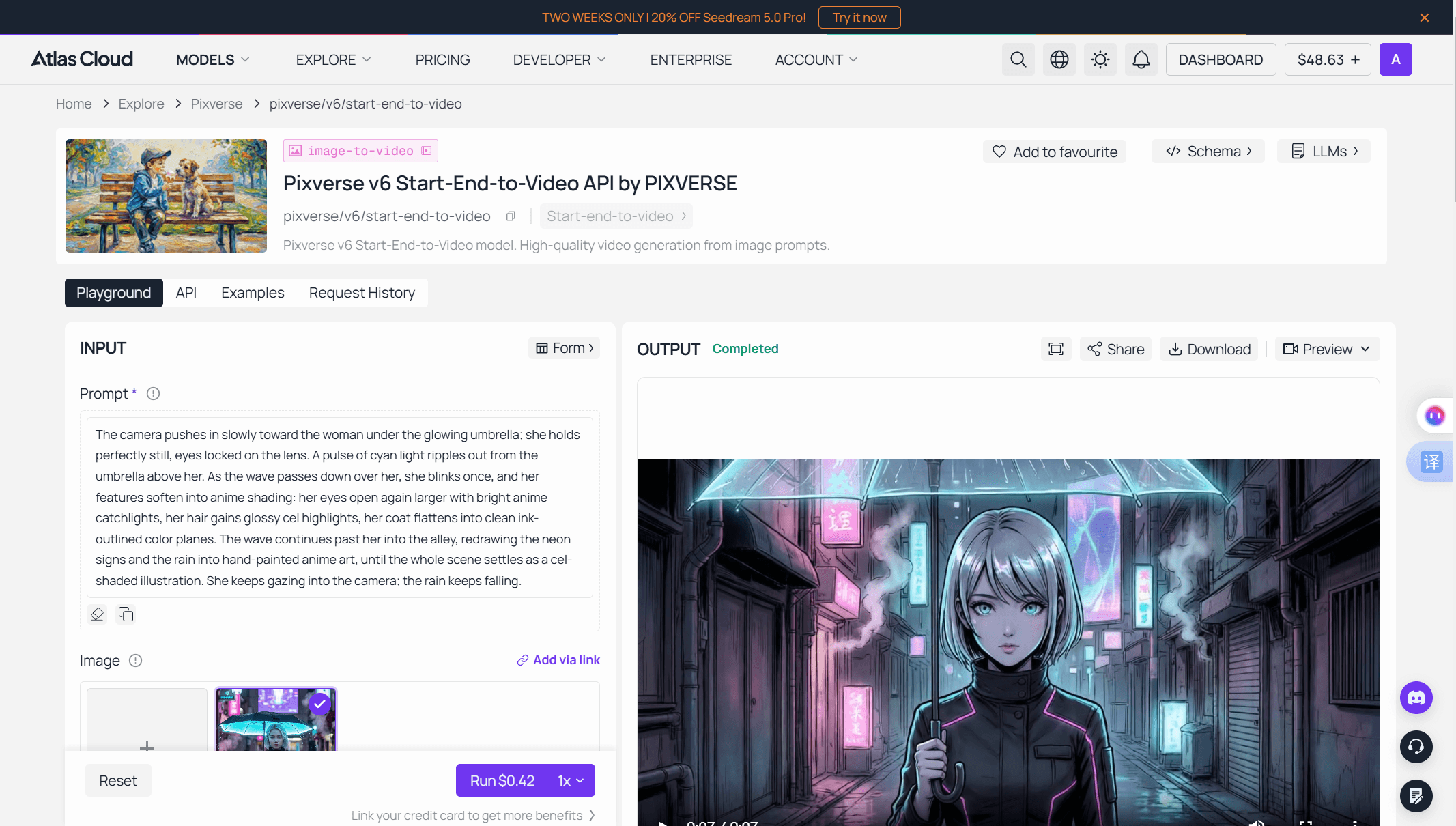
Method 1: Generate PixVerse Video in the Playground
Log in, open the playground, and the form is ready. Only the prompt is required.
- Write the prompt. Subject, action, camera, light, in plain sentences.
- Pick duration and quality. Defaults are 5 seconds, 720p, 16:9.
- Toggle audio. Sound is on by default and raises the per-second rate.
- Check the Run button. It quotes the exact price before you commit. At the defaults that is $0.30 per run, so $10 covers about 33 clips.
- Run and download. The finished video lands in the output panel.
Method 2: Call the PixVerse API From Code
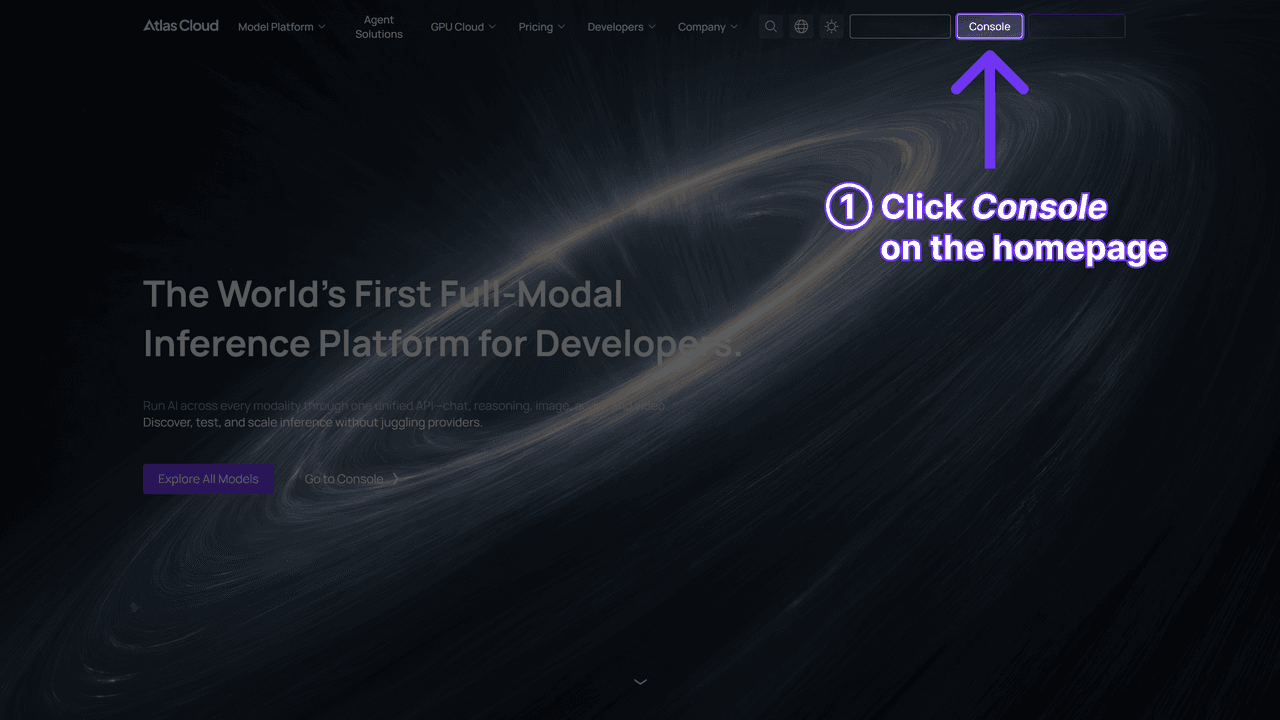
Step 1: Get your API key. Create a key in the Atlas Cloud console and store it as an environment variable, never in client-side code.
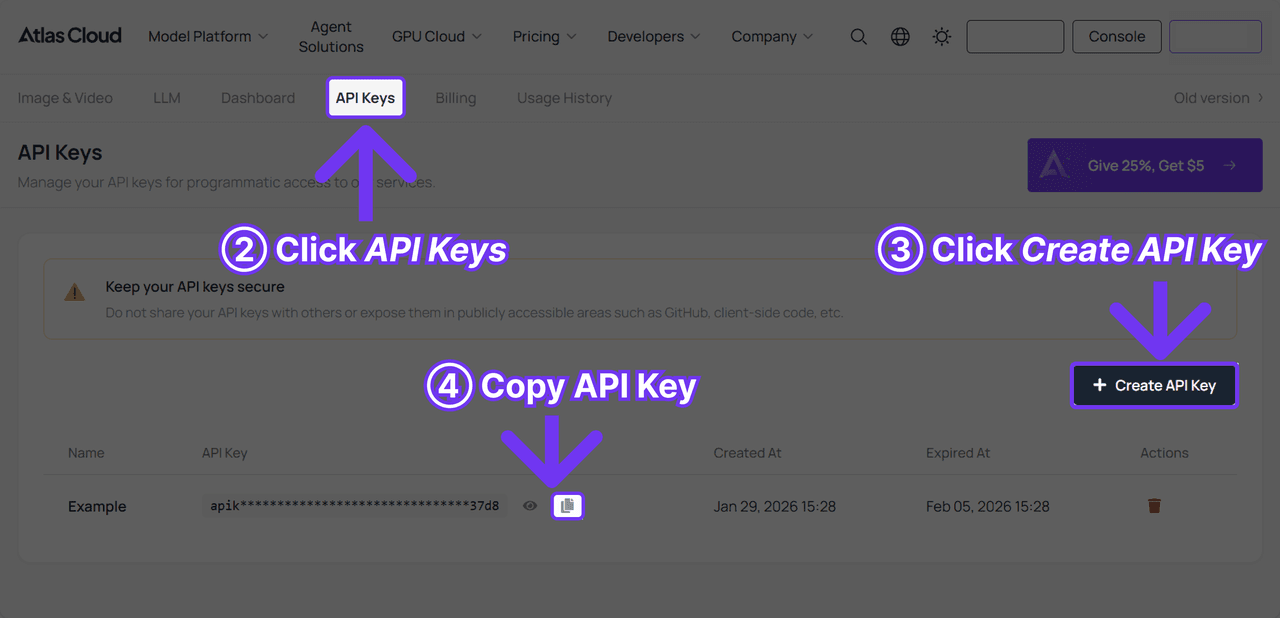 Step 2: Check the API docs. Endpoints, parameters, and authentication live in the API documentation.
Step 3: Make your first request. Submit the job:
plaintext1curl -X POST https://api.atlascloud.ai/api/v1/model/generateVideo \ 2 -H "Content-Type: application/json" \ 3 -H "Authorization: Bearer $ATLASCLOUD_API_KEY" \ 4 -d '{ 5 "model": "pixverse/v6/text-to-video", 6 "prompt": "A street violinist at dusk, warm lamplight, slow push-in as snow begins to fall", 7 "duration": 5, 8 "quality": "720p", 9 "aspect_ratio": "16:9", 10 "sound": true 11 }'
The response returns a prediction ID. Poll it until the status reads completed:
plaintext1curl https://api.atlascloud.ai/api/v1/model/prediction/<prediction_id> \ 2 -H "Authorization: Bearer $ATLASCLOUD_API_KEY"
The completed response carries the hosted video URL. Atlas Cloud runs one API across the platform: one key, one auth header, one submit-and-poll loop for every model it hosts. When the next PixVerse version ships, you swap the model string and keep the rest of the integration untouched.
PixVerse V5.5: Audio Reaches the V5 Line
Three months after V5's free-week debut, the generation got its biggest single upgrade. PixVerse V5.5 went live on December 1, 2025, timed to the platform's Black Friday promotion, and third-party coverage centered on two additions: native audio and multi-shot generation. Creators testing it that week called out character dialogue with matched lip movement, sound effects that track camera movement, and background music generated in the same pass as the visuals. One launch-day reaction summed up the pitch: sound plus multi-shot from a single prompt.
Multi-shot was the quieter but more structural change. Instead of one continuous take, PixVerse AI V5.5 could interpret a prompt as a sequence of shots, cutting between framings on its own. The official pricing table confirms both features in its structure: V5.5 is the first model in the V5 line with separate pricing columns for audio and for multi-clip generation.
Credit costs for a 5-second V5.5 clip:
| Quality | Single clip | Single clip, audio | Multi-shot | Multi-shot, audio |
|---|---|---|---|---|
| 360p / 540p | 45 | 55 | 75 | 85 |
| 720p | 60 | 70 | 90 | 100 |
| 1080p | 120 | 130 | 150 | 160 |
The pricing logic is unusually clean. Base rates carried over from V5 unchanged. Audio adds a flat 10 credits per clip regardless of resolution or length. Multi-shot adds a flat 30. So a 720p pixverse v5 5 clip with sound cost 70 credits where the silent V5 equivalent cost 60, a modest premium for what was effectively a built-in sound design pass.
V5.5 also stretched the duration menu: 5, 8, or 10 seconds, though 1080p stayed capped at 8. That 10-second tier is billed at a slight discount per second (99 credits at 540p, versus 90 for 8 seconds).
PixVerse V5.6: Final Update of the Generation
PixVerse V5.6 arrived on January 26, 2026, announced in an official post with three claims: studio-grade visual generation, native-level vocal fluency across languages, and less warping in motion. It was also free for Pro+ subscribers at launch. A month later the company had a scoreboard result to point at: the follow-up post announced V5.6 had taken the #2 spot worldwide on the Artificial Analysis video leaderboard, the V5 line's second top-two finish in six months.
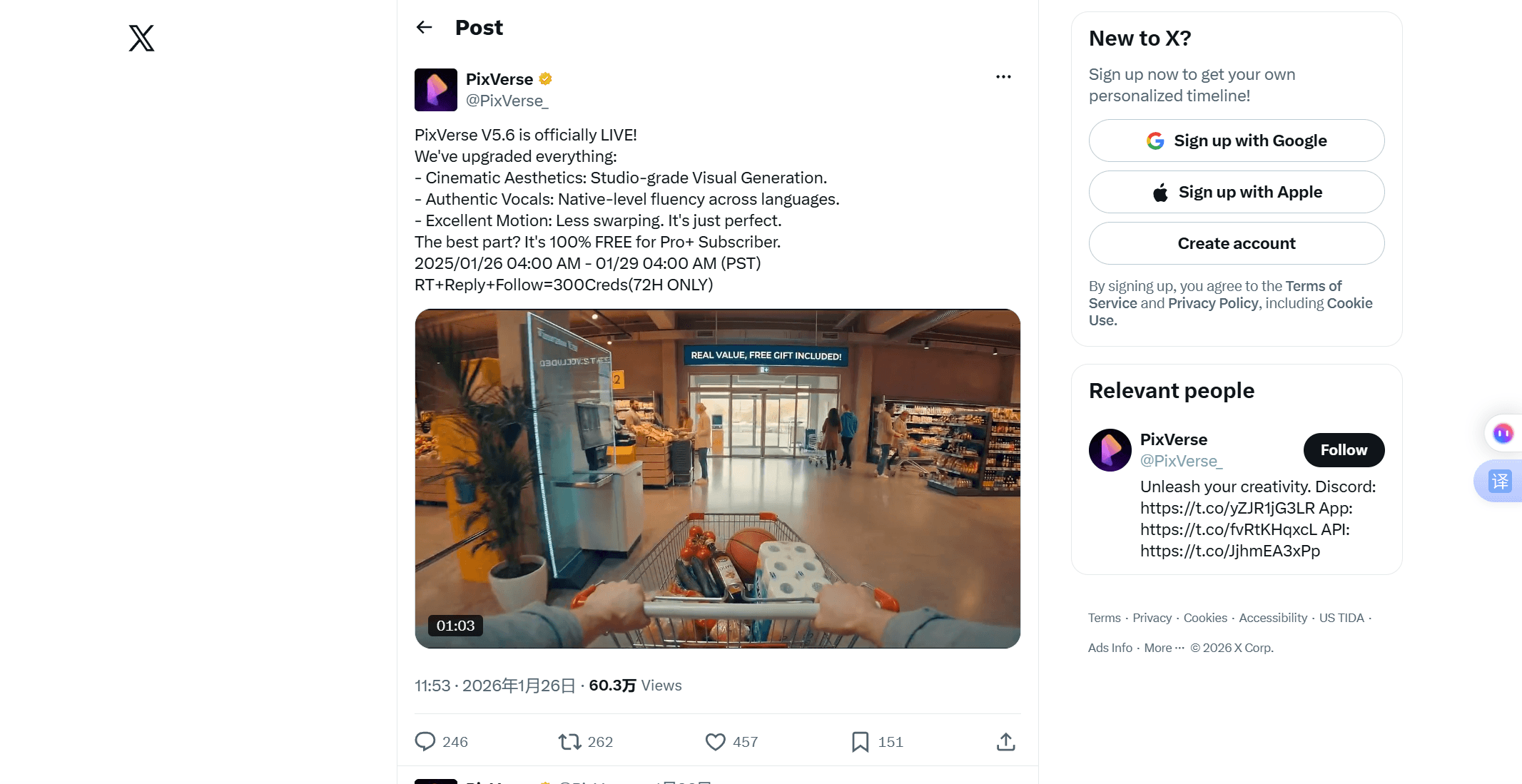 For anyone paying per clip, though, the headline was the repricing. V5.6 kept V5.5's duration menu and audio support but cut base credit costs across the board:
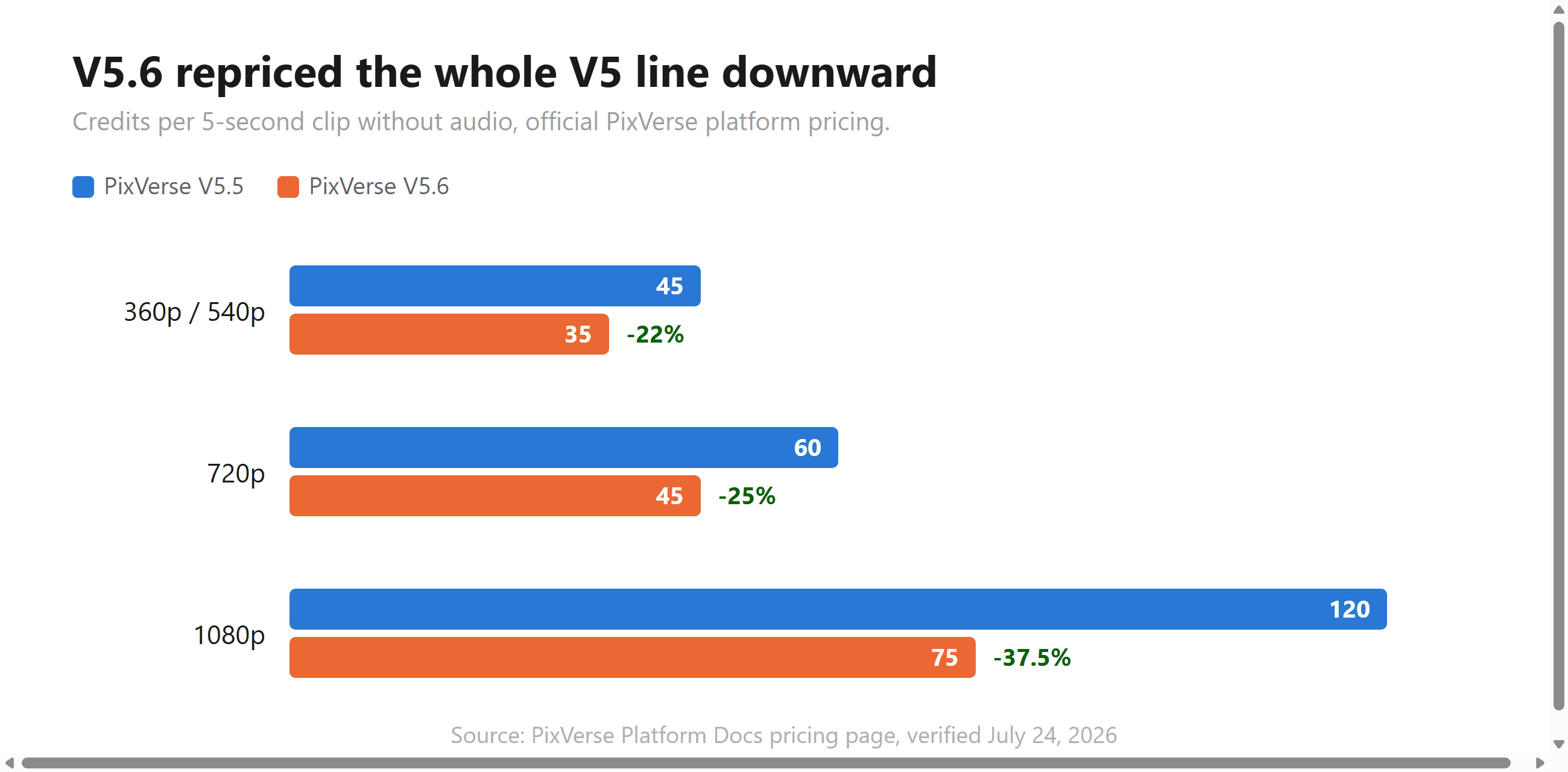 The 1080p cut is the notable one. At 75 credits for five seconds, V5.6 priced full-HD output within 15 credits of what a 720p clip had cost on launch-day V5. Audio-enabled tiers moved to a different scale on the official table rather than the flat 10-credit add-on, so check the platform pricing page for the exact audio figures before budgeting a project on them.
V5.6 closed out the generation. Nine weeks later PixVerse shipped V6, and the V5 line moved from flagship to legacy tier in a single release cycle.
PixVerse V5 vs V6: Worth Switching?
If you built a workflow on the pixverse v5 ai generation, the successor changes four things that matter in production.
| Dimension | PixVerse V5 | PixVerse V6 |
|---|---|---|
| Released | August 28, 2025 | March 30, 2026 |
| Durations | 5s or 8s fixed | Any length, 1 to 15 seconds |
| Audio | Not available | Optional, generated in the same pass |
| Billing shape | Per clip tier | Per second of output |
| 1080p 8s example | 240 credits | 144 credits (18/sec, no audio) |
| Atlas Cloud hosting | Not hosted | From $0.025 per second |
The billing change is bigger than it looks. V5 charges you for a 5-second block even when the shot you need is 3 seconds. V6's per-second meter means a 3-second insert shot costs three seconds of output, and a single 12-second take is on the menu, something no V5-generation text-to-video call offered.
Quality is the one axis where the answer got complicated in between. V5.6's Artificial Analysis ranking shows the late V5 line was still benchmark-competitive weeks before V6 shipped. If your pipeline depends on a specific V5-era look, the official API keeps every version from v3.5 up callable, so nothing forces a migration. For new work, per-second billing, native audio, and the 15-second ceiling make V6 the default, whether through PixVerse's credits or metered in dollars on Atlas Cloud.
Frequently Asked Questions
Is PixVerse V5 free to use?
The famous pixverse v5 free period was the launch window: August 28 to September 1, 2025, when all generations on PixVerse Web cost nothing. That offer is long over. Today PixVerse grants a small daily free-credit allowance (the company has declined to publish a fixed number, and the amount has varied between roughly 30 and 60). A 5-second 360p V5 clip costs 45 credits, so on a good day the free allowance covers about one clip. V5.6 was also free for Pro+ subscribers at its January 2026 launch.
Can you still use the PixVerse V5 model in 2026?
Yes. PixVerse's current API reference lists v5, v5.5, and v5.6 among the supported model values, alongside v3.5 through v6 and c1. The V5 generation is legacy but fully callable. Atlas Cloud hosts only the current V6 and C1 generations, so V5 access specifically runs through PixVerse's own platform.
What did PixVerse V5.5 add over V5?
Native audio (dialogue with lip sync, sound effects, background music), multi-shot generation that cuts between framings from one prompt, and a 10-second duration option below 1080p. Base credit costs stayed identical to V5; audio added a flat 10 credits per clip and multi-shot a flat 30.
Does PixVerse V5 generate audio?
No. The base PixVerse V5 model renders silent clips, and its official pricing has no audio column. Sound generation entered the line with V5.5 in December 2025. If you need audio in the same generation pass today, V5.5, V5.6, V6, and C1 all support it.
How much does a PixVerse V5 video cost?
At the $10-for-1,000-credits pack rate: a 5-second clip costs 45 credits ($0.45) at 360p or 540p, 60 credits ($0.60) at 720p, and 120 credits ($1.20) at 1080p. Eight-second clips cost exactly double. V5.6 lowered these tiers by 22% to 37.5%, and V6 on Atlas Cloud meters the equivalent 720p output at $0.045 per second without audio.
Conclusion
PixVerse V5 was the release that moved the platform from fast-and-fun to benchmark-competitive, and it did it with a free week instead of a keynote. V5.5 added sound, V5.6 cut the price, and V6 retired the line from the flagship spot seven months after launch day.
The version number matters less than the pattern: each step is still callable, each price is still published, and the current generation is a model string away. If V5 was where you first noticed PixVerse, the V6 playground is the natural next stop.





