Disney built its jungle on a Los Angeles soundstage, with $175 million and a thousand photographs of India for reference. In June 2026, a YouTube channel with 70 subscribers built one in 25 hours. That gap is the whole seedance 2.0 jungle book story, and it's worth telling properly.
This guide covers the short film behind the search term, the years of audience demand that preceded it, what a jungle short costs to render by API, the full workflow, and the one legal twist that makes The Jungle Book different from every other classic getting the AI treatment.
Key Takeaways
- On June 1–2, 2026, creator BEGINNERS BLOG released a 1-minute-40-second Pixar-style jungle short, built in about 25 hours with GPT Image 2 stills and Seedance 2.0 animation.
- The appetite is older than the model: "Jungle Book in real life" AI videos on YouTube show 830K, 290K, and 116K views, and the genre's biggest hit predates AI video generation entirely.
- Roughly 100 finished seconds at 720p prices out near $19 on Atlas Cloud with July 2026's 20% discount; a 480p draft pass runs about $9.
- Kipling's 1894 book is public domain. Disney's 1967 and 2016 films are not. Mowgli the literary character is free to use; Baloo's Disney design and song are not.
- The viral-safe move, and the one this creator made, is original characters in the jungle-adventure style rather than Disney recreations.
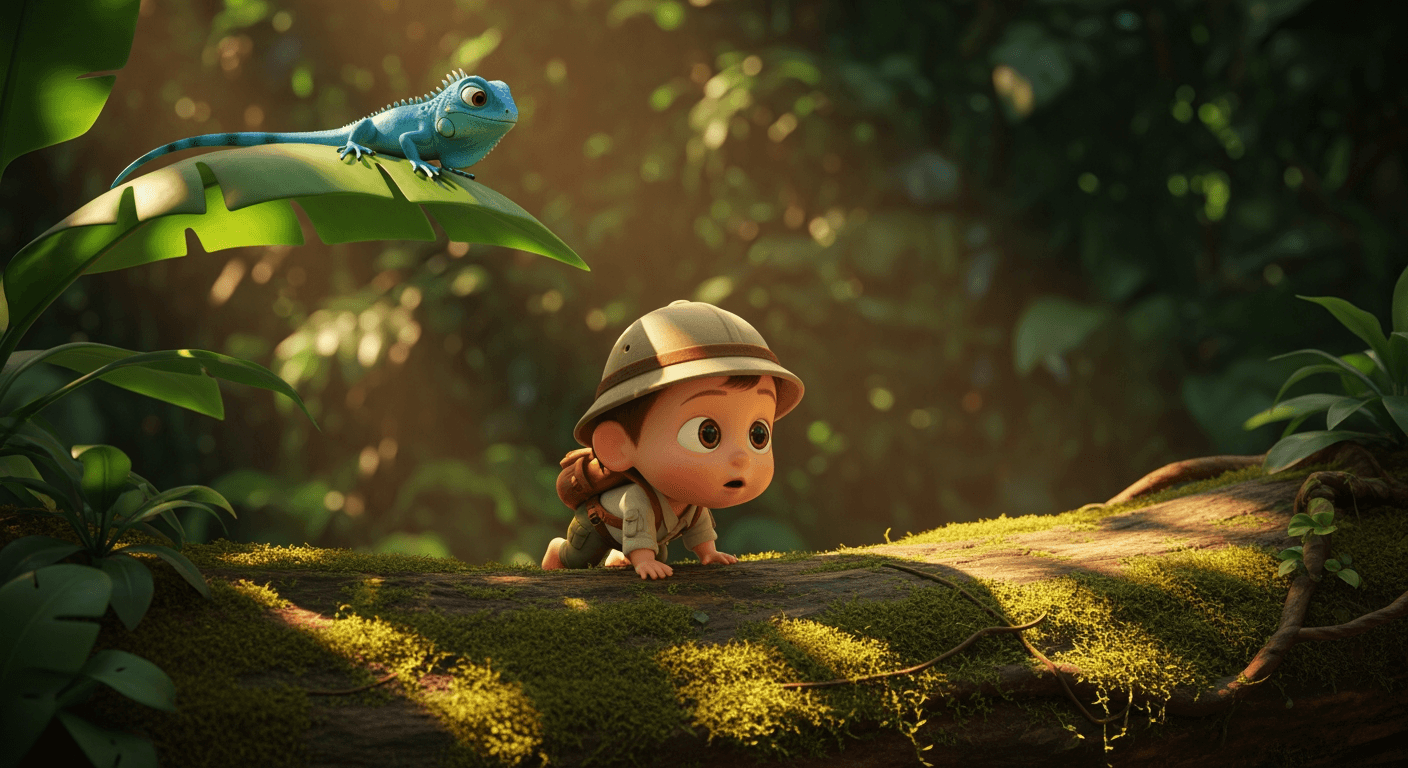
The Seedance 2.0 Jungle Book Short Behind the Search
Search seedance 2.0 jungle book and the top result isn't Disney footage. It's an indie short. On June 2, 2026, the creator behind the BEGINNERS BLOG channel posted a video on X with a disarming caption: "It's essentially a Pixar short that I made in about 25 hours with a few AI tools. 1 minute 40 seconds long." The post drew 105 likes and 54 replies. A follow-up titled it "Jungle Book: Part-1" and named the engine: Seedance 2.
The receipts, checked July 16, 2026:
| When | What | The numbers |
|---|---|---|
| June 1, 2026 | The YouTube upload, titled "The Jungle Book | GPT IMG 2.0 + SEEDANCE" | 296 views on a 70-subscriber channel |
| June 2, 2026 | The X post of the same short, with the 25-hour claim | 105 likes, 54 replies, 8 reposts |
| June 24, 2026 | Justine Moore shares a demo of a pro animator rendering 3D previz through Seedance | 6,189 likes |
| June 25, 2026 | Reid Hannaford posts a workflow: Blender blocking plus a start frame, fed to Seedance | 4,505 likes |
Here's the detail most reposts miss. The short isn't a Mowgli remake. Its stars are a baby explorer named Pebble and a small blue iguana, original characters in a jungle-adventure frame. "The Jungle Book" is the genre label, not the Disney property. That choice looks casual. It's actually the smartest legal call in this whole trend, and we'll come back to it.
Small numbers, then. Why does this short matter more than its view count? Because it's a floor, not a ceiling: proof that the full pipeline — story, stills, animation, music, edit — now fits inside one person's long weekend.
The Jungle Book AI Genre Was Waiting for a Model Like Seedance 2.0
The audience didn't appear in June. YouTube has hosted a "Jungle Book characters in real life" AI genre for years: creators generate photoreal versions of Mowgli, Baloo, Bagheera, and Shere Khan and present them next to the cartoon originals. A curated playlist of the format runs 28 videos deep.
The view counts, as shown by YouTube on July 16, 2026:
| Video | Channel | Posted | Views |
|---|---|---|---|
| "The Jungle Book Characters IN REAL LIFE" | WANA Plus | ~2022 | 830,000+ |
| Full cast in real life, Mowgli through Kaa | SLX News | ~August 2025 | 290,000+ |
| "Jungle Book Characters In Real Life" | FunToon | November 28, 2025 | 116,000+ |
| "AI Reimagined" character lineup | Game Reality | late 2025 | 35,000+ |
These are portrait showcases, not filmmaking — the 830K-view leader went up around 2022, before photoreal AI video generation existed at all. The demand curve was drawn before the supply: hundreds of thousands of people showed up for a jungle cast that barely moved.
Now consider what moving costs the official way. Disney's 2016 remake put one live actor, Neel Sethi, on soundstages in downtown Los Angeles and rendered everything around him; Wikipedia's production figures list a $175–177 million budget, a $966.6 million gross, nearly 70 CGI animal species, and about 1,000 photographed Indian jungle locations used as reference. Every leaf, every animal, all digital, all built by MPC and Weta.
Seedance 2.0, which ByteDance officially launched on February 12, 2026, generates that same category of shot — photoreal or Pixar-gloss jungle, believable animals, native audio — from a prompt and a handful of references. The genre's stills era just ended.
What a Jungle Book Short Costs on the Seedance 2.0 API
Here's the money section, and the numbers are small. Atlas Cloud hosts the full ByteDance model family on metered per-second billing, and the Seedance 2.0 image-to-video endpoint matches this short's exact workflow: generate a keyframe still, then animate it. A 20% limited-time discount is active in July 2026.
Pricing a 100-second short like "Jungle Book: Part-1":
| Render job | Model | Discounted price | List price |
|---|---|---|---|
| Per second, 480p draft | Seedance 2.0 | ≈$0.09/sec | ≈$0.112/sec |
| Per second, 720p final | Seedance 2.0 | ≈$0.1935/sec | $0.2419/sec |
| Single 10-second 720p generation | Seedance 2.0 | $1.93536 | $2.4192 |
| 100 finished seconds, 720p | Seedance 2.0 | ≈$19.35 | ≈$24.19 |
| 100-second draft pass | Seedance 2.0 Mini | ≈$4.50 | ≈$5.60 |
Two practical notes before you budget. First, nobody ships their first take. Plan for three to five times your finished runtime in raw generations. Draft at 480p or on Mini and re-render only keepers at 720p, and a polished 100-second short lands around $35–75 all in. Second, the keyframe stills are nearly free by comparison — whichever image model you draft them in, they run cents apiece. The animation seconds are where the budget actually lives.
Set against the genre's history, the math is absurd in the right direction. The portrait showcases pulled 830K views with barely a moving frame. Motion now costs twenty dollars.
Inside the 25-Hour Seedance 2.0 Jungle Book Workflow
The YouTube title doubles as a recipe: "GPT IMG 2.0 + SEEDANCE." Stills first, motion second. The upload's credits fill in the rest — two library music tracks by Epidemic Sound artists, meaning the score was licensed, not generated. Real pipelines mix tools, and that honesty is worth copying.
The stage-by-stage build for a short at this scale:
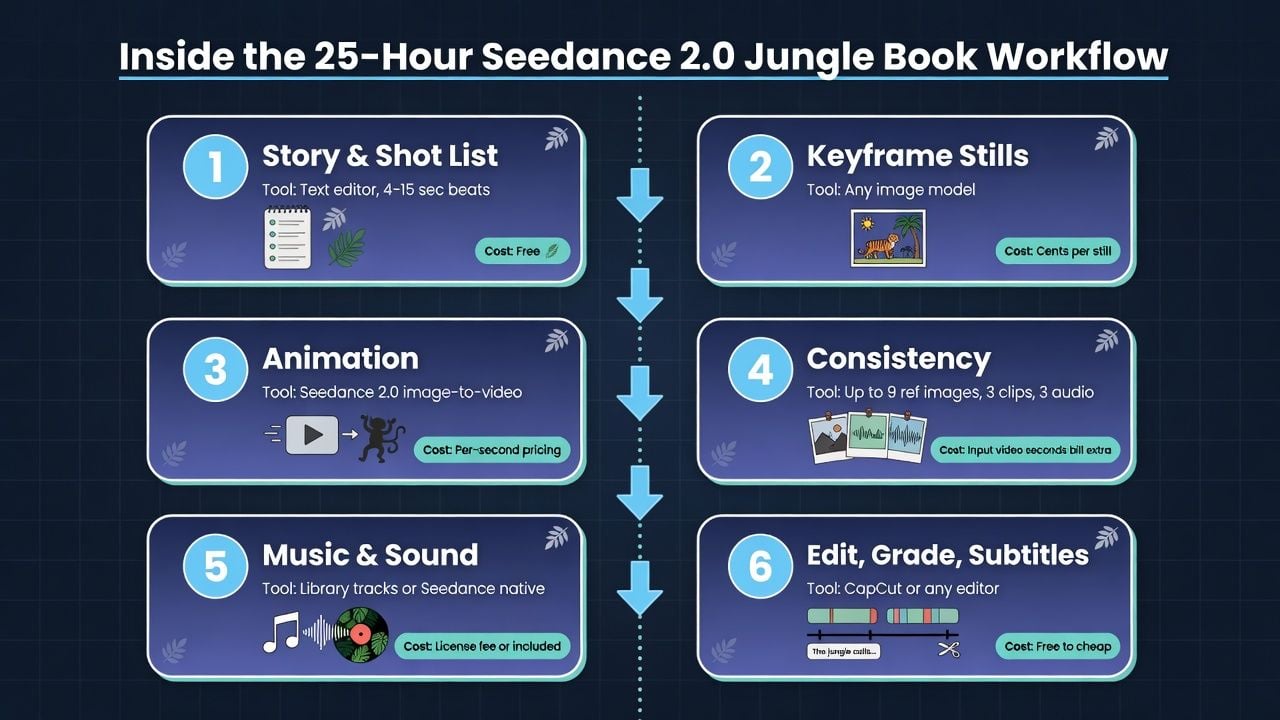
The two viral late-June posts from the receipts table show where this workflow is heading. In Justine Moore's shared demo, a professional animator blocked a scene as 3D previz and had Seedance render finished animation over it, motion and camera preserved. Reid Hannaford's version swaps in Blender: rough shapes choreograph the action, a start frame sets the style, Seedance makes it real. Both posts cleared 4,500 likes. The 25-hour jungle book was made with prompts and stills; the next one will be made with a camera you position yourself.
And if 100 seconds feels small, the scaling path is already mapped. Creators in the parallel anime wave stitch 50 to 100 generations into full episodes.
A Seedance 2.0 Jungle Prompt That Survives the Foliage
Jungles are a specific kind of hard. Dense foliage means constant occlusion, dappled light means shifting exposure, and wet leaves mean specular highlights that flicker when a model loses the plot. The prompts that hold up declare all three, and they give each shot one subject and one action.
A starting skeleton in the short's own register:
Glossy 3D animated short film style, soft studio lighting, big expressive eyes. A curious baby explorer in a leaf hat crawls along a thick mossy branch, deep jungle background with layered ferns and hanging vines. Dappled golden light through the canopy, gentle depth of field. A small blue iguana on a higher leaf tilts its head and chirps a warning. The camera tracks slowly alongside, low angle. Playful marimba score, distant birdsong, leaf rustle. 16:9, one continuous shot.
Why each line earns its place:
| Prompt element | What it prevents in jungle shots |
|---|---|
| Style declared first | The model choosing photoreal for one shot and cartoon for the next |
| Layered ferns, hanging vines | Flat wallpaper jungles with no depth to occlude against |
| Dappled light named | Exposure jumps between shots; dapple also hides small artifacts |
| One subject, one action | Limb chaos when a crawl and a reach happen at once |
| Audio written in-prompt | Silent output; Seedance 2.0 generates sound natively, so use the channel |
| Camera move specified | Unmotivated cuts mid-shot |
Swap the baby for a wolf cub or the iguana for a hornbill and the skeleton holds. What you shouldn't swap in, at least not carelessly, is Baloo. That's the next section.
Jungle Book Copyright: What's Free and What's Still Disney's
Here's the twist that makes this trend legally unlike the Lion King or Pokemon waves. The Jungle Book's source text is public domain. Rudyard Kipling published the stories in 1894 and 1895 and died in 1936; LegalClarity's analysis confirms the originals are free to adapt, noting that anyone may "create new derivative works based solely on the original text and characters as they appear in Kipling's books." Disney itself built on that freedom — Forbes once counted 50 Disney films drawn from the public domain, the 1967 Jungle Book among them.
What that means in practice:
| Element | Status |
|---|---|
| Kipling's stories, plots, and text | Public domain, free to adapt |
| Mowgli, Baloo, Bagheera, Shere Khan, Kaa as literary characters | Public domain |
| Disney's 1967 animated film, its character designs and voices | Copyrighted |
| "The Bare Necessities" and the other 1967 songs | Copyrighted |
| The 2016 remake's photoreal designs and footage | Copyrighted |
| New designs you create from Kipling's text | Yours; new elements added to a public domain work get their own protection |
The line is real, and so is the pressure on the model behind these videos. Disney sent ByteDance a cease-and-desist on February 13, 2026, one day after launch; TheWrap's report quotes counsel accusing the company of "hijacking Disney's characters." ByteDance pledged fixes on February 16, and by March 16 two US senators were demanding a shutdown outright.
Jungle Book creators get a wider lane, with guardrails:
- Adapt Kipling, not Disney. A lanky wolf-raised boy from the 1894 text is fair game; the 1967 red-loincloth design and Phil Harris's singing bear are not.
- Skip the songs. "The Bare Necessities" belongs to the 1967 film's catalog, not the novel.
- Or sidestep entirely with original characters, the Pebble-and-iguana route. It's the one path that survives both copyright enforcement and model-side prompt filtering.
- Disclose AI generation wherever you post. The creators driving this format do.

Frequently Asked Questions
Is the Seedance 2.0 Jungle Book short official Disney content?
No. The short behind the search term is independent fan-scale work by the BEGINNERS BLOG channel, starring original characters rather than Disney's cast. Disney has no connection to it, and the creator labels the work AI-generated.
Can I legally make a Jungle Book video with Seedance 2.0?
Kipling's 1894 stories and their characters are public domain, so adaptations built from the book's text are on solid ground. Disney's 1967 and 2016 films remain copyrighted, including character designs and songs, so recreating those specific versions carries the same risk as any other studio IP. When in doubt, design your own cast from the novel's descriptions.
What does a Jungle Book-length Seedance 2.0 short cost to render?
About $19 for 100 finished seconds at 720p on Atlas Cloud with July 2026's 20% discount, or roughly $24 at list. Add drafts and retakes at three to five times the finished runtime; doing those at 480p or on Seedance 2.0 Mini keeps a realistic all-in figure near $35–75.
Did Seedance 2.0 generate the music in the jungle book short?
No, and that's instructive. The upload credits two library tracks from Epidemic Sound artists, so the score was licensed separately. Seedance 2.0 does generate native synchronized audio, including effects and multilingual lip-sync, but this creator chose stock music for the soundtrack — a reminder that shipped AI films are assembled, not one-clicked.
Conclusion
The seedance 2.0 jungle book story has none of the usual viral fireworks: no million-like reel, no studio lawsuit with its name on it. What it has is better evidence. A years-old audience that made slideshow jungles worth 830,000 views. A model that animates them for cents a second. One creator who connected the two in 25 hours, using public-domain freedom and original characters so cleanly that there's no rightsholder to object.
Kipling's jungle has belonged to everyone for a century. The tools to film it finally do too. The endpoint is live in the Atlas Cloud playground, and the smartest version of this trend is the one where your characters, not Disney's, walk out of the foliage.





