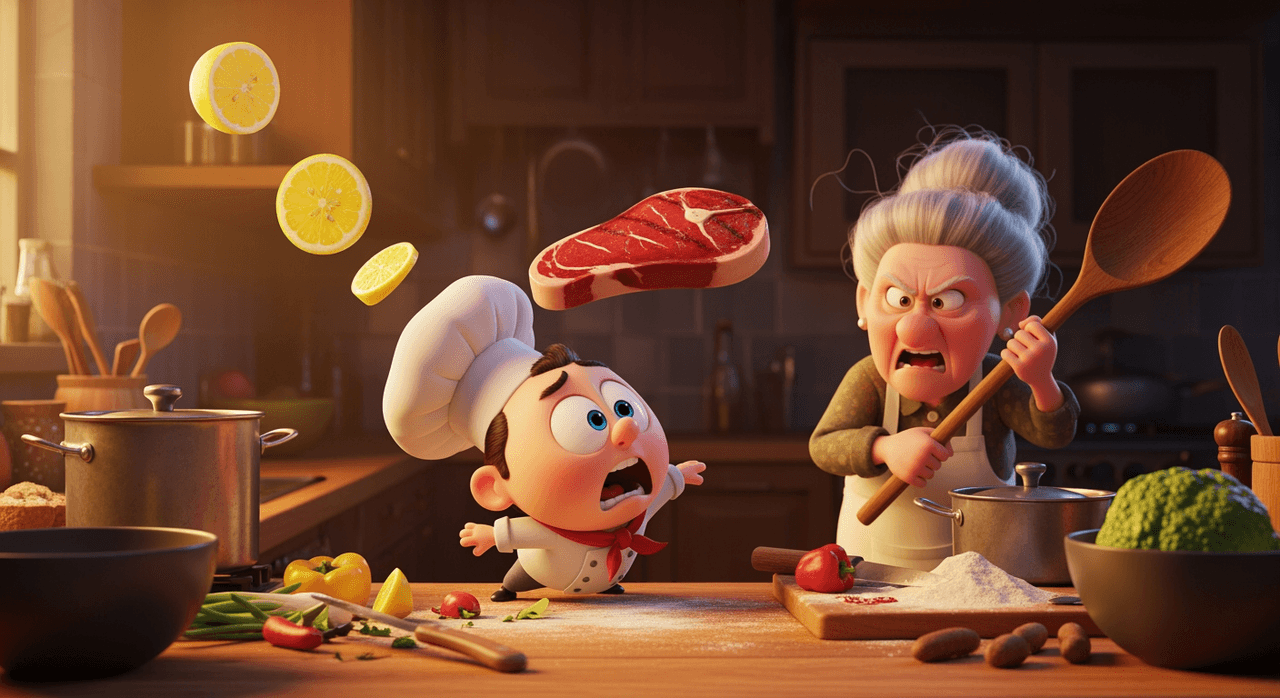
A furious grandma storms a fine-dining kitchen. Steaks fly. Lemon slices hang mid-air. A tiny chef's face crumples in a perfect animated close-up, and no animator touched a single frame. That sixteen-second reel, and hundreds like it, is why the seedance 2.0 pixar wave has taken over AI video feeds since spring 2026.
This guide covers why the format exploded, what the model actually does under the hood, what it costs to render, the character sheet workflow the best creators use, a prompt recipe you can copy, and where the copyright line sits.
Key Takeaways
- Seedance 2.0 Pixar-style shorts became a dominant AI video format by May 2026, with single-prompt Instagram reels pulling 390 to 700+ likes and prompt-request chains in every comment section.
- The model's 15-second multi-shot output, native dual-channel audio, and 9-image reference budget are what make consistent animated characters possible from text alone.
- On Atlas Cloud, Seedance 2.0 starts around $0.09/second with a limited-time 20% discount; a 60-second 720p short renders for about $11.61.
- The viral "full movie for under $1,000" claim roughly survives the math: 90 minutes of 720p output prices out near $1,045 in raw renders.
- The glossy 3D style is fair game. Pixar's actual characters are Disney IP, and Disney sent ByteDance a cease-and-desist one day after launch.
Why Seedance 2.0 Pixar Shorts Are Everywhere Right Now
ByteDance officially launched Seedance 2.0 on February 12, 2026, and within three months creators had turned it into an animation studio in a text box. By May, single-prompt 3D shorts in a glossy Pixar-like style were the platform-agnostic hit format: kitchens, rats, mice, monsters, all rendered with the big eyes and warm lighting audiences know on sight.
The receipts are all over Google's index as of July 2026:
| Where | The post | Traction |
|---|---|---|
| A chef-versus-grandma kitchen short captioned as having "just made Pixar nervous" | May 15, 2026, widely reshared | |
| A one-prompt animated short with camera direction and character acting, from @skaigenerated | 700+ likes | |
| A Ratatouille-flavored rat short billed as made from a single prompt | 490+ likes | |
| A fully storyboarded 3D short rendered from one written scene | 310+ reactions | |
| r/seedance2pro how-to threads on turning character sheets into animated shorts | Active through June and July |
Why did animation, of all formats, become the model's signature? Because stylized 3D is forgiving. A slightly rubbery hand or a physics wobble reads as cartoon charm in a Pixar-style clip, while the same glitch in photoreal footage screams AI. Creators found the lane where the model's weaknesses disappear into the aesthetic, and the algorithm did the rest.
Can Seedance 2.0 Really Deliver Pixar-Level Animation?
Close enough to fool a feed, yes. ByteDance's launch notes describe 15-second multi-shot audio-video output from a single generation, with up to 9 images, 3 video clips, and 3 audio clips accepted as references alongside the prompt. The Pixar-level animation Seedance 2.0 puts out isn't a style filter over live footage. The model renders stylized characters, cuts between angles, and scores the scene natively.
Map that against what a traditional pipeline needs and the trend makes sense:
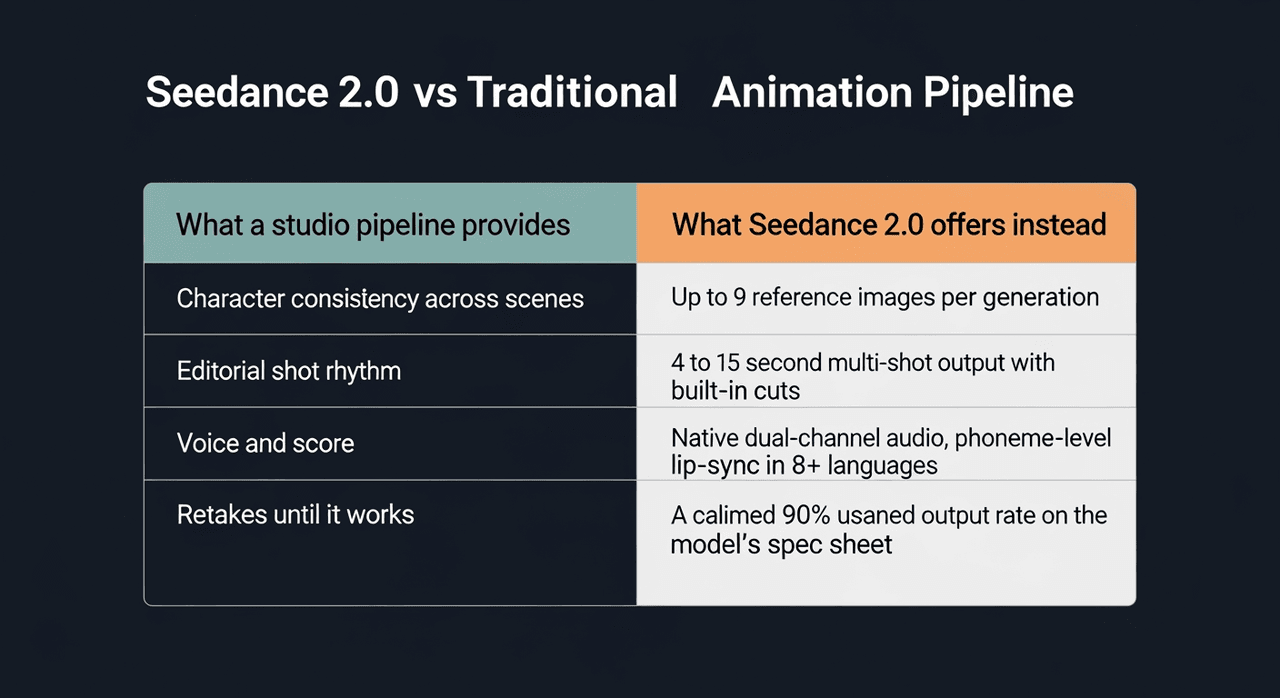
Now the honest part. A single generation caps out at 15 seconds, so anything longer is an editing job. Crowd scenes and fast hand interactions still wobble. And the Pixar level animation Seedance 2.0 can sustain across a full minute depends on your reference discipline, not on the model alone. One-prompt magic makes great reels; repeatable characters take preparation.
Where to Run Seedance 2.0 Pixar-Style Generations by API
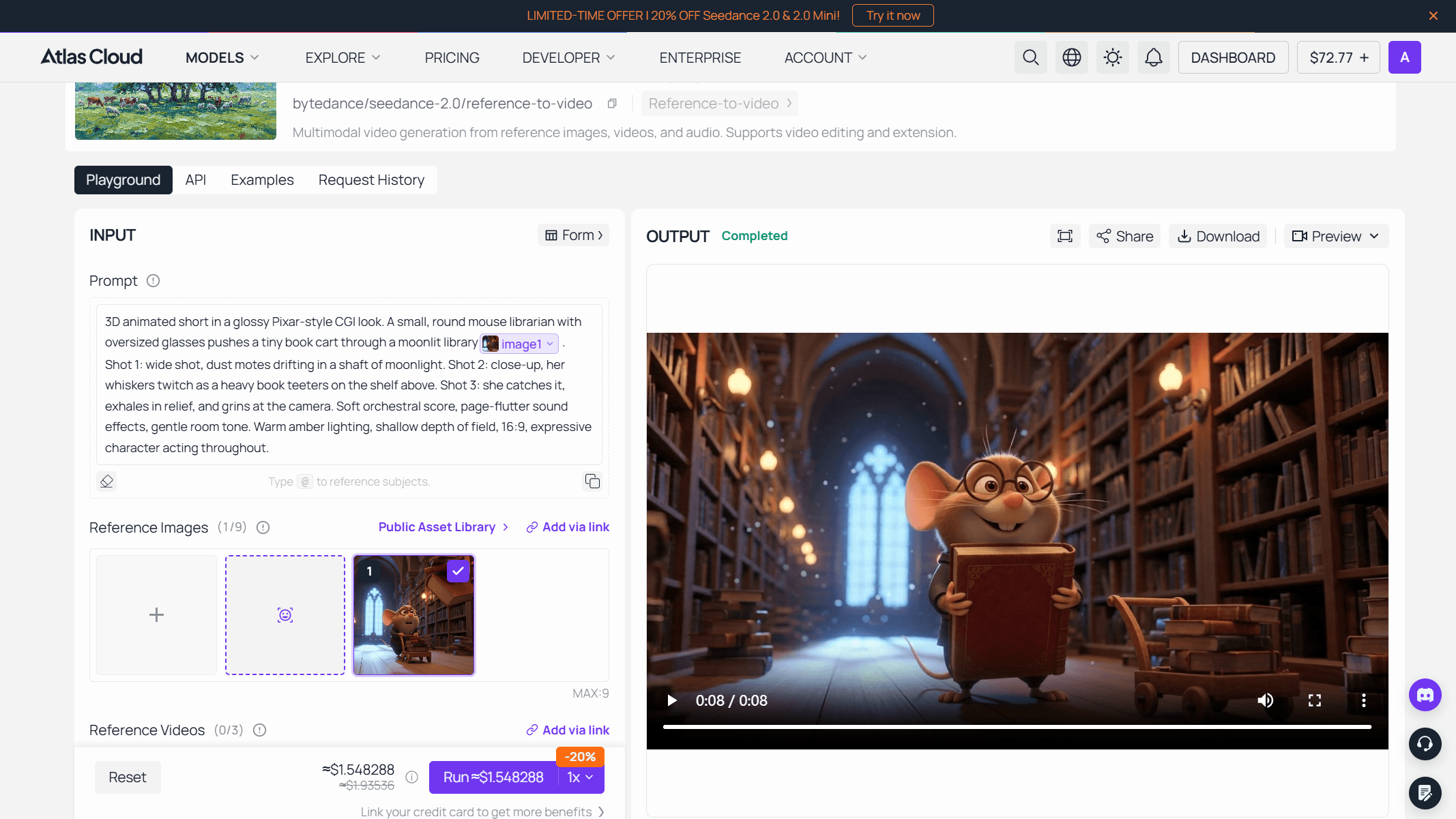
The consumer apps queue your job and compress the output. For direct model access, Atlas Cloud hosts the full ByteDance model family on a metered API, and the Seedance 2.0 reference-to-video endpoint is where most single-prompt animated shorts start. A 20% limited-time discount is active in July 2026, which puts the 480p floor near $0.09 per second.
Here's what typical Pixar-style render jobs actually cost:
| Render job | Tier | Cost with 20% discount (list) |
|---|---|---|
| 10-second test shot, 720p | Seedance 2.0 | $1.93536 ($2.4192) |
| 60-second draft pass | Seedance 2.0 Mini | from ≈$2.70 (≈$3.36) |
| 60-second final, 480p | Seedance 2.0 | ≈$5.40 (≈$6.72) |
| 60-second final, 720p | Seedance 2.0 | ≈$11.61 (≈$14.51) |
| 90 minutes of 720p output, raw renders only | Seedance 2.0 | ≈$1,045 (≈$1,306) |
That last row answers a claim you've probably seen. An AI implementer on X estimated a full movie in a week for under $1,000, and the post drew 160+ likes in May. On raw per-second math the number holds at 720p, and 480p drafts land near $486. Real projects re-render shots, so budget drafting on Mini and save the full model for finals. One billing wrinkle: attach a video input and your input clip's seconds are billed on top of the output's, so long reference clips quietly cost more than they save.
The Character Sheet Workflow Behind Pixar-Style Seedance 2.0 Shorts
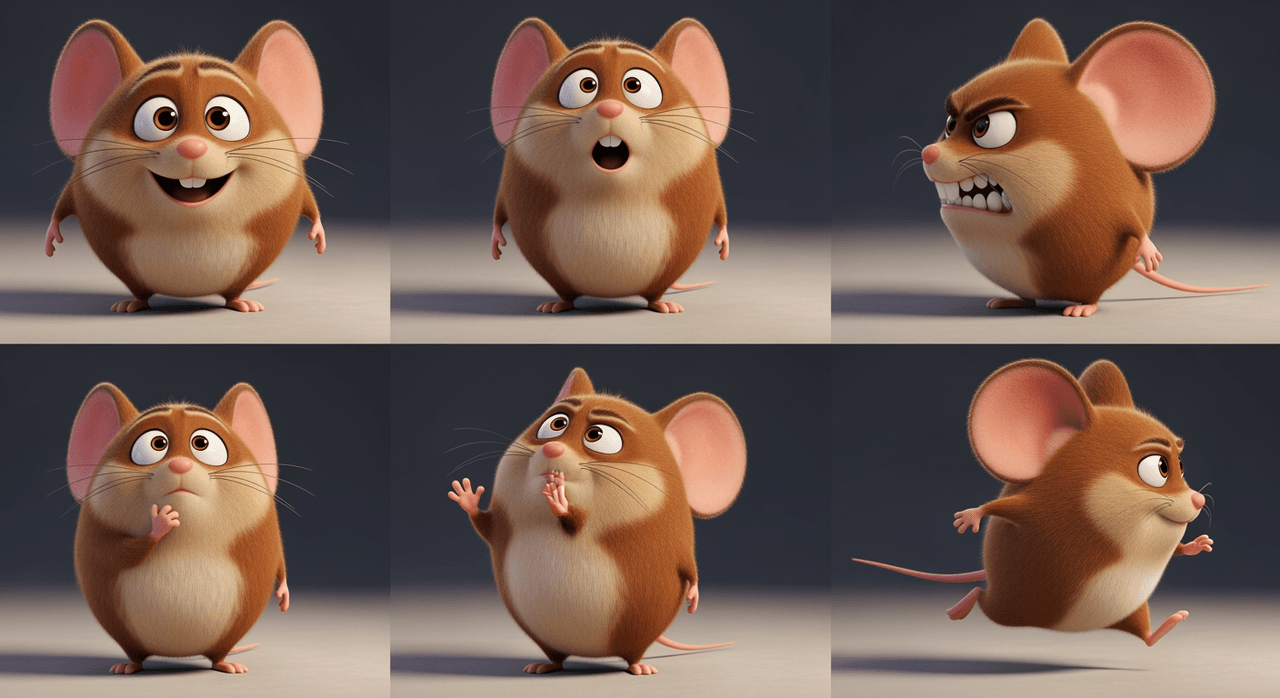
The best-performing shorts aren't one lucky prompt. They're pre-production. A recurring how-to question in the r/seedance2pro subreddit, one thread asks exactly how to turn GPT Image 2 character sheets into Seedance 2.0 Pixar-style animations, and the working answer looks like a miniature studio pipeline:
- Write the scene like a tiny movie: a hook in the first two seconds, one action per beat, a warm payoff. Creators publishing viral prompt threads describe this structure over and over.
- Generate character sheets and start frames in an image model first. GPT Image 2 is the community favorite; for choosing a stylized still generator, our Seedream 5.0 Pro versus GPT Image 2 bilind test shows how the leading options handle expressive character art.
- Attach the sheets as reference images and call each asset by name in the prompt.
- Generate in 4-to-15-second batches, bundling two or three shots into each one the way the prompt recipe below does, and describe camera moves and audio in every prompt.
- Assemble, grade, and caption in an editor. CapCut shows up constantly in creator credits.
Getting the reference budget right matters more than filling it:
| Reference type | What actually goes wrong | Fix |
|---|---|---|
| Character sheets | Mixed lighting or angles across images breaks identity lock | Shoot every sheet under the same light and a neutral background |
| Motion clips | A cluttered 15-second reference dilutes the one beat you wanted | Trim to the single motion or camera move you need copied |
| Audio | Re-recording the "same" line introduces subtle timbre drift | Reuse the exact same audio file across every generation, never a new take |
A Seedance 2.0 Pixar Prompt You Can Steal
Durations run 4 to 15 seconds, aspect ratios cover widescreen 16:9 down to vertical 9:16, and resolutions climb from 480p drafts to 4K, so the recipe below has room to breathe. It builds an original character on purpose. Swap in your own cast and the skeleton holds:
3D animated short in a glossy Pixar-style CGI look. A small, round mouse librarian with oversized glasses pushes a tiny book cart through a moonlit library. Shot 1: wide shot, dust motes drifting in a shaft of moonlight. Shot 2: close-up, her whiskers twitch as a heavy book teeters on the shelf above. Shot 3: she catches it, exhales in relief, and grins at the camera. Soft orchestral score, page-flutter sound effects, gentle room tone. Warm amber lighting, shallow depth of field, 16:9, expressive character acting throughout.
Each element is doing a job:
| Prompt element | Why it matters for the Pixar look |
|---|---|
| Style declared in the first line | Locks the render mode before anything else is parsed |
| Numbered shots | Plays directly to the 15-second multi-shot system |
| One action per shot | Keeps the character acting readable, the trick behind the viral formula |
| Audio written into the prompt | The model generates sound natively, so silence is a wasted channel |
| Lighting and lens language | Warm key light and shallow focus are half the aesthetic |
| Lighting and lens language | Warm key light and shallow focus are half the aesthetic |
The Pixar-level animation Seedance 2.0 returns from a prompt like this scales with the craft vocabulary you feed it. "Sad mouse" gets you a shrug. "Her ears droop and she hugs the book to her chest" gets you a performance.
Disney Pixar Style Seedance 2.0 Videos and the Copyright Line
Now the part the prompt-selling reels skip. Disney, Pixar's parent company, sent ByteDance a cease-and-desist on February 13, 2026, one day after launch. TheWrap's report on the letter says Disney's counsel accused the company of "hijacking Disney's characters," with SAG-AFTRA and the Motion Picture Association issuing condemnations of their own. ByteDance responded within days; Al Jazeera's February 16 coverage carries its pledge that it is "taking steps to strengthen current safeguards" around intellectual property and likenesses.
What does that mean for animated shorts specifically? Draw the line between a look and a cast:
- The glossy 3D aesthetic itself isn't something any studio owns. An original mouse librarian in that style is the low-risk, durable lane.
- A Disney Pixar style Seedance 2.0 clip that puts Woody, Nemo, or Lightning McQueen back on screen is unlicensed fan content. Portfolio piece, maybe; monetized channel, genuinely risky.
- Disclose AI generation. Every major platform now surfaces AI labels, and this audience rewards transparency.
- Expect the safeguards to tighten. ByteDance has publicly committed to it, so a content plan built on recreating protected characters can break overnight.
Frequently Asked Questions
Is Seedance 2.0 a Pixar or Disney product?
No. Seedance 2.0 is ByteDance's video generation model, launched February 12, 2026. "Pixar" in captions and searches describes the visual style creators are chasing, not an affiliation. Disney's only involvement so far has been the cease-and-desist letter it sent over character usage.
How much does a Pixar-style Seedance 2.0 short cost to generate?
On Atlas Cloud, a 10-second 720p generation costs $1.93536 with the current 20% discount, or $2.4192 at list. A 60-second short lands near $11.61 at 720p, and drafting on Seedance 2.0 Mini from about $0.045 per second keeps iteration cheap.
How long can one Seedance 2.0 Pixar-style generation run?
A single generation runs 4 to 15 seconds and can contain multiple shots with built-in cuts. The minute-plus animated shorts circulating on Instagram and YouTube are several generations assembled in an editor, with reference images keeping the characters consistent between them.
Can Seedance 2.0 recreate real Pixar characters like Woody or Nemo?
Treat it as off-limits. Those characters are Disney intellectual property, and ByteDance has pledged stronger safeguards after Disney's cease-and-desist, so expect such prompts to get blocked more aggressively over time. Original characters rendered in a similar 3D style carry far less exposure and age better.
Conclusion
The real headline isn't that AI can imitate a famous animation style. It's that one person with a scene on paper, a stack of character sheets, and a per-second budget can now produce a scored, voiced, multi-shot animated short before lunch. The format's winners all share the same habits: original characters, reference discipline, audio written into every prompt, and drafts kept cheap.
The style is free. The characters aren't. Build your own cast, steal the recipe above, and the seedance 2.0 pixar trend stops being something you scroll past and becomes something you ship.





