One creator couldn't sleep. On February 9, 2026, Bilibili uploader 无间道路_ posted a one-minute Pokemon short built overnight with Seedance 2.0, writing that friends who saw it assumed it was footage cut from the real anime. Five months later, that upload sits at 263,000 views, and the pokemon seedance 2.0 wave it kicked off has spread from Bilibili to YouTube and Instagram.
This guide traces where the trend started, why Bilibili got there first, what the clips cost to render, how the full fan episodes are built, and where Nintendo's lawyers fit into the picture.
Key Takeaways
- The first viral Pokemon Seedance 2.0 video landed on Bilibili on February 9, 2026, three days before the model's official launch, and shows 263,367 views as of July 2026.
- A single Pokemon battle clip topped 600,000 views in the launch-week anime rush, per Dexerto's February 10 report.
- Creators have escalated from 15-second clips to full 11-minute fan episodes, including a Pokemon Adventures manga adaptation with 124.6K+ YouTube views.
- On Atlas Cloud, Seedance 2.0 starts around $0.09/second with a limited-time 20% discount; a 10-second 720p clip runs $1.93536.
- None of it is licensed. Disney's cease-and-desist came one day after launch, more studios followed within the week, and Nintendo restated in July 2026 that AI involvement changes nothing about IP enforcement.
What Is the Pokemon Seedance 2.0 Trend?
The pokemon seedance 2.0 trend is a wave of fan-made AI videos that recreate, extend, or remix the Pokemon anime using ByteDance's Seedance 2.0 model. The clips range from 15-second Pikachu battles to complete episodes with voices, score, and cuts. ByteDance officially launched Seedance 2.0 on February 12, 2026, but Chinese creators had early access through the Jimeng app, so the trend was already live before the global release.
The timeline is compressed even by AI-trend standards:
| When | What happened | The receipt |
|---|---|---|
| February 9, 2026 | 无间道路_ posts a Pokemon short on Bilibili; viewers mistake it for original footage | Now past 263K views |
| February 10, 2026 | Dexerto reports a Pokemon battle clip past 600,000 views in the launch-week anime wave | Dexerto's launch-week report |
| February 12, 2026 | Seedance 2.0 launches officially with 15-second multi-shot audio-video output | ByteDance Seed launch blog |
| February 13, 2026 | Disney sends ByteDance a cease-and-desist; Paramount, Netflix, and Sony follow within the week | TheWrap's reporting |
| March–April 2026 | Full fan episodes arrive: an Ash-and-Serena special and a Pokemon Adventures manga adaptation | 188.2K+ and 124.6K+ YouTube views |
| June 2026 | Pokemon-tagged Seedance clips surface on Bilibili's Southeast Asia platform | Bilibili.tv listings, June 14 |
Why did Pokemon become the format's stress test? Anime is where video models usually crack. Flat cel shading, speed lines, impact frames, and faces every viewer has known since childhood leave nowhere to hide. In Dexerto's coverage from February 10, the viral Pokemon battle reel is described as looking "ripped from right out of the anime." When the hardest style holds up, the trend writes itself.
Why Seedance 2.0os Set the Pace
Search seedance 2.0 bilibili pokemon and the results are a wall of Bilibili video pages, not articles. That's no accident, and it isn't only about Jimeng's early access. Bilibili spent January building the stage: Tencent News' report on the platform's first AI Creation Competition describes a prize pool above 3 million RMB, a 1-million-RMB first prize, and platform figures of roughly 100,000 monthly active AI creators. A hundred-thousand-strong creator pool, a million-yuan prize, and a model the rest of the world couldn't touch yet: Pokemon became the community's agreed-upon benchmark.
The receipts, with titles translated from Chinese and view counts checked against Bilibili's public data on July 16, 2026:
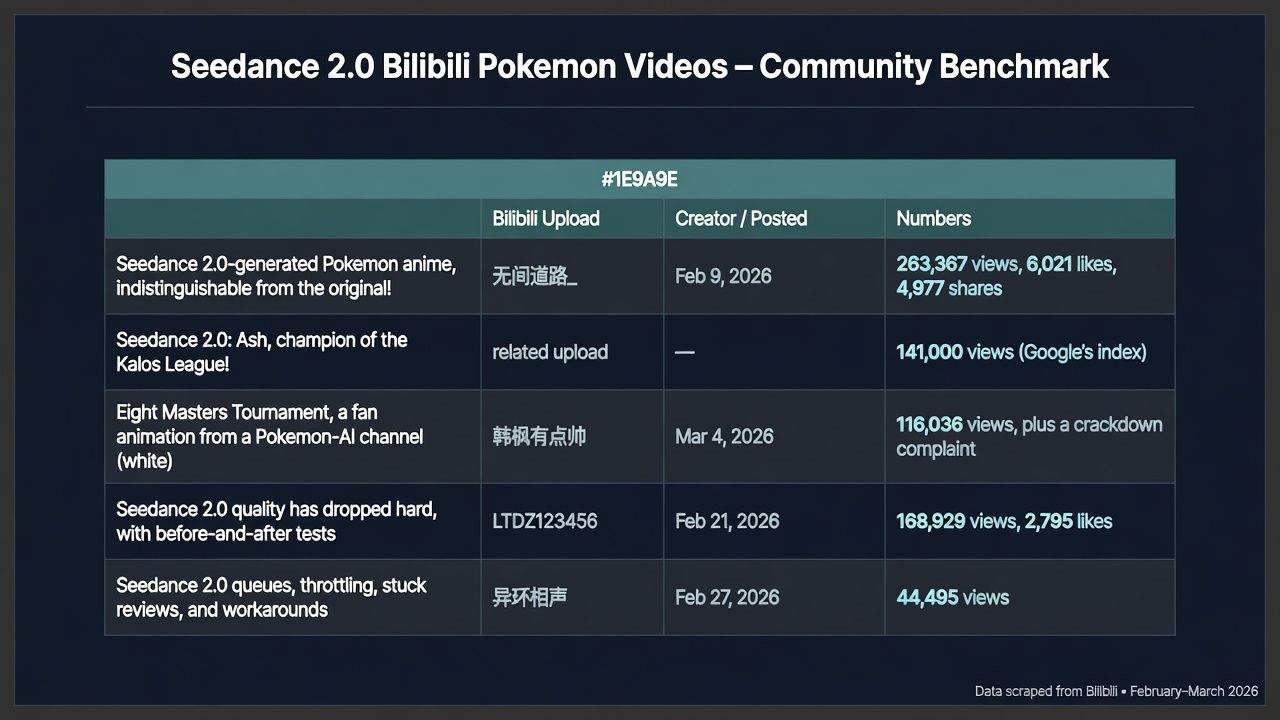
The top entry is the upload from this article's opening; its description is where the sleepless-night story comes from, and it also records prompt requests piling up in the comments. The upload is tagged to a Bilibili contest activity, too. Every viral clip on the platform doubles as a tutorial thread, and the contest turned that habit into a flywheel.
Notice the bottom rows, though. By late February, some of the biggest Seedance numbers on Bilibili belonged to complaint videos. A quality-degradation comparison test pulled 168,929 views. A survival guide for queues and stuck moderation reviews pulled 44,495 more. And on a 116,036-view upload, Pokemon-AI creator 韩枫有点帅 wrote that generations were tripping violation flags even when the source material contained no Pokemon at all. The consumer apps buckled, moderation tightened, and the workaround chatter started immediately. So where do serious creators render when the app itself becomes the bottleneck?
Rendering Pokemon-Style Clips Without the Queue on Atlas Cloud
For the creators who outgrew the apps, the fix is direct API access. Atlas Cloud hosts the full ByteDance model family on metered, per-second billing with no waitlist, and the Seedance 2.0 image-to-video endpoint fits this trend's workflow exactly: feed it an anime still or a character sheet and direct the motion from there. A 20% limited-time discount is running in July 2026.
What anime-style render jobs actually cost:
| Render job | Model | Discounted price | List price |
|---|---|---|---|
| Cheapest per-second rate, 480p | Seedance 2.0 | ≈$0.09/sec | ≈$0.112/sec |
| Cheapest per-second rate, 480p | Seedance 2.0 Fast | ≈$0.072/sec | ≈$0.09/sec |
| Per-second rate, 720p | Seedance 2.0 | ≈$0.1935/sec | $0.2419/sec |
| 10-second 720p clip, total | Seedance 2.0 | $1.93536 | $2.4192 |
| An 11:28 fan episode like the Red adaptation, 720p raw renders, total | Seedance 2.0 | ≈$133 | ≈$166 |
Two billing details matter for episode builders. First, the per-second rate scales with resolution, so drafting at 480p and re-rendering keepers at 720p or above cuts the bill roughly in half. Second, when you attach a video clip as a reference, its seconds are billed on top of the output's. Short reference clips are nearly free; padding every generation with a long one quietly doubles the cost.
Is the math viable for a hobbyist? A finished three-minute short runs about $35 in 720p renders, and 480p drafting on top costs nine cents a second. The gate that mattered in February wasn't price. It was the queue.
Seedance 2 Ash Pokemon Clips: How Fan Episodes Get Made
The seedance 2 ash pokemon format is where the trend graduated from clips to episodes, and one channel shows the whole arc. YouTube's Rising Master published "Ash & Serena cute moments" from its Pokémon Winds & Waves series on March 17, 2026, a fan episode whose chapter list includes "Ash decides to stay" and "Pikachu vs Snivy fixed." It shows 188.2K+ views in Google's indexed YouTube data as of July 2026. Sound familiar? It's the same grief-repair formula that powered spring's viral Lion King AI edits: fix the moments the show never gave you.
Then came the bigger swing. "Pokemon Adventures: Red Episode 1 | FULL EPISODE | Seedance 2 Animation," posted April 27, adapts the Pokemon Adventures manga into an 11-and-a-half-minute animated episode and shows 124.6K+ views in the same indexed data. The creator's Instagram runs a parallel series; a Gastly episode there shows 135.2K+ likes. Manga adaptation is the smart version of this trend. Dexerto's launch-week report noted the model "is capable of taking manga panels and fully animating them," and Pokemon Adventures offers thousands of drawn panels no studio ever animated, each one a ready-made reference frame.
The pipeline behind an episode like Red's looks like this:
- Script from the source first. Pick the manga chapter or the moment you want to fix, then break it into beats of 4 to 15 seconds, one scene goal per beat.
- Build the reference kit before generating anything: character sheets, manga panels, or stills from an image model.
- Generate shot by shot, attaching the reference images to every call and writing camera moves and audio into every prompt.
- Lock identity across batches. Reuse the exact same voice clip in the audio slots, and feed an approved earlier shot back in as a motion reference.
- Assemble, grade, and subtitle in an editor. An 11-minute episode means roughly 50 to 100 generations stitched end to end.
The reference budget is what makes a consistent Ash possible across dozens of generations:
| Reference slot | Limit per generation | How episode builders use it |
|---|---|---|
| Images | up to 9 | Character sheets and manga panels lock the character design |
| Video clips | up to 3, 15 seconds each | Earlier approved shots carry motion style forward |
| Audio clips | up to 3 | One reused voice clip keeps the phoneme-level lip-sync consistent |
Each generation covers 4 to 15 seconds and can hold several shots with built-in cuts, so an 11-minute episode means roughly 50 to 100 generations assembled in an editor. Creators generating their character stills first tend to use an image model for the sheets.
Writing Seedance 2 Animation Pokemon Prompts That Hold the Cel Look
Can Seedance 2.0 make anime? That's now a Google-suggested question, and the Bilibili numbers already answered it. The specs explain why it works: native dual-channel audio, multi-shot output with built-in cuts, and phoneme-level lip-sync in 8+ languages per the Atlas Cloud model page, so dialogue lands on believable mouth shapes. The seedance 2 animation pokemon clips that survive scrutiny all declare the art style before anything else.
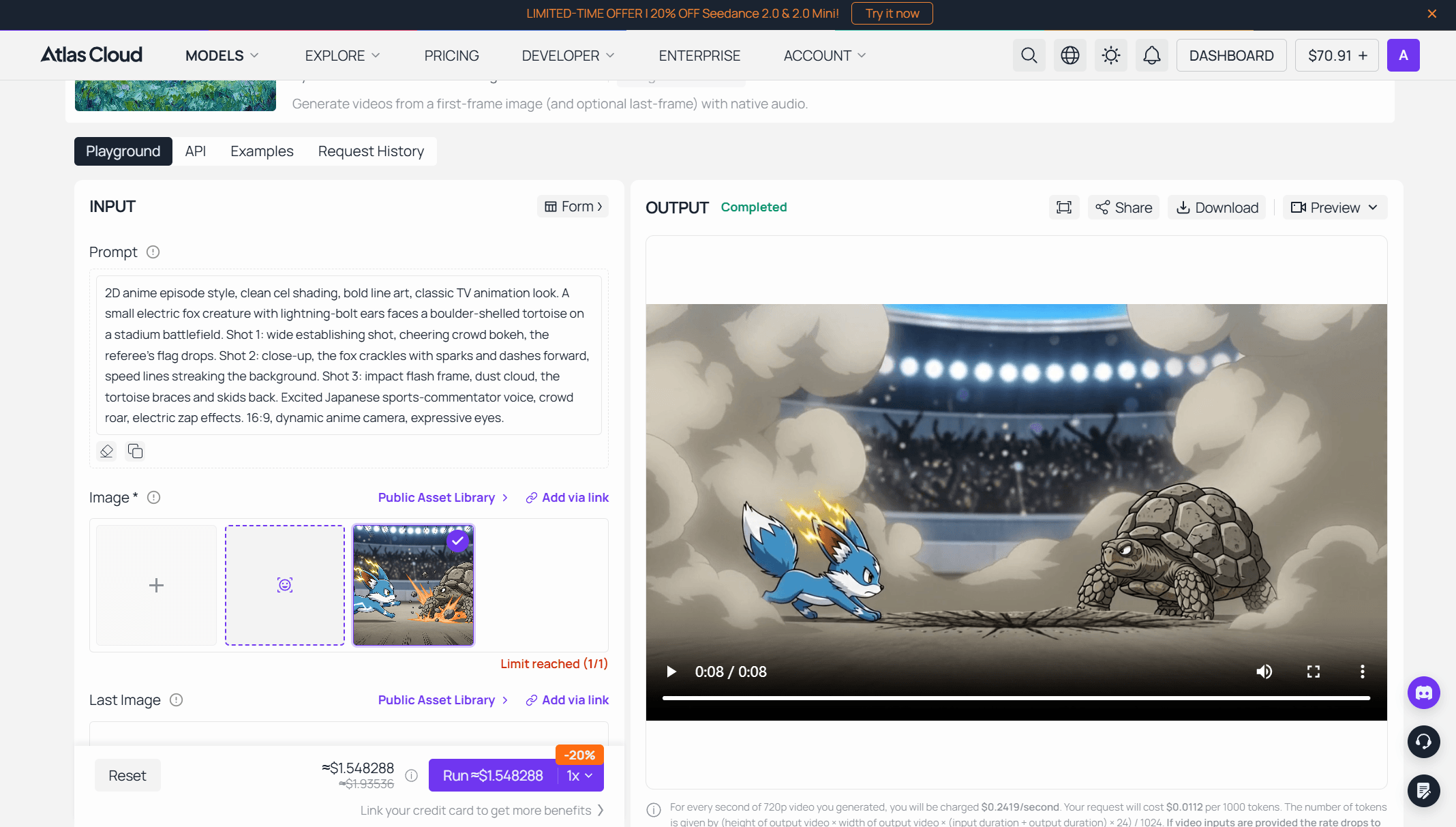
Here's a battle-scene skeleton built on an original creature, which is the durable way to ride this trend:
2D anime episode style, clean cel shading, bold line art, classic TV animation look. A small electric fox creature with lightning-bolt ears faces a boulder-shelled tortoise on a stadium battlefield. Shot 1: wide establishing shot, cheering crowd bokeh, the referee's flag drops. Shot 2: close-up, the fox crackles with sparks and dashes forward, speed lines streaking the background. Shot 3: impact flash frame, dust cloud, the tortoise braces and skids back. Excited Japanese sports-commentator voice, crowd roar, electric zap effects. 16:9, dynamic anime camera, expressive eyes.
Each element earns its slot:
| Prompt element | Why anime needs it |
|---|---|
| Style declared first | "Cel shading, bold line art" locks 2D rendering before the scene parses |
| Speed lines and impact frames | Anime grammar the model reproduces well when named explicitly |
| One action per shot | Multi-character chaos is where hands and anatomy break first |
| Commentator audio in-prompt | The model generates sound natively; silent anime reads as broken |
| Expressive eyes called out | Big-eye emotion carries anime acting; leaving it implicit gets flat faces |
Pokemon Seedance 2.0 Copyright: Where Nintendo Stands
Now the uncomfortable part. Every Pokemon Seedance 2.0 video in this article is unlicensed fan content built on the most fiercely defended IP in gaming. The industry response to the model was immediate: TheWrap's report on Disney's cease-and-desist quotes Disney's counsel calling the launch a "virtual smash-and-grab of Disney's IP," sent one day after release. Paramount's February 15 demand named IP from South Park to Star Trek, and Netflix and Sony followed within the week. ByteDance answered on February 16; Al Jazeera's coverage carries its pledge to "strengthen current safeguards" against unauthorized IP use.
Japan's reaction matters more for Pokemon, and it came without Nintendo saying a word. Japanese press coverage of the backlash named Ultraman, Detective Conan, Goku, and Doraemon among the recreated characters, and AI-strategy minister Kimi Onoda warned on February 13 that unauthorized use of copyrighted works "cannot be overlooked." By late February, Netease reported that ByteDance had begun restricting real-face references and IP-character generation for the Japanese market. Bilibili creators felt the tightening directly; that March 4 complaint about false violation flags is what enforcement looks like from the inside. It has stayed uneven, though. The Ash fan episodes kept shipping through April even as app-side flags multiplied, which is exactly why the guardrails below matter more than any single blocklist.
So where's Nintendo? Publicly silent on Seedance as of mid-July 2026, and the silence isn't a policy. Nintendo Life's report on the July 2026 shareholder Q&A quotes president Shuntaro Furukawa: "Regardless of whether generative AI is used, if Nintendo determines that something infringes on Nintendo IP, our policy is to respond appropriately." There's also precedent with this exact franchise. Viral Pikachu clips on Sora 2, including one of Sam Altman eating Pikachu, preceded OpenAI's October 2025 switch to opt-in permissions for copyrighted characters. Pikachu has already rewritten one AI platform's rulebook.
Practical guardrails if you're building rather than just watching:
- Treat named characters as radioactive for anything monetized. Ash, Pikachu, and Red are exactly the assets enforcement exists for.
- Original creatures in the same cel style carry far less exposure and age better than recreations.
- Disclose AI generation on every platform. The accounts driving this trend do, and their audiences reward it.
- Expect capability to shrink. ByteDance has committed to tighter safeguards, Japan already got a restricted build, and Bilibili creators report Pokemon-adjacent prompts getting flagged.
Frequently Asked Questions
Can Seedance 2.0 really make anime that matches the Pokemon TV look?
Close enough to fool fans, per the trend's own receipts. The first viral Bilibili upload was captioned "indistinguishable from the original," and its creator wrote that friends mistook it for real footage. The model's multi-shot output, native audio, and cel-style rendering carry the look; reference images carry the characters.
Are the pokemon seedance 2.0 episodes on YouTube and Bilibili official?
No. Every clip and episode in this wave is unofficial fan content, and none of it is licensed by Nintendo or The Pokémon Company. Neither company has commented on Seedance as of July 2026, but Nintendo's stated policy is to act on IP infringement whether or not AI is involved. Larger creators label their uploads as AI-generated fan work.
What does a Pokemon-style Seedance 2.0 clip cost to generate?
On Atlas Cloud, a 10-second 720p generation costs $1.93536 with the current 20% discount, or $2.4192 at list. The 480p floor starts around $0.09 per second, and an 11-and-a-half-minute fan episode prices out near $133 in raw 720p renders.
Why did the seedance 2.0 bilibili pokemon wave start before the official launch?
Chinese creators had early access through ByteDance's Jimeng app, so Bilibili's AIGC community was posting Pokemon tests by February 9, 2026, three days before the February 12 global launch. The first viral upload, its comment-section prompt exchange, and the follow-up tutorials all predate the worldwide release.
Conclusion
The pokemon seedance 2.0 story isn't really about Pokemon. It's about the gap between what fans want animated and what studios will ever ship, and about a model that closed that gap for the price of a takeout order. A sleepless Bilibili creator proved the look on February 9. Within ten weeks, full manga episodes existed that no studio made.
The characters belong to Nintendo. The technique belongs to anyone. Swap in an original creature, keep the cel-shading line at the top of your prompt, and the workflow in this guide is one API call away.





