ByteDance's Seedream 5.0 Pro launched straight into Reddit's favorite image-model argument: how close can anyone get to Google's Nano Banana line on realism, and at what price. Pro is new enough that organized community data on it is still thin, and that gap is exactly what this piece tries to close.
This comparison pulls from ByteDance's own model documentation, Google Cloud's official Nano Banana 2 announcement, current Atlas Cloud pricing, and specific Reddit threads posted after each launch.
Key Takeaways
- Seedream 5.0 Pro costs $0.054 per image on Atlas Cloud versus $0.08 for Nano Banana 2, roughly 33% cheaper, per Atlas Cloud's live pricing catalog (2026).
- Reddit's recurring sentiment is that Seedream holds its own image quality while being cheaper and less restrictive than Google's Nano Banana 2.
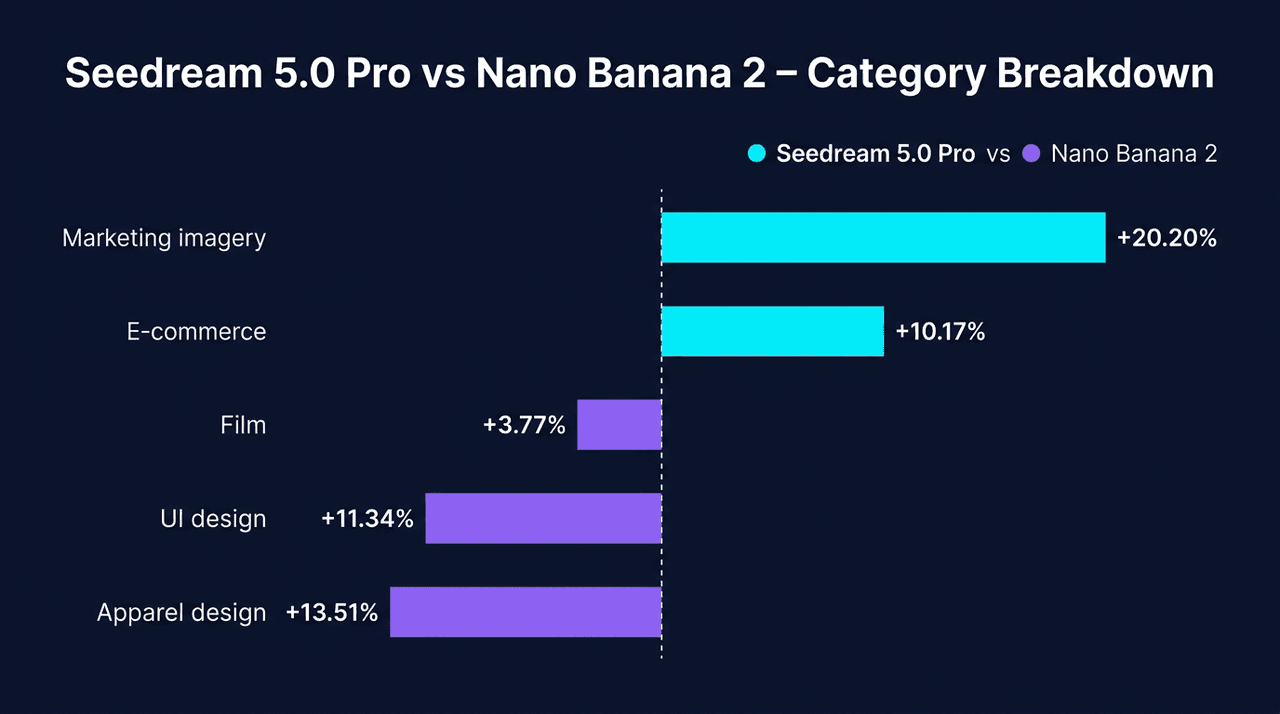
- ByteDance's own internal cross-industry benchmark puts Seedream 5.0 Pro at a 24.02% usable-generation rate against Nano Banana 2's 23.95%, effectively a tie that splits by category.
- A reproducible banding artifact bug is showing up across multiple hosting sites, and Reddit users report it going unfixed for weeks.

How Do Seedream 5.0 Pro and Nano Banana 2 Compare on Realism, Specs, and Price?
Both sit in the first tier for realism, and the split is stylistic rather than a clean win. Nano Banana 2's realism reads clean and commercial: disciplined color science, natural-light compliance, compositions that feel like documentary photography. Seedream 5.0 Pro's realism leans dramatically: stronger structural tension, cinematic lighting, and denser detail control in complex scenes. Which one looks "more real" depends on whether your reference point is a product catalog or a film still.
On the Google side, the strengths are photographic. In 302.AI's head-to-head test, close-up portraits from Nano Banana 2 rendered skin down to pores, blemishes, and peach fuzz, and the model led to real-world physics: lighting, materials, and shadows that hold together in intricate environments. Add strong high-dynamic-range color handling, and its generations come out polished enough to ship without post-processing.
Seedream 5.0 Pro answers with structure rather than surface. Its profile clusters around dramatic lighting, spatial logic, and layered detail in complex compositions, plus tight prompt adherence to physics-heavy and hardware-design briefs. That same profile shows up in Vidguru's lab test, where the Seedream line took the refraction-and-caustics round 5/5 against Nano Banana 2's 2/5, executing optical distortion and rainbow caustic shadows that trip up most models. It behaves more like a design tool than a camera.
| Dimension | Seedream 5.0 Pro | Nano Banana 2 |
|---|---|---|
| Underlying model | ByteDance Seedream 5.0 Pro | Google Gemini 3.1 Flash Image |
| Atlas Cloud price | $0.054/image | $0.08/image |
| Reference images | Up to 10 | Not published |
| In-image text languages | 15 native languages | Not published |
| Realism character | Dramatic lighting, strong structural tension and layering | Clean, commercial-documentary; saturated color, natural light |
| Material detail | Spatial depth and design-grade finishing in complex scenes | Macro-photography textures: pores, blemishes, peach fuzz |
| Closest reference point | Film still, professional design asset | Product catalog, editorial photography |
| Core edge | Spatial reasoning, prompt adherence, asset consistency | Visual intuition, HDR color handling |
Pricing reflects Atlas Cloud's current text-to-image and edit-variant listings (2026). At list price, that works out to Seedream 5.0 Pro running roughly 33% cheaper than Nano Banana 2, so the cost advantage Reddit keeps bringing up checks out numerically, not just as a vibe.
As of now, the only comparison conducted between Seedream 5.0 Pro and Nano Banana 2 with real data is an industry-wide benchmark test within ByteDance, reported by Atlas Cloud: a 24.02% usable-generation rate for Seedream 5.0 Pro against Nano Banana 2's 23.95%, parity on aggregate, with the useful signal in the category split:
The pricing figures throughout this piece come from Atlas Cloud, a unified inference platform that hosts both models in this comparison behind a single API key; the benchmark figures originate from ByteDance and are reported on Atlas Cloud's blog. Its ByteDance model family page covers the full Seedream line, from 5.0 Pro down to 4.5, alongside the Seedance video models, and the Seedream 5.0 Pro playground lets you rerun the realism comparisons in this article yourself before committing to the API.
Where Does Each Model Break Down in Production?
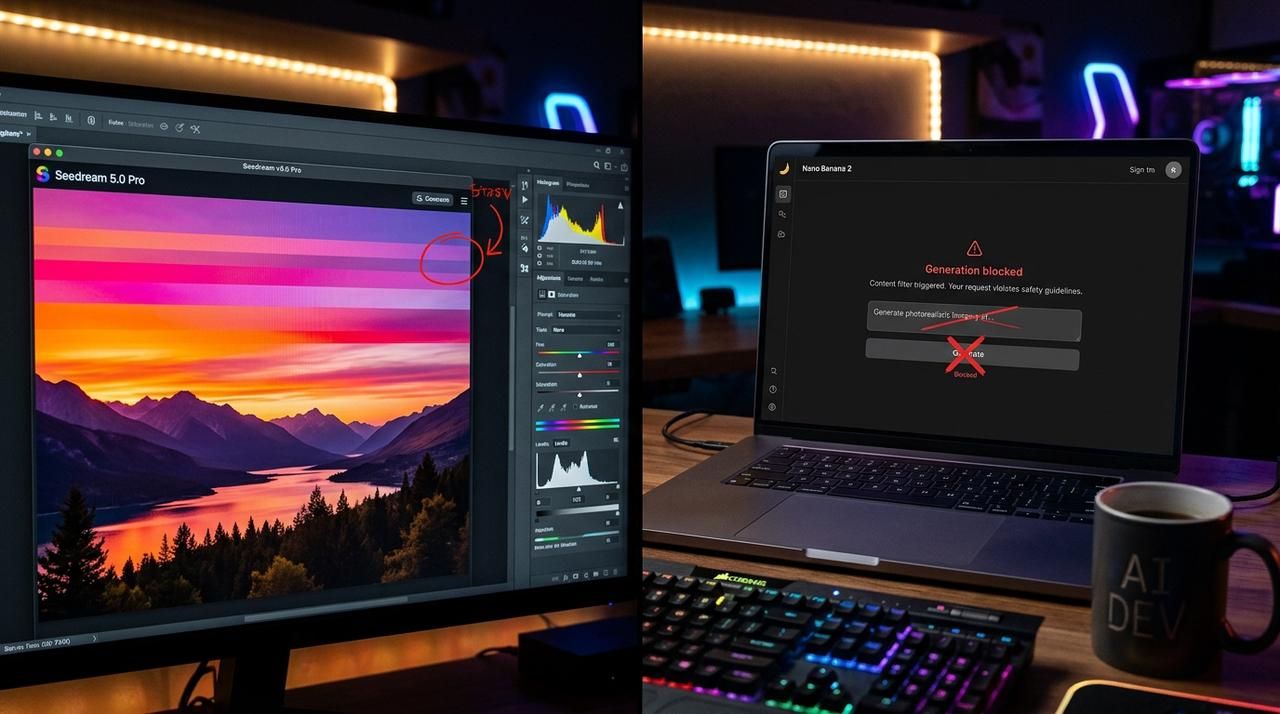
Seedream 5.0 Pro's documented failure mode is visual; Nano Banana 2's is behavioral. On the Seedream side, a visible color-band artifact is showing up in generated images across multiple hosting platforms, not something isolated to one integration. A r/Freepik_AI thread titled "seedream banding error" documents the issue with 24 comments and notes it reproduces across sites rather than being a one-off rendering glitch. Whether the banding traces back to the model itself or to how individual third-party sites call the API is still unclear from the public reports.
Nano Banana 2's friction shows up before the image renders rather than in it, and it's structural rather than incidental. Per a detailed breakdown of Gemini's image safety mechanism, the system runs two layers: one configurable via API parameters, and a second, non-configurable layer covering IMAGE_SAFETY, PROHIBITED_CONTENT, CSAM, and SPII that stays active no matter how permissively the first layer is set. Developers can't turn Layer 2 off, which is why setting every available safety category to its most permissive option still doesn't guarantee a clean run. One documented side effect is that anime-style generations get blocked noticeably more often than photorealistic ones on equivalent prompts, a pattern attributed to an oversensitive heuristic rather than a deliberate policy choice.
Reddit's version of this complaint is less technical but points at the same mechanism: more blocked generations and flagged prompts on Nano Banana 2 than Seedream produces on equivalent requests, which is exactly why permissiveness keeps surfacing as a Seedream selling point. That advantage is relative, not absolute. Seedream 5.0 has itself tightened up compared to 4.5, with some users hitting unexpected "sensitive" errors and "Image blocked by provider" messages.
The asymmetry worth remembering: one of these failure modes you can engineer around, the other you can't. Reroll past a banding artifact and the tool has done its job; there's no equivalent workaround for a hard-blocked safety layer, since no prompt rewrite reaches code the API can't touch.
Is Seedream 5.0 Pro's Layered Output Actually Real?
Officially yes, though Reddit hasn't finished stress-testing it. ByteDance's Seedream 5.0 Pro documentation lists layer editing and alpha-channel output as launch features, letting a single generation split into separately editable pieces instead of one flattened image. Community threads discussing this call it a "big claim" that still needs independent verification at scale, which is a fair standard to hold any new generation feature to before treating it as proven.
Nano Banana 2 has no published answer to this. Layered or alpha-channel output does not appear anywhere in its published capabilities, so generations come back as flattened images and any layer separation happens in post-production tools, at post-production labor cost.
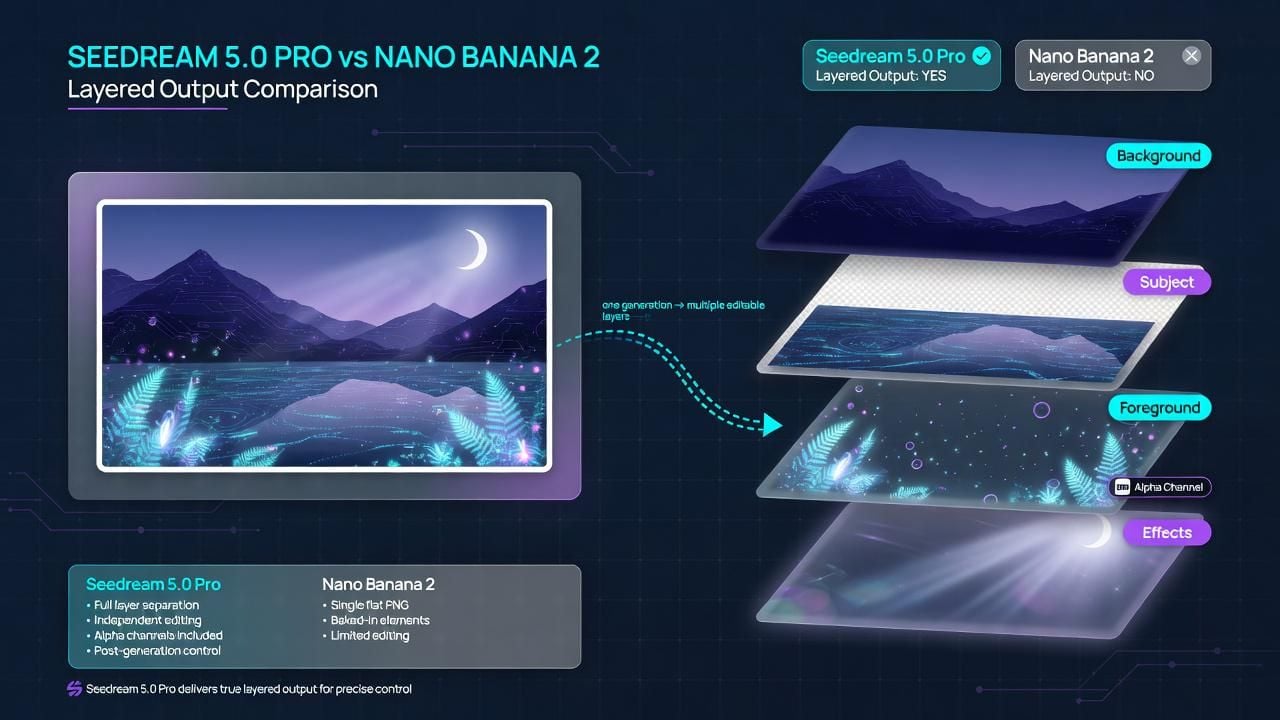
If layered output holds up under real production use, it changes the actual unit economics of a $0.054 render. One generation that unpacks into several usable, separately editable layers is worth more than the same price tag on a flat Nano Banana 2 image, even before factoring in the realism gap. That's a value case Reddit hasn't fully priced in yet because most testers are still evaluating single flattened outputs.
Which One Should You Actually Use?
Pick based on the job, not the headline comparison. The benchmark categories, pricing, and failure modes above collapse into a fairly clean decision table:
| Your workload | Better fit | Why |
|---|---|---|
| Marketing creative, e-commerce product shots | Seedream 5.0 Pro | Largest benchmark leads (+20.20%, +10.17%), at $0.054/image |
| Film frames, UI mockups, apparel design | Nano Banana 2 | Category benchmark wins at $0.08/image |
| Layer-based design pipelines | Seedream 5.0 Pro | The only pair with published layered/alpha output |
Developers testing both without committing to a single vendor relationship can run Seedream 5.0 Pro and Nano Banana 2 behind the same Atlas Cloud Seedream 5.0 Pro model page, switching models per request instead of integrating two separate provider APIs.
How Should You Prompt Each Model?
The stylistic split above translates directly into prompting technique, and the two models reward opposite habits. Nano Banana 2 responds best to photography language: name the lens, the light, the mood, and let the model's visual intuition fill in the rest. Its strength is making a short brief look professionally shot, so the skill is restraint — say what the photo is, not how to build it.
Seedream 5.0 Pro rewards the opposite. Its tight prompt adherence means it executes what the text says, including the parts you forgot to say, so treat the prompt like a design brief: state the layout, the materials, the lighting direction, and the exact text strings you want rendered, then attach reference images where consistency matters. Community threads collecting Seedream prompting techniques, like this r/fal breakdown, lean the same way: structure in, structure out.
Frequently Asked Questions
How much cheaper is Seedream 5.0 Pro than Nano Banana 2?
About 33% at list price: Seedream 5.0 Pro runs $0.054 per image on Atlas Cloud against Nano Banana 2's $0.08, with both billed pay-as-you-go rather than through a subscription.
Which looks more realistic, Seedream 5.0 Pro or Nano Banana 2?
It depends on your reference point. Nano Banana 2 leans clean and photographic, with disciplined color and micro-textures down to pores and peach fuzz, while Seedream 5.0 Pro leans cinematic, with dramatic lighting and stronger structure in complex scenes. On aggregate benchmark realism the two are effectively tied.
How does Seedream 5.0 Pro compare to Nano Banana 2 on benchmarks?
Essentially a tie on aggregate. ByteDance's own internal cross-industry benchmarking put Seedream 5.0 Pro at a 24.02% usable-generation rate against Nano Banana 2's 23.95%, with Seedream ahead in marketing and e-commerce categories and behind in film, UI, and apparel design.
What is the banding bug people mention on Reddit?
A reproducible color-banding artifact reported across multiple third-party hosting sites running Seedream 5.0, documented in a r/Freepik_AI thread with 24 comments. It's unclear whether the root cause sits in the model or in specific site integrations.
Conclusion
Seedream 5.0 Pro arrived with almost no dedicated Reddit discussion to judge it by, most of it still pointed at Nano Banana 2's older, more heavily-tested rival. Lined up directly, the two hold up as legitimate alternatives rather than a leader and a follower: comparable realism, a real price gap, and failure modes that show up in different places for different reasons. None of that is settled science. The benchmark behind this comparison is a snapshot, both models will keep shipping updates, and the third-party tests cited here were already measuring an earlier Seedream release by the time Pro launched. Treat this as a starting point for testing your own workload, not a final verdict, and expect the gap between these two to keep moving.





