

The Arcads help center prices a talking-actor ad down to the credit. The dollar prices only appear inside the app, after you sign up and save a card.
So we translated Arcads pricing into cost per ad. For short creatives, one rule decides the bill: talking-actor time is billed by the minute, and every clip rounds up. We then rendered and priced test ads on a pay-per-second alternative and built a break-even table to hold against your own plan price.
Key Takeaways
- Arcads lists plan credits publicly but shows dollar prices only inside its app after signup.
- Talking-actor ads cost 800 credits per minute per actor, and every clip rounds up to a full minute.
- Starter and Creator credits reset each month with no rollover; only Pro and higher tiers carry them forward.
- The 72-hour Arcads trial needs a card and converts to Starter automatically unless you cancel in time.
- Atlas Cloud's pay-per-second UGC ad generator has no monthly plan, so a short ad never pays for a full minute.
How Arcads Pricing Is Structured in 2026
Arcads sells subscriptions with a monthly credit allowance, so every plan is measured in credits. The help center lists three plans (Starter, Creator, and Pro), with Scale and Business above them for larger teams. Moving up the ladder also lowers your rate; in Arcads' own words, "higher volumes benefit from a lower cost per credit."
Dollar prices are the missing column. Arcads has no public pricing page (arcads.ai/pricing returns a 404), and its help center describes every plan in credits only.
The prices appear on the plan selection screen inside the app, which you reach after creating an account and saving a card. Treat any dollar figure in a third-party review as unverified until you see it on your own plan screen.
| Plan | Monthly credits | When credits run out | Unused credits | Where to buy |
|---|---|---|---|---|
| Starter | 8,000 | Account pauses until renewal | Reset each cycle | In-app plan screen |
| Creator | 16,000 | Account pauses until renewal | Reset each cycle | In-app plan screen |
| Pro | Not listed | Keeps running, extra credits billed per credit | Roll over while subscribed | In-app plan screen or sales |
| Scale, Business | Not listed | Keeps running, extra credits billed per credit | Roll over while subscribed | Sales team |
Plan rules as published in the Arcads help center, checked October 13, 2026.
Pro also adds features such as cloning yourself and custom voices, according to the Arcads FAQ. The table still leaves out the number you budget with: how many ads a credit balance buys.
What Arcads AI Pricing Works Out to per Ad
Credits only mean something once you know what each ad burns. For talking-actor videos, the help center gives one flat rate across all three actor models (Arcads 1.0, Audio-Driven, and OmniHuman 1.5): 800 credits per minute, per actor.
The catch sits in one short line: "Length is always rounded up." A 15-second ad is billed as a full minute. So is a 40-second one. Go one second past a minute and the meter jumps to 1,600.
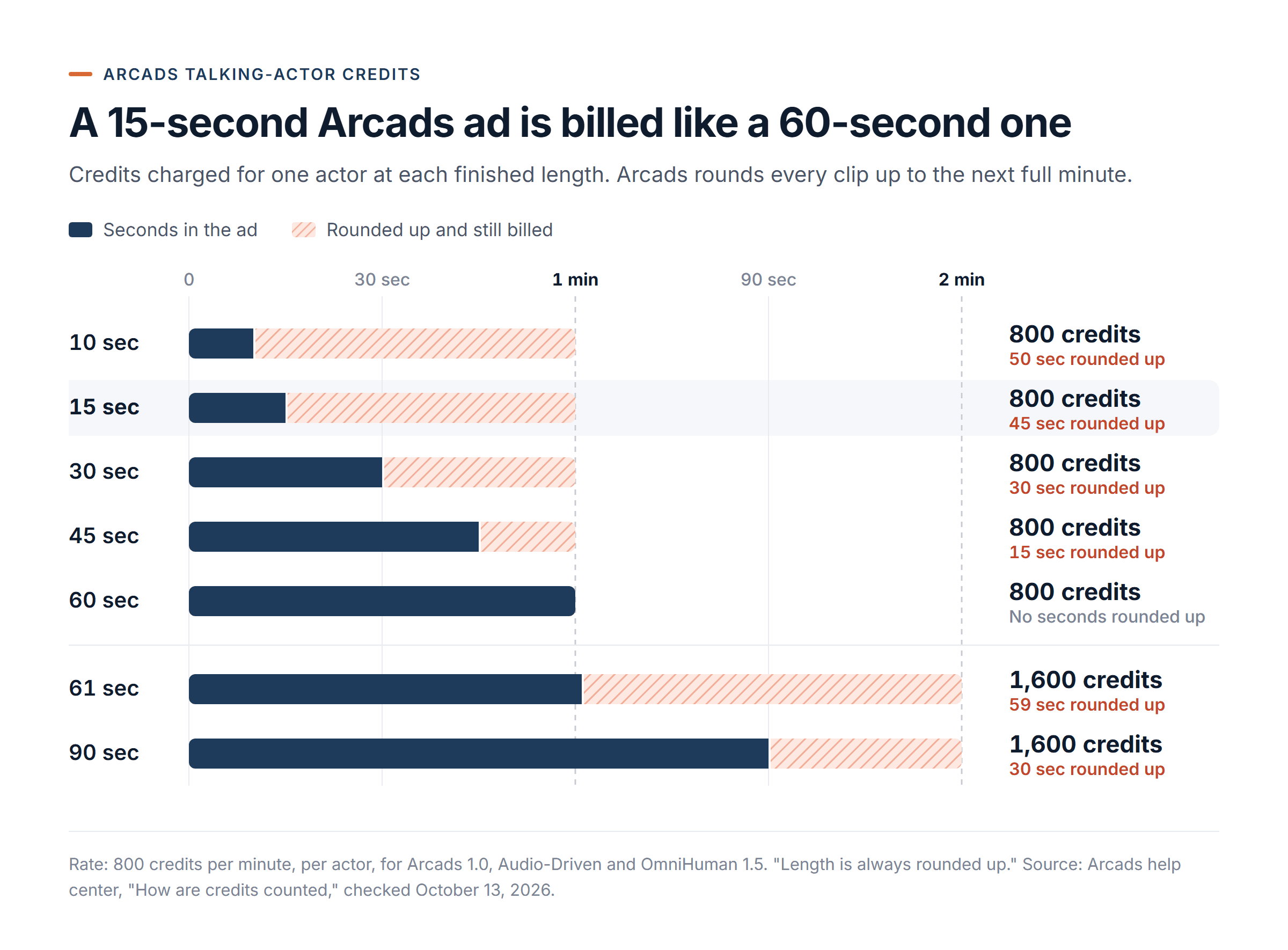
That makes the plan math blunt. Starter's 8,000 credits cover ten single-actor videos a month, whether each runs 12 seconds or 60. Creator covers twenty. Add a second actor and both numbers halve, since credits count per actor.
Not every Arcads ad is a talking head, though. Video model clips are priced per generation, with ranges that depend on the model and the complexity of the job: Kling 3.0 runs 176 to 560 credits, Seedance 2.0 at 720p runs 192 to 720, and Veo 3.1 is a flat 800. Presets have fixed prices too, like 400 credits for Unboxing POV and 800 for Product showcase.
Then come the finishing tools, and they stack:
- Captions: 80 credits
- Translate video: 240 credits
- Hook repurposer: 800 credits
- Upscale: 80 credits per 10 seconds
So a 15-second talking-actor ad with captions and one translation lands at 1,120 credits. That is 14% of a Starter month for a single deliverable.
A Pay-Per-Second Arcads Alternative: Atlas Cloud UGC Ads
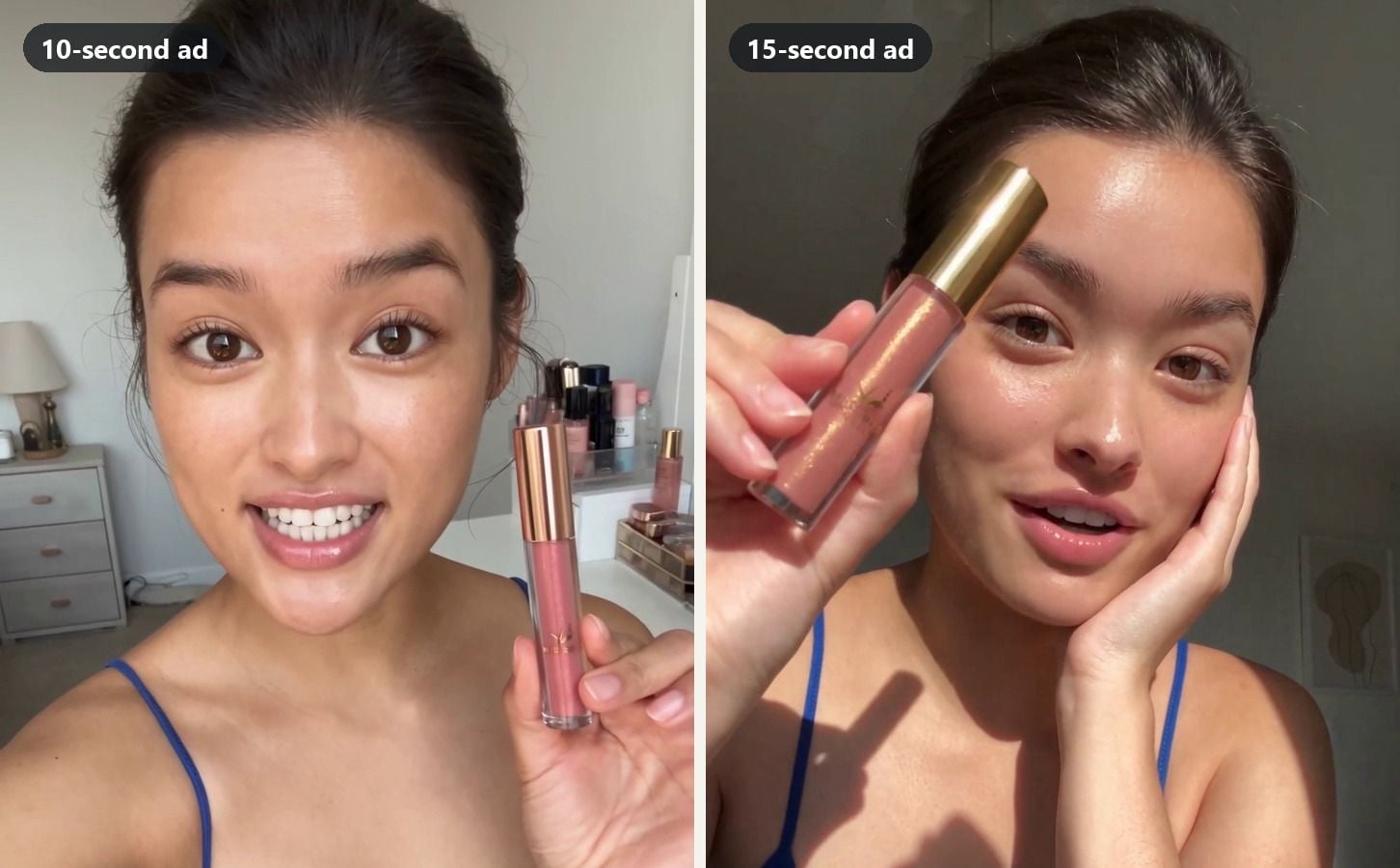
If most of your ads run 10 to 15 seconds, the minute rounding is what you overpay for. Atlas Cloud prices the same kind of creator-style ad by the second. For this test, a lip gloss photo, a creator photo, and a four-sentence brief went in, and this came out.

The 15-second 720p render as a GIF; the original has a generated voice track.
The UGC Ads workflow handles presenter, script, voice, and edit in one pass. Upload a creator photo to keep one face across a campaign, or skip it and the workflow invents a presenter.
Method 1: Generate a UGC Ad in the Browser
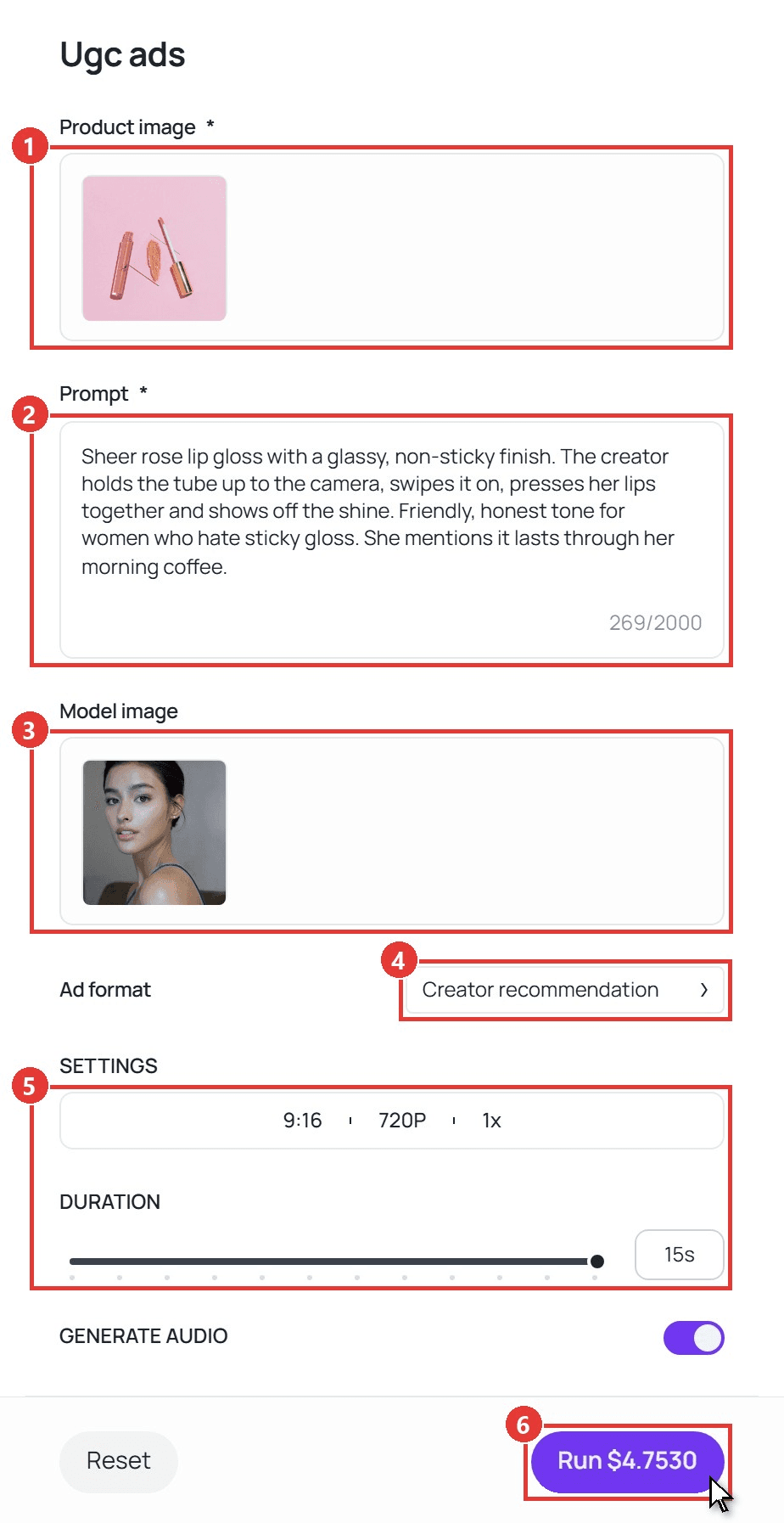
Log in, open the workflow, and fill the form from top to bottom. The numbers match the screenshot below.
- Upload the product image. One clean shot of the product on a plain background works best.
- Write the prompt. Give it the selling point, the audience, and any action you want on camera, such as "swipes it on, presses her lips together and shows off the shine." The box takes up to 2,000 characters.
- Add a model image if you want a specific face. Leave it empty for a generated presenter.
- Pick the ad format: creator recommendation, before-and-after, or unboxing.
- Set the output under SETTINGS: aspect ratio, resolution, and duration.
- Click Run. The finished clip appears in the Output panel on the right.
Method 2: Call the UGC Ad Workflow Through the API
The browser form is fine for a handful of ads. Once you're testing hooks across a catalog, the API is faster.
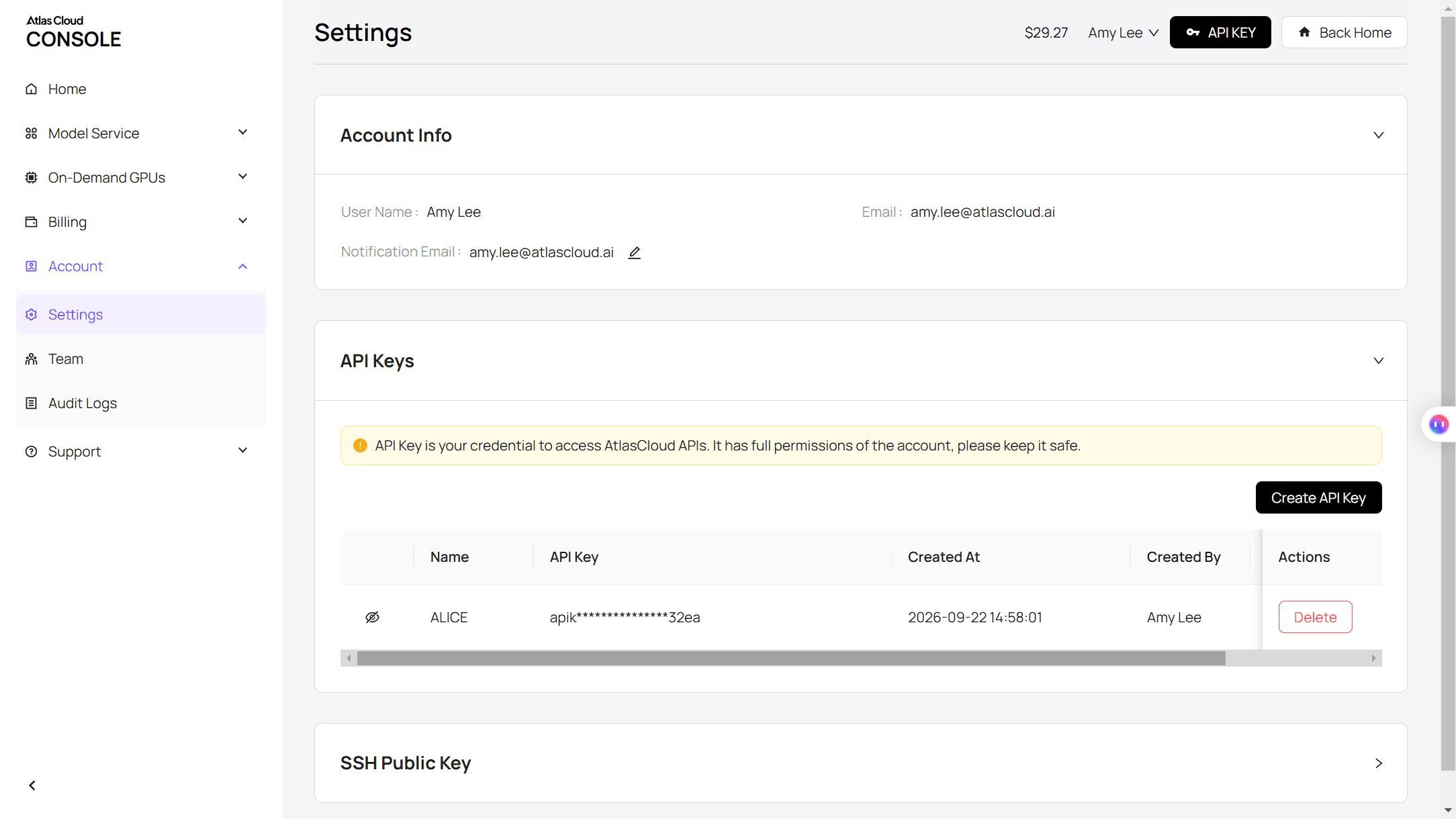
Step 1: Create an API key. Generate one in the Atlas Cloud console and keep it on your server, out of client-side code.
Step 2: Check the API docs. Authentication and polling are covered in the API documentation. The fields match the browser form, and the Schema tab on the UGC Ads model page lists the accepted values for each one.
Step 3: Send your first request. Only the product image and the prompt are required. The model image is optional, and ad_type takes creator_recommendation, before_after, or unboxing.
plaintext1curl -X POST "https://api.atlascloud.ai/api/v1/model/generateVideo" \ 2 -H "Authorization: Bearer $ATLASCLOUD_API_KEY" \ 3 -H "Content-Type: application/json" \ 4 -d '{ 5 "model": "atlascloud/studio/ugc-ad", 6 "product_image": "https://your-store.com/products/rose-lip-gloss.jpg", 7 "model_image": "https://your-store.com/creators/ambassador.jpg", 8 "user_prompt": "Sheer rose lip gloss with a glassy, non-sticky finish. The creator holds the tube up to the camera, swipes it on, presses her lips together and shows off the shine. Friendly, honest tone for women who hate sticky gloss.", 9 "ad_type": "creator_recommendation", 10 "duration": 15, 11 "ratio": "9:16", 12 "resolution": "720p", 13 "generate_audio": "yes", 14 "count": 1 15 }'
Generation is asynchronous. The response carries a request ID; poll it until the status reads completed:
plaintext1curl "https://api.atlascloud.ai/api/v1/model/prediction/<request_id>" \ 2 -H "Authorization: Bearer $ATLASCLOUD_API_KEY"
The outputs array then holds the video URL. Set count to 2 and one request returns two different creative takes on the same brief, which is a cheap way to split-test hooks. The same endpoint and key also serve Atlas Cloud's other video models and workflows, so trying one, such as the Virtual Try-On workflow, starts with changing the model string.
Arcads vs Atlas Cloud Cost per Ad, Side by Side
With both pricing models translated, they fit in one table. Arcads numbers are talking-actor credits for one actor.
Atlas Cloud numbers are the live per-run price at 720p with audio on (a flat $0.208 per render plus $0.303 per second), checked October 13, 2026, with no discount running. One Atlas Cloud render covers 4 to 15 seconds, so longer spots are priced as back-to-back renders.
| Ad length | Arcads credits | Share of a Starter month | Share of a Creator month | Atlas Cloud cost |
|---|---|---|---|---|
| 10 seconds | 800 | 10% | 5% | $3.24 |
| 15 seconds | 800 | 10% | 5% | $4.75 |
| 30 seconds | 800 | 10% | 5% | $9.51 (2 renders) |
| 60 seconds | 800 | 10% | 5% | $19.01 (4 renders) |
Since Arcads keeps its dollar prices inside the app, the useful comparison is a break-even point. Divide your Starter price by 10 and you get your cost per talking-actor ad, assuming you spend every credit. If that number is lower than the Atlas Cloud figure for your ad length, Arcads is cheaper. If it's higher, per-second billing wins:
- 15-second ads: Atlas Cloud costs less whenever Starter costs more than $47.53 a month.
- 30-second ads: the line moves to $95.06.
- 60-second ads: the line moves to $190.12.
On Creator, double each threshold, since the plan holds twenty ads instead of ten.
Those lines assume a perfect month. Starter and Creator credits expire at renewal, so an account that uses half its credits pays double per ad. Per-run billing has no monthly allotment to burn through. Drafting at 480p cuts a 15-second render to $2.32, which helps when you only need to check a hook before paying for the 720p version.
Read the Arcads Free Trial Rules Before Entering a Card
The trial is the first price you pay, so it deserves a close read. Arcads gives new accounts 72 hours and 1,000 credits with every feature unlocked, including Studio, Workflows, and the Agent.
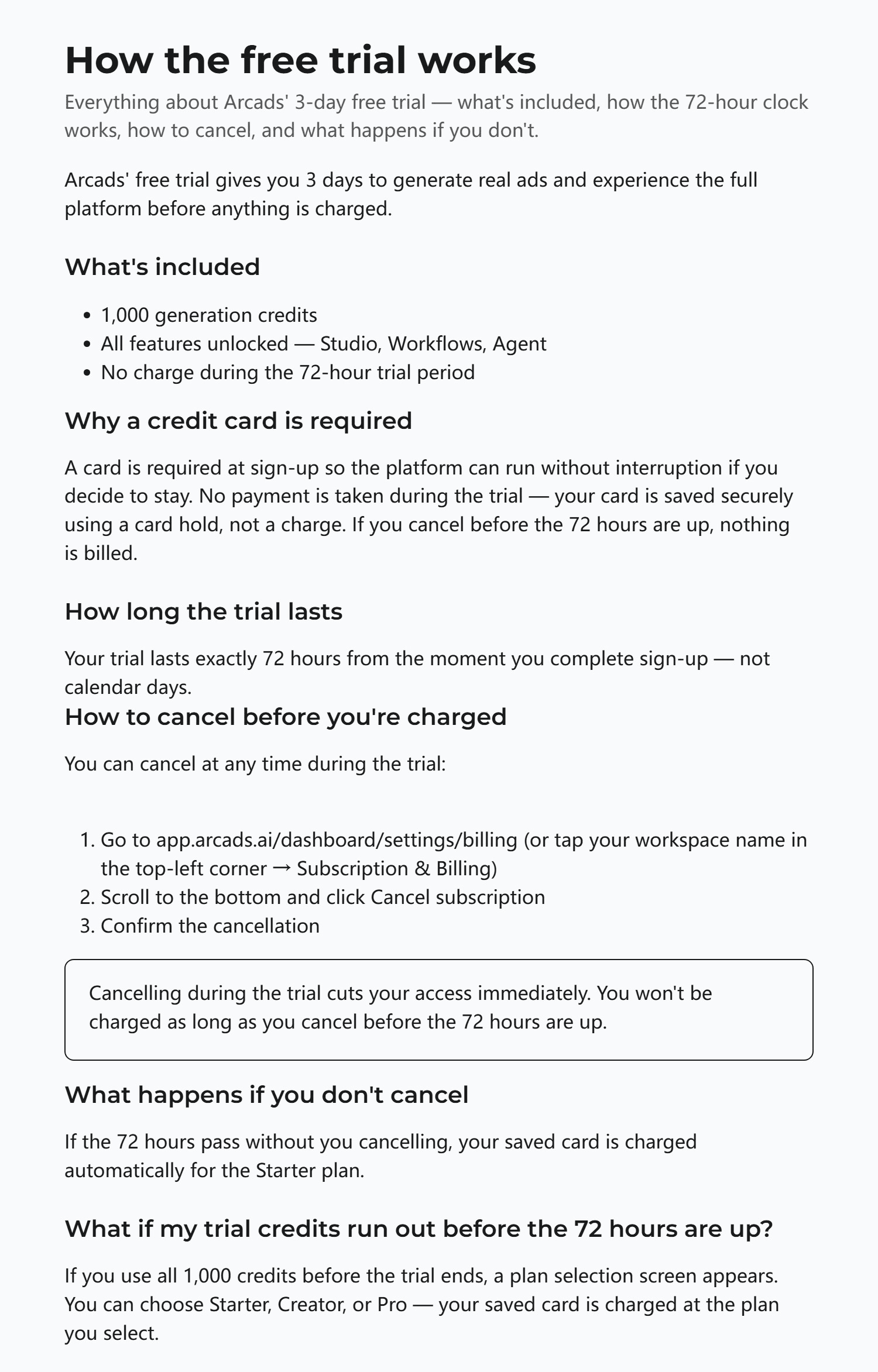
Source: Arcads help center, "How the free trial works," viewed October 13, 2026.
Four details decide whether your card gets charged:
- The clock runs 72 hours from signup, not three calendar days.
- A card is required. Arcads places a hold to verify it and takes no payment during the trial.
- Let the 72 hours pass without cancelling and the card is charged for Starter automatically.
- Spend all 1,000 credits early and a plan selection screen appears. Your card is charged for whichever plan you pick there.
In ad terms, 1,000 credits buys one talking-actor video up to a minute long, with 200 credits left for something like the Show Your App preset.
To cancel, go to Settings, then Subscription & Billing, and click Cancel subscription at the bottom. Access ends the moment you cancel, so finish testing first. If the trial converts before you get there, the window is narrow: a charge with no subscription credits used may qualify for a one-time courtesy refund, but only if you contact support within 24 hours.
Is Arcads Worth the Price for Your Ad Volume?
Price answers half of "worth it." The other half is what kind of ads you make and how steady your volume is.
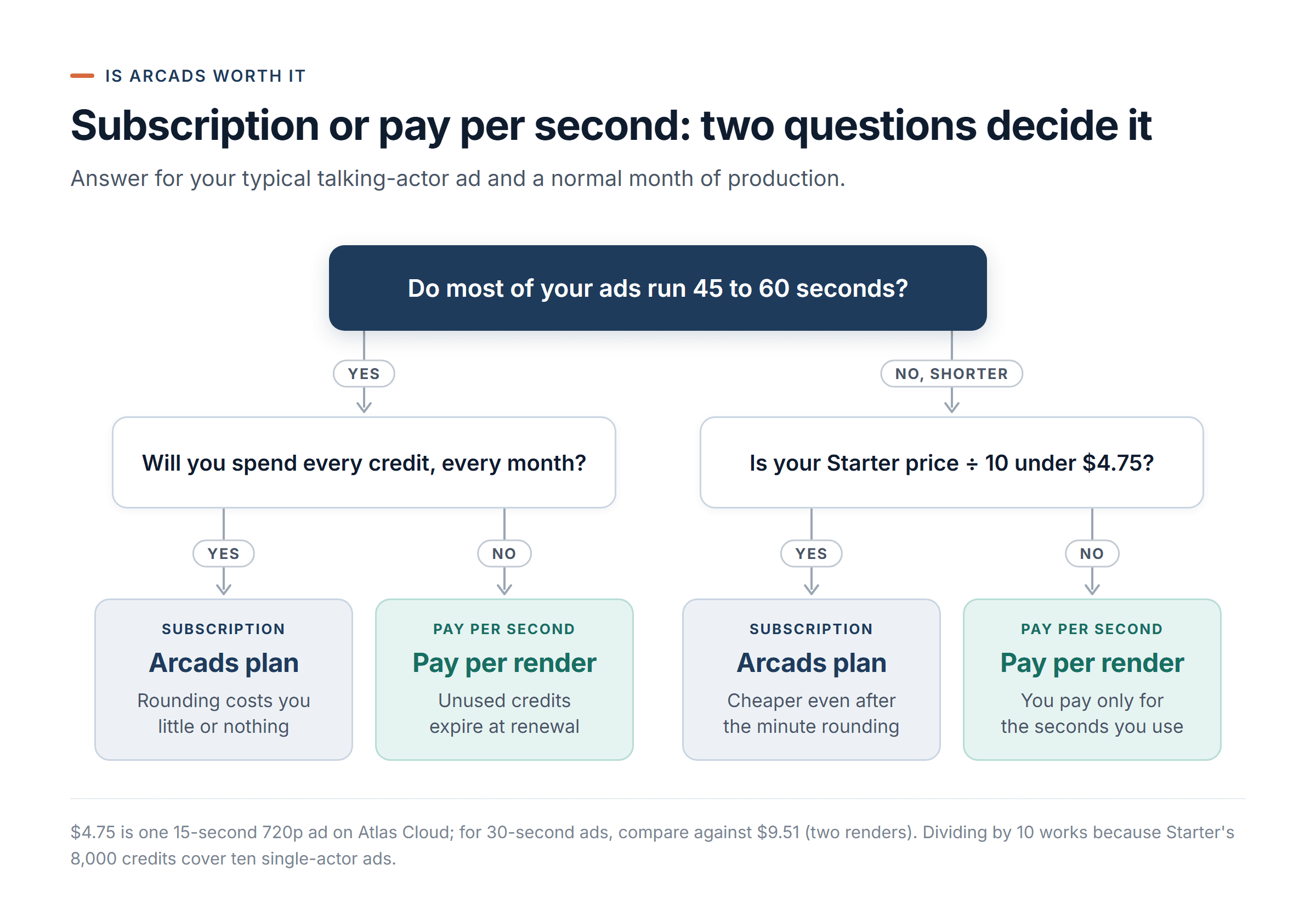
Arcads earns its plan when your scripts run close to a minute and you publish on a steady monthly rhythm. At 45 to 60 seconds the rounding costs you little or nothing, so nearly every credit turns into finished airtime. Teams that localize get extra value too: talking-actor voices cover 35 languages and accents, and Translate Video handles more than 130.
Per-second billing wins in the opposite case. Think short hooks, 10 to 15 second A/B tests, and months where output swings from three ads to thirty. If you're still deciding between AI tools and paying human creators, our breakdown of UGC video agency costs covers the other side of that budget.
Frequently Asked Questions
Does Arcads offer pay-as-you-go pricing?
Not on Starter or Creator. Both lock the account once the month's credits are gone, so a busy launch week can stall production until renewal unless you upgrade. Pro and above come closest to pay-as-you-go: they keep running and bill the extra usage per credit.
Do failed generations still use Arcads credits?
They can, but Arcads restores credits when a platform or system error caused the failure, as long as you ask within 30 days. Errors that say "used credits were not counted" refund automatically within minutes. Output you dislike, such as weak lip sync or an unexpected accent, doesn't qualify, so judge lip sync and accents during the trial, before a paid cycle starts.
How many credits does a two-actor Arcads ad use?
Double the single-actor rate: 800 credits per minute for each actor, rounded up. A 30-second dialogue ad with two actors costs 1,600 credits, and the help center's own example of a 1 minute 45 second video with two actors comes to 3,200. Dialogue formats burn credits twice as fast, so save the second actor for scripts that need a real back-and-forth.
Is there an Arcads plan for agencies or high volume?
Yes. Scale and Business are sold through the Arcads sales team, and Pro is available from the in-app plan screen or through sales. Teammates join from Settings, then Members, and custom actors stay private to your workspace, which matters when one account serves several client brands.
Conclusion
Arcads publishes its credit rules in detail and keeps its dollar prices inside the app. Once you know the 800-credits-per-minute rule and the rounding behind it, the plans become easy to judge. Each Starter month is ten single-actor ads, no matter how short you cut them, and any credit you don't spend disappears at renewal.
That leaves a simple test for Arcads pricing. Divide your plan price by your real monthly ad count and compare it with what a per-second render costs at the same length. Long scripts on a steady schedule favor the subscription. Short hooks and uneven months favor paying only for the seconds you render.





