

The bby wow guy ai trend turns a brief party moment into a four-beat visual joke: a dancer walks toward a phone camera, takes a bite of concha, locks eyes with the lens while chewing, then bounces back into the celebration. The bite is the setup. The unexpectedly serious stare is the punchline. Below, two online examples show the reference and an AI remake. Then we break down the motion and show an original, longer video made for this guide.
Key takeaways
- Keep the dance-in, concha bite, direct stare, and dance-away in that order; the sequence makes the meme recognizable.
- A short online remix demonstrates the format, while the original video later in this guide expands it past 20 seconds without repeating a static pose.
- Use a fictional adult or a person who has agreed to appear, and add the trending song through the social platform's licensed sound library when posting.
What makes the bby wow guy AI video recognizable?
The recognizable scene is a quinceañera party filmed like an informal vertical phone clip. A young adult in a dark staff-style polo crosses a busy dance floor carrying a concha, a round Mexican sweet bread with a patterned sugar crust. He approaches the camera with a loose shoulder bounce, bites the bread, and keeps his gaze fixed on the lens while he chews. The expression barely changes even as the music and party continue behind him. Finally, he turns and dances away. That mismatch between lively movement and an almost confrontational stare is the joke.
The meme is often paired with “BbY WOW” in social edits. The short phrase “dime dime baby” may appear in searches for the same sound. It does not change the visual recipe: this is the concha-bite party clip, not a synchronized two-person dance. Search results mix the two, so checking for the bread, the stare, and the exit is more useful than matching a sound name alone.
The online source clip and later AI remakes have different purposes. The source establishes the timing and handheld feel. The remakes show how a new fictional subject can perform the same sequence. A successful new version does not need to duplicate every background guest or camera shake. It needs a legible entrance, a visible bite, a sustained eye-contact beat, and a departure with enough movement to close the joke.
Online example 1: the short party reference
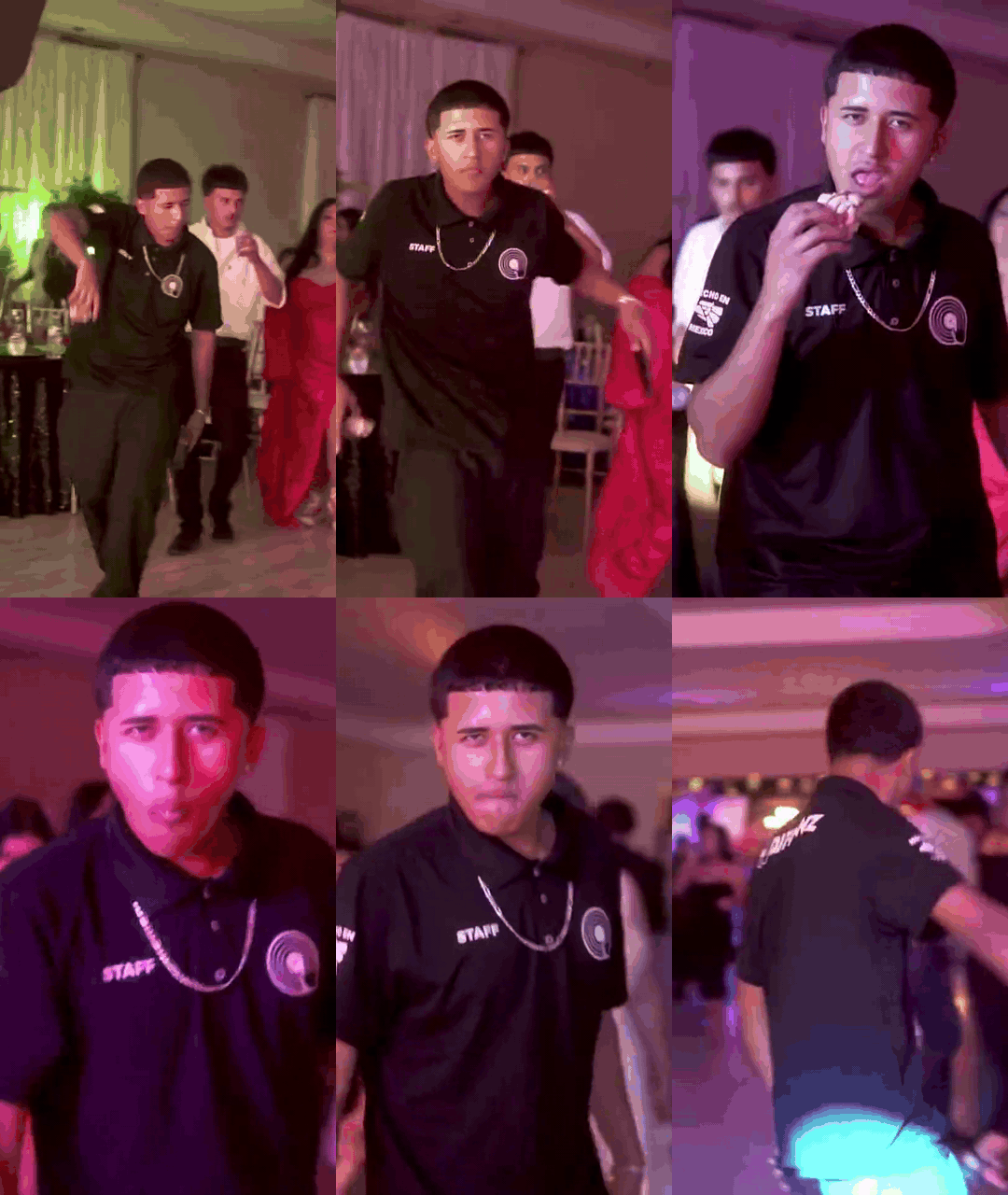
Online example, shown without sound. Watch how the bread reaches the mouth before the camera holds on the chewing expression.
The reference uses a phone-height camera rather than a carefully tracked shot. People and party lights remain visible behind the dancer, but they are not the point of focus. The camera does not have to move much: the subject crossing the floor creates the approach, and the face filling more of the frame makes the stare land. The bread stays in one hand and the reaction happens immediately after the bite. If the subject turns away too soon, viewers miss the joke.
Online example 2: an AI remake
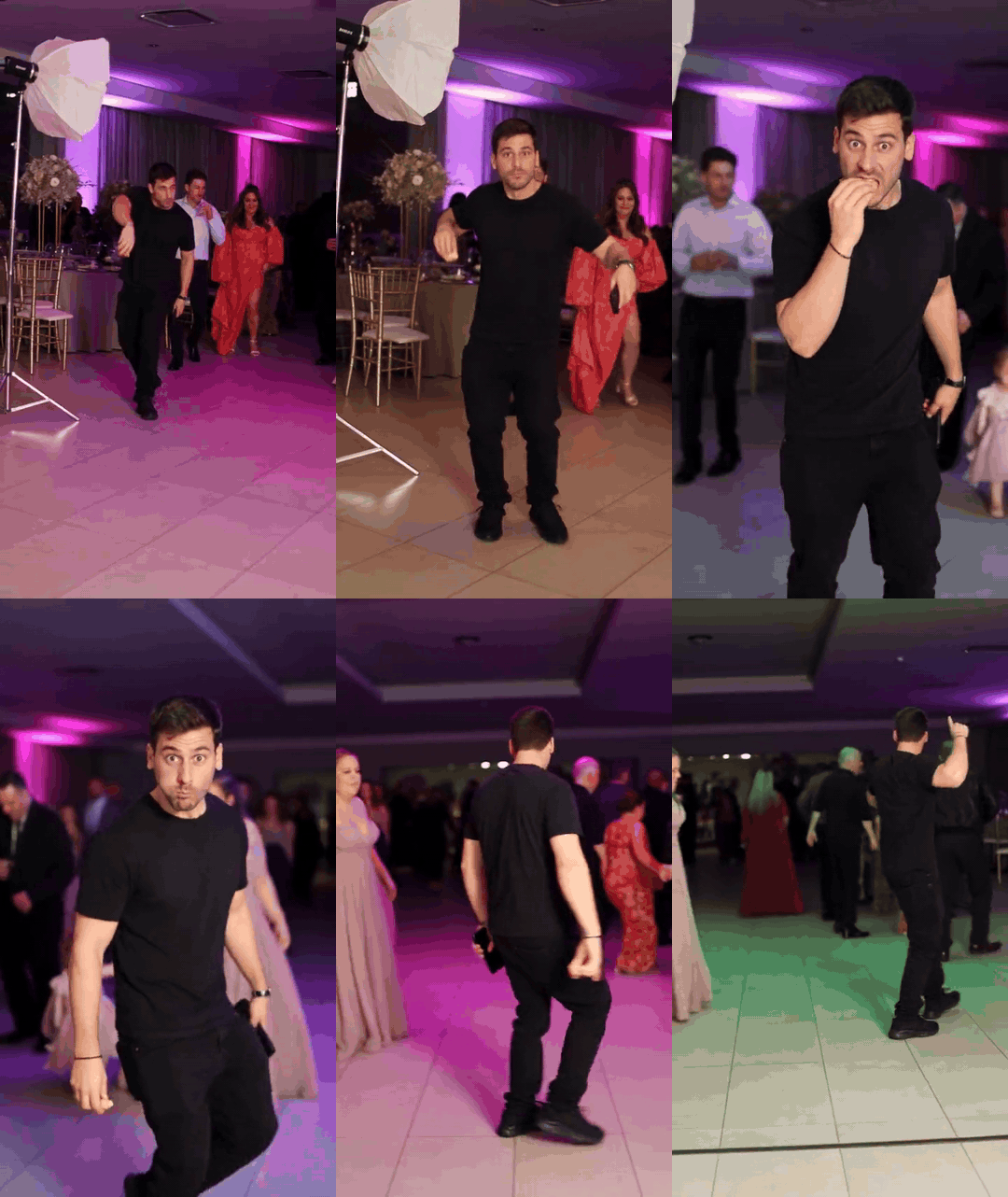
Online AI example, shown without sound. Compare the subject's motion and continuity with the short party reference above.
The remake demonstrates the trade-off of a prompt-driven version. The sequence can be transferred to a new subject, but each beat needs to remain understandable on screen. Look at the bread before and after the bite, the length of the close look into the lens, and whether the dancer actually travels away at the end. Those details are more important than matching the reference frame for frame.
| Beat | What viewers should see | Common failure |
|---|---|---|
| Entrance | An adult dancer moves from the party floor toward the camera | Subject starts already in close-up, so there is no approach |
| Bite | One visible concha is lifted and bitten | Bread changes shape, disappears, or never touches the mouth |
| Stare | Eyes hold the lens during chewing for a clear reaction beat | A passing glance is too brief to read |
| Exit | The subject turns and moves back into the party | Motion becomes a slow zoom or freezes on the face |
Why do some remakes feel like the trend and others miss it?
This format depends on a cause and effect chain. The party establishes a normal social scene. The dancer's approach invites attention. The bite supplies an ordinary action, then the serious eye contact makes that action oddly theatrical. The dance-away resets the room, as though nothing unusual happened. If an AI video only shows a face chewing in place, it has the central expression but loses the social setup and payoff.
Timing matters as much as appearance. In a compact clip, the entrance should happen quickly enough to make room for the close-up. The stare should last long enough to register as deliberate. In a longer clip, simply holding the same close-up for extra seconds makes the video drag. Add meaningful choreography before and after the stare: a side step around a table, a shoulder roll, a half turn, or a backward bounce through the party. Keep the four main beats in their original order.
The concha is a practical visual anchor. Ask for one bread, held consistently in one hand, with a small bite removed after contact. A model may treat the pastry as a prop that melts into a hand or reappears whole. A clear opening frame and a prompt that repeats “one concha” help, but inspection of the generated frames is still necessary. The mouth should meet the bread. A cutaway that merely implies the bite is less convincing because the bite is the setup for the stare.
Camera choices also support the joke. The online reference is a vertical phone clip; our original example below uses a 4:3 horizontal frame with a slightly imperfect handheld perspective. A medium-wide view keeps the dancer's feet visible while the face and bread remain readable. The camera follows the dancer as he approaches and retreats. The party remains a believable environment with guests and colored lights, while the foreground action stays visually clear.
How to make your own bby wow guy AI video
Start with a fictional adult character or a consenting adult's photo. For the original example below, we use a fictional staff member rather than the likeness of the person in the online clip. That keeps the choreography and humor while giving the generated result its own performer. A full or three-quarter body reference makes the first and last dance beats easier to stage than a tightly cropped face photo. A clear face remains important because the camera eventually comes close.
We built a 4:3 party starting frame in Atlas Cloud's Seedream image playground. The frame catches one adult staff-style dancer in a plain black polo taking a natural crossing step, with one concha held near the chest and both feet visible. The guests stay soft in the background. This frame locks the subject, pastry, dance pose, and space before animation. It is not an online case or a purported photo of a real party.
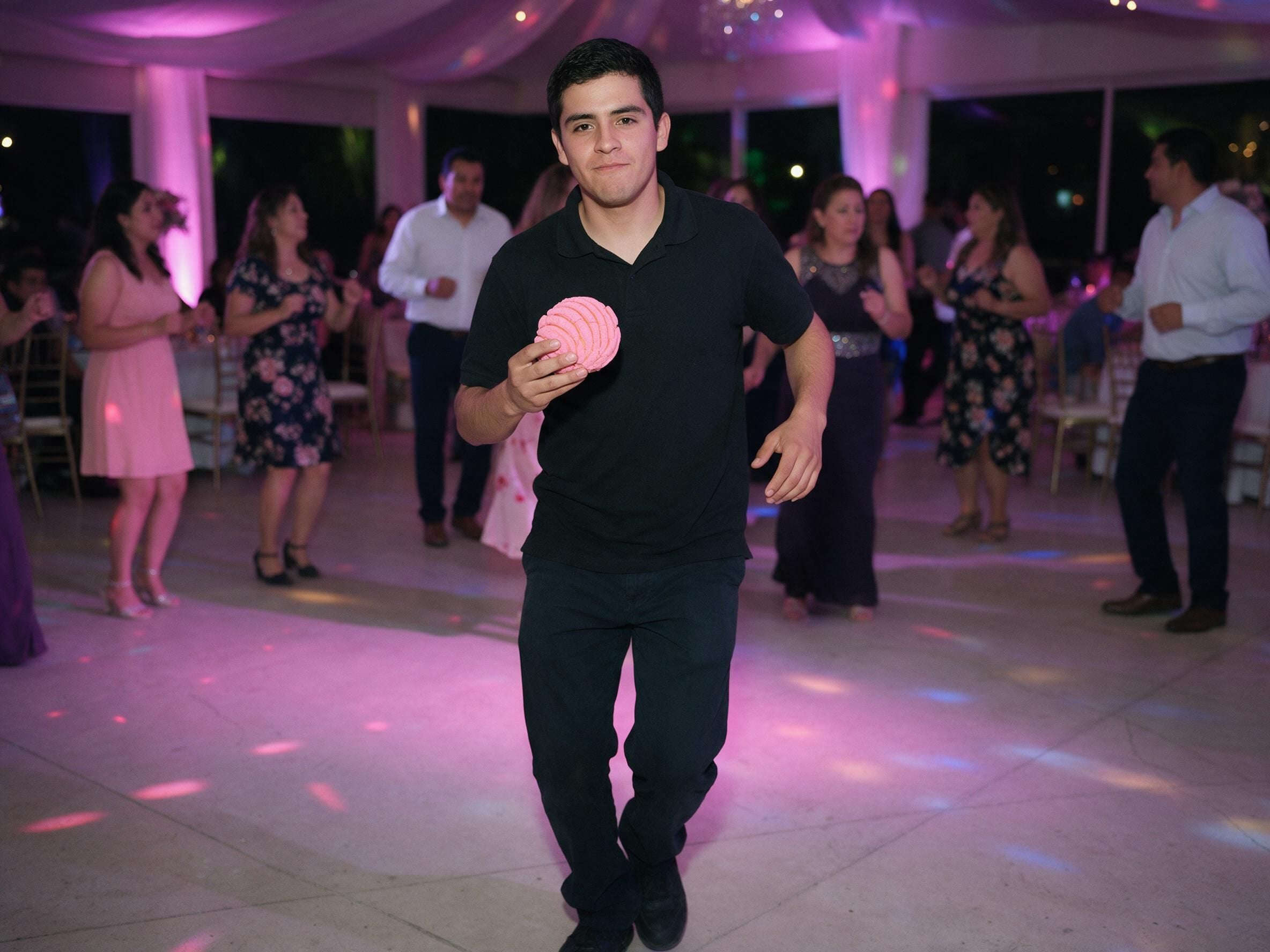
Original AI-generated starting frame used as the visual reference for the video below.
The motion stage uses Atlas Cloud's Seedance image-to-video playground. We requested 22 seconds in one generation so the performance runs continuously from the supplied first frame. Keep the same adult, clothing, bread, party, and light direction throughout. The dance begins in the opening frame and continues through the bite, gaze, turn, and retreat.
| Time | Action and camera | What to check after generation |
|---|---|---|
| 0–5 s | Medium-wide view; two brisk cross-step and step-touch phrases carry the dancer toward the camera, with one outward hand gesture | The feet travel across the floor from the opening; there is no standing-and-eating start |
| 5–8 s | He raises the concha and takes one bite during another step-touch | The bite reads clearly and the bread keeps its bite mark |
| 8–11 s | He chews and gives the lens a comically serious look while completing two measured step-touches | The gaze lands without a frozen pose or rapid body jitter |
| 11–15 s | A quarter-turn and half-turn lead into distinct heel-toe side steps and an arm flourish | The change in direction looks like a deliberate dance phrase |
| 15–22 s | The camera follows as he dances back toward the guests, adds two more step-touch phrases, and glances back | He stays visible and moving in the final frame; the room does not end empty |
Make the dancer's path and individual dance phrases explicit. The bite should be readable during a step-touch, followed by a brief stare that still includes measured footwork. Keep the camera wide enough to show the feet. Finish with a clear turn and several steps back into the room, with the camera following so the dancer remains visible. For a quicker version, ask for shorter gaps between the same steps and a livelier beat rather than speeding up the finished footage. Time ranges help prevent the model from stretching a single gesture into repetitive shaking.
Here is the core prompt for the performance. Adjust the seconds to your selected model's clip limit, but retain the sequence and continuity rules:
plaintext1Generate a 22-second 4:3 candid handheld party video from the selected first frame. Keep the same fictional adult in a plain black polo and the same single pink concha on a pink-purple quinceañera-inspired dance floor. Keep the choreography and story, but perform the steps about 25% faster at a lively natural party tempo near 130 BPM. Make each step crisp and shorten the pauses between steps; do not make the footage look fast-forwarded. Use visible traveling steps and a clear turn, without repetitive shaking. At 0–5 seconds, he performs two brisk cross-step and step-touch phrases toward the lens; his free hand gestures outward once, then swings naturally. At 5–8 seconds, he takes one clear bite during another step-touch; the small bite mark remains. At 8–11 seconds, he chews and gives the lens a funny serious stare while completing two quick, measured step-touches. At 11–15 seconds, he breaks the gaze, makes a quarter-turn and then a half-turn, and takes two distinct heel-toe side steps with a loose arm flourish. At 15–21 seconds, the handheld camera follows him in a medium-wide full-body view as he dances back toward the guests with brisk separate side steps and two more step-touch phrases. At 21–22 seconds, he is still visible among the guests, dancing and glancing back. Keep smooth human motion with original upbeat party percussion and crowd ambience. No knee pumping in place, twitching, wide lunges, slow motion, time-lapse, static close-up, camera-only zoom, disappearing subject, duplicate bread, changing face, captions, logos, or commercial melody.
For this example, set the duration to 22 seconds and use the 4:3 generated image as the first frame. When reviewing, check for distinguishable cross-steps, step-touches, a bite, a brief stare, a turn, and the dancing retreat. Watch the whole clip to catch repetitive jitter or a subject that leaves the frame too early. If the concha returns to its unbitten shape, revise the prompt and regenerate. Compare the face at the start, during the stare, and from the turning angle for continuity.
Our original video: a longer concha-bite performance
Original 4:3 AI-generated example, approximately 22 seconds. This faster-paced take keeps the crossing steps, bite, brief stare, and movement back across the dance floor. Audio uses an original party rhythm, not the commercial track.
Watch the finished example for distinct movement rather than continuous bouncing. Check the crossing steps near the start, the step-touch at the bite and stare, the turn, and the steps back toward the guests. The dancer remains in frame through the ending. The party lighting and wardrobe tie the scenes together, while the direct look remains the punchline.
How should you handle the sound and posting?
The familiar social edit uses “BbY WOW.” For a video that will be uploaded to TikTok or Instagram, choose the sound from that platform's licensed in-app library if it is available for your account and region. Do not assume that a downloaded song or another user's reel audio can be baked into a separate video file for reuse elsewhere. This guide's downloadable original example uses its own rhythm so the visual demonstration can be embedded here without republishing the commercial recording. The GIF examples are silent by design.
Set the music so the dancer's entrance catches a beat, the bite coincides with a short accent, and the stare has enough breathing room to become funny. If you add a voiceover or text caption, avoid covering the bread or eyes. The meme does not require spoken dialogue: the direct look at the camera is already the punchline. A caption can identify the AI remake or add context, but it should not explain the joke before the bite happens.
If posting a realistic synthetic performer, disclose the AI generation. TikTok's AI-generated content guidance says realistic generated video should be labeled and explains where the creator label is applied. Use a fictional adult or a consenting adult for any likeness-based version. For a quinceañera-inspired setting, keep background guests incidental and avoid presenting the generated scene as footage of an actual family's event.
FAQ
Is bby wow guy AI the same as the “dime dime baby” dance?
The searches overlap because the same song phrase appears in social edits. For this specific meme, look for the concha bite, direct stare while chewing, and dance-away at a party. A synchronized duet without bread is a different visual format.
Can I make a pet version?
Yes, but the action needs to be adapted to the animal's natural movement. Use a full-body pet reference, keep it on four legs, and replace the hand-held concha with a safe, stylized prop interaction. The core joke remains an approach, a food beat, eye contact, and a playful exit. Do not force human hands or a human torso onto the pet.
Why is the original example longer than the online GIFs?
The online clips explain the short meme. The original video is a separate, more developed demonstration: extra seconds are used for actual footwork and an exit through the room. Extending only the close-up stare would make the longer duration less useful.
What should I fix first if the generated video looks wrong?
Fix the story beats in order. Verify the dancer travels toward the camera, the mouth visibly contacts one concha, the eyes hold the lens, and the dancer travels away. Then correct continuity issues such as a changing face, polo, pastry, or lighting. Styling cannot rescue an unreadable bite or missing exit.


