The code looks finished. Then the tests fail, the fix changes an interface, and another request starts running. Choosing the best ai api for coding means finding a model and endpoint that finish your kind of work within an acceptable budget.
Start with Claude, GPT, or Gemini as a reference candidate. Compare DeepSeek, Qwen, and Kimi on the same tasks if you want alternative deployment and spending options. For debugging, prioritize regression tests. For refactoring, inspect the diff. For a coding agent, verify the entire tool loop before comparing token prices.
The frustration is measurable. In the 2025 Stack Overflow Developer Survey, 66% of respondents to the frustrations question reported nearly correct AI solutions; 45% reported spending more time debugging generated code. These are survey responses, not a 2026 model evaluation. (Stack Overflow Developer Survey, 2025)
Key Takeaways
- Choose the API and agent separately.
- Shortlist by task and required endpoint features.
- Save first answers and judge them against fixed acceptance tests.
- Include failed attempts and repairs in your cost calculation.
This guide provides a shortlist, three copyable evaluation tasks, and a cost worksheet. Research was checked on September 21, 2026. Model availability, documented capabilities, and measured results are separate evidence categories throughout.
Best AI API for Coding: The Shortlist
Start with two candidates: one that fits your existing application and one alternative. Use these six families to build that initial pair.
The table proposes tests, without claiming comparative performance. Access depends on your account, region, quota, and endpoint; a documentation listing does not confirm your credentials can call it.
| Specific model and ID | Access path | Task worth evaluating | Main decision boundary | Endpoint evidence | Price check |
|---|---|---|---|---|---|
Claude Opus 5, claude-opus-5 | Anthropic API | Constrained multi-file changes | Verify client and reasoning controls | Claude Platform model overview; account access untested | No rate quoted |
GPT-6 Astra, gpt-6-astra | OpenAI API | Multi-condition coding tasks | Verify route and tools | OpenAI model documentation; account access untested | No rate quoted |
Gemini 3.8 Flash, gemini-3.8-flash | Gemini API | Interactive generation and review | Verify latency and protocol | Google AI model directory; account access untested | No rate quoted |
DeepSeek V4 Pro, deepseek-ai/deepseek-v4-pro | Atlas Cloud model route | Numeric fixes; context experiments | Keep 0813 version separate | Exact model page verified; runtime features untested | September 21, 2026 |
Qwen3.5 122B A10B, qwen/qwen3.5-122b-a10b | Atlas Cloud model route | Refactors; self-contained interfaces | Specified version; not the latest | Exact model page verified; runtime features untested | September 21, 2026 |
Kimi K3, moonshotai/kimi-k3 | Atlas Cloud model route | Same three tasks; CSV interface | Verify output and completion limits | Exact model page verified; runtime features untested | September 21, 2026 |
Claude, GPT, and Gemini provide useful reference candidates. Their official model directories identify the versions above. Use a provider you already understand as your baseline, then test whether an alternative reduces accepted-task cost or integration work. Do not treat a consumer assistant's behavior as the corresponding API result.
OpenAI's model directory lists GPT-6 Astra alongside the GPT-5.6 family. That establishes a current candidate, not a coding win over the other rows. The table deliberately avoids importing old model IDs from undated comparison pages. (OpenAI model directory, accessed September 2026)
DeepSeek earns a place as a separate model family to investigate. Test whether it fixes the particular bug without widening the change. Choose another candidate if the deployed route cannot satisfy your required response format, tool behavior, or latency ceiling, regardless of the model's general reputation.
Evaluate Qwen by version. The named 122B A10B deployment supplies a concrete price reference. Run the parsing and browser checks before drawing a value conclusion. Context figures from other Qwen releases cannot be assigned to this model.
Kimi is the worked configuration candidate. Its public page identifies the model ID. Configuration review is possible; successful generation remains unverified. Evaluate its completed output against the same constraints as the other candidates.
Atlas Cloud sits at the access layer in this comparison. It is not a seventh model. Its relevance is practical: you can inspect several candidate model pages and compare their integration requirements before committing to a workflow.
For open weights, verify the exact release license and deployment artifact. Hosted inference has separate service terms and operating costs; the model family alone cannot establish these.
Coding APIs, Models, and Agents Explained
A model produces content in response to input. An API defines how your application sends that input and receives the result. A coding agent organizes the surrounding work: reading files, calling tools, applying edits, running tests, and deciding whether to continue.
Those three layers can fail independently. A model may propose a correct patch while the agent writes it to the wrong file. An API may return valid JSON while the application ignores a tool call. A capable agent may stall because its selected endpoint rejects a parameter.
Suppose you send a handler and ask for an ID parser. A basic code generation API returns text containing code. Your program still needs to extract that code, place it in a suitable workspace, and run the tests. A successful HTTP response establishes delivery, not correctness.
An agent can automate those steps only if you supply the tools and permissions. It also needs a stopping condition. Without one, it may repeatedly edit an already acceptable function, expand the task, or spend additional requests trying to improve an irrelevant detail.
Keep three budget lines separate:
- Tool subscription: the application, editor integration, or agent service you use.
- Inference usage: requests to the selected model endpoint, under its billing terms.
- Execution environment: containers, test runners, storage, and other infrastructure.
Some products bundle parts of this stack. Others expect you to bring separate credentials. Check the particular plan before assuming an editor subscription includes arbitrary API traffic from your own application.
Protocol compatibility also has a boundary. A service that accepts a familiar messages array may still expose different tool behavior, streaming events, context limits, or reasoning controls. Copying a base URL cannot establish support for every feature in another provider's ecosystem.
Map application, agent, endpoint, model, tools, and tests. Identify the billable component and responsible operator at each step before changing models.
Best AI API for Coding: 7 Selection Checks
1. Functional correctness and regression behavior. Write expected outputs before requesting code. A price function that handles ordinary integers but accepts null as zero violates the contract. Run both the new edge cases and existing project tests; passing one new test can hide a broken caller elsewhere.
2. Scope of the change. Compare the patch with the request. Extracting an ID parser should preserve the URL, success response, and error response. An unsolicited framework migration adds review work even when the replacement compiles. Decide in advance whether unrelated edits disqualify the answer or require a repair.
3. Useful context and output room. Your request includes instructions, relevant files, tool definitions, and prior conversation. Reserve enough space for the answer as well. A large advertised context window does not establish that the model will find the relevant invariant, or that your endpoint accepts the same maximum.
Test context quality with a dependency that matters. Include a caller whose interface must remain stable and verify that the model respects it. Measure truncation separately: a response ending midway through a function cannot be accepted because its opening lines looked promising.
4. Tool calling and structured output. Verify the deployed route with your actual tool schema. Check argument types, missing fields, tool identifiers, and the follow-up response after a tool result. A model that writes a plausible JSON object has not necessarily completed a native tool-call round trip.
5. Time to an accepted result. Record the duration of the whole attempt, including repairs and tests. For an interactive assistant, time to first visible text also matters, but it cannot replace completion time. A quick first token followed by a long unusable answer still blocks the developer.
6. Input, output, cache, and retry charges. Read the billing categories your chosen endpoint actually reports. Separate cache reads from ordinary input when applicable. Track unsuccessful requests and aborted loops. If the provider does not expose the detail you need, mark the estimate's missing assumptions explicitly.
7. Integration and code-handling conditions. Confirm that your editor or application supports the route, authentication method, and error format. Review the provider's current data-handling terms before sending private source. Open weights describe a model distribution choice; they do not establish how a hosted service treats your requests.
Public benchmarks can help you select candidates, provided you read their conditions. SWE-bench Verified contains 500 human-filtered instances. Its current page also describes a Bash Only view using the same mini-SWE-agent environment. These details help explain what is being compared. (SWE-bench, accessed September 2026)
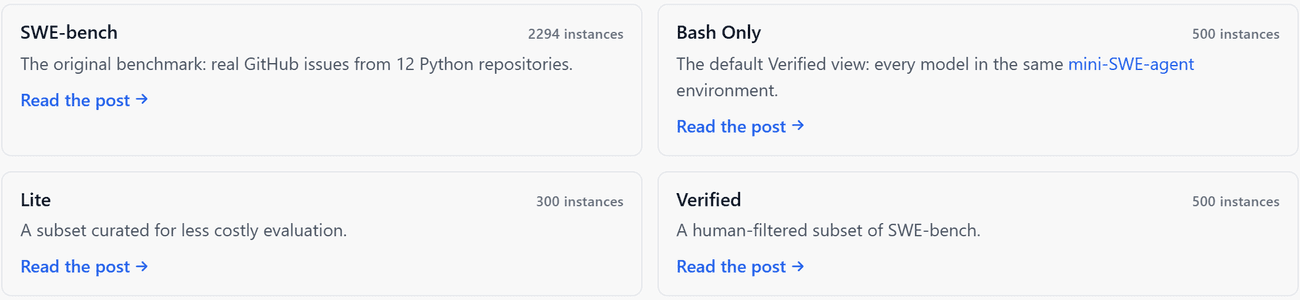 SWE-bench page showing the Verified dataset size and shared agent environment
Source evidence: the real benchmark page, captured September 21, 2026. Dataset and execution conditions belong beside any performance claim.
Benchmark results describe a particular setup. Your language, business rules, permissions, and review standards may differ. Make the final decision on work you can inspect.
Best AI API for Coding: Run Three Practical Checks
These three reproducible evaluation examples expose different failure modes. Fix their acceptance rules before requesting output. Judge the function or page against its contract, regardless of explanation quality.
For DeepSeek V4 Pro, Qwen3.5 122B A10B, and Kimi K3, the intended protocol is three independent runs per task. That means 27 initial attempts. Allow at most one feedback repair per attempt, preserve the first answer, and report initial and repaired outcomes separately.
Request temperature zero only where supported, recording the actual accepted setting. Use a requested output ceiling of 4,096 tokens for A and B and 8,192 for C after checking endpoint limits. Defaults and unsupported controls must be recorded. Low temperature does not guarantee identical answers.
Evidence status: test-environment access was blocked by a Cloudflare Access login screen. The 27 candidate attempts could not be executed. The following evidence shows locally executed original code and an article-authored CSV reference fixture, not candidate-model results. Model pass rates, token usage, and task costs remain unmeasured.
Task A: fix numeric price selection. Paste this exact prompt into a fresh session:
plaintext1Fix this JavaScript function without mutating the input array. 2Accept only finite numbers and non-empty strings that convert to finite numbers. 3Reject booleans, null, undefined, empty strings, NaN, and Infinity. 4Return the lowest valid price as a number, or null if none exists. 5Do not add dependencies. 6Return only the complete function. 7 8function lowestPrice(prices) { 9 return prices.sort()[0] ?? null; 10}
The fixed acceptance inputs are [2,10,3], ["12","3"], an empty array, invalid-only values, zero, negative numbers, and whitespace-only strings. Reject blank strings after trimming. Check that the original array has exactly the same elements in the same order after the call.
The original uses JavaScript's default sort and mutates its input. The task therefore checks two distinct obligations: select the correct numeric minimum and avoid changing the caller's data. Test conversion rules explicitly because a short coercion-based solution can accidentally accept booleans or null.
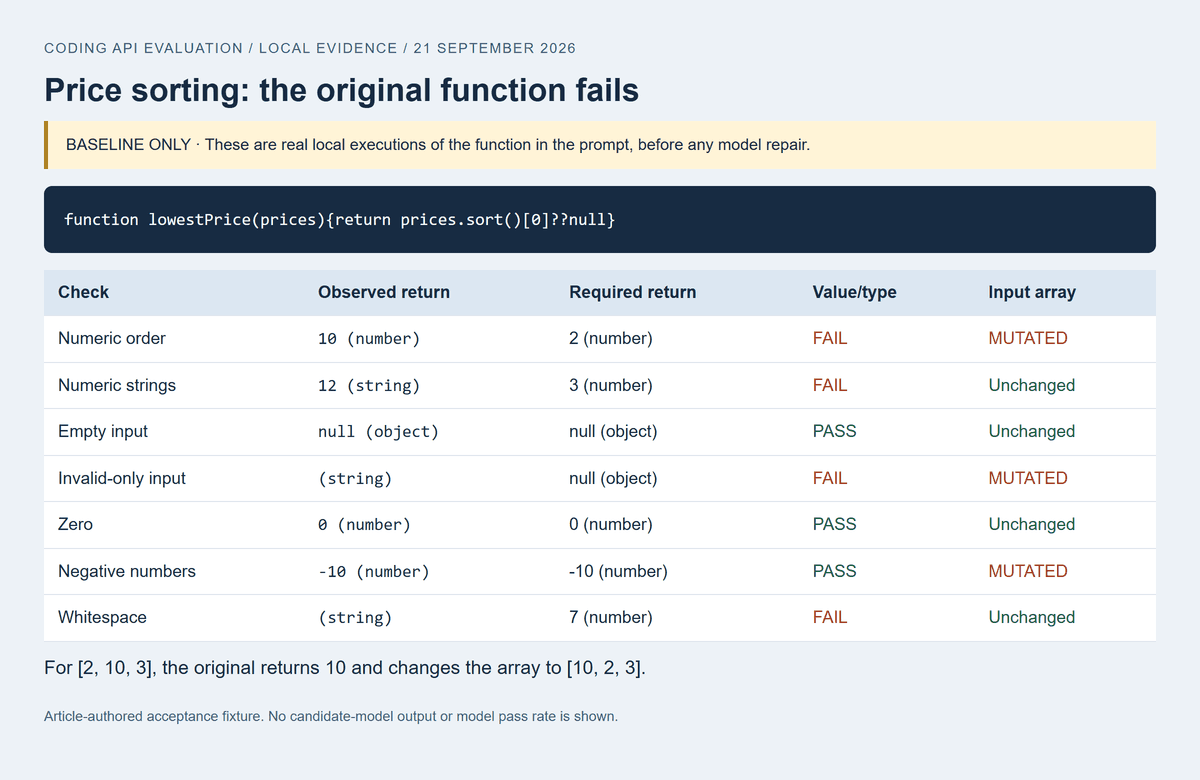 Local execution of the original price function showing incorrect numeric sorting and mutated input
Executed baseline: the original function returns 10 for [2,10,3] and changes the array to [10,2,3]. Numeric strings also fail the return-value contract. No model repair is shown.
Task B: preserve an interface during a small refactor. Use this prompt unchanged:
plaintext1Refactor this Express-style handler by extracting a pure parseUserId(value) function. 2A valid ID is a string containing only digits, representing a positive safe integer. 3Return null for every invalid value. 4Preserve the handler's existing success response and its 400 error response. 5Do not add dependencies or change the URL. 6Return parseUserId and the updated handler only. 7 8app.get('/users/:id', async (req, res) => { 9 const id = Number(req.params.id); 10 if (!Number.isInteger(id) || id <= 0) { 11 return res.status(400).json({ error: 'invalid id' }); 12 } 13 const user = await findUser(id); 14 return res.json({ user }); 15});
Accept "12" and "0012" as 12. Reject "1e2", "1.0", negatives, zero, whitespace, non-string inputs, and values beyond JavaScript's safe-integer range. Verify the registered path and both response bodies. Invalid input must not reach findUser.
This task tests whether the model understands the difference between numeric conversion and the specified string grammar. Inspect the diff for unrelated changes, then call the handler with stubbed request and response objects. A correct helper paired with an unchanged, permissive handler still fails.
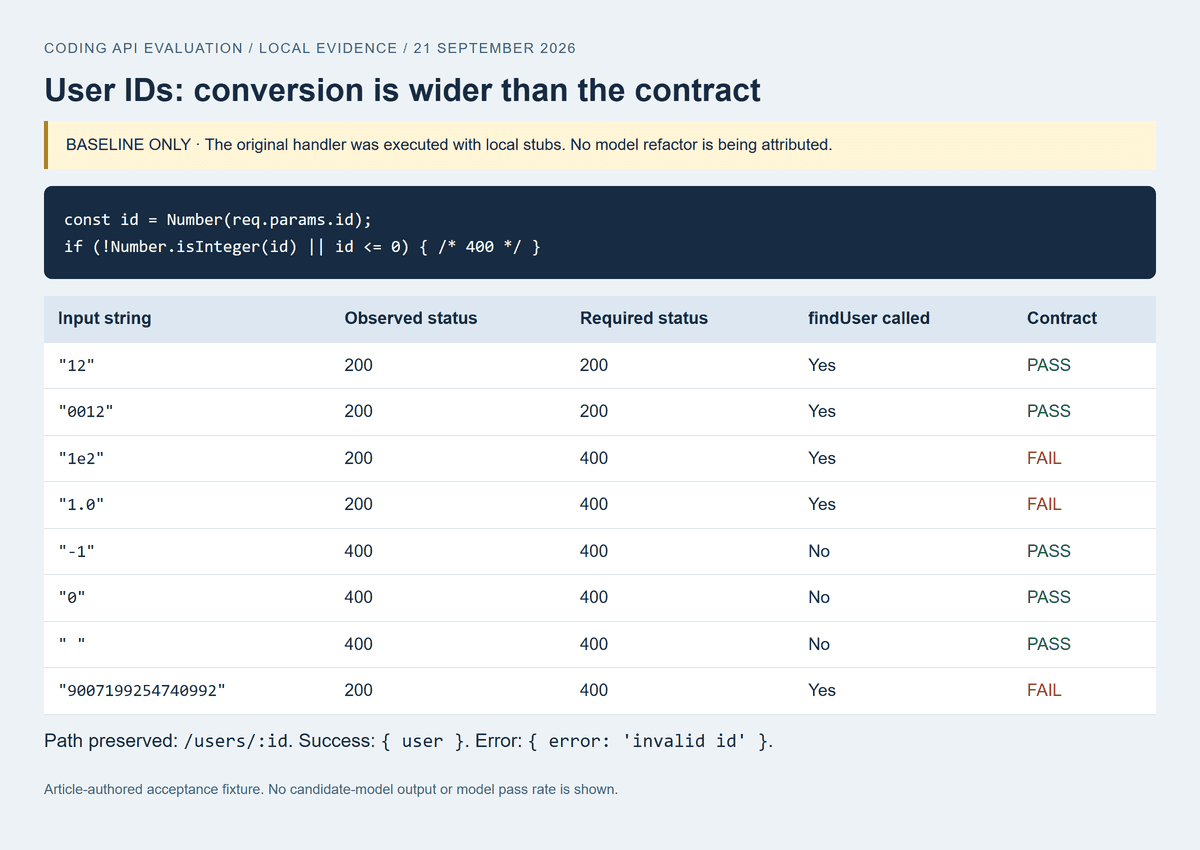 Original handler test log showing invalid numeric strings accepted with status 200
Executed baseline: the original handler returns 200 for "1e2", "1.0", and "9007199254740992", despite the required 400 response. Local stubs recorded the calls; this is not a model-generated refactor.
Task C: build a CSV preview that you can operate. Submit:
plaintext1Create one self-contained HTML file for a local CSV preview tool. 2Use plain HTML, CSS, and JavaScript with no external libraries or network requests. 3Include a labeled textarea, a Preview button, an error message area, and a semantic table. 4Support quoted fields, commas inside quoted fields, escaped double quotes, 5and both LF and CRLF line endings. 6Treat the first record as the header. 7Report inconsistent field counts without silently dropping data. 8Insert cell values as text, never as HTML. 9Return only the complete HTML file.
Test with these exact records, first using LF and then CRLF:
plaintext1name,notes 2Alice,"Hello, world" 3Bob,"He said ""yes""" 4Eve,<img src=x onerror=alert(1)>
Expect two columns, three data rows, Alice's comma inside one cell, and Bob's escaped quote displayed correctly. Eve's value must appear as literal text, with no image element, event execution, or network request. Add a row with three fields and confirm the page reports the mismatch visibly.
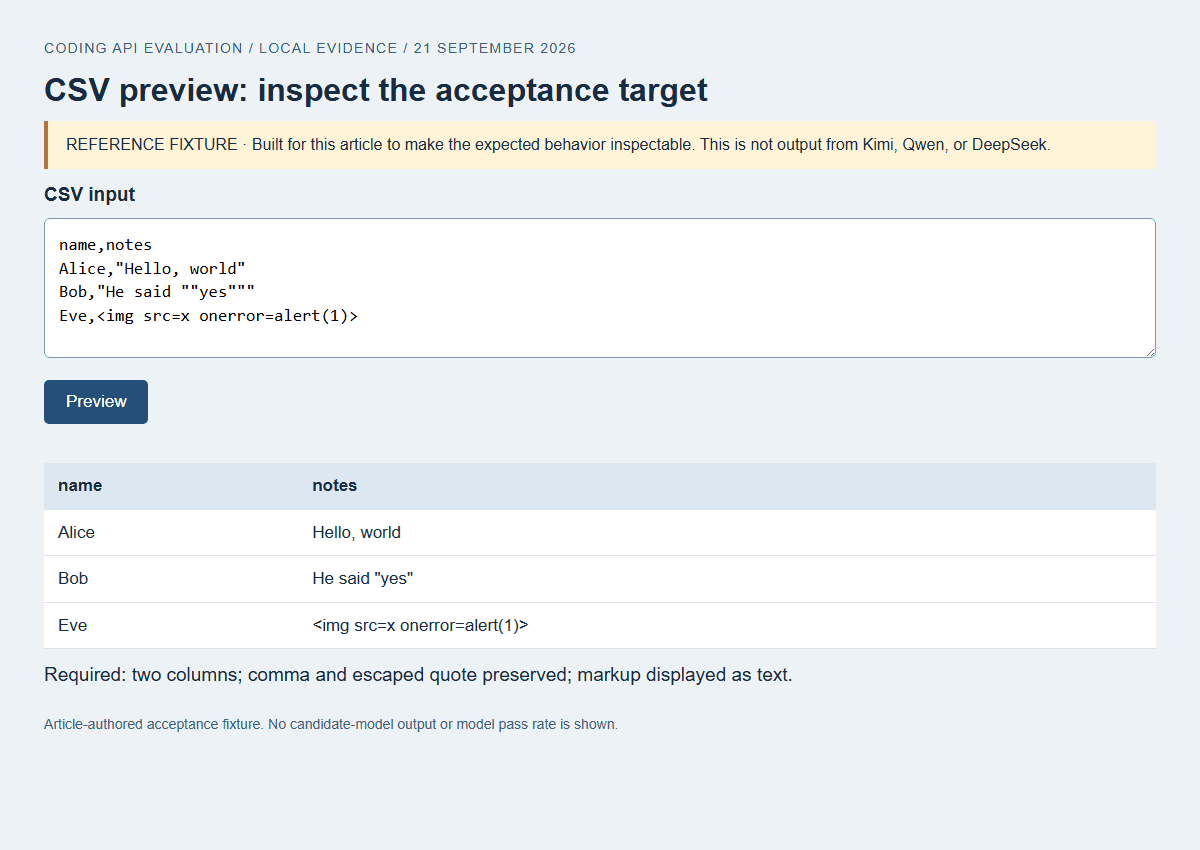 CSV acceptance fixture showing quoted values and literal markup requirements
Operated reference fixture, built for this article, not generated by a candidate model. Browser checks verified LF/CRLF parsing, escaped quotes, literal markup, visible field-count errors, and no HTTP requests. The screenshot shows the valid-input state after clicking Preview.
Save raw output, logs, model ID, date, parameters, timing, repairs, and manual edits. Send failed assertions for a repair without changing expected outcomes. Retain refusals, truncations, and errors alongside successes.
Best AI API for Coding on a Budget
Compare token rates alongside completion quality and usage. Repeated inputs can dominate code-review costs; whole-file generation can increase output charges. Repeated repairs add both.
The Atlas catalog and exact detail pages showed these USD-per-million-token rates on September 21, 2026:
- DeepSeek V4 Pro: $1.68 input and $3.38 output. The separate V4 Pro 0813 listing uses different rates; do not substitute it.
- Qwen3.5 122B A10B: $0.30 input and $2.40 output. The catalog displayed regular rates of $0.40 and $3.20 with a 25% discount, as of September 2026.
- Kimi K3: $3.00 input and $15.00 output.
These are displayed production rates, not invoices from the article's evaluation. Cache-specific rates and their applicability were not confirmed. Promotional discounts for DeepSeek and Kimi were not confirmed. A missing discount observation does not prove that no offer exists.
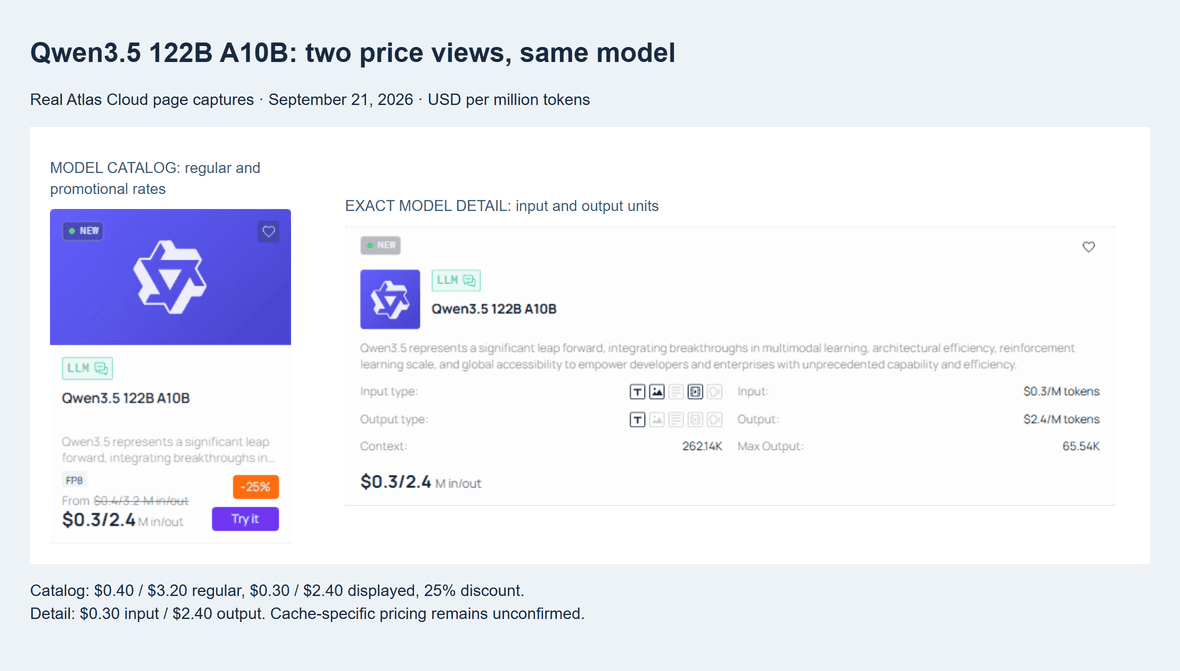 Qwen3.5 122B A10B catalog discount beside its exact model detail input and output rates
Qwen pricing cross-check, September 21, 2026: the catalog shows the 25% promotion; the exact model detail confirms $0.30 input and $2.40 output per million tokens. Cache-specific rates remain unconfirmed.
Calculate the model portion of a task as:
plaintext1Task model cost = sum of each request's applicable billing categories 2 3Ordinary input cost = uncached input tokens / 1,000,000 × input rate 4Output cost = billable output tokens / 1,000,000 × output rate 5Add separately priced cache reads, cache writes, or other applicable items. 6 7Model cost per accepted task = all evaluation request charges / accepted tasks
Do not charge cached tokens again as ordinary input if the billing record treats them separately. Check whether reasoning usage is included in billable output. If no task passes, report “no successful result”; dividing by zero or displaying a zero completion cost would mislead the reader.
For a transparent arithmetic example, assume 10,000 ordinary input tokens and 2,000 output tokens at the displayed Qwen rates. The estimated model charge is $0.0078, before any other applicable items. This is a hypothetical request, not observed token usage or an actual bill.
One equally sized repair would bring the estimate to $0.0156. Actual repairs include different context and output, so calculate each request from its recorded usage.
| Task | Model | First pass | After repair | Token usage | Cost source | Total charge | Total time | Manual changes |
|---|---|---|---|---|---|---|---|---|
| A, B, C; 3 repeats each planned | DeepSeek V4 Pro | Not measured | Not measured | Not recorded | No usage record | Unknown | Not measured | None evaluated |
| A, B, C; 3 repeats each planned | Qwen3.5 122B A10B | Not measured | Not measured | Not recorded | No usage record | Unknown | Not measured | None evaluated |
| A, B, C; 3 repeats each planned | Kimi K3 | Not measured | Not measured | Not recorded | No usage record | Unknown | Not measured | None evaluated |
For your own worksheet, expand each row into one row per model and repetition. Count a repaired success once in the accepted-task denominator. Include unsuccessful attempts in the numerator, and retain separate first-pass and final acceptance columns.
Track human review and infrastructure separately. Untangling an unnecessary rewrite can erase an inference saving. Compare candidates that meet both acceptance requirements and your review-time budget.
Best AI API for Coding with Atlas Cloud
Start with the Kimi K3 model page, confirm the ID, and inspect the API and Code views. Keep the chosen version beside the test record.
Read the LLM protocol documentation before treating two routes as interchangeable. It identifies Chat Completions as the broad-coverage route and directs users to each model's supported_apis. Sampling controls and tool features also depend on the model's advertised support.
There are concrete integration details worth checking here. The documentation says translated Anthropic requests do not apply cache_control, and provider-hosted tools are unavailable on that translated route. Those constraints matter if your existing agent assumes native caching or a hosted browsing tool. Match the client to the actual route.
The following Node.js example illustrates one text request. It uses built-in fetch, an environment variable for credentials, and the verified Kimi model ID. Save Task A's exact prompt as task-a.txt. Set the base URL environment variable to the Atlas API base shown in its documentation, ending in /v1.
javascript1// Node.js 20+. Configuration example; not an executed benchmark. 2import { readFile } from 'node:fs/promises'; 3 4const key = process.env.ATLASCLOUD_API_KEY; 5const base = process.env.ATLASCLOUD_BASE_URL; 6if (!key || !base) throw new Error('Missing Atlas configuration'); 7const endpoint = new URL('/v1/chat/completions', base); 8 9const prompt = await readFile('task-a.txt', 'utf8'); 10try { 11 const response = await fetch(endpoint, { 12 method: 'POST', 13 headers: { 14 Authorization: `Bearer ${key}`, 15 'Content-Type': 'application/json' 16 }, 17 body: JSON.stringify({ 18 model: 'moonshotai/kimi-k3', 19 messages: [{ role: 'user', content: prompt }], 20 max_tokens: 4096, 21 stream: false 22 }), 23 signal: AbortSignal.timeout(120000) 24 }); 25 if (!response.ok) throw new Error(`HTTP ${response.status}`); 26 const result = await response.json(); 27 const choice = result.choices?.[0]; 28 if (choice?.finish_reason !== 'stop' || 29 typeof choice.message?.content !== 'string' || 30 !choice.message.content.trim()) { 31 throw new Error('Incomplete or unsupported text response'); 32 } 33 console.log(choice.message.content); 34 console.error(JSON.stringify({ usage: result.usage ?? null })); 35} catch (error) { 36 console.error(error instanceof Error ? error.message : 'Request failed'); 37 process.exitCode = 1; 38}
messages carries the task; model selects the deployment; max_tokens requests an output ceiling. The response reader checks for ordinary completed text before returning code. The timeout bounds this example's wait; it does not establish that the server stopped processing or that no charge occurred.
Temperature is omitted because per-model support and committed behavior need verification. The example does not retry automatically. Review the failure class before adding a bounded retry policy, and never log the authorization header. This publication code was not executed with an API key during article production.
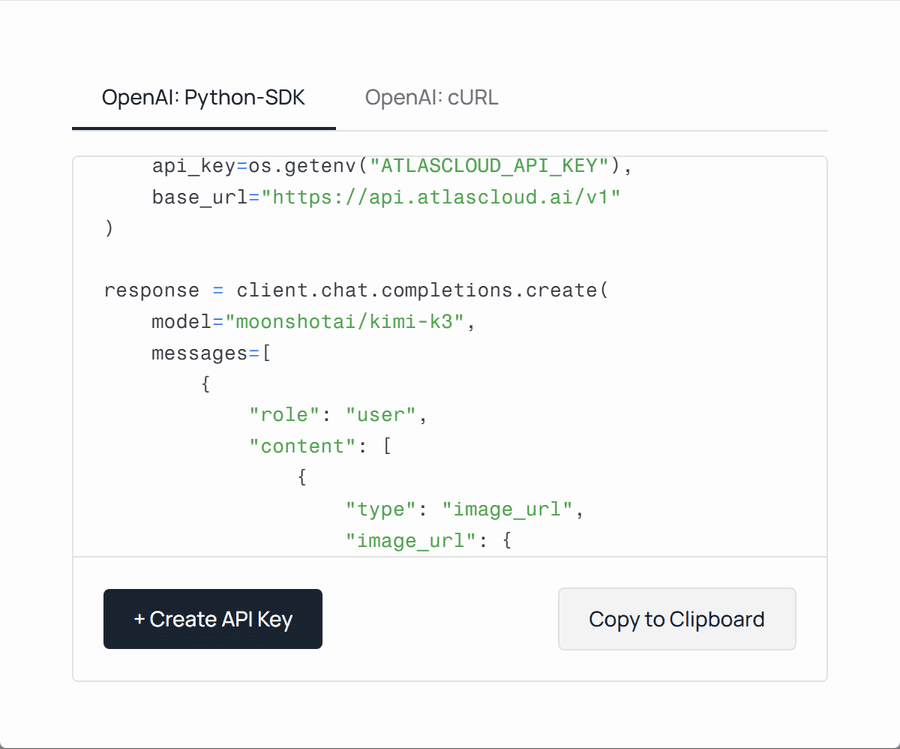 Public Kimi K3 API code example showing the Atlas endpoint and model identifier
Public Kimi K3 Code dialog, captured September 21, 2026. This is configuration evidence, not a completed coding run. The page's sample includes media input; the article example uses text only.
Run Task A's acceptance checks on any returnd function. Before switching to DeepSeek or Qwen, verify its protocol and parameters. Keep prompts and tests unchanged while comparing output and usage; a shared request shape does not establish identical behavior.
Before You Use a Coding API in Production
Run generated code in a disposable branch or isolated workspace first. For the CSV task, use a local browser context with network requests blocked and no access to sensitive application state. For repository tasks, give the process only the files and commands needed for the evaluation.
Define success outside the model's response. An agent saying “all tests passed” should lead you to an actual test log, exit code, and checked revision. Store the diff with that evidence. Otherwise, a later repair can change the files after the apparent success and leave the report stale.
Treat timeouts and retries as application behavior you own. Set a request deadline and a total task budget. Separate errors caused by credentials or invalid parameters from transient transport failures. Repeating an invalid request wastes time; repeating a request that triggers side effects can create duplicate work.
When the agent can call tools, distinguish read-only inspection from writes. Assign operation identifiers where your tool design supports them, and confirm state before repeating an uncertain write. A model endpoint's retry policy cannot guarantee idempotency for the tools your application executes afterward.
Protect logs as deliberately as source files. Record model IDs, timestamps, status, timing, and usage without routinely copying secrets or entire private repositories into telemetry. Keep any required raw-output evidence in an appropriately restricted location, and establish how long the team needs to retain it.
Check streaming with your real client. It must handle partial events, termination, errors, and usage records where available. Confirm rate limits for the actual account and deployment. A quiet single-user experiment cannot establish how the same route behaves when a team submits requests at once.
Use this short release checklist:
- Acceptance tests and existing regressions pass on the final revision.
- The diff stays within the approved task boundary.
- Timeout, cancellation, and retry behavior have been exercised.
- Tool calls and structured responses work on the selected endpoint.
- Logs exclude credentials and unnecessary private code.
- Data-handling terms meet the team's requirements.
- A fallback has its own verified configuration and test record.
Private repositories require a service-specific decision. Review current retention, training-use, access, and contractual conditions with the person responsible for the code. Send only approved material. Do not infer confidentiality from model weights being available, or from a protocol resembling one you already use.
Best AI API for Coding: Make Your Final Pick
Make the decision in three passes.
First, eliminate candidates that miss a required capability. Write down the conditions that must hold: an accepted output format, a functioning tool loop, an appropriate data-handling arrangement, or a workable response deadline. A candidate that misses one needs a separate remediation decision before it belongs in the final comparison.
Second, compare accepted-task cost and elapsed time. Use all attempts under the same repair policy. Separate first-pass successes from repaired successes, and show missing usage records. If two models both meet the contract, compare their review burden as well as model charges. Your developers will live with the resulting patches.
Third, keep one fallback and define its trigger. Examples include a sustained endpoint outage, repeated structured-output failures, or task costs exceeding a chosen ceiling. Test the alternate configuration in advance. Switching a model ID under pressure can introduce a second integration problem if its controls or response behavior differ.
The three small tasks in this guide are a screening exercise. Expand the suite with representative work from your own codebase before relying on a candidate for broad changes. Keep a few tasks outside prompt tuning so you can check whether improvements transfer beyond the examples you optimized.
The best ai api for coding is the combination you can explain: it completes the required work, exposes costs you can track, and fits the way your application runs. No universal winner is necessary to make that decision.
Open the current model catalog, choose two candidates, and save their exact IDs and settings. Then use the same task, the same tests, and the same stopping rule for both.
Frequently Asked Questions
What is the best AI API for coding on a small budget?
Start with a candidate whose displayed rates fit your likely input and output volumes, then compare cost per accepted task. The Qwen, DeepSeek, and Kimi rows provide concrete versions to investigate, without asserting a tested value winner. Limit repair attempts, reuse relevant context deliberately, and track failed requests. Include review time separately so a low inference bill does not hide a large cleanup burden.
Is a coding subscription cheaper than paying for API tokens?
It depends on your workload and what the plan includes. A subscription may suit interactive use inside its supported application, while usage billing may fit a custom service with variable traffic. Check model access, caps, concurrency, and whether external API calls are included at all. Compare the same amount of useful work over a representative period; a monthly sticker price and a token rate measure different things.
What is the difference between a coding model and a coding agent?
The model generates responses. The agent manages the loop around those responses, including file access, tool execution, tests, and stopping rules. You can call a coding model through an API without building an agent, for example to suggest a function for human review. If you want autonomous edits, evaluate the model together with the agent and permissions it will actually use.
Which AI API should I use for debugging and refactoring?
Shortlist candidates that fit your endpoint and code-handling requirements, then use small bugs and constrained refactors from your work. Task A checks correctness and input mutation; Task B checks parsing and interface preservation. Follow those with representative repository tests.
Prefer the candidate that meets your acceptance conditions with manageable review effort, rather than one that simply produces the longest explanation or most extensive rewrite.
Is there a free AI API for coding?
A trial credit, an application with a free tier, and downloadable model weights are different offers. None automatically gives your application unlimited hosted inference. Verify current eligibility, expiry, quotas, and supported models before budgeting around free access. This article does not assert a currently available free allowance.
If you host weights yourself, account for compute and operation even when downloading the weights costs nothing.
Can I send private repository code to a coding API?
Only send code your organization permits you to share under the specific service's applicable terms. Review retention, training use, access controls, and contractual requirements for the chosen deployment.
Remove credentials and unrelated files, and check what your agent includes automatically in prompts and logs. An open-weight model or familiar API format does not, by itself, establish that a hosted service meets your team's confidentiality requirements.





