

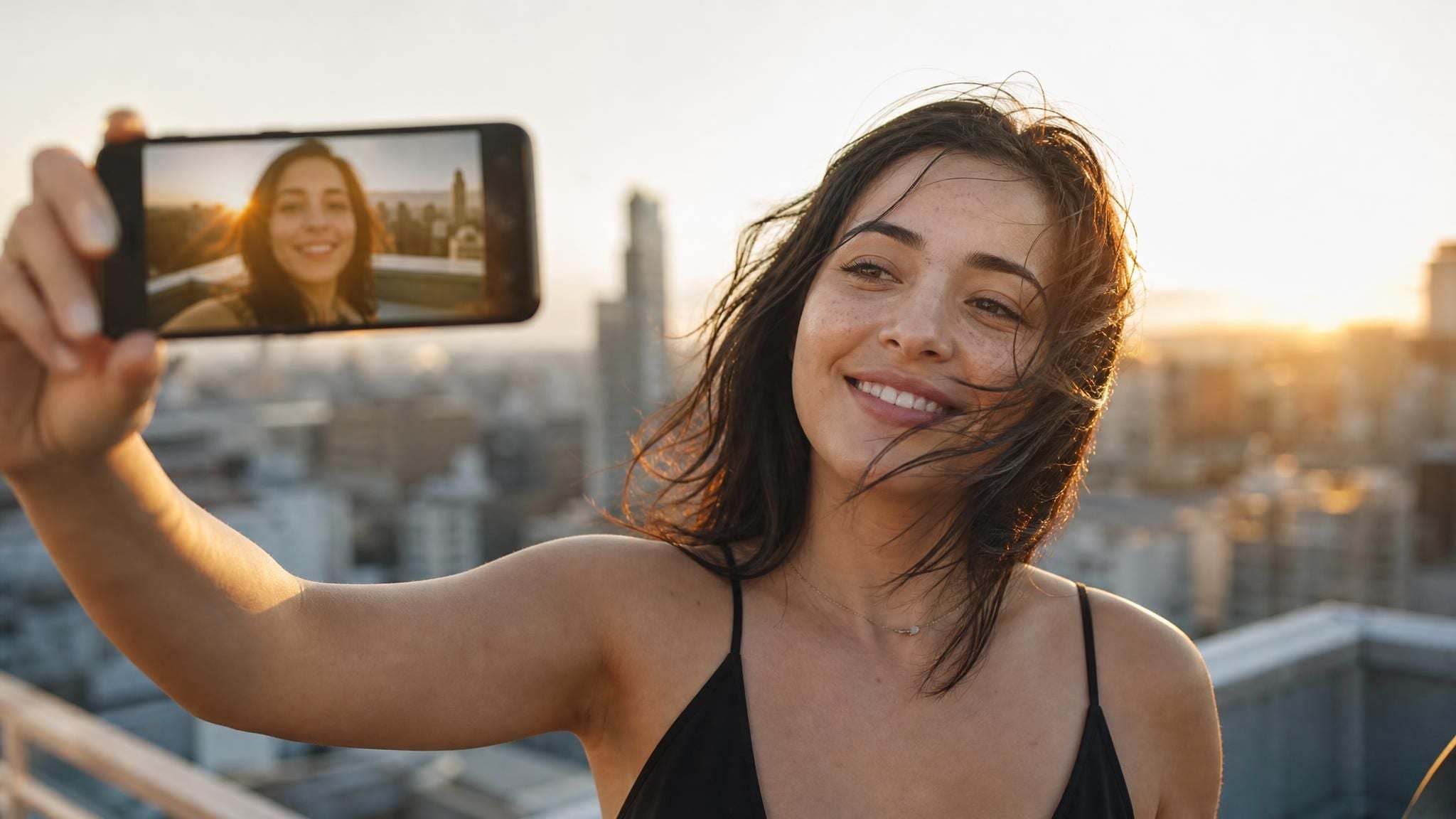
The photo you actually like of yourself was taken by someone else. You are turned three quarters away, mid-laugh, and it would be the perfect profile picture if only it looked like a selfie. That gap is what a best selfie AI generator search is really about: turning one decent photo into the shot you never took, without losing your own face in the process.
We ranked eight tools by what they do to a single portrait, checked every free tier against the vendor's own page, and ran two of them live on September 3, 2026, with and without an account. One tool's "no account needed, no watermarks" promise turned out to be two separate offers: without an account you get one watermarked file a day. Here is what we found, starting with how we judged.
Key Takeaways
- Selfie AI generators fall into three mechanisms: one-photo reframers, multi-photo trained models, and style filters. Pick by what you can upload.
- TheAtlas Cloud free AI selfie generatorrebuilds one portrait as an arm's-length phone selfie and keeps your face, hairstyle and freckles. Your first run is free after sign-in.
- "Free" ranges from watermark-free daily allowances to watermarked or low-resolution previews. Read the export line before you upload, and check the counter after.
- Tinder and Hinge do not ban AI selfies outright. They ban photos that do not look like you, and Tinder's Face Check compares a live video selfie to your profile photos.
- Stylized outputs (anime, Disney, painting) work for feeds and gaming avatars, not for anything that gets verified.
How We Ranked the Best AI Selfie Generators
A selfie generator has one job: produce a photo of you. So the first filter was intent. Text-to-image tools that draw a stranger from a prompt were out.
Headshot tools that swap your background for a grey studio were out too, because that is a different search with a different result (the selfie to headshot breakdown covers what those rewrite).
What remained splits into three mechanisms. One-photo reframers take a single portrait and re-render it from a new angle or in a new scene. Multi-photo trained models ask for 5 to 20 selfies, build a private model of your face, then generate dozens of shots. Style filters keep your pose and swap the medium: anime, watercolor, marble bust. The mechanism decides what you upload, how long you wait, and how much of your face survives.
For each tool we pulled the free tier, sign-in requirement, watermark policy and licence from the vendor's own product or pricing page. Two of the eight advertise runs without an account, so we ran those two live on September 3, 2026, anonymously and then with a free account, using portraits nobody on the team appears in. The Atlas Cloud run is our own, on a portrait supplied by the team.
| Tool | Input mechanism | Output style | Best for |
|---|---|---|---|
| Atlas Cloud | One photo, optional scene line | Photorealistic phone selfie | A realistic selfie that is still you |
| PixelPanda | One photo, 14 scene presets | Photorealistic scene swap | Dating and lifestyle scenes |
| Magic Hour | One photo, preset picker | Stylized (anime, marble, cartoon) | Free avatars with no account |
| VAKPixel | One photo, four preset groups plus a note | Photorealistic mood and lighting selfies | Picking the vibe of a selfie in four clicks |
| Fotor | One photo, art styles | Anime, Disney, oil painting | Art-style profile pictures |
| LightX | One photo, presets or text prompt | Stylized and photoreal presets | Browsing a huge preset library |
| Remini AI Photos | 8 to 12 selfies, trained | Photorealistic portrait sets | Batches of studio-style photos from a phone |
| PhotoAI | 5 to 20 photos, trained | Photorealistic sets | Volume shoots from a trained model |
1. Atlas Cloud: Best Selfie AI Generator for a Realistic Selfie From One Photo
Most tools on this list change the world around you. The Atlas Cloud selfie generator changes the camera.
You upload a photo someone else took, and it comes back as an arm's-length selfie: your pose rebuilt with the tilt and reach of a phone held out in front of you, your face and hair carried straight across. The tool page puts it as "freckles and all". Here is what one run did to a portrait taken by someone else.
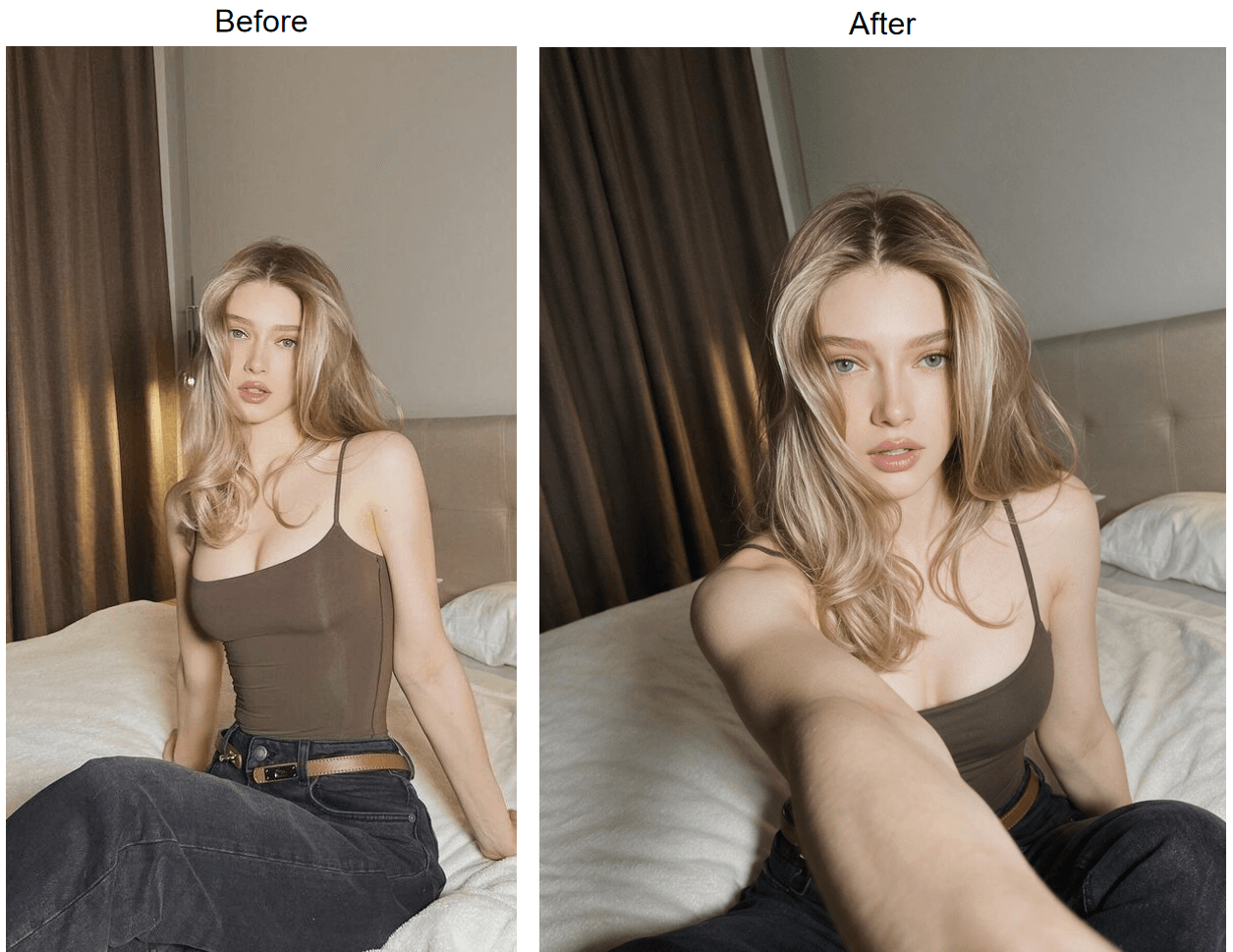
Left: input photo. Right: Atlas Cloud AI selfie generator output, run by the Atlas Cloud editorial team on September 3, 2026.
Look at the pair closely. The reframing is a re-render, not a crop: the arm, the tilt and the framing are new. The face, the hair, the clothing and the background carry over.
Because the whole frame is rebuilt from your one photo, the input still matters. The page's own tips: light your face with daylight or a bright lamp, pick a shot where both eyes and your whole face are visible, and start from a sharp file.
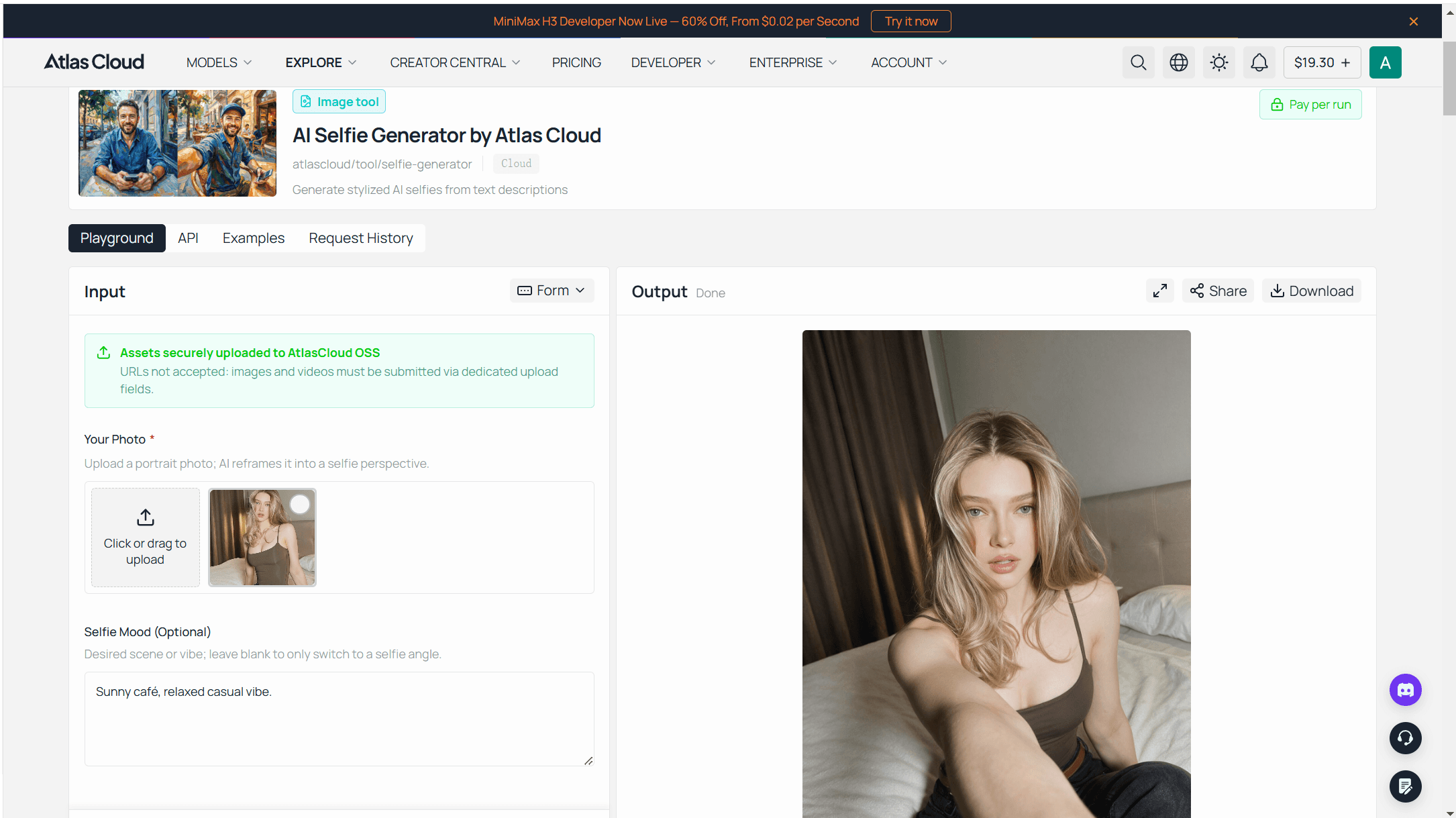
The tool sits in the free AI tools family on Atlas Cloud, listed there among the tools that give each eligible user one free trial. Running it takes three steps on the free AI selfie generator page:
- Sign in with Google, GitHub or email, then drop a portrait of up to 10MB into the uploader.
- Type a few words into the optional mood field, such as golden hour rooftop, or leave it blank. An empty field keeps your original setting and changes only the camera angle.
- Hit Run Free, wait about 30 seconds, and download a 1328 x 1776 portrait. The page's words on the file: "What you saw before downloading is exactly what you keep."
2. PixelPanda: Best AI Selfie Generator for Dating Profile Scenes
PixelPanda's pitch is scene presets, and the list reads like a dating profile checklist: Dating Profile, Coffee Shop, Golden Hour, Beach Vibes, Night Out, Cozy at Home, 14 in all. Under the hood the page names Flux Kontext, an image-to-image model, and promises a 3:4 portrait in 15 to 30 seconds. We fed it the sample portrait published on Atlas Cloud's tool page and picked Dating Profile.
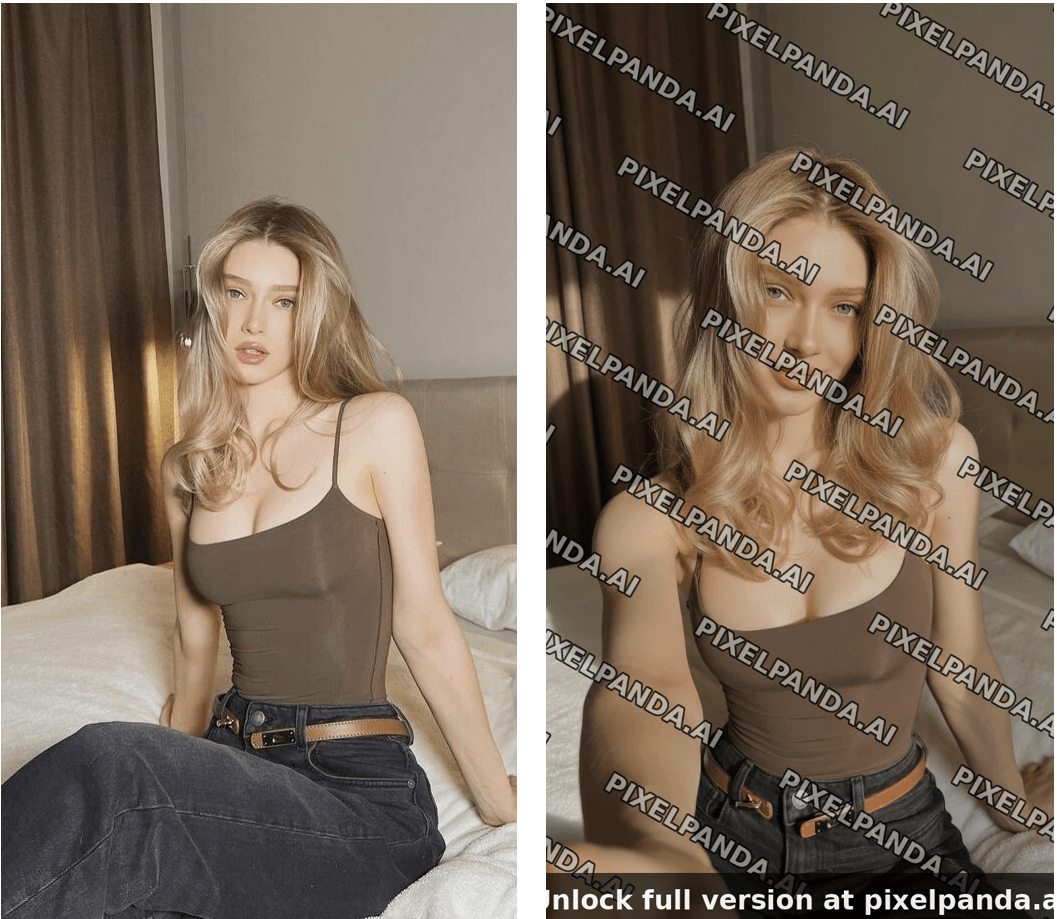
Left: input photo, the sample portrait from Atlas Cloud's tool page. Right: PixelPanda anonymous free output, run by the Atlas Cloud editorial team on September 3, 2026.
The scene work is competent. Warm café bokeh, evening light, a plausible off-shoulder top instead of the black dress. Then the free tier gets in the way. The FAQ reads, verbatim: "Totally free. 3 generations per day, no account needed, no credit card, no watermarks. The images are full resolution and yours to use however you want."
Our anonymous result arrived as a 1248 x 832 PNG covered in a diagonal tiled PIXELPANDA.AI watermark, with a footer bar reading "Unlock full version at pixelpanda.ai". The Download link pointed at a file inside a storage folder named watermarked-results, and the widget beside it said "Sign up free to download without the watermark.
The FAQ's sentence is really two offers stapled together. Without an account, on September 3, 2026, we got one generation a day and it carried the watermark. After a team member created a free account the same day, the counter showed three generations a day and the download came back clean. So the no-account tier is a preview of how you would look in each scene; the three clean files a day exist, behind the sign-up the FAQ says you do not need.
3. Magic Hour: Best Free AI Selfie Generator for Stylized Avatars Without an Account
Magic Hour is the tool to open when you want to try the idea before giving anyone an email address. Its FAQ promises "3 free selfies per day" with "no account needed", and a counter reading "3 images left today" sits above the uploader for anonymous visitors. We checked both claims by using one.
The run went like this. We dropped a 225 x 300 portrait, one of the example photos from Magic Hour's own page, into the uploader. Generation started on its own, with no button press, using the preset the widget had loaded by default: Studio Ghibli. The page promised about 15 seconds. Ours took closer to a minute in the free queue, then the counter dropped to 2.
The output was a 432 x 576 PNG, an anime rendering of the same pose, necklace and hoop earrings against a lantern-lit market. There was no watermark anywhere on the file, which matches the FAQ line: "No watermark on AI selfie generator photos for all users, including free users with no sign up."
| What we checked | Magic Hour free run, September 3, 2026 |
|---|---|
| Sign-in | None asked for |
| Counter | 3 images left today, then 2 |
| Preset | Studio Ghibli, loaded by default, ran on upload |
| Output | 432 x 576 PNG from a 225 x 300 input |
| Watermark | None on the downloaded file |
| Licence on free | "personal projects and non-commercial purposes" |
| Retention | Privacy panel says 1 day, FAQ says deleted within 7 days |
Two things hold it at third place, and both are in the table. The licence line means a free result is for personal use only; commercial rights come with a paid plan.
And the default result is a cartoon. The page lists professional styles alongside anime and marble, but the run starts the moment the upload lands, so switch the preset before you drop the photo or you will spend one of your three on Ghibli. Its own framing is stylized avatars, which is a different product from a selfie that could pass as a photo.
4. VAKPixel: Best AI Selfie Generator for Picking the Vibe
VAKPixel is sorts its presets by feeling rather than place rather than a scene. You upload one photo, click through four preset groups and an optional custom note, and the page states the result is "Powered by Nano Banana AI" using "the latest Gemini-powered models". The four groups on the page:
- Daily Life: Morning coffee vibe, Gym progress selfie, Late night thoughts, Rainy mood, Weekend chill, Travel day
- Mood: Sad, Confident, Romantic, Lonely, Happy
- Style: Cinematic, Soft aesthetic, Dark & moody, Golden hour, Vintage film
- Lighting: Natural light, Warm indoor, Neon glow, Blue hour, Dramatic
The interesting part is on the page itself: VAKPixel prints the instruction block it sends with every run.
It reads like a checklist for this whole article: "Generate a selfie of attached person", "100% character consistency", "No facial distortion. No change in features.", "no third person camera", and a licence to change "the background, environment, props, cloths, accessories, makeup, pose, hairstyle, lighting". That is the one-photo reframer recipe, written down.
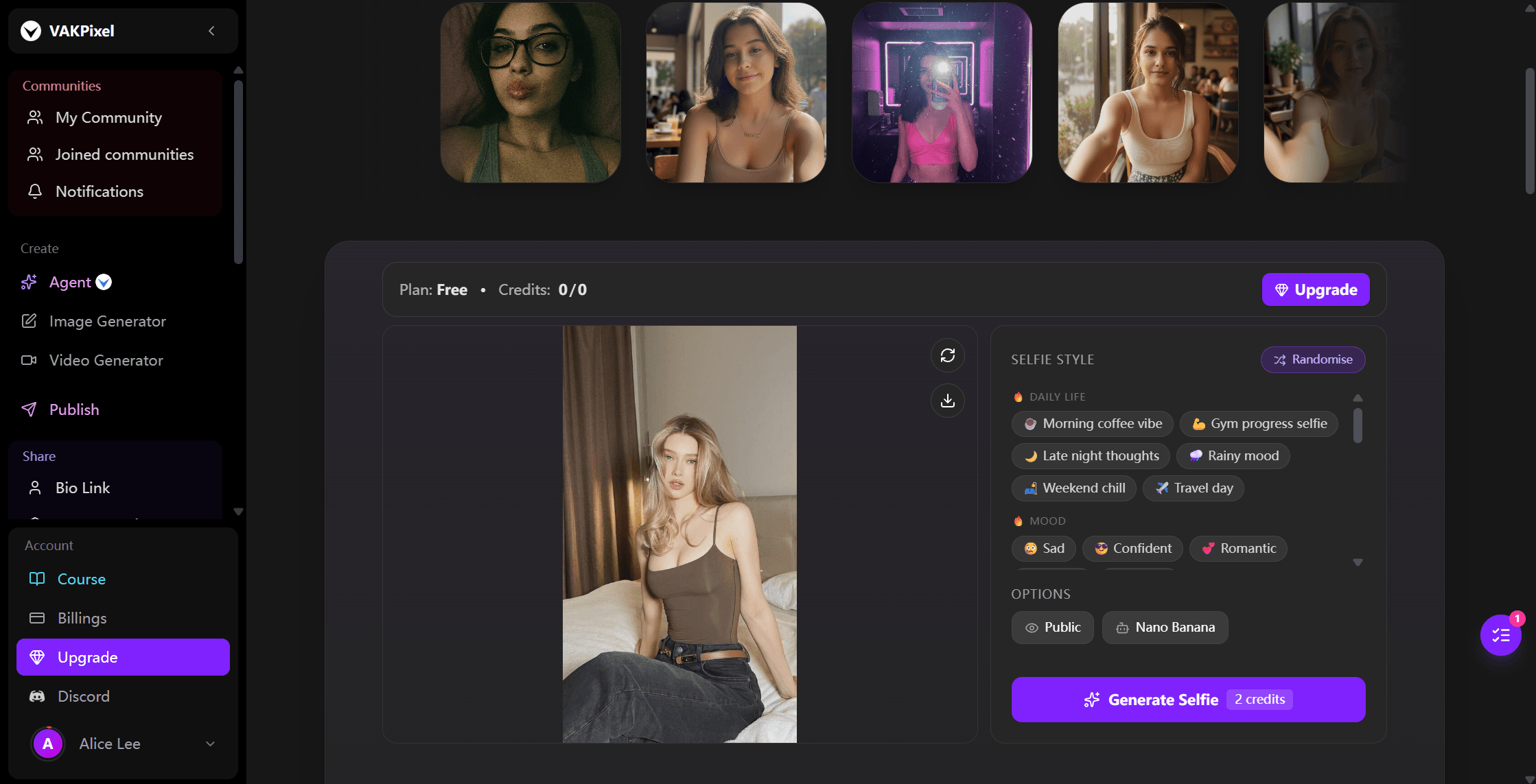
The free tier is real but conditional. The FAQ says you "can start for free by watching ads to earn credits" and that "Each selfie generation costs 2–4 credits depending on the model you choose"; the button on the page read 2 credits when we looked.
You can browse the presets without an account, but "You'll only need to log in when you want to upload a photo or generate a selfie", so a run always needs a sign-in. The sign-up form then asks for more than an email: a required Social Media field reads "Add at least one social media handle so we can verify your presence", with slots for X, Instagram, YouTube, TikTok or a website, and it will not continue until one is filled.
Downloads come as PNG, JPG or WebP. Watermark and output size are not stated on the tool page.
One FAQ line deserves a slow read before you upload: "By default, generated images are public." The Private toggle that keeps a selfie out of the public gallery is listed under the Pro, Ultimate and Creator plans. For a dating-profile selfie, that is the first setting to check, not the mood.
Where VAKPixel fits: you know the feeling you want the selfie to carry and would rather click Rainy mood than write a prompt. Where it does not: you want a free run without handing over an account and a social handle, or you want the result kept private without paying.
Four More AI Selfie Generators Worth Knowing
These four either turn you into artwork, need a stack of photos before they produce anything, or would not let us in on test day. Each has a clear use; none is a one-photo realistic selfie tool we could verify end to end.
| Tool | What the vendor page says about the free step | What paying unlocks | Fits |
|---|---|---|---|
| Fotor | "Limited Free credits" with "Watermarked JPG, PNG & PDF Exports" | "HD & Transparent PNG, Watermark-Free" exports, 1200 to 12000 credits a year by tier | Anime, Disney, game art or oil-painting versions of you |
| LightX | "5 daily free AI credits", "Generate up to 5 images daily"; watermark on free not stated | Pro: "No watermark on projects", 1000 AI credits a month | Browsing "1000+ Stylish Presets" plus a text prompt |
| Remini AI Photos | "Choose 8-12 images to teach the AI what you look like", a few minutes to train | Weekly and monthly in-app purchases; no price on the web page | A batch of studio-style portraits from a phone |
| PhotoAI | Trains "in about a minute" from 5 to 15 photos, 20 recommended; refunds only before a model is created | Paid plans with photo allowances per model; prices on its pricing page | Volume shoots from one trained model |
Fotor is the art-style entry. Its page asks you to "upload your portraits or selfies" and renders them as "anime, Disney character, game art, illustration, and oil painting"; its pricing table keeps watermark-free exports for paid plans. It is try-before-you-buy for an illustrated profile picture, and nothing it makes will read as a photo to a dating app.
LightX publishes the most generous daily count on this list and pairs its presets with a free text field, which is why it was in our top four on paper. On September 3, 2026, neither login nor upload went through for us after repeated attempts, so we could not see what a free export looks like and moved it here.
Remini and PhotoAI are the trained-model pair. Remini's page promises "dozens of stunning photos of yourself in different poses and angles" once you feed it 8 to 12 images; PhotoAI wants 5 to 15, recommends 20, and refunds only before a model exists. Both suit someone replacing a whole grid at once, and both overshoot someone who wants one selfie of tonight.
Best Free AI Selfie Generators: The Fine Print Behind Every Free Tier
The sections above answer whether each tool can make a selfie. This one answers whether the free selfie is usable. Five questions decide it, and the matrix below scores six tools on all five. Remini and PhotoAI sit out because neither publishes a free tier for photo generation.
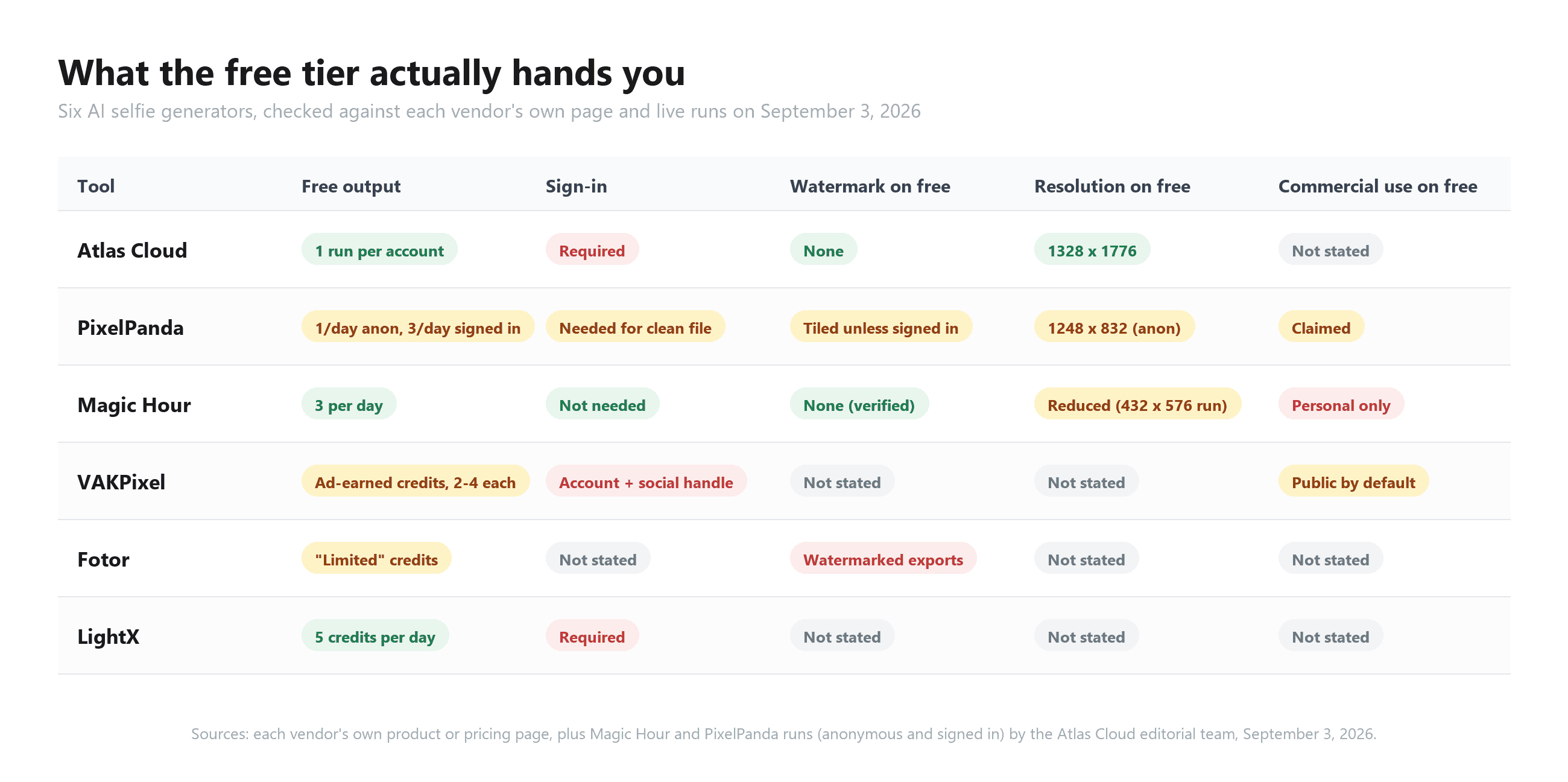
How to read it. A published count is a claim until the counter agrees. Of the four tools that print a daily or per-account number, Magic Hour's matched what we saw live with no account, and PixelPanda's three a day only appeared after a free sign-up. A "no watermark" line is a claim until the download link agrees; Magic Hour's held for anonymous users, PixelPanda's held only for signed-in ones.
Resolution and licence are where the grey cells pile up. Two vendors publish an output size for the free tier and the rest say nothing. Two vendors address the licence on free outputs, in opposite directions: Magic Hour restricts it to personal use, and PixelPanda grants full rights in one FAQ answer, then stamps the anonymous file in the next screen. The other four say nothing. VAKPixel adds a column of its own: free outputs land in a public gallery by default, and the Private toggle is a paid feature.
Retention is the quietest column. Magic Hour publishes two different numbers on one page. Atlas Cloud says results are filed in your request history. The others do not address it. If a free selfie is going anywhere public, the tools with the fewest grey cells are the safe picks, whatever their counters say.
Will a Selfie AI Generator Pass Tinder Face Check?
The reason most people want a realistic selfie is a dating profile, so the last question is whether the apps will accept one. Neither Tinder's nor Hinge's written rules ban AI-made photos outright. Both ban not looking like you, and Tinder now checks that with a camera.
Tinder's Community Guidelines put it plainly under a rule titled "Just be you": "Don't create a fake account or pretend to be someone you're not, even if it's just for fun." Enforcement moved from words to cameras in 2025.
Tinder's October 22 announcement states that "Face Check is now required for all new users in seven countries and the state of California". New members "complete Face Check by taking a short video selfie within the app" so the system can confirm "that their face matches the one shown in their profile photos."
Tinder's own Face Check FAQ describes the mechanism: your facial geometry becomes a "FaceMap", and the check asks "whether the person in your video selfie appears to be the same person as in your profile photos."
Hinge's Prohibited Content page lists two relevant lines: users may not "Misrepresent themselves by posting someone else's photo or likeness" and may not "Use fake identities or AI-generated content to mislead others." The operative words are mislead and likeness.
Hinge's AI dating guide, published March 5, 2026, goes further than the rules: "But skip the AI-generated profile photos. 88% of Hinge daters are uncomfortable with them." The figure comes from Hinge's Gen Z D.A.T.E. report; the guide does not publish the sample or method.
| Platform | Written rule | How it is enforced | Source date |
|---|---|---|---|
| Tinder | "Don't create a fake account or pretend to be someone you're not" | Face Check: live video selfie matched against profile photos, required for new users in seven countries and California | October 22, 2025 |
| Hinge | No "AI-generated content to mislead others"; no posting "someone else's photo or likeness" | In-app reports; official guidance to skip AI profile photos | March 5, 2026 |
Map that onto the three mechanisms. A one-photo reframer that keeps your face produces a photo of you at a new angle, which is the lowest-risk case under both rulebooks. A style filter produces an obvious cartoon, which no verification will match and no dater will mistake for a photo; use it on Discord, not on a verified profile.
A trained model is the middle case: a good one produces you, a flattering one produces a version of you that a video selfie will not match. Whatever you generate, put at least one unedited photo in the same profile and let the AI shot be the extra angle.
Frequently Asked Questions
What is the best selfie AI generator in 2026?
For a realistic selfie from one photo, Atlas Cloud's free AI selfie generator, because it rebuilds the camera angle while carrying your face and hair across, outputs at 1328 x 1776, and stamps nothing on the download. For scene presets aimed at dating profiles, PixelPanda, with the caveat that the no-account file is watermarked and the clean three-a-day tier needs a free sign-up. For a free stylized avatar with no account at all, Magic Hour.
Is there a best free AI selfie generator with no watermark?
Two tested clean on September 3, 2026: Magic Hour's free download had no watermark, and Atlas Cloud's tool page states the free file has nothing stamped on it. PixelPanda's page says no account and no watermarks, but its no-account result arrived tiled with the brand name and a sign-up prompt; a free account gets three clean generations a day. Fotor's pricing table lists watermarked exports on the free plan.
How many photos does an AI selfie generator need?
It depends on the mechanism. One-photo reframers and style filters (Atlas Cloud, PixelPanda, Magic Hour, VAKPixel, Fotor, LightX) need a single portrait; Atlas Cloud's guidance is a well-lit shot with your full face showing. Trained models need a set: Remini asks for 8 to 12 images, PhotoAI for 5 to 15 with 20 recommended.
If you want a professional headshot rather than a selfie, the free headshot generators ranking covers that separate category.
Can I use an AI selfie generator photo on Tinder or Hinge?
Yes, as long as it looks like you. Tinder requires new users in several regions to pass Face Check, a video selfie matched against profile photos. Hinge prohibits AI content used to mislead and advises daters to skip AI profile photos altogether. A one-photo reframe of your own face is the safest kind; a stylized or heavily beautified image is the kind that fails a match.
How much does an AI selfie cost after the free run?
Atlas Cloud shows the metered price of a run beside the Run button in its playground before you commit, so you see the figure before spending anything past the free generation. PixelPanda's page lists paid credits from $7.99 a week for 280 credits at one credit per generation.
VAKPixel's plans start at $19 a month for 500 credits, with each selfie costing 2 to 4 credits, and free credits come from watching ads. Remini's App Store listing shows in-app purchases from $4.99 to $9.99 a week and $9.99 a month, with no price on its web page. Magic Hour, Fotor and LightX sell paid tiers whose per-selfie cost is not published on their tool pages.
Conclusion
Eight tools, three mechanisms, one question that settles the ranking: after the generation, is the person in the frame still you? One-photo reframers answer it best when the goal is a realistic selfie, style filters answer it honestly by not pretending to be photos, and trained models only when you feed them enough good photos. The free tiers separate on paperwork rather than pixels, and a vendor's promise is worth exactly what its download link delivers.
Start with the photo you already like and one tool that changes the camera instead of your face. If the result reads as you at arm's length, you have found your best selfie AI generator, and the dating-app rules, the resolution question and the watermark question all answer themselves.





