An important client email arrives while you are in a meeting. By the time you open your inbox, the message has slipped beneath routine updates, a calendar change, and three threads that only need a polite reply. Claude Duet AI assistant is Anthropic's attempt to handle that gap: it checks connected apps, brings the consequential items to you, prepares work, and asks before taking sensitive actions. Announced on October 21, 2026, Duet is a research preview rather than a generally available digital chief of staff. The useful question is how much of your daily coordination it can carry without taking decisions away from you.
Key takeaways
- Claude Duet can brief you on connected email and calendar activity, draft replies, and continue assigned work while you are away.
- It asks for approval before sending messages, making payments, signing documents, or deleting things.
- Background checks use the same plan limits as Claude, so a useful setup depends on what Duet watches and how often.
- Access currently requires a US Claude Pro or Max account and an invitation from the waitlist.
What makes Claude Duet different from an ordinary chat?
In a conventional AI chat, you notice a problem, collect context, open a conversation, and ask for help. Duet changes the starting point. It can inspect connected apps, send a morning brief, and message you when it believes something needs attention. You can also send it a task by text or voice in one continuing thread. Anthropic says it carries over the memory, skills, and connected apps already associated with your Claude account. (Claude Duet product page, October 2026)
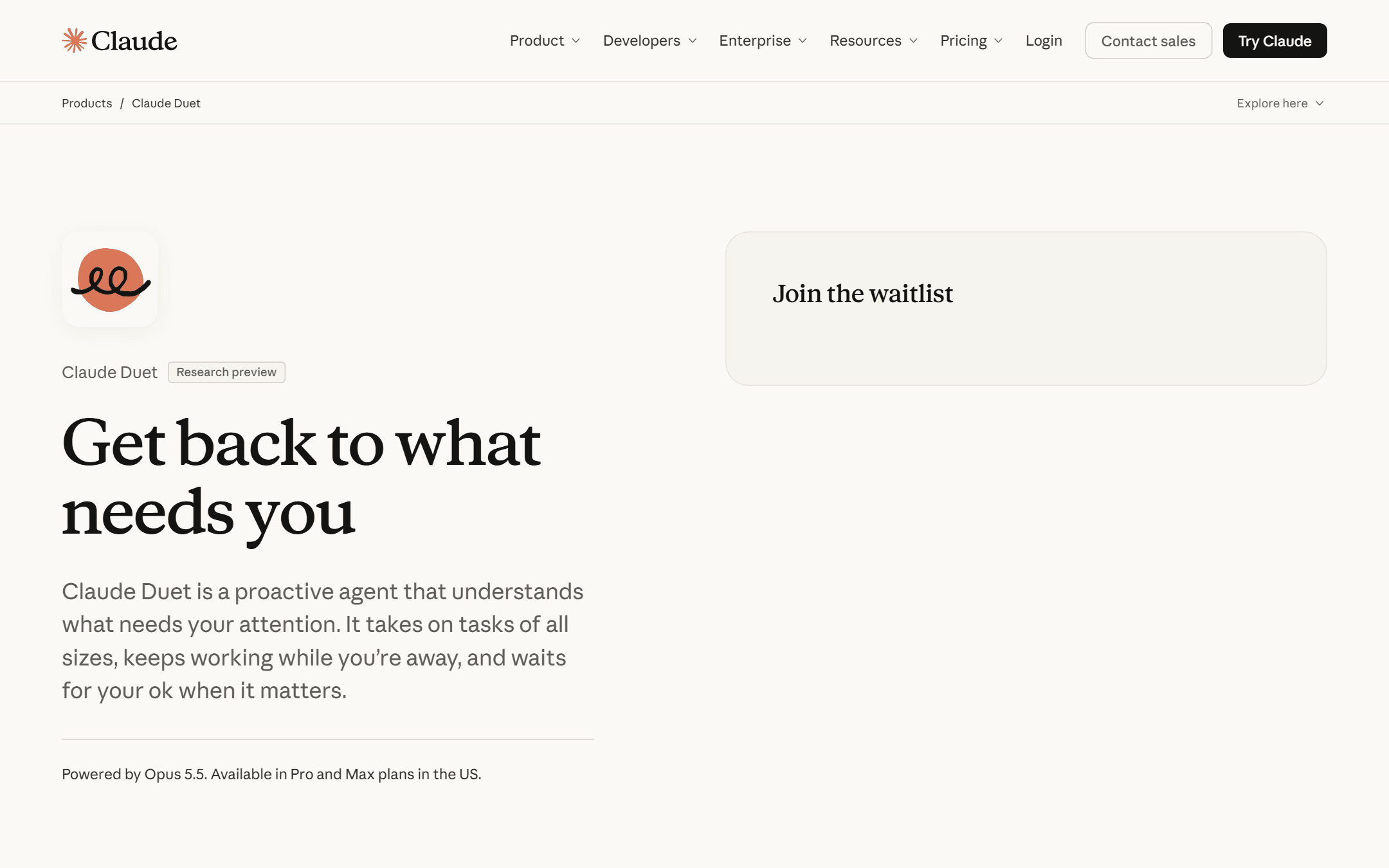
Anthropic's product page labels Duet a research preview and places the US Pro and Max waitlist beside its core promise.
That shift matters most for work spread across several places. A meeting request can sit in email while the relevant availability lives in a calendar and the background notes live in a document. Duet is designed to cross those boundaries, draft the next step, and return when it has an answer or needs a decision. Anthropic says the agent uses its own cloud computer and browser, so a task can keep running after you close your phone or laptop. The same design allows it to use connected services rather than wait for you to paste each item into a prompt.
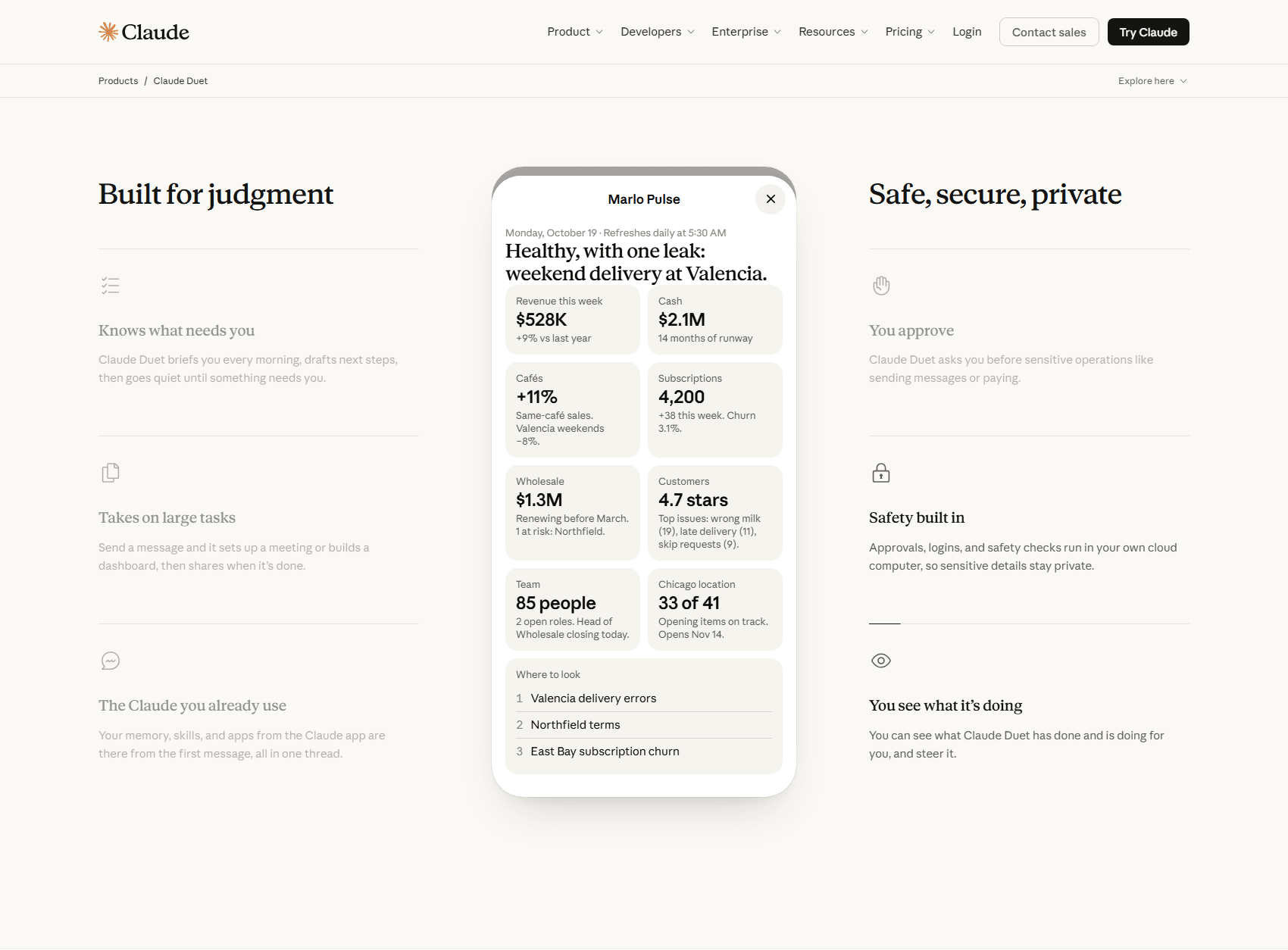
Claude Duet's official product page shows an example of prepared business context returned for review.
Duet is still an agent with imperfect judgment. Anthropic explicitly says it can misread a thread, mistake what is urgent, or miss an item between checks. That makes “proactive” a product behavior, not a promise that every important message will be caught. Treat its brief as a prioritized starting point and keep independent alerts for deadlines you cannot afford to miss.
What can it actually take off your plate?
The easiest way to assess a personal AI agent is to separate observation, preparation, and action. Duet has a clearer role in the first two. It can scan connected sources for items that appear to need attention, prepare a summary, draft a response, or assemble a file for review. Actions that affect another person or move money remain behind approval.
| Work you hand over | What Duet can prepare | What you still decide |
|---|---|---|
| Inbox triage | Highlight a message, summarize the thread, draft a reply | Whether the summary is complete and whether the reply should be sent |
| Calendar coordination | Spot a conflict, propose a time, prepare meeting context | Whether the meeting moves and who receives a message |
| Follow-ups | Find a stalled conversation or unpaid invoice, draft a reminder | Whether the reminder is appropriate and when it goes out |
| Larger work | Build a brief, deck, dashboard, or financial model | Whether the data, assumptions, and final output are sound |
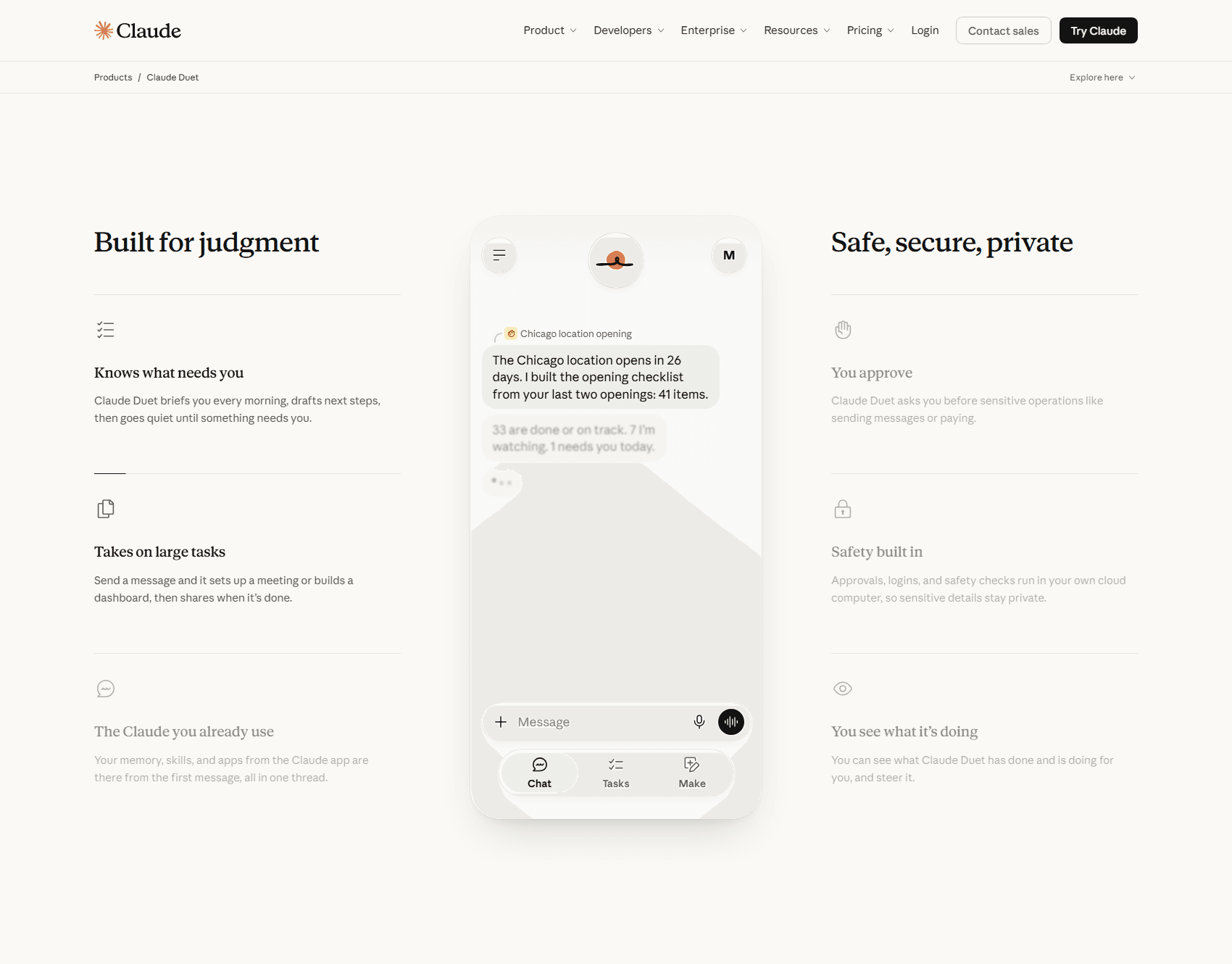
The official large-task example shows Duet preparing an opening checklist from earlier business context; the table above separates prepared work from decisions the user still makes.
Imagine a small business owner with an unpaid invoice and a client meeting tomorrow. A useful Duet result would identify the invoice from a connected accounting service, show the relevant correspondence, draft a tactful reminder, and prepare a short meeting brief. The owner then checks the balance, tone, and recipient before approving anything external. That is a more realistic standard than asking whether an agent can “run the business.” The value is fewer searches and first drafts; the owner remains accountable for the decision.
Anthropic's examples go beyond inboxes. Its announcement describes work with connected services for accounting, payroll preparation, contracts, sales follow-ups, and documents. The product page also says Duet works with more than 6,000 connectors and plugins. Those examples describe potential workflows through connected apps, not a guarantee that every account or connector will support every operation in the preview. Before planning around a specific service, confirm that its connector is available in your account and inspect the actions it exposes. (Anthropic launch announcement, October 21, 2026)
Where does Duet pause for your approval?
The key trust boundary is the moment prepared work becomes an external act. Anthropic says Duet asks before sending a message, making a payment, signing a document, or deleting something. It shows the proposed action for review. Some activities, including trading securities or transferring money between accounts, remain off limits even with approval. You can disconnect an app if you no longer want Duet to access it.
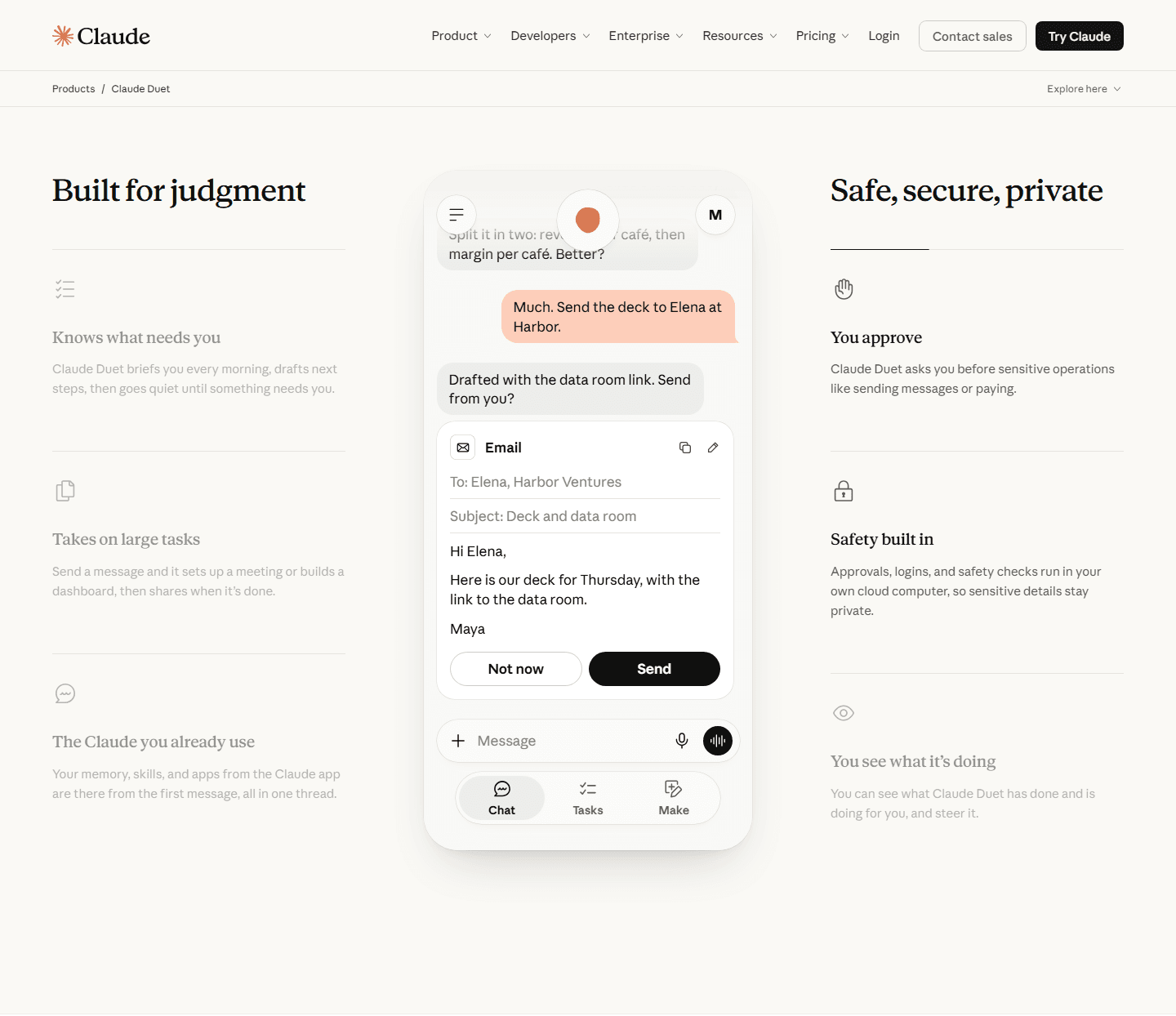
Anthropic's approval checkpoint is the boundary between a prepared draft and an external action.
That makes a draft different from a completed task. If Duet says it has prepared a reminder, check the named recipient, the amount, and the underlying invoice before approving. If it has prepared a contract, verify the parties and terms. Approval is useful only when the person approving can see the consequences. A rushed “yes” can turn a good safeguard into a formality.
The agent also has access to sensitive context by design. Anthropic says its protections are intended to prevent sharing strict categories such as credit card numbers and government IDs, while other sensitive material requires explicit user instruction before sending. These are product safeguards, not a reason to grant broad access without thought. Start with the accounts needed for a narrow task. Review app permissions, particularly for shared inboxes, customer records, payment systems, and documents containing personal information.
For a first trial, use work that is useful but easy to verify: a morning digest from one inbox and calendar, meeting preparation, or drafts for a small set of routine follow-ups. Compare Duet's output against the original sources for a week. Record what it missed, what it incorrectly elevated, and how often it interrupted you. That tells you whether its judgment fits your actual work better than any launch demo can.
How often does it check, and what does that cost in usage?
Duet is described as “always on,” but Anthropic says it checks connected accounts every few hours rather than continuously. More frequent checks would consume more of the plan's usage limits. Its background checks share those limits with the rest of Claude, and large tasks such as a deck or financial model require more turns than a simple brief.
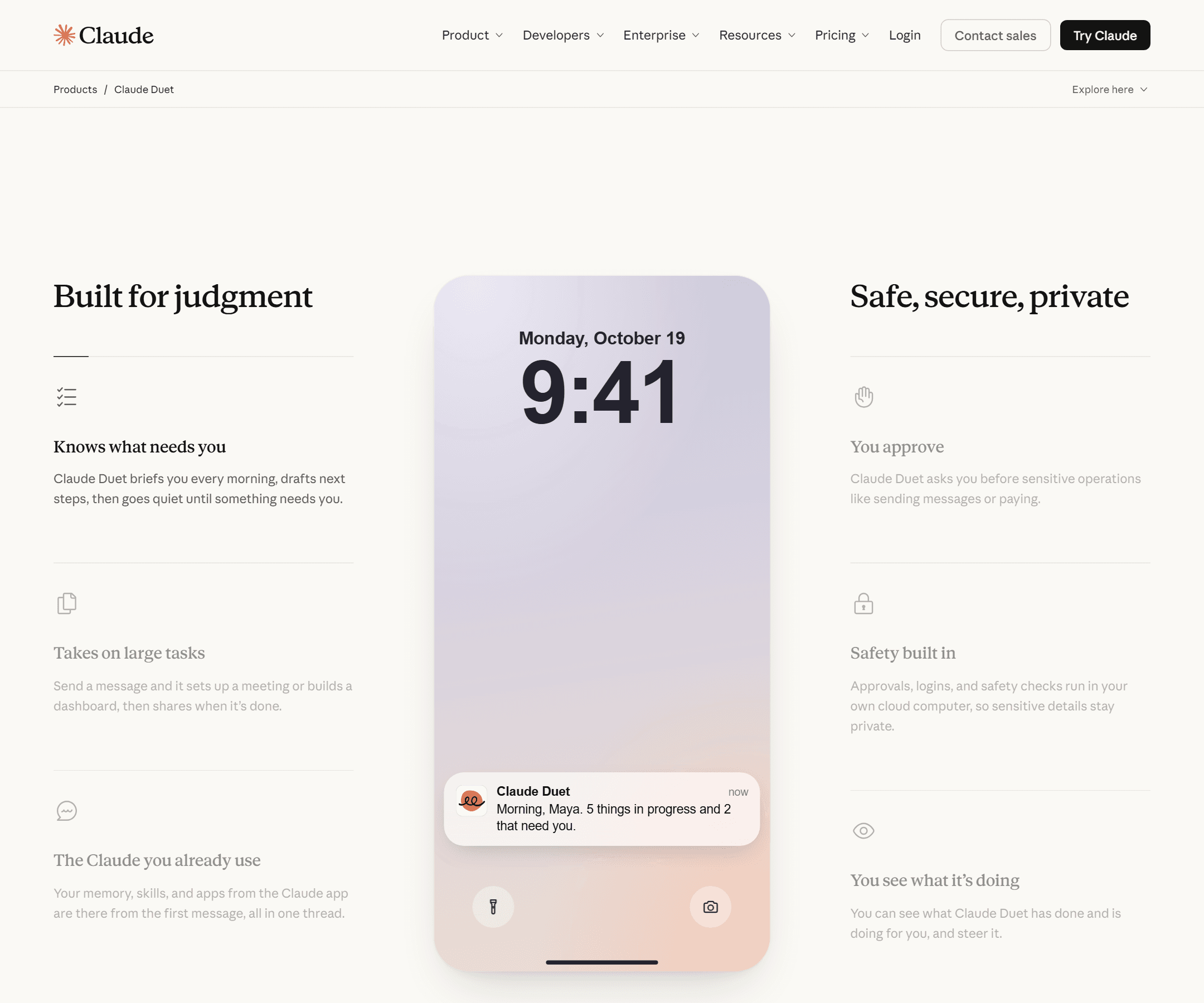
The product overview places the morning brief and approval controls in the same Duet experience.
This creates a practical trade-off. A daily summary may reduce the time spent scanning routine work. Asking the agent to watch many sources and run complex tasks in the background may use capacity you expected to spend elsewhere in Claude. Anthropic has not published a simple per-task price for Duet in the preview, so avoid estimating savings from a fixed number of checks. Instead, choose a narrow monitoring scope, watch your actual usage, and expand only where the results justify it.
Latency matters too. If a customer problem requires a response within minutes, an agent that checks every few hours should not be your only alert. Keep the original notification path for urgent messages and use Duet for prioritization, context gathering, and preparation. Its ability to follow up while you are away is valuable, but it is not the same as a real-time operations monitor.
Who can get Claude Duet now?
As of October 22, 2026, Claude Duet is a waitlisted research preview for Claude Pro and Max subscribers in the United States. Team and Enterprise plans are not included yet. Anthropic says Duet is available as a standalone iOS or Android app and on the web through Claude. Joining the waitlist does not mean immediate access; the company is inviting users gradually.
Duet uses the Claude account's existing context, but it currently lives in its own app, separate from the main Claude app. Anthropic also says personal errands such as booking tickets are weaker than its work-oriented examples, and users cannot yet view its browser as it works. Those limits matter if your idea of a personal bot is an all-purpose assistant that handles every household and business task. The present version is better understood as an early work assistant with specific permissions and checkpoints.
If you are outside the eligible group, the product page is still useful for understanding the direction of agent design: an assistant that notices, prepares, and asks. There is no need to rearrange your workflow around a preview you cannot yet use. List the repetitive coordination tasks you would test first, the connected data each requires, and the decisions that must remain yours. That work will make any future trial easier to evaluate.
A sensible first test when access arrives
Pick one recurring problem with a visible answer. “Tell me which customer threads need my reply each morning, explain why, and draft responses for review” is easier to judge than “manage my inbox.” Include a boundary: no message goes out without your approval. Use a second instruction that tells Duet which sources are authoritative when dates, names, or amounts conflict.
Then inspect three things in every result. First, trace the summary back to the source message or calendar event. Second, read the proposed action as its recipient would read it. Third, check whether Duet interrupted you at a useful moment. A personal agent succeeds when it saves attention without hiding uncertainty or creating new cleanup work.
Claude Duet AI assistant is an early example of AI moving from answering questions toward managing handoffs. Its strongest promise is not that it can decide everything for you. It is that it may bring the right context and a prepared next step to the point where your decision is needed. The preview's approval gates, usage limits, and imperfect timing are part of the product you should test, not details to skip past.
FAQ
Is Claude Duet the same as the regular Claude app?
No. It uses your Claude account context, including memory, skills, and connected apps, but Duet is a separate proactive agent experience. Regular chat starts when you open it and ask; Duet can brief and message you after checking connected sources.
Will Claude Duet send emails without asking me?
Anthropic says it asks for approval before sending messages. Review the recipient and full text before approving, especially for financial, legal, or customer matters.
Can it catch every urgent item in my inbox?
No such guarantee is stated. Duet checks connected accounts every few hours, and Anthropic warns that it can misread urgency or miss an item between checks. Keep separate alerts for time-critical work.
Is Claude Duet free with Claude Pro or Max?
Anthropic says the research preview is included for eligible US Pro and Max users, subject to the waitlist. It shares the plan's usage limits with the rest of Claude. This is not a promise that every task has zero usage cost or that access is open to all subscribers.


