

A 900-page project archive is easy to upload. The harder question is whether the model can point to the exact clause, commit, or data point you need. DeepSeek V4.1 Flash 1M context window use cases make sense when several related sources must be considered together, such as a codebase, a research corpus, or years of project records. The larger window reduces the need to split those materials upfront, while evidence checks still determine whether an answer is dependable.
The strongest fits are cross-file code review, research synthesis, policy comparison, feedback analysis, project timelines, and long multimodal records. DeepSeek lists a 1M-token context, but that capacity is not a guarantee that every detail will be recalled accurately. Check the model and API limits for your route, then test your own material before relying on the result.
Key takeaways
- Use a million-token window when the question depends on relationships across many relevant sources.
- Ask for file, section, or page references and separate direct evidence from inference.
- Start with a known-answer test and expand the context only when it improves the result.
- Estimate cost from input, output, and cache treatment, not from the context limit alone.
What does a 1M-token context window mean?
A context window is the amount of information a model can consider in one request or conversation state, including supplied material and the surrounding instructions. DeepSeek's current API pricing page lists DeepSeek-V4.1-Flash with a 1M context length and a maximum output of 384K tokens. That is the provider's stated limit; your application, endpoint, or request configuration can impose a smaller limit. ( DeepSeek API documentation )
Tokens are pieces of text, not words or pages. A source archive containing code, tables, markup, repeated boilerplate, and scans may tokenize very differently from clean prose of the same page count. For a real workload, estimate tokens with the tokenizer or usage reporting for the API you will call. Include system instructions, filenames, metadata, question text, and the answer budget in your estimate.
The practical benefit is continuity. You can ask about dependencies across several modules or contradictions between a current policy and its appendices without manually stitching summaries first. The trade-off is that a very large prompt can contain irrelevant or duplicated material, take longer to process, and still make exact retrieval harder. Treat “fits in the window” as a capacity check, then test whether the model can find the facts your task needs.
The best DeepSeek V4.1 Flash 1M context use cases
The right question is not “Can I upload everything?” It is “Which sources must be compared to answer this?” Use a long context when the answer depends on links between materials, and define how you will verify that answer before sending the full archive.
| Use case | Why a long context helps | What to include | What to verify |
|---|---|---|---|
| Large codebase review | Interfaces and conventions span modules | Relevant source, tests, architecture notes | File paths, symbols, test evidence |
| Research synthesis | Methods and findings need side-by-side comparison | Papers, reports, limitations | Each claim’s source and caveats |
| Contract or policy comparison | Definitions and exceptions recur across sections | Current and prior versions, appendices | Clause numbers and exact wording |
| Feedback analysis | Themes appear across many comments | De-identified feedback and coding rules | Representative quotes and counting method |
| Project history timeline | Decisions evolve across meeting records | Minutes, decision logs, release notes | Dates, owners, conflicting records |
| Long incident review | Logs, tickets, and postmortems explain different stages | Relevant time range and incident documents | Timestamp, event source, uncertainty |
| Multimodal document review | Text and visual evidence may need joint reading | Supported images and their captions or context | Whether the endpoint supports the media type |
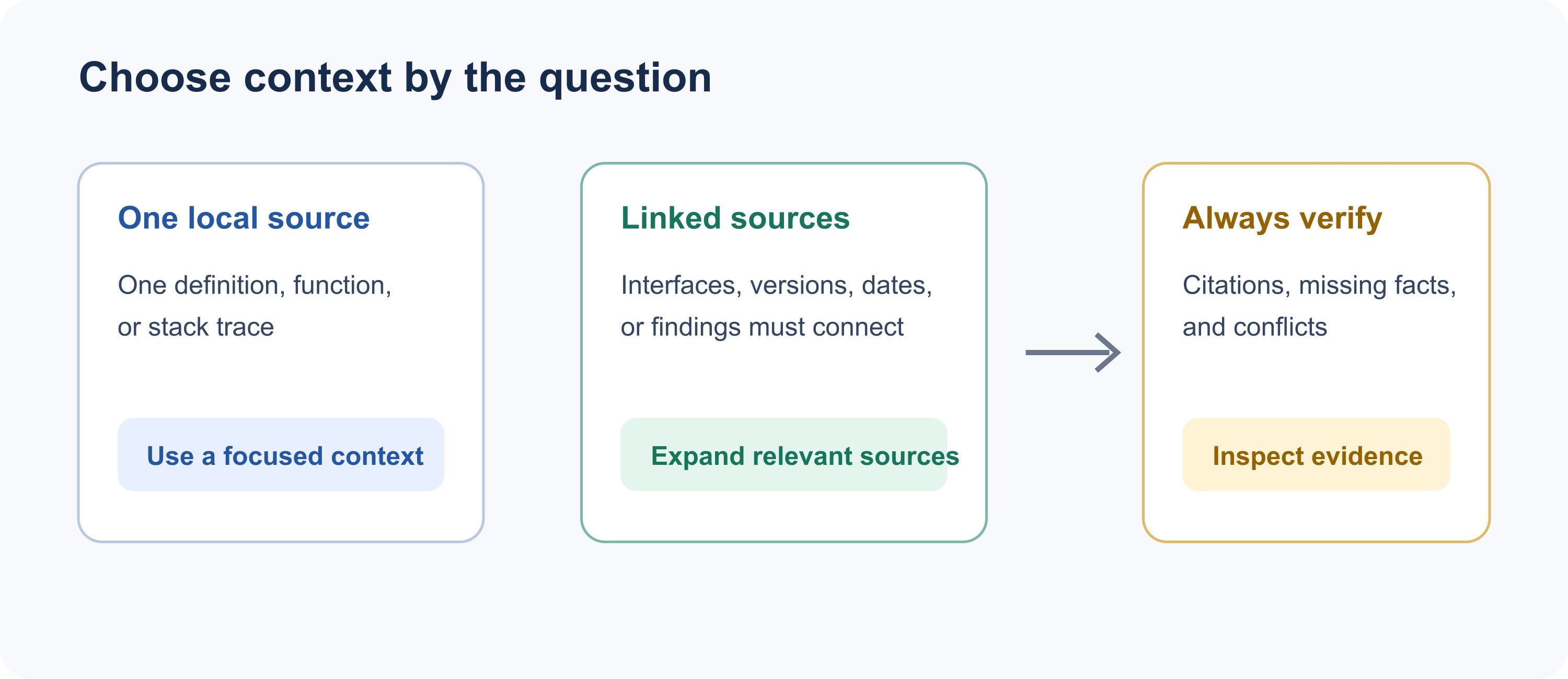
Use a focused context for a local question; expand when sources must connect, then inspect the evidence.
Review a large codebase across files
A million-token context can help an engineer trace a data structure from an API boundary through service logic, storage, and tests. It is useful for architecture summaries, finding likely affected modules, and drafting a refactoring plan that respects conventions documented in several places.
Give the model a bounded repository snapshot rather than an unfiltered disk dump. Include source files relevant to the change, the nearest tests, dependency manifests, and architecture notes. Exclude build outputs, vendored dependencies, generated bundles, and duplicate copies unless the question concerns them. Ask for file paths and symbol names for every proposed dependency, plus a distinction between observed behavior and an assumption.
Use the output as a review plan. Confirm each cited symbol exists, inspect the cited lines, and run the project’s checks yourself. The model should not claim tests passed unless a tool actually ran them and returned the result. For a localized bug in one function, a smaller context is often faster and easier to audit.
Synthesize research across papers and reports
A long context helps when studies use different methods, populations, measures, or definitions. Ask for a comparison table with one row per source and columns for research question, data, method, result, limitations, and relevance to your question. Keep source-level claims attached to their source rather than letting a blended summary erase disagreement.
For example, when comparing evaluations of a tool, distinguish a benchmark result from a field study and from an author’s interpretation. Ask the model to flag incompatible measures instead of ranking results that cannot be compared. Then open the source passages behind the most decision-relevant claims. A synthesis is a map of evidence, not a substitute for checking the papers.
Compare long contracts, policies, or specifications
Contracts and policies often define a term once and qualify it elsewhere. Supplying the operative version, amendments, schedules, and relevant older draft together can help surface changed definitions, cross-references, missing conditions, and apparent conflicts.
Request the exact section or clause for each observation and a short excerpt that a reviewer can locate. Separate textual differences from their possible consequences. The model can help organize a review, but legal interpretation, compliance decisions, and signing authority remain with qualified people who can account for jurisdiction and context.
Analyze customer feedback at scale
A large body of feedback can reveal recurring requests and objections across channels or time periods. Provide a defined sample, remove personal information that is not needed, and specify a coding scheme such as “onboarding friction,” “missing integration,” or “pricing confusion.” Ask for representative examples and counterexamples, not just a list of themes.
Do not present model-generated theme percentages as survey statistics. If you need counts, define the unit (message, customer, or issue), deduplicate records, apply a consistent labeling rule, and verify the count with a repeatable script or human-reviewed sample. The model is useful for proposing categories and finding examples; a documented method supports quantitative claims.
Build a timeline from project documents
For a handoff or postmortem, the relevant evidence may be scattered across meeting minutes, release notes, decision logs, and tickets. Ask for a chronological table with date, event, named owner where stated, source location, and confidence or ambiguity. Instruct the model to preserve conflicting dates rather than choosing one silently.
A useful timeline helps a new teammate see what was decided, when a requirement changed, and which document supports each event. Verify critical transitions against the source record, especially when a note was written later or summarizes a meeting rather than recording it directly.
Review long incident records and multimodal material
Incident review can benefit from keeping alerts, operational notes, tickets, and the postmortem in one evidence set. Ask for a sequence of observed events and explicitly distinguish timestamps in logs from later estimates in narrative notes. This can make the first pass more coherent, while the on-call engineer still checks source systems before taking action.
DeepSeek's official announcement says V4.1-Flash is live on its API with native multimodal support. The exact image formats, request methods, and limits depend on the endpoint and integration, so confirm those details before assuming that a million-token text budget also describes image handling. ( DeepSeek V4.1-Flash announcement )
When does a million tokens help, and when does it add noise?
More context helps when sources need to be cross-referenced. A code change involving a shared interface may require several modules and tests. A version comparison needs both complete versions and their appendices. A project timeline may need records spread across months.
A local bug with a clear stack trace may need only the function, its callers, and the relevant test. A question asking for one definition may need only the authoritative section. For those tasks, including an entire repository adds search space and can bury the useful passage.
Before expanding the prompt, remove repeated exports, obsolete drafts, unrelated folders, boilerplate, and records outside the question’s time range. Keep a manifest of what you included and why. If the answer changes when you add a large batch of unrelated files, that is a signal to tighten the source set and rerun the test.
A practical workflow for reliable long-context answers
Use a consistent evidence protocol so a fluent answer does not get mistaken for a verified one. First label the sources with stable filenames and, where possible, page numbers, headings, line numbers, dates, or version identifiers. Preserve enough surrounding context to interpret excerpts correctly.
Next, state one decision or research question. Specify the output shape and the locations the model must cite. A reusable prompt is:
plaintext1Analyze only the supplied materials. For every factual claim, cite the source filename and the closest available section, page, line, or heading. Separate direct evidence from inference. If sources conflict or evidence is missing, say so. Do not fill gaps with assumptions. Return a concise answer, an evidence table, and a list of unresolved questions.
For a codebase, add: “Cite repository paths and function or class names. Before proposing a change, list the affected files and the test evidence that supports the proposal. Do not say a test ran unless its result is included in the supplied evidence.”
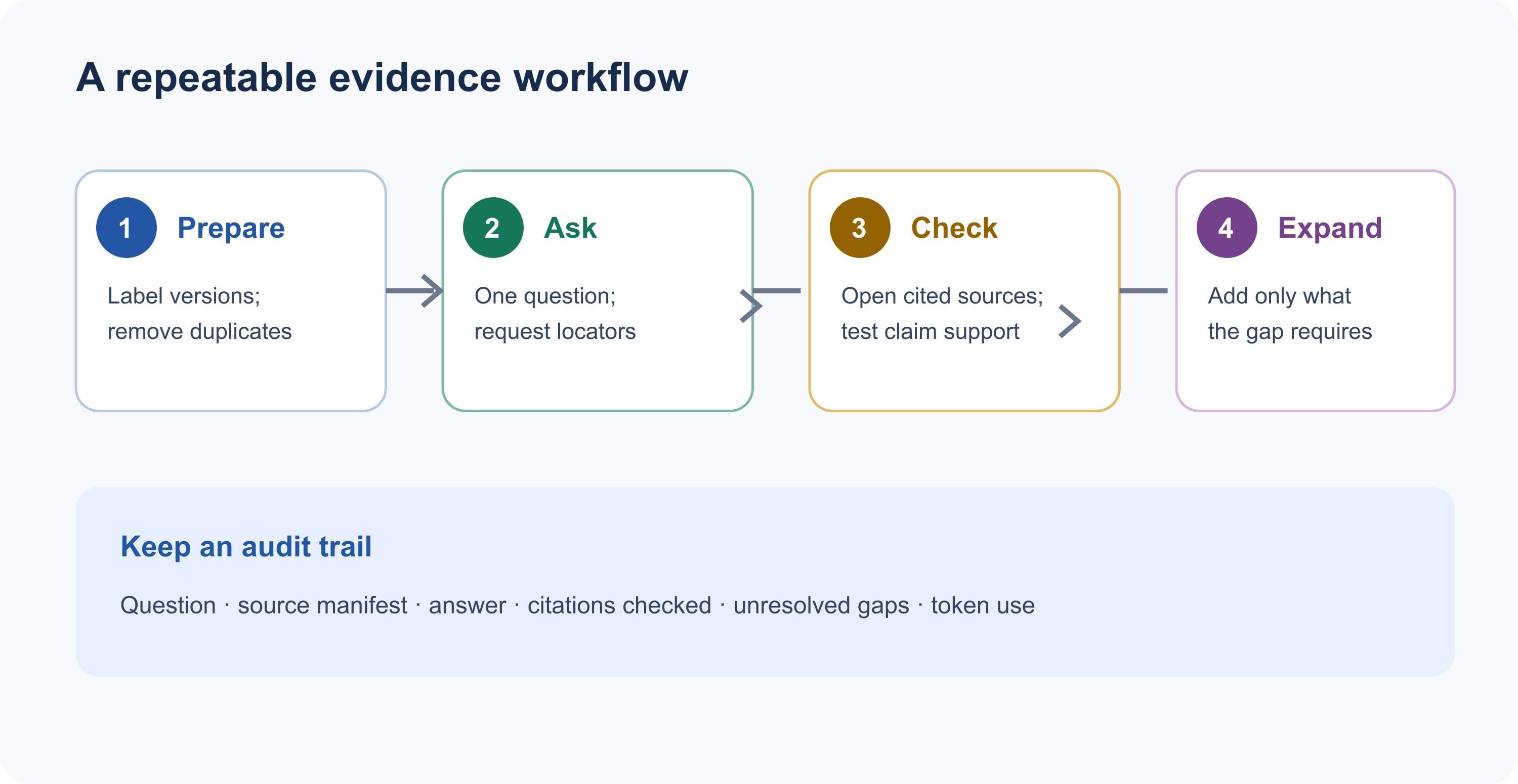
Prepare sources, ask a bounded question, check citations, and expand only to resolve a gap.
Then inspect the answer in three passes. Check whether each citation points to a real location. Check whether the cited passage supports the claim, rather than merely mentioning the topic. Finally, review omissions and conflicts by asking targeted follow-up questions against the same source set. For high-stakes decisions, have a qualified reviewer read the source material directly.
Long-context workflow evidence map
| Stage | Action | Keep | Stop signal |
|---|---|---|---|
| 1. Prepare | Label, deduplicate, and scope sources | Source manifest and versions | Unknown provenance or stale duplicate |
| 2. Ask | Set one question and an evidence format | Filenames and locators in the answer | Broad request with no decision target |
| 3. Check | Open cited passages and compare claims | Supported claims and explicit gaps | Citation does not support claim |
| 4. Expand | Add only sources needed for unresolved links | Improvement on known-answer checks | More input without better evidence |
How to test whether 1M context is useful for your task
Create a small evaluation set before loading the full archive. Write questions whose answers you already know from the source material. Put some facts near the beginning, some in the middle, and some near the end. Add at least one question that requires connecting two documents and one that cannot be answered from the supplied sources.
Run the same questions on a smaller, relevant subset first, then increase context in measured steps. Record factual correctness, locator accuracy, missed evidence, unsupported claims, refusal on the unanswerable question, latency, and token usage. Keep the prompt and decoding settings stable so changes are interpretable. Repeat a question if outputs vary materially between runs.
| Check | What a passing response shows | What to do after a failure |
|---|---|---|
| Known fact at early, middle, late positions | Retrieval across the source span | Check indexing, file labels, and prompt length |
| Cross-document link | Evidence can be joined across sources | Ask for both citations, then narrow the link question |
| Unanswerable question | The model can report missing evidence | Tighten “use supplied sources only” and retest |
| Citation audit | Locator and excerpt support the claim | Treat the claim as unverified until corrected |
| Larger-context comparison | Extra material improves the target task | Remove noise if accuracy or latency worsens |
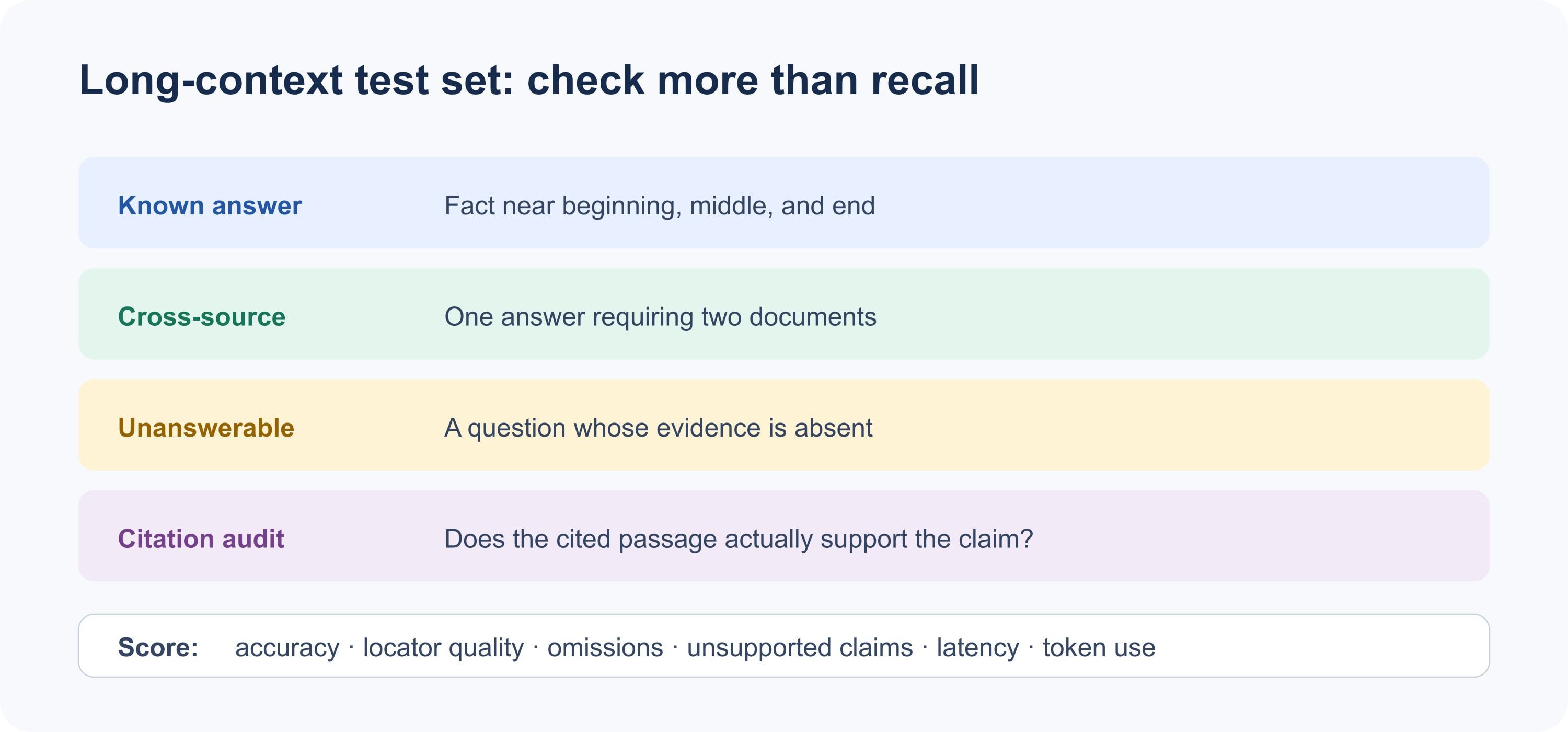
Score retrieval, citation support, omissions, unsupported claims, latency, and token use.
Community reports are mixed and task-dependent. One Reddit user shared a harness-specific increase in malformed tool arguments at larger context sizes, while commenters described successful work at higher token counts in other setups. That is a useful reason to benchmark your own harness, not evidence for a universal failure threshold. ( DeepSeek context discussion on Reddit )
A sensible scale-up is: validate the prompt on a small sample, add the source groups needed for cross-document questions, then test a representative large request. Keep the smallest context that answers the real question with dependable evidence. This also makes latency and cost comparisons easier to interpret.
DeepSeek V4.1 Flash API pricing and access
At Atlas Cloud, the model listing currently shows DeepSeek V4.1 Flash with a 1M context and rates of $0.30 per million input tokens, $1.20 per million output tokens, and $0.03 per million cache-read tokens. The listing shows no discount for this model. These are Atlas Cloud rates, distinct from DeepSeek’s own time-dependent peak and off-peak prices. Recheck the Atlas Cloud model catalog and model pricing page before publishing or budgeting because rates can change.
At the listed rates, a request with 100,000 uncached input tokens and 2,000 output tokens costs about $0.03 for input plus $0.0024 for output, or $0.0324 total before any other applicable charges. If the input is billed as cache reads, 100,000 cached tokens would be $0.003 instead. The example assumes those token counts and rates; it is not a quote for a specific workload. The full 1M capacity is not charged merely because it exists. Billing follows usage and cache treatment.
For teams that want one API entry point, the DeepSeek V4.1 Flash model page provides the model and calling details. Compare your measured token use and integration needs with the official endpoint as well; model names, limits, and prices can differ by provider.
Frequently Asked Questions
Is a 1M-token context window the same as 1M words?
No. Tokens may be parts of words, punctuation, code fragments, or other units. The number of words or pages that fit depends on the material and its tokenization. Use measured token counts rather than a fixed page conversion.
Does DeepSeek V4.1 Flash always use the full context window?
No. One million tokens is a maximum context specification, not a target for every request. A short prompt uses less, and a particular interface or API route may enforce a lower cap. Check the endpoint documentation and actual usage fields.
Is 1M context enough for an entire codebase?
It may fit some codebases by token count, but that does not make every file relevant or every answer reliable. Include the files needed for the question, verify cited paths and symbols, and test changes with the project’s real checks.
Should I put every available document into one prompt?
Only if the documents bear on the same question. Start from a source manifest, remove duplicates and unrelated material, then add more when a cross-document test needs it. The best DeepSeek V4.1 Flash 1M context window use cases are defined by evidence that must be compared, not by the size of the archive.


