A million-token context window tells you how much text a model may accept, not how reliably it will interpret every clause. For DeepSeek V4.1 Flash long document analysis accuracy, the public evidence is useful but incomplete: DeepSeek's model card reports 45.2 exact match on LongBench-V2 for the V4.1 Flash base model in a 1-shot setup, while the API has since moved to a newer 1017 build. That benchmark is a signal about one evaluation setup, not a pass rate for your contract, annual report, or research archive.
The practical answer is to use Flash for fast retrieval and first-pass synthesis, then require page-level evidence and human review for decisions that matter. No public source cited here provides a reproducible, current-build evaluation across the five document tasks below. The test plan is a ready-to-run protocol, not a claim that those runs have already happened.
Key takeaways
- The model family supports up to 1M tokens, but a context limit is not an accuracy guarantee.
- The published 45.2 LongBench-V2 score is for the base model and a 1-shot benchmark setup.
- DeepSeek's API now serves V4.1-Flash-1017; its release notes do not publish a new long-document score.
- Ask for evidence locations, check them against the source, and measure errors on your own documents.
What the 1M-token window means for document analysis
DeepSeek's model card describes V4.1 Flash as supporting contexts up to one million tokens. The API documentation currently identifies the served model as DeepSeek-V4.1-Flash-1017 and lists a 1M context length. Those are capacity specifications. They do not establish how often the model finds a footnote, keeps two document versions separate, or admits that a requested fact is absent. (DeepSeek model card)
A token is not a page. Page count varies with tables, footnotes, layout, language, and extraction quality. A scanned PDF may need OCR; a table may lose its row labels when converted to text; headers and repeated page furniture can consume context without helping the question. The prompt and requested answer also use tokens. A nominal one-million-token ceiling therefore does not mean every million-token file will arrive intact through every chat interface or API client.
Before a test, record the exact model identifier, client, and input method. Check whether the full extracted text was sent, whether the provider truncated it, and whether the request reached the expected model version. The current DeepSeek API uses deepseek-flash for the latest Flash build. If your gateway or SDK uses another alias, record that alias and verify its routing. Teams setting up repeatable hosted calls can start from Atlas Cloud's model platform, then open its DeepSeek V4.1 Flash API listing.
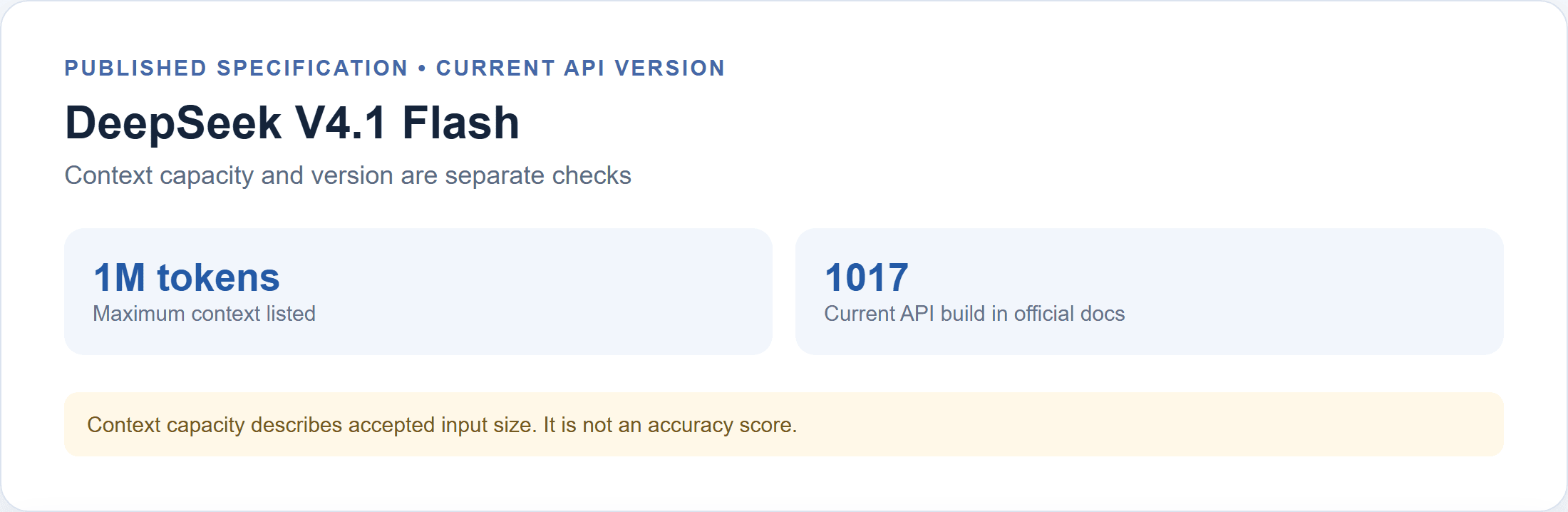
The published specification gives a 1M context maximum; the current API documentation identifies the 1017 build.
A successful upload or request only shows that the system accepted an input. To establish that a relevant detail influenced the answer, ask for a precise location, retrieve that passage, and confirm the surrounding text supports the claim.
What the LongBench-V2 score does and does not show
The model card's LongBench-V2 row reports exact-match scores under a 1-shot setting. Its table labels the results as base-model evaluations and says all base models use the same internal evaluation framework. It also states that scores within 0.3 are considered equivalent. The values are:
| Base model in the model card | LongBench-V2 (EM) | Shots |
|---|---|---|
| DeepSeek-V4-Flash-Base | 44.7 | 1 |
| DeepSeek-V4-Pro-Base | 51.5 | 1 |
| DeepSeek-V4.1-Flash-Base | 45.2 | 1 |
The 0.5-point gap between V4-Flash-Base and V4.1-Flash-Base is larger than the card's stated 0.3 equivalence band, but it remains a narrow benchmark comparison. The 45.2 is not “45.2% accuracy on long PDFs.” It is an exact-match score for a particular base model, benchmark set, prompt setup, and evaluator. It does not directly score a hosted instruct/API model answering your questions with a different prompt.
LongBench-V2 contains 503 multiple-choice questions across six categories, including single-document and multi-document question answering, long dialogue, code repositories, and structured data. Its contexts span 8,000 to 2 million words. The benchmark authors report 53.7% average accuracy for experts under a 15-minute limit, and 50.1% for the best direct-answering model in their reported evaluation. Its breadth makes it a useful stress test, but an aggregate number cannot diagnose which document operation is strong or weak. (LongBench-V2 paper)
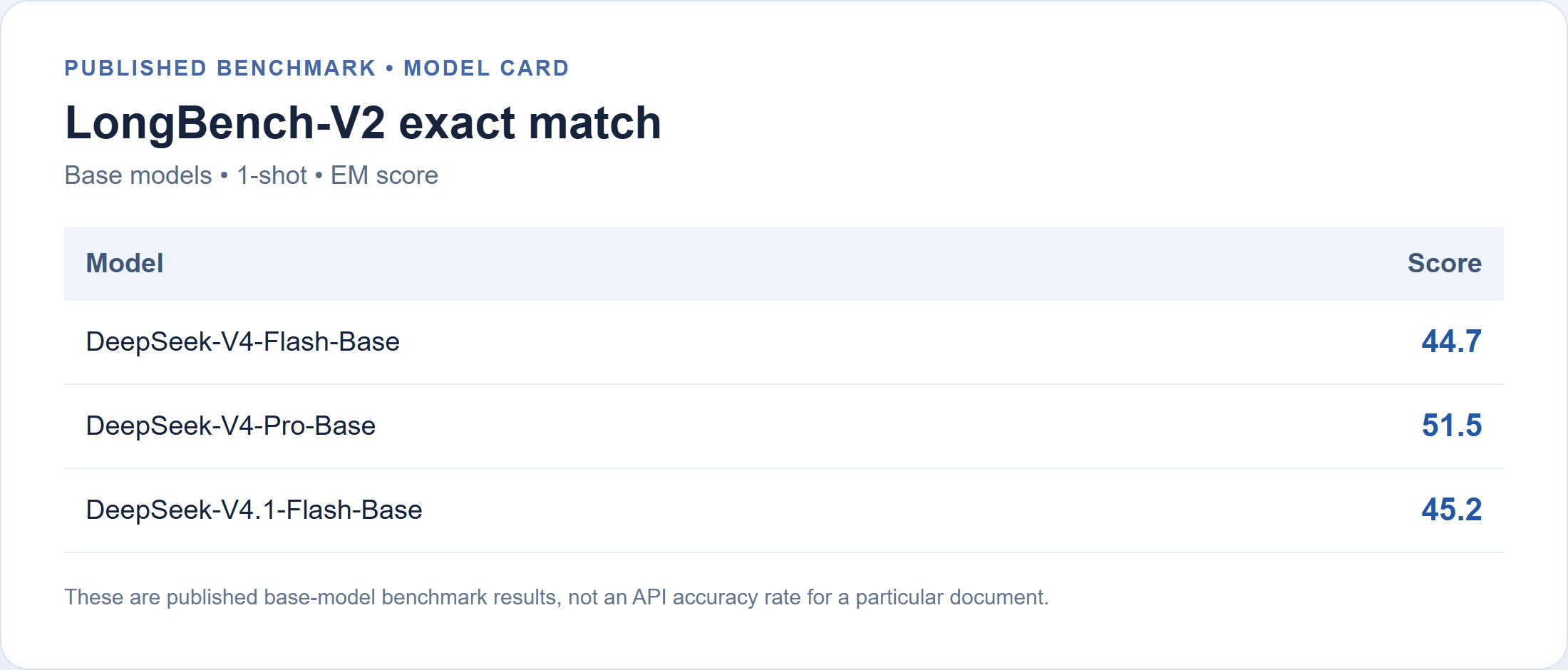
The published row is a base-model, 1-shot result. It is not a measured API pass rate.
There is a version caveat. DeepSeek's October 17 release notes say the API and web app have been upgraded to V4.1-Flash-1017, and the API model name remains deepseek-flash. The notes list updated agent and reasoning benchmarks, but do not report a new LongBench-V2 result. So 45.2 remains a useful published reference for the V4.1 Flash base model, while the accuracy of the current API build on long-document questions remains unquantified in those sources. Do not transfer unrelated benchmark gains to document QA. (DeepSeek V4.1-Flash-1017 update)
How to run a fair long-document accuracy test
A useful evaluation needs a fixed source, an answer key, and scoring rules. Start with a public annual report or technical report whose version and page structure can be shared. Save the PDF and extracted text, record the source URL and retrieval date, and note whether you used native text extraction or OCR. Avoid selecting a document because you already know the model handles it well.
Before prompting the model, write the answer key yourself from the source. For each question, record the expected answer and exact page or section. This prevents a convincing response from becoming the grading standard. Keep questions specific enough to score, while preserving the ambiguity a reader would actually face.
Use the same document, question set, model identifier, prompt, reasoning setting, and output format for each run. If the API exposes temperature or reasoning controls, record them. Run the set more than once if you want to estimate variability; one run is a sample, not a stable rate. Do not silently repair the output before scoring it.
A compact set can cover five different failure opportunities:
| Task | Example question shape | What to verify |
|---|---|---|
| Single-point lookup | “What date does the report give for the revised policy?” | Exact value and cited page |
| Cross-section link | “How does the risk in Section 2 relate to the control in Section 7?” | Both passages and whether the link is stated or inferred |
| Exception handling | “Who is excluded from the stated coverage?” | Footnote, scope, and qualifiers |
| Version conflict | “Which value applies after revision, and what did it replace?” | Dates, version labels, and both locations |
| Missing information | “What retention period does the report specify for vendor copies?” | Admission if the document says nothing |
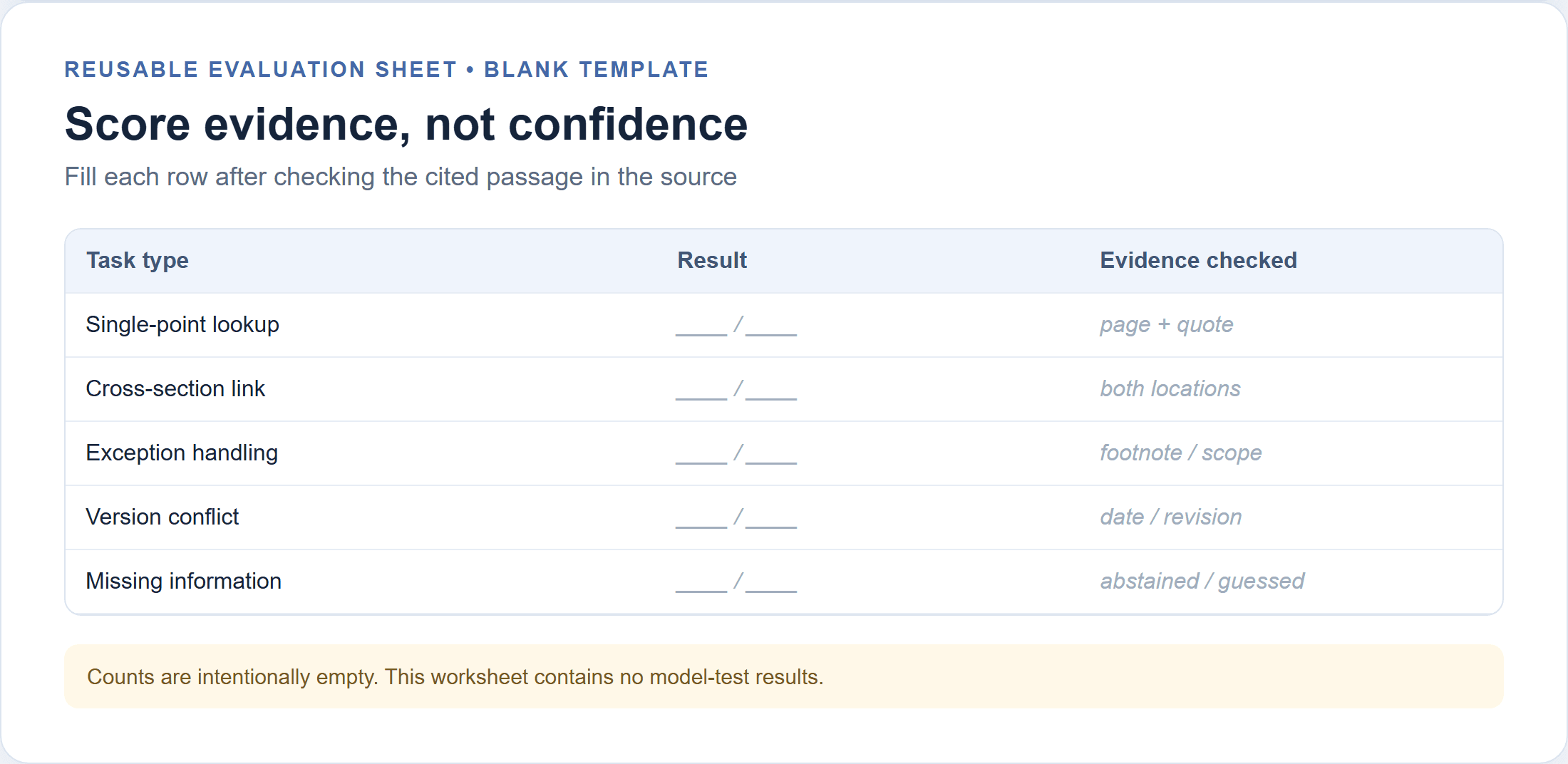
This is a blank scoring worksheet, not a result table. Fill it only after checking each answer against the source document.
Score each answer as correct, partial, wrong, unsupported, or correctly abstained. Count unsupported claims separately from wrong answers because a response can give the right headline answer and invent a detail. Check whether each citation points to the passage that supports the claim. Report the question count and category counts together. An overall percentage hides whether the model missed footnotes or struggled only when information was spread across sections.
Preserve the exact source file, extraction, prompts, raw responses, and scoring sheet. Publish only material you have permission to share, and redact confidential names or account details. A reviewer should be able to trace every scored answer from the model output to a page in the saved source.
Where long-document answers tend to fail
Without a current-build run against a stated document, it would be wrong to claim that V4.1 Flash exhibited a particular error rate or failure pattern. The categories below are things to inspect, not measured findings about this model.
Start with scope loss. A body paragraph may state a rule while a footnote limits it to a region, date range, or class of customers. Ask for the exception explicitly and inspect whether the cited passage includes it. A quote from the main paragraph alone may be insufficient.
Next check version confusion. Reports may repeat similar values in a draft and a revised section. Ask the model to name the date or version attached to each value instead of requesting just “the current number.” If it chooses one silently, score the response as incomplete even when it happens to choose correctly.
Cross-section questions invite inference. A model may combine two accurate facts into a causal explanation that the document never makes. Require it to label direct statements separately from inferences. Then compare the inference with the evidence and decide whether it is reasonable for the task.
Finally, test abstention. Include a question whose answer is absent. A confident guess is a failure even if it sounds plausible. For contracts, compliance, clinical material, or consequential financial analysis, ask a qualified person to check the original text before using a conclusion.
A verification workflow for safer answers
This prompt makes answers easier to audit. It cannot guarantee correctness or replace source review. Use it with an extraction that preserves page labels, then ask focused questions rather than requesting a general summary of a huge file.
plaintext1Answer using only the supplied document. 2For every factual claim, provide the page number and a short supporting quotation. 3Separate direct statements from inferences. 4If the document does not contain enough evidence, say “Not stated in the document.” 5If sources conflict, list each version and its location instead of choosing silently. 6Return a table with: question, answer, evidence location, confidence, and unresolved ambiguity.
For a long report, split the work by task, not automatically by arbitrary page count. First ask for a source map: section titles, dates, defined terms, and relevant tables. Then query a specific topic and request its supporting passages. For a cross-section conclusion, provide or retrieve both passages in the same turn and ask the model to explain the link while marking any inference.
Use a human verification loop:
- Check the cited page and quote in the original file.
- Confirm the quote includes neighboring exceptions and table headers.
- Mark each claim as direct, inferred, unsupported, or contradicted.
- Fix the prompt or split the task if extraction omitted important structure.
- Save the raw request and response so a reviewer can reproduce the decision.
When you use a hosted endpoint, include token usage in the run log. Atlas Cloud's model pricing page currently lists DeepSeek V4.1 Flash at $0.30 per 1M input tokens, $1.20 per 1M output tokens, and $0.03 per 1M cache-read tokens, with no listed discount. Check the current listing before budgeting. This price reference is for Atlas Cloud, not a universal DeepSeek API price.
At those listed rates, 100,000 uncached input tokens and 3,000 output tokens cost about $0.033: $0.030 for input plus $0.0036 for output.
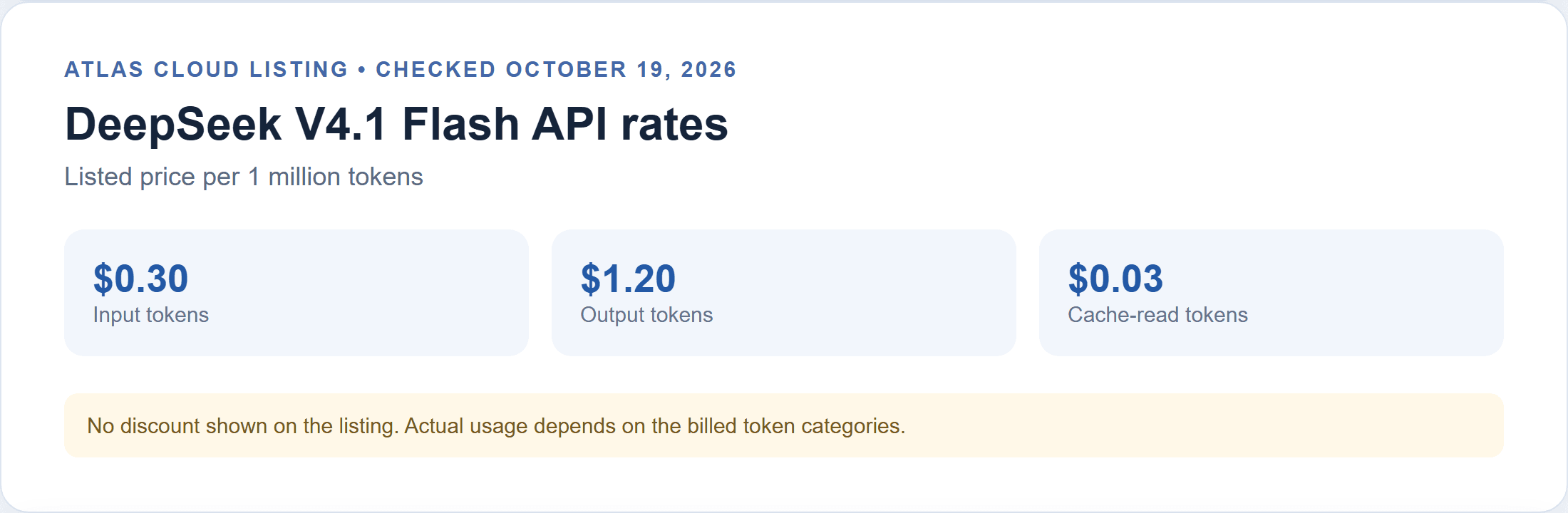
Atlas Cloud pricing checked October 19, 2026; the listing shows no discount. A 1M-token input and 20,000-token answer would cost about $0.324 at the same rates, before cache treatment or other billable items. These are arithmetic examples, not measured document-test bills. Actual input includes the prompt and extracted text; repeated calls add usage. Use the provider's returned token counts instead of estimating from page count.
When to use DeepSeek V4.1 Flash for long documents
Flash is a reasonable first pass when you need to locate definitions, gather dates, create a section map, or draft a summary that a person will check. Those tasks have visible evidence trails and are easy to rerun with tighter questions. For recurring work, keep known-answer questions and rerun them when the model version, extraction pipeline, or prompt changes.
Add controls when a question combines distant sections, depends on a footnote, or compares revisions. Use citations as navigation aids, not proof by themselves. If an answer will affect a contract obligation, compliance position, financial disclosure, or another high-impact decision, have a qualified reviewer verify each material claim in the source.
The useful question is whether this model, on your version of the document and exact workflow, returns answers with evidence that survives checking. That is the test that can establish DeepSeek V4.1 Flash long document analysis accuracy for your own use case.
Frequently Asked Questions
Does a 1M-token context window mean a model can analyze a 1M-token document accurately?
No. It describes supported context capacity. The actual request also includes instructions and output budget, while extraction, interface limits, and question difficulty affect whether useful evidence is available and interpreted correctly.
Is LongBench-V2 the same as document question-answering accuracy?
No. It includes several long-context task categories and reports performance under a specific setup. It is a comparison signal, not a guarantee for a particular PDF, API build, prompt, or domain.
Should I use one prompt or split a long document into sections?
Use a source map and focused questions when structure matters. Keep passages that must be compared available together for the synthesis step, and preserve page labels so you can verify the response.
How should I verify citations from an AI-generated summary?
Open each cited page in the original file, check the quote and surrounding text, and confirm the passage supports the specific claim. Verify table headings and footnotes as well as the cited sentence.
How do input and output tokens affect the cost?
Input tokens cover the document, instructions, and question. Output tokens cover the answer. Longer prompts, multiple calls, and repeated passages increase usage; use billed token counts and the current provider price table for estimates.


